About halfway through Max Weber’s famous lecture on politics, originally delivered in 1919, there is an extended digression on journalism. As more than a few people have noted recently, the lecture on politics overall still feels quite relevant today, and the bit on journalism is also surprisingly (or not) undated. It rang true to me, anyway; here are the best parts:
The journalist, along with the demagogue in general, the lawyer — and the artist as well — has no fixed social position. He belongs to a kind of pariah caste that “society” always judges socially by its least ethical members. As a result, the most outlandish ideas about journalists and their work are common currency.
Few people realize that a truly good piece of journalism requires at least as much “intelligence” as any scholarly writing, especially since it has to be produced on demand, on the spot, under completely nonacademic conditions, and moreover it must generate an immediate response. It is almost never acknowledged that the journalist’s responsibility is far greater than the scholar’s, and that as a rule the reputable journalist’s sense of responsibility is by no means less than the scholar’s–in fact it is greater, as we saw during the war.
This is almost never acknowledged because we quite naturally tend to remember precisely the irresponsible pieces of journalism, with their often-terrible effects. No one believes that competent journalists are more discreet than other people, as a rule. But they are.
…
Up until now journalism has not been a path to true leadership roles or responsible political conduct. Only time will tell how things will develop in the future. Whatever happens, though, journalism will remain one of the most important career paths for professional political activity. It is not for everyone — least of all for people of weak character, especially those who need a secure social position for their inner equilibrium. A young scholar’s life may be a matter of luck, but at least it is framed by stable conventions of social status that keep him on track. Meanwhile, the journalist’s life is left to sheer chance in every way and involves working under conditions that test a person’s inner fortitude like almost nothing else.
The journalist’s often-bitter professional setbacks may not even be the worst of it — even the most successful journalist faces especially difficult psychological and ethical challenges. It is no small thing to consort with the most powerful people on earth in their drawing rooms, on a seemingly equal basis, and to be flattered because you are feared, while all the time knowing that as soon as the door closes behind you your host may have to explain to his guests why he had anything to do with “the scoundrels from the press.”
And it is truly no small task to crank out quick and convincing responses to any and every problem or issue in the world, whatever “the market” demands, falling into neither total superficiality nor undignified self-exposure with all its inexorable consequences. What’s surprising is not that numerous journalists have lost their way or become worse human beings, but that, despite everything, this class of people contains so many worthy and genuine human beings, more than outsiders would dream of.
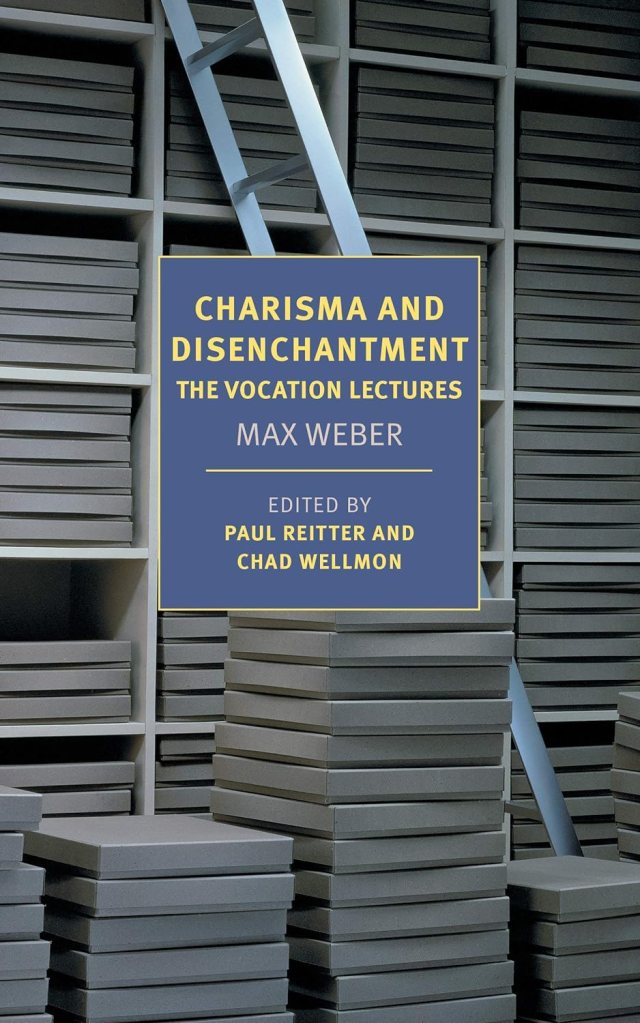
The quotation is from the new translation by Damion Searls, published (along with the earlier lecture on scholarship) in 2020 as Charisma and Disenchantment: The Vocation Lectures. It is quite conversational and accessible, two adjectives not normally associated with the great German sociologist. I read a lot of Weber at university, and while he is truly amazing, his usual mode is definitely more dry and forbidding. For a short introduction to Weber’s thought, these two lectures are a good place to start.
 The Tangled Woof
Funny that he should say journalism is not a path to leadership when Georges Clémenceau, the successful leader of France during WWI, and whom Weber as a German should be intimately aware of, was a former journalist.