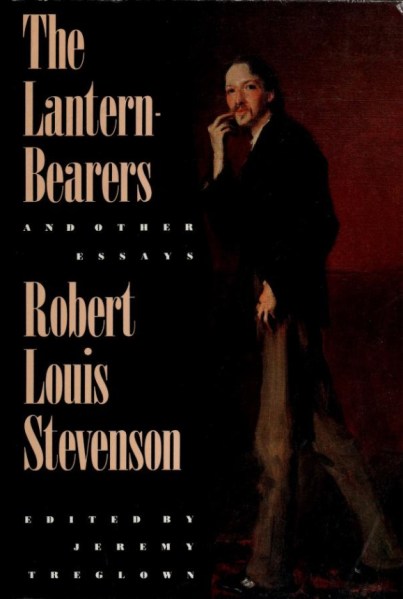
One of the reasons I keep a blog is as a kind of commonplace book, to keep a record of things that I liked reading and found thought-provoking. I recently stumbled across, then read through The Lantern-Bearers and Other Essays, a modern and readily available selection of the essays of Robert Louis Stevenson. Yes, that guy–Treasure Island, Dr. Jekyll. They were surprisingly enjoyable: nineteenth-century prose is definitely a brain-stretcher for those of us raised on concise and direct twentieth-century English, but after a while I appreciated the great variety in his sentences. Many of his essays have timeless observations that stand with the classics of the genre. Here are three of my favorite bits:
This passage from “The Day After Tomorrow” (1887) wonderfully captures the difficulty of getting a clear and objective view of the present day; the phrase “the obscurest epoch is today” feels particularly apt for 2025, even if it is true for every year:
History is much decried; it is a tissue of errors, we are told, no doubt correctly; and rival historians expose each other’s blunders with gratification. Yet the worst historian has a clearer view of the period he studies than the best of us can hope to form of that in which we live. The obscurest epoch is today; and that for a thousand reasons of inchoate tendency, conflicting report, and sheer mass and multiplicity of experience; but chiefly, perhaps, by reason of an insidious shifting of landmarks. Parties and ideas continually move, but not by measurable marches on a stable course; the political soil itself steals forth by imperceptible degrees, like a travelling glacier, carrying on its bosom not only political parties but their flag-posts and cantonments; so that what appears to be an eternal city founded on hills is but a flying island of Laputa.
There is a similar theme that comes up in “Crabbed Age and Youth” (1877), one of his greatest essays, which calls for us to recognize how provisional all of our ideas and understandings are, and embrace the necessity the necessity of change in our views, and ourselves, as time passes.
As we go catching and catching at this or that corner of knowledge, now getting a foresight of generous possibilities, now chilled with a glimpse of prudence, we may compare the headlong course of our years to a swift torrent in which a man is carried away; now he is dashed against a boulder, now he grapples for a moment to a trailing spray; at the end, he is hurled out and overwhelmed in a dark and bottomless ocean.
We have no more than glimpses and touches; we are torn away from our theories; we are spun round and round and shown this or the other view of life, until only fools or knaves can hold to their opinions. We take a sight at a condition in life, and say we have studied it; our most elaborate view is no more than an impression. If we had breathing space, we should take the occasion to modify and adjust; but at this breakneck hurry, we are no sooner boys than we are adult, no sooner in love than married or jilted, no sooner one age than we begin to be another, and no sooner in the fulness of our manhood than we begin to decline towards the grave.
It is in vain to seek for consistency or expect clear and stable views in a medium so perturbed and fleeting. This is no cabinet science, in which things are tested to a scruple; we theorise with a pistol to our head; we are confronted with a new set of conditions on which we have not only to pass a judgement, but to take action, before the hour is at an end.
And we cannot even regard ourselves as a constant; in this flux of things, our identity itself seems in a perpetual variation; and not infrequently we we find our own disguise the strangest in the masquerade. In the course of time, we grow to love things we hated and hate things we loved. Milton is not so dull as he once was, nor perhaps Ainsworth so amusing. It decidedly harder to climb trees, and nearly so hard to sit still. There is no use pretending; even the thrice royal game of hide and seek has somehow lost in zest.
All our attributes are modified or changed; and it will be a poor account of us if our views do not modify and change in a proportion. To hold the same views at forty as we held at twenty is to have been stupefied for a score of years, and take rank, not as a prophet, but as an unteachable brat, well birched and none the wiser. It is as if a ship captain should sail to India from the Port of London; and having brought a chart of the Thames on deck at his first setting out, should obstinately use no other for the whole voyage.
Finally, “Letter to a Young Gentleman Who Proposes to Embrace the Career of Art” (1888) is wonderful on the satisfactions of work in general, and writing in particular:
If a man love the labour of any trade, apart from any question of success or fame, the gods have called him. He may have the general vocation too; he may have a taste for all the arts, and I think he often has; but the mark of his calling is this laborious partiality for one, this inexistinguishable zest in its technical successes, and (perhaps above all) a certain candour of mind, to take his very trifling enterprise with a gravity that would befit the cares of empire, and to think the smallest improvement worth accomplishing at any expense of time and industry.
The book, the statue, the sonata, must be gone upon with the unreasoning good faith and the unflagging spirit of children at their play. Is it worth doing? — when it shall have occurred to any artist to ask himself that question, it is implicitly answered in the negative. It does not occur to the child as he plays at being a pirate on the dining-room sofa, nor to the hunter as he pursues his quarry; and the candour of the one and the ardour of the other should be united in the bosom of the artist. …
And the artist, even if he does not amuse the public, amuses himself; so that there will always be one man the happier for his vigils. This is the practical side of art: its inexpugnable fortress for the true practitioner. The direct returns – the wages of the trade – are small, but the indirect – the wages of the life – are incalculably great. No other business offers a man his daily bread upon such joyful terms. The solider and the explorer have moments of a worthier excitement, but they are purchased by cruel hardships and periods of tedium that beggar language. In the life of the artist there need be no hour without its pleasure.
I take the author, with whose career I am best acquainted; and it is true he works in a rebellious material, and that the act of writing is cramped and trying both to the eyes and the temper; but remark him in his study, when matter crowds upon him and words are not wanting — in what a continual series of small successes time flows by; with what sense of power as of one moving mountains, he marshals his petty characters; with what pleasures, both of the ear and eye, he sees his airy structure growing on the page; and how he labours in a craft to which the whole material of his life is tributary, and which opens a door to all his tastes, his loves, his hatreds, and his convictions, so that what he writes is only what he longed to utter. He may have enjoyed many things in this big, tragic playground of the world; but what shall he have enjoyed more fully than a morning of successful work? Suppose it ill paid; the wonder is it should be paid at all. Other men pay, and pay dearly, for pleasures less desirable.
 The Tangled Woof