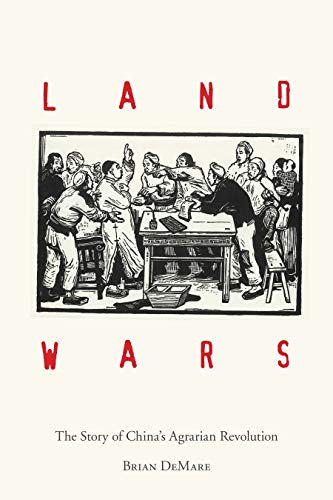
There are not too many sympathetic figures to be found in the waves of violence that swept the Chinese countryside during the Communist Party’s early pursuit of land reform, the subject of the Tulane historian Brian DeMare’s new book Land Wars: The Story of China’s Agrarian Revolution. But one of them was Xi Zhongxun, now best known as the father of current Chinese leader Xi Jinping. The elder Xi’s frequent disagreement with how the Party pursued land reform is known thanks to a major collection of documents published in 1988 (for internal distribution) by the National Defense University, one of the major sources on which DeMare draws.
Land reform–the forced redistribution of rural land from the rich to the poor–was central to the peasant-centered revolutionary strategy developed by Mao Zedong. He had formed his ideas on it by 1927, in investigating the peasant movement in his home province of Hunan. From the start, Mao conceived of the process as a violent confrontation between oppressed peasants and rich landlords, in which landlords were publicly attacked and humiliated before having their assets stripped from them. But Mao could not put this vision into practice while the Communist Party was in its United Front with the Nationalists to fight the Japanese invasion.
As that alliance started to break down into civil in 1945-46, Mao began to focus on radical land reform as a way to bring the peasantry onto his side. DeMare’s book is structured around the standardized process that the Communist work teams followed as they fanned out across the countryside: identifying disaffected elements within each village, labeling other residents of the village as class enemies, then organizing public confrontation and “struggle” sessions in which the “landlords” were humiliated and forced to admit guilt and give up their assets.
The resulting mob violence resulted in widespread torture, sexual assault and murder: “According to the party’s own accounting, in 1947 alone some 250,000 rich peasants and landlords were killed in the land reform campaigns of North China.” (Frank Dikötter’s chapter “The Hurricane,” in his The Tragedy of Liberation: A History of the Chinese Revolution 1945-1957, is a short history that vividly conveys the violence of land reform; see my post from 2018 for some more discussion).
Yet not all Communist Party leaders approved of the violent and often arbitrary score-settling that took place under the name of land reform. DeMare notes that the peak of the violence coincided with a January 1948 speech by Ren Bishi, a party theoretician, calling for a more nuanced approach to land reform and redressing errors. Around the same time, the elder Xi also intervened to try change the approach:
As mass violence threatened to derail agrarian revolution in early 1948, some party leaders began to speak out against land reform struggle. In the Northwest, Xi Zhongxun noted how activists had falsely created landlords, resulting in “manufactured struggle.” Campaigns that appeared spontaneous had in fact been jump-started by impure elements with dubious motivations. Activists in one poor peasant league, for example, had threatened to stone villagers to death if they did not take part in struggle; elsewhere, a work team ordered the local militia to string up landlords and beat village cadres. …
Writing personally to Mao, Xi was unflinching in his description of the extremes of rural revolution. In five days of land reform in Shaanxi’s Jia County, hooligans drowned victims in vats of salt water; they also poured boiling oil over the heads of struggle targets, burning them to death. Local cadres and their families were strung up and beaten in the search for wealth. Struggle even spread to a school for party children. There, teachers and students as young as seven years old were singled out as landlord running dogs. While these events were rare, Xi argued that they deeply affected rural society: peasants were so afraid they did not even dare to bury the dead. …
Xi even dared to question Mao’s assumptions about rural classes. Noting that middle peasants were already the dominant class in the Northwest, Xi argued that many of those who remained poor were in fact lazy. Putting these peasants in charge of land reform had resulted in chaos.
The worry was that the excesses of land reform were costing the Party valuable support during the civil war. By the middle of 1948, land reform was mostly put on hold, in favor of a return to an earlier, more moderate and reasonably successful policy of “double reduction”–negotiating lower rents and interest payments for farmers. But as the Communist Party approached victory over the Nationalists in 1949, land reform went back on the agenda.
The largest round of land reform came in 1950, when the Party recruited hundreds of thousands of people for “work teams” that would fan out through the countryside to reorganize rural villages. The Land Reform Law of that year was intended to correct some of the previous excesses of previous rounds of land reform, and DeMare goes out of his way to mention examples of peaceful, more legally restrained land reform in Shunyi, outside Beijing, and in Zhejiang. But the Party never abandoned the idea that land reform was fundamentally a violent struggle, and so violence continued.
For the party, any attempt to avoid struggle was unacceptable. Xi Zhongxun, long skeptical of struggle in the countryside, remained a true outlier. Reporting to Mao Zedong on the final stages of land reform in his Northwest Bureau, Xi once again found himself arguing against Mao’s grand narrative of rural revolution. Accepting the centrality of releasing the masses and struggle for raising class consciousness, Xi nevertheless insisted that the party not abandon leadership of land reform. Xi instructed the forty thousand cadres and activists under his direction to mobilize poor and middle peasants together, so that they might use “speak reason” struggle and prohibit “chaotic beatings.” …. Xi proposed embracing peaceful land reform, at least for the moment.
But Xi was a rare voice, and even he made concessions to Mao’s vision by arguing that this peaceful approach would “numb the enemy” and facilitate an eventual strategic attack on the landlord class. …Fierce struggle was essential to land reform and Mao’s grand vision of rural revolution. For the many who may have found such violence abhorrent, Chinese intellectuals were ready to provide a theoretical justification of class struggle.
DeMare includes quotes supporting the harsh approach to land reform from figures as eminent as Deng Xiaoping himself and the rural-policy specialist Du Runsheng, both of whom would be lionized a generation later for their roles in the rural reform of the 1980s. The land reform of the 1950s was less a prequel to that success than a violent political campaign that laid the groundwork for even more violent political campaigns: the collectivization of agriculture later in the 1950s, and then the Cultural Revolution of the 1960s. The violent, extralegal “struggle sessions” that the Cultural Revolution made famous were modeled on those used during land reform.
The elder Xi’s attempts to push back against excesses and pursue more humane policies show what type of leader he was, even if those attempts were ultimately unsuccessful (and probably contributed to his being purged in 1962). That strength of character helps explain why there has always been such enormous goodwill visible toward him in China. As do his later contributions: after Xi was rehabilitated in 1978 and appointed to leadership roles in Guangdong, he played a key role in liberalizing the economy. That reservoir of goodwill also undoubtedly fed into the optimism that initially greeted the ascension of his son to the leadership.
 The Tangled Woof