My upcoming talk “at” the University of Washington

I’ll be giving a talk next week hosted by the University of Washington China Studies program, over Zoom of course. In it I will introduce the results of a research project I’ve been working on over the last couple of years, to measure China’s state-owned enterprise sector and interpret its economic role. I’ll have slides with lots of cool charts, and am looking forward to a lively discussions with friends from UW and elsewhere.

Here’s the blurb, and the link for the event:

The State Never Retreats: State Enterprises in the Chinese Economy, 1995-2018

Even after forty years of market reforms, the question of what role the state and private sectors play in China’s socialist market economy is still unsettled. Is the country experiencing a steady expansion of private businesses, or a new advance of state enterprises? In this talk, Andrew Batson will introduce new estimates of the economic size and structure of China’s state-owned enterprise sector, which turn out to have been remarkably stable over the past quarter century. He will discuss what these research findings show about the nature of China’s political system, how they affect our understanding of the history of China’s reform era, and what they mean for the future trajectory of China’s economy.

Post-event update

The talk was not recorded, but I’m posting here the slides I presented:

What makes China want growth

I enjoyed this video interview with the historian Odd Arne Westad, talking about the book he is writing with Chen Jian on China’s long 1970s. The best part comes toward the end:

Westad: Both in the early 1970s, when Mao Zedong was still around, and maybe even more so in the late 1970s, both under Hua Guofeng and then Deng Xiaoping and his group, there’s this obsession with the idea that there will be war, that China will be attacked from the outside. Most likely by the Soviet Union, but also possibly by the Americans.

The imperative of growth, of rapid growth, came straight out of that. It’s remarkable to see how often leaders in this time period keep repeating that. From their perspective, this isn’t growth to help people get rich and move out of poverty. It’s all about strengthening the state, creating a state that can withstand the storms of that war that is going to come in the future. That was their thinking.

It’s fascinating to see how much of the literature that deals with this time period, especially from a US perspective, gets this exactly upside down. They think that economic reform is simply about releasing setting productive forces free and enabling a market transformation based on what had happened elsewhere. I think from the leadership’s perspective, then and probably also now, it’s the state imperative that is the most important. It’s what the state can extract from its own society in order to prepare for some kind of external conflict.

Karl Gerth: I’m often surprised that the Made In China 2025 plan is talked about as a form of autarky rather than as a form of geostrategic response. Just take the simple statistic that the US military budget is greater than the next 10 countries combined. It’s easy to imagine that China would find itself today, as it did then, in a position where it constantly needs to innovate and unleash productive forces.

Westad: I agree with that. If we look at the situation today, I think that’s very true, it’s exactly where much of this is coming from. It is less specific thinking about rapid economic development per se as it is a preparation for whatever the Communist Party and the Chinese government wants to do. There doesn’t necessarily have to be a contradiction between those two. But it’s very clear what comes first: it is the geopolitical strategy that determines how China approaches its economy, not the other way around.

At this moment, it’s easy to see these historical parallels: with the US openly attempting to strangle China’s technology sector, China clearly feels more externally threatened than it has in a while. As a result, it’s more obvious than usual how its geopolitical position is shaping economic policy. The geopolitical context for Chinese economic policy is also the subject of Covell Meyskens’ excellent recent book on the Third Front–see my review from last year.

The wisdom of the village Party secretary

In 1984, the Taiwan-born and US-trained anthropologist Huang Shu-min left his family in Iowa to live in a village on the Chinese island of Xiamen, just outside the city of the same name. By that time Chinese villages had already benefited from a few years of reform, and the changes underway were dramatic. Huang was impressed by the visible improvements in living standards, but also somewhat depressed by the constant presence of official propaganda and the regimented controls over daily life. At one point, he recounts trying to express this conflict to a villager:

“I must say that living conditions here are probably much better than what one might see in India or in Africa. To me, this seems to be directly related to the tightly controlled but highly efficient administrative system that one finds in China. The fundamental contradiction then is between economic development and human liberty. In order to achieve quick development, sometimes citizens of less-developed countries, such as China, may have to forgo some of their individual freedom. The problem I weigh is how to draw the delicate balance between collective interests and individual freedom.

In the Chinese context, it’s hard to imagine a more anodyne statement. These days, the effectiveness of China’s authoritarian state and the correctness of its tradeoff between liberties and development have been taken for granted by a generation. What you expect to happen here is for Huang to receive enthusiastic agreement and a lecture on the virtues of China’s system. So it’s pretty interesting that his interlocutor, the village Communist Party secretary Ye Wende, actually pushes back sharply against the whole framing:

Ye looked at me wearily. “I don’t know anything about India or Africa, nor do I know where you have picked up this great idea about the conflict between economic development and liberty. The only thing I know is based on my personal experience, and it seems to run counter to what you said. The more political controls imposed on the peasants, the less they want to work. On the other hand, when the national government shed itself of most controls in the countryside and gave peasants more free choice, they responded with greater enthusiasm and higher production.

This may not be true for all of China. But in Lin Brigade, at least as far as I can tell, it was only in the 1970s, when people realized the absurdity of political campaigns in the countryside and stopped cutting each other’s throats, and when the national policy became more flexible toward peasants, that we were able to achieve genuine development. If you don’t realize this point, you will never be able to understand current agrarian reform, either at the national level or in this village.”

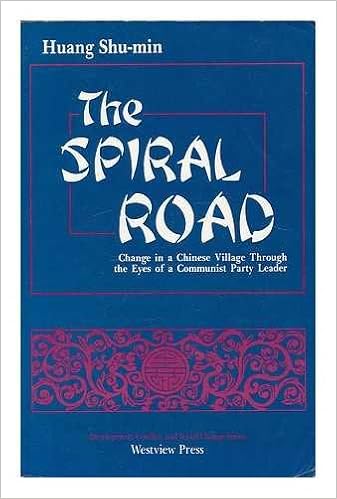
That exchange is from Huang’s 1989 book, The Spiral Road: Change in a Chinese Village Through the Eyes of a Communist Party Leader. It’s an unusual document, consisting entirely of extended interviews with Ye, who recounts an oral history of his village from the 1950s on. Bits like that offer a reminder of how different the intellectual environment was in China during the 1980s.