What I’ve been listening to lately

  • Byard Lancaster – It’s Not Up To Us. The star of this piece of free-jazz marginalia from 1968 is the criminally under-recorded electric guitar innovator Sonny Sharrock, delivering an early example of his extraordinarily forceful attack. When I saw Sharrock live in the early 1990s, he kept a stack of guitar picks on his amp, and wore them out at a furious pace–a physical approach to guitar noise that no one has matched. The theme “John’s Children” from this album was later reprised in more epic fashion as “Many Mansions” on Sharrock’s late-career masterpiece Ask The Ages. For more on his career, see this 1989 interview.
  • Sonny Rollins & Coleman Hawkins – Sonny Meets Hawk. The Jazz Great Meets Jazz Great formula beloved of midcentury record producers was not very reliable at actually generating good albums, though a few classics did result. Among them are Coltrane’s session with Ellington, and this one from 1963. I had not sought it out before because I just assumed it would be a courteous, traditional blowing session. Nothing could be further from the truth: it’s actually one of Rollins’ more adventurous recordings, featuring young avant-gardists like Paul Bley and Henry Grimes. Hawkins, whose own avant-garde credentials go back to his “Picasso” of 1948, meets them on that territory and plays wonderfully.
  • Dave Easley – Byways Of The Moon. Fellow practitioner Susan Alcorn has called the pedal steel guitar “the last musical instrument borne of the mechanical age” and its potential in a jazz context has still been barely tapped. In this recording, the Louisiana-based Easley demonstrates the fiendishly complex instrument’s capabilities in a recital of tunes by Monk, Miles, Coltrane and Carla Bley, also throwing in a couple of transformed pieces from the rock repertoire (Led Zeppelin, Brian Wilson). It sounds great.
  • William Parker – O’Neal’s Porch. Recorded in the opening months of this century but unheard by me until recently, this is a stunningly good session. It’s recognizably in the “freebop” mode of Ornette Coleman’s quartet (sax, trumpet, bass, drums) but with a radically different and funkier rhythmic approach from Parker and longtime comrade Hamid Drake on drums. Right now, I can think of few recordings that better mine the tension between rhythmic drive and vertiginous improvisation that is one of the singular pleasures of jazz. This 20th anniversary appreciation has good context on how the album fits into Parker’s impressive career.
  • Ben Goldberg – Everything Happens To Be. Improvisational counterpoint is one of my favorite things and there’s plenty of it on this new-ish session from an unusual quintet. The woody tone of Goldberg’s clarinet mixes wonderfully with the dry, breathy sounds from Ellery Eskelin’s tenor sax and Mary Halvorson’s guitar. And the rhythm section of Michael Formanek on bass and Tomas Fujiwara on drums is one of the best in jazz right now, one of the few rivals to the Parker-Drake combo.

What happened to common prosperity?

Xi Jinping rolled out his new slogan of “common prosperity” with great fanfare in 2021, using it to declare inequality a “major political issue” that would not be permitted to worsen further. The term was written into the five-year plan, highlighted in major speeches, and constantly promoted in state media. Common prosperity looked like one of the key concepts that would govern Chinese policy in Xi Jinping’s third term.

Yet the slogan of the moment is almost completely missing from the government’s official policy agenda for 2022, at least as it is presented in the documents for the annual legislative session that got underway this weekend. Premier Li Keqiang’s government work report, for instance contains exactly one mention of common prosperity (共同富裕), which is rendered as “prosperity for all” in the official English translation. And it’s a pretty generic statement:

We must act on the people-centered development philosophy and rely on the efforts of everyone to promote prosperity for all, so as to keep realizing the people’s aspirations for a better life.

The Ministry of Finance’s budget report also contains exactly one mention of common prosperity, which is simply a note of a provincial initiative: “We supported Zhejiang in be coming a leader in the exploration of new ways to promote common prosperity through public finance at the provincial level.” But the budget sets no goals for the central government relating to common prosperity, which is a bit strange as the Ministry of Finance would be in charge of any changes in taxes or spending to narrow income inequality.

The National Development & Reform Commission, the super-ministry that coordinates much economic policy and planning, seems to be taking the slogan more seriously: its annual development report does mention common prosperity a few times, and calls it a “major goal”. But the priority does not seem particularly high: common prosperity is listed as the last of the 10 tasks for its work in 2022, as an umbrella term for improving public services:

With a correct understanding of the main goal of common prosperity and the way to reach it, we will do everything possible within our means to constantly improve public services and resolve issues affecting the wellbeing of the general public.

This is all a bit puzzling coming after the massive propaganda push for common prosperity in 2021. It seemed reasonable to think of common prosperity as one of the planks in Xi’s “re-election campaign” for the 20th Party Congress later in 2022. He could argue that one of the reasons why it is important and necessary for him to have a third term is so that he can deliver common prosperity and solve the problem of inequality. Therefore I expected the messaging around common prosperity to ramp up this year, and get more specific and ambitious over time. Instead, it has turned more low-key.

Partly I think this reflects some of the incoherence that has been part of this slogan from the beginning. The rhetoric of common prosperity has simultaneously featured a call for revolutionary change and a denial that any fundamental change to China’s system is needed. As I wrote in an earlier contribution to a CSIS discussion on common prosperity:

It is remarkable how much of the official discussion of common prosperity consists of listing the things that cannot and should not change. Xi states that the common prosperity campaign cannot be allowed to hurt incentives for entrepreneurship, innovation, and hard work, nor can it be the occasion for the government to make “promises that cannot be fulfilled.” In other words, Xi is going out of his way not to promise a “new deal” for Chinese citizens, even though he has pledged to increase transfers to lower-income regions, adjust taxation, and boost the level of public benefits. There is thus something of a mismatch between common prosperity’s very broad political goals and the constrained policy instruments available to achieve them.

These contradictions make it hard to propose specific policies that would actually achieve the objectives of common prosperity, and even to articulate concrete objectives in the first place. That’s why I think common prosperity is more of a political campaign of gestures and symbolism than a technocratic economic agenda. Barry Naughton’s take is probably even more cynical than mine; as he said at UCLA event in February:

As a first approximation, the role that ordinary working people have in the Chinese Communist Party’s policy formulation is zero, and this is not an overture to them. It’s an effort to do two one things: one is to slap down this new capitalist elite and tell them you should know your place, and it’s not at the top, and the other is to put together a nice program that sounds good going into the 20th Party Congress.

So one interpretation of the recent downplaying of common prosperity could be that the rhetoric is simply collapsing under the weight of its own internal problems and difficulties. Yet I don’t think we’ve seen the end of common prosperity: the government is still pledged to deliver a plan for common prosperity, a process that will force it to articulate a somewhat more coherent agenda. The NDRC’s approach suggests that will center around improving the social safety net, an objective with plenty of political support.

Xi himself has certainly not abandoned the term; in a meeting during the legislative session, he said “As long as we consistently follow the road of socialism with Chinese characteristics, we will be able to continue to realize the people’s aspirations for a better life and continue to advance the common prosperity of all people.” I’d expect Xi to still use the common prosperity slogan prominently in his speeches around the Party Congress.

A different, though not incompatible, interpretation would be that the political context for this slogan has changed more than originally expected. Common prosperity probably made sense as a slogan during the triumphalist year of 2021, when China’s growth was strong and long-term goals seemed within reach, but perhaps makes less sense during the worrisome year of 2022, when growth is sliding and the world is in turmoil.

Xi Jinping’s most prominent public remarks at the legislative session this week have focused food and energy security, themes he has long favored but which now have much greater resonance as oil and commodity prices spiral upward. As Li Keqiang said in his work report, in a classic piece of understatement, “this year our country will encounter many more risks and challenges.” Common prosperity probably needs to go on the back burner for a bit while leaders deal with more urgent short-term concerns.

Reviving and reversing the Sino-Soviet trade bloc

Over the last month or so, since Vladimir Putin’s meeting with Xi Jinping in Beijing on the eve of the Winter Olympics, it’s been commonplace to say that ties between China and Russia are tighter than they have been since the Sino-Soviet alliance in the 1950s. In the joint statement issued after the meeting, the two countries went even further, asserting that “the new inter-state relations between Russia and China are superior to political and military alliances of the Cold War era.”

Doing a bit of reading, I discovered the parallels between 1950 and 2022 are pretty striking. Consider the sequence of events in both cases: the leader of the junior partner travels to the capital of the senior partner, where an agreement is announced formalizing ties between the two. Shortly afterward, the junior partner engages in military adventurism that results in US sanctions, making the junior partner even more economically dependent on the senior partner.

In the first iteration, the junior partner was of course China. Mao Zedong arrived in Moscow on December 16, 1949, just two months after declaring the foundation of the People’s Republic, seeking a treaty with the Soviet Union. Although Stalin dragged out the talks for weeks to emphasize Mao’s lower status, they signed the Treaty of Friendship, Alliance, and Mutual Assistance on February 14, 1950. Mao’s officials had only a few months to do follow-up work before North Korea invaded South Korea on June 25, 1950. On October 19, China’s own forces crossed the Yalu River and entered the war. On December 3, the US Department of Commerce announced a trade embargo against China (these dates are all matters of public record, but here I’m relying on the narrative in Jason M. Kelly’s recent book Market Maoists).

The terms of the embargo against China were even stricter than the one already in effect against the Soviet Union, intensifying China’s dependence on its socialist “big brother.” The arrangement between the two was simple: the Soviet Union would supply China with the technology, equipment and specialists it needed to build up its own industrial capacity, which China would pay for with exports of commodities and Soviet loans. Here’s an old-school infographic from a 1959 CIA report that captures the structure of China’s trade dependency nicely: it sold the Soviet Union farm products, metals and textiles, and bought machinery and weapons.

The second iteration unfolded on a much more compressed timescale. Putin landed in Beijing on February 4 for the opening ceremony of the Olympics, and the two governments issued a joint statement on their “future-oriented strategic partnership” the same day. The closing ceremony of the Olympics was held on February 20, and Russia began moving troops into Ukraine on February 21. The US announced its first sanctions on February 22, ramping to a joint announcement with allies of financial sanctions on February 26. The dizzying cascade of corporate announcements and market turmoil since then has starkly highlighted how China is now one of Russia’s most important remaining trade relationships.

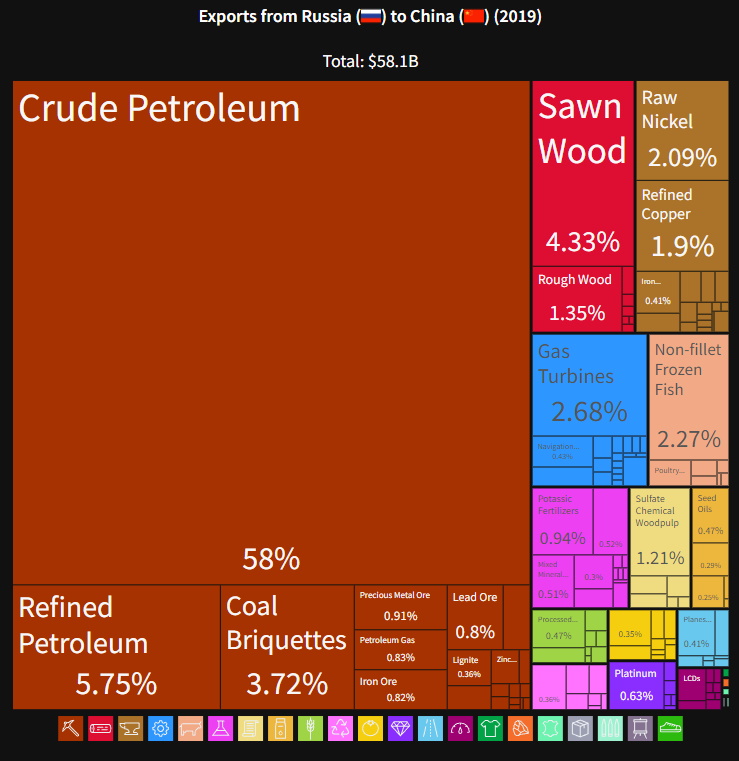
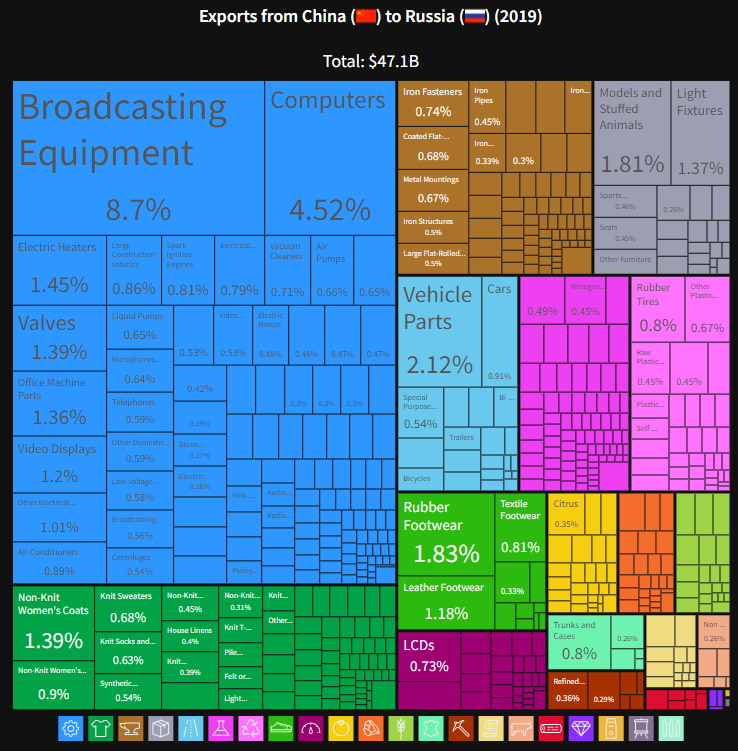
There’s no question that Russia is the junior partner this time around; it accounts for less than 2% of world GDP while China is now over 20%. The pattern of trade dependency is also the mirror image of what it was in the 1950s. As these nice visualizations from the Observatory of Economic Complexity show very clearly, it is now Russia who is the supplier of commodities and raw materials to China.

In turn, China now supplies Russia with machinery, electronics, and a range of consumer and capital goods.

Given that history is repeating itself in such an unusually straightforward way, it’s worth recalling that the Sino-Soviet alliance of the 1950s did not prove to be a stable arrangement. The explicitly hierarchical relationship was distasteful to China’s Communists, who were strong nationalists. But it was seen as a necessary temporary arrangement to rebuild the war-damaged Chinese economy. The supply of machinery and technical knowledge from the Soviet Union was a key part of a crash program to create China’s own socialist industrial base and achieve self-sufficiency. China never intended to be in an ongoing relationship of dependency. Eventually China lost faith in the Soviet Union and decided to exit the relationship to pursue self-sufficiency on its own terms, through Maoist projects like the Third Front.

For now, China and Russia seem happy to bond based on their shared criticism of the US and its aggressive assertion of authority over global trade and finance, which has resulted in sanctions on both countries. But I can’t help but wonder whether Russia is going to eventually find itself just as unwilling to acquiesce to long-term economic dependence as China was in its day.