If you were to make a list of the most significant pivot points in world history over the past half century or so, there’s no question that high on that list would be China’s move from poverty and isolation to a central position in the world economy. The fact that a backward and mostly agricultural country became the world’s largest trading nation and leading manufacturing power is almost now taken for granted, it’s part of the furniture of geopolitics, but from the perspective of the mid-20th century it was a shocking historical twist. And unlike many important historical changes, which unfold at a pace too slow to be observed except with hindsight, China’s transformation can be tied to an obvious and clearly datable event: the launch of economic reforms in 1978.
Assigning credit for China’s pivot seems straightforward. The death of Mao Zedong in 1976 allowed the feverish political infighting and exhausting campaigns that had consumed China to finally end, and the return of Deng Xiaoping to the leadership put in place a figure willing to make necessary changes. Anne Stevenson-Yang’s recent Wild Ride, a concise and cynical account of the reform era, summarizes the conventional take as: “The forceful and plain-talking Deng ascended and launched an economic revolution.” Deng’s leading role is attested to by both China’s official accounts, and by Western scholarly works such as Ezra Vogel’s acclaimed and comprehensive biography.

Such clear, straightforward narratives are, of course, an irresistible invitation for historians to correct and complicate the record. Revisionist accounts of the reform era have articulated two main critiques of the Deng-centric view. One is that while Deng arrogated to himself all the credit for various reformist ideas and programs, he often contributed fairly little. Many figures that Deng dominated or pushed aside–leaders like Hua Guofeng, Hu Yaobang and Zhao Ziyang–were actually responsible for the ideas and initiatives that transformed the economy. The other is that the Chinese people themselves, not any of their leaders, deserve much of the credit. The outcomes of reform were not actually what was planned in advance by the leadership, and often owed more to the initiative of ordinary people seizing opportunities than the wise, foresighted decisions of the elite (for me, the strongest statement of this argument is in Ronald Coase and Ning Wang’s How China Became Capitalist).
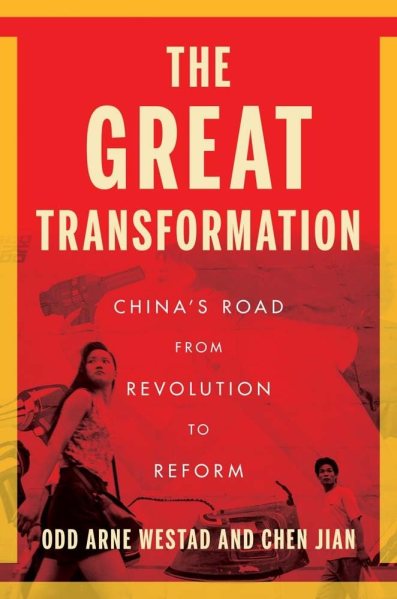
Both of these critiques have often been driven by a desire not to give all the credit for China’s economic successes to the same leaders who oversaw the brutal suppression of dissent and the crushing of political freedoms. Even if they are sometimes motivated by political score-settling, these critiques are nonetheless fundamentally correct: economic reform was not a top-down revolution single-handedly launched by Deng. The new book by Odd Arne Westad and Chen Jian, The Great Transformation: China’s Road From Revolution To Reform, comprehensively demonstrates this point, incorporating the revisionist perspectives into a balanced and marvelously readable account of elite machinations, grassroots developments, and international pressures.
Deng was a military leader who spent most of his time on domestic politics and foreign affairs; his appeal was his competence and practicality rather than his economic expertise. Westad and Chen argue that the ideological differences between Deng and other leaders in the 1970s, like Mao’s designated successor Hua Guofeng, were exaggerated; their power struggle was fundamentally personal rather than ideological. Deng simply thought he should be in charge and would do a better job, and Hua acquiesced for the good of the Party.
What Deng, a strong nationalist, did have was a restlessness and urgency about pushing China forward and remedying its weakness; that meant his decisions usually defaulted to supporting economic growth. But he was far from alone in his desire to improve the economy. And more broadly, the dramatic changes that unfolded in China through the late 1970s and early 1980s can’t be understood purely as the implementation of top-down decisions. Changes from below often outran the direction from the top, as farmers, workers and local officials had already started changing economic practices on their own initiative.
It’s easy to tear down the great-man theory of the reform era, but what to erect in its place? Westad and Chen’s organizing concept is the “long 1970s”: treating the period from the late 1960s to the mid-1980s as a single unit. The simplest summary of their overall thesis is that the reform era was a reaction against the Cultural Revolution, while at the same time being conditioned by and dependent on the changes the Cultural Revolution brought.
This is an idea that manages to be both obviously true and subtly subversive of received understanding. Usually the reform era and the Cultural Revolution are treated as polar opposites; the chief contribution of The Great Transformation is to treat them as part of a single historical process. Conventional histories of the reform era usually start in 1978, with the Third Plenum, or in 1976, with the death of Mao. Westad and Chen start theirs a full decade earlier, in 1966, with the launch of the Cultural Revolution that plunged China into years of political chaos.
In this account, 1978 no longer appears as an isolated pivot point, but the acceleration of a process that was already underway. “The most intense phase of Cultural Revolution turmoil was over by 1968, and at least by 1973, if not earlier, there were many new trends and tendencies that point forward to the reform era,” they write. The most intriguing part of their argument is its emphasis on how domestic policy changes were often driven by concerns about China’s international position.
The Soviet intervention in Czechoslovakia in 1968, and the border clashes with China that followed, made Mao feel that the Soviet Union was more aggressive and more of a near-term risk than the United States. Mao thought the Soviet Union was preparing to invade China, and that therefore China needed a stronger economy. It is now well known that Mao’s fears of invasion were the driver for the Third Front program of relocating industrial capacity to inland regions, as outlined in Covell Meyskens’ excellent book Mao’s Third Front (for more discussion, see my post “China’s security fears and the Cold War economy“).
Westad and Chen go even further, and argue that security fears were a key part of high-level political decisions that were made in subsequent years. Because of the risk of Soviet aggression, Mao “feared the strategic consequences of China’s material weakness, although he of course paid no attention to his own role in creating that weakness.” While Mao never wavered in his view that the Cultural Revolution was correct, necessary and successful, after 1969 he began shifting the emphasis slightly more toward economic development and tamping down on political infighting. In early 1970, for instance, the State Council called for “taking class struggle as the key link, firmly grasping preparations against war, and bringing about a new leap forward in the economy.”
The fear of the Soviets was clearly behind Mao’s willingness to respond positively to the secret overtures from newly elected US President Richard Nixon. It also influenced Mao’s decisions on personnel, including rehabilitating Deng Xiaoping and appointing the moderate Hua Guofeng, rather than any of the Cultural Revolution firebrands, as his successor. Mao felt that while the leftists he had elevated in the Cultural Revolution had the right political line, “they were not practical enough to lead the revolution on their own. People such as Deng Xiaoping were needed to keep the state moving forward and to consolidate and solidify the results of the shake-up.” When Deng took over, he maintained Mao’s view of the Soviet Union as “an implacable enemy of China. … It could serve neither as foreign friend nor as an economic model for China, Deng insisted.”
The Great Transformation is a true narrative history that avoids sweeping statements and sniping at other scholars, and instead builds up its argument through the careful depiction of events. The detailed, blow-by-blow accounts of key episodes like the Nixon visit, the death of Lin Biao, and the fall of the Gang of Four are authoritative and valuable. The bluntest statement of the geopolitical thesis is not in the pages of the book, but in an interview Westad gave while it was still being written: “There’s this obsession with the idea that there will be war, that China will be attacked from the outside. … The imperative of growth, of rapid growth, came straight out of that. It’s remarkable to see how often leaders in this time period keep repeating that.” (For a longer excerpt, see my post “What makes China want growth“.)
This argument is logical and well-supported, but Westad and Chen may downplay just how unsettling some of its implications are. Mao’s death seems to have been necessary for clearing the political stage and allowing the country to truly move on from the Cultural Revolution. But who made the strategic decision that China needed a stronger economy? Who elevated the practical-minded leaders who would make the hard choices necessary in implementing economic reform? After immersion in the history of the long 1970s, it becomes difficult to avoid the conclusion that the person who began China’s pivot to economic reform was none other than the Chairman himself, Mao Zedong.
 The Tangled Woof