After doing a round of India-China comparisons that focused on commonly cited macro indicators like manufacturing, investment and literacy (see last month’s post “India and the invidious comparison with China“), I wanted to highlight a lower-profile but perhaps even more interesting contrast: the structure of government and the nature of decentralization in large countries. One of the coolest China-India charts I have seen is in a 2020 article in the Journal of Economic Perspectives by Devesh Kapur, “Why Does the Indian State Both Fail and Succeed?” It shows how public employees in India, China and the US are distributed across different levels of government:
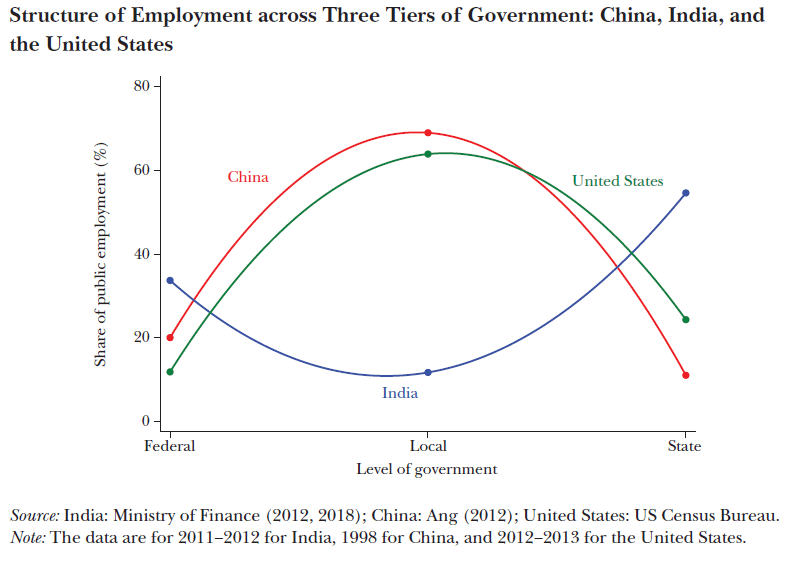
Notably, India has many more of its public servants at the state level than China does at the equivalent provincial level, and many fewer at the local (i.e. cities and towns) level than China does. (The China numbers come from an interesting paper by Yuen Yuen Ang; the data sources unfortunately stop in 1998). On this measure, state capacity at the local level looks much stronger in China than in India, which helps explain some of the long-running economic differences between them. (The structural similarity of China and the US in public employment is also pretty interesting!)
Some of the major indicators of India’s poor state capacity are its failures in delivering public services like health and education, which happen at the local level. China does much better in basic service delivery–and its local governments have also played a very obvious and important in driving growth, thanks to the competition and experimentation among local officials driven to develop their jurisdictions. That process presumes a certain baseline level of state capacity and autonomy at the local level, which may be harder to come by in India.
Why is the structure of government authority distributed so differently in Asia’s two billion-person continental-scale civilization-states? History. Karthik Muralidharan’s definitive book on state capacity in India, Accelerating India’s Development: A State-Led Roadmap For Effective Governance, says that questions of federalism and devolution greatly occupied the drafters of India’s constitution at independence. Despite the claims of nationalist propaganda, India had not been a unified state prior to British colonialism, and was not really a unified state under British rule. The leaders of the new country quite reasonably did not trust local authorities enough to give them great autonomy:
The political reason [for centralization] was the concern that post-British India would not remain unified, a fear amplified by the Partition of the subcontinent into India and Pakistan. Further, at the time of Independence, more than 40% of India’s land was ruled by over 500 erstwhile princely states, whose rulers had only recently acceded to the Indian Union, and some had done so quite reluctantly.
To understand the enormity of the challenge of uniting the nation, some historical context is useful. In the 2000 years before British rule, even 75% of the Indian subcontinent was politically unified for less than 200 years: under the peaks of the Mauryan and Mughal Empires (around 300-250 BCE and around 1600-1700 CE). So, preserving national unity was a top priority for the Constitution’s framers. This is why they gave the Central government strong political powers, including the ability to dismiss democratically elected state governments under Article 356.
The national elites designing independent India’s political structure also did not trust the traditional elites at the local level to share their social and economic agenda. They did not want to give local governments lots of authority over money and social programs, because they knew the traditional local power brokers would inevitably influence government for their own benefit:
The lack of autonomy of lower tiers of government reflected the concern that local elites would seek to perpetuate patriarchy and caste inequalities, through actions such as denying or limiting education to girls and disadvantaged castes, if they were given power over local service delivery. This lack of trust is perhaps best captured in the famous words of Dr. Ambedkar, ‘What is the village but a sink of localism, a den of ignorance, narrow-mindedness and communalism?’ …
Though the first principles of federalism suggest that local government should be responsible for service delivery, India’s approach to designing a federal governance system has been much more centralized than almost any other country in the world. A key reason for doing this was to have a professional state-level bureaucracy that could implement government policies and programmes to benefit disadvantaged groups, that may have been resisted or even thwarted by local elites.
Why have China’s political leaders been more confident that they could devolve some authority to local governments? They definitely cared a lot about national unity, but fissiparous tendencies were perhaps less of an immediate risk after the Communist Party’s victory in the civil war. China did have a longer history as a unified state (the boundaries of the People’s Republic of China are largely the same as that of the Qing Empire), and the fight against the Japanese invasion in the 1930s had helped forge strong popular nationalist sentiment.
The new Communist state in China was also just much more ruthless in ripping out traditional social structures and replacing them with its own lines of command. First there was the land reform in the 1950s that dispossessed and killed millions of local gentry. Later the Cultural Revolution eradicated many of the remnants of traditional society, as the nation was consumed with campaigns to tear down any source of authority other than the Chairman. Mao himself always favored local initiative and autonomy, at least rhetorically, but this assumed a framework of uniform nationwide loyalty to the Party. The Cultural Revolution’s relentless political campaigns also ended up destroying much of the ability of China’s new bureaucracy to function. Yet when the post-Mao leaders started rebuilding state capacity, they would have faced less competition from traditional social structures.
 The Tangled Woof