Two things happened this year to convince me to do some more intentional listening to Indian classical music, which I had long been aware of but had never really “got.” The first was the untimely death of Zakir Hussain, the beloved tabla virtuoso; he had been scheduled to play a concert near where I live and I thought I would finally take the opportunity to see him in person. Now I will never have one. The second, also unexpected, was an invitation to go to India for a conference, which would be my first time to visit. It seemed like a sign.
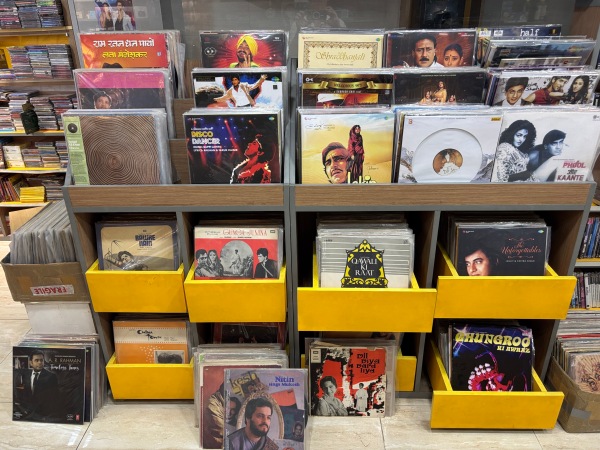
So, on a day off in Delhi, I paid a visit to Radio & Gramophone House–a 74-year-old record shop and one of the last remaining, Indians like everyone else having gone mostly to streaming. I asked them for an introduction to Indian classical music, instrumental not vocal, and the friendly gentlemen set me up with a bag of CDs to take home; I was only sad I could not carry some of the marvelous LPs they had. (If you’re in Delhi, please give them some business.)
Since then I’ve been working my way through that initial stack of CDs, supplemented by some other purchases and downloads and re-listening to things I already had but to which I had not paid proper attention. It’s been very worthwhile. If, like me, you appreciate the improvisational flights and rhythmic delights of jazz, then Indian classical music will not seem very foreign for long. The best bits are marvelous, without question. But it is a daunting edifice from the outside, and it is hard to know how to approach. Here are some of my initial thoughts on what is so great about Indian classical music, and how to get into it as a curious outsider.
You can think of music as having four axes of variation: melody, harmony, rhythm, orchestration. The structure of Indian classical music downplays two of these: there is no harmony, and the orchestration is minimal, with usually only one melody instruments and one or two accompanists. It’s all melody and rhythm, but these are intensely investigated. To the Western-trained ear, the lack of harmonic progression can make the structure of the music difficult to grasp, and is why people sometimes complain that it “all sounds the same.” It takes some repeated listening to hear what is there rather than what is not.
Another barrier is a more pratical one: most pieces of Indian classical music are long. Particularly in the northern, Hindustani style best represented on record, tracks rarely come in under twenty minutes, with full performances of a single raga easily reaching an hour or more. I like variety, so if I have an hour to listen to music I would usually prefer to listen to several different pieces rather than just one. Even for really great jazz players, I rarely want to listen to those forty or fifty minute jams. Improvisers can be prolix and reluctant to edit themselves, but for listeners shorter is usually better. For these reasons, I found some of the classic recordings from the LP era (mostly the 1960s) to be good places to start with Indian music. The constraints of the medium keeps the length of the pieces relatively contained, and that constraint is actually a benefit.
So if, to the Western ear, Indian classical music initially seems kind of long and boring, what is the attraction? It’s often marketed to Westerners as a kind of functional music for the spiritual lifestyle, accompaniment for meditation or whatever. The drones and the slow pace of the opening sections of the ragas contribute to this vibe, and it’s true you need a little patience to get started. But this is not what I’m after at all. The good stuff is actually quite exciting, with the interplay between the long melodic explorations and the intricate rhythms delivering some of the same joys that other improvised music does, while still being very much a distinct tradition.
The tabla. Percussion is really at the heart of Indian classical music, and while there are other percussion instruments, for now I’m still most in love with the sound of the tabla. Zakir Hussain is amazing and had a long and productive career; a reasonable algorithm for finding good recordings of Indian classical music is just to look for ones that he plays on. The Bandcamp page of his personal record label has a lot of good classical recordings, as well as many of his other efforts. (He also did a lot of fusion and cross-genre work, which I have not explored so much; honestly I haven’t loved what I’ve heard of Shakti, the band he was in with John McLaughlin).
His father, Alla Rakha, was also a tabla master and played on many classic recordings from the 1950s on; again, you could do worse than to just seek out recordings with his name on them. Both of them made solo tabla recordings, and even a few tabla duets together; I’ve sampled these but I think I’m not an advanced enough listener to really appreciate them, it’s not where I would start. Another major tabla player, recommended by the Radio & Gramophone House guys, is Shankar Ghosh.
The sitar. The chiming of the sitar’s multiple resonant strings is perhaps the most immediately identifiable sound of Indian classical music. It’s hard to avoid the sitar or Ravi Shankar in a survey of the recordings easily available outside India, and really there’s no reason to. I like his early Ragas & Talas LP, from 1959, and the other 1960s recordings are pretty good too. Other amazing sitar players are Nikhil Banerjee and Budhaditya Mukherjee, and it is easy to find lots of their work on streaming services.
The sarod. The best Ravi Shankar, however, might just be his collaborations with the sarodist Ali Akbar Khan, a towering figure in the music. Possibly the first example on record is this track from 1955, on a UNESCO compilation available through Smithsonian Folkways, but they kept playing together for decades. Their duets (known as jugalbandis) are some of the real high points of the genre; the call-and-response is delightful.
The sarod and sitar sound great together, but I discovered that I actually prefer the sarod: an instrument of the lute family, its sound is a bit deeper, more forceful and direct, highlighting the melody more. Ali Akbar Khan’s work is amazing and should be sought out; some other major sarodists are Sharan Rani, Amjad Ali Khan and Aashish Khan. Again, a wealth of marvelous material from all of them is available on streaming services. One individual recording I would highlight is the collaboration between Ali Akbar Khan and Nikhil Banerjee released on Khan’s own label as Signature Series Vol. 4; it’s widely recognized as a stone-cold classic.
Other instruments. The bansuri, the Indian side-blown bamboo flute, is another common lead instrument, but I don’t love it as much as the sarod. The most famous practitioner is Hariprasad Chaurasia, who is prolific and widely beloved. I quite enjoyed some of his recordings, but found others to be a bit soporific. The double-reed instruments, shehnai and nagaswaram, for me are hard to appreciate.
One of the interesting things about Indian classical music is how much innovation in instruments there has been: many Western instruments were adopted and modified by Indian musicians in the 20th century to play in the Indian classical style. For instance, there are now many violin players in the tradition, but I haven’t listened to them much yet so don’t have much to suggest. Bringing in new instruments has generally worked very well: modern instruments generally have more reliable tone, wider range, and better projection than traditional instruments–they are better as instruments.
One well-known figure is Vishwa Mohan Bhatt, who invented his own instrument, the mohan veena, a kind of cross between a guitar and the veena family of stringed instruments. He won a Grammy for his collaboration with the roots guitarist Ry Coorder; it’s a nice-sounding record but frankly his work in his own tradition is much better, and very rewarding. Again, there is lots on streaming.
Brij Bhushan Kabra, a student of Ali Akbar Khan, played a modified slide guitar, which sounds fantastic as an Indian classical instrument; I found a nice LP reissue of his 1982 record with Zakir Hussain. Kadri Gopalnath brought the alto saxophone into the southern, Carnatic tradition, and he is amazing too. Jazz listeners might be more interested, but really he sounds nothing at all like jazz. He has a unique sound but is not perhaps the best introductory listen for tuning your ears to the particular beauties of Indian classical music. For that I would go first to Ali Akbar Khan.
 The Tangled Woof
Indian classical vovcalists are worth exploring too, a jugalbandi to get you started:
Naina Lagai Ke by Ustad Shujaat Khan & Asha Bhosle
Indian devotional music aslo has some wonderful vocalists:
Kali Kapalini Mata Bhavani by Veena Sahasrabuddhe
Enjoy!