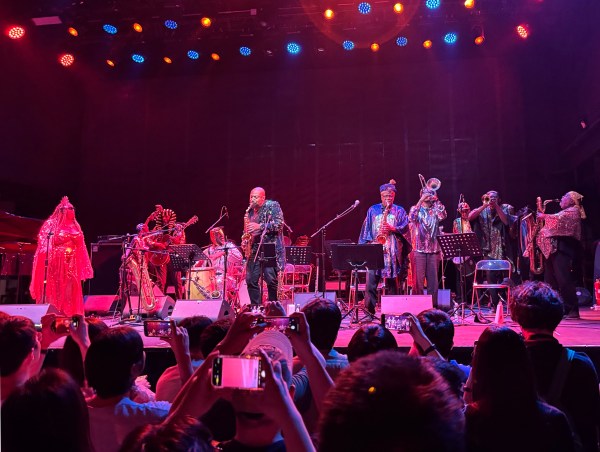
Another good year for music. Thanks to some lucky coincidences I saw the Sun Ra Arkestra, led by Knoell Scott, three times this year. Every show was different, and each a fun and life-affirming musical experience—see them if you can! Their most recent studio album is very charming, even if it lacks the wild avant-garde energy of yesteryear. The best-known standard-bearers of today’s jazz avant-garde, guitarist Mary Halvorson and saxophonist James Brandon Lewis, both had outstanding albums this year (About Ghosts and Abstraction Is Deliverance) that have been widely reviewed; if you follow jazz you probably know about them already. I liked both records a lot, but for my list this year I wanted to highlight some other names. Here are my favorite discoveries from a year of listening, listed by date of original release:
- Vijay Iyer & Wadada Leo Smith – Defiant Life (2025). At 84, Smith remains astonishingly productive, a true jazz elder at the height of his powers. His second collaboration with pianist Iyer is if anything even more wrenchingly beautiful than the first, A Cosmic Rhythm With Each Stroke from 2016; they should record more than once a decade. Smith’s abstract yet lyrical trumpet playing also appeared this year on another duet album, Angel Falls with Sylvie Courvoisier—also worth hearing but for me not quite at the same level—and two records with Danish guitarist Jakob Bro that I haven’t heard yet but look promising.
- Nels Cline – Consentrik Quartet (2025). One of the best small-group jazz albums of the year, out of a strong field. Cline’s quartet, featuring his guitar with the twisty tenor of Ingrid Laubrock, Chris Lightcap on bass and Tom Rainey on drums, feels like a real band with its punchy rhythmic drive. But the group isn’t locked into one style, and the varied tunes cover a lot of compositional ground.
- Cosmic Ear – Traces (2025). Christer Bothén was one of Don Cherry’s collaborators during his Scandinavian sojourn in the 1970s, and for this recording he gathers some fellow travelers for a heartfelt homage to Cherry’s style of spiritually inflected world jazz. It’s as good or better as anything from that era. Bothén’s bass clarinet is also featured on Jorden vi ärvde by the Vilhelm Bromander Unfolding Orchestra, a marvelous large-ensemble recording.
- Webber/Morris Big Band – Unseparate (2025). The two co-leaders use the resources of the jazz big band in nontraditional ways, finding all kinds of new combinations of sounds. Continuously inventive and surprising; a sterling example of what people are calling the “New Brooklyn Complexity.”
- Marty Ehrlich – This Time (2025). The horn-bass-drums trio is perhaps the most fundamental type of jazz group, and I find increasingly gravitate toward the directness of this format. The veteran multi-instrumentalist Ehrlich sticks mostly to alto sax for this one, an unusual choice in a trio. He plays tributes to Andrew Hill and Arthur Blythe, references that give a good idea of the inside-outside flavor of this excellent session. Ehrlich’s debut record, The Welcome, recorded some 40 years ago, was also a trio and is worth hearing too.
- Chad Taylor – Smoke Shifter (2025). Another standout small-group jazz session with a timeless feel, simultaneously recognizable and fresh. The sax-trumpet-vibes frontline recalls some of the forward-looking Blue Note dates of the 1960s while being thoroughly contemporary (the WSJ review is nice). Taylor is also the drummer for in the unique trio Hears & Minds, alongside Jason Stein on bass clarinet and Paul Giallorenzo on synthesizers. Their latest album, Illuminescence (2025), mines some of the seams first opened up by Sun Ra, and unearths new treasures.
- Augustus Pablo – King Tubbys Meets Rockers At 5 Cardiff Crescent, Washington Garden, Kingston (2025). A new collection of mostly unheard music from the great Pablo; it’s a sign of how productive the 1970s golden age of reggae was that there is still material of this quality out there. This collection of instrumental tracks is a stellar example of dub as vernacular avant-garde: the forms of pop music–three-minute songs performed on guitar, keys, bass, drums–are transmuted into mysterious slabs of rhythmic energy.
- Ebo Taylor – Jazz Is Dead 022 (2025). The Ghanaian music legend recorded this new session with Adrian Younge and Ali Shaheed Muhammad at the age of 88; his voice is weaker than it once was but the beats are as compelling as always. Also now reissued and readily available are his early albums Ebo Taylor (1977) and Conflict (1980), true classics.
- Jeff Parker – The Way Out of Easy (2024). Long, trance-inducing tracks selected from the years that Parker’s quartet played a regular Monday-night gig in L.A. Together they define almost a new genre of groove-oriented jazz that takes inspiration from other contemporary forms of beat music while staying improvisational and exploratory. Friends who don’t like much jazz like this.
- Ben Goldberg – Here to There (2024). Another unusual horn-bass-drums trio: the clarinet is rarely heard in this exposed format. Goldberg and his trio mates Todd Sickafoose and Scott Amendola have an affinity for Thelonious Monk: their album Plays Monk from a few years ago was excellent, and this one extends the engagement, developing new tunes from bridges of Monk songs.
- Seun Kuti – Heavier Yet Lays The Crownless Head (2024). The younger sun of Nigerian legend Fela Kuti, Seun Kuti inherited his father’s band Egypt 80, and much of his charisma and energy. I saw him on tour this year, and after a rocky start he delivered a stunning show. I like his new record a lot, the interlocking horn and drum parts are captivating as in the classic Afrobeat style, but the tunes more compact and focused.
- Lee “Scratch” Perry x Bob Riddim – Destiny (2023). A posthumous collaboration between the legendary Perry and a younger producer. The last few albums Perry released before his death in 2021 were not very strong, but this one is fantastic, a more suitable capstone to his long career. On the record Perry has an old man’s voice, weak and quavery, but it somehow makes the songs even more intense and moving.
- Charles Lloyd – Sangam (2006). Although I listened to a lot of Indian classical music this year, I didn’t put any on this list, as I still don’t really know how to talk about it. But I feel confident in saying this is one of the absolute best recordings of Indian-influenced jazz or jazz fusion. The interplay between the legendary tabla virtuoso Zakir Hussain and jazz drummer Eric Harland is tremendously exciting.
- Craig Taborn – Light Made Lighter (2001). I may be a sucker for the horn-bass-drums trio, but I don’t love piano trios as much as a lot of other jazz fans seem to. This early effort by the amazing Taborn, though, is consistently interesting, one of the best contemporary piano trio records. I was turned on to it by Vinnie Sperrazza, in his appreciation of the work of drummer Gerald Cleaver.
- Joe Lovano – Sounds of Joy (1991). Lovano’s first (but not last) trio recording, this often-overlooked album is an essential example of the form. The legendary drummer Ed Blackwell makes one of his last appearances on record with the two much younger musicians, Lovano on multiple reeds and Anthony Cox on bass.
- Amina Claudine Myers – Song for Mother E (1979). Myers on piano and organ is accompanied only by drums on this unusual early recording, which doesn’t sound like anything else out there. The propulsive spiritual jazz of Alice Coltrane is one reference, though Myers is inspired more by gospel than Indian music. This album is now widely available for the first time in decades as part of the ongoing reissues of the catalog of Leo Records.
- Miles Davis – On The Corner (1972). Like many jazz fans when On The Corner this record first came out, I just didn’t understand it the first time I heard it. What is this crap? I thought it was just bad funk. But when I went back to it this year, I could finally hear the music correctly. There are definitely highs and lows to Miles’ electric period, but this is one of the highs: dark and complex and intense.
- John Coltrane – Expression (1967). When I saw Ravi Coltrane’s group this year, he closed the set by announcing he would play one of his father’s tunes, the title track of this album. It was a beautiful piece but I didn’t recognize it, and I thought I knew most of the late-period Trane. I had missed this one, his last studio recording, and a great session. Although some of the intense workouts of his group with Alice and Pharaoh can be unlistenable, here Trane is more focused and structured. It was a new direction that he never finished exploring: John would pass a few months later, when Ravi was only two.
Previous lists: 2024 | 2023 | 2022 | 2021 | 2020 | 2019 | 2018 | 2017 | 2016 | 2015 | 2014
A lot of the stuff I am looking forward to listening to next year is on my Bandcamp wishlist.
 The Tangled Woof