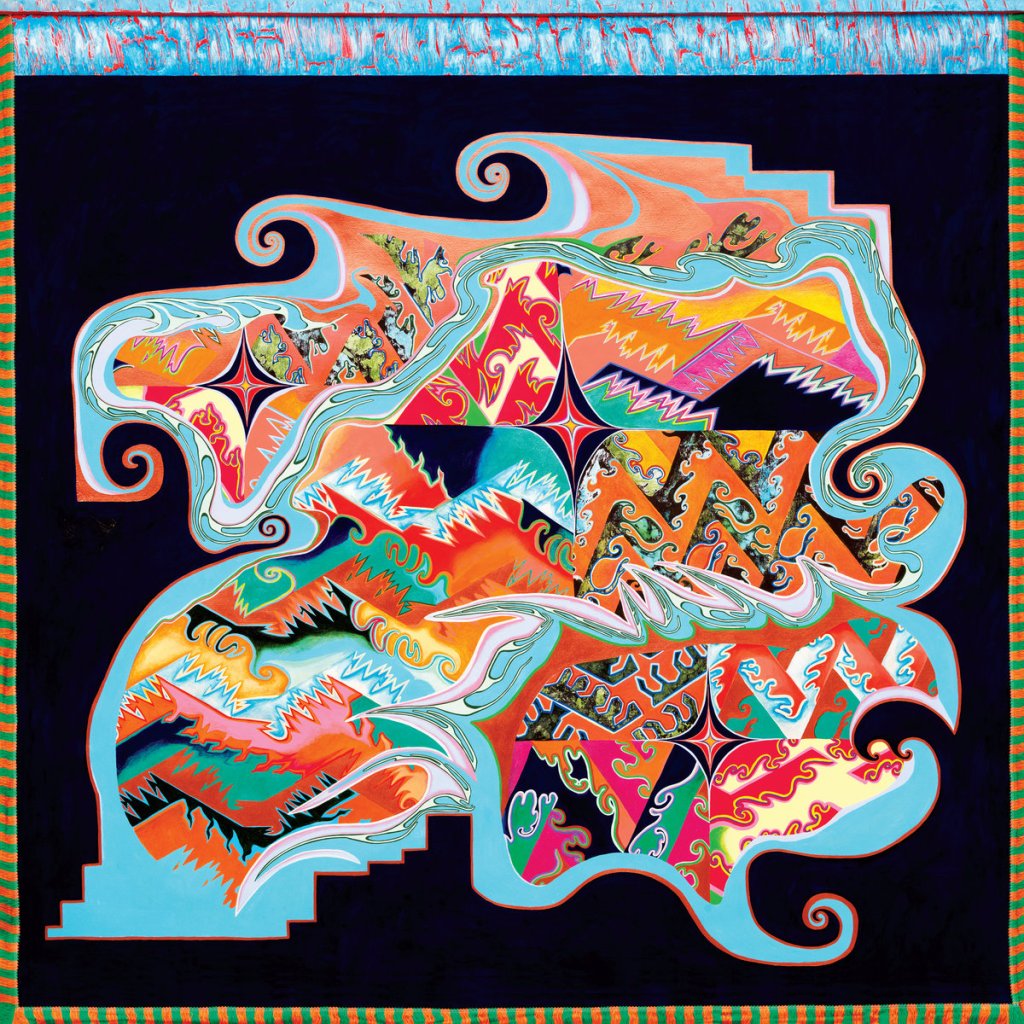
The best music I heard in 2025

Another good year for music. Thanks to some lucky coincidences I saw the Sun Ra Arkestra, led by Knoell Scott, three times this year. Every show was different, and each a fun and life-affirming musical experience—see them if you can! Their most recent studio album is very charming, even if it lacks the wild avant-garde energy of yesteryear. The best-known standard-bearers of today’s jazz avant-garde, guitarist Mary Halvorson and saxophonist James Brandon Lewis, both had outstanding albums this year (About Ghosts and Abstraction Is Deliverance) that have been widely reviewed; if you follow jazz you probably know about them already. I liked both records a lot, but for my list this year I wanted to highlight some other names. Here are my favorite discoveries from a year of listening, listed by date of original release:

  • Vijay Iyer & Wadada Leo Smith – Defiant Life (2025). At 84, Smith remains astonishingly productive, a true jazz elder at the height of his powers. His second collaboration with pianist Iyer is if anything even more wrenchingly beautiful than the first, A Cosmic Rhythm With Each Stroke from 2016; they should record more than once a decade. Smith’s abstract yet lyrical trumpet playing also appeared this year on another duet album, Angel Falls with Sylvie Courvoisier—also worth hearing but for me not quite at the same level—and two records with Danish guitarist Jakob Bro that I haven’t heard yet but look promising.
  • Nels Cline – Consentrik Quartet (2025). One of the best small-group jazz albums of the year, out of a strong field. Cline’s quartet, featuring his guitar with the twisty tenor of Ingrid Laubrock, Chris Lightcap on bass and Tom Rainey on drums, feels like a real band with its punchy rhythmic drive. But the group isn’t locked into one style, and the varied tunes cover a lot of compositional ground.
  • Cosmic Ear – Traces (2025). Christer Bothén was one of Don Cherry’s collaborators during his Scandinavian sojourn in the 1970s, and for this recording he gathers some fellow travelers for a heartfelt homage to Cherry’s style of spiritually inflected world jazz. It’s as good or better as anything from that era. Bothén’s bass clarinet is also featured on Jorden vi ärvde by the Vilhelm Bromander Unfolding Orchestra, a marvelous large-ensemble recording.
  • Webber/Morris Big Band – Unseparate (2025). The two co-leaders use the resources of the jazz big band in nontraditional ways, finding all kinds of new combinations of sounds. Continuously inventive and surprising; a sterling example of what people are calling the “New Brooklyn Complexity.”
  • Marty Ehrlich – This Time (2025). The horn-bass-drums trio is perhaps the most fundamental type of jazz group, and I find increasingly gravitate toward the directness of this format. The veteran multi-instrumentalist Ehrlich sticks mostly to alto sax for this one, an unusual choice in a trio. He plays tributes to Andrew Hill and Arthur Blythe, references that give a good idea of the inside-outside flavor of this excellent session. Ehrlich’s debut record, The Welcome, recorded some 40 years ago, was also a trio and is worth hearing too.
  • Chad Taylor – Smoke Shifter (2025). Another standout small-group jazz session with a timeless feel, simultaneously recognizable and fresh. The sax-trumpet-vibes frontline recalls some of the forward-looking Blue Note dates of the 1960s while being thoroughly contemporary (the WSJ review is nice). Taylor is also the drummer for in the unique trio Hears & Minds, alongside Jason Stein on bass clarinet and Paul Giallorenzo on synthesizers. Their latest album, Illuminescence (2025), mines some of the seams first opened up by Sun Ra, and unearths new treasures.
  • Augustus Pablo – King Tubbys Meets Rockers At 5 Cardiff Crescent, Washington Garden, Kingston (2025). A new collection of mostly unheard music from the great Pablo; it’s a sign of how productive the 1970s golden age of reggae was that there is still material of this quality out there. This collection of instrumental tracks is a stellar example of dub as vernacular avant-garde: the forms of pop music–three-minute songs performed on guitar, keys, bass, drums–are transmuted into mysterious slabs of rhythmic energy.
  • Ebo Taylor – Jazz Is Dead 022 (2025). The Ghanaian music legend recorded this new session with Adrian Younge and Ali Shaheed Muhammad at the age of 88; his voice is weaker than it once was but the beats are as compelling as always. Also now reissued and readily available are his early albums Ebo Taylor (1977) and Conflict (1980), true classics.
  • Jeff Parker – The Way Out of Easy (2024). Long, trance-inducing tracks selected from the years that Parker’s quartet played a regular Monday-night gig in L.A. Together they define almost a new genre of groove-oriented jazz that takes inspiration from other contemporary forms of beat music while staying improvisational and exploratory. Friends who don’t like much jazz like this.
  • Ben Goldberg – Here to There (2024). Another unusual horn-bass-drums trio: the clarinet is rarely heard in this exposed format. Goldberg and his trio mates Todd Sickafoose and Scott Amendola have an affinity for Thelonious Monk: their album Plays Monk from a few years ago was excellent, and this one extends the engagement, developing new tunes from bridges of Monk songs.
  • Seun Kuti – Heavier Yet Lays The Crownless Head (2024). The younger sun of Nigerian legend Fela Kuti, Seun Kuti inherited his father’s band Egypt 80, and much of his charisma and energy. I saw him on tour this year, and after a rocky start he delivered a stunning show. I like his new record a lot, the interlocking horn and drum parts are captivating as in the classic Afrobeat style, but the tunes more compact and focused.
  • Lee “Scratch” Perry x Bob Riddim – Destiny (2023). A posthumous collaboration between the legendary Perry and a younger producer. The last few albums Perry released before his death in 2021 were not very strong, but this one is fantastic, a more suitable capstone to his long career. On the record Perry has an old man’s voice, weak and quavery, but it somehow makes the songs even more intense and moving.
  • Charles Lloyd – Sangam (2006). Although I listened to a lot of Indian classical music this year, I didn’t put any on this list, as I still don’t really know how to talk about it. But I feel confident in saying this is one of the absolute best recordings of Indian-influenced jazz or jazz fusion. The interplay between the legendary tabla virtuoso Zakir Hussain and jazz drummer Eric Harland is tremendously exciting.
  • Craig Taborn – Light Made Lighter (2001). I may be a sucker for the horn-bass-drums trio, but I don’t love piano trios as much as a lot of other jazz fans seem to. This early effort by the amazing Taborn, though, is consistently interesting, one of the best contemporary piano trio records. I was turned on to it by Vinnie Sperrazza, in his appreciation of the work of drummer Gerald Cleaver.
  • Joe Lovano – Sounds of Joy (1991). Lovano’s first (but not last) trio recording, this often-overlooked album is an essential example of the form. The legendary drummer Ed Blackwell makes one of his last appearances on record with the two much younger musicians, Lovano on multiple reeds and Anthony Cox on bass.
  • Amina Claudine Myers – Song for Mother E (1979). Myers on piano and organ is accompanied only by drums on this unusual early recording, which doesn’t sound like anything else out there. The propulsive spiritual jazz of Alice Coltrane is one reference, though Myers is inspired more by gospel than Indian music. This album is now widely available for the first time in decades as part of the ongoing reissues of the catalog of Leo Records.
  • Miles Davis – On The Corner (1972). Like many jazz fans when On The Corner this record first came out, I just didn’t understand it the first time I heard it. What is this crap? I thought it was just bad funk. But when I went back to it this year, I could finally hear the music correctly. There are definitely highs and lows to Miles’ electric period, but this is one of the highs: dark and complex and intense.
  • John Coltrane – Expression (1967). When I saw Ravi Coltrane’s group this year, he closed the set by announcing he would play one of his father’s tunes, the title track of this album. It was a beautiful piece but I didn’t recognize it, and I thought I knew most of the late-period Trane. I had missed this one, his last studio recording, and a great session. Although some of the intense workouts of his group with Alice and Pharaoh can be unlistenable, here Trane is more focused and structured. It was a new direction that he never finished exploring: John would pass a few months later, when Ravi was only two.

Previous lists: 2024 | 2023 | 2022 | 2021 | 2020 | 2019 | 2018 | 2017 | 2016 | 2015 | 2014

A lot of the stuff I am looking forward to listening to next year is on my Bandcamp wishlist.
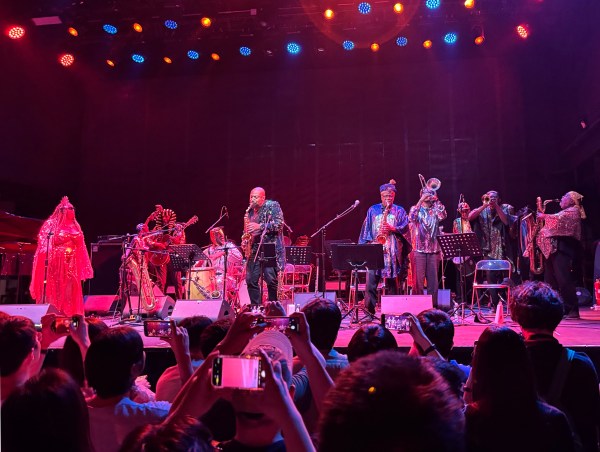
The Sun Ra Arkestra live in Beijing, September 2025

First explorations in Indian classical music

Two things happened this year to convince me to do some more intentional listening to Indian classical music, which I had long been aware of but had never really “got.” The first was the untimely death of Zakir Hussain, the beloved tabla virtuoso; he had been scheduled to play a concert near where I live and I thought I would finally take the opportunity to see him in person. Now I will never have one. The second, also unexpected, was an invitation to go to India for a conference, which would be my first time to visit. It seemed like a sign.

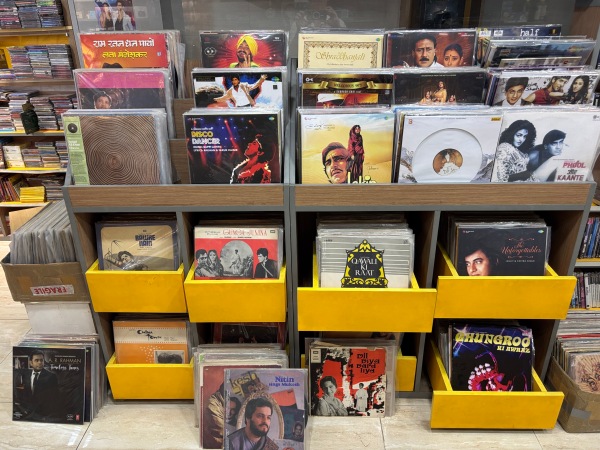
So, on a day off in Delhi, I paid a visit to Radio & Gramophone House–a 74-year-old record shop and one of the last remaining, Indians like everyone else having gone mostly to streaming. I asked them for an introduction to Indian classical music, instrumental not vocal, and the friendly gentlemen set me up with a bag of CDs to take home; I was only sad I could not carry some of the marvelous LPs they had. (If you’re in Delhi, please give them some business.)

The wares at Radio & Gramophone House in Delhi

Since then I’ve been working my way through that initial stack of CDs, supplemented by some other purchases and downloads and re-listening to things I already had but to which I had not paid proper attention. It’s been very worthwhile. If, like me, you appreciate the improvisational flights and rhythmic delights of jazz, then Indian classical music will not seem very foreign for long. The best bits are marvelous, without question. But it is a daunting edifice from the outside, and it is hard to know how to approach. Here are some of my initial thoughts on what is so great about Indian classical music, and how to get into it as a curious outsider.

You can think of music as having four axes of variation: melody, harmony, rhythm, orchestration. The structure of Indian classical music downplays two of these: there is no harmony, and the orchestration is minimal, with usually only one melody instruments and one or two accompanists. It’s all melody and rhythm, but these are intensely investigated. To the Western-trained ear, the lack of harmonic progression can make the structure of the music difficult to grasp, and is why people sometimes complain that it “all sounds the same.” It takes some repeated listening to hear what is there rather than what is not.

Another barrier is a more pratical one: most pieces of Indian classical music are long. Particularly in the northern, Hindustani style best represented on record, tracks rarely come in under twenty minutes, with full performances of a single raga easily reaching an hour or more. I like variety, so if I have an hour to listen to music I would usually prefer to listen to several different pieces rather than just one. Even for really great jazz players, I rarely want to listen to those forty or fifty minute jams. Improvisers can be prolix and reluctant to edit themselves, but for listeners shorter is usually better. For these reasons, I found some of the classic recordings from the LP era (mostly the 1960s) to be good places to start with Indian music. The constraints of the medium keeps the length of the pieces relatively contained, and that constraint is actually a benefit.

So if, to the Western ear, Indian classical music initially seems kind of long and boring, what is the attraction? It’s often marketed to Westerners as a kind of functional music for the spiritual lifestyle, accompaniment for meditation or whatever. The drones and the slow pace of the opening sections of the ragas contribute to this vibe, and it’s true you need a little patience to get started. But this is not what I’m after at all. The good stuff is actually quite exciting, with the interplay between the long melodic explorations and the intricate rhythms delivering some of the same joys that other improvised music does, while still being very much a distinct tradition.

The tabla. Percussion is really at the heart of Indian classical music, and while there are other percussion instruments, for now I’m still most in love with the sound of the tabla. Zakir Hussain is amazing and had a long and productive career; a reasonable algorithm for finding good recordings of Indian classical music is just to look for ones that he plays on. The Bandcamp page of his personal record label has a lot of good classical recordings, as well as many of his other efforts. (He also did a lot of fusion and cross-genre work, which I have not explored so much; honestly I haven’t loved what I’ve heard of Shakti, the band he was in with John McLaughlin).

His father, Alla Rakha, was also a tabla master and played on many classic recordings from the 1950s on; again, you could do worse than to just seek out recordings with his name on them. Both of them made solo tabla recordings, and even a few tabla duets together; I’ve sampled these but I think I’m not an advanced enough listener to really appreciate them, it’s not where I would start. Another major tabla player, recommended by the Radio & Gramophone House guys, is Shankar Ghosh.

The sitar. The chiming of the sitar’s multiple resonant strings is perhaps the most immediately identifiable sound of Indian classical music. It’s hard to avoid the sitar or Ravi Shankar in a survey of the recordings easily available outside India, and really there’s no reason to. I like his early Ragas & Talas LP, from 1959, and the other 1960s recordings are pretty good too. Other amazing sitar players are Nikhil Banerjee and Budhaditya Mukherjee, and it is easy to find lots of their work on streaming services.

The sarod. The best Ravi Shankar, however, might just be his collaborations with the sarodist Ali Akbar Khan, a towering figure in the music. Possibly the first example on record is this track from 1955, on a UNESCO compilation available through Smithsonian Folkways, but they kept playing together for decades. Their duets (known as jugalbandis) are some of the real high points of the genre; the call-and-response is delightful.

The sarod and sitar sound great together, but I discovered that I actually prefer the sarod: an instrument of the lute family, its sound is a bit deeper, more forceful and direct, highlighting the melody more. Ali Akbar Khan’s work is amazing and should be sought out; some other major sarodists are Sharan Rani, Amjad Ali Khan and Aashish Khan. Again, a wealth of marvelous material from all of them is available on streaming services. One individual recording I would highlight is the collaboration between Ali Akbar Khan and Nikhil Banerjee released on Khan’s own label as Signature Series Vol. 4; it’s widely recognized as a stone-cold classic.

Other instruments. The bansuri, the Indian side-blown bamboo flute, is another common lead instrument, but I don’t love it as much as the sarod. The most famous practitioner is Hariprasad Chaurasia, who is prolific and widely beloved. I quite enjoyed some of his recordings, but found others to be a bit soporific. The double-reed instruments, shehnai and nagaswaram, for me are hard to appreciate.

One of the interesting things about Indian classical music is how much innovation in instruments there has been: many Western instruments were adopted and modified by Indian musicians in the 20th century to play in the Indian classical style. For instance, there are now many violin players in the tradition, but I haven’t listened to them much yet so don’t have much to suggest. Bringing in new instruments has generally worked very well: modern instruments generally have more reliable tone, wider range, and better projection than traditional instruments–they are better as instruments.

One well-known figure is Vishwa Mohan Bhatt, who invented his own instrument, the mohan veena, a kind of cross between a guitar and the veena family of stringed instruments. He won a Grammy for his collaboration with the roots guitarist Ry Coorder; it’s a nice-sounding record but frankly his work in his own tradition is much better, and very rewarding. Again, there is lots on streaming.

Brij Bhushan Kabra, a student of Ali Akbar Khan, played a modified slide guitar, which sounds fantastic as an Indian classical instrument; I found a nice LP reissue of his 1982 record with Zakir Hussain. Kadri Gopalnath brought the alto saxophone into the southern, Carnatic tradition, and he is amazing too. Jazz listeners might be more interested, but really he sounds nothing at all like jazz. He has a unique sound but is not perhaps the best introductory listen for tuning your ears to the particular beauties of Indian classical music. For that I would go first to Ali Akbar Khan.

The best music I heard in 2024

My favorite listening experiences this year, both concerts and recordings, listed roughly in order of release date to highlight the newer material. A lot of the recent stuff is in my Bandcamp collection, feel free to browse.

  • The Messthetics and James Brandon Lewis, Live at the Clock-out Lounge (2024). I was lucky enough to catch this combo on the last night of their tour, when they were hot and fully in sync. The energy was extraordinary, drawing on both rock (Brendan Canty and Joe Lally are the best rock rhythm section since the Minutemen) and jazz. The same tunes are on their studio album, but for me it lacked the punch of the live show. I also very much enjoyed two other James Brandon Lewis albums with a more conventional jazz quartet., Transfiguration (2024) and Code of Being (2021).
  • Bill Frisell, Breaking the Shell (2024). Over the past decade or so, guitarist Frisell has collaborated with legendary drummer Andrew Cyrille on a series of recordings with shifting personnel but a shared aesthetic of atmospheric improvisation. This project combines them with pipe organist Kit Downes for a unique and spacious sound.
  • Exploding Star Orchestra, Live at the Adler Planetarium (2024). A suitably cosmic venue for Rob Mazurek’s mind-expanding big band. The lineup captured at this concert was particularly powerful, driven by two drummers and two keyboardists.
  • William Parker, Heart Trio (2024). On bass Parker is a peerless jazz virtuoso, but he periodically puts his main axe down to play an assortment of flutes and strings in a kind of non-specific world music style. This record documents his entrancing occasional trio with pianist Cooper-Moore, here playing homemade instruments, and drummer Hamid Drake.
  • Vinnie Sperrazza, Sunday (2024). A programmatic suite from drummer Sperrazza; the focus throughout is on the tunes, played with great sensitivity and clarity by his quartet Apocryphal.
  • Mary Halvorson, Cloudward (2024). Halvorson is without question the leading guitar player of her generation, but she may be even more talented as a writer for ensembles. My favorite records of hers are for larger groups, and this session by her new sextet is full of compact, complex arrangements that showcase all the players.
  • Wadada Leo Smith & Amina Claudine Myers, Central Park’s Mosaics of Reservoir, Lake, Paths and Gardens (2024). A marvelous, meditative session by two revered jazz elders–both are now in their 80s. It’s easy to call such a meeting historic, and it is, but the music is simply beautiful.
  • Hu Vibrational, Live at BRIC (2024). Adam Rudolph’s group, consisting of four percussionists and four harmony instruments, played one of the quietest and most fascinating concerts I’ve heard. Their recordings, though, seem to be a quite different vibe.
  • Tony Allen, Jazz is Dead 18 (2023). It’s a treat to have this posthumouly released session by the great Nigerian drummer, on the producer Adrian Younge’s Jazz Is Dead label. The music is in the same vein as, and stands up to, Allen’s late-career masterpieces The Source and Tribute to Art Blakey.
  • Ned Rothenbeg, Crossings Four (2023). An all-star quartet of New York players delivers a set of complex, moody pieces; Rothenberg’s bass clarinet is a standout.
  • Jason Adasiewicz, Roy’s World (2023). The Chicago jazz scene produced an unbelievable string of great music in the 2010s, and continues to do so today. This vibraphone-based quintet of local luminaries recalls classic Blue Note sessions while being absolutely fresh.
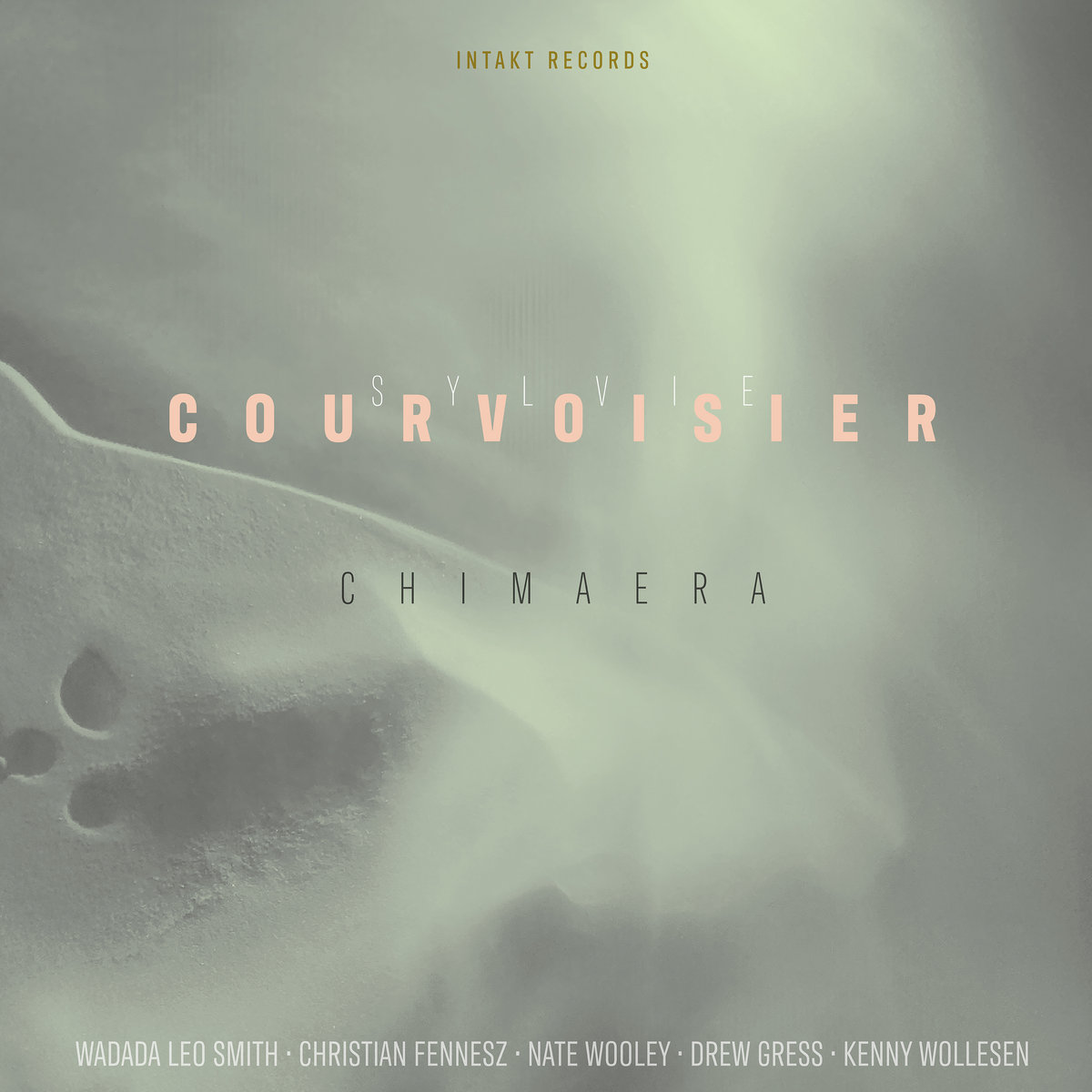
  • Sylvie Courvoisier – Chimaera (2023). Gorgeous, dreamy work from a band of top-flight improvisers. The music is a tribute to the unclassifiable French artist Odilon Redon, and it feels quite close to the floating clouds of color in his late works. Here’s a nice appreciation by Richard Williams.
  • Celestine Ukwu, No Condition Is Permanent (2022). A welcome reissue of one of the legendary recordings of Nigerian highlife from the 1970s. Veterans of the old music-blog scene will recall the great African music blog named after this record.
  • Ted Nash – Rauschenberg In Jazz: Nine Details (2022). An undeservedly obscure recording of a 2016 concert in Beijing. The American saxophonist worked with a group of China-based musicians to pull together a suite inspired by the concurrent exhibit of the work of Robert Rauschenberg; it’s exciting and unusual ensemble music.
  • Kirk Knuffke – Gravity Without Airs (2022). Moody, exploratory chamber music from an unusual trio. Knuffke’s cornet is alternately breathy and keening, and the great Matthew Shipp on piano and Michael Bisio on bass are constantly inventive.
  • Sonny Rollins, Complete Live at the Village Gate 1962 (2015). An important document: six hours of Rollins in a pianoless quartet with Don Cherry. The group is truly experimental, in the sense that the players are obviously working out their concept, and not all of it works. But a lot does, and the highs are very high.
  • Beno​î​t Delbecq, Ink (2015). Delbecq’s translation of the prepared piano into the jazz piano-trio tradition is fascinating and atmospheric.
  • Jemeel Moondoc, The Zookeeper’s House (2014). One of the last sessions by the largely unheralded saxophonist, a veteran of the 1970s loft-jazz scene; swinging and spiritual.
  • Darren Johnston, The Edge of the Forest (2009). Creative arrangements and great interplay from clarinet, trumpet, sax, bass and drums, almost like a modernist version of the old New Orleans three-horn frontline.
  • Keletigui et ses Tambourinis, The Syliphone Years (2009). The definitive collection of one of the great West African guitar bands: the long, looping lines are fantastic.
  • Bill Dixon, Modus Operandi (2007). The late, legendary avant-garde trumpeter made relatively few recordings, so every one is precious. This little-known session with a Canadian bassist and reed player is not in most discographies.
  • Greg Osby, Public (2004). A punchy, inventive live recording, one of a string of great records Osby made in the late 1990s and early 2000s. His The Invisible Hand, with Andrew Hill, is a modern classic, but I’ve found almost everything from this period is very worthwhile.
  • Mood – Doom (1997). A one-off masterpiece of atmospheric production and headnodding beats from hip-hop’s golden age.

Previous lists: 2023 | 2022 | 2021 | 2020 | 2019 | 2018 | 2017 | 2016 | 2015 | 2014

The Messthetics and James Brandon Lewis, At the Clock-out Lounge, September 14, 2024

What I’ve been listening to lately

A lot of stuff went onto my playlist late in 2023 that I didn’t have time to digest until recently; many of these could have made my best of the year list.

  • Sylvie Courvoisier – Chimaera. Gorgeous, dreamy work from a band of top-flight improvisers. The music is a tribute to the unclassifiable French artist Odilon Redon; by pure coincidence I also encountered Redon’s work for the first time last year, just before hearing this album, in a visit to the Musée d’Orsay in Paris. In fact the soundworld here feels quite close to the floating clouds of color in the selection of Redon’s late works that were on display then. Here’s a nice appreciation by Richard Williams.
  • Kirk Knuffke – Gravity Without Airs. Moody, mysterious and exploratory chamber music from an unusual trio. Knuffke’s cornet is alternately breathy and keening, and the great Matthew Shipp on piano and Michael Bisio on bass are constantly inventive.
  • Dave Easley – Ballads. More interpretations of the jazz songbook from the Louisiana-based genius of the pedal-steel guitar. The faithful cover of a Sonny Sharrock tune fits comfortably amid the tributes to Ellington and Ornette; it all sounds great.
  • Duke Ellington – The Complete Ellington Indigos. These atmospheric mood pieces were Duke’s particular genius. Aside from the obligatory take on Mood Indigo, most of this 1957 album collection is, unusually for Duke, reinterpretations of jazz standards.
  • Miles Davis – In Concert At The Olympia, Paris 1957. A new release of a historic concert with a local group featuring the great French tenor player Barney Wilen. The show was just days before Miles went on to record his legendary soundtrack album, Ascenseur Pour L’Echafaud. 1957 was a good year!
  • Ted Nash – Rauschenberg In Jazz: Nine Details. An undeservedly obscure recording of a 2016 concert in Beijing. The American saxophonist worked with a group of China-based musicians to pull together a suite inspired by the concurrent exhibit of the work of Robert Rauschenberg; it’s exciting and unusual ensemble music.

The best music I heard in 2023

The best of the music I listened to for the first time this year, listed in order of release date. Overall a pretty amazing year for music, both in new releases and older discoveries.

  • Exploding Star Orchestra – Lightning Dreamers (2023). Rob Mazurek’s big band has been exploring the outer reaches of jazz, composition and spacey grooves for almost two decades now, creating an extraordinary body of work. The new album is great, pushing further into new territory with a more focused and studio-oriented approach.
  • Natural Information Society – Since Time Is Gravity (2023). Joshua Abrams’ minimalism-jazz-trance-world ensemble has created one of the most distinctive sounds in contemporary music. A new record from them is a major event, at least in my musical world, and this one, featuring Chicago tenor legend Ari Brown, is awesome.
  • Buddy Guy – Damn Right Farewell Tour (2023). At the age of 87, Guy delivered one of the most memorable concerts I’ve ever seen: a seamless stream of storytelling, blues history and impossibly noisy guitar. It was simultaneously avant-garde and traditional in a way I can only compare to the Sun Ra Arkestra, who I had just seen two weeks prior.
  • James Brandon Lewis – For Mahalia, With Love (2023). The energetic young saxophonist delivers a perfectly judged synthesis of old and new: the simple, powerful gospel themes make for compelling improvisations from his modernist group.
  • Tyshawn Sorey – The Off-Off Broadway Guide to Synergism (2022). An epic live recording from drummer-composer Sorey’s piano trio, along with jazz elder Greg Osby, playing extended takes on standards and modern jazz classics. Absolutely fresh and in the moment.
  • Jeff Parker – Mondays At The Enfield Tennis Academy (2022). Long, pulsing pieces that are exploratory without ever letting go of the beat. A similar vibe from a similar group, also featuring guitarist Parker and bassist Anna Butterss, is on this year’s record by Daniel Villareal, Lados B.
  • Nina Simone – The Montreux Years (2021). The centerpiece of this reissue package is a complete 1968 concert by Nina at the height of her powers; better than any best-of compilation, it shows just how her unmatched voice forged a singular style from diverse material.
  • Marc Ribot – Plays Solo Guitar Works of Frantz Casseus (2021). The self-described noise guitarist plays these classical guitar pieces straight, in support of his teacher Casseus’ ambition to make a distinctive Haitian contribution to the repertoire. They are lovely, rhythmic miniatures.
  • Kuniko Kato – J.S. Bach: Solo Works For Marimba (2017). I love Bach, and I love the marimba, so I thought I would probably like Bach played on marimba. I was right! An absolutely gorgeous sound.
  • Fretwork – Purcell: The Complete Fantazias (2009). Marvelous Baroque counterpoint played by an all-viol ensemble. I know little of Purcell, but the comparisons of this long-neglected chamber music, from 1680, to some of Bach’s abstract masterpieces seem apt to me.
  • Darondo – Let My People Go (2006). A compilation of obscure but wonderfully soulful early 70s funk, from a mysterious figure who recorded little and later vanished from view. He gets close to the exalted level of Al Green, or Sly Stone’s solo records.
  • The Temptations – Psychedelic Soul (2003). A great overview of the male vocal group’s 1968-1973 collaborations with Barnett Strong and Norman Whitfield: extraordinarily creative and sublimely funky.
  • Augustus Pablo – El Rockers (2000). Pablo was given top billing on what is generally considered the single best dub reggae album, King Tubbys Meets Rockers Uptown. This is one of two excellent compilations of more spaced-out instrumentals from that period; the other is the earlier In Fine Style.
  • Joe Lovano – Trio Fascination (1998). A late-period classic of the sax-bass-drums trio, featuring jazz elders Dave Holland on bass and Elvin Jones on drums. The follow-up Flights of Fancy, with an assortment of different trios, is also worthwhile.
  • King Sunny Adé – Synchro System/Aura (1984). These two albums, re-released together, can be seen as the final installment of a trilogy of masterpieces of Nigerian juju, after the early compilation The Best Of The Classic Years and the crossover hit Juju Music. For me, they’re all essential.
  • Old And New Dreams – Old And New Dreams (1979). In an apparent bid to confuse future search technology, the group Old And New Dreams, made of Ornette Coleman’s old bandmates, recorded not one but two albums called Old And New Dreams. Both are great but I had previously missed this one, on ECM, in the confusion; it has what is perhaps the definitive version of Coleman’s “Lonely Woman.”
  • Tony Allen – No Discrimination (1979). After working with Fela Kuti to create the Afrobeat sound, drummer extraordinaire Tony Allen went his own way toward the end of the 1970s, recording a series of solo albums; this is my favorite of the bunch.
  • Stanley Turrentine – Dearly Beloved (1961). A certified soul-jazz classic. The big-toned tenor player recorded this album not long after his marriage to organist Shirley Scott, and they are definitely in sync here.

Previous lists: 2022 | 2021 | 2020 | 2019 | 2018 | 2017 | 2016 | 2015 | 2014

DALL-E prompted with the names of the artists in this list

What I’ve been listening to lately

  • François Houle – In Memoriam. On this new release, the Canadian clarinetist leads a multinational sextet through beautifully arranged pieces. The New Orleans-style front line of clarinet, trumpet, trombone is unusual these days, but perfectly suits the alternately elegiac and rousing tone. Consistently excellent.
  • Duke Ellington – Happy Reunion. An undeservedly obscure piece of Ellingtonia: two sessions recorded in Chicago over 1957-58 when Duke was passing through, with different subgroups of the full orchestra. The small-group playing here is relaxed and beautiful, and the sound more open and spacious; it’s too bad there’s only just over half an hour of material. The CD is out of print but not hard to find (I got mine for $1 from the clearance bin at Amoeba Records.)
  • Joe Lovano – Trio Fascination. The prolific saxophonist Lovano has tacked between more traditional and more avant-garde styles throughout his career. For me this 1998 album, with jazz elders Dave Holland on bass and Elvin Jones on drums, sits at a very pleasing point on that spectrum: it’s intimate and melodic but also forceful and varied.
  • Augustus Pablo – El Rockers. Pablo was given top billing on what is generally considered the best single dub reggae album, King Tubbys Meets Rockers Uptown, though like most dub it was really a group effort. If you want more of those wondrous spaced-out dub instrumentals, the reissue label Pressure Sounds has put together two compilations of Pablo material from the same period, this one and the earlier In Fine Style. Both are absolutely top-notch.
  • Natural Information Society – Since Time Is Gravity. A new record from Joshua Abrams’ minimalism-jazz-trance-world ensemble is always an event; the group has created one of the most distinctive sound worlds in contemporary music. Their latest brings in Chicago saxophone legend Ari Brown and some other ringers to fill out the large and ever-shifting ensemble. The choir of horns creates an even richer mass of shifting sounds, always solidly anchored by Abrams’ guimbri (a North African bass lute). Enchanting.

What I’ve been listening to lately

  • Natural Information Society – descension (Out of our Constrictions). Joshua Abrams’ minimalism/trance/jazz outfit is one of my favorite current groups, and I’m still catching up to everything they’ve put out. This is a recent live recording, with Evan Parker sitting in. The sonic combination of Parker’s soprano sax and Jason Stein’s bass clarinet is naturally reminiscent of the great Coltrane/Dolphy band, but this group is more about interplay and rhythm than expansive individual solos.
  • James Brown – The Payback. This 1973 album features more laid-back, hypnotic grooves than I’m used to hearing from James Brown. My all-time favorites are probably still the relentlessly catchy and more uptempo numbers on the compilations In The Jungle Groove and Motherlode, but I was pleased to put these tracks into the mix too.
  • Greg Osby – Inner Circle. Osby was responsible for one of the best turn-of-the-century jazz albums, The Invisible Hand, on which he enlisted jazz elders Andrew Hill and Jim Hall. Recorded around the same time but with a band of all younger players, this album is also excellent. With its complex tunes and Stefon Harris’ vibes opening up the sound, the session feels like a fresh update of some of the modernist Blue Note releases of the 1960s.
  • Ella Fitzgerald – Sings The Duke Ellington Songbook. I feel like I’m committing heresy when I confess I don’t really love Ella’s string of songbook albums that much: the orchestrations are mostly just too stiff and middlebrow for me. The Ellington songbook album, though, is a revelation: it’s the Duke himself and the band backing her up, and you can’t get jazzier than that. A true classic.
  • Darondo – Let My People Go. I was pretty surprised to hear some of these totally unknown yet wonderfully soulful funk tracks come across the stereo in the bar downstairs from my office in Beijing. Darondo was a mysterious figure who recorded little and subsequently vanished from view, which is too bad: he gets close to the exalted level of Al Green, or Sly Stone’s solo records.

What I’ve been listening to lately

  • Duke Ellington – Happy Birthday Duke! April 29th Birthday Sessions. A treasure trove of live Ellington, five hours of music from concerts in 1953 and 1954. The early 1950s are usually considered somewhat fallow years for Ellington, between the creative peaks in the 1940s and 1960s. But these are actually great shows, the sound quality is good and the soloists really get to stretch out.
  • Qasim Naqvi – Two Centuries. Naqvi is a Palestinian-American composer and drummer, here mostly playing synthesizer in a collaboration with two true jazz elders, Wadada Leo Smith and Andrew Cyrille. It’s beautiful, spacious music, one of the finer examples of melding electronics with jazz improvisation. There’s a nice write-up in The Washington Post.
  • Stanley Turrentine – Dearly Beloved. The big-toned tenor player recorded this album in 1961, not long after his marriage to organist Shirley Scott, and they are definitely in sync here. After having listened to a run of Turrentine’s 1960s Blue Note recordings, this is my favorite of the bunch, a certified soul jazz classic.
  • Walt Dickerson & Richard Davis – Divine Gemini and Tenderness. Walt Dickerson was an early star on vibes in the 1960s, making some well-regarded albums and collaborating with Sun Ra, before retreating from public view. In the 1970s he returned to recording, making a series of sessions with mostly minimal accompaniment: solos, duos, trios. These two duet sessions with the great bassist Richard Davis have a wonderful late-night avant feel.
  • A 90s hip-hop miscellany. Like many white college kids of my generation, I was turned on to hip-hop in the early 90s. But there was such a wealth of music released during that golden age that I missed a lot of it the first time around, and lately I’ve been trying to finally catch up. Some finds: Main Source’s first album, Breaking Atoms, is recognized as a classic, but their second album, F*** What You Think, is also pretty hot. Big L’s only album before his untimely demise, Lifestylez Ov Da Poor & Dangerous has forceful rhymes over spacious beats from the DITC crew. Cypress Hill’s second album Black Sunday was a ubiquitous stoner classic, but turns out their first album, Cypress Hill, also has a great vibe. The Pharcyde’s Bizarre Ride II The Pharcyde and Outkast’s Southernplayalisticadillacmuzik were hits when they came out and are in fact full of undeniable headnod material.

What I’ve been listening to lately

  • Marc Ribot – Plays Solo Guitar Works of Frantz Casseus. Ribot wrote movingly about Casseus, a family friend and his first guitar teacher, in his quasi-memoir Unstrung. The self-described noise guitarist plays these pieces straight, in support of Casseus’ ambition to make a distinctive Haitian contribution to the classical guitar repertoire. They are lovely, rhythmic miniatures.
  • The Temptations – Psychedelic Soul. Obituaries are a sad way to discover new music. In this case Richard Williams’ appreciation of Barrett Strong, who passed in January, led me to the 1968-1972 era of The Temptations and their collaborations with Strong and Norman Whitfield. This work is both extraordinarily creative and sublimely funky; everyone knows “Papa Was A Rolling Stone” but there is so much more great stuff on this collection.
  • Tyshawn Sorey – The Off-Off Broadway Guide to Synergism. This epic live recording topped many best-of-2022 lists, and deservedly so. Drummer Sorey here takes off his avant-composer hat to back his piano trio, and invites elder Greg Osby along for the ride to play standards and modern jazz classics. It’s all absolutely fresh and in the moment.
  • New Kingdom – Paradise Don’t Come Cheap. The golden age of hip-hop in the early 90s was a historic flowering of a new art form: a hundred flowers bloomed, though not all of them lasted. The unique sound of this album had few precedents (their previous album was pretty weak and inconsistent), and was not followed up. But the growled, hallucinatory lyrics atop echoey, bluesy beats still sound intense and compelling.
  • Muhal Richard Abrams – The Hearinga Suite. A sterling example of modern big band music, complex and interesting but not nearly as forbidding as some of Abrams’ earlier, more avant-garde excursions. Abrams deploys the full power of the massed ensemble sparingly, mostly preferring to string together different smaller combinations of instruments. The 1980s-vintage synthesizers now sound a bit dated, but otherwise this music is still remarkably cliché-free.

The best music I heard in 2022

All this music was new to me this year, if not necessarily to the rest of the world. I’ve listed my favorites by release date to highlight the more recent ones:

  • Sun Ra Arkestra – The Living Sky (2022). The latest release by the posthumous Arkestra is one of the gentlest and most purely beautiful albums in the Sun Ra canon. Even Marshall Allen’s squealing alto playing, which never seems to land straight on a note, fits into the mellow grooves. 2022 also saw new reissues of two of the best Sun Ra albums from the 1970s, Omniverse and Universe in Blue.
  • Steven Lugerner – It Takes One To Know One (2022). A charming trio recording — bass clarinet, bass, drums — in which two younger musicians enlist jazz elder Albert Heath to deliver fresh interpretations of modern jazz tunes.
  • Matthew Shipp Quartet with Jason Hao Kwang – Vision Festival Wednesday June 22 (2022). Now that I’ve started going to concerts again, I’m including live music in this list. This was without doubt the best performance I saw this year — a stunning hour-long improvisation driven by Shipp’s powerfully thematic piano and extraordinary sounds from Kwang’s violin and viola. The performance is archived online but honestly I haven’t dared listen to it again for fear the initial impact would be lost.
  • Dave Easley – Byways of the Moon (2021). Fellow practitioner Susan Alcorn has called the pedal steel guitar “the last musical instrument borne of the mechanical age,” and Easley’s recital shows how its potential in a jazz context has still been barely tapped.
  • Bill Frisell – Valentine (2020). Frisell’s stripped-down guitar trio, with long-time partners Thomas Morgan on bass and Rudy Royston on drums, is marvelously responsive and delivers a distinctive and very personal sound. I saw this group in concert this year and their interplay had advanced even beyond where it was on this excellent record.
  • Lucky Thompson – Complete Parisian Small Group Sessions 1956-1959 (2017). Thompson had one of the most beautiful tones on tenor saxophone of any jazz player, but never got recorded as much as he deserved. This collection of sessions from his sojourn in France is just classic jazz.
  • Jason Roebke – Cinema Spiral (2016). Bassist Roebke leads an octet of top-notch players from the Chicago scene through pleasingly complex tunes. To me the vibe was reminiscent in the best way of the more avant-garde Blue Note recordings of the 1960s.
  • William Parker – O’Neal’s Porch (2002). An incredible record that reworks the “freebop” of Ornette Coleman’s quartet (sax, trumpet, bass, drums) with a radically different and funkier rhythmic approach (this 20th anniversary appreciation has good context). I also enjoyed this year’s Universal Tonality, a release of some of Parker’s large-ensemble recordings from the same period; it’s less consistent but the high points are very high.
  • Ornette Coleman – Sound Museum: Hidden Man (1996). Coleman famously blew up traditional jazz ensembles with his pianoless quartets of the 1960s, so it’s surprising and pleasing to hear just how good he sounds here with the “standard” backing of piano, bass, drums.
  • Julius Hemphill – Fat Man and the Hard Blues (1991). Composer and alto saxophonist Hemphill is generally acknowledged as the guiding spirit behind the World Saxophone Quartet, one of the essential groups of the 1980s. After leaving the WSQ he started recording with an all-saxophone sextet which, for me, is even better.
  • Scientist – Meets The Space Invaders, Heavyweight Dub Champion, Rids The World Of The Evil Curse Of The Vampires, Encounters Pac Man, Wins The World Cup, Big Showdown At King Tubby’s, Dub Landing, Dub Landing Vol. 2 (1980-82). This run of albums on the Greensleeves label was perhaps the last gasp of classic dub reggae before electronics changed its sound forever. I listened to them all this year and there’s not much to choose among them: every one is killer (perhaps the albums with sports metaphors slightly edge the video-game-themed ones). Starting in 2016, these were reissued, for unclear reasons, under the names of other musicians, but the Scientist sound is consistent.
  • Art Pepper – Winter Moon (1981). I’d always heard this was a good record but didn’t quite believe that jazz-with-strings could escape boring middlebrow tastelessness. Once I listened to it I had to admit it’s wonderful, with some of Pepper’s most gorgeous ballad playing.
  • Marvin Gaye – Here, My Dear (1978). Much of what has been written about this classic album focuses on the lyrics rather than the music; Gaye was going through a divorce at the time. It’s not the subject matter that makes it great, though, but the music, a novel soundscape of complex, subtle funk. Stanley Crouch wrote a fascinating essay in 1979 on how it cut across boundaries of jazz and funk in new ways.
  • Enrico Rava – Enrico Rava Quartet (1978). This session pairs Rava’s lyrical trumpet playing with the earthier style of the legendary trombonist Roswell Rudd; the tunes are lovely and the interplay is top-notch. Reportedly Rava’s favorite of his own albums.
  • Burning Spear – Man in the Hills (1976), Dry & Heavy (1977). In preparation for seeing Burning Spear in concert this year, I filled in some of the gaps in my previous listening. His run of albums in the 1970s was just great, with horn ensembles that make for a deeper, more complex reggae sound. And he still puts on a great show at age 77.
  • Pepper Adams – Plays The Compositions of Charlie Mingus (1963). One of the first and best Mingus tribute albums, recorded with input from the composer himself. Adams’ powerful baritone works wonderfully as the lead voice.
  • Sonny Stitt – Sonny Stitt / Bud Powell / J.J. Johnson (1957). It’s easy to overlook all those unhelpfully titled jazz jam session records from the 1950s, but don’t skip this one: it’s pure, fierce bebop, recorded when the style was still fresh. Thanks to Ethan Iverson for the tip.

Previous lists: 2021 | 2020 | 2019 | 2018 | 2017 | 2016 | 2015 | 2014