
Holiday reading recommendations, Chinese New Year edition

I’ve been thinking over things I have read and things I want to read, as I’m about to head off for a long break over the Chinese New Year. Here’s some of the better books I have read since my last list in December 2014:

  • The Book of Strange New Things, by Michel Faber. Indeed a very strange novel. It would have to be categorized under “science fiction,” since it’s about a missionary going to an alien planet, but it avoids almost all the standard tricks, tropes and strategies of genre sci-fi. I found it consistently interesting since the story keeps not doing what you expect. This is not exactly the same thing as liking the book. Worth reading although ultimately a mixed bag.
  • How Adam Smith Can Change Your Life, by Russ Roberts. Highly praised by Tyler Cowen, this is indeed an excellent book, written in a very clear style and with a charming personal voice. It does not quite make up for not taking that course on Adam Smith back in college (I did Max Weber instead, hard call) but I learned a lot from it.
  • The Narrow Road to the Deep North, by Richard Flanagan. I have long had a morbid fascination with books about prisons (including prisoners-of-war), so when this won the Booker last year I knew I had to read it. The core of the book are the scenes in the Japanese internment camp, which are just unbelievably wrenching. I could not stop reading, but I cannot say I enjoyed it; if you are not in the mood for staring death and meaninglessness in the face you will find it hard going. The writing is generally fantastic, but the book as a whole does not quite achieve greatness in my view; the attempt to write some scenes from the Japanese officers’ point of view was admirable, but these did not work as well for me.
  • The Pioneer Detectives, by Konstantin Kakaes. One of the best up-close-and-personal accounts I have read of how the work of science actually happens. I particularly liked it because the focus is not some epoch-making discovery, but on the slow grind of gathering data and falsifying hypotheses (an underrated part of the scientific process). It’s a shortish ebook rather than a full-length nonfiction chronicle.
  • Annihilation, Authority and Acceptance, by Jeff VanderMeer (aka the Southern Reach Trilogy). Stunning and truly unique works of imagination. I read these in quick succession these over a period when I was having a lot of insomnia, which I think only accentuated the hallucinatory feel that pervades the books (and possibly meant that I was getting close to the author’s state of mind while he was writing them, according to this fascinating account). The close and personal attention to the landscape, which is unnamed but clearly the coast of the Florida panhandle, also resonated with me, since I have spent time there.
  • The Martian, by Andy Weir and The Just City, by Jo Walton. More normal and more fun sci-fi than the two more unsettling works listed above. I am probably one of the last people to catch on to the phenomenon of The Martian, so I have little to add to what you could read elsewhere; great problem-solving fun. I loved Jo Walton’s Among Others for its charming voice; her latest is a bit overly similar (female first-person narrator + kids at boarding school) and probably not quite as good for that reason, but still enjoyable, and with lots of Socratic dialogue as a bonus.

It tempts fate a bit too much to promise publicly that I’m going to read any particular book over vacation, but one thing in my pile is James Millward’s Eurasian Crossroads: A History of Xinjiang, which was highly recommended by a friend.
Can a closed internet be good industrial policy?

The latest round in the seemingly inexorable tightening of restrictions on internet use in China has gotten a lot of press coverage. And indeed, the mass of mechanisms blocking internet users in China from many major global sites and services, collectively known as the “Great Firewall,” hits people like me and foreign journalists hard, since we are physically located in China but have to stay linked to the outside world for professional reasons. It’s a terrible situation that keeps getting worse. While I could complain more about this, I’d rather try to think through some of the questions it raises. The spark for this is some recent Chinese statements justifying the internet controls, not for the usual political and moral reasons, but for economic ones–that they helped create China’s very large and successful internet companies.

The idea that Chinese internet companies are only successful because they can hide behind trade barriers is a pretty common view among foreigners here: how could a Chinese search engine out-compete Google if Google was not blocked? But most of my friends who work in the Chinese internet industry have always dismissed this line as uninformed, biased Western propaganda. They tend to say that the big American internet companies lost the China market because of their own mistakes. I’m a lot more sympathetic to this view than I used to be; my company has published detailed profiles of Alibaba and Tencent (sorry, subscribers only), and their history definitely supports the idea that these firms are successful because they came up with unique services that worked very well in China. People who don’t understand those companies, in my experience, consistently under-estimate how much business-model innovation they have done; in fact Alibaba and Tencent do not do at all the same thing as Google/Facebook/whoever. So it’s funny to see some quasi-official voices now coming out to say, in essence, those critics were right and in fact our internet companies do depend on market barriers erected by government policy.

Here are the two sources for this. Wen Ku, an official at the Ministry of Industry and Information Technology, had to answer a question at a press conference about the tightening of internet restrictions, and came pretty close to saying that can be justified because of how they help domestic companies (my translation):

In China, the Internet sector has developed very well, some good companies have growth rates of around 40-50%. Everyone can see Alibaba’s achievement in getting listed in the US. All of this comes from the Chinese government ensuring there is a good policy environment for the development of internet companies. Internet development in China must be in accord with China’s laws and regulations, and any unhealthy information should be managed according to Chinese laws.

In case those bureaucratic circumlocutions did not get the point across, the Global Times newspaper, a reliable purveyor of nationalist screeds, then made the claim much more directly in an editorial (again, my translation from the Chinese):

China’s Great Firewall is in fact a success, it has created the reality of China’s internet development today. China has produced network giants like BAT (Baidu-Alibaba-Tencent), they fulfill the vast majority of Chinese internet users’ needs, and are even expanding abroad. This is possibly an unintended consequence of the Great Firewall. If there was not this kind of management, then China today would perhaps be dominated by “Google China”, “Yahoo China” and “Facebook China”.

So here’s the big question: are these folks right? Is blocking global internet companies from offering all their services in China actually a good industrial policy, that is justified because it helps foster Chinese internet companies? And would this in turn mean that the Great Firewall, paradoxically, allows for more innovation and competition in the internet globally, because it is not dominated by an American oligopoly? I think this worth actually thinking about rather than dismissing out of hand. As much as I would like to be able to use my Gmail more easily, it’s not obviously the case that everyone in China would be better off if there was in fact no big domestic internet sector and everyone just used Google.

In essence the argument seems to be one for import-substituting industrial policies; by blocking the import of various internet services, China can create domestic companies and jobs that otherwise would not exist. Yet I do not think this argument is correct, and the reasons go back to the same ones that led import substitution policies to often fail in other industries and other countries. As my old colleague Joe Studwell showed very clearly in his book How Asia Works, the industrial policies that have been successful in Asia have in fact not been about blocking imports; instead, they encourage exports.

Blocking imports typically does not do much to encourage domestic companies to raise their game and improve technology. Particularly in lower-income countries, domestic markets are often small and underdeveloped, and are easily dominated by local tycoons or oligopolies that can turn policy and regulators to their advantage. Rather than increasing competition, import substitution reduces it, and lowers the incentive for domestic companies to meet or match the global technological level–they don’t have to, because they a captive market. So instead of giving domestic companies a free ride, good industrial policies force them to go out and compete in the global marketplace, where they can’t survive solely on the favoritism of regulators and have to adapt and innovate.

This is not to say that some Chinese internet companies do not prosper because of the government’s barriers; there is a whole sub-industry of companies offering local equivalents of global internet services. But it would be a mistake for the Chinese government to think that because they have both 1) some large successful internet companies, and 2) the Great Firewall, that having more of 2) means they will also get more of 1). The history and logic of industrial policy suggests they will not. A better course, again based on parallels with industrial policy for other sectors, might be to reward internet companies that are successful in selling their services outside of China. Though there is probably not much actual need for the government to do this, given the enormous slums sloshing around in venture-capital funds looking for the next big thing in the Chinese internet.

Ultimately, though, I doubt economic or industrial-policy motivations are really behind the policy of restricting access to the global internet, so I wouldn’t expect these criticisms (even when articulated by someone more influential than me) to have much effect. The politics are much more important.

Why is Justin Lin still obsessed with 8% growth?

Justin Yifu Lin, the former chief economist of the World Bank, has a piece out on Project Syndicate giving a fairly rosy outlook for China’s future growth. Basically, he thinks China can still grow at 8%, but the government is going to be prudent and conservative and set its growth targets a bit lower. This should be no surprise to anyone who has been paying attention to his public statements over the years: ten years ago he thought China had very high growth potential, and he still thinks that today.

Now Justin is perhaps the best-known Chinese economist in the world, and I am not, but I found his piece troubling in a couple of respects. It’s odd that he expresses so much certainty about a topic–future growth rates–about which there really is not a lot of certainty. What is odder is that Justin seems to be even more certain about future growth than the Chinese government, which has not officially aimed for 8% growth since 2012. I think this focus on delivering a positive message about growth prospects means that his piece ends up not being a particularly good guide to the current economic debates within China, as I’ll try to explain.

So how can we be so sure that China can grow at 8%? Here is Justin’s explanation, which is based on ideas about convergence and catch-up growth:

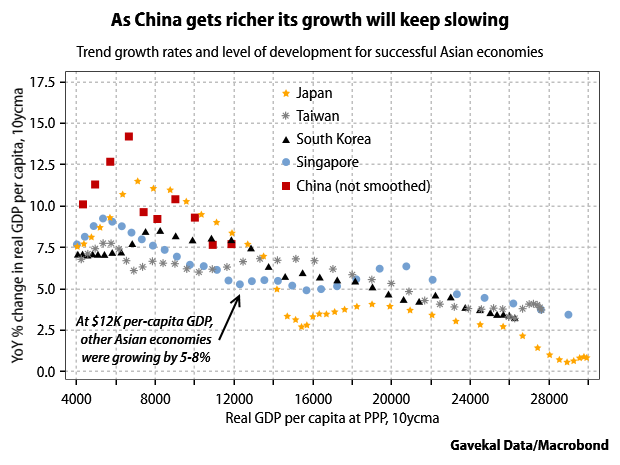
In 2008, China’s per capita income was just over one-fifth that of the United States. This gap is roughly equal to the gap between the US and Japan in 1951, after which Japan grew at an average annual rate of 9.2% for the next 20 years, or between the US and South Korea in 1977, after which South Korea grew at 7.6% per year for two decades. Singapore in 1967 and Taiwan in 1975 had similar gaps – followed by similar growth rates. By extension, in the 20 years after 2008, China should have a potential growth rate of roughly 8%.

That is not the only plausible interpretation of the historical evidence, but it is certainly a possible one (I have previously written about research that supports a different and less optimistic interpretation.) My own view is that the track record of other successfully industrializing Asian countries implies that China’s potential growth in per-capita GDP is more likely to be in the 5-7% range for the next several years (see the chart below for the visual evidence). These historical patterns are not iron laws of development, of course, but they are helpful given that there is no particularly good way of estimating a potential growth rate for a rapidly-changing economy like China’s. But the limitations of this technique are obvious, since it is based purely on comparisons of the level of per-capita income and ignores all other factors, including the possibility that China does not end up following the same development trajectory as Korea, Taiwan, etc. The point is that this historical evidence certainly not enough to rule out the possibility that China’s future potential growth is less than 8%, even before we consider all the other factors that could be at play.

Asia-growth-potential

The more interesting part of the argument is that Justin supports government growth targets that are below 8%, both last year’s 7.5% and presumably the widely-expected downshift to a 7% target for 2015. (He doesn’t even address the debate about whether government growth targets are a good idea in the first place, which is rather amazing in itself, but let’s leave that to the side for now.) This is a bit confusing: Why should the government deliberately try to run the economy below its capacity, thereby generating less employment and slower income growth than could otherwise be achieved, without the cost of higher inflation? Here’s his answer:

The US, Europe, and Japan are likely to experience continued sluggish performance, inhibiting China’s export growth. As a result, Chinese growth is likely to fall below its potential of 8% a year. As policymakers plan for the next five years, they should set China’s growth targets at 7-7.5%, adjusting them within that range as changes in the international climate dictate.

In other words, he thinks potential growth based purely on domestic conditions should be 8%, but once you take into account weak global demand, potential growth is actually a bit lower. Now it is certainly true that if demand for China’s exports is weak, then China’s growth will be slower than it would be otherwise. But it’s a bit convenient that the only factor he admits that might possibly be a drag on China’s potential growth rate is the poor management of other economies. There are of course plenty of other things going on inside China that could be a drag on future growth–like the end of a decade-long housing boom that is sapping investment growth, or a high debt level that makes it more difficult to run expansionary policies in the future.

Once you recognize that there are in fact big changes happening in China’s domestic economy, another explanation for why slower growth is desirable becomes much more convincing (at least to me). That is the need to encourage structural change. The current structure of China’s economy is not the structure that it will need in the future, mainly because of the end of the housing boom: all the indications are that future demand for housing, and associated goods like construction materials, will be lower in the future than it is today. So to run the economy at full capacity today would mean reinforcing the current industrial structure. But really, government policy should be trying to enable a shift toward the future industrial structure. To put it differently, to run the the economy at full capacity today, given the enormous existing capacity for building housing and supplying the needed materials, would mean stimulating an artificially high level of housing demand. Therefore to allow the economy to run somewhat below capacity is the right decision, because this does not send false signals about future demand to investors in housing and the makers of construction materials.

I think this is in fact the government’s actual justification for targeting lower growth. While decoding Chinese government jargon is not the easiest task, current official statements clearly recognize that there is excess capacity, and that the solution is to change the industrial structure, not stimulate demand. If you squint you can see that argument implied in these lines from the communique of the Central Economic Work Conference in December (my translation):

Currently the supply capacity of traditional industries is far in excess of demand, so the industrial structure must be optimized and upgraded. … The marginal effect of overall stimulus policies is clearly decreasing. We need to deal with excess capacity, and also explore the future direction of industrial development through market mechanisms.