
The Manchurian Recession

Coming back from my own trip out to the provinces, I find that Simon Denyer of the Washington Post has an excellent report on the economic problems of China’s northeast. As is becoming increasingly clear, if you want to find China’s recession, the northeast is the place to look. And you don’t have to look very hard: in the first half of 2015, nominal GDP growth in both Liaoning and Heilongjiang provinces was negative (Jilin managed a meagre 4.4% gain).

The three provinces that comprise most of historic Manchuria are more dependent on heavy industry and more dominated by state-owned enterprises than the rest of the country. So they are extremely vulnerable to the current downturn, whose main feature is stagnant or declining demand for many of the products, like steel, that are made by state-owned heavy industrial companies. The northeast is not the only part of China effectively in recession: coal-mining provinces like Inner Mongolia and Shanxi are suffering, as is Hebei, the nation’s largest steel producer. But these northern and northeastern provinces are at the center of China’s current problems, as is quite clear from the data:
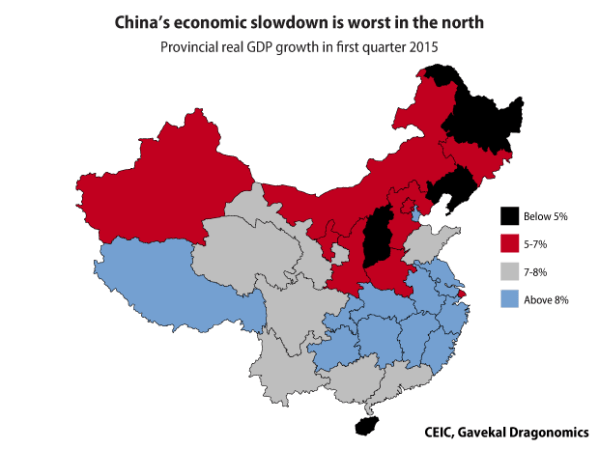
2015Q1-provincial-GDP-tradmap

Simon’s piece has a couple of choice observations that encapsulate some of the problems the northeast is facing. Here is one:

“Everyone knows what the problem is. It is structural,” said an official dealing with economic policy in the Liaoning government who spoke on the condition of anonymity because he was not authorized to talk to the press.

“Everybody knows what to do. You need to change the economic structure. But what concrete steps to take? Nobody knows,” he said. “What can we do? Financial sector? You can’t compete with cities like Shanghai. High-tech industries? Those won’t flourish overnight.”

and another:

Zhou Dewen, who runs a business association in Wenzhou, scouts out investment possibilities throughout China. He has led 20 small-business delegations to the northeast, but he has not been able to work up much enthusiasm for the region.

“The northeast still thinks of itself as the big brother, because they were the first to get rich after the new China was founded,” he said. “They are sitting on their glories and not advancing with time. Their mind-set is still the old planned-economy stuff. They don’t see that small businesses can do big things.”

Here are 10 absolutely killer jazz albums

One reader recently complained to me that there was not enough jazz on the blog. It has indeed been heavy on the economics of late, but since I’m on vacation right now this seems like a good time to remedy that problem. Here’s some jazz listening recommendations, 10 of my favorites. It’s not a top 10 list (I could easily do a few more such lists of albums I like just as much), and the only criterion is that the whole recording has to be excellent, not just one or two great tracks. I also skipped over the obvious ones that everyone knows, like Louis Armstrong or Miles Davis; there’s also no Ellington or Sun Ra, since their output is too big and too great to be reduced to one recording. Most of these are not new favorites but just things that have been called to mind because they came up recently when the iPhone was on shuffle. In alphabetical order:

  • Sonny Criss, Sonny’s Dream (aka Birth Of The New Cool). A masterpiece of modernist big band composition that has been completely and unjustifiably slept on. It’s really a Horace Tapscott album—he did the arranging but does not play—and the complex backgrounds inspire fierce alto sax solos from Criss that he never matched on other recordings.
  • Exploding Star Orchestra, We Are All From Somewhere Else. This group led by Rob Mazurek is the true contemporary heir of Sun Ra—large ensembles, free improvisation, spacey sounds. But I’m actually not a big fan of the 1970s style of squalling collective improvisation, so rest assured that this is something very different. While chaotic the group is intensely beautiful and very listenable.
  • Stan Getz & Bob Brookmeyer, Recorded Fall 1961. Those who, like me until recently, only know Stan Getz for his appearance on the wonderful if ubiquitous Getz/Gilberto are missing out on a great improviser. In this live recording the interplay between Getz and trombonist Brookmeyer is some of the finest I’ve ever heard.
  • Roy Haynes, Out Of The Afternoon. An incredibly powerful quartet album. Roland Kirk’s solos on multiple horns are some of the best he ever recorded. The band is so good, with fantastic and subtle drumming from Haynes, that it’s a tragedy they only made this one album.
  • Masada Chamber Ensembles, Bar Kokhba. One of the first albums I ever heard from John Zorn’s various Jewish-themed composing projects, which he has now been pursuing for more than two decades. And it is still one of my favorites—the tunes are lovely and the eclectic instrumentation, which varies on every track, gives each piece a distinct character.
  • Paul Motian, Garden Of Eden. One of a series of fantastic groups that Motian led in the last decade before his death. His drumming is of course without compare, but the real innovation of his groups, often featuring multiple saxophonists and guitars, is their focus on a distinctive style of collective improvisation more rooted in bebop.
  • Greg Osby, The Invisible Hand. Surely one of the best jazz albums of the century so far, from a modern jazz super group including pianist Andrew Hill and guitarist Jim Hall. Like Hill’s masterpieces from the 1960s, the sound is dark, complex, mysterious, but with stunning flights of invention.
  • Sam Rivers, A New Conception. One of the trio of great Blue Note albums that Rivers recorded in the 1960s. His Fuchsia Swing Song is an acknowledged avant-garde classic, but this album of standards is just as good and much less well known.
  • Allen Toussaint, The Bright Mississippi. A great jazz album from the godfather of New Orleans soul. Toussaint’s strong and rhythmic piano gives every piece a fantastic feel, in touch with the roots but very alive and not at all retro.
  • Mal Waldron & Steve Lacy, Sempre Amore. I have many recordings by this great jazz duo, but this is probably my favorite. The focus on Strayhorn compositions pushes Lacy’s astringent soprano sax and Waldron’s moody piano in a more lyrical direction than on some of their more abstract works.

Still wanted: some frank talk about China’s growth prospects

One of the more depressing pieces of economic news to come into my inbox recently was this piece in the Chinese-language Economic Information Daily. I translate the first paragraph below:

The Fifth Plenum will be held in October this year to research and draft the proposal for the 13th Five-Year Plan, but the Economic Information Daily has learned that as of now it is still undecided whether the economic growth target will be 6.5% or 7%. Economists have different views on China’s potential economic growth rate over the next five years, but most of them think it should be over 7%.

This is depressing because it appears to indicate (with the usual caveats about the reliability of Chinese press reports) that there is hardly any meaningful debate about China’s economic prospects at the highest level of policymaking. If the question is whether the growth target for 2016-2020 should be the same as the previous five years, or half a percentage point slower, then that’s not even asking the right question. It is also disappointing because there had previously been some discussion about whether the next five-year plan should jettison GDP growth targets entirely, and instead target other indicators more directly related to the welfare of its population (maybe China could do something crazy like, I don’t know, target inflation and unemployment instead?). A move away from the fetishization of GDP numbers and toward more realistic policymaking in China is desperately needed, and right now I’m not feeling so optimistic that it is coming.

To get a sense of the problem, sample the rest of the commentary in the article, which features quotes from lots of big names–the type of economists who speak at conferences, write op-eds and get asked to advise the government. Hu Angang, a prominent Chinese economist who has been on the academic advisory commission for a few five-year plans now, is quoted as recommending a growth target of “about” 7% for the next five-year plan period (2016-2020). He says this would imply that anything from 6.6% to 7.4% would be an acceptable growth rate, but that 6.6% would be a “floor” for growth. Peking University economist Liu Wei says potential growth will be 7% or higher until 2023. Fan Gang, another well-known economist from one of the main non-government think tanks, also thinks future growth should be 7% or higher. Wang Yiming of the Development Research Center, a major in-house government think tank, also plumps for 7%. A more cautious view comes from China Banking Association economist Ba Shusong, who warns that because of the exhaustion of the demographic dividend and slower exports, GDP growth is likely to slow to 6.5% over the next five years.

Is it just me, or is it feeling like an echo chamber in here? Of course, it is easy to find Chinese economists who are not wedded to the view that GDP growth will never fall below 7% (I even work with some). But the point is that the public discussion of future growth prospects has been extremely impoverished of late. For all the recent propaganda about a “new normal” that requires some tough adjustments to slower growth, there is little public discussion of scenarios other than continued steady 7% growth. While in the international media you can read about a full range of possibilities, from crash to boom, in the official Chinese press you rarely see numbers other than 6% or 7% growth (or even 8%–I have on this blog previously criticized Justin Lin’s insistence that growth will be 8%). It feels like the topic of future growth rates has become so politicized that, whatever people’s private views, they have little incentive to publicly argue that China should prepare for lower growth. And if that means no one is preparing for lower growth, then we have a problem.

Out in the real world, it is pretty obvious that growth will head below 7% during the next five-year plan period, thanks to extremely high debt levels, the end of a decade-long housing boom and a severe slowdown in private-sector investment. The IMF, hardly a bastion of radical views, is forecasting 6.8% GDP growth for this year, and said in its Article IV review last week that China should look for growth of 6.0-6.5% in 2016. The IMF is urging China to accept this slowdown to what it calls “safer and more sustainable” growth rates, and adapt policy to this trend. I sure hope they succeed.

A history of Singapore’s next 50 years

It’s rare for a member of the sober, spreadsheet-loving tribe of central bankers to venture into the realm of science fiction, so I can only applaud the willingness of the Monetary Authority of Singapore to offer a speculative vision of how their country evolves over the next 50 years. The occasion, of course, is Singapore’s weekend celebration of the 50th anniversary of its divorce from Malaysia and birth as an independent nation. My only real complaint is that I wish Ravi Menon’s speech was actually more playful and speculative–it reads a bit too much like a boring central bank report from 2065 (which, to be fair, is what it pretends to be).

Two big themes for the future emerge from his talk: 1) Singapore becomes even more specialized in exporting services, 2) Singapore benefits from economic reform and the lowering of trade barriers across Southeast Asia. On the first theme, medical tourism indeed seems like quite a plausible strategy for Singapore:

By 2025, Singapore had become a multi-faceted medical hub hosting the world’s top medical professionals and multi-national healthcare companies. This led to a vibrant ecosystem that created jobs in areas from research and training to conventions for medical professionals both locally and abroad, in addition to the large and diverse number of good jobs in hospitals.

But higher education seems less plausible as a big future export market, given Singaporean universities’ reputation for turning out rather dull and conformist students. The scenario he envisages may require more than just technocratic top-down reforms:

Singapore positioned itself as a choice location for quality education for a growing Asian middle class. By 2025, international students studying in Singapore could be awarded joint degrees from 10 of the top 20 universities in the world. Singapore was well on its way to become the premier educational hub of Asia.

The second theme is even more speculative. People have been waiting for Indonesia to finally get its act together and become an Asian tiger for a few decades now. That doesn’t mean it can’t happen in the next decade, but it hardly makes the following more likely:

Perhaps most significant for Singapore was the emergence of Indonesia as the fastest growing economy in the world, following far-reaching economic reforms in the early 2020s.

The politics of Asian integration are even harder to predict, but I think it’s clear that Asian economic integration is supported by nothing even close to the amount of political will and cultural similarity that drove European economic integration. So it is not at all obvious that ever-closer cooperation on trade and economic is indeed a long-term macro trend for Asia generally or Southeast Asia in particular. But if it is, then Singapore could probably be expected to do pretty well out of it:

In 2028, Malaysia and Singapore got together to set up the Iskandar-Singapore Economic Zone or ISEZ: one economic system spanning two sovereign countries. The experiment succeeded beyond expectations, providing global and regional investors an integrated production and services base that was unmatched in Southeast Asia.

In 2030, the most ambitious blueprint of the ASEAN Economic Community process came into being, with the establishment of the ASEAN Free Economic Zone, or AFEZ. Unlike traditional economic zones like the ISEZ which were contiguous entities, the AFEZ was a network of the major cities across ASEAN connected by extensive road, rail, air, and sea links, not to mention advanced digital communications. There was free movement of goods, services, capital, and people between these cities, which become vibrant hubs for trade and enterprise.

I don’t want to be overly critical of the thought experiment here; provoking disagreement is really part of the point. Menon is probably right in identifying two big macro trends that would be favorable for Singapore if they continue–the tradability of services and Asian economic integration. In closing it is probably worth repeating the disclaimer that he was obliged to attach to these speculations:

Everything about the future said here is pure imagination. It does not represent in any way a forecast or projection by MAS or by me. My intention is merely to paint a plausible scenario for Singapore. I can only be sure that someone reading this in 2065 will view it as totally lacking in imagination or realism or both.

Style is a special case of technique

That line is from one of the better passages in Philip Glass’ new memoir, Words Without Music. The point is as true of writing as it is of music of course, and it’s interesting that the memoir itself demonstrates it. What I mean is that the memoir does not have much style, because there is not much writing technique in it–a sharp contrast to the very distinctive Glass musical style. Most of the book’s charm comes from how artless it is; often it really does sound like a guy just telling you stories about his life (a guy who happens to be a famous artist). Of course that works better when you are sitting with the guy over a beer. It can get tiresome on the printed page, and there are definitely some longueurs in the memoir. But the occasional insights are still interesting, and the account of his musical education with Nadia Boulanger is clearly very heart-felt:

We sat quietly for only a moment and I understood, suddenly, that somewhere along the way, she had changed the point of the exercise. I had thought she was teaching technique— the how you “do” or “not do” in music. But that was over. She had raised the ante. Now we were talking about style. In other words, there could be many correct solutions to a musical problem. Those many correct solutions came under the rubric of technique. However, the particular way a composer solved the problem, or (to put it another way) his or her predilection for one solution over several others, became the audible style of the composer. Almost like a fingerprint. Finally, to sum this all up, a personal style in a composer’s work makes it a simple matter for us to distinguish, almost instantly, one composer from another. So we know without doubt or hesitation the difference between Bach and Bartók, Schubert and Shostakovich. Style is a special case of technique. And then, almost immediately, we know that, beyond a shadow of a doubt, an authentic personal style cannot be achieved without a solid technique at its base. That in a nutshell is what Madame Boulanger was teaching. Not as a theory, because theory can be debated and superseded. She taught it as a practice, a “doing.” The realization came through the work. Her personal method was to just bang it into your head, until one day, hopefully, you got it. That’s how, in the end, I understood my work with her.


China goes after occupational licensing

It is rare that the preoccupations of economics bloggers and the priorities of Chinese bureaucrats overlap. But yet it has come to pass, in the form of a July notice from China’s State Council declaring what sounds like an all-out bureaucratic assault on occupational licensing. “All localities and departments should further strengthen their efforts and continue to focus on cancelling occupational licensing and certification requirements,” the document reads. “Professional qualifications that lack a legal basis, whether established by government departments, national industrial associations or academic societies, must all be abolished.” The notice also terminates 62 types of occupational licenses recognized by the central government, for professions like “web advertising broker” (nope, that doesn’t sound like something you really need a license for to me either).

While this admittedly obscure announcement has drawn little public commentary that I’m aware of, it’s interesting that it comes at a time when excessive occupational licensing has become a moderately prominent policy issue in the US. Indeed, in July the White House published a report on occupational licensing that notes that “there is evidence that licensing requirements raise the price of goods and services, restrict employment opportunities, and make it more difficult for workers to take their skills across state lines.” The proliferation of licensing requirements in the US has drawn criticism from commentators and bloggers on both the left and the right, making it an unusually non-partisan issue.

The State Council’s move seems to be less a response to the grassroots and more of a top-down initiative, specifically Premier Li Keqiang’s recent campaign to slash various types of administrative red tape. According to a background paper by the labor ministry, central government agencies had 618 different types of occupational licenses by end-2013, and local governments another 1,875. The recent announcement is actually the third of its kind; in 2012 the State Council canceled 265 types of licenses, and then eliminated another 149 in 2013. With the latest 62 cuts, the central government has reduced by a third the number of occupational licenses under its control. There was no word on what local governments have done.

The trimming back of occupational licensing also seems related to recent government measures to reduce the employment costs created by mandatory social insurance programs (which I wrote about previously). Both are measures that could help increase employment by lowering the barriers and costs that employers face when hiring. It is probably too much to say that these moves portend a radical deregulation of the Chinese labor market, but I for one did expect to be writing two posts about supply-side labor market reforms in China in the space of two months.

Although I doubt that many people in the US are paying attention to the nitty-gritty of Chinese labor market regulation, it is fun to speculate about the potential demonstration effect here. I generally don’t have much truck with most attempts to use the example of China to argue for changes in US public policy–for instance in arguments that US is losing global leadership in renewable energy because China has much bigger subsidies. I don’t think that particular institution of China is something the US should be emulating; it probably led to a lot of renewable energy equipment (particularly wind turbines) being purchased before it could be effectively used by the grid, and it won’t be long before it is rendered obsolete by even newer technologies. But my personal experience of both countries leads me to believe that the problems of excessive occupational licensing are likely to be bigger in the US than in China–mainly because the US actually enforces these kind of rules, whereas in China there is usually a way around them. A nationwide effort by the US to identify and eliminate pointless occupational licensing requirements, which is just what China has been doing for a couple of years now, does not sound at all like a bad idea.