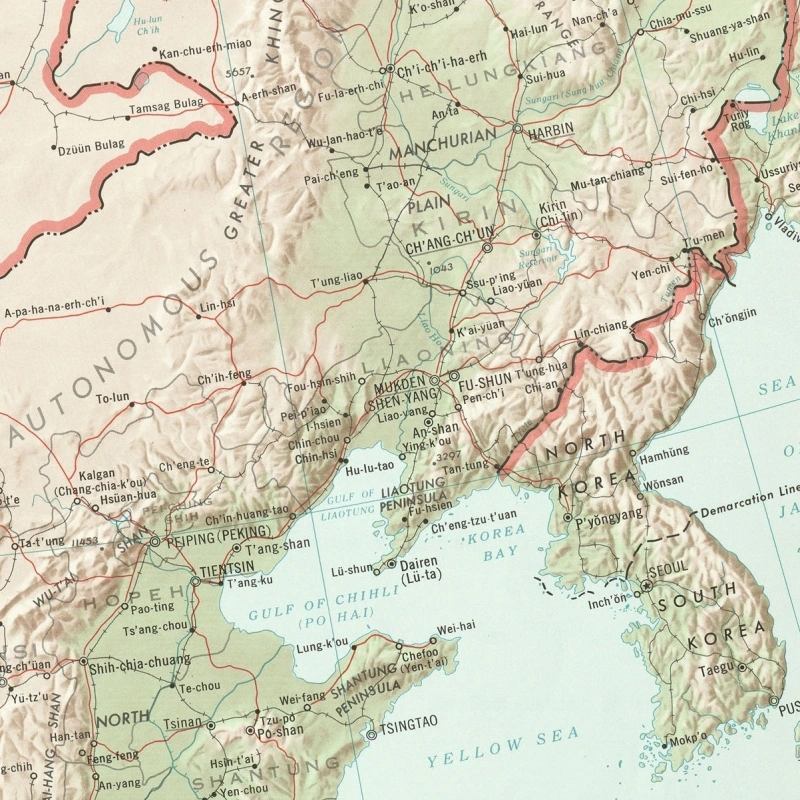
China has devoted an enormous amount of resources to improving transportation and other infrastructure in its historically poorer inland provinces. The theory was that this would remove the physical barriers preventing these places from developing. It’s a theory that looked plausible in the 1990s but feels less so today, as big regional gaps remain after almost 20 years of big-budget infrastructure projects. The infrastructure in even poorer Chinese provinces is already quite good; the problems that remain are unlikely to be caused by a shortage of transport links.
As the structure of the economy shifts, gaps in physical infrastructure may be getting even less relevant. The government likes to highlight the fact that China’s services sector is now larger than the industrial sector, and is growing faster. But for a government strongly concerned about regional inequality, for good reasons, this structural shift is a mixed blessing. All the evidence suggests that the high-technology and modern services sectors that the government is so eager to encourage have a much greater tendency to cluster in a small number of places. This type of clustering seems to be driven more by access to skilled employees and networks of related companies than transport costs for shipping containers. So the changing structure of the economy seems likely to reinforce existing regional inequalities rather than narrow them.
To me that suggests that China’s government should start focusing more on equalizing the distribution of universities than of highways. It is of course true that China has massively expanded the availability of university education across the country. But the country’s top universities–the kind that are most likely to generate superstar researchers and entrepreneurs–are still extremely concentrated in just a few places: Beijing above all, and also Shanghai and neighboring Jiangsu province. The table below I compiled from Shanghai Jiaotong University’s standard ranking of Chinese universities:

It’s striking how the current distribution of top universities perpetuates patterns around a century old: China’s first Western-style universities were founded in places with more Western influence, which meant coastal cities. The main elite (indeed only) universities pre-1949 were in places like Beijing (Peking University and Tsinghua), Tianjin (Nankai), Shanghai (Jiaotong, Fudan, Tongji), Jiangsu (Nanjing University), Zhejiang (Zhejiang University), Guangdong (Sun Yat-Sen University). The main exception to this rule is Wuhan in Hubei province, which was the site of one of China’s first modern universities and still has a decent cluster of good schools.
The overwhelming dominance of Beijing in the list above is also hard to miss. It’s not just that it is home to both of China’s top two universities, but that it has so many other top-ranked schools as well. I think this is a post-1949 phenomenon, part of the enormous bulking up of Beijing that has occurred in the last few decades. While the Communist Party did make conscious efforts to redistribute resources to some inland provinces, it also transformed Beijing from a mostly administrative center into a major economic one. Beijing gets an enormous amount of government favoritism (the Summer and Winter Olympics, to take just one example) because, as the capital, its glories are automatically the nation’s glories.
While having a top university does not guarantee that a particular place will become a high-tech hub, it at least increases the odds. But with so many top universities concentrated in so few places, other cities face very long odds in challenging the current high-tech dominance of Beijing, Shanghai and Shenzhen. Note in particular how six of China’s poorer provinces, with large ethnic-minority populations, do not have even a single one of the nation’s top 200 universities. Shifting this pattern is not easy, since elite universities are not formed overnight or by government decree. But supporting educational experiments, like private universities or partnerships with foreign schools, in places outside the existing club of top cities could be a start.

 The Tangled Woof