Should hukou system reform focus on rural land rights?

There is an interesting working paper out from the Hong Kong University of Science & Technology, “China’s mobility barriers and employment allocations“, that attempts to redirect the debate over China’s household registration (hukou) system.

China’s hukou system is intended to restrict and redirect urbanization, and this is exactly what it does: because people born with a rural hukou cannot claim government benefits in an urban area, fewer people migrate from rural to urban areas than would otherwise be the case. Most of the discussion over the hukou system (such as in these two excellent recent WSJ articles) emphasizes how it restricts migration through its links to various social services and social welfare policies. The authors of this paper (Rachel Ngai, Christopher Pissarides, Jin Wang) compare this aspect of hukou policy with a less-studied one: the potential for rural people to lose their land rights if they migrate to urban areas.

In our view, barriers to mobility from the hukou registration system arise mainly along two dimensions. First and foremost in the use of land, which is provided free by the state to rural families but is in principle withdrawn when the farmer gives up agricultural employment to move to a different job; and second in the provision of social services such as education and health, which are conditional on each person’s hukou registration and in particular the area that she lives. …

We show that the land policy embedded in the hukou system slows down migration from the land and calculate that this has led to overemployment in agriculture of 6.3 percentage points. The 6.3 points of overemployment in agriculture have come at the cost of 4.1 points underemployment in urban sectors and 2.2 points underemployment in rural non-agricultural sectors. The policy followed with respect to social transfers has further held back migration out of agriculture by another 0.4 percentage points. The biggest impact of the social transfer policy, however, is on urbanization (rather than industrialization). Because of it, rural businesses overexpanded at the expense of urban businesses, as agricultural workers prefer to stay in rural areas to benefit from their local hukou registration than move to the city and lose their local hukou. …

We find that land policy and the absence of property rights for farmers are the main channels through which the hukou system distorts both urbanization and industrialization. The social subsidies are too small by comparison, and although they have an impact on urbanization and the growth of rural enterprises, their impact on industrialization is much less. This is an important finding in light of the literature that highlights the role of hukou in restricting the access of migrants to the social services received by urban hukou holders. Such restrictions may have important social consequences but their distortionary effects on migration flows are not large.

This quantitative finding suggests that the economic benefits to China of liberalizing rural land rights would be much greater than the expansion of social welfare benefits. The theory is that if farmers had full property rights in their land, they would be able to transfer their land to others and could enjoy an income stream from the land even while working in the city. In that case more farmers would seek more productive non-agricultural employment, and national incomes would be higher as a result.

The quantitative estimate in the paper however assumes that no transfers of rural land are taking place in China today:

In the formal modelling that follows we deal with the complex issue of transfers by focusing on two extremes, one with no transfers and one with full property rights with transfers. We consider the former to be a much closer description of the present situation in China, whereas the latter corresponds to a policy reform that involves the privatization of land, something not yet contemplated by the People’s Republic. …

Although it is apparent that some unrecorded transfers of land are taking place, we ignore them in this derivation. They are small in number, the rental is unrecorded but believed to be below market rate and they do not make much difference to farmer’s attitudes. But given that some migrant workers do find ways to retain some income from their land, the impact that we calculate should be treated as an upper bound for the costs of the policy.

I’m not so sure that assumption is so easy to make. Transfers of land among farmers are allowed under current law, and have been officially encouraged (albeit with some limits) for several years now. Official statistics show that about one-third of the farmland managed under the household responsibility system has been transferred in one way or another, which is a lot more than zero.

I do think there are large economic effects from China’s rural property rights system, and the paper is right to focus on them. But the size of those effects is likely to be smaller than the estimates in the paper, as there has already been some gradual change in the direction it recommends.

Anton Chekhov, the investigative data journalist

I can no longer recall what pointed me toward Anton Chekhov’s Sakhalin Islandbut it is definitely one of my better literary discoveries in a while. In it we see a writer best known for short fiction undertaking a huge piece of nonfiction: a comprehensive account of the penal colony on Sakhalin in 1890, combining travel writing and character sketches with policy analysis and, perhaps most surprisingly, the presentation of vast quantities of data.

Here is some background on what prompted Chekhov’s investigation, which seemed just as out of character to his contemporaries as it does it to us; from the notes to this edition:

At the end of 1889, unexpectedly, and for no apparent reason, the twenty-nine year-old author announced his intention to leave European Russia, and to travel across Siberia to Sakhalin, the large island separating Siberia and the Pacific Ocean, following which he would write a full-scale examination of the penal colony maintained there by the Tsarist authorities. …

Sakhalin, since it was an island, and as far away from central Russia as one could go without leaving the country, was used at the time exclusively as a destination for long-term hard-labour convicts, who – apart from those on life terms – would serve out their sentences, then proceed to live in a local village to serve for several years with the status of a felon who was rehabilitating himself by learning to live a productive life in the community. Finally, when this period of “probation” was over, he or she would have their free-person’s rights restored to them and could leave for the mainland – but were still not allowed back to central Russia; they had to remain in Siberia for life. The authorities hoped by this policy to turn Sakhalin into a thriving colony on the lines of Australia, and numerous dishonest reports appeared in the European Russian press, planted by the government, claiming that this aim was being achieved.

There is a an argumentative core to the book, which is to show that the idea of using prison labor to develop a colony is a hopeless contradiction. The fundamental reason for this is that building up a successful economy and society in a colony requires individual initiative and responsibility, which is what a prison exists to destroy:

A prison is antagonistic to a colony, and their interests are in inverse ratio to each other. Life in the communal cells reduces a prisoner to the condition of a serf, and in the course of time, makes him degenerate; the habits of the life of the herd stifle within him the instincts of a permanently settled man and domesticated householder; his health declines, he grows old and weakens morally, and the later he leaves the prison the more reasons there are to fear that he will not turn out an active, useful member of the colony, but merely a burden to it.

A related theme is that in any competition between exile or convict labor and free labor, free labor always wins, because they do a better job. And therefore that the government idea behind the colony–that forced exile can be an effective economic development program–is fatally flawed. (Of course, this did not prevent the Soviet government from attempting the same thing on a much vaster scale with the Gulag system in the twentieth century.) In this passage Chekhov thinks through what the rational economic development of Sakhalin might look like, and concludes that the penal colony would inevitably wither away:

The major wealth of Sakhalin, and its – possibly enviable and happy – future, lies not, as people think, in fur-bearing animals but in the seasonal fish. … For fishing to take on the significance of a serious industry, the colony should be moved closer to the mouth of the Tym or the Poronai. But this is not the only prerequisite. It is also necessary that free individuals should not compete with the exile population, since there is no type of business in which, where there is a clash of interests, the free would not gain the upper hand over the exiles.

However, the exiles are in competition with the Japanese, who either conduct their fishing in a contraband fashion or else pay duty, and with the officials, who take possession of the best spots for the prison fisheries, and the time is already approaching when, with the construction of the Siberian railway and the development of shipping, rumours of the fabulous wealth of fish and fur-bearing animals will attract the free to the island; immigration will commence, genuine fisheries will be set up, in which the exile will take part not as a proprietor-businessman but merely as a hired hand, and then, judging from similar situations in the past, complaints will begin that the labour of the exiles is, in many respects, inferior to the labour of the free, even to that of the Manzes and Koreans; from the economic point of view, the exile population will come to be considered a burden for the island, and, with the expansion of immigration and the development of a settled and commercial way of life on the island, the state itself will find it more just and profitable to take the side of the free element and call a halt to the process of exile. And so, fish shall constitute the prosperity of Sakhalin, but not of the exile colony.

But there are actually very few of these moments where Chekhov speaks in his own voice to editorialize or tell us what to think: his method is “show, don’t tell,” and the patient accumulation of overwhelming and often heartbreaking detail. As part of his three-month investigation, Chekhov made his own census of the exile population, conducting brief interviews with every household he could find. This provided him with a wealth not only of impressions and anecdotes, but also data. Here is one of the more quantitative passages to give a taste of this aspect of the book:

In order to form a judgement as to the time of the year escapes are most often committed, I have utilized the few statistics which I did manage to find and note down. In 1877, 1878, 1885, 1887, 1888 and 1889, 1,501 convicts absconded. This figure breaks down into months thus:

  • January 117
  • February 64
  • March 20
  • April 20
  • May 147
  • June 290
  • July 283
  • August 231
  • September 150
  • October 44
  • November 35
  • December 100

If one were to draw a curve of the escapes on a graph, its highest points would relate to the summer months and to those winter months when the frosts are heaviest. Obviously, the most favourable moments for carrying out escapes are when the weather is warm, when work is being carried on outside the prison, during the seasonal fish run, when the berries are ripening in the taiga, and when the settled exiles’ potatoes are fully mature, and after these, the time when the sea is covered with ice, when Sakhalin ceases to be an island. Also conducive to the rises in the summer and winter months is the arrival of new parties on the spring and autumn voyages. Least of all abscond in March and April, because during these months the ice breaks up on the rivers, and it is impossible to obtain food either in the taiga or from settled exiles, who by the spring usually no longer have any food left themselves.

In 1889, 15.33 per cent of the average yearly complement escaped from the Alexandrovsk Prison; from the Dooay and Voyevodsk Prisons – where, besides overseers, sentries with rifles also keep guard over the prisoners – 6.4 per cent escaped in 1889, and from the prisons of the Tymovsk District, nine per cent. These figures relate only to the year under review, but if one were to take the entire available total of convicts over the whole duration of their stay on the island, the ratio of those who have run off at various times to the total complement amounts to no less than sixty per cent – that is, of every five individuals whom you see in the prison or in the streets, three, for a certainty, will have already attempted to decamp. From talks with the exiles I gained the impression they had all gone off at some stage. It is rare for anybody, during the course of his sentence, not to arrange a holiday for himself.

The comprehensiveness–geography, population, health, economy–of Chekhov’s account seems characteristically and delightfully nineteenth-century to me. It’s not a perfect book: a nonfiction writer today would use a much less schematic structure, and would try to link the chapters with more of a narrative thread than Chekhov does. But in the end it is a wonderfully vivid and detailed portrait of a particular place at a particular time, which is probably more valuable than a purely personal reflection or polemical argument.

51gnnwjwobl-_sx321_bo1204203200_

One complaint is that although the translation reads very well, it was not well-served by the publisher: in the electronic edition the notes are not linked, making them basically unusable, and in the print edition the type is too small.

Will centralizing power solve China’s economic problems, or worsen them?

The relationship between the central government and local authorities is perhaps one of the least understood and most important questions about how China works today.

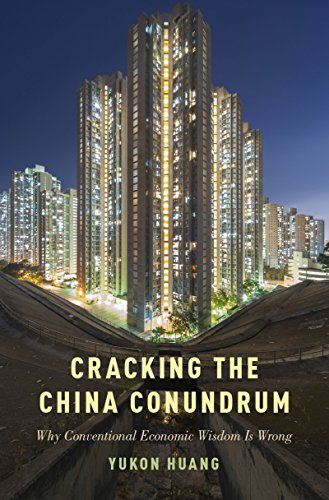
The past is, as per usual, probably better understood than the present. There is a pretty strong consensus on the importance of local initiative in the 1980s and 1990s–see Yuen Yuen Ang’s book How China Escaped The Poverty Trap for a good recent account. Yukon Huang’s new book, Cracking the China Conundrum: Why Conventional Economic Wisdom Is Wrong, is also good at giving a more top-down macro account of the importance of the decentralized model:

In China’s system, local authorities are motivated to promote growth. By encouraging competition, this has helped China to contain the worst aspects of the distorted signals and “soft budget constraints” that afflicted the other centrally planned economies in the former Soviet Union. Efficiency comes from having different jurisdictions and their affiliated enterprises compete against each other for their relative positions. They also compete to build the new institutions that China needs as it moves toward becoming a more market-oriented economy.

There is indeed a lot of evidence that this competition for growth among local authorities was an important positive feature of China’s system in the past. But the dynamics of that competition are not the same today as they were three decades ago:

When the state and the market complement each other, the results can have a dramatic impact on productivity and living standards, as has been the case during most of the post-Mao era. Since the onset of the global financial crisis in 2008, however, a confluence of events has altered these relationships. The creation of local-government financing vehicles (LGFVs) put local governments into direct competition with existing firms in property-related commercial activities and also enlarged the opportunities for corruption by local authorities. The government’s stimulus program channeled loans through the financial system to SOEs and local authorities, which made such opportunities even more attractive. Initially, these relationships helped redirect resources that were monopolized by the state, such as land, into more productive use in partnership with private agents. Over time, however, this process has become distorted, resulting in wasteful expenditures that the leadership is currently trying to address.

While local competition may have previously made socialist “soft budget constraints” harder than they otherwise would be, the post-2008 changes in the financial system seem to have led to an epidemic of soft budget constraints. These concerns are related to the argument in “The Long Shadow of China’s Fiscal Expansion,” by Chong-En Bai, Chang-Tai Hsieh, and Zeng Song (previously discussed here). Here’s a longer excerpt from that paper:

[Prior to 2010] local governments were actively providing special deals to favored businesses, but could not borrow from or influence the lending decisions of state-owned banks. The effect was that the assistance provided by local governments to favored firms largely consisted of exemptions from the country’s thicket of rules and regulations, but local governments could not provide the private firms they were trying to assist with preferential access to capital. These two institutional features—high-powered incentives to provide special deals, along with restrictions on access to capital—explain how China was able to grow rapidly despite seemingly low-quality institutions.

We show that the off-balance-sheet financial institutions created to fund the fiscal stimulus program changed the nature of the special-deals regime. Specifically, we show that the off-balance-sheet financial institutions continued to grow even after the stimulus program was over, because local governments now had a powerful new tool, the LGFVs, to provide support for favored firms. …

This might have had positive effects on welfare and growth if local governments had used these resources for projects that would have high social returns but had been starved of resources. However, we provide evidence that in addition to funding infrastructure projects, the relaxation of financial constraints also made it possible for local governments to channel financial resources to commercial projects favoring certain firms.

Other observers also see significant changes in the decentralized growth model in recent years. A recent piece by Barry Naughton suggests that the central government is moving away from encouraging local competition for growth and toward more top-down direction of the economy:

Since about 2010, China’s “miracle growth” era has come to an end, due to rapid changes in labor force conditions, incomes, and external markets. In the wake of this change, the complementarity between bureaucratic incentives and the plan appears to be declining.

The Xi Jinping administration has since 2012 reduced the focus put on economic growth in official success indicators, squeezing in new indicators such as managing local government debt, reducing poverty, and improving the environment. At the same time, the most recent 13th Five-Year Plan (2016–2020) GDP target of “more than 6.5%” growth is close to, or perhaps even above, growth potential. The 13th Five-Year Plan seems to have become an instrument to maintain high-speed growth, even as the bureaucratic incentive system becomes less single-minded.

It is a paradox of contemporary China that administrative interventions are increasing in size and multiplying in form just as growth potential is slowing and the benefits to a less-interventionist stance would seem to be increasingly evident.

Given that local governments get the blame, fairly or not, for the rapid accumulation of debt and wasteful investment projects in recent years, it’s understandable that the central government would try to change things. But it’s not really clear yet what model is replacing the old regional growth competition dynamic, and what the effects of this attempted shift might be.

Has regional competition now become a malign force that must be disciplined? Or will the weakening of regional competition sap China’s economic dynamism? Or both?

Here is Huang once more:

President Xi’s consolidation of power has been interpreted by the more optimistic observers as a precursor for bolder economic reforms in the coming years. For them, China will eventually allow the private sector to play a “decisive” role in guiding the economy as stated in the Third Plenum policy statement. But the many pessimists see in recent actions only hesitancy in addressing much needed productivity enhancing measures. Consolidation of authority means more centralized control over economic activities, continued protection of major SOEs and less competitive pressures in the market space. Thus China’s move from its former collective leadership to relying on a single powerful leader might lead to a less dynamic economy and eventually political instability. Only time will tell if either of these two scenarios becomes the reality.

51zr4nonx5l

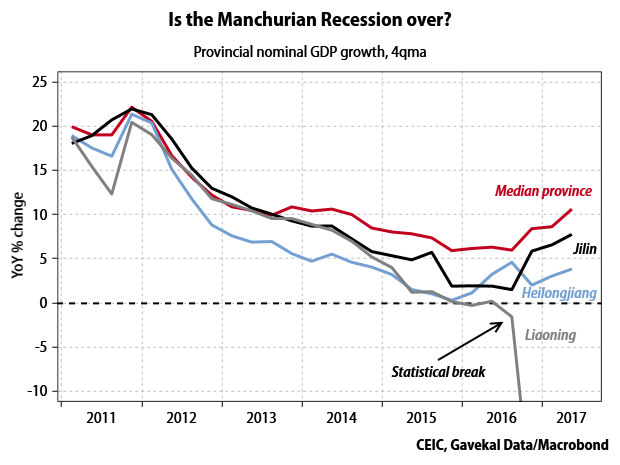
Is the Manchurian Recession over?

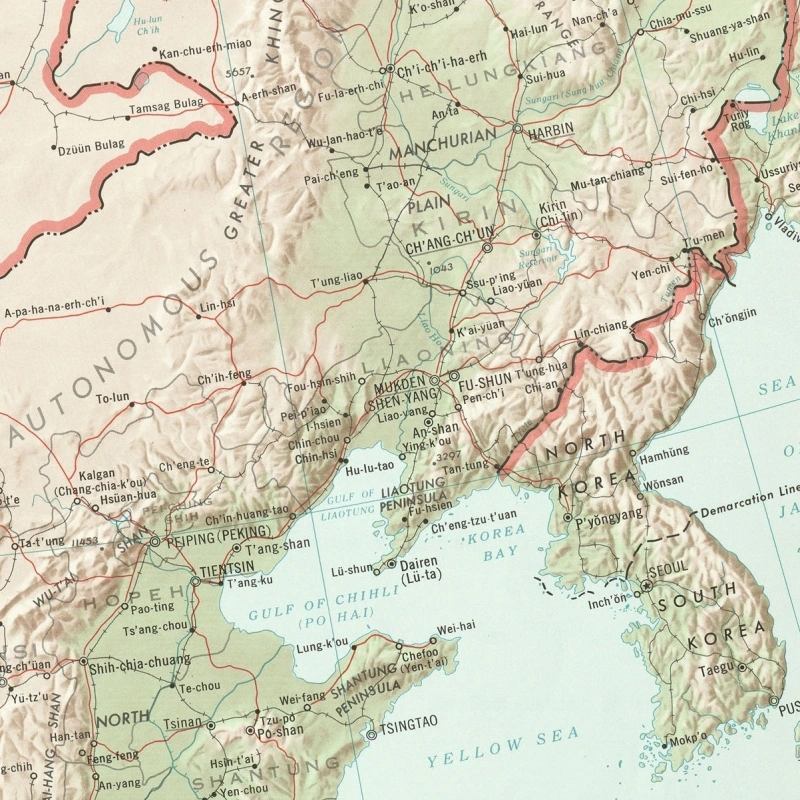
China’s provinces are reporting economic data for the first half of 2017, and the long-suffering northeastern provinces, where the recent economic downturn was most severe, are putting up some better numbers. The main exception is Liaoning, but this is because an anti-corruption investigation found that the province had inflated some statistics and forced them to be marked down–however the historical figures haven’t been revised so growth rates don’t make any sense right now. While Liaoning’s numbers look worse than the others, in reality it’s probably doing the same or better.
manchurian-recession

The downturn in the northeast prompted a national-level effort to boost growth in the region, so the pickup is getting a lot of attention. At least one article declaring the “worst is over” for the northeast has appeared in print, and this cautiously optimistic tone is common in official channels. Here is how, Sun Donghai, the director of the Anhui provincial Development Research Center, summarized the situation:

In the technology-intensive regions, represented by Guangdong, Jiangsu, Zhejiang, Shanghai, economic growth is stable, and there is a lot of momentum for both upgrading traditional industry and developing new industries. … Regions heavily dependent on natural resources, such as the three northeastern provinces, Shanxi, and Hebei, are facing great pressure to transition, but developing new growth drivers will require a long time. At the same time, we can see some positive changes, some resource-dependent provinces have reversed the declining trend since 2013, and economic growth has bottomed out and recovered. Jilin’s GDP grew 5.9% [in the first quarter] for a stable start to the year: economic growth has returned to an appropriate range, and has started to move on a normal track.

A more in-depth view of official thinking comes from Fan Hengshan, a deputy secretary-general of the National Development and Reform Commission who has traveled frequently to the northeast. In May he gave a lengthy interview on the northeast to the China Economic Times. He starts out in the conventional way, attributing the improving indicators to the government’s supportive policies for the region, but also noting the recovery of commodity prices (more significant in my view):

The government’s implementation of the new round of the northeast revitalization strategy is now taking effect, objectively speaking it has provided an effective policy environment and systemic support for the stabilization of the northeastern economy. At the same time, the rollout of supply-side structural reform has had a clear impact on the internal dynamism of economic growth. Following the implementation of supply-side structural reform and the stabilization of international commodity prices, industries that are significant for the northeast, like oil, coal, and steel, gradually returned to stability. For resource-dependent and single-industry cities this alleviated the severe mismatch between fiscal revenues and expenditures.

While maintaining the requisite note of optimism, Fan’s discussion of the problems in the northeast’s economy focuses on deep-rooted structural issues that seem quite difficult to solve. Here are some excerpts (my translation):

The problems faced by the northeast are, on the surface, caused by a lack of external demand and weakness in investment. In fact, they are the manifestation of the institutional, systemic and structural problems of an old industrial base.

From the institutional perspective, the northeast region’s level of marketization is still insufficient compared with the developed eastern region. The decisive role of market mechanisms has not been fully developed, and efforts at economic development still have a pronounced administrative tone. The historical burdens of state-owned enterprises are heavy, their vitality is insufficient, and a modern system of enterprise operation and governance has not been completely established. The old problems of incentives and restraints for state-owned enterprises have not been completely eliminated. Development of the private sector is insufficient, and the spirit of entrepreneurship in society is weak. The northeast has a strong foundation in education and science, but these scientific resources cannot be effectively transformed into real activity.

In terms of economic and industrial structure, out of the three growth drivers of investment, exports and consumption, the northeast’s economy is excessively reliant on investment. The investment rate is too high and the efficiency of investment is relatively low, and this kind of growth model is not sustainable. The industrial structure is not adapted to market demand: the leading industries are mainly the investment-facing sectors of energy, raw materials and heavy equipment manufacturing, while new emerging industries are small and undeveloped. Many cities have undiversified industrial structures with only a single pillar industry or two interrelated industries. From the perspective of industrial organization, there are many gigantic enterprises but few small and medium-sized enterprises. A development model based on industrial clusters and the integration of large, medium and small enterprises has not yet formed.

It’s interesting that Fan talks about the northeast in the same way that many foreigners talk about China: the problem is obvious, their economy is too dependent on investment and state-owned enterprises are stifling the vitality of the private sector. It’s all relative I guess.

But the northeast has an additional burden: people are leaving in droves, and companies can’t get them to stay (see my previous post on the emerging demographic crisis in the northeast). Here is more from Fan:

Many enterprises and research institutions in the northeast have told me that in recent years it has gotten more difficult to attract and retain personnel. Some graduates of top universities choose to go elsewhere for jobs, and some local technical and management personnel also leave the northeast to seek better job opportunities.

The northeast still has a “big government, small market” environment, where local governments are still directly allocating resources and micromanaging. This kind of system is a constraint on the development of enterprises and people. Particularly in recent years companies in many traditionally strong industries and sectors have encountered difficulties, so the salary, benefits and career development opportunities they can offer are pretty limited compared to companies in the east. Objectively speaking, their ability to attract mid- to high-level staff has declined.

In addition to salary considerations, people are also increasingly looking at a city’s level of modernization, the convenience of its transport, and social, cultural, ecological and other “soft” environmental factors. It is worth noting that some local governments and businesspeople report that, because the northeast’s winter is cold and long, the low temperatures are increasingly becoming a reason for some people to choose not to stay in the northeast and work. This creates many challenges for high-tech enterprises in the northeast to attract talent, and some companies have no choice but to set up branch offices in the south in order to attract high-level staff.

This all rings true: the northeast  has a brutal climate and a closed economy where it is difficult to get ahead if you don’t have government connections or an SOE job. This is, in my experience, more or less what Chinese people from the northeast say about their home–it is no mystery why they leave.

So I would lean toward viewing the current recovery in the northeast as reflecting the recovery in commodity prices more than anything else–although if China’s government can succeed in keeping prices stable with its many interventions into commodity demand and supply (policies that go by the somewhat deceptive moniker of “supply-side reform”) that unquestionably will help these provinces.

More broadly, I think the current regional problems in the northeast are another reason to see China’s SOE reforms of the late 1990s and early 2000s as incomplete and only partially successful (see a previous post on this topic). The northeast felt the brunt of the layoffs of that era, but once the commodity boom evaporated so did many of the apparent improvements. Here is a nice piece of oral history that gives a worker’s-eye view of the trajectory of a major SOE in Heilongjiang:

It was with honor that a sprightly 19-year-old Wang Dianyu heeded the central government’s call and joined the ranks of China’s heavy industry workers. Almost 60 years later, his eyes still glow with the pride of having worked for one of his country’s largest state-owned factory groups: China First Heavy Industries (CFHI).

Founded soon after the establishment of the People’s Republic of China in 1949, CFHI was a beacon of the country’s industrial ambition, churning out gigantic pieces of machinery both civilian and military from its base in Fularji, a district in Heilongjiang’s second-biggest city, Qiqihar. “We had a lot of catching up to do,” Wang tells Sixth Tone of China’s then-inferiority compared to the might of international rivals. “Heavy industry is the backbone of a country.”

Today, that backbone is buckling. Economic growth in the industrial northeast, once fondly known as “the Republic’s eldest son,” is slowing, and an era of overproduction for the region’s heavy industries has given way to rampant borrowing. For the 2016 fiscal year, CFHI reported losses of 5.73 billion yuan (around $850 million), compared with 2015’s loss of 1.8 billion yuan and 2014’s loss of 25.7 million yuan; it is now scrambling to pay back debt by selling off shares to its parent company, China First Heavy Industries Group Co. Ltd.

CFHI’s troubles were compounded in 2015 when its chairman, Wu Shengfu, died suddenly just weeks after the state’s anti-corruption watchdog launched an investigation into CFHI’s parent company. Some news outlets at the time quoted sources stating that he was found hanging in his office, a detail that was downplayed in later state media reports. The anti-graft investigation discovered a number of infractions, including mismanagement of state funding, violations of recruitment procedure, and “indifference toward Party principles.”

What I’ve been listening to lately

Been a while since I’ve done one of these–life has been getting in the way.

    • Philip Cohran – On The Beach. May he rest in peace. Although mostly known for his association with Sun Ra, Cohran made wonderful music on his own: I love the gorgeous African Skies, as well as the record with his children, the Hypnotic Brass Ensemble. But I had missed this classic 1968 recording, with a vigorous large ensemble and a great feature for Cohran’s “Frankiphone.” Random fun fact: the New York Times obituary notes that he picked up the Muslim name Kelan, rather unusually, in China (it’s the Chinese transliteration for the Quran).
    • The Skatalites – Foundation Ska. This was the first recording of Jamaican music I ever purchased, and it sucked me in immediately. I’ve been going back to these tracks recently, and they are still absolutely entrancing and, yes, foundational. Active for only about two years, The Skatalites created their own musical world with a combination of propulsive rhythms and moody, interlocking horn parts.
    • Miles Davis – Bitches Brew Live. The classic Bitches Brew album is a long, sprawling mess, clearly a work of genius but still rather exhausting. These versions of the same tunes, performed by stripped-down ensembles, are tighter, punchier, and may actually be better.
    • Joe Henderson – The Elements. The peaks of the “spiritual jazz” subgenre of the 1970s can be pretty wonderful, but the valleys between those peaks tend to be long and deep. But I’m happy to report the ratio is quite good on this rather obscure album. Henderson has a killer band including Alice Coltrane, Michael White, and Charlie Haden, and their peaks are very high indeed.