What surprised Pieter Bottelier about Chinese economic history

Pieter Bottelier has observed a lot of recent Chinese economic history, starting with his tenure as head of the World Bank’s office in China from 1993-97. But his new book, Economic Policy Making in China (1949-2016): The Role of Economists, goes farther back, and opens with an interesting collection of “puzzles and surprises” he encountered doing research on these earlier periods.

I quite enjoyed these observations; here is a selection of a few of them:

  • Surprise: The Chinese communists, who were relatively inexperienced in economic matters when the CPC was gaining strength in the 1930s and ’40s, were more effective in suppressing inflation in areas they controlled than Chiang Kai-shek’s more experienced Nationalist government.

If Chiang Kai-shek had been able to control hyperinflation during the civil war, it would have been much harder for the communists to prevail in that conflict. I was surprised to see how much importance the communists attached to financial stability and how effective they were in fighting inflation before the establishment of the PRC in 1949. …While most historians typically focused on the political and military achievements of the CPC, I found that the financial history, including a surprising degree of fiscal conservatism and appreciation of the importance of financial stability, deserves more attention.

  • Surprise: The extent to which initial economic reforms in the late ’70s were influenced by the need to create jobs for the millions of people (especially youth) returning to the cities from the countryside after the Cultural Revolution had ended.

To reduce the risk of social instability, there was a compelling need for job creation in urban areas after the Cultural Revolution. One of the first and most important reform measures in the late 1970s was to legitimize and facilitate street vending and other labor-intensive retail trading. Most of the millions of people returning to the cities after the Cultural Revolution had been forced by the Party to undergo “re-education” through labor in rural areas. If it hadn’t been for the special efforts to create job opportunities in urban areas for these people, Deng Xiaoping’s economic reforms might not have been as successful as they were.

  • Surprise: The importance of coining the term “socialist market economy” in 1992 to describe the kind of economic system China wanted to establish.

I was surprised to learn how important this had been in the evolution of China’s reforms. In the West, we normally don’t attach a lot of importance to names; we ask rhetorically: “what’s in a name?” By contrast, in China the name of a person, thing or concept is typically very important; a name has real meaning. One of the more important contributions Jiang Zemin made to China’s reform efforts when he was the Party’s General Secretary (1989-2002) was to give a name to the goal of these efforts.

  • Surprise: I was surprised to find that leading Chinese reform economists consider Gu Zhun, a philosopher/economist and historian (who was trained as an accountant and who died in 1974), the “father” of China’s market reforms.

Gu Zhun is now recognized as one of the most important thinkers of the Mao era. He was a brilliant and courageous intellectual; an original thinker with a fiercely independent, some say stubborn, mind. Like Sun Yefang, he opposed some of Mao’s economic policies in the 1950s. He died (of lung cancer) at the age of 59. Had his health kept up for another decade, he might have emerged as one of the most important Chinese reform economists under Deng Xiaoping. Given the breadth and depth of his interests and academic pursuits, he would be called a “Renaissance Man” in the West.

There are several more surprises discussed in the introduction, and I could have read even more of them – it’s a nice format. But the book then shifts gears, and becomes mainly a series of biographical sketches of a number of people who were influential on Chinese economic policymaking (despite the title, not necessarily trained economists). Both parts were reminders of just how much there still is to learn about even fairly recent history in China, so much of which is still obscured by a combination of official propaganda and reformist mythmaking.

51sgc1eqpbl-_sx331_bo1204203200_

Lessons from watching *Dying to Survive*

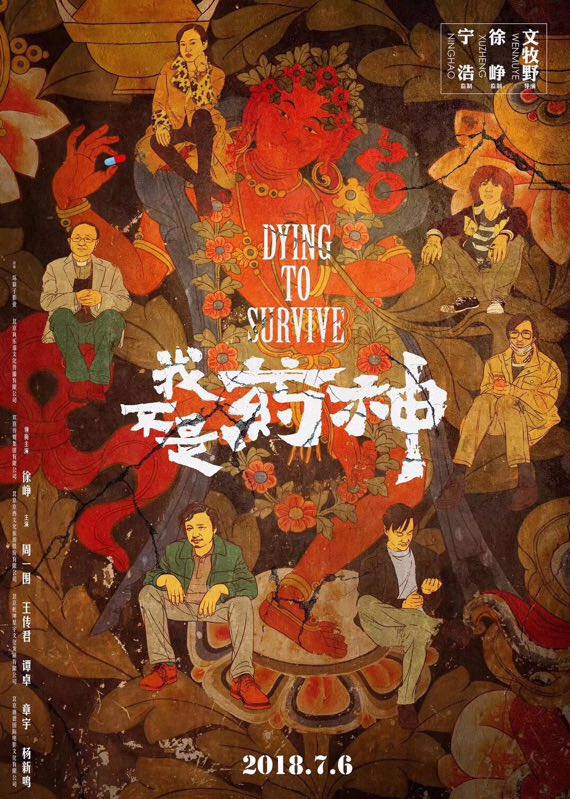
On the recommendation of several friends, my wife and I went to see China’s hit summer movie in Beijing last month. Called “Dying to Survive” in English — the Chinese title 《我不是药神》 translates as “I Am Not the Medicine God” — it’s an unusual blockbuster in that it’s not escapist action fare but a realistic social drama. It tells the story, loosely based on real events, of a Shanghai man who smuggled Indian generic cancer drugs for patients who could not afford the real thing.

It’s a pretty good movie and worth seeing (the print we saw in Beijing had English subtitles, so it’s accessible to non-Chinese viewers): it’s well shot, well acted, well edited, and if the tearjerker parts of the storyline are not too surprising, they are still moving and effective. The first half of the film is my favorite, thanks to its sympathetic and realistic depiction of the lives of people living at the margins of Shanghai’s glitzy society. The protagonist starts out as an obviously dodgy seller of supposed aphrodisiacs, and his partners in crime include a dancer in a club, a rural migrant working in a slaughterhouse and, most surprisingly, a Christian pastor.

But what’s really interesting about the film is how you can see the struggle between the demands of making popular art and satisfying official propaganda playing out in the open. How many dramatizations of social problems end by displaying on screen a detailed timeline of the government policy measures that decisively solved said social problem? (The Economist wrote a bafflingly wrong-headed article about the film, calling it “a radical departure from China’s film policy, which is to encourage the production of uplifting fare that presents the government in a good light.” They must not have stayed for the credits.)

At times “Dying to Survive” feels like two movies stapled together. When the main characters are on the screen, the tone is of low-key realism. But when the police and court system appear, everything changes: the actors are stiff and predictable, straight from central casting for one of China’s cookie-cutter state television dramas. The cops are upright, businesslike and effective, the judges wise and firm. They ensure that the drug smuggler is eventually brought to justice, and serves a prison sentence for his crimes. The message is: yes, high drug prices are a social problem, but that does not excuse breaking the law; the government will take care of things.

What’s more interesting is how the movie departs from the real-life story of Lu Yong, who did smuggle into China the Indian generic version of Novartis’ cancer drug Glivec (the drug did not have patent protection in India). Lu was himself a patient who needed the drug, while the movie’s protagonist Cheng Yong gets into smuggling because he needs the money, and then develops sympathy for the struggling patients over time. (Lu has publicly stated he was unhappy with being portrayed in this way, and said he had not been consulted or compensated by the producers of the movie.) This alteration is rather understandable, as it creates a more interesting story arc: Cheng Yong starts off as an unsympathetic character (he hits his ex-wife in an early scene) and gradually matures into a sympathetic one.

The real punchline is that Lu Yong never served a prison term for his smuggling. When he was brought before a court, the public outcry led the judges to release him. The true story, in other words, was even more like a movie than the movie: in the end, the morally upright hero is recognized for doing good deeds and praised rather than condemned. (In Lu Yong’s blog post about the movie, he says that the movie’s producers told him that a political leader had ordered that the movie play up the role of the government and play down individual heroics.) That courtroom scene would have been a triumphant climax for any other drama. But suggesting that popular morality can override the demands of the law was apparently a bit too dangerous.

I do think “Dying to Survive” is a successful piece of popular art, but it is one that shows very clearly the constraints under which it was made. For further reading, I recommend this piece by Richard Yu, in which he argues that it serves as a potential template for how Chinese movies can discuss social problems–as long as they celebrate the accomplishments of the government.

dying-to-survive