One of themes running through Superpower Showdown, the instant history of the US-China trade conflict by Bob Davis and Lingling Wei, is nostalgia for former Chinese premier Zhu Rongji. Two decades ago, Zhu was a strong advocate for China’s entry into the WTO and pushed hard for China’s government to accept difficult reforms in order to grasp that bigger prize. “When China needed to change to join the World Trade Organization, Zhu was able to win President Jiang Zemin’s support and push through reforms that eliminated thousands of state-owned firms, even though that produced massive layoffs,” Davis and Wei write.
Ever since then, successive US administrations, up to and including the Trump administration, have searched for a similar figure they could work with to drive further liberalization of the Chinese economy. They have never found one. “Washington needed another Zhu Rongji,” they write, but “none was on the horizon.” To this day, especially among foreigners, Zhu is often seen as the hard-charging reformer who remade the Chinese economy through sheer force of will, a hero who achieved significant market liberalization.
At this point, it’s clear Zhu’s advocacy of WTO accession for China was the correct strategic choice: it led to massive gains in China’s global export market share, while fears that Chinese farmers and domestic companies would be swamped by foreign competition proved unfounded. But for all his charisma, it is too simplistic to think of Zhu as a heroic figure with a widely celebrated legacy. It’s worth recalling that out of the seven people who have served as Premier of the People’s Republic of China, Zhu had the second-shortest tenure: a single five-year term (1998-2003), exceeding only Hua Guofeng’s truncated four-year tenure (1976-1980). On many of the issues most closely associated with Zhu, his positions have since been reversed or weakened by successive Chinese administrations. It is not an accident of history that a Zhu-like figure has not risen again.

Zhu paid a serious political price for how the WTO negotiations played out. In an episode recounted in detail in Davis and Wei’s book, Zhu visited Washington in April 1999 at a low point in the negotiations, and made a strong offer to get them restarted. President Bill Clinton nonetheless rejected it, and, in a major breach of protocol, publicized the specific terms Zhu had offered. They went well beyond what other Chinese leaders had expected. The US bombing of the Chinese embassy in Yugoslavia in May further poisoned the atmosphere for making concessions to the Americans:
The combination of Clinton’s rejection of Zhu’s WTO offer followed by the embassy bombing badly weakened the premier. As soon as Zhu returned home from his U.S. trip, committees under Li Peng’s National People’s Congress questioned whether Zhu had gone too far in offering concessions. Wu Jichuan, the head of the Ministry of Information Industry, threatened to resign over Zhu’s offer to open the telecommunications industry to foreign competition. At a meeting of senior Communist Party officials, Zhu offered Mao-style self-criticism, or jiantao, for his U.S. trip. He said he was too anxious to get a deal done, said a senior government official at the time.
The rest of the Chinese leadership made sure that Zhu would not go freelancing again, and set clear limits on what he could offer. The WTO deal that the US and China eventually agreed on did not go as far as Zhu’s April 1999 offer; notably, Wu Jichuan prevailed in his insistence that foreign companies be essentially blocked from the telecommunications market. Today, with the US and China locked in a conflict over mobile-phone apps and semiconductor technology, it is hard to imagine there are many Chinese officials who think Wu Jichuan was wrong about that and Zhu Rongji was right.
The domestic economic reform most closely associated with Zhu’s spells as vice-premier and then premier was the downsizing of the state sector, which began around 1995 and accelerated in 1998-2000. Zhu allowed local governments to close or privatize underperforming state firms, and oversaw mergers and consolidation of the larger companies controlled by the central government–a policy summarized by the slogan “grasp the large, release the small”. As a result, the number of people employed by state-owned enterprises fell from 77 million in 1995 to 42 million in 2003, the end of Zhu’s term.
There is some evidence that Zhu expected or hoped that the downsizing process would continue after he left office. According to William McCahill, who worked at the US Embassy in Beijing during Zhu’s tenure and is now a senior fellow at the National Bureau of Asian Research:
When Zhu Rongji left the post of premier in 2003, he foresaw the number of central government-owned SOEs shrinking in five years from around 180 firms to around 15, all operating in national security areas like telecoms and energy.
What actually happened was that the downsizing of SOEs slowed and then stopped almost immediately after Zhu left office. In March 2003, the government established a new organization, known as Sasac, to supervise SOEs. At the Third Plenum in October 2003, the Communist Party approved a new architecture for economic policy that focused on “preventing the loss of state assets,” a pejorative term for botched privatizations. Within two years Sasac effectively brought a halt to management buyouts and other common methods of SOE privatization, and they have never resumed. The number of centrally owned SOEs directly supervised by Sasac has now fallen to 97. But all of that shrinkage has come from merging those companies into larger conglomerates that would be more effective national champions, and their numbers have been little changed in recent years.
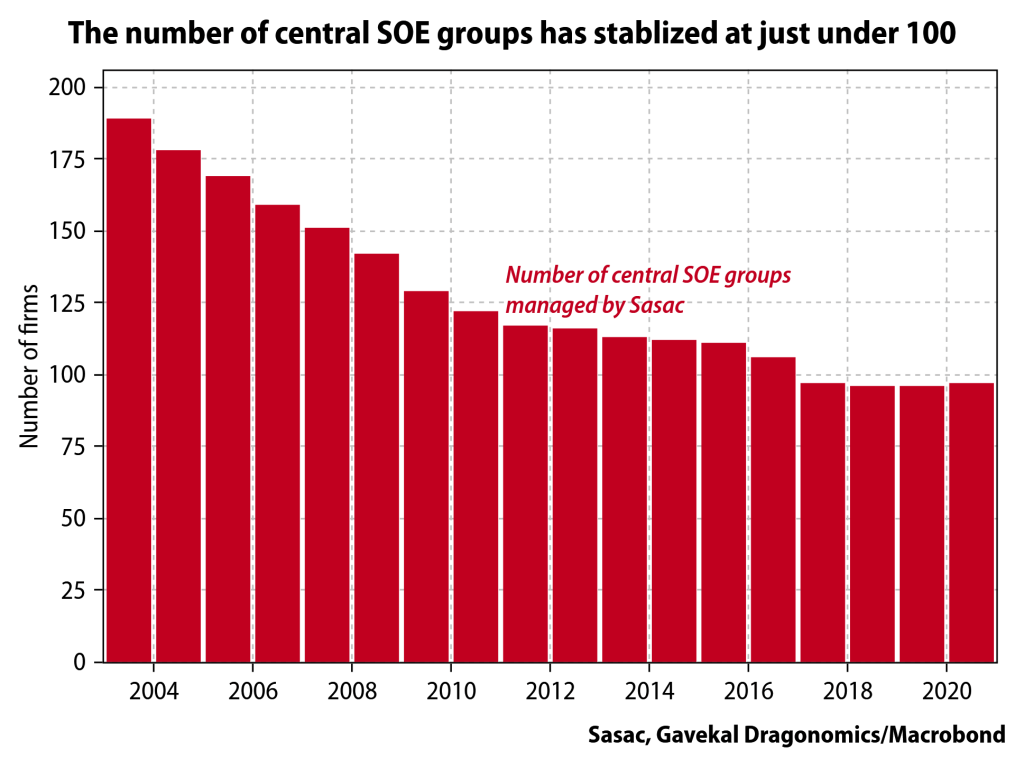
While Zhu Rongji focused on encouraging competition among different SOEs in order to energize the domestic economy, more recent administrations have instead emphasized reducing competition among SOEs and building up larger entities that can more effectively take on Western multinationals.
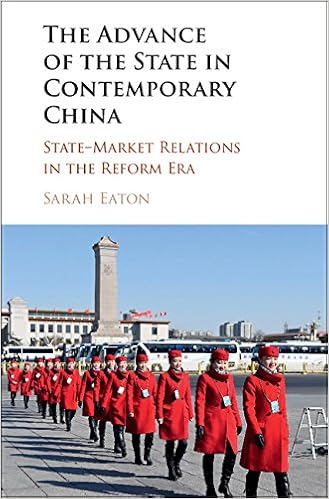
The layout of China’s state sector today perhaps owes less to Zhu than to Li Peng, his predecessor as premier and frequent sparring partner in internal economic debates. According to Sarah Eaton’s excellent 2015 book The Advance of the State In Contemporary China, as early as 1991 Li presided over an effort to identify 100 SOEs as “large enterprise groups” that would receive special government support to become a team of stronger, more competitive companies. That idea continued to be influential during Zhu’s tenure, and beyond:
In particular, ‘grabbing the large’ – one half of the most controversial policy of ‘grab the large, let go the small’ (zhua da fang xiao 抓大放小) – carried forward the essential aims of the large enterprise strategy championed by Premier Li Peng in earlier years. In general terms, the idea was to focus the state’s resources on supporting a group of ‘elite SOEs’ that would anchor a trimmer, fitter state economy.
The simplest way of summarizing China’s SOE policy since Zhu left office is that it gave up on the “release the small” part of the policy, but has redoubled support for the “grasp the large” part. The combination of social unrest among laid-off SOE workers, and public criticism over corruption in the privatization process, had made continued SOE downsizing politically untenable by the 2000s. But the economic upheavals of the last two decades have generally only reinforced Chinese officials’ belief that SOEs play a necessary role in stabilizing the economy. Xi Jinping’s public commitments to keep making SOEs “stronger, better and bigger” are just the latest iteration of a line of thinking that is at least three decades old.
The conventional take on Li Peng has been that his conservative socialist economics were overruled by Deng Xiaoping, and lost out to Zhu Rongji’s liberalizing forces. Looking at how China’s state sector has evolved over the last couple of decades, that story does not seem completely right. Li Peng has clearly had a lasting legacy, and helped fix the state-capitalist direction of China’s economic strategy.