
Demographics might change everything for China–except the growth model

The working paper on demographics recently published by the People’s Bank of China is a pretty interesting document, and has gotten more than the usual amount of attention. It doesn’t read much like the cautious, dry and technical papers previously released by this august institution. There’s not much quantitative analysis or rigorous logical argument; it’s more like an extended op-ed, arguing vigorously that major demographic changes for China are coming and that the country needs to wake up to that fact and adapt quickly.

This call to arms is well-timed. It seems likely that the much-delayed figures for China’s 2020 population census will confirm what many demographers have been saying for a while: that China’s fertility rate has been overstated, and therefore that its demographic transition and the aging of its population are going to happen even faster than standard forecasts project. The authors (listed as Chen Hao, Xu Ruihui, Tang Tao, and Gao Hong) say that China’s government should lift all remaining policies that restrict births, and switch to strongly encouraging childbirth and reducing the financial burdens (like education) that discourage families from having more children. They even suggest that China could experiment with immigration–previously an almost taboo topic–to help replenish its shrinking and aging population.

But what is perhaps more interesting than all the things the authors think should change is what they think China should not change: an investment-focused growth model. They don’t actually hold out a lot of hope that pro-natalist policies will be able to turn the demographic tide; they acknowledge that the measures tried in the past by developed countries generally have not had dramatic effects (their point is more that China’s government government should at least stop actively discouraging childbirth). They argue that the only really successful adaptation to a shrinking and aging workforce has been to boost investment: substituting capital for increasingly scarce labor. The analysis of Japan is particularly interesting:

In response to declining labor and rising wages, developed countries have gradually replaced labor with capital, and in order to overcome diminishing marginal returns to capital, have conceived of using the abundant labor resources of developing countries to complement their excess capital. To this end, developed countries have used multinational corporations’ overseas expansion, deploying their output and capital exports to capture a higher return on capital. In fact, this strategy of developed countries has been extremely successful. Japan, for example, whose aging is severe, has created another Japan overseas during its supposedly lost two decades; the annual capital gains from overseas repatriation are about 3-4% of its GDP, and this money has become an important source of funding for its retirement.

An aging population poses a challenge to an investment-driven growth model, because it implies that the supply of household savings that can be mobilized for investment will shrink. This is pretty intuitive: as the population ages, a larger share of people become net consumers (retired people living off their savings) while a smaller share of people are net savers (working people at the peak of their earnings power). Therefore the average savings rate across households is lower. China’s data seem to support a strong role for demographics in both the rise of its household savings rate, and its decline since 2010 (see chart). As the population ages further, we should expect the savings rate to decline more.
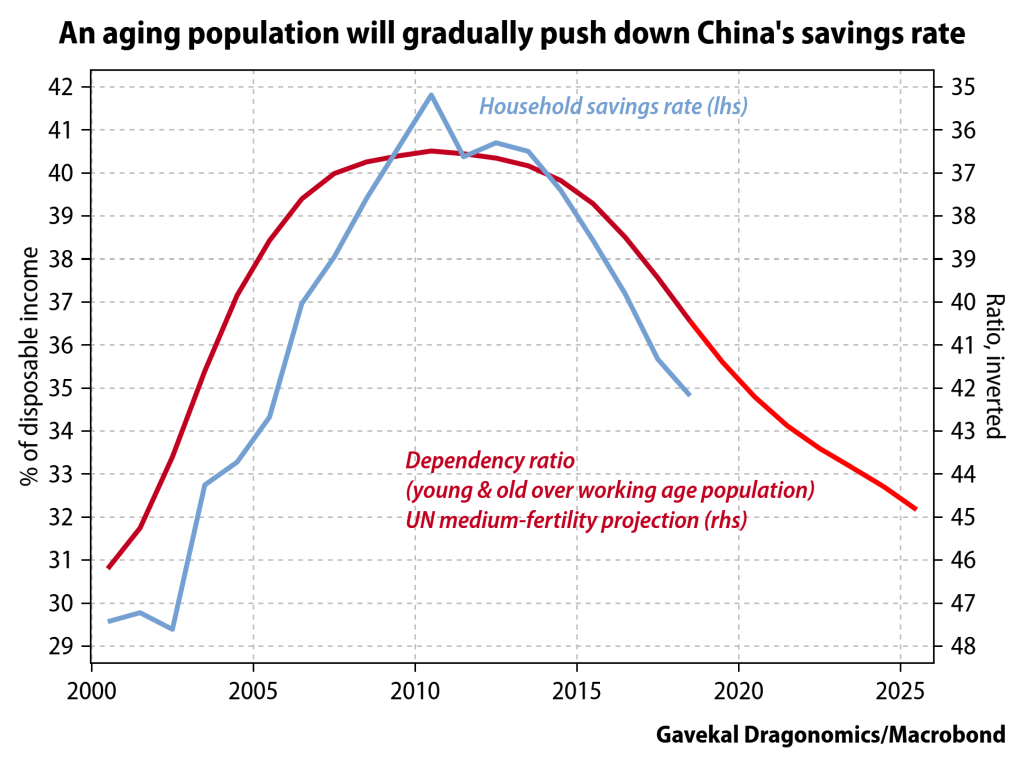
For many economic observers outside China, the typical reaction to this prospect is something like relief: finally, China’s economy will normalize from its unbalanced, high-investment phase onto a trajectory more typical of other economies. This is decidedly not the reaction of the authors of this paper. They view the prospect of naturally lower savings rate with something like alarm. They do not see the transition to a lower share of investment and higher share of consumption as a normal process that unfolds as China becomes more developed, but something to be vigorously resisted. This section is worth quoting in full:

First of all, we should be highly vigilant and prevent the savings rate from declining too rapidly. We must be clear that our country not only bears the burden of development, but the burden of caring for the elderly. Understand this: without [capital] accumulation, there is no growth. Secondly, we must recognize that consumption is never a source of growth. We must understand that it is easy go from frugality from extravagance, but difficult to go from extravagance to frugality. The high consumption rate of developed economies has historical reasons; once you switch, there’s no going back, so we should not take them as an example to learn from. Thirdly, we should pay attention to investment. We must expand domestic investment in the central and western regions; although China’s marginal return on capital continues to decline, the potential for replacing workers with robots in the these regions is still promising. We must expand outward, and especially invest in Asia, Africa and Latin America, because these regions provide the only remaining large demographic dividend.

It’s remarkable how justifications for regional investment policies and the Belt and Road Initiative have worked their way into a paper on demographics. I don’t know if these prescriptions are wrong or right; certainly I cannot claim to have solved the problem of how to respond economically to an aging society. But I do find this paper a fascinating example of contemporary economic thinking in China, for the way in which it starts from different premises than we might expect, and comes to different conclusions. Many countries are already dealing with reality of an aging population, and as China starts to face up to the same problem, we should not assume that the solutions it reaches for will also be the same.

What I’ve been listening to lately

  • Floating Points & Pharaoh Sanders – Promises. This unusual collaboration has been almost universally hailed as a late-career masterpiece for Sanders, the one-time terror of the 60s avant-garde who has mellowed into something like elder-statesman status (see reviews in the New Yorker, Pitchfork, and the New York Times). Richard Williams’ review calls it less challenging than some earlier jazz-meets-ambient work, such as the great John Tchicai With Strings, which is fair enough. But it’s still strikingly lovely.
  • Morwell Unlimited – Dub Me. Somehow this didn’t grab me when I first listened to it a decade or so ago–whoops, mistake. Perhaps that’s because it’s quieter and more pared-down than an a lot of dub. In fact it is a masterpiece of minimalism, one of King Tubby’s finest efforts. I picked this up back when the Blood & Fire reggae reissue label was still going strong and its CDs were still in circulation; it’s harder to find now (the link is to Deezer).
  • Sonic Youth – Simon Werner a Disparu. These instrumental jams are the last studio recordings Sonic Youth made before they broke up in 2011. They were my favorite band back when I was a Young Alternative Dude, and the chime of their detuned guitars can still bring a smile to my face. There’s nothing too groundbreaking here, but if you like the spacey bits of other SY albums then this will also be enjoyable.
  • Stan Getz – Captain Marvel. Chick Corea, may he rest in peace, played electric piano on this 1972 date, and his fusion-y Return To Forever band made up with the rest of the sidemen. But the resulting sound bears little resemblance to other offspring of Miles Davis’ electric period: it’s a rare example of electric jazz without rock gestures, just that gorgeous Getz tone throughout.
  • Edgard Varèse – “Density 21.5.” Originally composed in 1936, this solo flute piece has had a strange afterlife as a symbol of the potential for cross-pollination between jazz and classical music. A copy of the score with a signed dedication from the composer was found among Eric Dolphy’s papers in the Library of Congress, and Dolphy reportedly performed it at a 1962 concert. Among the many losses from Dolphy’s tragic early death in 1964 is the fact that we will never hear his take on it. The original 1950 recording of the piece is spooky, but actually does not sound too radical compared to the vocalized sounds Dolphy would develop in his own flute playing.

China’s fiscal policy and the new rhetoric of inequality

The Chinese Communist Party is now ideologically committed to reducing income inequality. That the previous sentence is not in fact a meaningless circular statement says a lot about the peculiar evolution of socialism in China since 1978. But after dodging around that part of its socialist ideological heritage for the last few decades, China’s leadership is now grappling with the issue of inequality more directly, at least in its rhetoric. The 14th Five-Year Plan adopted in March includes a section that calls for “proactively narrowing regional, urban-rural and income gaps.” And Xi Jinping himself has recently been highlighting the goal of “common prosperity,” a term that has deep political resonance in China because of its use by Deng Xiaoping.

This has not been a sudden shift of direction. Various elements of the bureaucracy have been working over the last couple of years to lay the ground for this new policy focus, a process that I described in a previous post. Attention to inequality is a natural sequel to, and development of, Xi’s now-concluded campaign to eliminate absolute poverty. But how this new rhetoric will translate into reality is far from clear. Officials have not yet put forward big ideas on how to actually narrow inequality, and it seems they could not reach agreement on the details in time for them to be included in the plan. The Five-Year Plan document itself includes only a general discussion of goals, and a pledge to draft a separate “action plan” on common prosperity.

In the US, those who want the government to do more to reduce inequality usually focus on major shifts in fiscal policy, like raising taxes on higher-income households and expanding benefits for lower-income ones. But China’s fiscal policy is peculiarly conservative in its spending priorities and its tax structure is actually regressive. It’s notable that, for instance, the government declined to offer any direct income support to households during the Covid-19 pandemic, which it could have done for a very modest fiscal cost. Rightly or wrongly, a bias toward supply-side policy is strongly entrenched among Chinese officials. Xi’s new political rhetoric about reducing inequality and achieving common prosperity thus sits rather awkwardly on top of a set of entrenched government policies that have long tolerated, or even encouraged, greater income inequality.

The signals so far do not suggest that a radical reordering of the government’s taxing and spending priorities is on the way. At a press conference last week, assistant minister of finance Ou Wenhan was asked about how fiscal policy would help advance “common prosperity,” and his response offered a few clues to official thinking. Importantly, he said that “it is necessary to maintain the overall stability of the macro tax burden” over the coming five years. That means there will not be a major increase, or decrease, in tax revenue’s ratio to GDP. In other words, the government is not preparing to raise revenue to finance a major expansion of the welfare state. Indeed, Ou indicated that it still wants to cut taxes at the margin for manufacturers and small businesses.

Any additional spending on redistributive programs will therefore have to come from moving around existing funding sources. While Ou did pledge to improve the social safety net, there were no promises of a generous New Deal for China’s citizens. Indeed he warned that protections must not go too far, or be too expensive. “We must strengthen our ability to evaluate the fiscal affordability of livelihood policies, and avoid the risk of over-promising and over-protecting,” he said.

Another indication of the government’s interest in keeping down the fiscal cost of addressing income inequality is its focus on the so-called “tertiary distribution.” In the jargon, the primary distribution of income is income directly received from labor and capital, while the secondary distribution of income results from the government redistributing that income through taxes and spending. The tertiary distribution of income refers to the additional redistribution achieved through private charities. Ou said the government will “support the role of charity and other forms of tertiary distribution, and give full play the role of charitable organizations” in supporting the poor, elderly and sick. That suggests a desire to keep some of the costs of political promises off the government’s books.

The finance ministry does sound as if it is getting ready to toughen enforcement of China’s rather lax personal income tax system, and bring many of the high-income individuals that now successfully evade taxes into the tax collection net. Ou spoke of establishing “personal income and property information systems,” and of the need to “appropriately regulate excessively high incomes, outlaw illegal income, and curb income obtained through monopoly and unfair competition.” It does sound like the new era of common prosperity will be one of tougher legal and political scrutiny of high-income and high-net-worth individuals.

The most substantive commitments to inequality-reducing policies were in Ou’s pledges to “Increase financial support to less developed regions and gradually achieve equalization of basic public services” and to “further tilt transfer payments to central and western regions and depressed regions.” China’s government has long preferred to treat poverty and inequality as problems of geography: if poor people tend to be in certain places, just give those places more money. Raising fiscal transfers to lower-income provinces could certainly help those areas, and given that it uses existing institutions, would also be a relatively easy policy to execute. But there has already been a lot of regional aid in China in recent decades, and using government-sponsored investment projects as a tool of regional development has at best a mixed track record.

Malthus reconsidered

The name of Malthus will forever be associated with the idea of resource constraints on human population growth– which is unfortunate, because his argument appears to have been completely wrong. But I feel a need to compensate a bit for my little essay on those mistakes after reading John Maynard Keynes’ delightful biographical sketch of Malthus. Keynes offers an alternative intellectual history of Malthus, in which the Essay on the Principle of Population appears as a youthful work that gave him much notoriety, but was far from his most significant intellectual accomplishment.

It is difficult to overstate just how good Keynes’ essay on Malthus is: it is wonderfully detailed yet short, warmly sympathetic yet intellectually sharp. (Among other tidbits, we learn the name of Malthus is derived from “Malthouse,” and should be pronounced similarly.) Tyler Cowen has called Keynes “one of the greatest biographical writers in the entire English language.” And indeed I found Keynes’ Essays in Biography to be very good, though the meat of it is really the biographical essay on Malthus and a more extended one on Alfred Marshall; the sketches of British politicians for me were less interesting and insightful.

Keynes claims Malthus as his intellectual forebear, “the first of the Cambridge economists,” on the strength of Malthus’ early attention to the demand side of the economy, and his invention of the concept of “effective demand,” a precursor to today’s “aggregate demand.” As far back as 1820, in his Principles of Political Economy, Malthus recommended “the employment of the poor in roads and public works” as a remedy to economic downturns. But the first appearance of this idea actually came in 1800, in an anonymous pamphlet called An Investigation of the Cause of the Present High Price of Provisions:

Malthus’s conception of “effective demand” is brilliantly illustrated in this early pamphlet by “an idea which struck him so strongly as he rode on horseback from Hastings to Town” that he stopped two days in his “garret in town,” “sitting up till two o’clock to finish it that it might come out before the meeting of parliament.” He was pondering why the price of provisions should have risen by so much more than could be accounted for by any deficiency in the harvest. He did not, like Ricardo a few years later, invoke the quantity of money. He found the cause in the increase in working-class incomes as a consequence of parish allowances being raised in proportion to the cost of living. …

The words and the ideas are simple. But here is the beginning of systematic economic thinking.

Keynes found that Malthus’ economic thinking was best developed in his long correspondence with David Ricardo, a relationship that managed to combine deep and sincere friendship with equally profound intellectual disagreement:

This friendship will live in history on account of its having given rise to the most important literary correspondence in the whole development of Political Economy. … Here, indeed, are to be found the seeds of economic theory, and also the divergent lines—so divergent at the outset that the destination can scarcely be recognised as the same until it is reached—along which the subject can be developed. …

The contrasts between the intellectual gifts of the two were obvious and delightful. In economic discussions Ricardo was the abstract and a priori theorist, Malthus the inductive and intuitive investigator who hated to stray too far from what he could test by reference to the facts and his own intuitions. …

One cannot rise from a perusal of this correspondence without a feeling that the almost total obliteration of Malthus’s line of approach and the complete domination of Ricardo’s for a period of a hundred years has been a disaster to the progress of economics. Time after time in these letters Malthus is talking plain sense, the force of which Ricardo with his head in the clouds wholly fails to comprehend. Time after time a crushing refutation by Malthus is met by a mind so completely closed that Ricardo does not even see what Malthus is saying.

Malthus’ strengths, on Keynes’ account, are his close attention to the realities of economic life and his detailed investigation into practicalities, which gave him insights that Ricardo’s abstractions could not. It’s interesting, therefore, that he characterizes Malthus’ first writings on population as “a priori and philosophical in method,” the precise terms in which he criticizes Ricardo’s arguments.

While Malthus added huge amounts of empirical material to the second edition of the Essay on the Principle of Population, it is clear that the inspiration for the first edition was not empirical. It was more of an abstract conviction, one that arose during a theological argument with his father. William Otter, a friend of Malthus, relates the story in his Memoir of Robert Malthus:

The mind of Mr. Malthus was certainly set to work upon the subject of population, in consequence of frequent discussions between his father and himself respecting another question, in which they differed entirely from each other. The former, a man of romantic and somewhat sanguine temper, had warmly adopted the opinions of Condorcet and Godwin respecting the perfectibility of man, to which the sound and practical sense of the latter was always opposed; and when the question had been often the subject of animated discussion between them, and the son had rested his cause, principally upon the obstacles which the tendency of population to increase faster than the means of subsistence, would always throw in the way; he was desired to put down in writing, for maturer consideration, the substance of his argument, the consequence of which was, the Essay on Population.  

Keynes does not discuss whether Malthus’ theory of population–that it would always grow exponentially while food production could only grow linearly–was actually correct, seeing it mainly as an early example of the power of his intellect. When the early work on population is considered along with the later work on political economy, the intellectual contrast with Ricardo is perhaps not as sharp as Keynes makes it out to be: Malthus too could be bullheaded in holding to his a priori theories in the face of contrary argument. But who among us has not been guilty of that?