China in the 2020s is not France in the 1960s

That sentence seems obvious enough that I would not need to write it. But there does seem to be a strain of thought out there that sees China’s economic system, with its high levels of state ownership and extensive planning, as basically the same thing as the mixed economies that Western Europe had in the immediate postwar decades, which featured more state ownership and planning than after the 1980s. In this view, China today confronts the Western economies not with a completely foreign economic system, but with an image from their own past, a reminder that they have drifted too far in a market fundamentalist direction. The most prominent proponent of this line is probably Thomas Piketty; his recent commentary on China includes this passage:

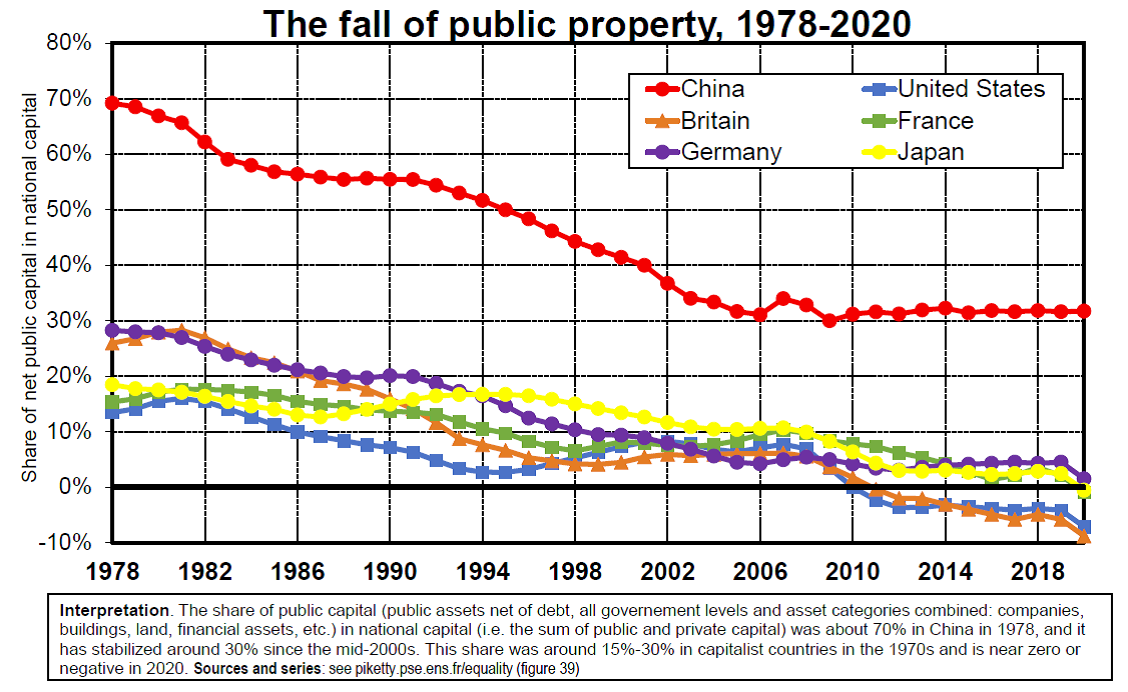
On the economic and financial level, the Chinese state has considerable assets, much greater than its debts, which gives it the means for an ambitious policy, both domestically and internationally, especially regarding investments in infrastructure and in the energy transition. The public authorities currently hold 30% of everything there is to own in China (10% of real estate, 50% of companies), which corresponds to a mixed economy structure that is in many ways comparable to that found in the West during the period of prosperity 1950-1980 (known in France as the ‘trente glorieuses’). Conversely, it is striking to note the extent to which the main Western states all find themselves in the early 2020s with almost zero or negative patrimonial positions. 

Piketty’s comparison is based on empirical data: the estimates he made, in a joint paper with Li Yang and Gabriel Zucman, of the extent of government ownership of assets in China. He finds that China’s recent level of 30% is similar to the 15-25% that prevailed in Western countries in the 1970s. So if you squint at his chart, the line for China today does get close to the lines for Britain and Germany in 1978.
The good thing about data is that they can challenge your intuitions. Still, the claim that an authoritarian state that spent decades under socialism has basically the same political-economic structure as that of the postwar European democracies is not the world’s most obviously plausible argument. And looking at different data indeed tells a different story.

When I’ve tried to grapple quantitatively with the question of the role of the state in China’s economy, I’ve focused on state-owned enterprises, whose large role is one of the most obviously distinctive features of China’s system. China’s own official data on state-owned enterprises imply that they have generated value-added equivalent to around 25-30% of GDP in recent years. (If you don’t believe my numbers, there is a World Bank paper that comes to basically the same conclusion using different methods). Conceptually, these figures represent the flows of income generated by the stock of assets counted by Piketty.

We can compare these numbers to historical figures for European and other economies thanks to an IMF research project from 1984 published as the the book Public Enterprises In Mixed Economies. According to these estimates, state-owned enterprises accounted for 12-13% of GDP in France in the 1960s, 10% of GDP in Germany in the 1970s, 7% of GDP of Italy in the 1970s, and 10% of GDP in the UK in the 1960s and 1970s. After the privatization wave of the 1980s, state-owned enterprises in the UK accounted for about 2-3% of GDP, according to the 1995 World Bank study Bureaucrats in Business (it did not have more recent estimates for continental Europe). In the US and Japan, state-owned enterprises have historically been about 1% of GDP.

The state-owned enterprise sector in China today, therefore, is actually two to three times larger relative to the economy than it ever was in continental European economies. And China’s state enterprise sector is 10-15 times larger than the now quite minimal state sectors in the English-speaking economies. Those are big differences! It seems clear that China’s socialist market economy is quantitatively and qualitatively different than the mixed economies of the postwar European social democracies, as indeed we should expect given their quite different political foundations. When these economies engage with China, they are not engaging with a version of their past selves but with a quite different kind of entity. I think these differences make China more interesting and worth understanding than if it were just retreading the past trajectory of Western Europe.

It is true that the European economies had sustained fast growth in the postwar decades, which invites comparison to the sustained fast growth of China in more recent decades. But in both cases I would point to the magic of catch-up growth and trade liberalization as the most obvious drivers (on this, see Brank Milanovic’s interesting comments on the misplaced nostalgia for Europe’s postwar years). Europe in 1945 and China in 1978 both had quite backward capital stocks that could be rapidly expanded and modernized, as well as relatively high levels of human capital that could be productively deployed once war and political turmoil were over. And in both cases increased participation in global trade, through the European Community/European Union or GATT/WTO, could further accelerate specialization and technological progress.
Food security and structural transformation

There is a new working paper out from the Bank of Japan, written by four authors from its international department, considering the prospects for China’s productivity growth over the long term. It’s pretty interesting and not just the usual stuff. One of the novel aspects is its analysis of food security. While that’s not a traditional topic for a productivity analysis, the logic is pretty straightforward.

Part of the growth in China’s labor productivity is coming not just from improving the productivity of specific industries, but from the shift of workers across industries (since China’s workforce stopped growing about a decade ago, labor productivity growth accounts for virtually all of its GDP growth: GDP growth = growth in output per worker + growth in number of workers). The structural transformation of the economy–moving workers from sectors where they produce less value-added, like agriculture, to those where they produce more value-added, like manufacturing–is one of the fundamental motors of economic development.

The authors estimate that out of China’s 10.7% average annual productivity growth from 2006-10, moving workers across sectors accounted for about 2 percentage points, and about 1.5 percentage points of the 7.6% growth from 2011-15 (these numbers are not given in the text, so I estimated them from a chart; apologies for any inaccuracy). But the reallocation of labor across sectors contributed less than 0.5 percentage points of the 6.9% growth over 2016-19, so a slowdown in structural change does seem to a factor in China’s overall growth slowdown.

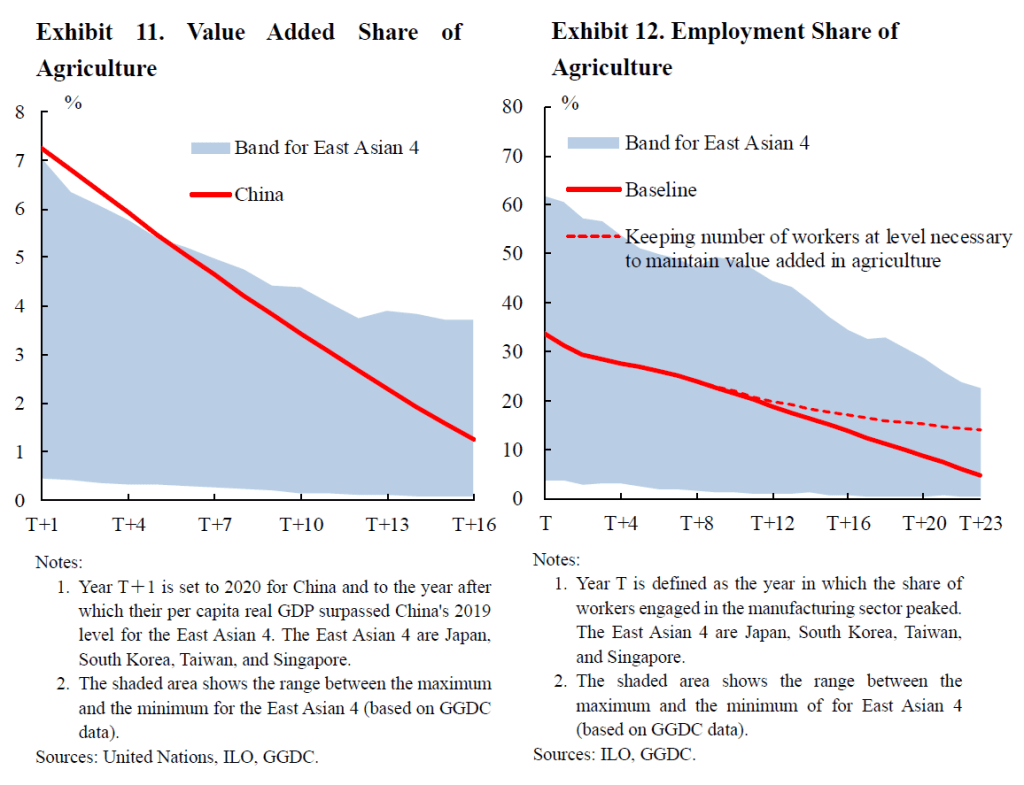
The authors suggest that if the government’s concerns for food security lead it to try to keep workers in agriculture, that could impede structural transformation and therefore slow growth. They model a future growth trajectory for China that suggests that if its industries continue on the same path of productivity convergence and structural change as Japan, South Korea, Taiwan and Singapore, it can grow by an average of about 4.8% until 2035. But that trajectory of structural transformation would mean a continued sharp decline in the agricultural share of employment, and thus (since labor productivity growth in agriculture is slow) in agricultural output. So a continued rapid pace of structural transformation may not be compatible with food security. Here’s the relevant passage from the paper and the supporting charts:

The first issue concerns the balance between food security on the one hand and the shift of labor from agriculture to other industries on the other. In China, agriculture at present accounts for a larger share of GDP than in the East Asian 4 when they were at a similar per capita GDP level, reflecting the Chinese government’s policy of achieving a rate of food self-sufficiency of 95% or higher. However, in the baseline estimate, the employment share of agriculture and the share of agriculture in GDP will decrease significantly in the future due to a combination of the movement of labor across sectors and the effects of the aging of the population. As a result, real output in agriculture would drop to less than 40% of the current level, which means that China would have to effectively abandon food self-sufficiency.

However, in practice, it is unlikely that the Chinese government will tolerate such a change in industrial structure from the perspective of food security. Therefore, to consider a more realistic path, we assume that the shift of labor from agriculture will be limited to an extent that maintains the current level of real output in agriculture. In this case, GDP in 2035 would be about 10% lower than in the baseline estimate and only 1.87 times the current level.

It is possible to quibble with some of the details in this analysis. The Chinese government does not actually have a target of 95% self-sufficiency in all food supply. In the past, there had been an official target of 95% self-sufficiency of staple crops (liangshi 粮食, which is usually translated as grain but also includes beans and tubers). But this was difficult to enforce, and in practice large imports of soybeans have been tolerated. Xi Jinping proposed adjusting this policy early in his tenure to have a more realistic target (see my previous post from 2015 on the food security policy debate).

The white paper on food security published in 2019 mentions 95% self-sufficiency in cereals (rice, wheat, corn), but as an achievement rather than a strict target. The white paper does articulate an overall goal of self-sufficiency–“China makes sure it relies on itself for food supply”–but this is not given a strict quantitative definition, which allows the government flexibility (see this analysis from the excellent Dim Sums blog on Chinese agriculture). The government’s actual goal is probably to maintain certain levels of output of staple grains rather than to limit all food imports. It’s likely that could be accomplished even as the shares of agricultural employment and value-added continue to decline.

Nonetheless, I think the paper’s point that official food security concerns can act as a brake on structural change is correct. China’s actual agricultural policy has been fairly conservative, in the literal sense of trying to conserve an existing order. The trade war with the US reinforced the risks of relying on imported food, and Xi urged more focus on domestic production. While there may not be hard target on the acceptable level of food imports, there is a general push to maintain a large population of agricultural workers and slow rather than accelerate their shift into other sectors. Xi’s government for instance is encouraging rural residents who migrated to the cities for nonagricultural work to return to rural villages. The government has been clear that it wants to preserve the collective system of rural land ownership, which prevents farmers from being dispossessed of their land but also limits their freedom to leave it (for more on this point, see this Dim Sums post from March).

The paper is entitled “China’s Long-Term Growth Potential: Can Productivity Convergence Be Sustained?” and is worth a read.

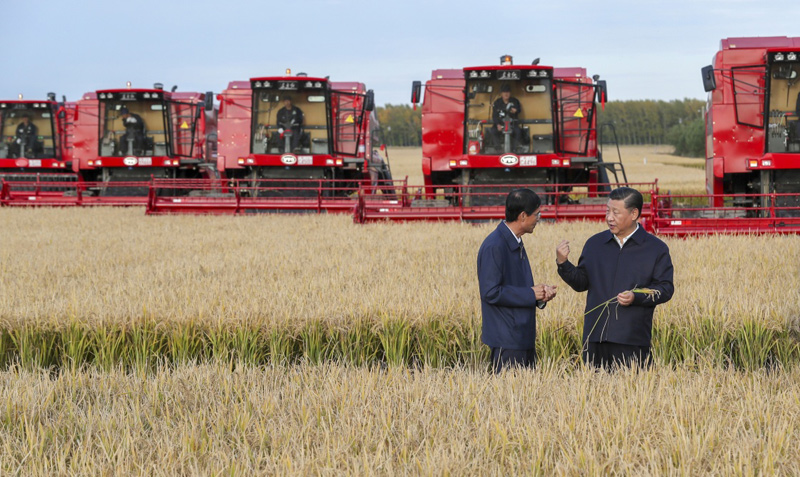
Xi Jinping on a September 2018 tour of Heilongjiang province

What I’ve been listening to lately

  • Alice Coltrane – Ptah, the El Daoud. A real classic. Joe Henderson and Pharoah Sanders are not an obvious combination of players, but they are surprisingly complementary here, delivering dark and complex lines over Coltrane’s driving piano. Still, the centerpiece of the album for me is the moody, bluesy “Turiya and Ramakrishna,” on which the horns lay out; it’s one of my favorite pieces of jazz piano trio.
  • Susan Alcorn – Pedernal. I’ve been catching up on various best-of-2020 lists, many of which featured this album. It has one of the more distinctive sounds of recent jazz bands: an all-string lineup of pedal steel guitar, guitar, violin, bass, drums. The complex tunes pay homage to the pedal steel’s country heritage while still exploring outer space. A truly unique musician, Alcorn is starting to get more of the recognition she deserves.
  • Webber/Morris Big Band – Both Are True. Another widely praised release of 2020, this is complex and up-to-the-minute contemporary ensemble work. The compositions by Anna Webber and Angela Morris deploy an amazing range of instrumental sounds in carefully chosen combinations, mixing minimalist repetition and improvisational climaxes to excellent effect.
  • Carla Bley – Andando El Tiempo. Bley has had a long and distinguished career (ably documented by Ethan Iverson), but for my money her recent recordings are among her very best. This is the second in a series documenting an intimate trio with bassist/husband Steve Swallow and saxophonist Andy Sheppard. Although Bley is more known for her large ensemble arrangements, the small-group interplay here is wonderful.
  • Alice Coltrane – Journey In Satchidananda. Alice gets two, as there’s been a strong need for spiritual jazz lately in my house. The monster bass lines from Cecil McBee tie the whole thing together, and Pharoah Sanders is mostly restrained and even pretty on soprano sax throughout. The interplay between Rashied Ali’s drums and Vishnu Wood’s oud on the closing “Isis and Osiris” is one of many highlights.