
Reading China’s five-year plans, one of the most immediately striking things is just how many things they attempt to plan. These are not just documents about where to build airports or highways (although such proposals do go into the plan). Recent iterations also cover many things that are not obviously amenable to top-down direction, such as what sorts of technological breakthroughs will happen in the future, and how social mores and customs will develop. In China’s Leninist political system, government attempts to specify the contours of “national economic and social development” are the norm rather than the exception.
In this context, restraint can be more notable than ambition. It’s not that surprising when plans declare extraordinary goals; it is more surprising when plans step back from attempted intervention. The 15th Five-Year Plan for the years 2026-30, now being drafted according to a set of “recommendations” approved by the Communist Party leadership in October, will certainly not be a laissez-faire document. Most media coverage has emphasized how the recommendations show China prioritizing industrial policy as it attempts to gain an edge in its geopolitical competition with the US. Here is a relevant section from the official English translation:
A modernized industrial system provides the material and technological foundations for Chinese modernization. We should keep our focus on the real economy, continue to pursue smart, green, and integrated development, and work faster to boost China’s strength in manufacturing, product quality, aerospace, transportation, and cyberspace. The share of manufacturing in the national economy should be kept at an appropriate level, and a modernized industrial system should be developed with advanced manufacturing as the backbone.
The obsession with advanced manufacturing as the avatar of the “real economy” is familiar from years of similar documents from China’s planning apparatus. But if we read this passage in the spirit of looking for what is missing, rather than what is included, one thing stands out: the language on the share of manufacturing. The 14th Five-Year Plan, when it was published in 2021, included a new goal to “maintain the basic stability of the manufacturing share” of GDP.
Previous plans had included goals to raise the service sector’s share of GDP, which at the time was seen as an indicator of the structural transformation and modernization of the economy. The 14th plan dropped those goals, and replaced them with the goal for stability in the manufacturing share of GDP. Rather than accepting that China’s economy would eventually look like everyone else’s–with the manufacturing share of GDP gradually falling over time–planners wanted China to stand out globally by avoiding the trend of de-industrialization.
It’s one thing to declare such goals, another to achieve them. The structural composition of an economy is not particularly easy to control: there is no single dial to turn that will boost manufacturing or scale back services. And in the event, the 14th plan’s declaration did not stop the manufacturing share of GDP from declining: it has gone from 26.6% in 2021, the first year of the plan, to 24.9% in 2024, and looks like it will tick down a bit more to around 24.8% by the end of 2025, when the plan period concludes.
This is not a large decline, and what counts “basic stability” is, after all, up to the government to decide. The Ministry of Industry and Information Technology, the agency responsible for this target, has already publicly declared that the manufacturing share is in fact basically stable. But the direction is clear: the manufacturing share of GDP has been in mostly uninterrupted decline since 2021. It spiked up during the post-Covid export boom of 2021, but has since resumed the downward trend.
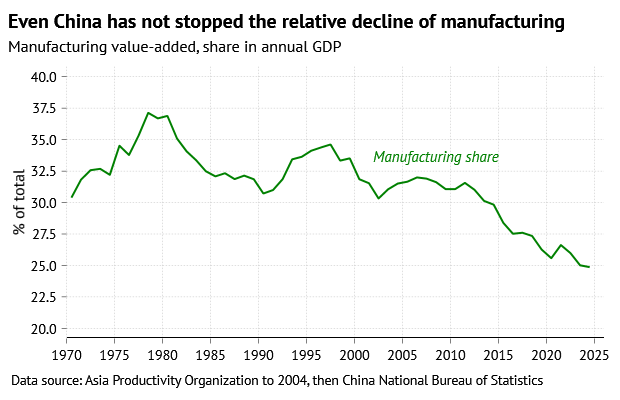
The change in the wording for the next plan must therefore be read as an implicit admission of defeat: it was not actually possible to keep the manufacturing share of GDP unchanged, even with very generous subsidies for manufacturing investment and output. The next plan’s goal has thus been scaled back, from stopping the decline in the manufacturing share to just making sure the manufacturing share is “appropriate,” whatever that means. That this wording accepts some continued future decline in the manufacturing share of GDP was made clear in an explanatory article published in Seeking Truth, an official journal of the Communist Party leadership:
Traditional economics holds that a decline in the share of manufacturing and a rise in the share of services as the size of a country’s economy increases is a universal economic phenomenon. … The share of manufacturing in China displays an inverted U-shaped curve of “first rising and then falling,” which basically accords with the theory and practical regularities of industrialization. However, what we must be alert to is that this share must not decline too rapidly, nor fall to an excessively low level, as this could lead to serious consequences.
Among the main reasons that the manufacturing share of GDP tends to decline and the services share to increase in higher-income economies are that incremental household spending shifts from goods to services as incomes rise, and that changes in relative prices tend to make services (which tend to have slower productivity growth than manufacturing) a larger share of nominal GDP over time.
Both of these trends are a consequence of economic success, in terms of higher output and productivity: at least some of what is decried as “de-industrialization” is good actually. It is also good for China’s planners to recognize that reality and not distort the economy in pursuit of an impossible outcome. Obviously, a loss of export competitiveness would be a less positive reason for the manufacturing share to decline, but it makes more sense to focus on that issue directly than indirectly through an ambiguous indicator like the manufacturing share of GDP. Again, it’s not just significant what plans attempt to control—it is also significant what they do not attempt to control.
Will this change make a difference? Arguably, no. Since it’s not really possible for the government to directly control the relative shares of GDP of different sectors, it might not make much practical difference whether it has such stated goals. And there is still plenty of planning language about supporting the manufacturing sector. But it’s also arguable that changing the rhetoric will have effects. Technically, everything in the five-year plan has the force of law, and government officials are obligated to pursue the goals. The goal of maintaining the manufacturing share of GDP may have served as part of the justification for lots of specific policies that subsidized manufacturing output and investment.
There’s even a case to be made that those policies actually depressed the manufacturing share of GDP: by boosting output and capacity above where they would have been otherwise, subsidies probably contributed to the sustained decline in prices for China’s manufactured goods over the past few years, weighing on their share of nominal output. If subsidizing manufacturing output and investment is no longer so politically urgent, because there is no structural imperative to meet, then perhaps there will be room for those subsidies to retreat at the margin. That would certainly not be the outcome most outside observers expect from a five-year plan generally described as “doubling down” on industrial policy.
 The Tangled Woof