Who is Lev Gumilev?

I did not know the answer to that question, but now I am very glad that I do. In an excellent weekend piece in the Financial Times, Charles Clover explains why this Russian “academic scribbler of a few years back” is now being name-checked by Putin:

Working as a historian from the late 1950s to the end of his life, Gumilev became a renowned expert on the steppe tribes of inner Eurasia: the Scythians, the Xiongnu, the Huns, Turks, Khitai, Tanguts and Mongols. Their history did not record the progress of enlightenment and reason but rather an endless cycle of migration, conquest and genocide. Every few hundred years, nomads would sweep out of the steppes, plunder the flourishing kingdoms of Europe, the Middle East or Asia, and then vanish into history’s fog just as quickly as they had come. The victors in these struggles were not the societies that led the world in technology, wealth and reason. Instead, they had something that Machiavelli described as virtù, or martial spirit, while the medieval Arab philosopher Ibn Khaldun described the tribal solidarity of nomadic raiders of civilised cities as asabiyya. To Gumilev, this was passionarnost.

In this idea was the germ of a new Russian nationalism. In his later years, Gumilev celebrated Eurasianism, a theory developed in the 1920s by Russian exiles. Nostalgia for their homeland and the trauma of the Bolshevik revolution had led them to reject the idea that Russia could ever be western and bourgeois. Instead, they wrote, it owed its heritage more to the fierce nomads and steppe tribes of Eurasia. The Enlightenment, in the form of advanced European social theories, had brought Russia to genocide and ruin, while there was a harmony in the wildness of the Huns, the Turks, the Mongols. The steppe lands and forests of the inner continent had traditionally been prone to rule by a single conquering imperial banner. The Russians, they — and now Gumilev — wrote, were the latest incarnation of this timeless continental unity.

Gumilev’s theories have become the standard for a generation of hardliners in Russia, who see in his books the template for a synthesis of nationalism and internationalism that could form the founding idea of a new Eurasia, a singular political unit enjoying much the same frontiers as the USSR. Gumilev’s Eurasianism, a buzzword in official circles, provided the inspiration for Putin’s Eurasian Union, a vision first laid out in October 2011, a week after he announced his intention to return as president of the Russian Federation. Russia, said Putin, would join its former Soviet subjects in a union “that won’t be like other previous unions”. Few, however, doubt that the new union aims to bring the region once again under the Kremlin’s hand.

Clover’s book on Russian nationalism is out later this year.

Reluctant pioneers on China’s northern frontier

Over the Chinese New Year holiday I read James Reardon-Anderson’s Reluctant Pioneers, one of the relatively small number of modern English-language histories of China’s Northeast, aka Manchuria. The Northeast is my favorite part of China, so of course I wanted to read the book, but the history of the Chinese migration into Manchuria is fairly amazing and of more general interest. Thomas Gottschang, another historian who has tackled the subject, summarized why in a 1987 article (JSTOR link):

The migration to Manchuria (Northeast China) from the North China provinces of Hebei and Shandong between 1890 and 1942 was one of the world’s largest population movements in the early 20th century. With an average annual flow of 500,000 people and a total net population transfer of over 8 million, the migration was comparable in size to the westward movement in the United States between 1880 and 1950. It was roughly twice as large as the great 19th-century emigration from Ireland, and its peak years in the late 1920s and early 1940s rivaled the heaviest flow of European immigration to the US in the mid-19th century.

Reardon-Anderson’s book argues that while the Chinese migration north of the Great Wall may have been similar in scale to the migration into the western US, the social and cultural dynamics of this Chinese frontier were utterly different. Many of the characteristics Americans automatically associate with frontier life were missing: socially, a pattern of individual homesteads striking far out on their own, and culturally, a sense that “conquering the frontier” transformed both people and the country for the better. I’ve stitched together some quotes to summarize the argument:

Most Chinese who found themselves, owing to the vicissitudes of life, outside the Great Wall were neither happy nor proud to be there. The movement of migrants and refugees was rarely driven by a quest for fortune or adventure or by a religious, political, or ideological calling. Instead, young men were sent out by their families to earn and return, while the punishment for failure was exile. (p.143)

Chinese crossing the Great Wall moved only as far as they had to. Most settled in the south, where natural conditions, previous acquaintances, and established communities made life seem familiar, comfortable, and promising. The earliest arrivals were often successful in renting or reclaiming land, founding new villages or joining communities that were sparsely populated and welcomed new recruits. As these areas filled up, later migrants arrived, adding to the burden of overpopulation and triggering a secondary migration into the next ring of land, which was more sparsely populated and able to absorb newcomers. (p. 137)

The opposite example–pioneers who had moved directly from China proper to some remote location to wrest land and livelihood from the wilderness–is conspicuous by its absence. Figures on the arrival and departure of migrants in northern Manchuria during the period 1921-26 show that only about 7.5% of the new arrivals chose to stay in the north while the remainder returned to southern Manchuria or to China proper. (p. 140)

Why did Chinese migration take this “reluctant” form of incremental moves out from existing settlements, rather than single households striking out into the far frontier? Contemporary observers of the migration to Manchuria in the 1920s favored cultural explanations: the alleged collective spirit of the Chinese as compared to the individualist nature of the American. Reardon-Anderson gives a more a nuanced account of how the social structure of northern Chinese villages affected incentives for migration, but does not entirely dismiss this type of explanation. He does however explain how other factors were also important:

One reason that migrants, even refugees with few choices in life, after traveling as far as the railroads or their legs would carry them, returned home or to densely populated southern Manchuria was that land on the frontier was expensive and tightly held by a minority of large owners who were disinclined to sell or in some cases even rent the land to the new arrivals. The policies of the late Qing to sell land and settle population in Manchuria and Inner Mongolia, which were ostensibly designed to raise money and strengthen the nation’s defense, also had the effect of shifting wealth and power to a minority of well-connected landowners. By the early 20th century, the ownership of land in these regions was concentrated in very few hands, and the refugees of the 1920s found little for sale or even for rent at prices they could afford. (p. 153)

Another reason was probably the different attitude of the government toward the exploitation of the frontier:

The Manchus recognized that China proper was the core of their empire and the main source of its wealth and power, while Manchuria was part of a periphery that must serve the function of protecting and preserving the core. Despite their special interest in the Manchu homeland and neighboring Inner Mongolia, the Qing treated these territories as a buffer zone. …Absent from the Qing agenda in Manchuria, Inner Mongolia, or any other border region was an ideological or developmental drive to conquer, convert, and control these territories. (p. 87)

One of the more interesting comparisons in the book is with the Russian settlement of Siberia (the lands north of Manchuria). Here the pattern seems more like the American frontier:

In contrast to Russian settlement west of the Urals, which operated under the thumb of Moscow, favored the landed elite, and kept labor in check, settlement in the east involved greater freedom of movement and choice on the part of peasants and less control by the military, the nobles, and the state. This pattern of migration and settlement produced in Siberia a society and culture with a distinct identity and separate regional character, of a sort unknown among Chinese communities in Manchuria. Russian migrants came to Siberia from throughout the “Black Earth” region, an area more than five times as large as Shandong and Hebei, with the result that settlers in the Russian Far East were more diverse and less likely to share a common identity than their counterparts in Manchuria. Russians moved as entire households, determined to leave the village for good, in contrast to Chinese who sent one or two young men on a temporary mission to find work and return with money to advance the fortunes of the family back home. (p. 164)

The book is clearly organized, reasonably well written, and no longer than it needs to be, all virtues; it is however an overpriced academic-press tome so hard to recommend that the casual reader pick it up. But at least there are things for the English-language reader to read about Manchuria (notably Michael Meyer’s excellent memoir In Machuria from last year). The Scholar’s Stage blog has an excellent discussion (Why Do We Know So Little About China’s WWII?) on the many, many important eras and episodes in Chinese and Asian history for which not a single English-language narrative history exists.

The African drone manifesto

I wasn’t quite sure what to expect when I started reading J.M. Ledgard’s little e-book Terra Firma Triptych, but I loved his novel Submergence, and that was enough for me to pick up the new book once I became aware of it (thanks to Slate). It is indeed a triptych, two parts lyrical travel writing about Africa, and one part development economics and drone manifesto–a combination I am fairly sure so other writer has ever attempted.

The writing is characteristically beautiful and heartfelt, and the first two sections do actually lay the groundwork for his discussion of why drones could revolutionize Africa: because the land transport is so terrible. The combination is surprising and the argument convincing; here’s a few samples:

I think about this every day, how things shudder on land in Africa, and how they might slip faster in many directions if only they were pushed into the sky. …

There is no room for techno-utopianism in our bare-fisted future. However, it is important to understand that Africa is coming online just as robotics is coming online. As fast as Africa develops, robotics will develop still faster. Robotics may have negative implications for workers in industrial countries, since tasks such as mopping floors and pushing carts can be performed more cheaply by robots. But in nonindustrial countries, robotics can buy you efficiency that you could not otherwise afford. When it comes to flying robotics, radical breakthroughs are possible. …

The last-mile drone delivery of the kind envisaged by Amazon Prime Air and other developers—a tub of sorbet on a suburban lawn—is a rich-world indulgence that does not make sense in off-grid Africa. What is needed here are cargo drones capable of flying loads over mountain ranges, across the largest lakes, along the seashore, and up isolated estuaries and mangroves, saving lives and creating economic opportunities. … Commercial cargo drone routes will begin to appear in Africa around the year 2020. They will boost economic productivity by flying high-value goods over and over again. The cargo drones will deliver to oil and gas installations, mines, farms, conservancies, churches, hospitals, and government outposts.

Ledgard, a longtime foreign correspondent, thinks African adoption of drone technology will be much like its adoption of mobile-phone technology: extremely rapid, and to some extent compensating for a failure to adopt earlier technologies:

Over the last decade reporting out of Africa, I came to see that the most important story was not a news story at all. It was the mass adoption of mobile phones—a technology capable of reordering time and space in even the poorest communities. It was not inevitable that Africa would have access to cellular communications. Development experts argued that mobile phones would always be too expensive for the poor, and besides, how could an African village that was incapable of looking after a grain silo be expected to look after a cell tower? But the price of mobile phones came tumbling down, and financial deals involving the towers showed that there was cash to build out a system. Even the mobile phone operators could not see the possibilities. They underestimated their own market. For instance, the 2003 business plan for the Kenyan telecom Safaricom was to get to half a million mobile phone subscribers by 2013. These would be traders, priests, taxi drivers, prostitutes—people willing to pay a premium to stay in touch. But Safaricom now has 21 million users. To emphasize: the uptake of the advanced technology was forty-two times greater than expected.

Geoff Ryman’s science fiction for development economists

Lots of economists like science fiction, but science fiction that directly engages with the issues that economists think about is actually pretty rare (this list of science fiction novels for economists is, to my eye, more just a list of good science fiction). Paul Krugman once made a case for Charles Stross’ Merchant Princes series as being essentially about development economics, since the books dramatize the interaction between societies at very different technological levels. I read the first novel in the series because of his recommendation, but found it rather more lightweight than Krugman’s post suggested, although still enjoyable.

For a science fiction novel that really is about development economics, I recommend Geoff Ryman’s Air: Or, Have Not Have, a 2004 novel that I read over the holidays and very much enjoyed. Ryman is British and seems to be not that well known in the US, though Air was nominated for and received a number of awards when it came out. The premise is simply stated in the very first sentence:

Mae lived in the last village in the world to go online.

The book is set in a fictional but very plausible Central Asian country, where an imagined technology is being introduced by a combination of a clueless government, a bumbling United Nations and a scheming local businessman. Already that makes it more realistic than much science fiction, and Ryman is very good at village life and the interlocking of personal and business relationships in small-scale societies. What makes this book so good is how it explores the social and personal consequences of new technology. Without giving too much away, here’s a sample from early in the book that illustrates how he does this:

The men in the club chose what movie they wanted. Since the satellites, they could do that. Satellites had ruined visits to the town. Before, it used to be that the men were made to sit through something the children or families might also like to watch, so you got everyone together for the watching of the television. The clubs had to be more polite. Now, women hardly saw TV at all and the clubs were full of drinking. The men chose another kung fu movie.

Like any good novel, it’s more moving and more complicated than a summary of the premise can convey, but I think much of it will ring true to anyone who has spent time in developing countries. I’m retroactive adding Air to my list of the best books I read in 2015. Ryman has apparently written some other books based on Cambodia, which I have not read but now look forward to checking out.

The best books I read in 2015

Here are my favorites out of the books that I read for the first time in 2015, regardless of date of publication (the same rules as previous instalments). This year I (in hindsight anyway) favored fiction about poor white people living in harsh conditions; in non-fiction there were some very good China books, which I do not often recommend. The lists are alphabetical by author, since I find it hard to rank books.

Nonfiction

  • The Night of the Gun, by David Carr. It was only after this legendary journalist died early this year that I discovered he had written a memoir. I generally don’t have much time for memoirs, but this one grabs you from the opening and never lets go. In an an unflinchingly honest investigation into his own past, he destroys all the convenient fictions about his past that he himself had come to believe. Few people have ever been better at calling bullshit.
  • The Utopia of Rules, by David Graeber. Graeber is the only current example I know of a public intellectual who is an anthropologist (a species whose influence has always lagged economists, historians and sociologists). He’s a clear and vigorous writer, and is good at mining the minutiae of daily life for broader insights. These essays are always thought-provoking, though there is always plenty to disagree with.
  • Exit, Voice and Loyalty, by Albert O. Hirschman. A legendary work of social science that fully lives up to its reputation–there are more ideas per page than in anything else I read this year. This 1970 book contains, among other things, a startlingly prescient analysis of how American political parties work, and reflections on the relationship between producers and consumers that provide a ready-made conceptual framework for understanding internet commerce. I’m still digesting it.
  • Why Did Europe Conquer the World?, by Philip T. Hoffman. An admirably clear and concise entry in the genre of big-idea books explaining European dominance. Though there are lots of interesting historical tidbits in the book, it is less a narrative than the presentation of a model that that explains why Europeans could conquer so many other peoples. The clarity of his model also allows him to make good comparisons and to think through counterfactuals very logically. More history should be written like this.
  • Meditations, by Marcus Aurelius. Okay, I know it’s a bit corny to put Meditations on a list like this, but it fits: I had not read it before, and it is certainly one of the best things I read this year. I doubt I have much to add to the centuries of commentary on this work already out there, but it’s instantly clear why this book is a classic: its immediacy and directness are almost shocking. I read the fairly new Gregory Hays translation, which is very clear and contemporary sounding; I’d be interested to see if other translations read very differently.
  • In Manchuria, by Michael Meyer. It’s a real pleasure to see a popular and nicely written book on my favorite part of China. It mixes memoir and reporting on rural conditions with a quixotic attempt to recover the mostly-forgotten history of northeast China. A reminder of how many stories about China still remain to be told.
  • China Under Mao, by Andrew Walder. An excellent and very clearly written analytical history of China under socialism. Despite the title, it is not a book about Mao per se, but really an effort to understand the economic and social systems that the Communist Party created under Mao’s leadership, and of the problems those systems in turn created. The account of the early days of Communist rule and the gradual transition to the planned economy is excellent, as is the comparison of how China fit into the development of other Communist states globally.

Fiction

  • Fourth of July Creek, by Smith Henderson. A vivid and emotionally intense novel about some rather bleak lives in rural Montana (what we used to call poor white trash). There are a couple of larger plot threads, involving a survivalist who may be a terrorist, and the protagonist’s search for his lost daughter, that flirt with the conventions of the thriller. But these help give structure to the daily struggles of our characters rather than distract from them.
  • Get Shorty, by Elmore Leonard. Joan Acocella’s retrospective of Leonard’s career was the prod for me to check out this universally-praised writer, and her recommendations did not disappoint. An endlessly amusing novel whose twists repeatedly threaten to turn into an ordinary mystery plot, but thankfully never quite do so.
  • Aurora, by Kim Stanley Robinson. A very unusual book: an epic piece of hard science fiction about why space flight is a bad idea. The polemical component of the book leaves it open to nitpicking from space geeks, but it is nonetheless a compelling and emotionally authentic story. Robinson is certainly on a roll of late–after a few books I found somewhat uninspiring, he has in short succession delivered both this book and Shaman, which was on my best-books list last year (Shaman I think has been underpraised relative to Aurora; it is a less polemical and better book).
  • Air: Or, Have not Have, by Geoff Ryman (late addition). A moving and vivid portrait of how an unpredictable new technology changes village life. A rare example of that tiny genre, science fiction for development economists.
  • The Greenlanders, by Jane Smiley. An unforgettable portrait of a people on the brink of social breakdown and environmental disaster, this 1988 novel is easily one of the best things I have ever read. Both the subject and the style recall the great medieval Nordic sagas, with their dry humor and matter-of-fact approach to death and dismemberment. Smiley pulls off the difficult trick of not having a single protagonist–the focus of the narrative moves among a number of different though related figures–without confusing the reader or losing the thread. We see the ups and downs in a family’s daily life, and how small events ramify into years-long feuds with enormous consequences. Altogether completely engrossing and convincing, historical fiction at its best. I don’t think I really have the same taste in books as Jonathan Franzen, but it’s nonetheless interesting that in 2012 he called this the best American novel of the last 20 years.
  • The Color of Money, by Walter Tevis. I have no memory of seeing the 1986 film with Tom Cruise and Paul Newman so I came to the book fresh. The story arc is simple: aging pool player tries to get his mojo back. But there are lots of surprises along the way, and the emotional struggles are as compelling as the action in the poolhall. Tevis had a fondness for the novel of competition–his The Hustler (also pool) and The Queen’s Gambit (chess) have the same structure–but this one is the best of the lot.
  • AnnihilationAuthority, and Acceptanceby Jeff VanderMeer (aka the Southern Reach trilogy). Stunning and truly unique works of imagination. They are clearly inspired by H.P. Lovecraft, but unlike Lovecraft they are actually good: hallucinatory but also emotionally powerful, and distinguished by a close and loving attention to the landscape (which is unnamed but clearly the coast of the Florida panhandle).
  • 361by Donald Westlake. I thought I had already read most of the classics of hard-boiled crime fiction, but occasionally I still find a great one. It’s hard to describe without giving too much away, so I won’t.

Genre fiction runners-up

All of these books I quite enjoyed and would happily recommend for a read on the beach or a plane ride, but they each had some weaknesses that don’t allow me to in conscience say they were among the best things I read this year.

  • The Library at Mount Char, by Scott Hawkins. Ancient gods walk among us, and they are mean.
  • Radiant State, by Peter Higgins. A warped retelling of the rise of Stalin, with golems, aliens, witches and suchlike.
  • Europe in Autumn, by Dave Hutchinson. Political thriller in a divided future Europe.
  • Seveneves, by Neal Stephenson. Classic problem-solving science fiction with plenty of orbital mechanics: what to do when the Moon blows up?

Alternate economic histories: What if China had not been united?

On a long plane flight I read Philip T. Hoffman’s Why Did Europe Conquer the World?, an admirably clear and concise entry in the genre of big-idea books explaining European dominance. Though there are lots of interesting historical tidbits in the book, Hoffman is mainly trying to present a model that explains why Europeans could conquer so many other peoples. Europeans won because they had better guns (really a shorthand for a whole complex of military technologies), and they developed better guns because they fought a lot with other states that also had guns, and consistently invested lots of resources in making their guns better. This model clearly comes out of the literature on the “fiscal-military state,” the argument that one of the most important elements in Europe’s modernization was the ability of European states to effectively raise money to fight wars.

Hoffman is good at avoiding value judgments, and he never argues or implies that Europeans won because they were more virtuous or innovative or freedom-loving. Indeed you could say that his model shows that “good” states (large, well-governed, peaceful) loose out in the long run to “bad” states (small, chaotic, warlike), because the “bad” states tend to get better at warfare over time. (Large states do not fight frequent wars because their smaller neighbors are usually not foolish enough to think they can attack and win.) The clarity of his model also allows him to make good comparisons, and to think through counterfactuals very logically; see here for an excellent discussion of how Hoffman embraces the idea of historical contigency–that things could easily have turned out differently.

For today’s reading, here is an excerpt where he uses his model to think through an alternate historical path for China. Hoffman’s model leads him to conclude that a large, relatively peaceful state that spends most of its military energy fighting off annoying nomad attacks (eg, China) will end up militarily disadvantaged relative to smaller, more warlike states that frequently fight with near-equals (eg, Britain). Therefore it is logical for him to ask what would have happened if China had been smaller and less peaceful? You may not agree with the conclusions, but the thought process is interesting. The point of departure for his alternate history is that the Mongols do not conquer (and thereby unify) China in the thirteenth century:

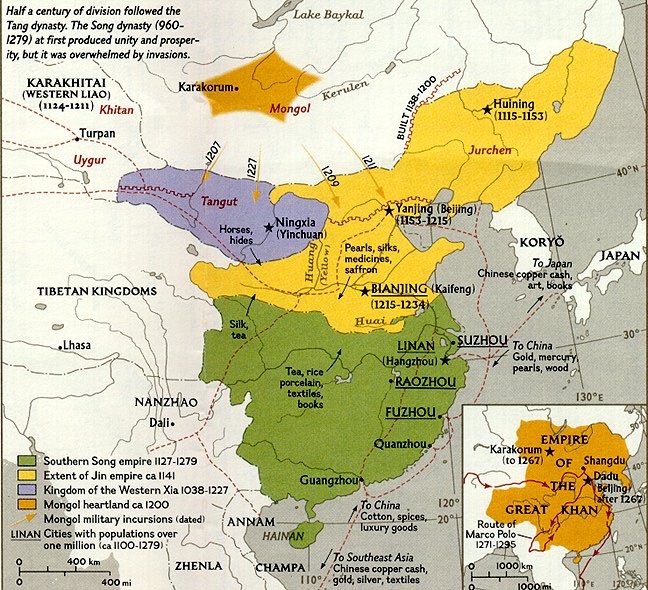
In the early thirteenth century, before the Mongols took over, East Asia was split into three hostile powers locked into a military equilibrium: the western Xia and the Jin to the north, and the southern Song to the south and along the coast. If the Mongols had not shattered this equilibrium (and no other nomadic mega-empire had taken their place), then China might well have remained divided, and the southern Song would have continued to prosper.

Since fighting with the western Xia and the Jin would not have stopped, the southern Song would have persisted in developing their commercial taxes and their navy, which had helped them survive a Jin invasion and would have protected both inland waterways and their coastal capital. Over time, one could easily imagine merchant elites in prosperous southern Song cities lobbying (like their mercantile counterparts in western Europe) for a powerful oceangoing navy to protect their burgeoning overseas trade. Gunpowder had been put to military use in China since the tenth century, with the southern Song and the Jin wielding it against one another in their wars and along the way developing gunpowder bombs and what was likely the first fire lance, an ancestor of the modern gun. Without a Mongol conquest, the southern Song and their opponents would have continued to push the gunpowder technology forward, probably even further than the southern Song did in fighting the Mongols. …

What would the outcome have been? Militarily, the southern Song state would have been large by European standards, and it would not have been free of threats from nomads. Hence the southern Song could not have specialized in the gunpowder technology: like the Ottomans and the Russians, they would have had to divide their resources between the gunpowder technology and the older means of dealing with nomads. But they would not have been a hegemon, and with their substantial commercial tax revenues, they could have spent more on the technology and so pushed it further than the Ming or the Qing ever did, all the more so since the Ming and Qing emperors themselves were often (though certainly not always) hegemons too. And since it would have been much easier for southern Song merchants to establish maritime trading centers abroad, the southern Song (like the Russians) would have had less trouble buying the latest version of the technology from western Europeans, should they ever find themselves lagging behind. The end result would likely have been a much stronger state by 1800, one that might have held off the Europeans and the Japanese in the nineteenth century, or at least negotiated with them on more equal terms. …

Would China have also industrialized faster? One might think that seaborne trade would have encouraged industrialization, but there was too little of it to have much of an effect in state as big as the southern Song. And China would still lack England’s cheap coal, or so historians who focus on energy costs would argue. Yet one could imagine a different path to industrialization, one based on a textile industry like that found in the early United States. It would not require cheap coal, although China did have coal deposits, because coal’s importance for industrialization has been exaggerated. In this scenario, the ongoing warfare would have already drawn manufacturing into fortified cities along the coast, raising urban wages and creating concentrations of manufacturing that would help spread new technology. In the long run, industrialization would follow…

Such a southern Song China might not have been the first to industrialize, but it would likely have joined Japan, the United States, and continental Europe in having an industrial revolution not in the twentieth century, but in the 1800s.

Rocket scientists, secret cities and runaway brides: the stories behind the one-child policy

mei-fong-one-child

Congratulations to my old friend and colleague Mei Fong, whose new book One Child is out just in time to mark China’s transition out of the one-child policy era into the new two-child policy. It’s not a dry piece of demographic analysis, but has vivid and heartfelt reporting that digs out the many fascinating stories behind the slogans. The rocket scientists who designed the policy, the town where a two-child policy was pursued in secret, the personal stories of officials who enforced the policy–it’s all here. Plus there are close-up views of the complexities of sex, fertility and family in today’s China: we see rural villages empty of women, visit sex doll factories and hospices, meet surrogate mothers and adopted children. The ebook is out now, print edition coming in January.

What if innovation requires irrationality?

I recently finished The Knockoff Economy: How Imitation Spurs Innovation by Kal Raustiala and Christopher Jon Sprigman, as part of my periodic attempt to educate myself on productivity issues. I decided to tackle to my to-read list from the bottom rather than the top for a change, and since this book had been sitting there for at least two years, it was the winner. It’s very good and clearly written, and a lot of their arguments have become more mainstream since it was published in 2012.

There are many interesting tidbits throughout, but one I found very intriguing came at the very end, in a coda not closely related to the main substance of the book. Here is an excerpt of the relevant section:

Conventional thinking about innovation and IP relies on the concept of a rational innovator. It assumes that innovators calculate, either explicitly or implicitly, the cost of creation versus the size of the return they will likely enjoy. A writer might anticipate a certain advance from her publisher; a musician might estimate the sales of a new song. This expected return shapes how much effort they pour into creation and what kinds of creation they pursue. Abundant research in economics and psychology, however, suggest that their judgments are often likely to be wrong—and systematically so.

As many studies have found, individuals are very bad at assessing their own future prospects. They have a pronounced optimism bias. They think they will succeed where others have not, and they heavily discount the prospect of failure. Nearly all newlyweds, for example, believe they will not get divorced, when in fact a large minority will—and often within a few years. Likewise, students wildly overestimate their likely grades, even in the face of stiff competition. Like the residents of Lake Wobegon, we all want to believe we are above average. … Optimism bias, in short, leads many innovators to think they will gain a greater return from their intellectual creations than they actually do.

Why is this important to understanding the interaction between copying and creativity? Because optimism bias likely acts as a subsidy for innovation. Creators who have an unduly strong belief in their ultimate prospects for success should be willing to invest more in their creativity. And this increased willingness to invest is likely, in turn, to lead to increased creative output as compared with a world in which creators rationally calculated the odds—odds that may include expected losses from copying.

There is another important, and related, factor that skews how innovators assess their expected return on innovation. Many contemporary markets for creative goods are what economists call “winner take all” or “tournament” markets. In these markets, a huge reward goes to a few at the very top—the superstars—while much less goes to those just below them. This dynamic is easy to see in areas like professional sports: just think about Major League Baseball, where the very best players receive enormous salaries, while those who are merely excellent languish on AAA farm teams, earning a tiny fraction of what the true stars do.

Tournament markets amplify small differences in performance into enormous disparities in reward. Given this basic dynamic, we might expect people to shy away from competing in markets like these—the risk of failure is great, competition can be very intense, and the difference between success and failure hard to determine until years of effort have been invested. Yet we see large numbers of individuals competing to become a sports star, a national politician, a CEO, or, most important for our purposes, a musician, writer, or inventor of the next huge Web concept. Many markets for creative goods are tournament-like. A hit song can yield huge sums for the right creative artist. Yet the vast majority of songs go nowhere, commercially speaking. Likewise, books and screenplays can rake in enormous revenues if they are truly successful, but New York and Los Angeles are awash in the tens of thousands of authors who tried and failed. …

Like optimism bias, tournaments induce more investment than is rational. So both optimism bias and tournament markets push innovators toward high levels of innovation. …The important point is that both of these effects exaggerate anticipated benefits. And it follows that exaggerated expectations of benefit will tend to keep innovation buoyant, beyond what a rational calculation of return would predict.

In other words, pursuing innovation to some extent depends on having irrational expectations about the future. To me, this ties very neatly into David Graeber’s bureaucratic theory of technological stagnation: he argues that the more research is driven by corporate bureaucratic practices that require precise estimation of the outcomes and benefits of said research, the less innovation actually happens. This contention directly challenges William Baumol’s idea of the “free-market innovation machine”: that sustained rapid economic growth is possibly precisely because innovation can be turned into a routine organized activity, and does not have to depend on random flashes of insight.

It does seem clear that once innovation becomes a routine corporate activity with a budget and cost-benefit analysis, then that cost-benefit analysis should be more accurate than what individual people do in their heads with all the usual cognitive biases and errors. But if the incentive to innovate depends on systematically over-estimating the potential benefit of innovation, then doing an accurate cost-benefit analysis will not in fact be a good thing. It may lead to less wasted effort at the individual or firm level, but could also mean less innovative activity in aggregate.

To be clear, this is not at all what Raustiala and Sprigman argue–to the contrary, they think that the irrationality of innovation in fact makes it more resilient to bad regulation or intellectual property-rights violation, and therefore is a reason to be more not less optimistic about the future of innovation. And I don’t completely believe the bureaucratic theory of technological stagnation either (Baumol is a genius and more likely to be right than Graeber). It is worth thinking about though.

The Russian origins of Chinese economic reform

DXP   

One of the more interesting arguments in Pantsov and Levine’s new biography of Deng Xiaoping is that China’s post-1978 economic reforms should be understood not as a rejection of Soviet-style Communism, but as a development of a different tradition of economic thought within Communism. Specifically, they argue that many of the features of the 1980s reforms were directly inspired by the “New Economic Policy” practiced in Soviet Russia in the mid-1920s. Here’s what they say in the introduction:

The theory of reform and opening that Deng developed several years after Mao’s death, in the late 1970s and early 1980s, did not originate with him. It was rooted in the Russian Bolshevik Nikolai I. Bukharin’s interpretation of Lenin’s New Economic Policy aimed at developing a market economy under the control of the Communist Party. Deng studied this concept in the mid-1920s in Moscow during his sojourn as a student at a Comintern school and began implementing it as soon as he solidified power.

The central idea of the NEP, so far as I can make out, was to back away from full-scale state ownership and planning, and allow market transactions and some private enterprise in the context of an economic system still dominated by the Communist Party. This is indeed pretty much the formula that Deng pursued after he came to power. And of course Deng, who studied in Moscow during the period of the NEP, would have been well aware of these ideas. He even mentioned the NEP in passing in August 1985 in a conversation with Robert Mugabe:

What, after all, is socialism? The Soviet Union has been building socialism for so many years and yet is still not quite clear what it is. Perhaps Lenin had a good idea when he adopted the New Economic Policy. But as time went on, the Soviet pattern became ossified. We were victorious in the Chinese revolution precisely because we applied the universal principles of Marxism-Leninism to our own realities.

Pantsov and Levine somewhat misleadingly paraphrase this quote as Deng saying that “he openly acknowledged that ‘perhaps’ the most correct model of socialism was the New Economic Policy of the USSR.” Part of what Pantsov and Levine are trying to do with this, as in much of their book, is to counterbalance some of the hagiography of Deng and cut his historical status down to size. But I’m not sure how much difference it makes to our evaluation of Deng where he got his ideas from–everybody gets their ideas from somewhere, and we usually expect national political leaders to be good decision-makers rather than original intellectuals (that’s a staff job). And it was common for many of China’s early economic reforms to be justified by references to canonical Communist texts (here’s another example), which made them easier to digest.

Nonetheless, it is clear that there was a groundswell of interest in Bukharin and the NEP during the early reform period, an interesting phenomenon of which I was previously unaware:

In 1981 Chinese scholars began publishing their own articles on Bukharin. Over a period of two years, no fewer than thirty-six articles appeared in various PRC journals on his life and works. One of the first articles, by the historian Zheng Yifan, a 1959 graduate of Leningrad University, which was published in the first issue of Shijie Lishi (World History), caused quite a stir. Zheng flatly stated that Bukharin was a Marxist theorist and economist, and that everything Stalin had said about him was false. In this connection, he noted in particular the truth of Bukharin’s slogan addressed to Russian peasants: “Enrich yourselves, accumulate, develop your farms.” Understandably, he did not compare this slogan with Deng’s well-known idea that it was good to be rich, but everyone knew what he meant. Naturally, the majority of articles addressed Bukharin’s economic views. Chinese social scientists recognized that they “were relevant today.” They appreciated Bukharin’s acknowledgment that socialism in the USSR was “backward in form,” his defense of prosperous peasants, his insistence that the growth of industry directly depended on the growth of agriculture, his support of the harmonious combination of planned and market regulations, and his recognition of the important role of the law of value in commodity-financial relations under socialism.

This context also I think helps us better understand the changing ideas about the economy in the first half century of the People’s Republic. The long struggle over economic policy in China was clearly not one between proponents of the planned economy and backers of a Western market economy. It makes much more sense to see it as a battle among Communists over competing interpretations of Marxism-Leninism.

Andrew Walder’s recent book China Under Mao: A Revolution Derailedwhich I highly recommend, argues that Mao’s economic policies in the 1950s were based on an early and extreme interpretation of Marxism-Leninism. But Mao’s ideas were already viewed as outdated by other Communist states, who were already moving toward a less rigid version of the planned economy. Deng Xiaoping, and other figures such as Chen Yun, were clearly part of a different tradition within Communism that was less strictly ideological and more concerned with improving living standards. Deng and other reform-era leaders were not Western liberals in disguise working secretly within the system; they were committed Communists who argued for the superiority of their version of Marxism.

W. Arthur Lewis on stagnation, slowdowns and traps

The case for pessimism about sustained fast growth in any economy has rarely been so well put as in the following passage, one of my favorites, from Lewis’ 1955 book The Theory of Economic Growth:

“There are thus many pits into which a country may fall, as a result of prolonged growth: it may weary of material things, its entrepreneurs may behave less competitively, its public may create barriers to change, the distribution of income may alter unfavorably, it may exhaust its natural resources, it may lose its place in international trade, or it may run out of innovations. In addition, it may be a victim of natural disaster, or it may be ruined by war, by civil strife, or by misgovernment.

None of these is inevitable. On the other hand, when there are so many pits into which a country may fall, it is not in the least surprising that countries have fallen into one or more of these pits in the past. One cannot predict when the rate of investment in any particular country will begin to slow down–whether it will be after decades or after centuries. But the expectation that a long period of growth is in due course succeeded by slower growth, by stagnation, or even by decline seems fairly well supported by the little we know of the economic history of the past four thousand years.”

The passage comes from the section on secular stagnation in the book, a concept that is obviously having something of a renaissance these days. Lewis is mostly known today for his model of how labor in a poor country moves from a traditional to a modern sector, a concept many people feel captured something fundamental about how China and other developing nations work. But this book is not referred to much these days, though you can read a quite favorable recent overview of the whole thing here. I confess I have only dipped around in it–the prose style is not always invigorating–but each time to my benefit.

I like this passage because of the way it makes clear that economic growth is not easy and that lots of things can go wrong with it. It’s a simple point, but it’s basically why I’m never been that enamored of the concept of the middle-income trap. In its original formulation, it was the idea that middle-income countries tend to stop growing because their exports get squeezed between low-wage competitors and high-wage innovators. Sure, there are things that can go wrong in middle-income countries so that they fail to maintain fast growth–but lots of things can go wrong besides export competitiveness, and things can go wrong at pretty much any income level, not just the middle.

What’s interesting is to figure out what might be going wrong in each individual case (though I’m still waiting for an actual example of a nation that became “weary of material things”). It is indeed not surprising that a country may fall into a pit, but we still want to know which pit it is and why it fell, and not assume it’s always the same pit. As I’ve argued before, it’s not clear for instance that the middle-income trap model of declining export competitiveness is really the best explanation of what’s happening in China right now.