The concept of progress: appreciating Ted Gioia’s History of Jazz

Somewhat against my better judgment, I’ve been desultorily reading Ted Gioia’s History of Jazz. These kind of books are dangerous, to me anyway, because in the minutes it takes to read a few pages you can come up with many, many hours of new stuff to listen to. But it has already inspired me to go back and listen again to some great early jazz recordings which have not been on the playlist for many years–in particular, rediscovering the sprightly chamber jazz of Joe Venuti and Eddie Lang has been a real treat. And passages like this one lift the book far above the ordinary:

From its earliest days, jazz had been a forward-looking art, continually incorporating new techniques, more expansive harmonies, more complex rhythms, more intricate melodies. Sometimes this ideology of progress was stated explicitly, as in Beiderbecke and the Chicagoans’ oft-spoken praise of Stravinsky and other contemporary classical composers; in other instances, no words were necessary, as with the implicit modernism of Armstrong’s breakthrough recordings of the 1920s. But whether they expostulated about the future of music or merely announced its arrival through the bells of their horns, the leading musicians of early jazz were modernists in the truest sense of the term. They were admired—or chastised, as the case may be—as daring exponents of the new and bold.

It is easy to lose sight of just how remarkable this modernist bent was, given its context. The concept of progress has played a modest role in most ethnic music traditions. Those who draw connections between jazz and African music miss this important difference. The griots of West Africa, for example, aim to preserve their cultural legacy as it is handed down to them. This is not a mere aesthetic choice, but a cultural imperative: they are the historians of their society and must maintain the integrity of their precious musical heritage. …

Almost from the start, jazz players embraced a different mandate, accepting their role as entertainers and pursuing experimentation with an ardent zeal. This created a paradoxical foundation for jazz, one that remains to this day: for the jazz musician soon proved to be a restless soul, at one moment fostering the tradition, at another shattering it, mindless of the pieces. Even more striking, this progressive attitude of early jazz players came from members of America’s most disempowered underclass. Recall that this music was not only viewed with apprehension by much of the ruling class but was often belittled and derided even within black America’s own ranks. In the face of this hostility, simply preserving the African American vernacular music heritage—saving the legacy of a Buddy Bolden or King Oliver from the oblivion that obscures the early history of most traditional forms of music— would have been a major achievement. But advancing the jazz idiom to produce an Ellington or Armstrong was nothing short of miraculous—and all in the span of a single generation. One searches in vain through all the countries of the world to find another example of such a rapid and dramatic transformation from folk music to art music.

Books like these are a huge organizational challenge because the material can be approached so many different ways: chronologically, biographically, thematically. Gioia has done a good job of using all three approaches; the frame of the book is chronological, but when he introduces each figure they get a full biographical treatment, even when that requires going well outside the chronology of the rest of the chapter. For instance, the xylophonist Red Norvo is discussed early on for his 1930s recordings, but Gioia also assesses his 1950s work with Mingus and other later recordings (the treatment of Norvo is also a good example of Gioia’s generous approach to “minor” figures outside the standard jazz pantheon).

He is also, by the way, an excellent guide to more recent music: his annual best-of lists are wonderful, eclectic and huge.

Are African economies doing better or worse than we thought?

I did not find myself with a clear answer to that question after reading Morten Jerven’s new book Africa: Why Economists Get It Wrong, which I picked up in hopes of adding to my very scanty knowledge about the region. About three-quarters of the book seems to be arguing that Africa is doing better than than many people thought, as it criticizes a whole swathe of economic research about a supposed “chronic failure of growth” in Africa. Here’s a sample:

The simple point I am making is that, in contrast to what the growth literature tells us, the African growth experience has not been one of persistent stagnation. According to GDP data in international prices from the Angus Maddison dataset, the African GDP per capita in 1960 was about one-sixth of world GDP per capita. This remained true until 1977, after which the gap widened, and by 2000 the African GDP per capita was less than one-tenth of world GDP per capita. The African growth shortfall is thus a more recent phenomenon: before 1977, African economies were not lagging behind significantly in terms of growth rates.

A lot of his effort goes into attacking growth regressions that ignore both the historical trajectory of the growth data and take a simplistic view of the social and institutional factors supposedly related to growth. I am very sympathetic to these criticisms, but even after accepting his arguments it’s not clear that we are left with a very positive growth picture for Africa. So it’s not true that African economies have never experienced economic growth; on the other hand, it still looks like the growth data are pretty poor for a good three decades or so.

In the last quarter of the book Jerven then switches to arguing that Africa is in fact doing worse than some people think. He reviews some of his previous work on African GDP statistics to tackle the opposite side of the growth stagnation argument, and argues that the optimistic “Africa Rising” story of recent years is also overwrought and undersupported:

It is likely that very recent growth data are overestimating economic growth. First, for some economies – and Ghana is the best example – the growth figures are higher because there was a recent large upward revision in GDP levels. When the time series is smoothed out across the 2000s in light of these new data, it shows an exaggerated acceleration in growth. Second, for those economies that have very outdated base years, the GDP level is most probably underestimated. This has two effects. One is obvious: when the base is too low, growth estimates are too high. … A second effect results from statisticians and consultants adding to the GDP measure to make it more exhaustive by revising current and previous GDP estimates upward as they go along.

Jerven does not spend much time building up a new narrative about Africa to replace the two that he demolishes. But when he is describing Africa itself rather than people’s arguments about it, the description is not terribly positive: African governments for instance are “relatively fragile and particularly vulnerable to economic downturns and temporary fluctuations.” Such weak governments are unlikely to be able to replicate the kind of “developmental state” policies that have been successful in Asia (the best recent summary of this strategy is Joe Studwell’s How Asia Works). And nothing in this book challenged my naive understanding of most African economies as being heavily reliant on agriculture and exports of raw commodities, and therefore unlikely to generate the kind of sustained growth seen in the more successful examples of economic development in Asia and the European periphery.

I tend to agree with the Financial Times review that the book tends to skate over some rather obvious facts in its mission to show that Africa’s situation is more complicated than many theories allow. On the whole I felt that too much of the book is devoted to internecine academic warfare, and not enough to developing a coherent narrative about African economic development for the general reader. I am still in the market for one of these, so suggestions would be very welcome.

Style is a special case of technique

That line is from one of the better passages in Philip Glass’ new memoir, Words Without Music. The point is as true of writing as it is of music of course, and it’s interesting that the memoir itself demonstrates it. What I mean is that the memoir does not have much style, because there is not much writing technique in it–a sharp contrast to the very distinctive Glass musical style. Most of the book’s charm comes from how artless it is; often it really does sound like a guy just telling you stories about his life (a guy who happens to be a famous artist). Of course that works better when you are sitting with the guy over a beer. It can get tiresome on the printed page, and there are definitely some longueurs in the memoir. But the occasional insights are still interesting, and the account of his musical education with Nadia Boulanger is clearly very heart-felt:

We sat quietly for only a moment and I understood, suddenly, that somewhere along the way, she had changed the point of the exercise. I had thought she was teaching technique— the how you “do” or “not do” in music. But that was over. She had raised the ante. Now we were talking about style. In other words, there could be many correct solutions to a musical problem. Those many correct solutions came under the rubric of technique. However, the particular way a composer solved the problem, or (to put it another way) his or her predilection for one solution over several others, became the audible style of the composer. Almost like a fingerprint. Finally, to sum this all up, a personal style in a composer’s work makes it a simple matter for us to distinguish, almost instantly, one composer from another. So we know without doubt or hesitation the difference between Bach and Bartók, Schubert and Shostakovich. Style is a special case of technique. And then, almost immediately, we know that, beyond a shadow of a doubt, an authentic personal style cannot be achieved without a solid technique at its base. That in a nutshell is what Madame Boulanger was teaching. Not as a theory, because theory can be debated and superseded. She taught it as a practice, a “doing.” The realization came through the work. Her personal method was to just bang it into your head, until one day, hopefully, you got it. That’s how, in the end, I understood my work with her.


What I read on my summer vacation

I did get some good reading done on my recent two weeks off, though I’m padding the list with a couple things finished before I went on break:

  • In Manchuria, by Michael Meyer. I quite enjoyed this book on my favorite part of China; it is very nicely written and insightful. The structure is a combination of a few different threads: 1) a memoir of the time the author spent living in his wife’s home village in rural northeast China, 2) a history of northeast China and how that history has and has not been remembered locally, 3) a bottom-up portrait of the process of land consolidation now going on in many Chinese villages. The book’s subtitle–“A Village Called Wastleand and the Transformation of Rural China”–highlights only strands 1) and 3), but while I enjoyed all three strands I thought the history of strand 2) was the best part. The unearthing of the (often deliberately) forgotten history of this particular bit of nowhere is very interesting and well done. My judgment may be suspect as I am personally quite interested in this part of the world, but I think Meyer succeeds in making it lively and human with by interweaving his personal story and lots of reportage, and many of his observations are just spot-on. More reviews here.
  • 361, by Donald Westlake, and The Friends of Eddie Coyle, by George V. Higgins. I go through occasional phases of reading classic hard-boiled and noir crime fiction, and these were the result of the latest. 361 is hard to describe without giving too much away, but really is quite good and involving, and actually manages to pull off hard-boiled prose trick of conveying inner turmoil by only describing outer surfaces (a lot of hard-boiled fiction fails to do this and ends up flat.) In Eddie Coyle Higgins essentially invented the genre of books about incompetent criminal lowlifes written almost entirely in dialogue. Elmore Leonard for one idolizes this book, a paperback copy of which appears onscreen in the last episode of the wonderful TV series Justified. I didn’t find it as great as everyone says, though this is likely because so much of what was new about the book when it was written is now commonplace.
  • The Color of Money, by Walter Tevis. I stumbled across Tevis because he wrote The Man Who Fell To Earth, which became the great, weird film starring David Bowie. His name meant little to me but apparently he was a quite successful popular novelist back in the day, with many of his other books also being adapted into films, including this one. I have no memory of seeing the 1986 film with Tom Cruise and Paul Newman so I came to the book fresh. The story arc–aging pool player tries to get his mojo back–sounds simple but I found it surprisingly compelling and empathetic. Somehow the details about snooker etc. were enthralling even though I know nothing about the game.
  • State, Economy and the Great Divergence: Great Britain and China, 1680s-1850s, by Peer Vries. I bought this based purely on the title, as it hits on a lot of my interests. Ultimately it is hard to recommend as a book, as like so many academic tomes, it is far too long, poorly organized, and often unable to distinguish between minor detail and important fact. But I still found it useful for getting up to speed on some of the big economic-history debates on China, Britain and the origins of the Industrial Revolution, and there are some good thoughts in here. Those who are more familiar with this material may not find it of as much value. One of these days I will blog about some of the specific points of interest I took away from the book.
  • Seveneves, by Neal Stephenson. I’ve actually never been a real Stephenson fan though I know he is widely revered; I’ve attempted some of his previous works but not finished them, put off by the overly mannered prose and self-conscious techieness. This book is different. It’s really a throwback to an earlier age of science fiction, with its straightforward “what if?” premise, careful technological extrapolation, and unabashed exposition of orbital mechanics and suchlike. I happen to prefer that style to the majority of sci-fi produced today, which is really about recombining a fixed set of genre tropes for a narrow audience and has almost nothing to do with imagining how the world might be different. Seveneves is not a perfect book by any means: the simplistic good-scientists-versus-evil-politicians dynamic of the middle section quickly gets tiresome, and the plot of the last third of the book holds no surprises whatsoever. But much of it is enjoyable and convincing, and it’s a great summer read for anyone interested in space travel.
  • From the Tsar’s Railway to the Red Army and The Chinese Labour Corps, by Mark O’Neill. I am quite pleased to plug these two short ebooks by Mark, a former colleague in the Beijing foreign press corps. They are part of a series Penguin did in 2014 to mark the 100th anniversary of World War I, and cover the little-known stories of the Chinese people who went abroad during the war, to Russia and to England. Neither wave of people turned out to be an earthshaking historical event, which is probably why these are not more widely-known historical events. But the obscurity is part of the charm of these stories of out-of-place people.
  • The Greenlanders, by Jane Smiley. I’m cheating a bit here as I’m only partway through this book, but I’m really enjoying it so far. Modeled on the old Norse sagas, it’s the story of a family in a 14th-century colony on Greenland. The plain one-thing-after-another style of the narration dispenses with many standard fictional techniques, but this only increases its verisimilitude–for instance, characters die quite randomly, as people do in life. I was sucked in immediately, and will go read more once I press the publish button on this post.

One book, twenty views about China

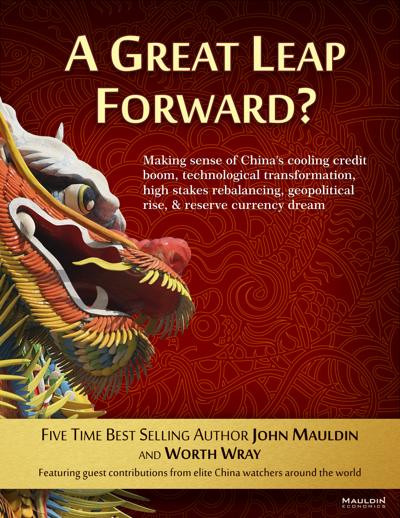
The universe of independent research on China has grown much larger in recent years, as can be seen from the contents of this new e-book. John Mauldin and Worth Wray have pulled together a good number of commentators and China watchers, among whom are some friends and partners in crime in Beijing and Hong Kong. My employer Gavekal is also well represented, with a piece by our CEO Louis and one by my colleague Ernan Cui. My own piece is on China’s exports and its New Silk Road ambitions. There’s a wide range of views about China represented in the book, including some I disagree with, so it should make for a good and varied read.


mauldin_book_small

In China of the 2010s, some echoes from the 1970s

Browsing at the Beijing Book Fair this past weekend, I stumbled across an old book (in English) called China’s Economy: A Basic Guide, by one Christopher Howe, mixed in among the usual mess of the collected works of Mao and art auction catalogs. Of course I snapped it up; not because it is some kind of lost classic, but because it presents a view of China circa 1976, before the reform era and big changes in the Chinese economy that ensued. In these days when China’s massive role in the global economy is a fact of life, it’s hard to look at its history without having your view colored by the knowledge of what happened after 1978. I think it’s quite informative to see what China looked like to people who did not already know that it was going to turn into a world-shaking economic power.

In fact there seem to be some interesting continuities between the China of the 1970s and the China of the 2010s, suggesting that the launch of “reform and opening” was not such a break with the past as it sometimes seems. I have only skipped around in the book so far, but a few interesting parallels have already jumped out. Take this passage, which appears to show that today’s obsession with the internationalization of the renminbi has deep historical roots:

The Chinese frequently refer to the fact that trading partners from sixty countries use the renminbi as the unit of settlement. In general, this reflects the wishes of the Chinese rather than of their trading partners; indeed, insistence that contracts are denominated in the renminbi has at times been a serious obstacle to trade.

On the domestic front, this passage describing urbanization policy also sounded spookily contemporary:

In 1958 a further policy was introduced, one that has persisted to this day. This is the policy of developing “small and medium” cities. In conversation, Chinese officials give varying definitions of these city types, but an authoritative article published in 1958 described the policy in the following terms. “Small cities” have populations of up to 300,000, and are to be “generally developed”; “medium cities” are those with populations of 400,000 to 700,000, and are to have “limited development.” Anything bigger is a “large city,” and is to be “generally restricted.” Special emphasis is put on control of cities with populations of a million or more.

With some updates to the numbers for the size of cities, this passage would serve nearly word-for-word as a summary of the current government’s urbanization policy. It is interesting that the focus on “small and medium” cities, which I think is misguided, has such a long history. It’s not clear why this policy has remained so attractive over time–Howe notes that the justifications for the policy kept changing–but perhaps inertia explains some of its persistence. I suspect further reading will reveal even more parallels.

ChrisHoweChinasEconomy_small

How many China predictions still hold up after 113 years?

I have low confidence that many of today’s China predictions would meet such a longevity test. But John A. Hobson’s classic Imperialism: A Study, published in 1902, seems to have called the direction China would ultimately take pretty much correctly–albeit after a period of 75 years or so when things were going the other way. Here is the quote, which I find quite amazing even after having read it several times:

It is at least conceivable that China might so turn the tables upon the Western industrial nations, and, either by adopting their capital and organisers or, as is more probable, by substituting her own, might flood their markets with her cheaper manufactures, and refusing their imports in exchange might take her payment in liens upon their capital, reversing the earlier process of investment until she gradually obtained financial control over her quondam patrons and civilisers. This is no idle speculation. If China in very truth possesses those industrial and business capacities with which she is commonly accredited, and the Western Powers are able to have their will in developing her upon Western lines, it seems extremely likely that this reaction will result.

This discussion on China is in Part II, Chapter V of Imperialism, which is available online. I claim no credit for discovering this wonderful snippet; that goes to Duncan Green via Branko Milanovic. However it does make me wish that I had kept reading Hobson when I first picked up the book a couple years ago.

The bureaucratic theory of technological stagnation

I’m finding David Graeber’s new book, The Utopia of Rules, to be a surprisingly enjoyable read. He’s a clear and vigorous writer, and as befits an anthropologist he is good at mining the minutiae of daily life for broader insights. Though admittedly my own long-ago degree in anthropology biases me to cheer him on, since Graeber is the only current example I know of a public intellectual who is an anthropologist (a species whose influence has always lagged economists, historians and sociologists.)

But I have to confess I was surprised to find the second of the book’s three essays tackling a fashionable topic among economists, bloggers and other non-anthropological commentators: the pace of technological progress, or rather the perceived lack thereof. The piece, entitled “Of Flying Cars and the Declining Rate of Profit,” mounts an original and compelling argument for why technology seems to be changing so much less quickly than we once hoped it would: in a word, it’s all about bureaucracy. Bureaucracy is not a synonym for “government,” even though Americans now tend to use the word that way. It’s a way of doing things, one whose pervasiveness means, in his words, that “a timid, bureaucratic spirit has come to suffuse every aspect of intellectual life.”

To summarize his argument as briefly as I can (and with much less style than the original):

  1. Corporations increasingly only spend their research money on product development and marketing, rather than seeking true breakthroughs. “The amount of really innovative research being done in the private sector has actually declined since the heyday of Bell Labs and similar corporate research divisions in the fifties and sixties.”
  2. Government investment in basic research has increased substantially, but since the 1980s has been directed primarily toward military purposes that are easier to justify, rather than true fundamental research. “The U.S. government…shifted their emphasis sharply away from civilian projects like the space program and in the direction of military research.”
  3. In academic institutions, the actual practice of research has become incredibly bureaucratic, time-consuming, and generally organized in such a way as to prevent genuine creativity.

On this last point, there is no substitute for quoting Graeber at a bit more length:

Our collective fascination with the mythic origins of Silicon Valley and the Internet have blinded us to what’s really going on. It has allowed us imagine that research and development is now driven, primarily, by small teams of plucky entrepreneurs, or the sort of decentralized cooperation that creates open-source software. It isn’t. These are just the sort of research teams most likely to produce results. If anything, research has been moving in the opposite direction. It is still driven by giant, bureaucratic projects; what has changed is the bureaucratic culture. The increasing interpenetration of government, university, and private firms has led all parties to adopt language, sensibilities, and organizational forms that originated in the corporate world. While this might have helped somewhat in speeding up the creation of immediately marketable products— as this is what corporate bureaucracies are designed to do— in terms of fostering original research, the results have been catastrophic.

Common sense dictates that if you want to maximize scientific creativity, you find some bright people, give them the resources they need to pursue whatever idea comes into their heads, and then leave them alone for a while. Most will probably turn up nothing, but one or two may well discover something completely unexpected. If you want to minimize the possibility of unexpected breakthroughs, tell those same people they will receive no resources at all unless they spend the bulk of their time competing against each other to convince you they already know what they are going to discover. That’s pretty much the system we have now.


How does this stand up? Well, it’s an essay and not an exercise in econometrics, and the piece is not, shall we say, overburdened with detailed empirical evidence. But it’s actually not too hard to find some. Point 1 has support from some economic research, notably a recent NBER paper entitled: “Killing the Golden Goose? The Decline of Science in Corporate R&D.” The title pretty makes the point pretty clear, but the specific finding is that “Over the period 1980-–2007…investments in scientific research by publicly traded American companies, as measured by publications in scientific journals by company scientists, has diminished over time.”

Point 2 is straightforwardly factual, as can be determined from a quick check of the data on federal R&D spending collated by the AAAS. After 1981, the share of defense R&D in total federal spending on R&D rose sharply from around 50% to 60-70% (though interestingly, it has come back down to about 50% over the last couple of budgets). Point 3 is a bit more difficult to substantiate with data, but it’s hard to imagine that other accounts of the grant-writing process are going to end up concluding that it is an ideal system. So it’s intuitively appealing. The risk of course is that we often think our current institutions are flawed and imperfect reflections of what our great ancestors did, which is why measuring things is a good corrective. But on the whole, I’d say the case against bureaucracy is definitely one I’m going to be thinking about.

Things from the UK that I’m enjoying

And I mean besides the stalwarts of rain, irony and mushrooms for breakfast, all of which I got to sample briefly on a work trip last week.

A recent discovery is Europe in Autumn by Dave Hutchinson. The setting of a future Europe that has splintered into numerous microstates has a ripped-from-the-headlines feel, even though it was published well before Scotland’s close-call referendum on independence. Technology plans almost no role in this imagined future, most of the thinking is about political and social changes and their consequences–a surprisingly rare strategy for any author, genre or otherwise. The book was highly recommended by Adam Roberts, himself a British author of no mean chops, and I did quite enjoy it–the best parts are almost like an Alan-Furst-for-the-2030s in the way they give you a view from the social and geographic margins of Europe. The plot of last third or so of the book rather falls apart, which for me keeps it from being the kind of masterpiece that Roberts calls it, but on the whole it’s both fun and thought-provoking. Previous British entries in this smallish category of “political science fiction” include Ken MacLeod’s excellent Fall Revolution series.

Under the more capacious category of obscure 1960s jazz, we have the UK reissue this year of Dejeuner sur l’herbe, a 1968 album by The New Jazz Orchestra. Neil Ardley is the man behind it, and no, I had never heard of him or most of the British players on this album before either. The rapturous comments on the Amazon.co.uk site call this one of the best jazz albums ever, which it probably is for a certain generation of British jazz listener. I haven’t listened to it enough yet to make that call, but already it is clear that it is in fact very good, and very reminiscent of the great Gil Evans albums of the 1960s. It’s a good reminder that there was some interesting stuff happening in the UK jazz scene back then. In particular I’m a great fan of Joe Harriott, who recorded some lively albums in the idiom of Ornette Coleman, and also some of the first and best attempts to meld jazz with Indian classical music.

Holiday reading recommendations, Chinese New Year edition

I’ve been thinking over things I have read and things I want to read, as I’m about to head off for a long break over the Chinese New Year. Here’s some of the better books I have read since my last list in December 2014:

  • The Book of Strange New Things, by Michel Faber. Indeed a very strange novel. It would have to be categorized under “science fiction,” since it’s about a missionary going to an alien planet, but it avoids almost all the standard tricks, tropes and strategies of genre sci-fi. I found it consistently interesting since the story keeps not doing what you expect. This is not exactly the same thing as liking the book. Worth reading although ultimately a mixed bag.
  • How Adam Smith Can Change Your Life, by Russ Roberts. Highly praised by Tyler Cowen, this is indeed an excellent book, written in a very clear style and with a charming personal voice. It does not quite make up for not taking that course on Adam Smith back in college (I did Max Weber instead, hard call) but I learned a lot from it.
  • The Narrow Road to the Deep North, by Richard Flanagan. I have long had a morbid fascination with books about prisons (including prisoners-of-war), so when this won the Booker last year I knew I had to read it. The core of the book are the scenes in the Japanese internment camp, which are just unbelievably wrenching. I could not stop reading, but I cannot say I enjoyed it; if you are not in the mood for staring death and meaninglessness in the face you will find it hard going. The writing is generally fantastic, but the book as a whole does not quite achieve greatness in my view; the attempt to write some scenes from the Japanese officers’ point of view was admirable, but these did not work as well for me.
  • The Pioneer Detectives, by Konstantin Kakaes. One of the best up-close-and-personal accounts I have read of how the work of science actually happens. I particularly liked it because the focus is not some epoch-making discovery, but on the slow grind of gathering data and falsifying hypotheses (an underrated part of the scientific process). It’s a shortish ebook rather than a full-length nonfiction chronicle.
  • Annihilation, Authority and Acceptance, by Jeff VanderMeer (aka the Southern Reach Trilogy). Stunning and truly unique works of imagination. I read these in quick succession these over a period when I was having a lot of insomnia, which I think only accentuated the hallucinatory feel that pervades the books (and possibly meant that I was getting close to the author’s state of mind while he was writing them, according to this fascinating account). The close and personal attention to the landscape, which is unnamed but clearly the coast of the Florida panhandle, also resonated with me, since I have spent time there.
  • The Martian, by Andy Weir and The Just City, by Jo Walton. More normal and more fun sci-fi than the two more unsettling works listed above. I am probably one of the last people to catch on to the phenomenon of The Martian, so I have little to add to what you could read elsewhere; great problem-solving fun. I loved Jo Walton’s Among Others for its charming voice; her latest is a bit overly similar (female first-person narrator + kids at boarding school) and probably not quite as good for that reason, but still enjoyable, and with lots of Socratic dialogue as a bonus.

It tempts fate a bit too much to promise publicly that I’m going to read any particular book over vacation, but one thing in my pile is James Millward’s Eurasian Crossroads: A History of Xinjiang, which was highly recommended by a friend.