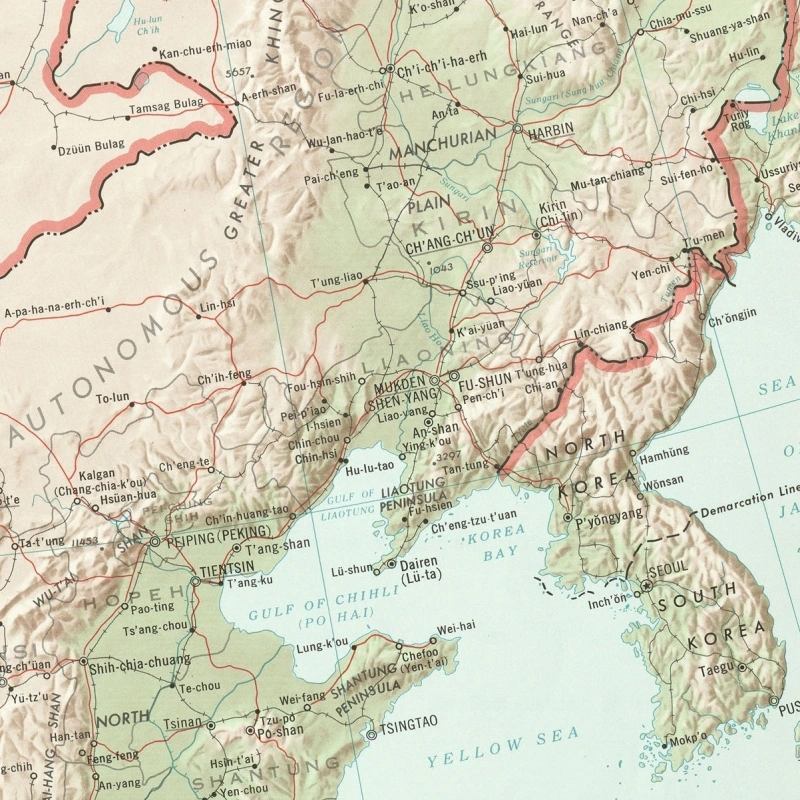
The backstory to why Hong Kong ended up still being a British colony after the end of World War II is interesting, and I did not previously know the details. At the time it probably appeared to be a small matter, but it did have big long-term consequences. This account is a from a recent review essay by Stephen Kotkin, Stalin’s biographer, in Foreign Affairs:
Arguably, with the exception of the Soviet capture of Berlin in May 1945 and the stern telegram that U.S. President Harry Truman sent to Stalin in August of that year warning him not to invade Hokkaido (one of Japan’s four main islands), the physical reoccupation of Hong Kong by the British in 1945 exceeded any other wartime episode in its strategic implications.
When Japan’s surrender suddenly appeared imminent in the summer of 1945, surprising Washington, the Truman administration hastily accelerated work on a plan for the hand-over of Japanese-occupied territories and assigned the acceptance of Japan’s surrender of Hong Kong not to the British but to Chiang Kai-shek’s Chinese Nationalist government. The British, however, undertook furious military and political preparations to reclaim Hong Kong for themselves. U.S. officials wanted to satisfy their British allies but also allow Chiang to save face, and so they cleverly suggested that the British could accept the surrender on behalf of the Chinese government. But the British refused that offer, and eventually, Washington acquiesced. Chiang acquiesced as well, dependent as he was on U.S. military and logistical support to reclaim other areas of China. The upshot was that Hong Kong passed from the Japanese back to the British and remained that way even after 1949, when the Communists triumphed over Chiang’s Nationalists in the Chinese Civil War but shrank from attempting to expel the British from the strategic southern port.
Had the British acquiesced rather than the Americans and Chiang, history would have played out very differently. As it was, the communist regime in Beijing was able to take extraordinary advantage of something it would not otherwise have possessed: a world-class international financial center governed by the rule of law. During the period of Deng’s reforms, British Hong Kong ended up funneling indispensable foreign direct investment into mainland communist China—from Japan and Taiwan, especially.
People often ask why Soviet Premier Mikhail Gorbachev, when attempting to reenergize the Soviet economy in the second half of the 1980s, did not follow the successful Chinese approach to reforms. Beyond the immense gulf between a highly urbanized, heavily industrialized country and a predominantly rural, agricultural one, the Soviet Union had no Hong Kong to attract and direct incoming investment according to market, rather than political, considerations. No British Hong Kong, no Chinese miracle.
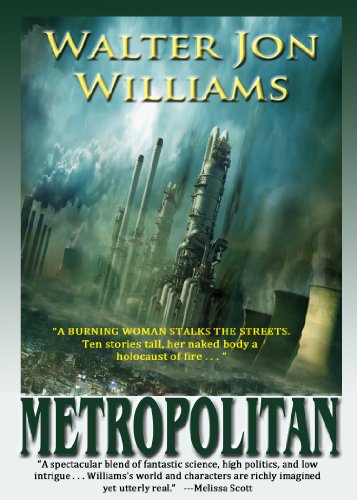
Henry Farrell recently recommended Walter Jon Williams’ novel Metropolitan, and after devouring it quickly I will second the recommendation: it’s sharp, thoughtful, and engrossing. Nothing dates faster than visions of the future, but the vision in this 1995 book still seems strikingly contemporary. The book presents mind-blowing technological power that coexists with depressing stagnation, its extraordinary capabilities diverted mostly to bureaucracy and status-seeking.
This theme is comes out into the open at one point when one of the characters starts ranting about the inability to build new buildings, a synecdoche for the broader problem of social stagnation:
“Nothing changes in our world,” he says, “because the cost of change is so enormous. Not the least is simply the cost of space. Consider what’s needed simply to build a new building. There will be something on the site already, so the old building must be purchased, and all the people living or working there moved. All those displaced people will have to go somewhere else, at enormous cost, and even if the builders manage somehow not to pay the displacement fees, somebody will. So every new structure is a drain on the economy before it even starts. …
Nothing can be transformed in any significant way, because the cost of transformation is just so high.”
The resonance with the contemporary debates over why it’s so hard to build stuff in the US is pretty obvious. Because it’s a novel and not social science, there’s no explicit argument about what has caused this problem in the fictional world.
But the world-building makes an implicit argument that stagnation is the result of the closing of the frontier. The conceit in the title is that virtually the entire surface of the earth, apparently including the oceans, is covered by cities. There is literally no usable space that is not already occupied by some structure and some political entity. Hence the problem that any new construction requires removing whatever is already there.
Furthermore, the universe beyond the earth is not visible or accessible, with the sky, sun, moon and stars walled off by a barrier called the Shield. This feature reinforces the book’s cosmically claustrophobic atmosphere, portraying a world in which people are trapped into zero-sum competition over a limited pool of resources. (As I recall, there’s a similar theme running through Iain M. Banks’ Against a Dark Background, though I read it some time ago.)
There is definitely a real difference between places where things can be built from scratch and places where building requires first compensating and removing the existing users (and it’s not just a US issue–compensation for residents displaced from their homes by new development has been a long-running political problem in China). But the the tradition of American science fiction, in which space travel is often the most important indicator of technological progress, is somewhat biased toward the idea that progress depends on having new frontiers of empty space to exploit.
We should hope this idea is not true. In general terms it probably is not: the American frontier was declared closed in 1890, but technological progress and economic growth in the US has been faster after 1890 than before. Nonetheless, I found Williams’ portrayal of stagnation pretty convincing and it will stick in my head for a while.
This year I had better luck with my fiction reading than with my nonfiction, so I’m putting my fiction recommendations first. Books are listed in the order in which I read them:
Fiction
Rachel Kushner, The Mars Room. A stunning and vivid evocation of a delinquent San Francisco childhood that turns into an adulthood behind bars. It’s hard to convey just how good the writing is.
Hernan Diaz, In The Distance. An anti-Western in which a Swedish immigrant wanders around the American frontier, never quite fitting in and never quite understanding what is going on around him. A portrait of loneliness.
Octavia Butler, Parable Of The Sower. In this 1993 book Butler was one of the first to make the intellectual leap from thinking of “the apocalypse” as a discrete, dramatic event to thinking of it as the gradual and often unnoticed breakdown of systems. This insight (picked up by William Gibson in his excellent The Peripheral) helps account for some of the book’s uncannily prescient moments.
Mary Renault, Fire From Heaven. As an enjoyer of historical fiction I’d heard about Renault’s Alexander the Great books for a while. But I was still surprised at how immediately compelling her 1969 novel about Alexander’s youth turned out to be. It is even endorsed by historians. However the sequel, The Persian Boy, was much less convincing.
Elena Ferrante, My Brilliant Friend. Through a misguided desire not to jump on literary bandwagons, I hadn’t picked this up before, but once I did, I couldn’t put it down. The writing is always remarkably precise and emotionally honest.
Stephen King, Billy Summers. Classic American noir fiction updated to the (last possible pre-Covid) moment, with stripped-down prose precisely describing the logistics of various criminal actions. The details are everything in this kind of writing and the details here are absolutely on point.
Jenny Erpenbeck, The End Of Days. One woman lives multiple lives through the events of twentieth-century German history. The structuring conceit adds to rather than subtracts from the realism, and the prose (translated by Susan Bernofsky) is always striking.
Pat Barker, Regeneration. The crackling intellectual sparring between psychologist and patient makes this portrayal of a World War I mental hospital much more than an account of the human costs of war.
Neal Stephenson, Termination Shock. “Climate-change thriller” is not yet a recognized genre of fiction, but perhaps it will become one on the strength of Stephenson’s thoroughly plausible example. The opening chapter is a particularly brilliant depiction of just how complicated overlapping unanticipated consequences can get.
Nonfiction
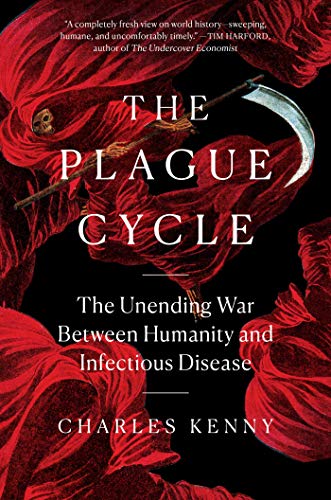
Charles Kenny, The Plague Cycle. One lesson of the last couple of years is that it is difficult to understand what happens to human societies without understanding the biological context in which they operate. Kenny’s book is an excellent introduction to this relatively new way of seeing history (see my post on his reinterpretation of Malthus for more).
John Maynard Keynes, Essays In Biography. Keynes’ accounts of the life and work of economists Thomas Malthus and Alfred Marshall are wonderful pieces of writing: detailed, sympathetic and thoroughly engaged with the substance of their work in a way that probably only another genius economist could manage (here’s more on Malthus).
James C. Scott, Against The Grain: A Deep History Of The Earliest States. An excellent survey of the rise of what is usually called “civilization.” Scott’s anarchist politics and anthropological background are similar to David Graeber’s, who was also interested in the history of the early states. But Scott is the more careful scholar, making clear the limits of our knowledge while Graeber reliably lunges for the tendentious over-interpretation.
Rachel Kushner, The Hard Crowd: Essays 2000-2020. After the miracle of The Mars Room I had to read more Kushner. Like any collection of occasional journalism this is a bit of a mixed bag, but the best pieces are very good indeed: her prose is always sharp and unsentimental.
Joan Didion, Slouching Towards Bethlehem. I wouldn’t normally expect magazine writing from the mid-1960s to age particularly well, but this classic collection of essays is not dated at all, and in fact often seems shockingly contemporary.
J.G. Ballard, Extreme Metaphors: Collected Interviews. From his perch in suburban England, Ballard’s outsider view on society was always interesting and original. Of course, he wasn’t right about everything, and his obsession with Freudian psychology turned out to be an intellectual dead end. But these interviews show how he saw where things were headed very clearly, not because he particularly understood technology but because he understood people.
Ken Jowitt, New World Disorder: The Leninist Extinction. A collection of essays on the political culture of the Soviet Union and other Communist states, filled with insights and a catholic range of historical and literary references. Although dating mostly from the late 1970s, a very different intellectual moment, the persistence of what Jowitt prefers to call Leninism in China has kept his project relevant.
A growing theme in China’s recent policy rhetoric is the forceful contrast between economic policymaking in China and “the West,” particularly the US. Not just in the old-school “our socialism is better than your capitalism” way, though there is some of that, but more in the vein of: “we do orthodox fiscal and monetary policymaking better than you do.” Central bank governor Yi Gang wrote an impressive article in 2019 in which he laid out China’s determination to avoid zero interest rates, quantitative easing, and all the rest of it. A more recent example of the genre was a speech this month by Guo Shuqing, China’s top financial regulator; here’s a couple of samples from the official English translation:
When fiscal spending has been largely supported by money printing, it is like an airplane getting stuck in a spinning vortex: it would be very hard for the airplane to get out easily on its own. Before 2008, the Fed balance sheet was less than about US$800 billion, but it has now expanded to almost $8 trillion. Meanwhile, the ratio of the US federal debt to its GDP has surged to a record high since the World War II. …
China didn’t flood the market with liquidity while strengthening its macro policy responses. Some countries criticize that China failed to implement adequate policy responses and make sufficient contribution to global economic recovery, which is evidently a bias or misconception. In fact, China has made quite strong policy efforts.
What I’ve only recently started to appreciate is just how deep the historical roots of this kind of thinking are in China. During the civil war between the Communists and the Nationalists, each side issued its own currency in areas they controlled, so there was competition between the different monetary and fiscal regimes. The Nationalists lost that battle: their money printing to finance fiscal obligations led to dramatic hyperinflation in the mid-1940s, with triple-digit increases in the money supply and price indexes (see for instance the 1954 article “Hyperinflation in China“). After the Communist victory in the war, one of the new government’s first great accomplishments was to stabilize the currency and end hyperinflation.
That seems to have been a formative experience for many of China’s economic thinkers. Even a couple of decades later, they were still touting the benefits of a stable currency and low government debt to Western visitors. There’s an interesting anecdote to this effect in John Kenneth Galbraith’s A China Passage, his diary of a 1972 visit to China in the company of Wassily Leontief and James Tobin (I did not know about this book before but recently stumbled across a copy at my favorite bookstore in Philadelphia). Here’s the relevant passage:
The government has no external or internal debt–a loan from the Soviets negotiated at the time of the Korean war was paid off ahead of schedule in 1968. The budget operates with a slight surplus. In our discussions in Peking information on Chinese finances was provided with great precision and competence by a member of the Institute of Economics of the Academy of Sciences. She notes that “The Chinese currency is one of the most stable in the world. In contrast with some capitalist countries, no borrowing, no inflation, no devaluation.” Being, like all our hosts, impeccably polite, she did not specify the capitalist country.
One of the more engaging moments of the visit was when James Tobin, who with Walter Heller was one of the men who made the New Economics legitimate under President Kennedy, undertook to explain in response to a question why it was often good for the United States to have a budget deficit and increase its debt. He might have had it easier with Andrew Mellon.
There seems to be a pretty direct line from Galbraith’s unnamed Chinese interlocutor in 1972 and the defiantly conservative posturing of today’s top economic policymakers. With the commemorations of the 100th anniversary of the Party’s founding in full swing, there’s even more attention than usual to this history. The Economic Daily newspaper has been running a series of articles on the Party’s pre-1949 economic policies: one focuses on Chen Yun’s success in containing inflation in 1943-44, while another highlights Xue Muqiao’s achievements in stabilizing the currency in 1940-41. The message from such historical arcana is pretty straightforward: the Party’s track record of steady economic management goes back a very long way.
Skeptics will be quick to point out that this kind of rhetoric is a bit incongruous coming from the country that, in the decade after the 2008 global financial crisis, engaged in one of the largest and most expansions of debt in economic history. Yet the effects of the old conservative line of thinking were visible even then. Because the Ministry of Finance was obsessed with keeping its own debt and deficit metrics under control, it ended up tolerating excessive borrowing by local governments and SOEs.
A couple of further comments on the Galbraith book: I wish it had had more of the kind of anecdotes I quoted above. On the whole it is not very insightful: he is too obviously and easily swayed by the fact that his Chinese hosts fed him well and put him in nice accommodations. He modestly announces his lack of China expertise at the opening, but does nothing to compensate for how those gaps in his knowledge kept him from understanding the context of what he was seeing (a problem that is blindingly obvious now but was clear even to other contemporary non-specialists; see for instance Martin Bernal’s 1973 review). As a result, he makes some fairly cringeworthy comments.
The name of Malthus will forever be associated with the idea of resource constraints on human population growth– which is unfortunate, because his argument appears to have been completely wrong. But I feel a need to compensate a bit for my little essay on those mistakes after reading John Maynard Keynes’ delightful biographical sketch of Malthus. Keynes offers an alternative intellectual history of Malthus, in which the Essay on the Principle of Population appears as a youthful work that gave him much notoriety, but was far from his most significant intellectual accomplishment.
It is difficult to overstate just how good Keynes’ essay on Malthus is: it is wonderfully detailed yet short, warmly sympathetic yet intellectually sharp. (Among other tidbits, we learn the name of Malthus is derived from “Malthouse,” and should be pronounced similarly.) Tyler Cowen has called Keynes “one of the greatest biographical writers in the entire English language.” And indeed I found Keynes’ Essays in Biography to be very good, though the meat of it is really the biographical essay on Malthus and a more extended one on Alfred Marshall; the sketches of British politicians for me were less interesting and insightful.
Keynes claims Malthus as his intellectual forebear, “the first of the Cambridge economists,” on the strength of Malthus’ early attention to the demand side of the economy, and his invention of the concept of “effective demand,” a precursor to today’s “aggregate demand.” As far back as 1820, in his Principles of Political Economy, Malthus recommended “the employment of the poor in roads and public works” as a remedy to economic downturns. But the first appearance of this idea actually came in 1800, in an anonymous pamphlet called An Investigation of the Cause of the Present High Price of Provisions:
Malthus’s conception of “effective demand” is brilliantly illustrated in this early pamphlet by “an idea which struck him so strongly as he rode on horseback from Hastings to Town” that he stopped two days in his “garret in town,” “sitting up till two o’clock to finish it that it might come out before the meeting of parliament.” He was pondering why the price of provisions should have risen by so much more than could be accounted for by any deficiency in the harvest. He did not, like Ricardo a few years later, invoke the quantity of money. He found the cause in the increase in working-class incomes as a consequence of parish allowances being raised in proportion to the cost of living. …
The words and the ideas are simple. But here is the beginning of systematic economic thinking.
Keynes found that Malthus’ economic thinking was best developed in his long correspondence with David Ricardo, a relationship that managed to combine deep and sincere friendship with equally profound intellectual disagreement:
This friendship will live in history on account of its having given rise to the most important literary correspondence in the whole development of Political Economy. … Here, indeed, are to be found the seeds of economic theory, and also the divergent lines—so divergent at the outset that the destination can scarcely be recognised as the same until it is reached—along which the subject can be developed. …
The contrasts between the intellectual gifts of the two were obvious and delightful. In economic discussions Ricardo was the abstract and a priori theorist, Malthus the inductive and intuitive investigator who hated to stray too far from what he could test by reference to the facts and his own intuitions. …
One cannot rise from a perusal of this correspondence without a feeling that the almost total obliteration of Malthus’s line of approach and the complete domination of Ricardo’s for a period of a hundred years has been a disaster to the progress of economics. Time after time in these letters Malthus is talking plain sense, the force of which Ricardo with his head in the clouds wholly fails to comprehend. Time after time a crushing refutation by Malthus is met by a mind so completely closed that Ricardo does not even see what Malthus is saying.
Malthus’ strengths, on Keynes’ account, are his close attention to the realities of economic life and his detailed investigation into practicalities, which gave him insights that Ricardo’s abstractions could not. It’s interesting, therefore, that he characterizes Malthus’ first writings on population as “a priori and philosophical in method,” the precise terms in which he criticizes Ricardo’s arguments.
While Malthus added huge amounts of empirical material to the second edition of the Essay on the Principle of Population, it is clear that the inspiration for the first edition was not empirical. It was more of an abstract conviction, one that arose during a theological argument with his father. William Otter, a friend of Malthus, relates the story in his Memoir of Robert Malthus:
The mind of Mr. Malthus was certainly set to work upon the subject of population, in consequence of frequent discussions between his father and himself respecting another question, in which they differed entirely from each other. The former, a man of romantic and somewhat sanguine temper, had warmly adopted the opinions of Condorcet and Godwin respecting the perfectibility of man, to which the sound and practical sense of the latter was always opposed; and when the question had been often the subject of animated discussion between them, and the son had rested his cause, principally upon the obstacles which the tendency of population to increase faster than the means of subsistence, would always throw in the way; he was desired to put down in writing, for maturer consideration, the substance of his argument, the consequence of which was, the Essay on Population.
Keynes does not discuss whether Malthus’ theory of population–that it would always grow exponentially while food production could only grow linearly–was actually correct, seeing it mainly as an early example of the power of his intellect. When the early work on population is considered along with the later work on political economy, the intellectual contrast with Ricardo is perhaps not as sharp as Keynes makes it out to be: Malthus too could be bullheaded in holding to his a priori theories in the face of contrary argument. But who among us has not been guilty of that?
Few people are as famous for being wrong as Thomas Robert Malthus, the English cleric and early student of population growth. Malthus thought that while population could grow exponentially, food production could grow only linearly. Therefore population growth would always outpace food production, and famine would always then cause population to decline to a sustainable level. In An Essay on the Principle of Population, first published in 1798, he wrote:
We should be led into an error if we were thence to suppose that population and food ever really increase in the same ratio. The one is still a geometrical and the other an arithmetical ratio, that is, one increases by multiplication, and the other by addition. Where there are few people, and a great quantity of fertile land, the power of the earth to afford a yearly increase of food may be compared to a great reservoir of water, supplied by a moderate stream. The faster population increases, the more help will be got to draw off the water, and consequently an increasing quantity will be taken every year. But the sooner, undoubtedly, will the reservoir be exhausted, and the streams only remain. When acre has been added to acre, till all the fertile land is occupied, the yearly increase of food will depend upon the amelioration of the land already in possession; and even this moderate stream will be gradually diminishing. But population, could it be supplied with food, would go on with unexhausted vigour, and the increase of one period would furnish the power of a greater increase the next, and this without any limit.
The dynamics that Malthus described did hold true for most of human history. Technological improvements allowed the number of people that could be supported off the land to increase, but that increase in population absorbed most of the increase in output and average living standards did not rise much–exactly as Malthus predicted. Before the industrial revolution, there is little evidence of any sustained increase in per-capita income over time. Nonetheless, Malthus stopped being right not too long after the publication of his book. The last two centuries or so of modern economic growth show that the production of food, and other goods and services, can in fact grow exponentially for sustained periods thanks to technological progress. (Gregory Clark’s A Farewell to Alms is a very clear exposition of the Malthusian model for prior human economic history, and how the industrial revolution transformed it.)
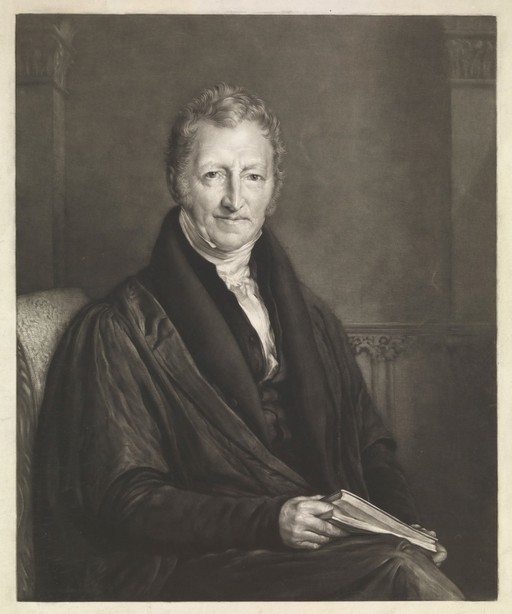
Thomas Robert Malthus (by John Liddell, 1834)
One of the most interesting ideas in Charles Kenny’s compact and lively new history of humanity’s struggle with infectious disease, The Plague Cycle, is that this common understanding of how Malthus was wrong is itself wrong. Malthus’ mistake was not simply a failure of imagination, the inability to imagine exponential technological progress. Kenny argues that Malthus’ mistake was even more basic: in fact, food production has never operated as a real constraint on human population growth:
For most of the time civilization has existed, pestilence has wiped out far more lives than famine and violence combined—so much so that Malthus’s proposed final limit of land and resources as the check to human numbers has rarely been approached. Disease has usually kept populations below the levels that could have been supported given agricultural technologies at the time.
Kenny credits Ester Boserup, a Danish economist and consultant to the United Nations, for the insight that food production was always more capable of improvement than Malthus assumed, and that the potential for bringing more land into production, and making land more productive, was hardly ever exhausted. In her 1965 book The Conditions of Agricultural Growth, she argued that population growth actually makes higher agricultural output possible through intensified cultivation (for those who, like me, were not aware of Boserup’s work, there’s a useful review at EH.net.) Malthus’ argument that improvements in food output were only linear rather than exponential was therefore wrong before the industrial revolution, as well as after it.
Something clearly operated to keep human population in check before its explosion over the last couple of centuries. But it was generally not starvation. The real problem is that population growth begets population density, and population density, in the absence of sanitation, antiobiotics, and other checks on infection, begets disease and death:
Earth scientist Jed Kaplan and colleagues suggest that less than one-half of the land currently used for food production was used in 1600 and less than one-third in 100 CE. It is true that making more of the land available takes more work—sometimes brutally hard work, and that risks malnutrition. Again, some land couldn’t be cultivated without innovations, including heavy plows and irrigation. Nonetheless, it seems clear that throughout most of history the number of humans on earth fluctuated far below the maximum possible.
Instead, we should probably thank (or blame) the regulatory mechanism of infection for limiting populations. As the number of people grew, population density drove up disease rates. This thinning mechanism was, in most places, probably the most powerful check on the number of people, particularly during the centuries that humans have been farmers. …And when infectious death declined in the nineteenth and twentieth centuries, population, urbanization, intensification, land use, and prosperity all climbed to historically unprecedented levels worldwide.
Although there’s a lot of interesting history in Kenny’s book, I’m not sure he does enough with this insight. To me it seems a fairly important finding that the foundation of modern technological civilization is the ability to control infectious disease. (To be fair to Malthus, he did discuss disease as one of the mechanisms that acted to limit human population growth, but he generally discounted its importance relative to food supply.) Modern economies are all fundamentally dense, urban economies–the US is 82% urban, China 60%–and this population structure cannot be sustained without a set of technologies and practices that manage infectious disease.
When industrialization and urbanization happened without those controls, as they did in early 19th-century Britain, they led to actual declines in living standards and life expectancy. Rampant disease in pre-industrial cities like ancient Rome killed off residents faster than they could reproduce, requiring a continuing inflow of migrants to maintain their population. If our current systems for controlling infectious disease weaken or fail, therefore, we’re in trouble. That may be a remote tail risk, but it seems at least as serious a tail risk as, say, an asteroid crashing into Earth, a possibility that seems to get a lot more popular discussion. Kenny acknowledges the risk, but ever the optimist, quickly brushes it off:
Given how many infections we share with animals, how many animal diseases may be only a few mutations away from infecting humans, and how rapidly viruses and microbes in particular can mutate and then spread in a connected world, new global pandemics will surely continue to hurl themselves at humanity. Ronald Barrett and colleagues from the Department of Anthropology at Emory University in Atlanta have gone as far as to suggest that the emergence and re-emergence of disease threats owing to globalization and antibiotic resistance is a sign that we’re entering a “third epidemiologic transition” comparable to the rise of infection at the dawn of civilization and its fall in the last century and a half. That (hopefully) goes too far, but it certainly suggests the scale of the risk we need to confront.
The Malthusian fear that physical resource constraints could stop economic advance and population growth has been a persistent one in economic thinking over decades (and one to which I must confess making my own contribution). Kenny’s book suggests we should have instead been working to better understand and manage the fundamental biological systems on which our civilization depends.
Once an obscure topic, China’s industrial policy now gets attention from heads of state. The entire US-China trade war waged by the Trump administration was, in formal legal terms any way, justified as a response to distorting industrial policy. Understanding industrial policy seems to be a requirement for participating in current intellectual debates about China.
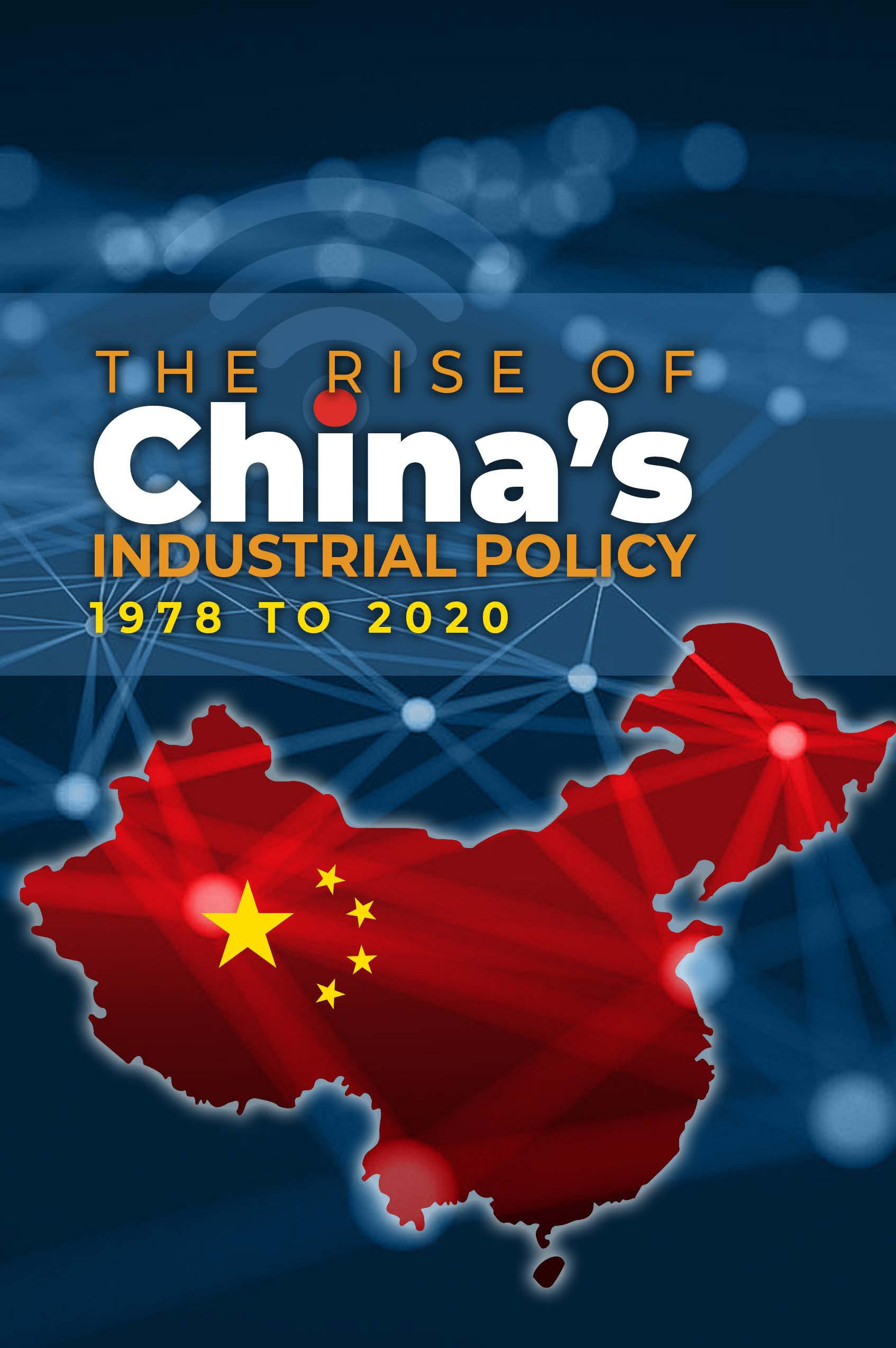
Thankfully, Barry Naughton has written a short and highly readable book, The Rise of China’s Industrial Policy, 1978 to 2020, that explains its history and functioning. Even better, it is available as a free PDF download from the Centro de Estudios China-México at the Universidad Nacional Autónoma de México. Based on a series of lectures, the book has a conversational tone and jargon-free style that is rare for this subject matter, a topic both highly technical and highly politicized.
Naughton’s argument is plainly stated in three short sentences:
Until 2006, China never had “industrial policy.” Since about 2010, China has had industrial policy on a massive and unprecedented scale. The outcomes of post-2010 industrial policy in China have not been adequately studied and are as yet unknown.
A prominent economic historian of China–his textbook The Chinese Economy is the standard–Naughton argues that industrial policy on its current grand scale is a very recent development in post-1978 China, and not at all part of the “China model” responsible for its decades-long growth miracle. He sees current policies as a departure from past practice, rather than as part of the deep structures of Chinese socialism.
Powerful targeted industrial policies in China have been generally absent (1978-2005) and have sometimes been overbearing (2010-present), but they have never been a crucial component in explaining rapid Chinese economic growth. That doesn’t mean that government doesn’t matter, or that distinctive Chinese approaches have not been important: it does, and they have been. Indeed, it should be intuitively obvious that the impact of a large-scale fixed investment effort, massive investment in human resources, and the presence of thousands of growth-promoting local governments competing with each other will be much greater than the impact of government efforts to directly intervene in the sectoral development pattern of the economy. Of course, these are not mutually exclusively choices. But targeted industrial policy is still utterly unproven in terms of its impact on China’s development. It may turn out, 20 years from now, to have been a huge success, but as of today, there is very little evidence for its importance or success.
Naughton admits his own skepticism of the benefits of large-scale industrial policy, but his main point is that neither scholars nor the Chinese government have a solid understanding of the actual consequences. The scale of resources being mobilized by industrial policy is enormous, and thus clearly poses some economic risks. He thinks that China was well on its way to being a global technological powerhouse before the introduction of all of these industrial policies, thanks to its highly competitive manufacturing sector and skilled technical workforce. So to him, it is not obvious those risks were worth taking:
It is unclear to what extent Chinese policy-makers have considered the technological, economic, and international risks of their industrial policies. It appears rather that policy-makers have been seduced by the vision of a technological revolution and a substantial re-ordering of global strategic relations and have rushed ahead with an aggressive and decisive round of industrial policies. At a minimum, this is an enormous gamble. As stated repeatedly in this essay, Chinese would in any case have emerged as a technology giant over the next decade or two. It is not necessarily beneficial to have government forcibly attempt to accelerate the process, creating substantial additional risk, waste, and conflict. Indeed, it may end up seriously retarding the global benefits that are potentially available from new technologies, particularly if the world ends up partitioned into competing technological blocks.
Plainly, the Chinese government thought that the risks of not carrying out industrial policy were also great. And Naughton does a good job of explaining the intellectual framework that has justified their large-scale interventions. I found the book helpful and clarifying.
In 1984, the Taiwan-born and US-trained anthropologist Huang Shu-min left his family in Iowa to live in a village on the Chinese island of Xiamen, just outside the city of the same name. By that time Chinese villages had already benefited from a few years of reform, and the changes underway were dramatic. Huang was impressed by the visible improvements in living standards, but also somewhat depressed by the constant presence of official propaganda and the regimented controls over daily life. At one point, he recounts trying to express this conflict to a villager:
“I must say that living conditions here are probably much better than what one might see in India or in Africa. To me, this seems to be directly related to the tightly controlled but highly efficient administrative system that one finds in China. The fundamental contradiction then is between economic development and human liberty. In order to achieve quick development, sometimes citizens of less-developed countries, such as China, may have to forgo some of their individual freedom. The problem I weigh is how to draw the delicate balance between collective interests and individual freedom.
In the Chinese context, it’s hard to imagine a more anodyne statement. These days, the effectiveness of China’s authoritarian state and the correctness of its tradeoff between liberties and development have been taken for granted by a generation. What you expect to happen here is for Huang to receive enthusiastic agreement and a lecture on the virtues of China’s system. So it’s pretty interesting that his interlocutor, the village Communist Party secretary Ye Wende, actually pushes back sharply against the whole framing:
Ye looked at me wearily. “I don’t know anything about India or Africa, nor do I know where you have picked up this great idea about the conflict between economic development and liberty. The only thing I know is based on my personal experience, and it seems to run counter to what you said. The more political controls imposed on the peasants, the less they want to work. On the other hand, when the national government shed itself of most controls in the countryside and gave peasants more free choice, they responded with greater enthusiasm and higher production.
This may not be true for all of China. But in Lin Brigade, at least as far as I can tell, it was only in the 1970s, when people realized the absurdity of political campaigns in the countryside and stopped cutting each other’s throats, and when the national policy became more flexible toward peasants, that we were able to achieve genuine development. If you don’t realize this point, you will never be able to understand current agrarian reform, either at the national level or in this village.”
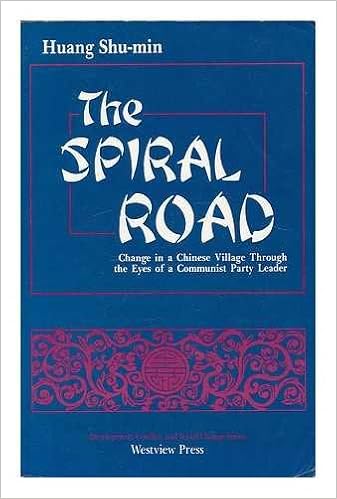
That exchange is from Huang’s 1989 book, The Spiral Road: Change in a Chinese Village Through the Eyes of a Communist Party Leader. It’s an unusual document, consisting entirely of extended interviews with Ye, who recounts an oral history of his village from the 1950s on. Bits like that offer a reminder of how different the intellectual environment was in China during the 1980s.
It’s been an exhausting year for me, not a great one for reading. I resorted to a lot of escapist fiction and comforting re-reads to keep going. Still, I made some pretty good new discoveries that I am happy to recommend. The favorites below are listed in roughly the order I read them:
Nonfiction
Claud Cockburn, A Discord of Trumpets. The endlessly entertaining autobiography of a British journalist who was born in Beijing, spent his childhood in England and Hungary, and worked in Germany and the US. A feast of snarky one-liners, but also good first-hand account of events like the 1929 stock market crash.
Freeman Dyson, The Scientist as Rebel. The first and possibly best collection of Dyson’s essays for the New York Review of Books; invigorating reflections on science, politics, and history. Every one follows his cardinal principle: “It is better to be wrong than to be vague.”
Hou Li, Building For Oil: Daqing and the Formation of the Chinese Socialist State. A unique blend of bottom-up and top-down history, and very well written in spite of the academic title and pricing. Actually one of the best books for understanding life in the early People’s Republic. (More discussion here.)
Michael Schmidt, Gilgamesh: The Life of a Poem. A deep appreciation of the oldest work of human literature that confronts its strangeness and mysteries head-on.
Neil S. Price, The Children of Ash and Elm: A History of the Vikings. Fascinating on both the broad sweep of the Vikings’ impact on the world (much bigger than I had ever realized), and the often-surprising details of their daily life.
Robert Charles Wilson, Spin. A classic piece of what-if science fiction that brings the expansive drama of cosmic time down to human scale.
C.J. Samson, Dissolution (and its sequels). Page-turning historical thrillers that also happen to be deeply researched and critical accounts of the cruel politics and ideological orthodoxy of Tudor England. Malcolm Gaskill’s appreciation in the LRB is a good guide.
Lydia Fitzpatrick, Lights All Night Long. A troubled youth travels from one isolated oil-industry town in Siberia, to another, in Louisiana.
M. John Harrison, The Sunken Land Begins To Rise Again. A profoundly unsettling book involving water, conspiracy theories, and miscommunication. Harrison’s prize-winning prose is spectacular, every sentence precisely turned.
Paul Howarth, Only Killers and Thieves. Two boys confront violence on the Australian frontier; consistently compelling though often brutal.
Susanna Clarke, Piranesi. This tale of a man finding meaning in repetitive acts inside confined spaces was, in retrospect, highly appropriate pandemic reading.
Emily Wilson, trans., The Odyssey. It’s been a while since I’ve re-read Homer, and it felt like a complete rediscovery thanks to Wilson’s translation. What struck me was how concrete and physical the language is, and how focused the poem is on morality and duty rather than adventure. Her enlightening introduction alone is worth the price of admission.
The book that Odd Arne Westad is now working on sounds very interesting. It’s a collaboration with his fellow historian of the Cold War, Chen Jian, on China’s “long 1970s.” Their project tackles the late 1960s to the mid 1980s as one unified period, rather than dividing them into the conventional eras of the Cultural Revolution and Reform and Opening. The overarching question is a basic one: how and why did China make that transition from revolutionary politics to economic growth?
In a webinar last week organized by the University of California, San Diego, Westad said they still have three chapters to write, but was able to summarize some of the book’s main arguments. One of them is the importance of “change from below, from outside the state and Party sectors.” The following passages are from my notes of Westad’s remarks, slightly rearranged for readability:
It’s pretty clear to us that much of the economic transformation of China during the long 1970s originated in the south. It’s most visible in Guangdong and parts of Fujian. This is a fascinating story. It’s something that starts after the first, most intense phase of the Cultural Revolution is over.
It’s a kind of market revolution carried out in desperation by people and families who knew a bit about a how a market economy would operate, and were deathly afraid that things would move back to a situation like the Great Leap Forward. There are these small businesses that come up, completely against any regulation, already in 1972 and 1973, based on a barter economy and links to Hong Kong and Southeast Asia. This vanguard was already in place when reform from the center was launched.
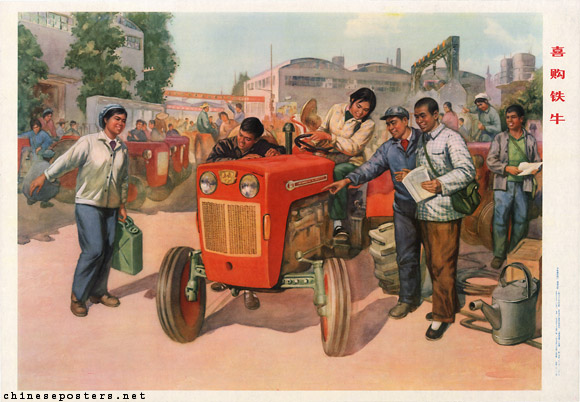
One example we use is the No.3 Memory of Lenin Tractor Repair Factory in Zhuhai, which already in 1973 had started repairing tractors outside the plan. It would take tractors that needed to be repaired from other units, repair them on the side of the plan, and then get payment in kind. That payment in kind was then either bartered further within Guangdong, or smuggled downriver to Hong Kong. By 1973 this unit had a Hong Kong bank account. If this had been discovered at the central level, these people would have been shot.
We are not arguing that the specific models of economic and social transformation that you see in Guangdong were then put in motion at the central level. But it primed units to behave in ways they had already prepared for. That made it possible for them to get one step ahead in Guangdong. They could develop very quickly into very profitable companies.
This is really significant for China’s history over the next generation. Without these moves that had privileged certain areas and certain units prior to 1978, that development would have taken a very different course. With one exception, all the units that we looked at have since become constituent elements of some of the largest companies in China.
The tractor factory with a Hong Kong bank account is amazing! It reminds me of Frank Dikotter’s 2016 article “The Silent Revolution: Decollectivization from Below during the Cultural Revolution,” which uses archives to give numerous examples of people leaving collectives to raise crops or run factories on their own initiative, often with the implicit or explicit toleration of local officials.
Buying a tractor in 1975
It seems as if the book’s focus will be less on high politics and foreign relations than one might have guessed from their previous works: Westad is the author of, among other things, a survey of China’s foreign relations entitled Restless Empire: China and the World since 1750, while Chen is the author of Mao’s China and the Cold War. But the Cold War context of this period clearly informs their analysis. Here are some more interesting comments from Westad:
It’s very unlikely, at least to me, that Chinese reform would have been as successful if it weren’t for the Cold War, if the US did not have an interest in facilitating China’s economic reform and economic growth. What the Americans found when they started coming back to China was just how far behind China was in terms of economy, technology, science. US leaders from Nixon to Reagan believed they had China as a partner in putting pressure on the Soviet Union, but they discovered quickly that China was far too weak to play that role. So that put great pressure on them to help China develop. The fact that the Chinese state after 1976 made use of the security links with the US to get the technology and credit it needed is of crucial importance.




 The Tangled Woof