China bows to de-industrialization

Reading China’s five-year plans, one of the most immediately striking things is just how many things they attempt to plan. These are not just documents about where to build airports or highways (although such proposals do go into the plan). Recent iterations also cover many things that are not obviously amenable to top-down direction, such as what sorts of technological breakthroughs will happen in the future, and how social mores and customs will develop. In China’s Leninist political system, government attempts to specify the contours of “national economic and social development” are the norm rather than the exception.

In this context, restraint can be more notable than ambition. It’s not that surprising when plans declare extraordinary goals; it is more surprising when plans step back from attempted intervention. The 15th Five-Year Plan for the years 2026-30, now being drafted according to a set of “recommendations” approved by the Communist Party leadership in October, will certainly not be a laissez-faire document. Most media coverage has emphasized how the recommendations show China prioritizing industrial policy as it attempts to gain an edge in its geopolitical competition with the US. Here is a relevant section from the official English translation:

A modernized industrial system provides the material and technological foundations for Chinese modernization. We should keep our focus on the real economy, continue to pursue smart, green, and integrated development, and work faster to boost China’s strength in manufacturing, product quality, aerospace, transportation, and cyberspace. The share of manufacturing in the national economy should be kept at an appropriate level, and a modernized industrial system should be developed with advanced manufacturing as the backbone.

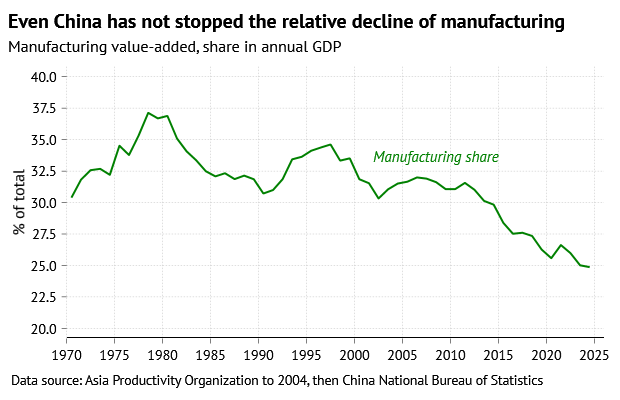
The obsession with advanced manufacturing as the avatar of the “real economy” is familiar from years of similar documents from China’s planning apparatus. But if we read this passage in the spirit of looking for what is missing, rather than what is included, one thing stands out: the language on the share of manufacturing. The 14th Five-Year Plan, when it was published in 2021, included a new goal to “maintain the basic stability of the manufacturing share” of GDP.

Previous plans had included goals to raise the service sector’s share of GDP, which at the time was seen as an indicator of the structural transformation and modernization of the economy. The 14th plan dropped those goals, and replaced them with the goal for stability in the manufacturing share of GDP. Rather than accepting that China’s economy would eventually look like everyone else’s–with the manufacturing share of GDP gradually falling over time–planners wanted China to stand out globally by avoiding the trend of de-industrialization.

It’s one thing to declare such goals, another to achieve them. The structural composition of an economy is not particularly easy to control: there is no single dial to turn that will boost manufacturing or scale back services. And in the event, the 14th plan’s declaration did not stop the manufacturing share of GDP from declining: it has gone from 26.6% in 2021, the first year of the plan, to 24.9% in 2024, and looks like it will tick down a bit more to around 24.8% by the end of 2025, when the plan period concludes.

This is not a large decline, and what counts “basic stability” is, after all, up to the government to decide. The Ministry of Industry and Information Technology, the agency responsible for this target, has already publicly declared that the manufacturing share is in fact basically stable. But the direction is clear: the manufacturing share of GDP has been in mostly uninterrupted decline since 2021. It spiked up during the post-Covid export boom of 2021, but has since resumed the downward trend.

The change in the wording for the next plan must therefore be read as an implicit admission of defeat: it was not actually possible to keep the manufacturing share of GDP unchanged, even with very generous subsidies for manufacturing investment and output. The next plan’s goal has thus been scaled back, from stopping the decline in the manufacturing share to just making sure the manufacturing share is “appropriate,” whatever that means. That this wording accepts some continued future decline in the manufacturing share of GDP was made clear in an explanatory article published in Seeking Truth, an official journal of the Communist Party leadership:

Traditional economics holds that a decline in the share of manufacturing and a rise in the share of services as the size of a country’s economy increases is a universal economic phenomenon. … The share of manufacturing in China displays an inverted U-shaped curve of “first rising and then falling,” which basically accords with the theory and practical regularities of industrialization. However, what we must be alert to is that this share must not decline too rapidly, nor fall to an excessively low level, as this could lead to serious consequences.

Among the main reasons that the manufacturing share of GDP tends to decline and the services share to increase in higher-income economies are that incremental household spending shifts from goods to services as incomes rise, and that changes in relative prices tend to make services (which tend to have slower productivity growth than manufacturing) a larger share of nominal GDP over time.

Both of these trends are a consequence of economic success, in terms of higher output and productivity: at least some of what is decried as “de-industrialization” is good actually. It is also good for China’s planners to recognize that reality and not distort the economy in pursuit of an impossible outcome. Obviously, a loss of export competitiveness would be a less positive reason for the manufacturing share to decline, but it makes more sense to focus on that issue directly than indirectly through an ambiguous indicator like the manufacturing share of GDP. Again, it’s not just significant what plans attempt to control—it is also significant what they do not attempt to control.

Will this change make a difference? Arguably, no. Since it’s not really possible for the government to directly control the relative shares of GDP of different sectors, it might not make much practical difference whether it has such stated goals. And there is still plenty of planning language about supporting the manufacturing sector. But it’s also arguable that changing the rhetoric will have effects. Technically, everything in the five-year plan has the force of law, and government officials are obligated to pursue the goals. The goal of maintaining the manufacturing share of GDP may have served as part of the justification for lots of specific policies that subsidized manufacturing output and investment.

There’s even a case to be made that those policies actually depressed the manufacturing share of GDP: by boosting output and capacity above where they would have been otherwise, subsidies probably contributed to the sustained decline in prices for China’s manufactured goods over the past few years, weighing on their share of nominal output. If subsidizing manufacturing output and investment is no longer so politically urgent, because there is no structural imperative to meet, then perhaps there will be room for those subsidies to retreat at the margin. That would certainly not be the outcome most outside observers expect from a five-year plan generally described as “doubling down” on industrial policy.

Exams are everything in China

The first people you meet in life are your parents. That simple fact makes the family the foundational institution of society: learning how to be a person, and what other people are like, happens first in the family. After that, the next social institution most people encounter, in modern societies anyway, is usually schooling and education. Schools transmit social values to new generations, and help determine the specific social roles that the members of the new generations will occupy. Education is always a window onto society, and the new book The Highest Exam: How The Gaokao Shapes China, by the economists Ruixue Jia and Hongbin Li, is very illuminating on how China’s educational system has mattered for both social and economic outcomes, and on just why education is so important to so many Chinese families.

More profoundly than that, though, it makes a case for how one specific set of educational practices–the college-admissions exam known as the gaokao–serves as a fundamental structuring institution of contemporary Chinese society. Scores on the gaokao (or more precisely, the relative ranking of those scores) are the sole determinant of which students get admitted to which universities. Because college admissions are determined by gaokao scores–and nothing else, not recommendations or ability to pay–the test functions as a meritocratic channel for social advancement. There is fierce competition for the opportunity to attend the best colleges, but the competition is based on merit and merit is measured by exams.

In this basic structure, the gaokao is widely understood as the modern reincarnation of the keju, the imperial examination system that offered a chance, in theory, for any man in China to join the emperor’s civil service. The authors describe how millions wasted their lives in fruitless efforts to score high enough on the imperial exam to achieve a new and higher social status. But the fact that a meritocratic channel for social advancement existed was important; not having one seems to have, historically, not worked out well. The authors observe: “The exam system persisted for over a millennium, but after years of mounting criticism, the Qing government abolished it. Shortly thereafter, the Qing dynasty itself fell in 1911.” The ending of the exam system meant a huge loss of opportunity for the men who had spent years preparing for it, an experience that politically radicalized many of them.

When the Communist Party took over after China’s civil war, they moved quickly to reinstate a meritocratic channel for social advancement. The gaokao was first established in 1952, in the early years of the People’s Republic, as a nationwide exam that would identify talented young people for further education. The new leaders wanted a modern system for testing useful knowledge, not the ability to recite the Confucian classics, so the gaokao was a self-conscious modernization and reform of the old system. But the cultural memory of the keju was broadly positive: the population was already prepared to accept the idea that an examination system is, in fact, a fair way to identify merit. By associating itself with a traditional culture of exams and meritocratic advancement, the new Communist government gained rather than lost legitimacy.

The next Chinese leader foolish enough to mess around with exams was Mao Zedong, who during the Cultural Revolution shut down the gaokao, along with the normal functioning of the entire educational system. The Cultural Revolution for a while turned meritocracy on its head, punishing the educated classes and elevating workers and peasants. Universities did eventually resume classes, but they were mostly about ideology, and admissions were done on the basis of political recommendations. But Mao’s death opened the floodgates, and the leaders in Beijing were inundated by protests and petitions demanding the reinstatement of the gaokao. Although the start of China’s “reform era” is conventionally dated to 1978, when some top-level political meetings were held, some people consider the real start to be 1977, when Deng Xiaoping restored the test and univerisites admitted a new class of students selected on the basis of academic merit.

One possible reading of the last century or so of political history in China, therefore, is that governments who provide a meritocratic channel for social advancement have legitimacy and popular support, and governments who do not provide one, do not. Such a pattern may have held in previous centuries as well: one of the co-authors’ many papers summarized in the book quantifies how the introduction of the keju system, around the 7th century AD, reduced Chinese emperors’ risk of being dethroned by a factor of 10. Certainly, the way more recent governments have behaved suggests they think the gaokao helps keep them in power. The gaokao is not seen as legitimate because it is instituted by the Communist Party; rather, it is the Communist Party that gains legitimacy by administering the gaokao in an even-handed way.

That’s not to say that the exam system is without downsides. For all of its popular support, the gaokao creates an incredibly high-pressure social environment. It’s not just that there’s one test that everyone has to take, but that children’s entire educational trajectory is built around preparing for success on that test. The gaokao is just the culmination of a series of tests and sorting procedures that choose who will be admitted to China’s elite universities, which to a remarkable extent determines who will be in the social and economic elite. Parents work relentlessly to position their children to do well on the gaokao, because, literally, nothing else matters; there are essentially no alternative pathway to success in Chinese society. Because people arrange their entire lives to help their kids succeed on the gaokao, changes can threaten the investments already made, and lead to strong resistance.

In 2013, according to the book, Hongbin Li was asked by China’s government to design a replacement for the gaokao. The initial idea was to switch out the single all-important test administered on only one day for a series of tests in different subjects, which could be taken multiple times throughout a student’s high school career–somewhat analogous to the Advanded Placement (AP) tests in US high schools. That probably would be less stressful for students, and make for a fairer assessment of their achievements. Li designed textbooks and tests and even started training teachers in the new approach, before the whole effort was scrapped. Even smaller changes to the gaokao system to try to address entrenched inequality had generated surprisingly widespread political protests, and been quietly walked back. The impression is very much that the exam system amounts to an untouchable “third rail” of Chinese politics.

One of the more interesting implications of the book is that because the social prestige of the gaokao is so high in China, and because everyone has been trained to understand and work with that kind of system, that it has implicitly become the model for other social institutions outside of education. The authors analyze the underling structure of the gaokao as a “centralized hierarchical tournament”: the competition between students is centralized because there is only one standard of success, and it is hierarchical because success is defined in relative terms, by doing better than those around you. Once the concept is grasped, it is easy to see many other centralized hierarchical tournaments in Chinese society.

The most consequential of these is probably the competition among local governments to generate economic growth, which many scholars have identified as one of the fundamental structures underlying China’s reform-era growth boom. Local officials are always competing for promotion and advancement, and one of their key performance indicators is economic growth in their jurisdiction. That competition is centralized because there is, effectively, only indicator of success, GDP growth, and only one arbiter of success, the central Party apparatus. And it is hierarchical because success is defined relative terms: it’s about where is your GDP growth relative to your peers and predecessors in office.

That system makes sense for some of the same reasons that the gaokao does: GDP growth, like an exam score, is a relatively objective and transparent metric, better than many alternatives. Also, centralized hierarchical tournaments seem to be good at creating very effective incentives. The competition among Chinese students to do well on the gaokao does in fact result in most of them acquiring real skills and knowledge. And the competition among local governments has in fact delivered a lot of GDP growth.

The centrality of the gaokao, and gaokao-like institutions, in China makes it all the more intriguing that the man now sitting on top of the political system seems less committed to them than many others. Xi Jinping belongs to the last generation of “worker-peasant-soldier” students admitted to university on the basis of political recommendations rather than exam scores. (This wasn’t an automatic result of his being the offspring of a senior Party leader. Joseph Torigian has documented that because Xi’s father had been purged during the Cultural Revolution, his initial applications to university starting in 1973 were rejected; but eventually a sympathetic administrator approved his admission.) This has always set Xi apart from other more “technocratic” figures in the government, like his former No. 2 Li Keqiang (see my old post on “The education of Li Keqiang“).

Xi famously oversaw the shuangjian or “double reduction” campaign launched in July 2021, which aimed at easing the “burdens” on students of excessive homework and after-school tutoring–one of the most high-profile attempts to address the downsides of the gaokao system in recent years. This got a lot more attention outside China than most such political campaign, because it essentially outlawed the business model of some publicly traded companies. While the rules remain on the books, recent evidence suggests that enforcement has been relaxed, and businesses are again being allowed to meet parents’ demand for tutoring, which remains very high. The exam system remains a fundamental social institution of today’s China, and as such very difficult to change.

Historical trajectories of local government in India and China

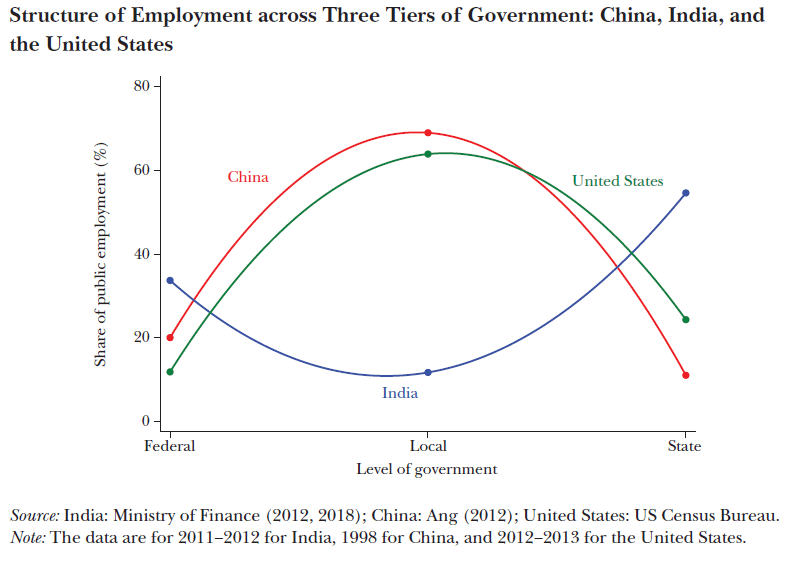
After doing a round of India-China comparisons that focused on commonly cited macro indicators like manufacturing, investment and literacy (see last month’s post “India and the invidious comparison with China“), I wanted to highlight a lower-profile but perhaps even more interesting contrast: the structure of government and the nature of decentralization in large countries. One of the coolest China-India charts I have seen is in a 2020 article in the Journal of Economic Perspectives by Devesh Kapur, “Why Does the Indian State Both Fail and Succeed?” It shows how public employees in India, China and the US are distributed across different levels of government:

Notably, India has many more of its public servants at the state level than China does at the equivalent provincial level, and many fewer at the local (i.e. cities and towns) level than China does. (The China numbers come from an interesting paper by Yuen Yuen Ang; the data sources unfortunately stop in 1998). On this measure, state capacity at the local level looks much stronger in China than in India, which helps explain some of the long-running economic differences between them. (The structural similarity of China and the US in public employment is also pretty interesting!)

Some of the major indicators of India’s poor state capacity are its failures in delivering public services like health and education, which happen at the local level. China does much better in basic service delivery–and its local governments have also played a very obvious and important in driving growth, thanks to the competition and experimentation among local officials driven to develop their jurisdictions. That process presumes a certain baseline level of state capacity and autonomy at the local level, which may be harder to come by in India.

Why is the structure of government authority distributed so differently in Asia’s two billion-person continental-scale civilization-states? History. Karthik Muralidharan’s definitive book on state capacity in India, Accelerating India’s Development: A State-Led Roadmap For Effective Governance, says that questions of federalism and devolution greatly occupied the drafters of India’s constitution at independence. Despite the claims of nationalist propaganda, India had not been a unified state prior to British colonialism, and was not really a unified state under British rule. The leaders of the new country quite reasonably did not trust local authorities enough to give them great autonomy:

The political reason [for centralization] was the concern that post-British India would not remain unified, a fear amplified by the Partition of the subcontinent into India and Pakistan. Further, at the time of Independence, more than 40% of India’s land was ruled by over 500 erstwhile princely states, whose rulers had only recently acceded to the Indian Union, and some had done so quite reluctantly.

To understand the enormity of the challenge of uniting the nation, some historical context is useful. In the 2000 years before British rule, even 75% of the Indian subcontinent was politically unified for less than 200 years: under the peaks of the Mauryan and Mughal Empires (around 300-250 BCE and around 1600-1700 CE). So, preserving national unity was a top priority for the Constitution’s framers. This is why they gave the Central government strong political powers, including the ability to dismiss democratically elected state governments under Article 356.

The national elites designing independent India’s political structure also did not trust the traditional elites at the local level to share their social and economic agenda. They did not want to give local governments lots of authority over money and social programs, because they knew the traditional local power brokers would inevitably influence government for their own benefit:

The lack of autonomy of lower tiers of government reflected the concern that local elites would seek to perpetuate patriarchy and caste inequalities, through actions such as denying or limiting education to girls and disadvantaged castes, if they were given power over local service delivery. This lack of trust is perhaps best captured in the famous words of Dr. Ambedkar, ‘What is the village but a sink of localism, a den of ignorance, narrow-mindedness and communalism?’ …

Though the first principles of federalism suggest that local government should be responsible for service delivery, India’s approach to designing a federal governance system has been much more centralized than almost any other country in the world. A key reason for doing this was to have a professional state-level bureaucracy that could implement government policies and programmes to benefit disadvantaged groups, that may have been resisted or even thwarted by local elites.

Why have China’s political leaders been more confident that they could devolve some authority to local governments? They definitely cared a lot about national unity, but fissiparous tendencies were perhaps less of an immediate risk after the Communist Party’s victory in the civil war. China did have a longer history as a unified state (the boundaries of the People’s Republic of China are largely the same as that of the Qing Empire), and the fight against the Japanese invasion in the 1930s had helped forge strong popular nationalist sentiment.

The new Communist state in China was also just much more ruthless in ripping out traditional social structures and replacing them with its own lines of command. First there was the land reform in the 1950s that dispossessed and killed millions of local gentry. Later the Cultural Revolution eradicated many of the remnants of traditional society, as the nation was consumed with campaigns to tear down any source of authority other than the Chairman. Mao himself always favored local initiative and autonomy, at least rhetorically, but this assumed a framework of uniform nationwide loyalty to the Party. The Cultural Revolution’s relentless political campaigns also ended up destroying much of the ability of China’s new bureaucracy to function. Yet when the post-Mao leaders started rebuilding state capacity, they would have faced less competition from traditional social structures.

Who believes in China’s output gap?

I recently wrote a piece at my job, and somewhat unusually for us, it’s come out from behind the paywall so that everyone can read it. Here’s the opening:

There are two statements about China’s economy that receive broad agreement today. One is that China faces a long-term structural slowdown in its growth rate, due to a laundry list of factors including the law of large numbers, changing demographics and less catch-up potential as an upper-middle-income country. The other is that China’s economy has recently been underperforming, suffering from extended deflation and weak employment, and would benefit from more aggressive cyclical stimulus. It’s not contradictory to believe both of these things, but there is some tension between them.  

The way people resolve that tension is, at least implicitly, by taking a view on the output gap–the difference between actual economic growth and its underlying potential. If you believe more strongly in the structural slowdown story, then you think the output gap is unlikely to be large, as the economy’s potential growth is steadily declining. If you believe more strongly in the current underperformance, then you think the output gap is large, and needs to be addressed. What’s curious is that while China’s government professes to believe that the potential growth rate of the economy is high (thanks to all of its wise industrial policies), it doesn’t act that way.

Whatever their expressed views might be, China’s policymakers are not acting as if they believe there is currently a big output gap. While fiscal stimulus has stepped up in 2025, the support from monetary- and property-policy measures has been less than expected. Official rhetoric is increasingly treating deflation not as a sign of deficient aggregate demand, but as a structural problem best dealt with through regulatory changes and industrial policy. Such interventions have stepped up since the July meeting of the Central Commission on Financial and Economic Affairs, chaired by top leader Xi Jinping, said the government would “regulate and manage disorderly low-price competition among enterprises in accordance with laws and regulations.”

Despite some public differences, it seems that both Chinese government officials and the staff of multilateral institutions hold fundamentally similar views: they believe more strongly in the structural slowdown of the Chinese economy than in the contemporary evidence of a large output gap. Financial-market participants, by contrast, tend to hold more strongly to the view that more aggressive stimulus is necessary.

I’m with the markets here: I believe in the output gap. The structural slowdown of the Chinese economy is an incredibly consensus view, and I believe in it too. But for a variety of reasons I think it makes more sense to stay agnostic about forecasts of potential GDP growth, and focus more on the signals the current performance of the economy is sending.

You can read the whole thing here.

India and the invidious comparison with China

In June I went to India for the first time. It was a quick trip, just a week, but I still got a pretty intense introduction to current debates on the Indian economy at the India Policy Forum in Delhi. As a China specialist with only a newspaper-reading level of familiarity with India, I was quite intimidated by the prospect of joining a roomful of people who have spent their entire lives working on tough economic questions of India. It turned out, though, that if you’re going into the equivalent of a high-level graduate seminar on Indian economics as an outsider, having a background in China is not the worst preparation. Almost every paper and every talk about India’s economic problems seemed to be motivated by some implicit comparison with China.

At first I thought I was over-interpreting things because I am biased to look at things from a China perspective, so I asked around to check my perceptions. The answer was: Yes, all this is in fact about China. It’s because the Indian elite has assumed for decades that India is destined to be the next global economic superpower after China, so the overriding question for them is why that hasn’t happened and what needs to be done to make it happen. The comparison with China seems to revolve around a number of generally accepted stylized facts, which form the basis for identifying policy issues and posing research questions. To me (as, again, an outsider to these debates), the key ones seemed to be around manufacturing, investment, human capital and state capacity.

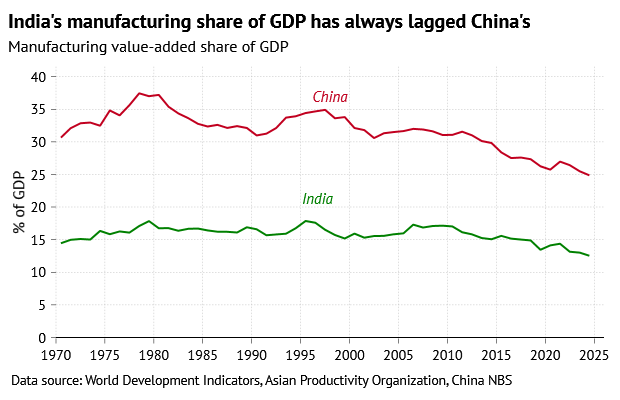
One of the most obvious economic contrasts between India and China is that China has followed the East Asian model of export-led manufacturing, like Japan, South Korea and Taiwan (albeit at much greater scale), and India has not. All of those Asian economies historically had high manufacturing shares of GDP, and while in all of them the manufacturing share is lower today, it is still higher than in India. In recent years India’s manufacturing share of GDP has been around 13%, about half of the level in China, and historically it has never exceeded 18%. One of the central debates among Indian economists is how much of a problem the relative weakness in manufacturing is, and what should or could be done about it.

Historically, it is definitely true that manufacturing has been a key motor for structural transformation away from traditional agriculture to modern production based on wage labor and economies of scale. And the reason many Indian economists worry about the low manufacturing share is that it seems to be a symptom of slow structural transformation: the agriculture share of GDP and employment has remained largely static in recent years. So while the modern sector in India’s economy is clearly growing, it doesn’t seem to be pulling workers out of the traditional sector, limiting the income gains. That concern is behind proposals to encourage the growth of labor-intensive manufacturing.

India’s government has also set explicit targets for the manufacturing share of GDP: the “Make In India” initiative back in 2014 called for pushing up the manufacturing share to 25% by 2022, which obviously didn’t happen. NITI Aayog, the public-sector think tank that has replaced the old Planning Commission, is still talking about a 25% target, this time for 2047, the centenary of India’s independence. It is worth noting that China has, in fact, never set a quantitative target for the manufacturing share of GDP. Currently the government just talks about “maintaining basic stability” in the manufacturing share, which hasn’t stopped it from declining.

It’s also interesting that a recent comparative study of China, India, Indonesia, Mexico, and South Africa emphasizes that transitions out of agriculture played a limited role in raising household incomes out of poverty; income gains within sectors often played a larger role than reallocation among sectors. Which is not to say that more structural transformation of the economy would not be helpful for India, but perhaps it is not right to get hung up on the relative shares of different sectors. After all, there’s no economic theory that can tell India what its optimal share in GDP of manufacturing should be. You can’t treat shares of GDP like temperature readings, and use naive cross-country comparisons to say, oh, this level is obviously too low, there’s a deficiency, or this level is obviously too high, there’s an excess.

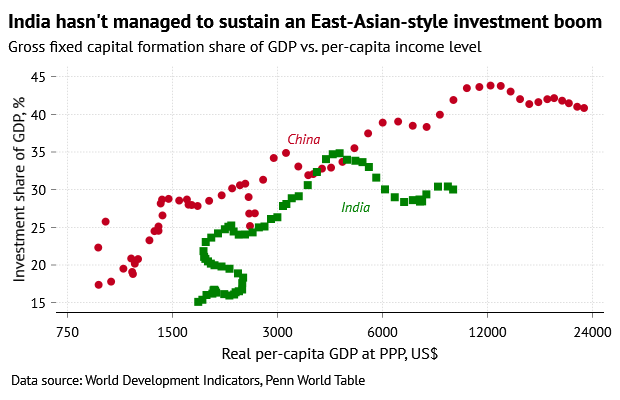
A closely related contrast between India and China is its relatively lower investment share of GDP. One assertion I heard, which received broad agreement, was that no country has been able to successfully develop without sustaining an investment share of GDP of over 30% for decades. This is based on the East Asian development experience: Japan, South Korea and Taiwan, as well as Malaysia and Singapore, all sustained 30%-plus investment rates for long periods of time, alongside their higher manufacturing shares of GDP. China of course, is the investment champion, for better and for worse, keeping its investment share of GDP consistently over 30% since 1992, and over 40% for the past 15 years. Again, China is implicitly (and often explicitly) the point of departure for the Indian debate. A World Bank report this year endorsed a “reform” agenda to push India’s investment share of GDP to 40% by 2035.

India’s investment share of GDP is actually not that low: it’s been around 30% in recent years, and was over 30% for roughly the period of 2005-13. True, this does not quite meet the (perhaps arbitrary) historical threshold for an East Asian-style investment boom. And some Indian economists express concern that the recent pickup in investment is aided by large public-sector investment in infrastructure, which may not be sustainable, and that private-sector corporate investment has been static or falling as a share of GDP. While corporate profits have been strong in recent years, they report that the weakness of private-sector investment seems to be concentrated in manufacturing: companies just do not see good prospects for adding manufacturing capacity. If India does not have a manufacturing boom, it probably will not have a broader investment boom.

An alternative view expressed by some other economists is that India is already growing rapidly with a 30% investment rate, the current returns on services investment are high, and it’s not obvious that it needs to push a lot more investment. I found myself sympathetic to this side of the debate. China today, after all, is hardly a model to follow: it has experienced massive excess capacity and declines in returns on capital since the 2008 global financial crisis, largely due to forced public-sector investment.

Still, China’s current excess investment is a product of both its peculiar quasi-socialist institutions and particular historical circumstances, neither of which have very close analogues in contemporary India. If India can find productive uses for a few more percentage points of GDP worth of investment, that would probably be welcome, and would hardly put it on the path to Chinese-style excess. But equally, it’s hard to take a simple cross-country comparison as sufficient justification for massive macroeconomic interventions to push up the investment share.

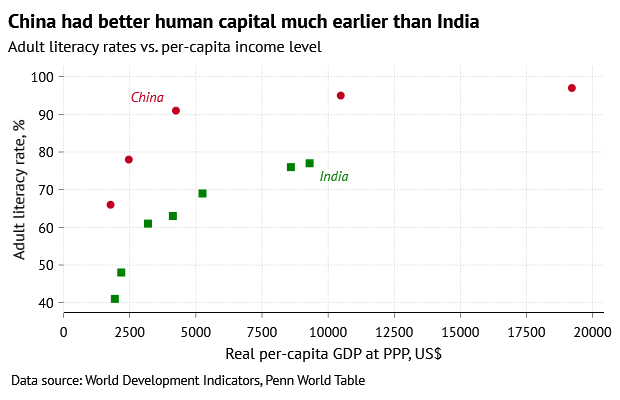
A more supply-side perspective on India’s relative dearth of manufacturing and investment focuses its failure to establish the necessary social preconditions for an East Asian-style growth takeoff. As Wang Feng’s recent book China’s Age Of Abundance emphasized, China was able to seize the opportunity presented by labor-intensive export manufacturing in the 1980s because it had made substantial improvements in health, education and gender equality in prior decades. China’s workforce already had the necessary human capital to transition effectively to jobs in the modern economy, when reforms started to make those jobs available.

In terms of some basic measures of human capital, India has yet to catch up to where China was decades ago. According to the World Bank, India had an average adult literacy rate of just 77% in 2023–roughly China’s level in 1990. This average gap is aggravated by the scandalously low female literacy rate in India, just 70%. (Other measures like average years of schooling also show a gap). One reason why manufacturing has not taken off in India may well be that India does not have a mass workforce equipped with the basic skills to perform manufacturing jobs.

The low average endowment of human capital in India is striking given the high achievements of the most educated: India obviously does have a workforce equipped to perform high-skilled jobs in information technology and services. A recent paper by Nitin Kumar Bharti and Li Yang collects a remarkable amount of historical data to show substantial differences in educational priorities between India and China. After independence, India invested more in university education but neglected primary and secondary education, producing a relatively small cohort of skilled graduates amid a large uneducated and illiterate population. China, by contrast, initially focused on achieving broad-based basic education before emphasizing the expansion of university education after the 1980s.

Bharti and Li document that India has since the 1990s tried to expand enrollment in primary and secondary education, which is reflected in rising literacy rates. But the quality of basic public education still seems poor, and more education spending is not always producing better results. There are lots of shocking stories about widespread teacher absenteeism and incompetence. It is generally reported that higher-income Indians will do whatever they can to stay out of the public education and healthcare systems. This points to an even more fundamental contrast between India and China, which is in state capacity: the government’s ability to get things done.

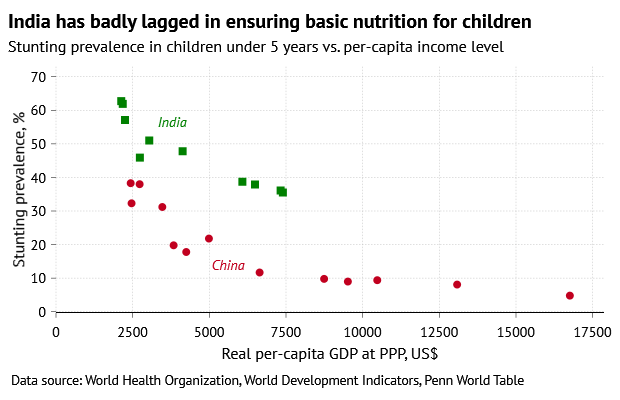
In particular, India’s government seems to struggle to deliver basic public services and provide a baseline level of human welfare. Another fact about India that is, deservedly, often repeated is its alarmingly high proportion of underweight and stunted children. The last survey data collected by the World Health Organization show that 36% of young children in India were stunted (far too short for their age) in 2020. That’s similar to the proportion in China in the mid-1980s; but China at the time had per-capita GDP of only a third of India’s today. An interesting case study of Karnataka, one of India’s most developed states and home to the IT hub of Bangalore, reinforces the point. While Karnataka has had one of the best growth stories in India, it has still a higher proportion of children who are stunted, underweight or not enrolled in school than some poorer states. The significant increase in economic resources available to the state government does not seem to have translated into better outcomes for much of its population.

One set of these comparisons and stylized facts, those on manufacturing and investment, are frequently used to argue for more aggressive efforts to transform India’s economy and put it on something more like a Chinese (or East Asian) trajectory. But the other set of comparisons, on human capital and state capacity, implicitly counsel caution. If India does not have the necessary preconditions for a manufacturing takeoff, companies probably would not respond strongly to government favoritism for manufacturing (and indeed most people seem to think the response to the Make In India initiative has been underwhelming). In any case, a government that struggles to deliver basic public services is unlikely to be able to execute interventionist industrial policies effectively. Even China has plenty of waste and corruption scandals alongside the success stories.

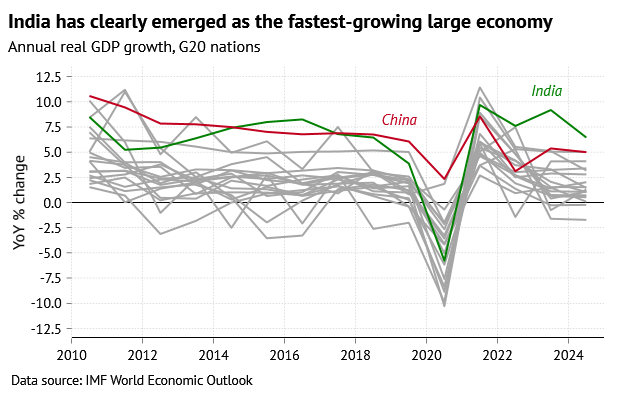
Yet it is also worth emphasizing that India does not come off the worse in all comparisons with China. It’s an important fact that, since the pandemic, India has overtaken China to become the world’s fastest-growing large economy, averaging real GDP growth of over 7%. This is all the more remarkable given that India clearly is not having an East-Asian-style boom in manufacturing and investment. Therefore, it must be having some other kind of boom: one led by services. The IT outsourcing wave, which got started in 1985 when Texas Instruments opened a research center in Bangalore, seems to have stepped up to a new level in the last few years, possibly boosted by the post-pandemic changes in working patterns. Foreign investment clearly plays a big role in this process, and I saw huge swathes of new office parks going up outside Delhi, adorned with multinationals’ names.

Given that, by general consensus, India has not solved its outstanding problems in agriculture and manufacturing, the fact that the services boom is strong enough to power 7%+ aggregate growth is pretty impressive. It’s hugely important that India now has a self-reinforcing growth cycle in foreign and private-sector investment and exports. It’s almost reminiscent of what happened in China in the 2000s after its WTO entry, even if India’s cycle is mostly in services, which have fewer spillovers to the rest of the economy than manufacturing. If there is an alternative school of thought to the one focused on trying to “be like China” in terms of macro aggregates, it is that India should focus on building on what is already working. That means not just facilitating the tech boom, but also making more sectors outside IT services attractive to investment from both domestic and foreign businesses, and trying to steadily improve state capacity and public services.

Incremental reforms might be more politically realistic than trying to drive a “big push” in manufacturing investment. Most of the commentary I heard in Delhi was pessimistic about the outlook for big policy changes, since the current fast GDP growth sends a signal that things are going well, and makes disruptive and politically costly reforms seem less necessary. But it is also true that evidence-based comparisons with China should be able to motivate lots of different ideas about what India can do: China itself has gone through lots of changes, and the growth model has been quite different at different points in time. There are a lot of people these days who think “being like China” means “doing manufacturing-heavy industrial policy,” but this is a perspective distorted by the particular set of government priorities since 2015 or so.

China’s turn to aggressive industrial policy came only after it had already become a quite successful export manufacturer. And that turn was explicitly justified on grounds of national security rather than promoting growth. It was precisely because China was already quite developed that it could afford to put lots of money into import substitution and speculative technological bets. The industrial-policy apparatus of today’s China is a completely inappropriate model for India, which faces a very different set of problems with a different set of capabilities. A focus on removing impediments to a private-sector-led expansion would in fact make India more like China–just the China of a different, less statist era.

Revolution, reaction, reform

If you were to make a list of the most significant pivot points in world history over the past half century or so, there’s no question that high on that list would be China’s move from poverty and isolation to a central position in the world economy. The fact that a backward and mostly agricultural country became the world’s largest trading nation and leading manufacturing power is almost now taken for granted, it’s part of the furniture of geopolitics, but from the perspective of the mid-20th century it was a shocking historical twist. And unlike many important historical changes, which unfold at a pace too slow to be observed except with hindsight, China’s transformation can be tied to an obvious and clearly datable event: the launch of economic reforms in 1978.

Assigning credit for China’s pivot seems straightforward. The death of Mao Zedong in 1976 allowed the feverish political infighting and exhausting campaigns that had consumed China to finally end, and the return of Deng Xiaoping to the leadership put in place a figure willing to make necessary changes. Anne Stevenson-Yang’s recent Wild Ride, a concise and cynical account of the reform era, summarizes the conventional take as: “The forceful and plain-talking Deng ascended and launched an economic revolution.” Deng’s leading role is attested to by both China’s official accounts, and by Western scholarly works such as Ezra Vogel’s acclaimed and comprehensive biography.

Mao and Deng

Such clear, straightforward narratives are, of course, an irresistible invitation for historians to correct and complicate the record. Revisionist accounts of the reform era have articulated two main critiques of the Deng-centric view. One is that while Deng arrogated to himself all the credit for various reformist ideas and programs, he often contributed fairly little. Many figures that Deng dominated or pushed aside–leaders like Hua Guofeng, Hu Yaobang and Zhao Ziyang–were actually responsible for the ideas and initiatives that transformed the economy. The other is that the Chinese people themselves, not any of their leaders, deserve much of the credit. The outcomes of reform were not actually what was planned in advance by the leadership, and often owed more to the initiative of ordinary people seizing opportunities than the wise, foresighted decisions of the elite (for me, the strongest statement of this argument is in Ronald Coase and Ning Wang’s How China Became Capitalist).

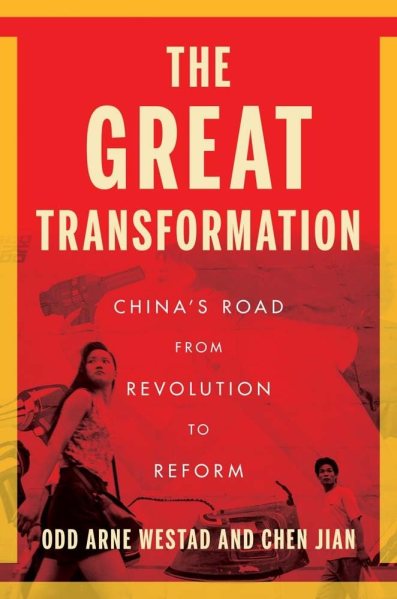
Both of these critiques have often been driven by a desire not to give all the credit for China’s economic successes to the same leaders who oversaw the brutal suppression of dissent and the crushing of political freedoms. Even if they are sometimes motivated by political score-settling, these critiques are nonetheless fundamentally correct: economic reform was not a top-down revolution single-handedly launched by Deng. The new book by Odd Arne Westad and Chen Jian, The Great Transformation: China’s Road From Revolution To Reform, comprehensively demonstrates this point, incorporating the revisionist perspectives into a balanced and marvelously readable account of elite machinations, grassroots developments, and international pressures.

Deng was a military leader who spent most of his time on domestic politics and foreign affairs; his appeal was his competence and practicality rather than his economic expertise. Westad and Chen argue that the ideological differences between Deng and other leaders in the 1970s, like Mao’s designated successor Hua Guofeng, were exaggerated; their power struggle was fundamentally personal rather than ideological. Deng simply thought he should be in charge and would do a better job, and Hua acquiesced for the good of the Party.

What Deng, a strong nationalist, did have was a restlessness and urgency about pushing China forward and remedying its weakness; that meant his decisions usually defaulted to supporting economic growth. But he was far from alone in his desire to improve the economy. And more broadly, the dramatic changes that unfolded in China through the late 1970s and early 1980s can’t be understood purely as the implementation of top-down decisions. Changes from below often outran the direction from the top, as farmers, workers and local officials had already started changing economic practices on their own initiative.

It’s easy to tear down the great-man theory of the reform era, but what to erect in its place? Westad and Chen’s organizing concept is the “long 1970s”: treating the period from the late 1960s to the mid-1980s as a single unit. The simplest summary of their overall thesis is that the reform era was a reaction against the Cultural Revolution, while at the same time being conditioned by and dependent on the changes the Cultural Revolution brought.

This is an idea that manages to be both obviously true and subtly subversive of received understanding. Usually the reform era and the Cultural Revolution are treated as polar opposites; the chief contribution of The Great Transformation is to treat them as part of a single historical process. Conventional histories of the reform era usually start in 1978, with the Third Plenum, or in 1976, with the death of Mao. Westad and Chen start theirs a full decade earlier, in 1966, with the launch of the Cultural Revolution that plunged China into years of political chaos.

In this account, 1978 no longer appears as an isolated pivot point, but the acceleration of a process that was already underway. “The most intense phase of Cultural Revolution turmoil was over by 1968, and at least by 1973, if not earlier, there were many new trends and tendencies that point forward to the reform era,” they write. The most intriguing part of their argument is its emphasis on how domestic policy changes were often driven by concerns about China’s international position.

The Soviet intervention in Czechoslovakia in 1968, and the border clashes with China that followed, made Mao feel that the Soviet Union was more aggressive and more of a near-term risk than the United States. Mao thought the Soviet Union was preparing to invade China, and that therefore China needed a stronger economy. It is now well known that Mao’s fears of invasion were the driver for the Third Front program of relocating industrial capacity to inland regions, as outlined in Covell Meyskens’ excellent book Mao’s Third Front (for more discussion, see my post “China’s security fears and the Cold War economy“).

Westad and Chen go even further, and argue that security fears were a key part of high-level political decisions that were made in subsequent years. Because of the risk of Soviet aggression, Mao “feared the strategic consequences of China’s material weakness, although he of course paid no attention to his own role in creating that weakness.” While Mao never wavered in his view that the Cultural Revolution was correct, necessary and successful, after 1969 he began shifting the emphasis slightly more toward economic development and tamping down on political infighting. In early 1970, for instance, the State Council called for “taking class struggle as the key link, firmly grasping preparations against war, and bringing about a new leap forward in the economy.”

The fear of the Soviets was clearly behind Mao’s willingness to respond positively to the secret overtures from newly elected US President Richard Nixon. It also influenced Mao’s decisions on personnel, including rehabilitating Deng Xiaoping and appointing the moderate Hua Guofeng, rather than any of the Cultural Revolution firebrands, as his successor. Mao felt that while the leftists he had elevated in the Cultural Revolution had the right political line, “they were not practical enough to lead the revolution on their own. People such as Deng Xiaoping were needed to keep the state moving forward and to consolidate and solidify the results of the shake-up.” When Deng took over, he maintained Mao’s view of the Soviet Union as “an implacable enemy of China. … It could serve neither as foreign friend nor as an economic model for China, Deng insisted.”

The Great Transformation is a true narrative history that avoids sweeping statements and sniping at other scholars, and instead builds up its argument through the careful depiction of events. The detailed, blow-by-blow accounts of key episodes like the Nixon visit, the death of Lin Biao, and the fall of the Gang of Four are authoritative and valuable. The bluntest statement of the geopolitical thesis is not in the pages of the book, but in an interview Westad gave while it was still being written: “There’s this obsession with the idea that there will be war, that China will be attacked from the outside. … The imperative of growth, of rapid growth, came straight out of that. It’s remarkable to see how often leaders in this time period keep repeating that.” (For a longer excerpt, see my post “What makes China want growth“.)

This argument is logical and well-supported, but Westad and Chen may downplay just how unsettling some of its implications are. Mao’s death seems to have been necessary for clearing the political stage and allowing the country to truly move on from the Cultural Revolution. But who made the strategic decision that China needed a stronger economy? Who elevated the practical-minded leaders who would make the hard choices necessary in implementing economic reform? After immersion in the history of the long 1970s, it becomes difficult to avoid the conclusion that the person who began China’s pivot to economic reform was none other than the Chairman himself, Mao Zedong.

Eileen Chang on China

Eileen Chang’s first book of essays, Written on Water, in the marvelous Andrew F. Jones translation, has been recently reprinted, and I’ve been savoring it in small pieces. Published when Chang was just 24 years old, the book shows her as something like the Joan Didion of pre-revolutionary China: a preternaturally sharp and cool observer. The discursive, personal essays are not easy to summarize or excerpt, and are short enough that you should just read them. But she made a few offhand generalizations about her country that still rang true to me, 80 years after their first publication, and which can stand on their own.

This one is from “What Is Essential Is That Names Be Right”:

China is a nation of words. When an emperor met with misfortune, he would immediately change the name of the reign period in hopes of turning the country’s luck in the year to come. What used to be the Twelfth Year of the Martial Advent would suddenly become the Inaugural Year of the Era of Great Celebration, thus putting an immediate end to the sufferings of the past. An excessive faith in the power of words is our most distinctive characteristic.

This one is from “Peking Opera Through Foreign Eyes”:

Chinese people like the law, and they like breaking the law, too, not necessarily through murder or plunder of property but by way of trivial and unmotivated violations of the rules. If a wooden sign by the side of the road reads, “Stay to the Right,” they will inevitably walk on the left. …such a spirit [is] less a subversion of the system itself than a playful tug at an object reverenced by all, a tug that ultimately becomes a form of recognition rather than rebellion.

This one is from “Poetry And Nonsense”:

Living in China has something lovable about it: amid dirt and chaos and grief, one discovers everywhere precious things, things that bring joy for an afternoon, a day, a lifetime. I hear the roads in Germany are so squeaky clean that you can use them as a mirror, that they are wide, ruler straight, tidy to a fault, and planted all along their length with towering trees. And yet I suspect that walking along such a road day after day would drive one mad.

Then there is Canada, a country that in the majority of people’s minds seems to lack any distinguishing characteristics whatsoever: a formless and desolate land. And yet my aunt says it is the best place in the world, with a cool climate, blue skies, emerald-colored grass, creamy white Western-style houses with red roofs as far as one can see, each with a freshly scrubbed look and boasting its own garden. If she could choose, she would live the rest of her life there. If I were to choose, I could not bear to leave China: I’m homesick even before I leave home.

Chang, of course, did leave China, and spent the last 40 years of her life in the US.

China’s moment of flux: a podcast with Jude Blanchette

In mid-December, I recorded a podcast with Jude Blanchette of the Center for Strategic and International Studies, which has now been published, on their website and via the usual podcast channels. Jude’s one of the best informed and most insightful observers of Chinese politics that I know, and we covered a lot of interesting territory. With the kind permission of CSIS, I’ve produced the following transcript of our conversation, which has been lightly edited for clarity.

Jude: China has emerged as one of the 21st century’s most consequential nations, making it more important than ever to understand how the country is governed. Welcome to Pekingology, the podcast that unpacks China’s evolving political system. I’m Jude Blanchette, the Freeman Chair of China Studies at CSIS, and this week I’m joined by Andrew Batson, China Research Director at Gavekal Dragonomics. Today we’ll be discussing his blog post, Xi’s New Growth Synthesis. Andrew, thanks for joining us.

Andrew: Thanks for having me, Jude.

Jude: So I wanted to start by asking how you first became interested in China and as a related question, how did you find your way to this career of thinking and writing about China’s political economy?

Andrew: My career pathway is a bit weird. The way I got into being a China expert, I think, is different from a lot of other people that I know who do similar things. A lot of the people that I’ve met over the years who do the kind of thing that I do, they got into China-related careers because they had some kind of early life experience that pushed them in that direction. They studied Chinese in high school, maybe, or they have a family connection to China that made it natural to be curious about China.

Actually, I don’t have any of those things. I’m a white kid. I grew up in a small town in southeastern Louisiana. My exposure to China growing up was that my dad would take us out to a Chinese restaurant on Friday nights. That’s kind of it. I basically became interested in China because I lived in China, not the other way around.

And that happened through a pretty circuitous chain of events. But basically, when I was trying to break into journalism and get a job, I went around to meet people, and I was introduced to some people who were involved in journalism in Asia. They introduced me to some people, and they introduced me to some people, and I ended up getting connected with this consulting company in Beijing of all places. The consulting company was looking for educated young people that they could underpay and exploit. So, you know, naturally I was interested in that.

At the time I hadn’t really ever given much thought to China particularly, but here was someone who was willing to pay me to go live in a foreign country and that seemed like a pretty interesting chance that I shouldn’t say no to. So I said, sure, I’ll give it a shot. And then I showed up in Beijing and basically started from scratch. I didn’t have any knowledge of Chinese when I first moved here. I didn’t have that much background knowledge, didn’t have many preconceptions. And because of that, I was immediately confronted with this huge puzzle, right? I’d placed myself in this completely different physical, cultural, social environment. And I had to figure out how it worked. In a sense, that’s what I’ve been doing ever since.

I think the other piece of my biography that’s maybe relevant to this and has shaped my approach is that, although my job for a long time now has been to analyze the Chinese economy, I actually wasn’t trained as an economist. I was trained as an anthropologist: at school, my undergraduate degree was in anthropology. We had a very rigorous exposure, I would say, to a kind of more traditional mid-century style of social science, a little bit different than what people get taught today in most places. The organizing questions that we were asked to investigate were, how do human social systems function, and how do we understand the diversity of human social systems: what are the differences, what do those differences mean?

And I think if I look back at the stuff I’ve been doing over the years, basically the question I’ve been trying to answer, from different angles and in different ways, is what is the nature of China’s system? How is its system different from other systems? And I think the reason I asked the question in that way is because I was exposed to this particular school of social science at a formative age.

Jude: Andrew, one of the things I wanted to ask you, and actually I’m going to make this a new feature on the podcast. I always appreciate sections of podcasts where they ask for book recommendations, but I usually find that that entails me having to go spend $30 on a book. And then realistically, I’m probably not going to read the book. It’s going to end up in the pile here, as you can see my behind me.

But I’ve often found sometimes the most helpful tool for me is when someone says something, some sort of framework or heuristic or insight that actually is an “a ha” moment and is a tool that I can then use to bring to bear on thinking about China. So as I wrote to you in an email, I wanted to use you as a guinea pig for a new running feature of the podcast, which is, is there some, borrowing from Daniel Dennett, an intuition pump or a heuristic or some insight that you have heard or developed that helps you think through China?

And just for the audience, I’m not sure this is a heuristic as such, but just to give an example, you often hear some people say China’s not a monolith. Now that’s a really simple comment, but I think people who articulate that, what they’re trying to do is to get to a deeper insight where they want folks to embrace the complexity of the Chinese system, rather than thinking of it as Xi Jinping in the mothership, turning dials to get the system to operate as he wants.

You think a lot about thinking about China. So I wonder if I could put the question to you. Is there some sort of, again, a heuristic, an intuition pump, an insight, a framework that you find very useful and might be useful to others.

Andrew: Yeah, I thought quite a bit about this. It’s a tricky question. So I came up with something, I’m not sure it’s going to be an “a ha” moment for you, but maybe it’ll be helpful for other people. Because this is something that’s come up in a lot of conversations I’ve had about China. One basic, simple thing about China, that I keep coming back to, is that it’s really important to realize that Chinese people mostly believe that China is a great nation that should be at the forefront of the world.

So what I mean by this is not that the Chinese people are all these rabid, frothing-at-the-mouth nationalists. That’s not at all my point. What I mean is more that there’s a baseline assumption across all kinds of people that you meet, of different classes, of different political beliefs, that essentially there’s no particular reason why China should not be the best in the world, at any given thing, regardless of what that thing is. And if China isn’t the best in the world, then it can be, and they just have to work harder to get there.

When I was living in China, I encountered this attitude a lot, so it didn’t seem exceptional to me or that remarkable. It was just part of the background, it was there all the time. As I’ve spent more time in other developing countries, and more time in developed countries as well, I’ve really started to appreciate that this attitude is kind of unusual. There’s a lot of small countries or poor countries, where the people are in fact not really confident that they can be the best in the world at any particular thing. They’re very conscious that they lag behind other countries in the world, that their position is relatively poor and it doesn’t seem necessarily plausible to them that that’s going to fundamentally change.

And that belief might not be wrong. So, if we’re talking about Spain or Indonesia, just to pick some country names out of a hat, is it really realistic for those countries to have aspirations to be, for example, the global center for artificial intelligence research? Might not be. But it is kind of realistic for China to have those aspirations.

The other thing I would say about this is, again, it’s an attitude. It’s not a political belief or a political creed. So a lot of Chinese people have this attitude, but it’s compatible with a lot of different political beliefs. It doesn’t determine, necessarily, where China ends up.

I think if you talk to Chinese people who are more on the right of the political spectrum, in Chinese domestic terms, they may tend to think that the way that China becomes the best in the world, an even better place, is by converging with the global ideals, whether this be the rule of law, market economics, individual freedom, and so on. And for Chinese people who are more on the left of the political spectrum, again, in the domestic context, they may tend to think more it’s about China following its own path and using the power of the socialist state to shape outcomes. So how China gets to be the best in the world is something that Chinese people are debating amongst themselves.

But I think they all share the premise that China is going to keep becoming a better place, that it is a great nation, and is going to become an even greater nation in the future. So I think if you wanted to offend every Chinese person across the entire political spectrum, what you would do is to deny that premise or try to throw roadblocks in its way.

Jude: Before we get to your blog posts, let me ask you one additional high elevation question. I read your professional, day-job writing and I also read your blog posts and I like both, but what I especially like about the blog is I can see that you’re still puzzling through, trying to understand the Chinese political system. You draw on comparative writings, you sort of puzzle through government documents or party documents that come out, and we’re going to talk about one of these posts in a minute.

But I wanted to, before we get into that, ask you: We’re at a time where I think a lot of people see massive change occurring in China in its growth model and its political system. I’m curious, as you draw on your experience, in China and analyzing China, and as we record this, you’re in Beijing right now, when you think about China’s political system or political economy, are there beliefs you had, which you now just fundamentally question? Are there beliefs you’ve long held, which still hold constant when you think about the structure of China’s political system and its economy?

In other words, what do you think you know about China? In a deep, true sense. And what are the areas of your knowledge about China where the theses are tentative or shifting?

Andrew: Thank you for putting the question in that way, because it is true that I’m still a student of this stuff and will continue to be a student, you know, probably for the rest of my life. It’s a process to figure this stuff out. I think one thing that’s changed for me over the last 10 years is that I feel like I do have a better understanding of the Chinese political system than I did before. I’ve done a lot more reading about that, and also just had more time to observe how things work and talk to people.

So at the moment, I have reasonably high confidence that I understand the basic parameters of the Chinese system. The key concept for me is basically the idea that China is a Leninist system. And this is a technical term, not a term of abuse. I learned this from reading, in particular, Joseph Fewsmith, who’s a well-known scholar of Chinese politics, and also this guy Ken Jowitt, who’s an older scholar of the Soviet Union.

A Leninist system is fundamentally a hierarchical, top-down political system in which the cadres, the members of the Communist Party, are mobilized to pursue political goals. This mobilization is a key idea, and the political goals are a key idea. And the reason these are important is because China is not actually governed by a neutral civil service or a bureaucracy that’s based on following written rules of procedure and implementing regulations in a value-neutral way. If we look at China, we see something that appears on its surface to resemble such a bureaucracy, but actually that bureaucracy is subordinate to the Leninist political system, or to put it a different way, the Leninist political system interpenetrates the bureaucracy at every level. So that’s on the political side.

And then on the economic side, I’ve also spent a lot of time trying to figure out what exactly is the nature of China’s system. The term that I come back to, which is maybe not ideal, but seems to be the best that we have available, in English anyway, is state capitalism. And so this is what I use. This is just a shorthand term an economy in which there are high levels of government ownership, high levels of government intervention, but these coexist with market mechanisms, the decentralized setting of prices and so on.

I think in China’s case, this kind of political system and this kind of economic system reinforce each other. They’re highly compatible for obviously for historical reasons, but also in a logical way, right? The key dynamic of a Leninist system is that the leaders, they do not just feel that they are entitled to direct the development of their nation in a particular way, but they’re actually obligated to. That’s their job. This is the reason the government has power.

The government’s role is not to use its power to provide a neutral framework in which individual people and companies and different entities can all pursue their own goals and aspirations. This is what I take to be the defining conceit of Western liberalism: life, liberty, and the pursuit of happiness. The government’s job is just to enable all this.

In a Leninist system, that’s not the government’s job. The job is to push the whole society to go in a certain direction. And so if that’s the underlying political conception, it’s actually difficult to have a fully market-based economy because the government, the state, the party is not inclined to just accept the market outcomes. They’re inclined to mobilize the society to achieve certain goals and use the different tools they have available. And that’s part of what these state-owned enterprises and different regulatory interventions are for.

And in the other direction, right, the fact that you have this whole cavalcade of state owned enterprises and different government institutions to organize and direct different parts of society justifies or encourages a Leninist approach. Because otherwise, you know, what is this stuff for? Why do we have all this state ownership? Why do we have all this state intervention? It must be for some reason. If there’s no reason to use it, we could just get rid of it. And so since they don’t want to get rid of it, they find reasons to use it.

Basically, my intellectual process of the last 10 years has been specifically to try to figure out what’s the reason for all the weird things about China’s economy that people obsess about. Why do we have such high rates of investment? Why are there these boom and bust cycles? Why is China able to have high rates of economic growth, even though it doesn’t have very good legal institutions? All these kinds of puzzles. In my view, basically it all comes back to this basic political structure, this basic political economy of a Leninist system.

So that’s the thing I feel reasonably certain about. For now.

Jude: I don’t know if you’ve ever read Michael Oakeshott, the London School of Economics political philosopher whose heyday was in the fifties and sixties, but I’ve often thought about him because he talked about two different conceptions of statehood. One is what he called a democracy, which is, as you just described, a political system that is not ends oriented, but is an institutional set up with laws and apolitical bureaucrats.

And then he talks about, contrasts that, with this conception of teleocracy, obviously coming from the Greek word telios meaning, moving towards an end. And he’s writing this in a description of the Soviet union, but I’ve always liked his work on teleocracy because I think it jives with what you were just saying about China as a system oriented towards objectives or goals. To put it in a more crude way, I thought about the party as something like a shark: sharks die if they stop moving forward.

In a fundamental sense, the Chinese system isn’t structured absent some conception of a goal to be striving for. You couldn’t run it. Cadres wouldn’t know what to do. If. It didn’t have that sort of continual churn of plans and objectives and meta objectives, whether these are high level Marxist aspirations or just five-year plans. So it is a unique feature of these Leninist systems, which I appreciate you highlighting because I do think it’s important.

Let me grab the steering wheel and turn the direction suddenly, if I may, which is I wanted to now start getting into some of the substance of what you’ve been thinking and writing about both in your blog post on Xi’s new growth synthesis, but also some of the other thinking and writing you’ve been doing about the growth of securitization in the policy agenda in China.

And I thought I might start with something which I don’t have a clear answer to and think you might take a better stab at it. Which is, before we talk about securitization or the growth of securitization, I think there’s confusion that I hear about how external analysts and observers think about growth and political stability. I often hear people, indeed, just in the past few weeks, I’ve heard various people say, that on the one hand, Xi Jinping doesn’t care about growth. He’s willing to supplement growth for higher objectives, whether these be Taiwan, or to build a fortress economy that can withstand what he sees as a containment/suppression/encirclement strategy by the United States.

Then I’ll hear people say, well if growth falls below 3%, then the Communist Party is doomed. So they have to find ways to revive the economy. And you’re probably old enough to remember this too, I think this is back in the mid to late 2000s, I just remember there was always this thing in news articles where it would say if Chinese growth drops below 8%, I don’t know why 8% or how we got there, but if it drops below 8%, you’re going to see massive instability in the system.

So how do you, at a higher level, think about trade-offs, or the connection between economic activity and growth, and political stability in the Chinese context. Not in the context of Norway or the United States, where I think the relationship is different. Do you buy the logic that whatever the number is, whether it’s 8%, 3% or 1%, there is an absolute floor underneath which, if growth craters, it will have a demonstrative rippling effect of instability. Do you think this is not the right way we should think about how they think about the growth-stability relationship? Or is my question so inchoate that you have a better way that I could frame this?

Andrew: So the answer to most of your questions is no. I don’t think there’s a floor to growth where it triggers instability.

I remember very well this debate over 8% growth and social stability from back in the 2000s. This was one of my formative experiences as a China analyst, trying to understand and intervene in this debate, so actually, I have a pretty detailed memory of this. My recollection is when that came up back in the day, it was because somebody had done a calculation, I think it might have been the World Bank, and they basically said: If you look at the number of new jobs that are created every year, and then you divide that by the GDP growth rate, this shows that each point of GDP growth generates X number of jobs. Therefore, this implies that you need a certain amount of GDP growth to have enough jobs, because based on the population, or number of college graduates, you’re going to need this number of jobs. And therefore you have to have this number of GDP growth to deliver that.

So as economic analysis, obviously this is totally nonsense. Or maybe it wasn’t obvious, because a lot of people said it. But I mean, it’s total nonsense. There’s no such thing as a fixed relationship between GDP growth and job creation in any economy anywhere. And anyway, I think the calculations in the Chinese case didn’t make that much sense because government actually doesn’t have very good data on job creation. So the numbers that they were plugging into that equation were probably bogus in the first place. Still, I think this kind of argument got traction inside of China and outside of China, but I think for somewhat different reasons.

Inside China, the reason it got traction and the reason people found it attractive is because there’s a group of people in China who wanted the government to focus on employment rather than GDP growth, right? They saw the pursuit of GDP growth as creating all kinds of distortions and problems. And fundamentally what really matters for people’s lives, for prosperity, is job creation. So we should really think about GDP growth as a means of creating jobs rather than as this abstract target we’re trying to hit for no particular reason.

And that idea, I think, has been quite influential in China. When Li Keqiang, the late lamented, was premier, he often said that employment was the most important thing. So at the level of rhetoric, that seems to be influential. But I think, if you actually look at how he or how other administrations actually ran the economy, it was pretty obvious that the labor market was not what was driving how they managed the economy or what key decisions were being made. It was usually other kinds of cyclical indicators of the economy, the property market or industry or what have you. And I think to be honest, they probably don’t really have enough accurate information about the labor market to use it as a guide to short-term macro policy.

Outside of China, I think the reason people latched on to this idea was because it played to certain prejudices or preconceptions about the nature of China’s political system. I think there’s a tendency for people, in the U. S. particularly, to think that with the Chinese people living under an authoritarian regime, they must inherently always be dissatisfied with the regime, and they must always be looking for ways to overthrow it. If they’re not being constantly pacified with lots of money, they would just rise up the instant that happened.

As with many things, there is a grain of truth to this. So if we look comparatively across different countries, different forms of government, you can correct me on this, but I think the finding is that authoritarian regimes tend to be a little more fragile and have less popular legitimacy than other kinds of political systems. So there’s more of an issue for them. But I think we both know that it’s just not true that daily life in China is some kind of dystopian hellscape that is going to force people to rise up in a revolt if the economy is not so good.

I think the other idea about political system that’s been very influential outside China is this idea that there’s a social contract, right? That people in China traded, in a more or less explicit way, political freedom for economic growth. We’ll accept not having all of these political freedoms as long as enough prosperity is delivered to compensate us for this loss.

There is some truth to this. I think economic performance is one of the ways in which the government shows people that it’s doing a good job, that it deserves their support. But obviously, or again maybe not so obviously, it’s not true that people’s satisfaction with the government is mechanically related to the GDP numbers or mechanically related to economic performance in such a specific way.

So yeah, I don’t think that there is any particular fixed relationship between political stability, in the sense of at least of popular unrest, and economic growth, that there’s some kind of trigger that we can identify where economic problems become serious enough that that’s going to have an impact on the foundations of the political system.

Jude: Let me ask you another related question, and this is very much a live topic of discussion now, which is how economic growth is being rebalanced in relation to another goal, which is security or national security. You’ve written on this, there’s stuff on your blog on this, so I might ask you to regurgitate what you’ve already said on this.

This is a really interesting question for me. Part of it is a little bit of Freudian psychology, of people trying to get in Xi Jinping’s head. I will hear people say, Xi Jinping doesn’t care about growth. I don’t agree with that statement, but I understand, as you were just saying, there’s a kernel of truth there.

We’re seeing security rise to the fore of the active policy agenda in ways that are clearly at an elevated pitch from previous leadership groups. But I wanted to get your thoughts on this. If someone says to you, growth is out the window and it’s all about security, what’s your response? If someone says they’re trying to balance growth and security, what’s your response?

How do you think through what, on the surface, to some extent appear to be zero-sum trade offs. What’s your thesis for what the Chinese are trying to do and how these two objectives sit together or separate?

Andrew: So the way I think about this goes back to this concept of the Leninist system that’s organized around a mobilizational goal for the whole society.

For me, I think the fundamental way to understand what Xi Jinping is doing, particularly since his second term, is that he is changing the mobilizational goal. And that the mobilizational goal had been basically the same from 1978 until 2017, when Xi gave his speech at the Party Congress. In that speech, he basically said, in so many words, that there had been one goal in the reform era, which was the pursuit of economic growth, or development, or prosperity, there are different synonyms for this, and that that was over. And that now China is on a different trajectory.

I think where I would differ slightly from the way that you phrased the question is that I don’t think that he’s clearly articulated what the new trajectory is. So I think security is part of this new message, but it hasn’t been made that clear. What was very clear, and continues to be very clear, is that the pursuit of economic growth has been downgraded in importance relative to other goals. It’s not gone. It’s not that they don’t care about growth, but the system was previously organized around the pursuit of economic growth, and now it is not.

What is the system organized around now? Well, I would say it’s not that clear, to be perfectly honest, and this is why I think that, in a way, that there’s a lot of political instability in China. And this goes back to your previous question, where you’re asking about political stability in the Chinese context.

So I think if you think in terms of China having a Leninist political system, where what’s fundamentally important is having the mobilizational goal and then communicating that mobilizational goal, in that context, actually, China’s in a moment, I would say, of political instability, because the new mobilizational goal has not been clearly communicated. There’s some directional guidance, but the actual goal is not that clear.

When I say that there’s political instability, I don’t mean that there’s different factions within the Communist Party or that there’s going to be riots in the street or a coup or anything like that. Xi has very tight political control. He has left very little room for any competing power centers to emerge. But I think there’s instability in the system’s own terms. There’s just ambiguity about what the mobilizational goal is. There’s ambiguity about what people should be doing.

Xi has talked about different things. One of the organizing conceptions in his original speech in 2017 was this idea of a “better life.” That’s about as vague as you can possibly get, right? It has all kinds of different components. So, we shouldn’t pursue economic growth, we should pursue a better life instead. What does that mean in practice? I think nobody knows.

More recently, there’s been a lot of emphasis on national security, and technological self sufficiency. These are very specific goals, but are they enough to function as like the overall goal for the whole system?

I think the problem here is that this talk about national security and self-sufficiency, the only thing that really makes those make sense, and seem convincing to people, is the fact that there are worries about China getting into a conflict with the U.S. The U. S. has put tariffs and technological sanctions on China. And China clearly has to have a response to this. I think that’s why this talk about technological self sufficiency has gotten a lot of traction and is quite popular in China.

But I think it would be quite a difficult thing for Xi to come out and say explicitly that the goal for the nation is to prepare for a war with the U.S. Because that’s not a goal that people are really going to get behind. War is bad. People don’t like it. They’re not going to go to war if they don’t have to. So I think the problem with security as a mobilizational goal is that it’s not an attractive one, fundamentally.

You can frame the security, self-sufficiency issues more as, oh, we need to do things to protect ourselves and it’s all just in case. But I think that doesn’t really function as an organizing principle for the whole society. So I think what you’ve ended up with is this confusing signaling, where the government is saying, well, we shouldn’t pursue economic growth as aggressively as we did in the past. And we should pursue some of these other things, technological self sufficiency, food security, the preservation of traditional culture, there’s a long list, more aggressively than in the past.

But again, that’s not that satisfying. And it doesn’t, fundamentally, give the actors in the system very clear guidance about what their priorities should be, and how they should make particular decisions. Ultimately, this is my diagnosis about why everyone in China seems so unsettled and seems really uncertain right now. They literally don’t know where the country is going.

I don’t mean that in an abstract sense. It’s in the sense of, the country is organized around having a goal towards which it should be proceeding. And people aren’t really sure what that goal is. The Leninist system is unsettled and therefore the people who live in this system are also unsettled.

Jude: You had a really good blog post on what must be the level of relative confusion or uncertainty for cadres in the system who are clearly being transitioned to a new paradigm, but without, as you say laser-like clarity on on precisely what’s the relative weighting of the various objectives. This does exist at some level in terms of performance indicators that cadres are evaluated on, but it’s clear from just anecdotal evidence that those are not sufficient to give actors in the system certainty of action, knowing that here’s the green zone, here’s the yellow, here’s the red. And, of course, they still live in a world where there are growth targets and growth expectations. If you’re in Guizhou, you probably also have some expectations. You’re going to develop some sort of innovation cluster, but you’re also going to have some national security imperative. So it does seem like Xi Jinping is pushing the system into a new level of dysfunctionality.

Let me now ask you to pick up your rusty, dirty crystal ball, brush it off, and see if you can peer into it. I know no one likes to predict the future, especially on China, and I know you’re a careful, nuanced thinker, so the answer, I will say it for you, on the questions I’m about to ask you is probably, I don’t know.

But nonetheless, I wanted to get your sense of, you’ve laid out a picture just now of an inchoate, somewhat confused policy agenda that is sending multiple signals. You probably have actors in the system interpreting those signals differently. You have China dealing with a very different external environment. You know, it had a very benign external environment from the late 1990s through till fairly recently. You have a political system that is becoming more, in some sense, more capital-L Leninist, but also in some ways de-Leninized as Xi Jinping really personalizes the system.

So first question is, how strong, how robust and resilient do you think this political-economic system is to withstand internal challenges from Xi Jinping trying to move the system or shift gears, and externally, whether it’s Chinese corporates now facing a much harder regulatory environment, BRI facing pushback. You pick the policy initiative and there are challenges. I don’t think anyone anymore is in the China galactic ascendancy trajectory. Are you China muddles through? Are you China can get its mojo back? Or are you China not on the cliff, but heading in the direction of a more catastrophic hard landing that could be a political hard landing? Or option D, which is whatever you, whichever option I didn’t list that you think is better.

Andrew: I think there are a lot of issues in the Chinese economy and political system they’re trying to deal with. We outlined why it’s been pretty challenging to deal with them. I would say that in the medium term, my bias is to not be completely pessimistic, and this kind of goes back to what I was talking about at the opening of our conversation, where I feel like there’s this general sense among Chinese people that China’s going to get better, and if they work hard, they can achieve it.

Again, I would be frank that this is sort of more of an intuitive sense than something I can justify very rigorously with lots of evidence and statistics. But I do feel like there is a continued momentum in China for it to catch up with the technology and capabilities of other countries, and that catch up can continue to propel China’s incomes up over time.

But I feel that this is more of a bottom-up process, right? That it’s not something that’s necessarily driven by all of these government initiatives, in terms of industrial policy, R&D subsidies, what have you. And to some extent, this bottom-up dynamism in China exists despite these government policies or even in opposition to them. I think it’s still very much a real thing, so we should not assume that it has gone completely away.

And I guess the other thing I would say this just in terms of global perspective, of global impact is that it’s hard to imagine a future scenario in which China becomes internationally irrelevant. So maybe China becomes more relevant in a good way, maybe becomes more relevant in a bad way, but it’s very unlikely for it to be less relevant.

The shape of the world economy has changed very substantially and China has huge stocks of manufacturing capacity, of technological capability, that are not going to go away, even if the economic outcomes are poor. Economists like to talk about stocks and flow. So maybe the flow of new economic activity, i.e. growth, is weak over the next few years, but China’s already built up a lot. It’s 20 to 30% of world manufacturing output. That’s not going to go away.

So I think we should broadly anticipate that even if China faces a lot of challenges, it’s going to continue to be relevant in a macro sense, and also in several very specific senses. It seems pretty obvious that China is very far along the way to becoming the global center of production for clean energy technology that the rest of the world is going to use in the transition away from fossil fuels. So that’s almost a done deal.

To go back to your question of more generally, how does China deal with these problems? I think in my day job, the problem that we’ve been trying to figure out is basically what kind of economic policy decisions does China make given its set of priorities and the fact that the priorities now are clearly different than they were in the past? I think over the past 12 months in China, since basically the Covid restrictions were dropped, there’s been a lot of flux, a lot of change. And I think there’s this ongoing process of everyone within the system trying to get more clarity on what the overall goal is. Officials in the government, and also people in the population at large, they’re trying to decode the signals. And also the people at the top, Xi Jinping and his associates, are at the same time trying to fine tune the signals in order to get the results that they desire.

So you’ve seen Xi come up with various new formulations that try to synthesize what you talked about as the growth and security concerns, or new formulations that imply that growth and security are not opposed to one another. That it’s not a zero sum game: we can do both at the same time and everything will be great.

In fact, it’s a very interesting and uncertain moment for Chinese policymaking. I think there’s a general sense that all of the economic problems over the past year have pushed the government to make some tough choices to face up more explicitly to these trade-offs, and to try to come up with a more coherent policy agenda.

So where does this balance between growth and the rest of the agenda, like security concerns, where do they stand now? Obviously, economic growth is pretty poor right now, the property market is in real trouble. And you’re seeing, at the margin, a little bit more of a pivot back towards growth-supporting policies. That’s what a lot of the economic analysis and discussion domestically is about right now: oh, we’re getting these positive signals finally, so things are good.

But I think what the government is trying to do is to find a new synthesis, right? They want to find a way to have decent economic growth, a way to stabilize the current situation, that’s compatible with this new political agenda, that doesn’t involve just giving up and saying, oh, we were wrong to try to pursue this new set of goals. We can actually still pursue this new set of goals and also get these good things.

I think a lot of people domestically want to see the old system come back. They want to see the old growth goal come back. They want China to pivot away from the pursuit of security, a better life, this different political agenda that Xi has outlined, and back towards, let’s just do economic growth and not worry about the other stuff.

If you look back over this past year, you see every marginally positive development in the economy has been interpreted as showing that this has happened. So first: oh, they dropped Covid controls, that means they don’t care about this other stuff and it’s all out. And, no. So then at the beginning of this year, the new premier Li Qiang made all these nice comments about the private sector when he was appointed. People were like, ah, see with this new administration, we’re back to the good old days. Uh, no. Then we had the Politburo meeting saying, we need to do more to support growth. And people said, oh, look, finally, they’ve seen the light and it’s going to be off to the races again. It wasn’t. The most recent one, Xi Jinping went to Shanghai and people said, oh, look, this is a signal there’s now more focus on economic growth. I think basically all of these interpretations have been wrong and people will probably continue to make this kind of interpretation in the future. And it’s still going to be wrong in the future. That’s my prediction.

I think the old system where you had this decentralized pursuit of high growth, and you tolerate anything as long as it gets growth–this is gone. Xi has killed it. He’s not going to bring it back. But at the same time, I think it’s true that they haven’t figured out what is the exact balance they want between growth and these other concerns. Between growth and security is the way you put it. It’s being renegotiated. It’s in flux.

And so that’s why I think right now it’s a super interesting moment for Chinese economic policy. This is what I look at every day. There’s huge political pressure, and there’s huge economic pressure. The economic problems are very serious, and the political constraints are also very binding. So they need to come up with some new ideas. They need to find some ways to help the economy that are going to be consistent with these new political priorities. They have to get growth, but they have to get growth in a way that’s compatible with this objective of, we need to restructure the economy to help us prevail in the global competition with the U. S.

So I think it’s a very interesting moment. It’s a very uncertain moment. Almost certainly, China is going to come up with some new things to surprise us as a result of these intense pressures. It’s not guaranteed that the balance they find is going to be the perfect one, or that it’s going to generate the kind of growth outcomes that people want or expect. It is a moment of flux and change, I would say, in the Chinese system. Maybe that’s a cop out.

Jude: It’s the truth, so it may be a cop out, but I also don’t know a better answer.

And anyone selling certainty in this moment is going to have a bridge they’re going to sell you next as well. So find the folks more credible when they’re willing to frame it, just as you did. You’re in Beijing right now, so you’d have a better sense, but I do pick up from Chinese friends and interlocutors that same sense of unease. Where problems China had to be sure, but there was some certainty in the trajectory, namely, tomorrow is going to be better than today. Your kid’s life was going to be better than yours, but even with your own lifetime, you are going to have likely ample opportunities for improvement. And that window feels to be collapsing. And I can absolutely see the desire of many to get back to the old growth model. Again, with all the pathologies and problems it had, it also had a lot to offer.

We’re definitely in new territory. But again, I am just so glad Andrew, that you’re thinking and writing about this. I would like to say that all audience members should go shake their couch cushions and find some money to become clients of Gavekal Dragonomics, I realize that’s probably unrealistic for most. So luckily, Andrew, you are writing. frequently, and I think with great nuance about a lot of these challenges on your blog, The Tangled Woof. If people are thinking, what the hell does The Tangled Woof mean? You’ll have to go to andrewbatson.com, there is an explanation of what that means. But I can’t recommend your analysis enough, Andrew, and really look forward to reading what you write next.

So thank you for your insights. Thanks for your writing and thanks for your time today.

Andrew: Thanks so much, Jude. It was a really great conversation.

The education of Li Keqiang

Even in death, China’s former premier Li Keqiang cannot escape the shadow of his overweening boss, Xi Jinping. The commentary around his untimely passing–Li was only 68 and not obviously in poor health–has been filled with implicit and explicit comparisons to the man he served loyally for a decade as China’s second-ranked Communist Party leader.

The general temptation to see Li as representing an alternative school of thought and the potential for a different political trajectory is as strong as it is unsupported by real evidence. Despite much speculation about internal differences between Xi and Li, the system is designed to prevent us from knowing much about the personal views and predilections of Chinese politicians.

The differences in their background made it almost inevitable that Xi and Li would be perceived as representing different ideas, interest groups and, dare I say, classes. Education everywhere is a strong determinant of social position, and due to the accidents of Chinese history, the educational experiences of the two men differed dramatically.

Li was among the first group of students to take the restored college entrance examination in 1977, in which he did well enough to earn a place at the prestigious Peking University. That made him a symbol of meritocracy and the return to traditional intellectual values. Xi is two years older, and started college in 1975, when universities were still more focused on political indoctrination than education; he got his place as a “worker-peasant-soldier” student on the basis of political connections. Fairly or not, those experiences have formed how people interpret the two men: Li as a true child of the reform era, Xi with one foot still in the Mao era.

Writers have mined public records and private recollections to piece together pictures of their early years. Chun Han Wong’s new biography of Xi Party of One: The Rise of Xi Jinping and China’s Superpower Future, has a particularly valuable opening chapter on Xi’s early life, with lots of interesting details that are clearly sourced.

Xi was among nearly 2,700 students who enrolled at Tsinghua University’s Beijing campus in the fall of 1975 … as a worker-peasant-soldier student. He pursued a degree in organic chemistry, but university education at the time was more political than academic, marred by a lack of intellectual rigor and patchy teaching. One friend described Xi’s Tsinghua training as a degree in applied Marxism. Not that it mattered to Xi, who told another friend that he had no plans to work in the chemical industry. Xi, the friend recalled, “wanted to enter politics.”

While many of his peers indulged in romance, alcohol, and movies, Xi focused on politics, overseeing propaganda work as a member of his class’s party committee. Friends recalled a budding politician who showed savviness beyond his years.

More about what university life in China was like at that time, and what it exactly it meant to be a “worker-peasant-soldier” student comes from Jaime FlorCruz’s memoir The Class of ’77: How My Classmates Changed China. FlorCruz, a Filipino who later became an eminent foreign correspondent in Beijing, enrolled as a foreign student at Peking University in 1977, overlapping with both the last cohort of worker-peasant-soldier students and the new cohort of students who had passed the entrance examination. But his first encounter with Chinese university life came in 1971, when he visited as part of a unofficial delegation from the Philippines.

The makeup of the student body was curious as well. None of them had to take an entrance test to gain admission—a surprising development given that China was the historic originator of the concept of qualifying public service examinations. Many of the students we met had spent two to three years working in farms and factories; most of them, they said, got into Beida on the recommendation of the farmers and laborers they had worked with. Other students had previously served in the army and were similarly recommended.

The prerequisites for admission were simple: good health, work experience, and high “political consciousness.” Academic prowess was much less important than a student’s commitment to the ideals of the Chinese revolution and to the belief that working with one’s hands was better than book learning. As part of what Beida officials called the concept of “open-door schooling,” students were expected to extend their education beyond the classroom and to engage in street cleaning, farming, and assisting factory laborers with compiling “revolutionary histories” of their workplaces. These would help develop their moral, physical, ideological and intellectual character, we were told.

The guiding principle for all the subjects was a rigid Maoist perspective, including the doctrines of “combining theory with practice,” of “learning by doing,” and of “being socially relevant.” Students said that high grades were unimportant. Academic performance was rated as excellent, good, or fair but no one failed. Each class automatically moved from one level to another every year. Individual achievement was downplayed. Assignments were completed collectively, including the writing of essays and even sitting for examinations. In another break with tradition, where it once used to take four or six years to complete a degree like physics, the requirement had been reduced to two or three years.

The deficiencies of this system were pretty obvious, and Deng Xiaoping had already tried to overhaul university education in 1974, but was thwarted by conservative opposition. After the death of Mao in 1976, though, things changed quickly:

In 1977, Deng Xiaoping had not yet re-emerged as paramount leader, but he was already a force behind the scenes, and he and the other reformers knew that the existing worker-peasant-soldier student body of China’s universities would not be able to deliver his “Four Modernizations”—in agriculture, industry, science and technology, and defense. So, it was decided to overhaul the education system. One of the first results was the Class of ’77.

This class, the first step towards normalcy after the Cultural Revolution, was selected from a huge number of applicants of the “lost generation,” capable students whose studies had been cut short or denied after 1966. The average level of knowledge was much higher than those of the Worker-Peasant-Soldier students, who did not have to pass competitive entrance exams to enroll. The selection process for the Class of ’77 was a dramatic throwback to an older China, the revival of competitive qualifying examinations for college admission. It provided an opportunity for those who had been shut out of college for political reasons.

According to the memoirs of former vice-premier Li Lanqing, the demand for the college entrance examination was so high that the government ran out of paper on which to print the exams; the problem was solved by using paper that had been allocated for printing Mao’s Selected Works. FlorCruz’s account makes it clear how the return to exam-based meritocracy was very much a form of “class struggle” in reverse, an explicit decision to valorize the groups that had been targets during the Cultural Revolution and downgrade those (the workers, peasants, soldiers) who had been valorized.

Though separated by only two years in chronological age, Xi and Li ended up being situated on opposite sides of this historic divide in education. That must have had profound effects on their life experience and personality, though inevitably these we must speculate about most of these. In 2011, Chris Buckley interviewed many of Li Keqiang’s classmates from Peking University; the resulting piece gives a good flavor of the time, and why people expected Li to be relatively liberal. Li’s liberalism, if such it was, ended up being expressed more in terms of affect and attitude than in substance. Perhaps that’s because in the end what Xi and Li had in common outweighed those differences: both had political drive and ambition from an early age, and spent their adult lives pursuing ever-higher office in the same political system.

The fiscal consequences of a unitary state

The reason fiscal policy is interesting is that it is the concrete expression of a country’s political priorities: how governments spend money tells you how they work and what their priorities are. By the same token, it is impossible to really interpret fiscal policy without some understanding of the political structure in which the government operates. There are a lot of major differences in political structure–to put it mildly–between the country I grew up in, the US, and the country I have spent my professional life in, China. One of the ones whose importance took me a while to figure out is that China is a unitary state while the US is a federal state.

This issue springs to mind every time I read assertions like this about China: “The ratio of central government debt or sovereign debt to GDP is a mere 21 percent, the lowest among the world’s major economies.” (I’m quoting from the most recent example to have arrived in my inbox, but this argument is so widespread that I don’t need to pick on anyone in particular.) It is indeed true that, if you look at statistics on government debt in China, the majority of it is assigned to local governments rather than central governments (see chart). Many people therefore contend that while local governments have strained balance sheets and limited capacity to borrow further, the central government does not.

Such a distinction would make sense if China were a federal state: if the central and local governments were independent entities with clearly defined constitutional and legal roles and separate finances. But China is not a federal state, and local governments are not separate from the central government. There is only one government throughout China; local governments are merely the authorized agents of this state. There is no constitutional or legal support for the idea that China’s local governments have any independent fiscal power and could ever be considered as having balance sheets that are separate from the central government.

It’s true that China’s government is often deliberately obscure about its true organization and structure. But some things are out in the open. Let’s turn to the Constitution of the People’s Republic of China:

Article 105. Local people’s governments at various levels are the executive bodies of local organs of State power at various levels and are the local organs of State administration at the various levels.

Article 110. Local people’s governments at various levels throughout the country are all organs of State administration under the unified leadership of the State Council and are all subordinate to the State Council.

That’s pretty clear. There is only one government in China, and the State Council, meaning essentially the executive, controls that government. As a matter of constitutional theory, local governments have power and authority only because the State Council gives it to them. The fiscal implications of the unitary state are also clearly spelled out in the Law on the Administration of Tax Collection:

Article 5. The competent department for taxation under the State Council shall be in charge of the administration of tax collection throughout the country. The national tax bureaus and the local tax bureaus in various places shall administer tax collection respectively within the limits set by the State Council. 

The local people’s governments at various levels shall strengthen their leadership over or coordination of the administration of tax collection within their respective administrative regions, and support the tax authorities in performing out their duties in accordance with law, calculating the amounts of taxes to be paid according to the statutory tax rates and collecting taxes in accordance with law. 

This is also quite clear. The authority to raise tax revenue lies solely with the central government. Again as a matter of constitutional theory, local governments’ job is to help implement the tax policies decided by the central government. They do not have any authority to raise taxes on their own, and have no independent sources of revenue.

If you look at local government budgets in China, there are two sources of funds: revenue “at the local government level,” historically 55-60% of total revenue, and transfers from the central government, historically 40-45% of the total. In reality, though, these are the same thing: money from the central government. The central government allows local governments to retain a share of the taxes that are collected at the local level. The remainder that is handed over to the central government, and the taxes collected at the central level, are then redistributed back to local governments as transfers. Ultimately all tax revenue is controlled by the central government, which decides how much money local governments get.

What’s surprising is that, in a unitary state, there could even be such a thing as local government debt. And indeed before 2010 there was not. The local government bonds that have been sold since then are a curious thing: the central government approves their issuance, so the local governments do not have any independent borrowing authority. And the central government controls how much revenue local governments have, so whether local governments can repay the debt still ultimately depends on the central government. This is a weird arrangement. The central government could just issue the same amount of money in treasury bonds and redistribute it to local governments. But for internal political reasons that I honestly struggle to understand, it is considered desirable that some of this debt be “in the name” of local governments. Even though local governments do not have any authority to raise revenues to repay the debt!

Because of this unitary structure, it makes no sense to split either the income statement or the balance sheet of China’s government between central and local entities. There is only one state in China and its finances are unified. I should point out that an excellent recent quantitative overview of China’s government balance sheet by the IMF, “Fiscal Policy and the Government Balance Sheet in China,” does not fall victim to the fallacy I criticize; the authors follow best practices by presenting their assessment on a “general government” basis, i.e. the combination of central and local governments. That’s the right way!

What all this means is that you cannot wave away the debts of local governments by saying they are local, and it’s only central government debt that matters. The central and local governments are part of a single unitary state, and the central government is in charge of figuring out how to repay all of its debt. This is precisely why it has been such a disaster for the central government to allow local governments to engage in all that uncontrolled off-balance-sheet borrowing. If China was a federal state, local fiscal incontinence wouldn’t matter too much ultimately. When local authorities borrowed beyond their means, they eventually wouldn’t pay it back, and it would just be an issue between them and their creditors without national implications. But because China is a unitary state, every time local authorities abused their power by creating unauthorized liabilities, they worsened the fiscal situation for the entire state.

Moral of the story: a unitary state needs to act like one, not pretend to be a federal state. A combination of centralized revenue-raising authority and decentralized liability-creating authority is the worst of both worlds, and the sooner China gets away from it the better.

P.S. My thanks to the excellent NPC Observer website for making it easy to track down the relevant laws.