A history of Singapore’s next 50 years

It’s rare for a member of the sober, spreadsheet-loving tribe of central bankers to venture into the realm of science fiction, so I can only applaud the willingness of the Monetary Authority of Singapore to offer a speculative vision of how their country evolves over the next 50 years. The occasion, of course, is Singapore’s weekend celebration of the 50th anniversary of its divorce from Malaysia and birth as an independent nation. My only real complaint is that I wish Ravi Menon’s speech was actually more playful and speculative–it reads a bit too much like a boring central bank report from 2065 (which, to be fair, is what it pretends to be).

Two big themes for the future emerge from his talk: 1) Singapore becomes even more specialized in exporting services, 2) Singapore benefits from economic reform and the lowering of trade barriers across Southeast Asia. On the first theme, medical tourism indeed seems like quite a plausible strategy for Singapore:

By 2025, Singapore had become a multi-faceted medical hub hosting the world’s top medical professionals and multi-national healthcare companies. This led to a vibrant ecosystem that created jobs in areas from research and training to conventions for medical professionals both locally and abroad, in addition to the large and diverse number of good jobs in hospitals.

But higher education seems less plausible as a big future export market, given Singaporean universities’ reputation for turning out rather dull and conformist students. The scenario he envisages may require more than just technocratic top-down reforms:

Singapore positioned itself as a choice location for quality education for a growing Asian middle class. By 2025, international students studying in Singapore could be awarded joint degrees from 10 of the top 20 universities in the world. Singapore was well on its way to become the premier educational hub of Asia.

The second theme is even more speculative. People have been waiting for Indonesia to finally get its act together and become an Asian tiger for a few decades now. That doesn’t mean it can’t happen in the next decade, but it hardly makes the following more likely:

Perhaps most significant for Singapore was the emergence of Indonesia as the fastest growing economy in the world, following far-reaching economic reforms in the early 2020s.

The politics of Asian integration are even harder to predict, but I think it’s clear that Asian economic integration is supported by nothing even close to the amount of political will and cultural similarity that drove European economic integration. So it is not at all obvious that ever-closer cooperation on trade and economic is indeed a long-term macro trend for Asia generally or Southeast Asia in particular. But if it is, then Singapore could probably be expected to do pretty well out of it:

In 2028, Malaysia and Singapore got together to set up the Iskandar-Singapore Economic Zone or ISEZ: one economic system spanning two sovereign countries. The experiment succeeded beyond expectations, providing global and regional investors an integrated production and services base that was unmatched in Southeast Asia.

In 2030, the most ambitious blueprint of the ASEAN Economic Community process came into being, with the establishment of the ASEAN Free Economic Zone, or AFEZ. Unlike traditional economic zones like the ISEZ which were contiguous entities, the AFEZ was a network of the major cities across ASEAN connected by extensive road, rail, air, and sea links, not to mention advanced digital communications. There was free movement of goods, services, capital, and people between these cities, which become vibrant hubs for trade and enterprise.

I don’t want to be overly critical of the thought experiment here; provoking disagreement is really part of the point. Menon is probably right in identifying two big macro trends that would be favorable for Singapore if they continue–the tradability of services and Asian economic integration. In closing it is probably worth repeating the disclaimer that he was obliged to attach to these speculations:

Everything about the future said here is pure imagination. It does not represent in any way a forecast or projection by MAS or by me. My intention is merely to paint a plausible scenario for Singapore. I can only be sure that someone reading this in 2065 will view it as totally lacking in imagination or realism or both.

Is diffusion the answer to the US productivity puzzle?

Few economic debates are as long-running, as intractable, and as beloved of bloggers as that over the pace of technological change and productivity growth. As we all have seen, changing technology has dominated daily life and news headlines in the US to amazing degree in recent years. But these changes are barely evident in the economic statistics on productivity, which should tell us if technology is really raising living standards over the long term. This disconnect between the apparent pace of technological change and our tools for measuring it has led to a huge debate over whether technological progress is “really” slow or “really” fast. A new theory now making the rounds has the potential to shake up some of the entrenched positions in this debate.

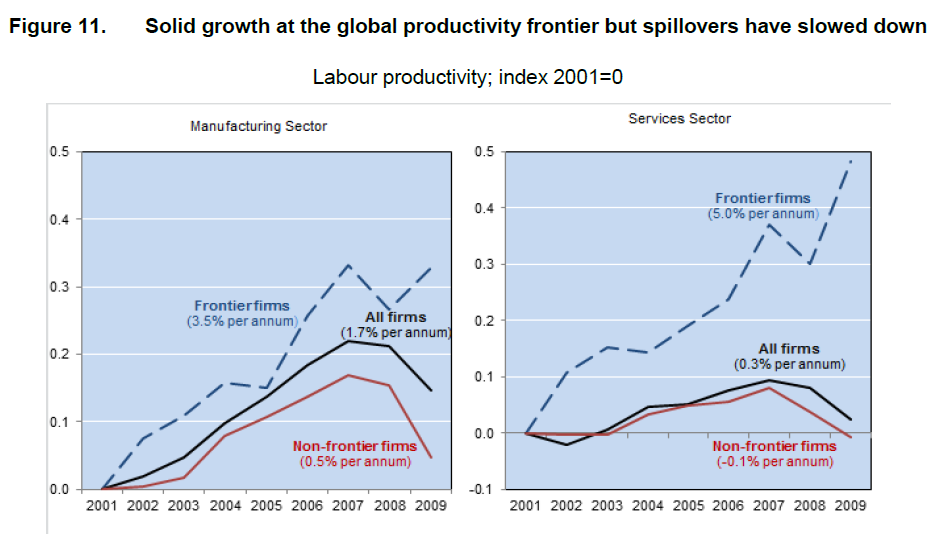
Somewhat surprisingly, this new theory comes out of the staid and consensus-loving world of multilateral institutions: the OECD, which recently published an interesting book titled The Future of Productivity. Out in the blogosphere, it has drawn notice from Timothy Taylor and Nick Bunker. Like all good insights, the one in this book is simple. There is no problem with the pace of technological progress, the authors* say: productivity improvements in the most technologically advanced firms are as fast or faster than they have ever been. The reason overall productivity growth is slow is that these improvements are not being adopted as quickly by the rest of the economy. It is a problem of the diffusion of innovation, rather than of innovation itself. Here’s a short quote and the key chart:

The main source of the productivity slowdown is not so much a slowing of innovation by the most globally advanced firms, but rather a slowing of the pace at which innovations spread throughout the economy: a breakdown of the diffusion machine. Indeed, a striking fact to emerge is that the productivity growth of the globally most productive firms remained robust in the 21st century but the gap between those high productivity firms and the rest has risen.

oecd-productivity-spillovers

I find this explanation very intuitively appealing. I also like the way that it moves the debate over productivity back to real empirical phenomena (the adoption of technology), and away from subjective evaluations of recent innovations.  The debate between the techno-optimists and techno-pessimists was never a very satisfying one, because it was so clearly just a static clash of preconceived views (the WSJ’s Tim Aeppel captures it well in his piece on Joel Mokyr and Robert Gordon). The iPhone is amazing, say the optimistists; but it’s not as great as indoor plumbing, say the pessimists. There’s no obvious way to decide between those two statements, so which tribe you supported in the battle was more a matter of emotion and prior disposition than anything else.

The techno-pessimists think the productivity numbers, though not without their problems, are telling us something about the pace of technological progress: it’s slowing down. The techno-optimists prefer to believe their eyes rather than the numbers, and say there are all kinds of reasons why the wonders we see every day might not be showing up in the statistics. The diffusion explanation allows you to believe both your eyes and the numbers: it’s true that amazing things are happening in research labs, but it’s also true that these things are not giving the whole US economy much of a lift.

The diffusion argument also seems like a more satisfying approach than returning to the debate over how well the productivity statistics capture the effect of technological change. This debate was done to death in the 1990s, when the advent of the personal computer similarly failed to ignite nationwide productivity growth–at least, until the IT bubble. While many people in Silicon Valley are now reviving this argument (again this was well covered by Tim Aeppel in a recent piece), the latest iterations offer little that has not been said before. The diffusion argument says, essentially, that Silicon Valley is being measured just fine, but Silicon Valley is not the whole economy–a point which is probably obvious to anyone not in Silicon Valley.

Of course, defining the problem as one of diffusion does not immediately solve the productivity puzzle, since how the diffusion of ideas and technologies works is not well understood. The problem could, for instance, be related to the decades-long slowdown in the pace at which new firms are being created. Though since no one really understands why the startup rate is slowing, it’s not even clear if it is a cause or an effect of the productivity slowdown. But the diffusion argument at least opens up productive (ahem) ways of thinking about the issue. The thesis is clearly linked, for instance, to the ideas of Edmund Phelps, who is worried that innovative activity is too concentrated in a small part of today’s societies, and is much less socially widespread than it was during the 19th century (see his recent piece in the New York Review of Books).

* The authors of the OECD report deserve to be named; they are: Müge Adalet McGowan, Dan Andrews, Chiara Criscuolo and Giuseppe Nicoletti.

The real source of China’s local government money problems

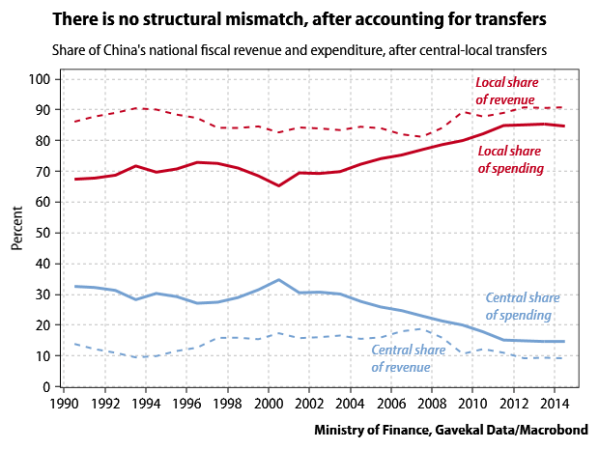
China’s struggles to deal with its mounting burden of local government debt continue to make headlines, giving the dry topic of intergovernmental fiscal relations an unusual amount of relevance these days. The proximate cause of all this local government debt is obvious enough: when the world was falling apart in late 2008, the central government wanted to do a big stimulus, but didn’t want to pay for it. So instead it told local governments to spend whatever they needed on infrastructure to get growth going, and told banks to lend the local governments whatever they needed, and turned a blind eye to any irregularities in all this borrowing. But many scholars and analysts argue that the roots of the problem lie even deeper, that they are the result of a system where there is a fundamental mismatch between the huge burden of public services that local governments have to provide, and the scanty revenues the central government permits them to raise. It’s not just in infrastructure that Beijing pushes the burden down on local governments, the argument goes, but in schools and hospitals and so on. Exhibit 1 in this argument is usually some variant of this chart: Central-local mismatch From these figures, it is easy to get the impression that China’s central government is just rolling in money and not spending any of it–so no wonder local governments have to borrow so much just to make ends meet! Yet this impression is totally false. What is the central government doing with all this revenue? Simple: giving it back to local governments. Of the 6.45 trillion RMB in revenue that the central government collected in 2014, it sent 5.16 trillion back to local governments as transfers (it also spent 2.25 trillion itself, so it was running a deficit). These enormous transfers account for about 60% of total local government revenue, and are the main method by which money is redistributed from richer provinces to poorer ones. If these transfers are treated as what they really are–the main source of local government revenue–then the apparent mismatch disappears: Central-local-mismatch-disappears So while it is fashionable these days to blame excessive centralization of revenues for the mess in Chinese local government finances, this clearly is not a sufficient explanation. Yet it is equally clearly the case that there are real problems in local government finances, and that many localities have to resort to extra-budgetary or extra-legal means to raise money, for infrastructure projects as well as other spending. So how to understand this? As Linda Chelan Li and Zhenjie Yang put the question in a recent article (available for free for a limited time):

The dominant view is that excessive centralization of revenues and decentralization of expenditure responsibilities have precipitated a fiscal crisis in many Chinese counties and townships, with dire consequences to local governance. The ‘gap’ argument emphasizes the relative ratio of central vis-a-vis local revenues and the impact of decentralization of expenditure, and slights the impacts of other parallel fiscal developments, in particular the large flows of central subsidies to local coffers since the 1994 tax sharing reform. As pointed out by the few sceptics, the presence of a large and growing central fiscal subsidy, of a comparable size to the centralized tax revenues, means that logically the latter cannot in itself constitute a sufficient condition for local fiscal difficulties. What then accounts for the difficulties, as localities are not blatantly short of monies?

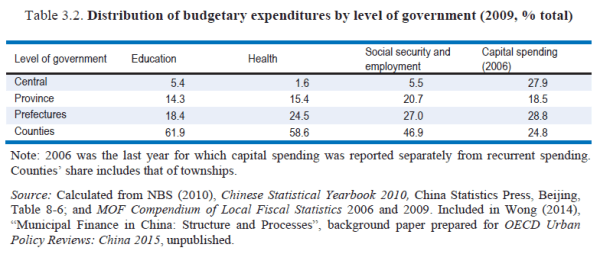
The answer is that there is not one thing called local government in China: there are multiple levels of local government (at least three). Money does not just have to flow from the central government to local government, but between different levels of local governments. And it is easy to see that this flow might not always be smooth, or that “leakage” may happen along the way as different officials get their hands on the funds. This in fact is the key problem: the central government sends plenty of money to local governments in aggregate, but it does not end up in the right places. The lowest-level governments (counties) are where spending responsibilities are concentrated (see table below), but they are the furthest away from the flow of money from the top. And since responsibility for spending is often assigned without regard to where the revenues come from, mismatches abound. OECD-spending-by-govt-level So the lowest-level governments do in fact have many fiscal obligations and often not enough resources to meet them. The better recent research on China recognizes this more complex reality. Li and Yang’s article demonstrates it through a case-study approach that documents how higher-level local governments undercut those below them, while the OECD’s urban policy review of China has a more data-driven presentation (see pages 189-212). The issue is not that the central government does not give enough money to local governments; it is that the money does not go to the right local governments. As the OECD notes, transfers are often made based on assessments of need that do not match up well with reality:

One of the limitations of the Chinese system is that the need for transfers is assessed mostly based on registered rather than actual population in a province. The problem is that the actual population is generally lower than registered population in low-income provinces, given that migrants remain registered in their home province, regardless of where they live. The government is set to henceforth include 15% of the difference between actual and registered population in the formula for determining transfers. This will partly take into account the cost of migrants to a province.

It’s understandable why the simpler account of a central-local fiscal imbalance dominates the discussion: “the central government has too much money” is a much better slogan than “the fiscal transfer system is suboptimal.” But the first the step in fixing the problem is coming to an accurate diagnosis.

Is food security the untouchable “third rail” of Chinese politics?

One of the most interesting developments in the first year of Xi Jinping’s tenure was his iconoclastic approach to farm policy. He gave a major speech on agriculture in December 2013, in which he outlined a relaxation of China’s policy of maintaining 95% self-sufficiency in grains. As usual for speeches announcing a change in policy, there was much fiery rhetoric about why the old policy was correct: “We cannot look at grain security only from an economic perspective, we must also look at the political perspective,” he said. But in substance what Xi proposed was allowing a higher level of food imports, and focusing efforts at self-sufficiency on only a few crops with sustainable levels of domestic production. (The full text of the speech is not online, but is available in a book of Xi’s speeches, which I’m sure you own.) The new grain security slogans, with included a prominent mention of “appropriate imports,” then made their way into numerous government policy documents.

And then things stopped. As the new line started to get more publicity and public discussion, media coverage and criticism started to mount. The furor got so intense that in February 2014, the Ministry of Agriculture ended up publicly denying that the new slogans meant that China was softening its commitment to grain security. Since relaxing the grain security standard was the whole point of adopting the new slogans, this of course was not really true. But it was significant that the government did not reinforce Xi’s decision to break with past policy, but rather reaffirmed the existing policy. Possibly as a result, there have been no specific measures that actually put into practice the new grain security policy: more than a year and half after the new framework was finalized, there is still no clarity on exactly what level of imports of what products are officially considered acceptable. There have also been possibly retrograde developments, like the new national security law that names grain security as one the key parts of national security. Agricultural economist Cheng Guoqiang summarized the situation in a recent presentation: policymakers remain divided, with some emphasizing the traditional approach to self-sufficiency while others urge change, and there is no consensus on how to move forward.

Why is it important for China to change its approach to grain security? The most obvious reason is that the old one isn’t working: China imports much of its soybean supply, and recently became a net importer of corn (the concept of grain used in China is really a broad category of staples, including beans and potatoes as well as cereals). But as the excellent and indefatigable Dim Sums blog has repeatedly documented, Chinese bureaucrats’ obsession with maintaining high levels of domestic grain output has led to many other problems, like the stockpiling of grain on a vast and wasteful scale, as well as huge overuse of fertilizers and increasing degradation of land. It has also required increasing levels of government subsidy and market intervention to maintain. As the OECD has documented, China has been steadily ramping up subsidies and other farm supports at a time when many other governments have been scaling them back (in absolute terms, China is both the world’s largest agricultural producer and the largest disburser of agriculture subsidies). So in environmental and financial terms, maintaining a high level of self-sufficiency looks increasingly unsustainable–and is only likely to become more so. The chart below shows some model results from Kym Anderson (from an online presentation; here is an ungated version of the supporting paper), arguing that maintaining self-sufficiency in key products will require implausible, and WTO-illegal, levels of tariffs and trade restrictions by 2030.

self-sufficiency-tariffs

Grain security is probably not the most urgent short-term issue Xi Jinping has to deal with right now, so it’s understandable that he may not want to spend much political capital to push through this particular change. But many reformist figures in China view the overhaul of grain security as a key market of progress on Xi’s pledge to give market forces a “decisive role” in the economy. Since Chinese prices for grain are higher than world prices, if market forces play a greater role, then more market forces means more grain imports. Finance minister Lou Jiwei himself, in a now-famous rant about how China can avoid the middle-income trap, named agricultural reform as one of the top economic priorities. “From seed to table, the whole chain has subsidies and interference in resource allocation,” he said at an April forum at Tsinghua University (the Chinese transcript is online; here’s an English write-up). “What should we do? Liberalize prices, preserve crop rotation, give subsidies for fallow land, and import.” Such matter-of-fact acceptance of large food imports breaks is clearly still rare in China. The desire for self-reliance, and the related tendency to see their country as alone in an uncaring world, have deep roots.

Technical note:

How exactly did Xi Jinping propose relaxing the grain security policy? This is a bit hard to explain without resorting to some Chinese terms. The original self-sufficiency policy (laid out in a 1996 white paper) was that net imports of grain were not to exceed 5% of domestic demand. But grain is not just grain; the Chinese term liangshi also includes soybeans and potatoes, among other things. Since China is now a huge importer of soybeans, mostly to make animal feed, this is clearly a big problem for the old policy. Corn (maize) imports are also now growing, and also go mainly into animal feed.

One of the new slogans (谷物基本自给、口粮绝对安全) therefore does away with liangshi, and in its place introduces two new terms: guwu, or cereals, and kouliang, or food grains. There must be “basic self-sufficiency” in cereals (rice, wheat, corn), and “absolute security” in food grains (rice, wheat). Because liangshi is no longer the operative term, the requirement to maintain self-sufficiency in soybeans (and potatoes, for that matter) has been quietly jettisoned. And since corn is subject to the looser “basic” standard, the new policy also means greater tolerance for corn imports. The problem is that there is not yet a definition of what “basic” or “absolute” self-sufficiency might mean in numerical terms, and without that clarity it is hard for officials to know how to actually implement the new policy. The text of the new national security law also refers to the old formulation of grain security in terms of liangshi, further muddying the issue.

Term liangshi (粮食) guwu (谷物) kouliang (口粮)
Usual translation grain cereals food grains (i.e., not feed)
Technical meaning rice, wheat, corn, beans, tubers rice, wheat, corn rice, wheat
Old policy 95% self-sufficiency
New policy “basic self-sufficiency” “absolute security”

Feedback between the stock market and real economy

I have a short post up at the Paulson Institute blog, in response to a question about the impact of the sharp fall in Chinese stock prices. The even shorter version:

If the rising stock market has been supporting the real economy, then that support could well be in the process of unraveling. It’s difficult to find much strong evidence of such support.

Issues considered include the wealth effect, corporate investment, and the surprisingly large contribution of the financial sector to GDP.

Finally, China starts to tackle the high cost of hiring

There was a lot of news out of China last week–stock markets tanking, interest rates being cut, etc–so it’s understandable that some other interesting developments slipped through with little notice. This one is worth highlighting as I think it may well mark the beginning of an important longer-term shift in China’s labor market and policies: the State Council lowered employers’ required contributions to two social insurance programs, injury and maternity insurance, a move it said would save firms 27 billion renminbi a year (see the China Labour Bulletin for an English-language summary). Yes, I know this sounds boring and technical, so why is it important? Because it starts to address one of the biggest but least-known issues in China’s job market: the very high costs employers face to hire workers.

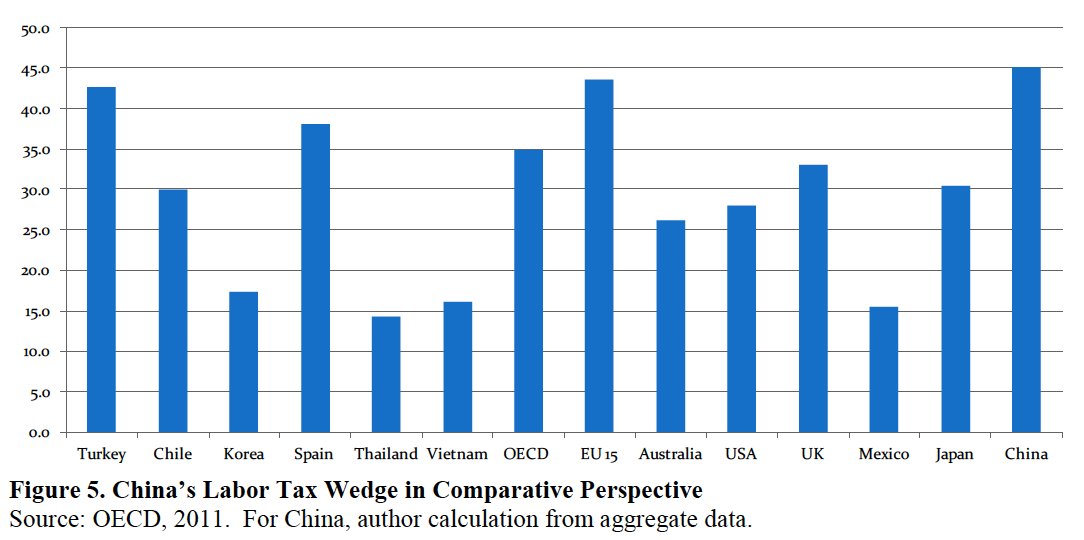
It is not a very well-known fact that China has some of the toughest labor regulations in the world, and some of the highest required contribution rates to social insurance programs. As a result, the “labor wedge”–the percentage of the total cost of an employee that comes from things other than wages–in China is around 45%, as high as in a number of European countries (this is according to an estimate by John Giles in a World Bank paper; see chart below).

laborwedge2

This fact does not square with the widespread perception of China as a nation of sweatshops employing hordes of migrant workers, and indeed is a relatively recent development stemming from the 2008 Labor Contract Law. But China’s problem with these generous worker protections is ultimately the same one that many other developing countries have encountered: strong legal protections and generous insurance programs are so expensive that in practice they only become available to part of the workforce. Effectively China has two labor markets: one for urban white-collar jobs with all the legal protections, and one for blue-collar jobs held by rural migrant workers that generally lack the full set of benefits. As John and his co-authors summarize the issue in their 2013 paper:

China’s urban social insurance system carries heavy burdens for both employers and workers, and may carry significant implications for China’s long–run competitiveness. Moreover, this high implied labor tax wedge likely encourages informalization of the labor market: employers under-report wages and game the system in numerous ways, while workers have incentives to opt out of participation in social insurance schemes. As in other developing countries, high mandated contribution rates provide strong incentive for employers to evade compliance through the use of labor dispatch services and under-reporting of employment and wages.

The IMF in its last Article IV report on China also, very correctly in my view, highlighted this issue and urged the government to change:

Social contribution rates, which are high and very regressive, should also be reduced as they distort the labor market, make growth less inclusive, and favor informal over formal employment.

So economists have for years been flagging this issue as an area where “structural reform” is needed. Having a relatively high cost of employment should, other things being equal, discourage employers from hiring. But there’s been little evidence that this was in fact a real problem over the last few years–instead, it was much more common to hear complaints and anecdotes about labor shortages. So the very high rates of social contributions did not seem like they were imposing much of a cost on the economy: the job market stayed tight and wages continued to grow rapidly. While high hiring costs may have lowered employers’ demand for workers relative to what it otherwise would have been, this effect was not big enough to seriously affect the balance of the labor market.

That has all changed in recent months, as the economy has continued to weaken. With employers finding growth in demand for their products continuing to soften, it’s hardly surprising that their demand for additional workers is also softening. Public data on China’s labor market is limited, but there is much labor data that is collected but not published, and this seems to have been enough to get policymakers worried. The State Council has warned of “growing pressure on employment,” and rolled out a whole series of measures designed to assist the unemployed, such as tax breaks for hiring new workers, cheap loans for small businesses, and support for laid-off workers to start their own companies. The most recent of these moves, the small cut in some social insurance costs, may indeed be a needed reform, but, as is so often the case, the timing of reform is being driven by the economic cycle.

We therefore seem to be at a tipping point in the labor market that is causing the government to look again at the cost-benefit analysis of its labor policies. And as China’s economic growth continues to slow in coming years, I expect the costs of its current set of labor policies will become increasingly apparent. So the balance of its policies should shift more toward encouraging employment, and preferring higher rates of enrollment in social insurance programs to higher benefit levels. European countries have often been criticized for preferring labor policies that reward people who already have jobs at the expense of people who want jobs. China’s latest move is a clear if marginal shift in the other direction: it would prefer that 27 billion renminbi not go to improve the welfare of people who already have jobs, but instead be spent on hiring new workers.

The fact that China is moving relatively early to make this adjustment–before there has been a big increase in unemployment–to me is a hopeful sign that it could be more flexible in navigating this transition than some other countries. That may not be the most obvious conclusion, since China is after all a Communist country that one might expect to have a strong ideological commitment to social-welfare institutions. But the “socialist market economy with Chinese characteristics” of the past three decades has in fact never been particularly keen on socialist labor market institutions, as a whole host of workers’ rights groups will tell you.

One book, twenty views about China

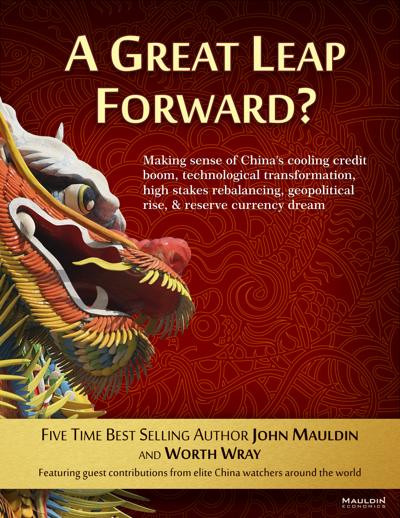
The universe of independent research on China has grown much larger in recent years, as can be seen from the contents of this new e-book. John Mauldin and Worth Wray have pulled together a good number of commentators and China watchers, among whom are some friends and partners in crime in Beijing and Hong Kong. My employer Gavekal is also well represented, with a piece by our CEO Louis and one by my colleague Ernan Cui. My own piece is on China’s exports and its New Silk Road ambitions. There’s a wide range of views about China represented in the book, including some I disagree with, so it should make for a good and varied read.


mauldin_book_small

Risks and politics in capital account liberalization

Various talking heads, including yours truly, are quoted in this Bloomberg piece about the risks to China’s decision to step up the pace of capital-account liberalization in recent months. Here are some indicative comments:

“History shows that if China prematurely opens the capital account before properly sequencing in other reforms the results could be disastrous for financial stability and longer-run growth prospects,” said Kevin Gallagher, an associate professor of international relations at Boston University who co-wrote a paper on China’s cross-border capital deregulation. “I worry that they are forgetting the past.”

The best sequencing would have China first free up its domestic financial sector and shift to using interest rates as the major tool to affect credit, according to Louis Kuijs, Royal Bank of Scotland Group Plc’s chief China economist. Next, policy makers should allow greater currency flexibility, and then open the borders to capital flows, said Kuijs, who previously served as the World Bank’s senior economist in Beijing.

Why all the hand-wringing? In April, central bank governor Zhou Xiaochuan made a surprisingly public and specific pledge to complete some additional opening of the capital account during 2015–a timetable explicitly driven by the goal having the renminbi blessed by inclusion in the IMF’s currency basket for the SDR, whose quinquennial review begins in November. The IMF has made very positive noises in response, so it is looking like a done deal. The symbolism of having the renminbi recognized as a reserve currency is obviously very important to China. Or, what I think is more likely, the symbolism is politically useful for Zhou. An issue of national prestige is a much better way to convince the rest of the government of the merits of additional capital account opening than a technical economic argument. In any case, it seems pretty clear that the decision to open up more to capital flows (through measures like the trading link between the Shanghai and Hong Kong stock markets) is not being driven by technocratic concerns about sequencing, but by political opportunity.

It’s reasonable to worry about the potential consequences of this opportunistic strategy. I have a lot of respect for Louis Kuijs and do not quibble with his preferred sequencing. And there are definitely a number of Chinese economists who think opening the capital account should be a relatively low priority, undertaken only after more liberalization of the domestic economy. However if we are describing what is actually going on in China, rather than prescribing what it should be doing, I think it is pretty clear that the proper sequencing of reforms is not the big priority.

Does this make sense? If you think about how governments actually work, it does. Policy changes tend not to happen at the exact moment that the eggheads think is optimal, but when there is a political opportunity to get agreement on them. Proposals can sit on the shelf for years until the right political moment arrives. It looks like Zhou has decided to seize the moment to push through some additional opening of the capital account, without worrying too much about whether it is exactly the right time to do so. Sure, some people may quibble about the sequencing of reforms, and there may be some messes to clean up later. But getting the sequence wrong may be less of a risk than missing a political window of opportunity that may re-open for years. At least, that is the apparent calculation.

The politics of capital-account liberalization are a useful reminder that China’s economic reforms do not, despite how it may sometimes seem to outsiders, proceed according to a detailed top-down plan made long in advance.

Does this plan for tackling China’s excess capacity have a chance?

What is to be done about the excess capacity in China’s heavy industry? As the decade-long housing boom has topped out in recent years, companies that had bet on ever-rising demand for construction and building materials are finding themselves with idle factory capacity. The excess is probably most serious in steel, but is also evident in related sectors like coal mining (the fuel for the power plants that drive steel smelters). This idle capacity weighs on the economy by depressing prices and margins in the affected industries, and holding back corporate investment and hiring plans. The debate over how to respond to this issue pits those who advocate letting the troubled companies collapse and markets right themselves, against those who fear too much dislocation and argue for extending more subsidies and bank credit to help troubled companies through a rough patch.

Neither of these options is particularly attractive, and the choice to some extent is a false one. Yet discussion of the excess capacity problem seems to mostly swing between an extreme Andrew Mellon-style “liquidationist” position, and the “extend and pretend” school of hoping the problem will go away eventually if troubled enterprises get enough support. The government of late has seemed to lean toward the latter position: the central bank’s lowering of interest rates makes it easier for indebted companies to stay current on their interest payments. A May decision to lower industrial electricity rates and give iron ore mines a tax break was also clearly aimed at reducing operating costs for excess-capacity sectors. Recently Liu Shijin, an economist and senior official at the Development Research Center, a government think tank, stepped in with a proposal cleverly designed to appeal to both sides.

Because I think his proposal is both interesting and realistic in the Chinese context, I have translated here the relevant section of interview in which it appears. The key point is that he proposes using government debt to fund a restructuring plan to shut down excess capacity–which, because it will have real money behind it, will be more effective than previous such plans. I think he is right that direct government funding will be more effective than indirect measures like subsidies, and that there is a public interest in getting the market to clear sooner rather than later. But his plan does require the government to accept a higher level of official debt–something it has historically been reluctant to do, though recent plans for restructuring local-government debt have shown some acceptance of the principle. On the other hand, the sum of 300 billion renminbi that he quotes is hardly a prohibitive figure, given the size of China’s economy and government revenues. Overall this proposal seems like an advance on the current confused strategy, but I do not know how to handicap its chances of actually becoming policy.

China Economic Times: In recent years, China has been restructuring industries with serious excess capacity, but the speed of adjustment is not satisfactory. What are the underlying causes, and how can the situation be improved?

Liu Shijin: I think that the slow pace of restructuring in industries with serious excess capacity in recent years is due to two reasons. First is the effect of the “acceleration principle” that is inherent to the heavy and chemical industries. Due to the increasing specialization of the modern market economy, the production chain for final goods including infrastructure and real estate has lengthened. When demand for these final goods enters into a long-term phase of rapid growth, intermediate inputs will experience a self-reinforcing “acceleration effect.” So the extent of excess capacity in these industries, and the scale of the required reduction, could be greater than originally expected.

Second is the fact that local governments’ attitude toward industrial restructuring is not very proactive, or even passive. Although everyone has recognized that overcapacity is serious and that restructuring is inevitable, often they hope that others will restructure first so they do not have to. In addition to trying to avoid the conflicts caused by shuttering businesses and dealing with debts and re-employment, there is also a lot of selfish thinking by local governments: maintaining the existing businesses means you have a chunk of GDP, from which you can also get tax revenue. The result of these actions is that businesses are losing lots of money; bad companies want to exit the market but cannot, and good companies are also worn down. This is not sustainable.

To cope with this difficult situation, we must have determination to make progress, within a specific time period, in the exit and restructuring of this serious excess capacity. We can consider implementing an action plan for reducing capacity and raising efficiency in industries with serious excess capacity.

China Economic Times: Can you tell us about the specific ideas and measures you envision being part of this action plan?

Liu Shijin: I think this plan should include the following six parts:

First, select the industries to be included in the scope of the action plan, such as steel, coal, petroleum, petrochemicals, iron ore and other industries.

Second, draft a capacity reduction plan. As a preliminary calculation, the plan can be drafted to cover 10% of nationwide production in 2015, with the affected provinces’ plans made according to their share. State macro management departments can sign capacity reduction commitments or agreements with the affected provinces.

Third, establish a “capacity reduction and restructuring fund,” funded largely through the issuance of long-term (10 years or more) dedicated bonds. The amount of the bond issue will be determined by the scale of the capacity reduction in each province. The bonds will be issued and repaid by provincial governments, but the central government will subsidize the interest. The fund will be mainly used to subsidize corporate closures, restructuring and capacity reduction, as well as the placement and re-employment of affected workers. The size of the fund will be approved on the basis of these costs.

Fourth, the affected provinces will use this fund as a lever to promote implementation of the capacity reduction and restructuring plan. When designating production capacity for exit, we should not use the phrase “backward production capacity,” as this terminology is very characteristic of the planned economy. In practice it often means using the size or age of the equipment as a benchmark, rather than its efficiency or compliance with regulations. We recommend using the categories of “illegal capacity” and “inefficient capacity;” the former meaning that which does not national regulations on environmental, energy saving, safety, etc., and the latter meaning capacity with low efficiency that does not have a strong position in market competition. Local governments should follow open and transparent criteria to make a list of companies with “illegal capacity” and “inefficient capacity,” and guide these companies to take the initiative to participate in the capacity reduction and restructuring action plan. Companies that go through closure, restructuring and other capacity reduction measures can receive corresponding subsidies for capacity reduction, staff placement and re-employment. Regions with a large number of competitive enterprises can try using an auction technique, in which the company that bids the lowest [restructuring] cost will have preference in obtaining the subsidy. In short, the idea is to reduce the barriers and conflicts in the process by giving some compensation and some choice to companies that reduce their capacity.

Fifth, give local governments a relatively large amount of autonomy and scope for innovation in the use of the fund and the techniques for cutting capacity. [trimmed for space reasons] …

Sixth, there should be appropriate preventive and punitive measures to prevent a situation where companies think “other people are cutting capacity so I don’t have cut to cut capacity.” National statistics and auditing agencies can do checks in the affected regions, and we can also introduce mechanisms for public supervision. If they find that capacity reductions have been reduced or falsified, there can be a public report and criticism, and a corresponding reduction in the central government’s subsidy. There can also be a request for political discipline of those areas that have committed to reduce capacity. We can use administrative methods in combination with market mechanisms to ensure the desired effect.

China Economic Times: What do you think will happen if such an action plan is implemented?

Liu Shijin: If you implement this action plan for reducing capacity, restructuring industry and raising efficiency, it will send an important signal to society, which is that there will be important changes in the relationship of supply and demand in the affected industries. This signal may drive a rebound in prices. Coal and steel account for a large share of the industries with severe overcapacity. According to preliminary estimates, the funds required for these two sectors are 80-100 billion yuan and 200 billion yuan respectively. If the term of the bonds is over 10 years, and there is an interest subsidy from the central government, it will not create great pressure for local governments. In the short term, there may be some impact on the growth of local GDP and tax revenue from cutting capacity, but once prices rise, these losses will be more than made up for. This is a process of “trading quantity for price,” and is overall beneficial to the locality. Therefore this should be considered a supportive policy for areas with a high concentration of excess capacity, particularly the old industrial bases that have a high proportion of heavy and chemical industries.

 

In China of the 2010s, some echoes from the 1970s

Browsing at the Beijing Book Fair this past weekend, I stumbled across an old book (in English) called China’s Economy: A Basic Guide, by one Christopher Howe, mixed in among the usual mess of the collected works of Mao and art auction catalogs. Of course I snapped it up; not because it is some kind of lost classic, but because it presents a view of China circa 1976, before the reform era and big changes in the Chinese economy that ensued. In these days when China’s massive role in the global economy is a fact of life, it’s hard to look at its history without having your view colored by the knowledge of what happened after 1978. I think it’s quite informative to see what China looked like to people who did not already know that it was going to turn into a world-shaking economic power.

In fact there seem to be some interesting continuities between the China of the 1970s and the China of the 2010s, suggesting that the launch of “reform and opening” was not such a break with the past as it sometimes seems. I have only skipped around in the book so far, but a few interesting parallels have already jumped out. Take this passage, which appears to show that today’s obsession with the internationalization of the renminbi has deep historical roots:

The Chinese frequently refer to the fact that trading partners from sixty countries use the renminbi as the unit of settlement. In general, this reflects the wishes of the Chinese rather than of their trading partners; indeed, insistence that contracts are denominated in the renminbi has at times been a serious obstacle to trade.

On the domestic front, this passage describing urbanization policy also sounded spookily contemporary:

In 1958 a further policy was introduced, one that has persisted to this day. This is the policy of developing “small and medium” cities. In conversation, Chinese officials give varying definitions of these city types, but an authoritative article published in 1958 described the policy in the following terms. “Small cities” have populations of up to 300,000, and are to be “generally developed”; “medium cities” are those with populations of 400,000 to 700,000, and are to have “limited development.” Anything bigger is a “large city,” and is to be “generally restricted.” Special emphasis is put on control of cities with populations of a million or more.

With some updates to the numbers for the size of cities, this passage would serve nearly word-for-word as a summary of the current government’s urbanization policy. It is interesting that the focus on “small and medium” cities, which I think is misguided, has such a long history. It’s not clear why this policy has remained so attractive over time–Howe notes that the justifications for the policy kept changing–but perhaps inertia explains some of its persistence. I suspect further reading will reveal even more parallels.

ChrisHoweChinasEconomy_small