The Russian origins of Chinese economic reform

DXP   

One of the more interesting arguments in Pantsov and Levine’s new biography of Deng Xiaoping is that China’s post-1978 economic reforms should be understood not as a rejection of Soviet-style Communism, but as a development of a different tradition of economic thought within Communism. Specifically, they argue that many of the features of the 1980s reforms were directly inspired by the “New Economic Policy” practiced in Soviet Russia in the mid-1920s. Here’s what they say in the introduction:

The theory of reform and opening that Deng developed several years after Mao’s death, in the late 1970s and early 1980s, did not originate with him. It was rooted in the Russian Bolshevik Nikolai I. Bukharin’s interpretation of Lenin’s New Economic Policy aimed at developing a market economy under the control of the Communist Party. Deng studied this concept in the mid-1920s in Moscow during his sojourn as a student at a Comintern school and began implementing it as soon as he solidified power.

The central idea of the NEP, so far as I can make out, was to back away from full-scale state ownership and planning, and allow market transactions and some private enterprise in the context of an economic system still dominated by the Communist Party. This is indeed pretty much the formula that Deng pursued after he came to power. And of course Deng, who studied in Moscow during the period of the NEP, would have been well aware of these ideas. He even mentioned the NEP in passing in August 1985 in a conversation with Robert Mugabe:

What, after all, is socialism? The Soviet Union has been building socialism for so many years and yet is still not quite clear what it is. Perhaps Lenin had a good idea when he adopted the New Economic Policy. But as time went on, the Soviet pattern became ossified. We were victorious in the Chinese revolution precisely because we applied the universal principles of Marxism-Leninism to our own realities.

Pantsov and Levine somewhat misleadingly paraphrase this quote as Deng saying that “he openly acknowledged that ‘perhaps’ the most correct model of socialism was the New Economic Policy of the USSR.” Part of what Pantsov and Levine are trying to do with this, as in much of their book, is to counterbalance some of the hagiography of Deng and cut his historical status down to size. But I’m not sure how much difference it makes to our evaluation of Deng where he got his ideas from–everybody gets their ideas from somewhere, and we usually expect national political leaders to be good decision-makers rather than original intellectuals (that’s a staff job). And it was common for many of China’s early economic reforms to be justified by references to canonical Communist texts (here’s another example), which made them easier to digest.

Nonetheless, it is clear that there was a groundswell of interest in Bukharin and the NEP during the early reform period, an interesting phenomenon of which I was previously unaware:

In 1981 Chinese scholars began publishing their own articles on Bukharin. Over a period of two years, no fewer than thirty-six articles appeared in various PRC journals on his life and works. One of the first articles, by the historian Zheng Yifan, a 1959 graduate of Leningrad University, which was published in the first issue of Shijie Lishi (World History), caused quite a stir. Zheng flatly stated that Bukharin was a Marxist theorist and economist, and that everything Stalin had said about him was false. In this connection, he noted in particular the truth of Bukharin’s slogan addressed to Russian peasants: “Enrich yourselves, accumulate, develop your farms.” Understandably, he did not compare this slogan with Deng’s well-known idea that it was good to be rich, but everyone knew what he meant. Naturally, the majority of articles addressed Bukharin’s economic views. Chinese social scientists recognized that they “were relevant today.” They appreciated Bukharin’s acknowledgment that socialism in the USSR was “backward in form,” his defense of prosperous peasants, his insistence that the growth of industry directly depended on the growth of agriculture, his support of the harmonious combination of planned and market regulations, and his recognition of the important role of the law of value in commodity-financial relations under socialism.

This context also I think helps us better understand the changing ideas about the economy in the first half century of the People’s Republic. The long struggle over economic policy in China was clearly not one between proponents of the planned economy and backers of a Western market economy. It makes much more sense to see it as a battle among Communists over competing interpretations of Marxism-Leninism.

Andrew Walder’s recent book China Under Mao: A Revolution Derailedwhich I highly recommend, argues that Mao’s economic policies in the 1950s were based on an early and extreme interpretation of Marxism-Leninism. But Mao’s ideas were already viewed as outdated by other Communist states, who were already moving toward a less rigid version of the planned economy. Deng Xiaoping, and other figures such as Chen Yun, were clearly part of a different tradition within Communism that was less strictly ideological and more concerned with improving living standards. Deng and other reform-era leaders were not Western liberals in disguise working secretly within the system; they were committed Communists who argued for the superiority of their version of Marxism.

An ode to the surprising complexity of Chinese ice cream

As the last hints of summer warmth vanish from the Beijing air, ice cream season is coming to an end. So it seems like the right time sing the praises of Chinese ice cream, since it will be many more months before we start eating it again. For many years now, I have been the only American I know who really appreciates Chinese ice cream, but I can’t figure out why. There’s a lot to appreciate.

Chinese ice cream is different, and those differences reflect a different economic and technological context. American ice cream is mainly sold by grocery stores in large containers to be eaten at home. So the basic assumption is that people have freezers at home in which to store the ice cream. Even when ice cream is sold on-the-go, it is sold out as scoops out of those big containers. But historically in China most people did not have freezers at home, though many more of them do now. Ice cream in China is therefore usually sold by convenience stores or roadside stalls, in small packages to be eaten immediately. So rather than big vats of ice cream, it is mostly individual bars.

These constraints have pushed innovation in Chinese ice cream in different directions. You can get all kinds of amazing wacky ice cream flavors in the US, but they are all delivered in mostly the same form: a tub of ice cream eaten with a spoon. Chinese ice cream innovates on form and texture more than with ingredients, with many bars featuring not just crunchy outer layers of chocolate but interior elements made of various yummy substances.

The structural complexity of some ice-cream bars is so great that it’s common for the package to have a 3-D cutaway diagram to illustrate all the goodies on the inside. One of my favorites, whose wrapper I’ve scanned in below, is the “Qiao Le Zi” (the name is untranslateable, at least by me). Note how many layers it has: an outer layer of chocolate and nuts, a rather thin inner layer of ice cream, followed by a chunk of nutty chocolate in the middle.

ChineseIceCream_small

The brand’s slogan, written in small characters above the logo, is xihuan ni, mei daoli which means “I like you, there’s no reason.” Yes, exactly!

In the last few years, the pendulum of popular taste in China seems to have swung away from baroque architectural complexity and toward retro simplicity and purity. The key example here is the “Dong Bei Da Ban,” which is just a rectangular block of pure milk ice cream. The name means literally means “Northeast Big Bar” and is a brand that people seem to associate with simpler times.

DongBeiDaBan

These are everywhere now, along with similar all-natural single-flavor options.The Big Bars are indeed nice but I still find myself plumping for crazy, crunchy complexity when given the choice. Sadly, the wackier ice-cream constructions are getting harder to find these days at Seven-Eleven, let alone more upscale markets. But at the newsstands and other roadside vendors you can still find many options that may not be as “authentic,” but are much more inventive.

Marxist numerology, or why seven workers are different than eight

The new biography Deng Xiaoping: A Revolutionary Life, by Alexander V. Pantsov and Steven I. Levine, is for some reason now available for less than $4 on Amazon, so I bought it and started browsing around. The following passage caught my eye:

In 1978–79, the urban population grew by six and a half million people, and in the early 1980s by another twenty million. What could be done with this labor force if state enterprises were unable to provide jobs for all of them? Small-scale urban businesses had to be permitted—individual household enterprises operating on the market. So that no one in the party could object to such a zigzag, Deng’s supporters dug out of the fourth volume of Marx’s Capital the story of a capitalist who exploited eight workers. “If Marx spoke precisely of eight, it means that the hiring of seven would not make one a capitalist,” they logically concluded. “And if the boss himself will be working, then what sort of capitalism could this possibly be?” Deng liked this “scholarly” argument, so on his initiative the leadership of the CC and the State Council permitted individual household enterprises with no more than seven workers. There was an immediate explosion in the sphere of daily service enterprises: small private restaurants, shoe repair and tailor shops, barber shops, and others like it began to grow like wild mushrooms.

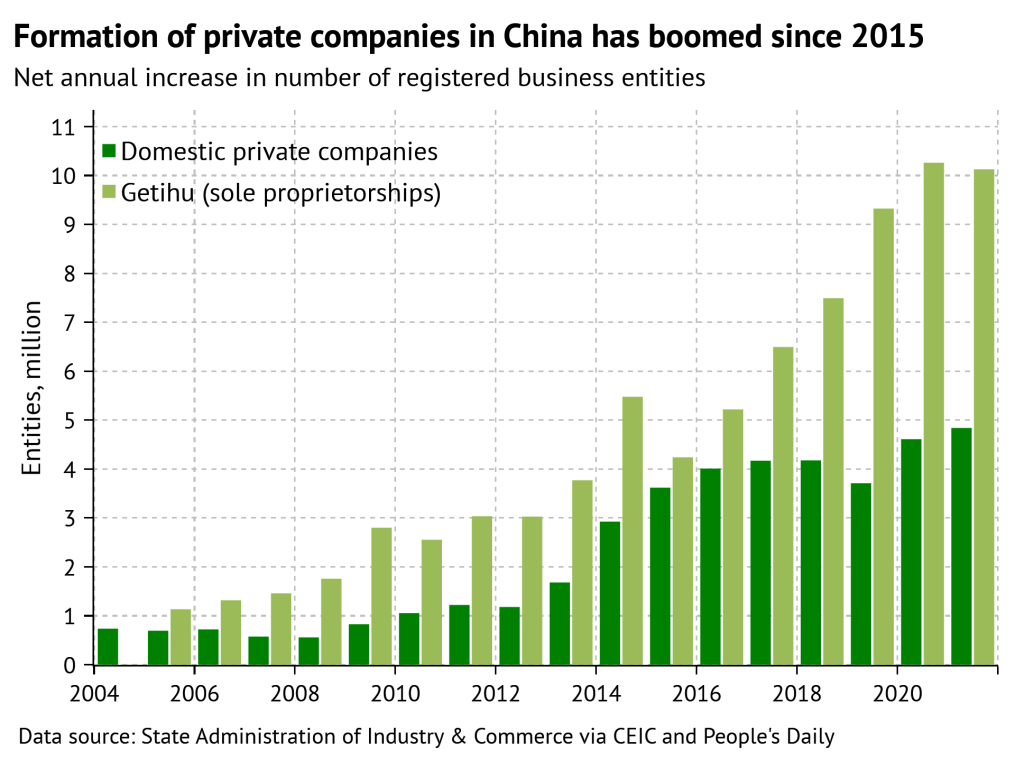
Here was the answer to one of those Weird China Things. These “individual household enterprises” or getihu, are the default legal form for small business in China. Getihu are not companies: they are considered an extension of the household. But they can do some things that companies do, like hire people–but no more than seven people. Why seven? Apparently because Marx said so–how great is that?

But of course I still wanted to know: where did Marx say that employing exactly eight people makes you a capitalist?  Pantsov and Levine’s footnote cites Ezra Vogel’s earlier biography, Deng Xiaoping and the Transformation of China, as the source for the anecdote. But I followed the reference and in Vogel there are not really any more details. Many other sources repeat the assertion that the limit of seven employees for getihu comes from Marx, but without actually citing the canonical text.

Searching around in Volume IV of Capital did not produce any obvious suspects. No one less than Wu Jinglian, in a footnote in his China’s Long March to a Market Economy, says that the source was a numerical example in Volume I, Chapter 9 of Capital. However this cannot be correct: the numerical examples in this chapter do not deal with the number of workers at all. I eventually found the correct source cited in X.L. Ding’s The Decline of Communism in China: Legitimacy Crisis 1977-1989. It is actually Marx by way of Engels; in his Anti-Dühring Engels summarizes Marx as follows:

On the basis of his previous examination of constant and variable capital and surplus-value, Marx draws the conclusion that “not every sum of money, or of value, is at pleasure transformable into capital. To effect this transformation, in fact, a certain minimum of money or of exchange-value must be presupposed in the hands of the individual possessor of money or commodities”. He then takes as an example the case of a worker in any branch of industry, who works eight hours daily for himself — that is, in producing the value of his wages — and the following four hours for the capitalist, in producing surplus-value, which immediately flows into the capitalist’s pocket. In this case, a person would have to have at his disposal a sum of value allowing him to provide two workers with raw materials, instruments of labour and wages, in order to pocket enough surplus-value every day to live as well as one of his workers. As the aim of capitalist production is not mere subsistence but the increase of wealth, our man with his two workers would still not be a capitalist. Now in order to live twice as well as an ordinary worker and turn half the surplus-value produced back into capital, he would have to be able to employ eight workers, that is, he would have to possess four times the sum of value assumed above.

So there you have it: to be a true capitalist, you have to have at least twice the standard of living as a worker, and to do that you must employ eight workers. Therefore, if you employ less than eight workers, you are not a capitalist. This is of course a simplification of the original Marx, though Marx does endorse that idea that beyond a certain threshold the nature of the employer-employee relationship changes fundamentally. The passage Engels cites is from Volume I, Chapter 11 of Capital:

If this labourer were in possession of his own means of production, and were satisfied to live as a labourer, he need not work beyond the time necessary for the reproduction of his means of subsistence, say 8 hours a day. He would, besides, only require the means of production sufficient for 8 working-hours. The capitalist, on the other hand, who makes him do, besides these 8 hours, say 4 hours’ surplus-labour, requires an additional sum of money for furnishing the additional means of production. On our supposition, however, he would have to employ two labourers in order to live, on the surplus-value appropriated daily, as well as, and no better than a labourer, i.e., to be able to satisfy his necessary wants. In this case the mere maintenance of life would be the end of his production, not the increase of wealth; but this latter is implied in capitalist production. That he may live only twice as well as an ordinary labourer, and besides turn half of the surplus-value produced into capital, he would have to raise, with the number of labourers, the minimum of the capital advanced 8 times. Of course he can, like his labourer, take to work himself, participate directly in the process of production, but he is then only a hybrid between capitalist and labourer, a “small master.” A certain stage of capitalist production necessitates that the capitalist be able to devote the whole of the time during which he functions as a capitalist, i.e., as personified capital, to the appropriation and therefore control of the labour of others, and to the selling of the products of this labour. The guilds of the middle ages therefore tried to prevent by force the transformation of the master of a trade into a capitalist, by limiting the number of labourers that could be employed by one master within a very small maximum. The possessor of money or commodities actually turns into a capitalist in such cases only where the minimum sum advanced for production greatly exceeds the maximum of the middle ages. Here, as in natural science, is shown the correctness of the law discovered by Hegel (in his “Logic”), that merely quantitative differences beyond a certain point pass into qualitative changes.

It is rather amazing to think that this rather abstract and obscure passage in Marx ended up having such a huge practical impact in China. I’m sure that in its absence Deng would certainly have found some other justification for allowing small private enterprises to hire people. But the limit might not have been set at seven employees.

Mapping China: Which provinces are most dominated by state-owned firms?

The answer I’ve come up with is not quite the one I expected, but it does make sense I think. Beijing is number one, naturally–it’s the place where all the major national state-owned enterprises are headquartered, and SOE influence is inescapable. But after that easy one, anecdotal impressions do not provide much of a guide. According to my scoring system, the provinces where SOEs have the biggest economic weight are the wealthy coastal municipalities, and the far western provinces. In other words, SOEs dominate both the richest and poorest provinces in China, and play a relatively lesser role (though still a large one) everywhere else.

It is interesting that this pattern does not map that well onto the geographic distribution of China’s economic slowdown. Liberals like Sheng Hong of the Unirule Institute argue that the slowdown is caused by the poor performance of SOEs. At least in terms of simple correlations, that does not look to be totally true–indeed the provinces with a high SOE influence score are among those where economic growth has held up relatively better. This is probably because spending by SOEs is one of the main channels the government uses to support growth (it’s the Chinese replacement for countercyclical fiscal policy, which otherwise they don’t do much of).

The provinces where growth has been really terrible are those whose industrial structure is most exposed to the downturn in housing construction, which mainly means places with big mining or steel sectors. Since a lot of mines and steel mills are in fact privately owned, these provinces are actually not as SOE-dominated as some others. I think the poor western provinces have such high SOE influence scores because they do not have much indigenous industry, and are heavily dependent on investment projects funded by the central government and SOEs.

I would not let SOEs are completely off the hook, though it is tricky to disentangle the effects of state ownership and the effects of industrial structure. You could argue (and I probably would) that SOEs tend to make poor investment decisions and thus contributed to excess capacity in the steel and mining sectors, making the slowdown worse. But this argument is complicated by the fact that the provinces with the most resilient, service-driven economies–Beijing and Shanghai–are also incredibly state-dominated. So there’s not a straight correlation between more SOE influence and worse economic outcomes. At first glance, the relative outperformance of services against heavy industry seems to be a bigger effect than the outperformance of private firms against SOEs.

Anyway, food for thought, and further work. And now to the fun part–the map! I use my hex grid map of China in order to show the province names more clearly, and not diminish the importance of the three coastal municipalities which are geographically small but economically large.

hex-map-provincial-SOE-rank-readable

The three indicators I used to compute the SOE economic influence score are: state-owned enterprises’ share of gross industrial output value (as of 2011), state-owned enterprises share of fixed-asset investment (as of 2012) and the ratio of local state-owned enterprises’ assets to provincial GDP (as of 2013). For each indicator I use the most recent data available, but these ratios do not change dramatically over time. I normalized the reading of each indicator and then summed the normalized scores for each province to generate the overall score and ranking.

If I had to pick one indicator out of the three as the most reliable, it would be the SOE share of fixed-asset investment. The SOE share of industrial output (which I mapped previously) does not account for the important role SOEs play in the service sector, which is particularly important in places like Beijing, while the assets of local SOEs would not capture activity by central SOEs which is quite significant in some places. The northeastern provinces, which are generally viewed as having very state-dominated economies, rank very high in terms of the SOE role in industry, but not as high in terms of the broader indicators–which is an interesting corrective to the standard regional prejudice. The complete ranking of the provinces is below:

Top 10   Middle 11   Bottom 10  
Beijing 1 Shaanxi 11 Hunan 22
Qinghai 2 Shanxi 12 Jilin 23
Gansu 3 Heilongjiang 13 Zhejiang 24
Tibet 4 Ningxia 14 Jiangxi 25
Guizhou 5 Guangxi 15 Guangdong 26
Chongqing 6 Anhui 16 Liaoning 27
Yunnan 7 Sichuan 17 Hebei 28
Xinjiang 8 Inner Mongolia 18 Jiangsu 29
Shanghai 9 Hainan 19 Shandong 30
Tianjin 10 Hubei 20 Henan 31
Fujian 21

Du Runsheng, world’s most influential economist?

Last week, Du Runsheng passed away at the ripe old age of 102. The death of the “father of rural reform” was widely covered in China and Hong Kong, as Du’s proteges include such Chinese economic luminaries as Zhou Qiren and Justin Yifu Lin, not to mention Wang Qishan, who is now one of the seven most powerful men in China. But I have yet to see a proper obituary of Du in the foreign press, which is a real pity. You could make a case that Du was one of the most influential economists to have ever lived.

He was one of the primary authors of the rural reform policies China adopted in the early 1980s, which reversed agricultural collectivization and returned control of farmland to individual farm households. It is no exaggeration to say that as a result, hundreds of millions of people were able to escape poverty. If you measure influence by the sheer number of lives affected, then it seems Du would have to rank pretty high.

By all accounts, Du was a sensible and modest fellow who would never have described himself in this way. As a 2012 article in Caixin, on the occasion of his 99th birthday, said:

Since retiring, Du has downplayed his personal contributions to the rural household contract system. Rather, he credits farmers with coming up with the basic ideas that led to the successful policy.
It’s most important when handling rural land reform, he has often stressed, that government officials “respect farmers’ choices” and “investigate” in the field before adopting new policies.
At the birthday party, Du was honored for his special contributions to rural development research. A tribute cited the work of a Rural Policy Research Office team under Du that led to the household contract system, which was called the economic theory that’s had the greatest influence on modern Chinese society.
Du said he would accept the honor as “just a symbol of this team” because “rural reform relied on a team.”

Like many reform-era figures, Du survived earlier purges and was later rehabilitated. Though it is tempting for someone who went through so much and made such great contributions, we should probably not see him simply as a saintly figure dedicated to the welfare of farmers. Du was a military leader during the civil war, and also contributed to the initial post-1949 land reform; both roles would have meant being involved in quite a bit of violence. But I am pretty sure his life offers some great, complex stories that are begging to be told more widely.

For further reading, there is a first-person account by Du of the early days of rural reform, published in English by the International Food Policy Research Institute. There is also of course a Wikipedia page, and some of Du’s policy speeches have been translated and collected.

W. Arthur Lewis on stagnation, slowdowns and traps

The case for pessimism about sustained fast growth in any economy has rarely been so well put as in the following passage, one of my favorites, from Lewis’ 1955 book The Theory of Economic Growth:

“There are thus many pits into which a country may fall, as a result of prolonged growth: it may weary of material things, its entrepreneurs may behave less competitively, its public may create barriers to change, the distribution of income may alter unfavorably, it may exhaust its natural resources, it may lose its place in international trade, or it may run out of innovations. In addition, it may be a victim of natural disaster, or it may be ruined by war, by civil strife, or by misgovernment.

None of these is inevitable. On the other hand, when there are so many pits into which a country may fall, it is not in the least surprising that countries have fallen into one or more of these pits in the past. One cannot predict when the rate of investment in any particular country will begin to slow down–whether it will be after decades or after centuries. But the expectation that a long period of growth is in due course succeeded by slower growth, by stagnation, or even by decline seems fairly well supported by the little we know of the economic history of the past four thousand years.”

The passage comes from the section on secular stagnation in the book, a concept that is obviously having something of a renaissance these days. Lewis is mostly known today for his model of how labor in a poor country moves from a traditional to a modern sector, a concept many people feel captured something fundamental about how China and other developing nations work. But this book is not referred to much these days, though you can read a quite favorable recent overview of the whole thing here. I confess I have only dipped around in it–the prose style is not always invigorating–but each time to my benefit.

I like this passage because of the way it makes clear that economic growth is not easy and that lots of things can go wrong with it. It’s a simple point, but it’s basically why I’m never been that enamored of the concept of the middle-income trap. In its original formulation, it was the idea that middle-income countries tend to stop growing because their exports get squeezed between low-wage competitors and high-wage innovators. Sure, there are things that can go wrong in middle-income countries so that they fail to maintain fast growth–but lots of things can go wrong besides export competitiveness, and things can go wrong at pretty much any income level, not just the middle.

What’s interesting is to figure out what might be going wrong in each individual case (though I’m still waiting for an actual example of a nation that became “weary of material things”). It is indeed not surprising that a country may fall into a pit, but we still want to know which pit it is and why it fell, and not assume it’s always the same pit. As I’ve argued before, it’s not clear for instance that the middle-income trap model of declining export competitiveness is really the best explanation of what’s happening in China right now.

The concept of progress: appreciating Ted Gioia’s History of Jazz

Somewhat against my better judgment, I’ve been desultorily reading Ted Gioia’s History of Jazz. These kind of books are dangerous, to me anyway, because in the minutes it takes to read a few pages you can come up with many, many hours of new stuff to listen to. But it has already inspired me to go back and listen again to some great early jazz recordings which have not been on the playlist for many years–in particular, rediscovering the sprightly chamber jazz of Joe Venuti and Eddie Lang has been a real treat. And passages like this one lift the book far above the ordinary:

From its earliest days, jazz had been a forward-looking art, continually incorporating new techniques, more expansive harmonies, more complex rhythms, more intricate melodies. Sometimes this ideology of progress was stated explicitly, as in Beiderbecke and the Chicagoans’ oft-spoken praise of Stravinsky and other contemporary classical composers; in other instances, no words were necessary, as with the implicit modernism of Armstrong’s breakthrough recordings of the 1920s. But whether they expostulated about the future of music or merely announced its arrival through the bells of their horns, the leading musicians of early jazz were modernists in the truest sense of the term. They were admired—or chastised, as the case may be—as daring exponents of the new and bold.

It is easy to lose sight of just how remarkable this modernist bent was, given its context. The concept of progress has played a modest role in most ethnic music traditions. Those who draw connections between jazz and African music miss this important difference. The griots of West Africa, for example, aim to preserve their cultural legacy as it is handed down to them. This is not a mere aesthetic choice, but a cultural imperative: they are the historians of their society and must maintain the integrity of their precious musical heritage. …

Almost from the start, jazz players embraced a different mandate, accepting their role as entertainers and pursuing experimentation with an ardent zeal. This created a paradoxical foundation for jazz, one that remains to this day: for the jazz musician soon proved to be a restless soul, at one moment fostering the tradition, at another shattering it, mindless of the pieces. Even more striking, this progressive attitude of early jazz players came from members of America’s most disempowered underclass. Recall that this music was not only viewed with apprehension by much of the ruling class but was often belittled and derided even within black America’s own ranks. In the face of this hostility, simply preserving the African American vernacular music heritage—saving the legacy of a Buddy Bolden or King Oliver from the oblivion that obscures the early history of most traditional forms of music— would have been a major achievement. But advancing the jazz idiom to produce an Ellington or Armstrong was nothing short of miraculous—and all in the span of a single generation. One searches in vain through all the countries of the world to find another example of such a rapid and dramatic transformation from folk music to art music.

Books like these are a huge organizational challenge because the material can be approached so many different ways: chronologically, biographically, thematically. Gioia has done a good job of using all three approaches; the frame of the book is chronological, but when he introduces each figure they get a full biographical treatment, even when that requires going well outside the chronology of the rest of the chapter. For instance, the xylophonist Red Norvo is discussed early on for his 1930s recordings, but Gioia also assesses his 1950s work with Mingus and other later recordings (the treatment of Norvo is also a good example of Gioia’s generous approach to “minor” figures outside the standard jazz pantheon).

He is also, by the way, an excellent guide to more recent music: his annual best-of lists are wonderful, eclectic and huge.