Endless maps most beautiful, China edition

Maps are enjoying a renaissance these days, with many websites and news outlets turning maps into wonderful graphical tools for showing data and seeing new patterns. There are now lots of good free tools for putting these kind of infrographics together, but a lot of what is available is rather US-centric. So I am very pleased to have recently stumbled across a couple of pretty wonderful free tools for making informative maps of China. The first and most amazing one is the ChinaMap project hosted over at Harvard, which allows you to plot a huge variety of social and economic data in map form.

Here’s a fun one: the language regions of China. Other cool ones for history buffs include the locations of Ming dynasty garrisons, the concentration of Qing dynasty entry exams–and, you guessed it, locust attacks during the Yuan dynasty. There’s also more practical and recent stuff like the routes of natural gas pipelines, air pollution, GDP per capita and similar economic indicators. The depth and variety of what’s available is stunning. I could play with this for hours (and in fact I have…)

china-languages


The other new entrant in the cool China map sweepstakes is the PUMA project just launched by the World Bank, an open platform that pulls together an enormous amount of information about urban boundaries gathered from satellite photography (it includes China rather than being specifically for China). The level of detail here is amazing: check out for instance this illustration of the urban expansion of Beijing. The in-browser software seems quite sophisticated and has lots of useful features, though it’s less of a general-purpose mapping tool than one for tracking urbanization specifically. Still, pretty nifty.

beijing-expansion


Is bigger really better for China’s GDP?

Over the last few months there’s been a fair amount of news about China’s GDP statistics, all of it pointing in one direction: China’s level of output and income was larger than we previously thought. This has been pretty much universally taken as good news for China, and generally as reinforcing the China-is-big and China-is-taking-over-the-world narratives in the press. But there are some other more sobering implications that are also worth pointing out.

In October, the IMF released updates to its World Economic Outlook database that incorporated the latest estimates of purchasing-power parity exchange rates. This pushed China’s per-capita GDP at PPP in 2013 from $9,828 to $11,868. It’s not everyday that economies grow 20% overnight! The change unfortunately also resulted in a lot of guff about how China had suddenly become the world’s largest economy, which is mostly nonsense: PPP exchange rates are really intended to help compare living standards across countries. For most purposes, the total size of an economy is something that’s much more meaningful at market prices.

China objected to the new PPP estimates, apparently mostly because it didn’t want people to think it was the world’s largest economy. Mostly this seems to be a political rather than technical objection: China often finds it advantageous to present itself as a developing country with lots of poor people rather than a major global economic power (of course, it is both). And given how the press keeps harping on the China-as-largest-economy theme, those jitters seem justified. However it’s not clear what the technical quibbles actually are, and it it seems much more likely that the new PPP numbers are in fact more accurate. Economists including Robert Feenstra and Angus Deaton have pointed out problems in the 2005 estimates that would have over-estimated the PPP exchange rate, and under-estimated GDP, which seem to have been corrected in the latest work.
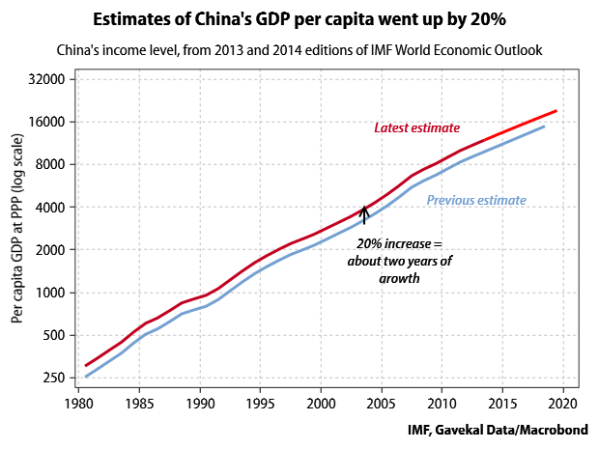
PPP revision effect on per capita GDP

But Chinese statisticians rather reinforced the trend when in December they published the results of their own economic census, a quinquennial effort where they go around the country and try to make sure they have an accurate count of businesses and their output. This resulted in GDP estimates for 2013 being revised upward by 3.4%, or about $308 billion. In the Chinese context, this was in fact not a huge change, even though it is equivalent to finding another Malaysia lying around. So apparently it’s okay for Chinese GDP to be a bit bigger, just not a lot bigger.

All this is perhaps more than just a storm in a statistical tea cup, as much fun as it is to debate the technicalities. China’s income level does have implications for how its economy might perform in the future. This is because fast-growing emerging economies like China benefit from what is called “catch-up growth”: they can grow more quickly than the US and Europe by adopting technologies and practices from them. Because China doesn’t have to invent everything itself, but can rapidly absorb past inventions from other countries, it can grow faster than countries where those inventions are already widespread. But catch-up growth has this property: the more of it you’ve already done, the less of it you have left to do. The fact that estimates of China’s income level keep getting higher means that China has in fact done more catching up than we realized–about two years worth, to be precise (i.e., per-capita GDP in 2014 is now at a level that China was previously not forecast to reach until 2016). So the more successful China has been at catch-up growth, the closer the future gets when China is just an ordinary economy that does not grow at supercharged rates.

One illustration of this general tendency is the research Barry Eichengreen and his Korean co-authors have done on growth slowdowns. They find that there has been a pattern for economies to shift to a permanently slower rate of growth around $10-11,000 of per-capita GDP, and sometimes again around $15-16,000. So the fact that China is currently around $12,000 per-capita GDP means that its growth slowdown over the past few years is likely to have been a permanent downshift, and not a temporary episode that will be followed by more fast growth at the previous rate. While this is certainly my own view, it has been a contentious one within China, where some prominent local economists insist potential growth has not slowed down. The winds shifted last year, when the Chinese government’s official rhetoric about getting used to a “new normal” for the economy marked an acknowledgement that 10%-plus GDP is indeed a thing of the past. But the patterns from Eichengreen’s research also suggest China could well have another downshift in growth in a few years time, and this is certainly not the official line. So probably the most important implication of the fact that China’s economy is bigger than we thought is that the slower-growth future is closer than we thought, too. This of course is a mark of success, not failure.


Asian growth slowdowns by income level

Here’s some clear thinking about the causes of the Industrial Revolution

For some reason, there has been a spate of commentary recently about the Industrial Revolution on the economics blogs I follow. From my perspective this has been great: I am an enthusiastic if amateur reader of economic history, and putting together a comprehensive account of this event is one of the great, incomplete projects of social science.

Dietz Vollrath’s excellent Growth Economics Blog sets up the discussion very nicely by contrasting two canonical and competing views of the drivers of the Industrial Revolution: Joel Mokyr’s idea-centric argument that an English culture of innovation laid the groundwork for an explosion of new technologies, and Robert Allen’s hard-nosed factor prices argument that high wages in England simply created stronger incentives to adopt new technologies. For me his great contribution is pointing out that these two arguments are not in fact in contradiction:

There are two different questions about the IR in Britain that we want to answer. First, why did several particularly important innovations take place in Britain, and not in other places? Second, of all the innovations available, why were they adopted first (or with greater speed) in Britain than in other areas of Europe?

Ultimately, Mokyr’s thesis is an answer to the first question, and Allen’s thesis is an answer to the second question. This is more or less the same point made independently by Anton Howes on his very good blog:

Allen’s theory is therefore one that best explains bias in the adoption of Britain’s numerous inventions (both in Britain, and abroad). … For a fuller explanation of the IR, though, we need to go right to the inventive source – why was there so much more invention in Britain to be adopted in the first place?

Well, that’s a shocker all right: one of the most complex and important historical events of all time turns out not to have a single cause or a simple explanation. And to complete the roundup of recent blog posts, inequality guru Branko Milanovicpoints out that the England-had-high-wages explanation is itself incomplete, because we still need to know why England had higher wages than other places. He links to a recent paper that argues the root cause is “the difference in the response to the Black Death-driven increase in real wages.” In other words, that it goes back to social and political institutions. The details are interesting but I won’t repeat them here. At any rate I now feel much better equipped to tackle some more Industrial Revolution scholarship.

Does any of this have contemporary relevance? Sure. The problem of explaining how modern economic growth came to pass in the first place two hundred-plus years ago is of course a very different problem than that of explaining how  economic growth can be sustained and replicated in today’s world. But there are some obvious parallels that arise: is it more important for China, say, to develop a Mokyr-style “culture of innovation,” or should we focus instead on Allen’s relative prices?

One could for instance make an Allen-style argument that the sharp rise of labor costs in China in recent years has created a much stronger incentive for companies to adopt labor-saving technologies. In that case, higher labor costs would not be the death knell for China’s international competitiveness that some say they, but rather the trigger needed to push productivity and income to the next level. I haven’t decided whether I believe this or not–there are some complexities given that China has had cheap capital as well as cheap labor–but it’s not obviously absurd and bears thinking about.