What I’ve been listening to lately, International Jazz Day edition

I’m pleased that there is such a thing as International Jazz Day, though I’m not sure exactly how to observe it, other than by putting on some jazz, which I would probably do anyway. On to the tunes:

  • Duke Ellington – The Complete 1936-1940 Variety, Vocalion And Okeh Small Group Sessions. A massive Mosaic box set that I eyed for years before I finally picked it up, just before it went out of print. This is flat-out some of the most wonderful jazz ever recorded, at least for my taste. These small-group sessions have the unmistakable Ellington flair for arrangement and color, but often feel looser and more laid-back than the full orchestra. The first-ever recording of “Caravan” is here, but a few “hits” do not really cover the impact of the whole thing. Truly a near-endless supply of casually tossed-off genius, charming and delightful.
  • Paul Motian – Garden of Eden. The obituaries for Motian, who passed in 2011, invariably start with his role as the drummer in Bill Evans’ classic piano trio. But I think he was one of the great bandleaders of recent decades, and this 2004 recording is one of his peaks: a gorgeous wash of sound, featuring no fewer than three guitarists, along with two saxophonists. The two Mingus covers (strangely rare for some reason) are particularly great.
  • Chris Lightcap’s Bigmouth – Epicenter. This group’s 2010 recording Deluxe was one of my favorite jazz albums of recent years, thanks to its combination of smart compositions and groove. The 2015 follow-up is just as good and even more varied. Craig Taborn mostly plays electric piano, giving the group a nicely spacy backdrop to the interplay between tenor saxophonists Tony Malaby and Chris Cheek (in what is probably not a coincidence, the same saxophonists as on Garden of Eden). But the writing by bassist-leader Lightcap is what really sets it apart, with some West African riffs and even an arrangement of a Velvet Underground tune.
  • Hamiett Bluiett – The Calling. Perhaps one of the most diverse jazz recordings I’ve ever heard, despite a seemingly minimal lineup of Bluiett on winds, D.D. Jackson on keyboards, and Kahil El’Zabar on percussion. The three old masters change instruments and styles on virtually every track to create a mosaic portrait of modern jazz in all its variety, with plenty of rhythm and humor.
  • Curtis Fuller – Blues-ette. A near-perfect masterpiece of hard bop from 1959, featuring the great tenor saxophonist Benny Golson along with trombonist Fuller. Nearly as good is Imagination, recorded the same year and adding Thad Jones’ trumpet to the front line.

Why is China not a “transition economy”?

When I first started working on the Chinese economy, most of the research I read compared China to other Asian economies, particularly the “miracle” economies of Japan, South Korea and Taiwan. Grouping these economies together, despite their differences, is fairly easily justified by their exceptionally high growth performance over a long period of time.

But if we think back to the late 1970s and early 1980s, before China had that growth track record, it was not at all obvious that it belonged in the club. South Korea, Japan and the US were allied with the US, and China was, despite its feud with the Soviet Union, still very much part of the international socialist community. The term “transition economies” now conventionally refers only to Eastern Europe and former Soviet Union, and so leaves out by the far biggest example of an economy in transition away from central planning. So how exactly did China end up in the Asian growth miracle club, rather than the transition economy club? Some recent reading has helped me to understand this history better.
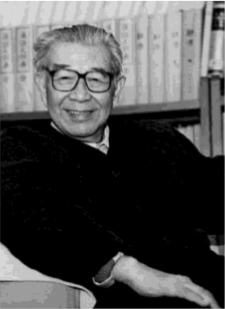
Yu Guangyuan

Yu Guangyuan

The examples of other socialist countries were in fact of great interest in China for a time. In the early years of the reform era, from roughly 1978 to 1985, there was a strong emphasis on establishing that economic reforms were ideologically consistent with socialism. One of the key figures in this effort was Yu Guangyuan, a Marxist theoretician/economist associated with Deng Xiaoping (he passed away in 2013). Yu presented China as one of several socialist countries in the world, all of whom had borrowed the Stalinist system from the USSR, all of whom had encountered problems in applying it to their own conditions, and all of whom were all trying to reform the socialist model. Hungary had had its “Goulash Communism” and Yugoslavia its “workers’ self-management” for years already. This rhetorical strategy emphasized how China was part of the global socialist movement, and how it risked falling behind even smaller socialist countries who were reforming.

Here is Yu on how the example of the Eastern European countries played an important role in early thinking about economic reform, from the preface to a recent anthology of his works:

After World War II, the Communist League of Yugoslavia seized power and proclaimed Yugoslavia a socialist country. Later, the League had differences with Joseph Stalin and was expelled from the socialist camp. Accordingly, the Communist Party of China also refused to recognize Yugoslavia as a socialist country and suspended its relations with the Communist League of Yugoslavia. In the 1950s and 1960s when the Chinese and Soviet parties were engaged in a polemic, we still regarded Yugoslavia as a negative example.

In 1978, a delegation of the Party Central Committee visited Yugoslavia. The delegation was headed by Li Yimang, with me and Qiao Shi being his deputies. Our mission was to conduct field inspections and contacts and then submit a report to the Party Central Committee on the basic conditions of that country and on whether interparty relations should be resumed. Before that, I had contacted some economists from the Soviet Union and Eastern European countries for their views on reform but never conducted any field inspection.

Yugoslavia’s practice left a deep impression on us. From this inspection, we drew a conclusion that socialist countries could have diverse economic models. The delegation submitted a report to the Party Central Committee after the visit. The report held that Stalin tried to impose the Soviet economic system and model on Yugoslavia but Joseph Tito rejected them, which led to a deterioration of the Soviet-Yugolsav relations, and that Yugoslavia was a socialist country and the Communist League of Yugoslavia was a party upholding socialism. Based on this report, the Party Central Committee decided to recognize Yugoslavia as a socialist country and to resume its relations with the Communist League of Yugoslavia. This meant that the Party Central Committee changed its views on the diversity of socialist models…[which] represented an ideological shake-off of the party from the shackles of the Soviet model. …Nevertheless, many people indicated they could not accept the Yugoslav ‘autonomy’ system. In fact, our reform later did not follow that road.

…At the end of 1979, the Party Central Committee dispatched me to head a delegation to visit Hungary for a reform inspection. This inspection deepened our understanding that socialism could have diverse models, and enabled us to have more understanding of many concrete issues in the course of reform.

Yu also sponsored much of the early wave of research into the ideas of Mikhail Bukharin, the theorist behind the mixed-economy model adopted in Russia in the 1920s under the label of the “New Economic Policy” (see this previous post for more). But it is nonetheless the case that once the reform drive got beyond broad political conceptions and into practicalities, China took relatively little from the examples of Hungary, Yugoslavia, Poland and the USSR itself. Rather than restricting itself to models drawn from the international socialist brotherhood, China started looking to countries that were politically more distant but geographically closer.

One of the turning points in this shift is generally held to be the Moganshan conference of August 1982, organized with assistance from the World Bank. Edwin Lim, an early World Bank official in China, recalled the result in a 2005 account (source here):

Other than Adrian Wood and myself, all the other international participants were East European practitioners in Soviet-type reforms, particularly price reforms. Two major conclusions came out of this conference. First was that price reforms of the type attempted in the Soviet Union and Eastern Europe—more price adjustments than fundamental reforms of price-setting mechanisms—were not seen as true reforms. China thus began to look beyond the Soviet Union and Eastern Europe for its reform strategy. By the end of the decade, China was far ahead of the Soviet Union in moving toward a market economy. Second was the consensus among both international and Chinese participants that China simply did not have the margin of error to consider rapid reforms or shock therapy.

Another famous meeting of economists in 1985 helped cement the shift. Again from Lim:

Three years later, following the publication of the second Bank economic report, the question the reformists faced was how to manage a market economy and, particularly, the transition to it from a command economy. To address that question, we organized what has become known in China as the Bashan Boat Conference. The premier attached a great deal of importance to this conference and wanted many of the senior economic policymakers to participate. To ensure their complete attention, the conference was held on a boat (the Bashan) that floated slowly down the Yangtze River through the Three Gorges for seven days. Spouses of the international participants were invited, and each day the boat would dock to allow them to go sightseeing while the conference continued.

The foreign participants to this conference, in addition to Adrian Wood and myself, included Jim Tobin, the Nobel Laureate from Yale, who explained the basic principles of macro-management in a market economy; Sir Alec Cairncross of Oxford, who talked about management of a market economy, particularly the postwar experience of the United Kingdom in dismantling the wartime price control and rationing systems; Otmar Eminger, former president of the Bundesbank, who talked about the role of an independent central bank in macro-management as well as the German experience in dismantling the wartime control economy; Michel Albert, former head of the French planning commission, who talked about indicative planning in a market economy; and Janos Kornai of Hungary, who talked about behavior of a planned economy that may persist in a reformed scenario.

The decisive intervention may have been that of Janos Kornai, judging from how Ezra Vogel summarizes the result:

By the end of the conference, Chinese participants, already doubtful about the appropriateness of Eastern European models for China, were thoroughly convinced that the structural problems in socialist economies—such as the “soft budget constraints” that permitted firms to survive even with low performance and cycles of overproduction—were systemic problems in planning systems. This marked the end of the use of Eastern European reform models and greater acceptance of the role of markets.

If the fellow travelers in Eastern Europe did not have the answers, who did? There were some strong contenders not far away. Here is Vogel again (both quotes are from his Deng Xiaoping and the Transformation of China):

In the early 1980s, while Chinese leaders were exploring the experiences of Eastern Europe and making use of World Bank advisers, they were also studying Japanese experiences. Although Japan was a member of World Bank, Japanese efforts to work with China were generally done bilaterally and were conducted on a larger scale than China’s relations with any other country. Although China was also interested in the Taiwan and South Korea experiences in modernization, mainland China did not have direct relations with them until the late 1980s so their experiences in the early 1980s did not play a major role in shaping Chinese views. …

In the 1980s, Japanese gave more aid and built more industrial plants in China than did citizens from any other country. The Japanese factories built in China set standards by which China measured its progress in achieving efficient industrial production. For the study of modern science, the Chinese looked overwhelmingly to the United States. But more new machinery to build assembly lines in Chinese factories came from Japan than from anywhere else. Prime Minister Ikeda’s income-doubling plan for the 1960s became the inspiration for Deng’s goal of quadrupling the gross value of industrial and agricultural output in the 1980s and 1990s. And from 1974 on, Deng met more delegations from Japan than from any other nation.

By 1985, the idea that China would join the ranks of fast-growing East Asian countries was no longer ludicrous, though not exactly widely accepted. The Harvard economist Dwight Perkins was one of the first to posit that China would follow the high-growth East Asian path and not the less exciting example of the European transition economies. The following passage is from his 1986 book China: Asia’s Next Economic Giant? (note the question mark! a sign of the times):

Reform in the Chinese case means moving closer to at least certain key features of the economic strategy and economic system found elsewhere in East Asia. In concrete terms that means retaining an emphasis on an expanding role for foreign trade, household-based agriculture operating in response to market forces, and a substantially enhanced role for the market in industry subject to continued state guidance but not direct control. … Hungary and Yugoslavia, for example, have achieved reforms in their economic systems that go well beyond those currently in force in China in many respects, but no one contemplates 6 to 8 percent growth rates in GNP in those countries over the next decade or two. … Japan, South Korea, Taiwan and other others have demonstrated that GNP growth rates of 8 percent a year and even higher are feasible in the post-World War II era. In terms of per capita income, level of capital formation, and degree of income inequality China has characteristics similar to those of its East Asian neighbors when they entered into sustained periods of rapid growth.

Ultimately, the reason why China favored Asian over East European models was most likely that those models were more relevant to its conditions on the ground. Despite the political affinity with other socialist states in Europe, China’s economic structure at the start of the reform era was quite different, and more similar to the other Asian economies at the beginning of their growth take-off processes. The classic statement of this argument is a 1994 article by Jeffrey Sachs and Wing Thye Woo, “Structural Factors in the Economic Reforms of China, Eastern Europe, and the Former Soviet Union,” (JSTOR link):

China began reform as a peasant agricultural society, EEFSU as urban and overindustrialized. China faced the classic problem of normal economic development, the transfer of workers from low-productivity agriculture to higher-productivity industry. In EEFSU, the problem is structural adjustment: cutting employment in inefficient and subsidized industry to allow new jobs in efficient industry and services. …Crucially, China’s agricultural workers had nothing to lose, indeed much to gain, from the dismantling of socialism, while much of the industrial and even agricultural work force in EEFSU has plausible fears that dismantling the old system could leave them worse off, at least in the short run.

These days, the differences between China and the other Asian “miracle” growth stories are becoming more apparent–the most important being the continued large role of state-owned enterprises in its economy (the best summary of those similarities and differences is the last chapter of Joe Studwell’s How Asia Works). I wonder if, in this context, comparisons of China to the European “transition economies” will soon start to seem more relevant.

A Singaporean perspective on American and Chinese nationalism

I enjoyed this talk from long-time Singaporean diplomat Bilahari Kausikan for its relatively objective view of the peculiarities of both the US and China, and how it roots the difficulties the two countries have in their respective sense of identity. I’ve pulled out some of the key passages below:

The essential source of American and Chinese nationalism is a sense of exceptionalism; the US and China both consider themselves exceptional countries. But the conclusions they draw are different.

America is an inclusive culture that wants everyone to become like it and believes that the world would be a better place if this were so. … China’s rise has been psychologically unsettling to many in the West because in China, capitalism flourishes without democracy. This is regarded as unnatural and illegitimate because it punctures the western myth of the universality of its political values and of the inevitability of the development of political forms similar to its own. Unlike the former Soviet Union, China cannot be dismissed as an economic failure and thus challenges in a very fundamental way the western sense of self which assumes its political and moral superiority as a key element. …

I think the US knows that preservation of CCP rule is the most vital of Chinese core interests and is reluctant to endorse this explicitly. The US deals with the CCP pragmatically; it has no choice. But to invest CCP rule with legitimacy requires a redefinition of American values, including a de facto abandonment of the idea of universality that is apparently too painful to bear. …

China has an exclusive culture that rejects the notion that anyone could become like China as impossibly pretentious. To China, the best others can do is humbly acknowledge China’s superiority and the sooner we do so the better for everyone.

This is a very ancient and deeply ingrained feature of China’s approach to international relations. Throughout its history, China took great pains to preserve the forms of its centrality, at least in its own mind, even when the facts were otherwise. It never lost its sense of superiority even when powerless before the West and Japan. Now that China has re-emerged as a major power, this sense of superiority has become the underlying cause of the difficulties in China’s relations with many countries. The attitude that China is entitled to have its superiority acknowledged and that failure to do so can only be due to recalcitrance or ill-intention, is why I think China will always suffer a deficit in ‘soft power’ and evoke resentment. …

One of the basic functions of diplomacy is to see the world through your competitors’ eyes in order to understand the frame of reference he is operating within, and thereafter one of the basic purposes of statecraft to use what means are available and appropriate to manoeuvre him into your preferred frame of reference or if this is not possible, to operate within the same frame in order to achieve your purposes. A stable modus vivendi can only be reached if all parties are operating within the same frame of reference. Are the US and China operating within the same frame of reference? I think they do substantially but not entirely and therefrom arises the complexity and risks of the relationship. Can they be brought within a common framework? That is not yet clear. …

If a new modus vivendi requires the US to acknowledge that different political systems can have their own legitimacy, it requires China to resist the temptations of triumphalist nationalism.

There’s a lot more, but I had to condense more than usual to keep this post from getting too long; a transcript and video of the full talk is at the link.

bilahari-kausikan

Is steel excess capacity a symptom of China’s system, or of its size?

The wave of Chinese steel exports hitting world markets is one of the most visible ways in which the country’s domestic slowdown is affecting the rest of us. All too visible, as it is leading to the shutdown of steel plants across Europe and prompting many countries to push for anti-dumping tariffs on Chinese steel.

How should we understand this phenomenon? The usual tendency, among both Chinese and foreign observers, is to attribute Chinese problems to distinctively Chinese causes. China is always different, it stands alone culturally, politically, economically. So the tendency is to take China’s excess capacity in steel as a sign of something peculiar to its system.

This may not always be the right way to look at the question. Indeed there is a more parsimonious explanation for the excess capacity that gets less discussion. What if the main reason that the world cannot digest China’s steel exports is not that its steel industry is peculiarly distorted, but that China is peculiarly large? I have previously suggested that the effects of China’s enormous size are not well understood, and I think this may be one area where size is indeed a very important factor (I am not denying that the excesses of state-led investment are part of the story; my point is that it’s not all of the story).

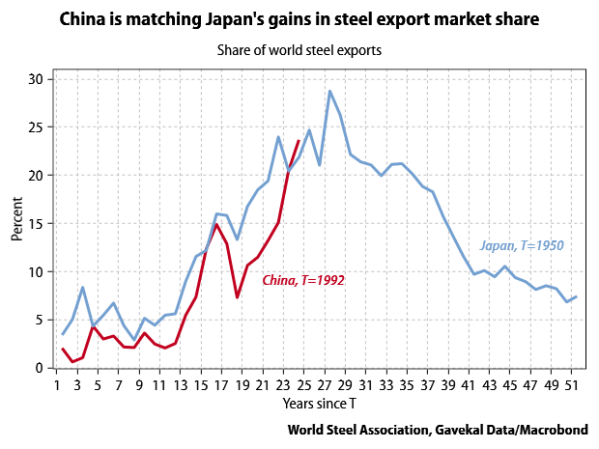
A comparison with Japan I think makes this easier to see. The primary use of steel, as discussed previously, is as a construction material, so rapid increases in steel use are usually a result of urbanization. Japan’s domestic steel output and steel consumption surged throughout the 1960s, but its domestic steel consumption peaked in 1973 (it later hit a new high in the late 1990s, but let’s ignore that for now). Other indicators of construction activity also peaked around the same time, so that was apparently a turning point for Japan’s urbanization process. While domestic steel consumption continued at a decent level, it retreated from the peak and stopped growing. However the capacity that the steel industry had built up to serve domestic demand was still there. So Japan naturally started exporting more steel. In the early 1970s, Japan’s steel exports accounted for 20% or more of all global steel exports.

The trajectory of China’s steel exports is eerily similar. China’s domestic steel consumption appears to have peaked in 2013, and since then its steel exports have surged, hitting 112 million tons in 2015. China’s share of global steel exports also is now probably around 20%, matching Japan’s in the early 1970s. The chart below shows the parallel. Japan could not sustain a global steel export market share of over 20% for long, and given the political backlash that China is now experiencing, it will probably encounter a similar ceiling in market share.

Japan-China-steel-export-market-share

In relative terms Japan and China do look quite similar. China’s peak level of true domestic steel use in per capita terms was close to, but below, Japan’s, meaning it is actually a somewhat more efficient user of steel–as one would expect given three more decades of technological improvement. In absolute terms of course they are quite different: Japan had about 100 million people in the 1970s and China has 1.4 billion now. Japan’s crude steel production in the late 1970s was just over 100 million tons a year, but China’s is now over 800 million tons a year. China’s steel exports last year are larger than Japan’s annual steel output in the early 1970s.

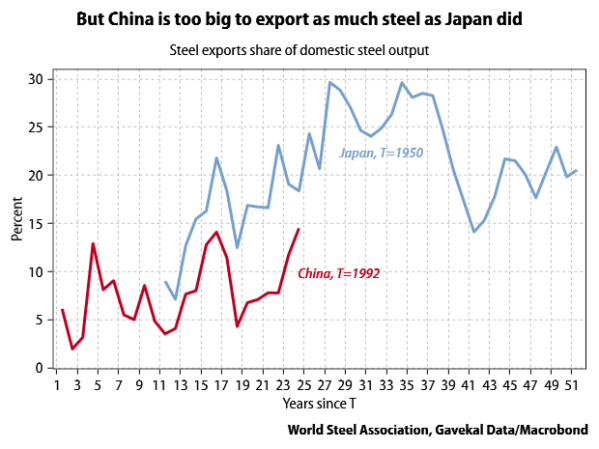
That size is now a problem for China, because a 20% global market share in steel exports is, well, just not enough in domestic terms. China is now exporting close to 15% of its domestic steel output, the most it ever has. But in the early 1970s, Japan was exporting close to 30% of its domestic steel output. And once you factor in indirect steel exports–the steel contained in products like cars and ships–Japan was actually exporting 40-50% of its domestic steel output.

Japan-China-steel-export-output-share

Japan built up a steel industry to serve domestic urbanization, but then was able to successfully transition the industry to exports. China cannot plausibly transition its steel industry to exports. Why? Because China is too big (or, depending on your point of view, the world is not growing fast enough; if India’s steel demand was now beginning a Chinese-style urbanization boom, this whole discussion could be moot). If China was a small Communist country, it could just export enough steel to keep its domestic industry afloat, and no one would complain that much. Because it is a large Communist country, it can’t export enough steel to keep its domestic industry afloat. And therefore there is a lot of excess capacity. But most people tend to focus on the fact that it is a Communist country, not on the fact that it is a large country.

What’s the implication of all this? Well, as the Chinese industry official I quoted recently said, China probably cannot avoid reducing its steel output in coming years–unless it rather quickly becomes a much, much bigger exporter of cars and other steel-using goods.


Note on sources. Thanks to Wing Thye Woo of UC Davis for asking the question that prompted this little investigation. The historical data are from the yearbooks of the World Steel Association, a wonderful resource. Since the older historical data is somewhat patchy, I had to convert between different concepts (steel production and apparent steel use) and statistical bases (crude steel equivalent and finished steel equivalent) to get these longer time series, so the figures in the charts should be taken as approximations rather than precise records. Also though I had data for China’s steel exports for 2015, I did not have the world total, so the figure in the chart is a guesstimate.

Where is Chen Yun when we need him?

I’ve been dipping in and out of Ezra Vogel’s Deng Xiaoping and the Transformation of China, which is less a biography and more an authorized history of elite policymaking. The sections on the early reform era are particularly interesting, not least because they do not sound anything like what is going on in China today. In the very first years after the Third Plenum formalized the turn toward a market economy, there was a constant back-and-forth on the right direction for the economy.

Deng was gung-ho for growth, and viewed aggressive growth targets as a way of breaking free of the oppressive Maoist orthodoxy. But he shared power with Chen Yun, who was widely respected for correctly opposing Mao’s excesses in the Great Leap Forward, and who was consistently a voice for caution and realism. Deng of course ultimately won the argument, and Chen Yun today is often viewed, rather unfairly, as a planned economy stick-in-the-mud. But in fact he played a “necessary but annoying” role, as Vogel puts it, in keeping Deng’s ambitions tied to economic reality.

Reading the passages below, I could not help but wonder: who in China’s leadership is now playing Chen Yun’s role? Of course we know little of what is going on behind the scenes, but there are no obvious candidates. And wouldn’t China be better off if the overriding focus on highly politicized growth targets, which have become a form of orthodoxy themselves, was offset with some concern for enormous (if hidden) government deficits, rising strain in the financial system, and other economic imbalances? In short, couldn’t China today do with a bit more of the Chen Yun spirit?

Okay, editorializing over. Here is a history lesson from Vogel:

When Deng became preeminent leader in December 1978, Chen Yun, who had just rejoined the top leadership team, called attention to a potential crisis looming in the economy: visions of growth had gotten out of hand, the budget was out of balance, and commitments for purchasing technology from abroad had exceeded China’s foreign currency reserves, which were needed to pay for them. Among the leaders trying to provide direction for the economy in this new uncharted era, there were countless opinions about how to proceed. But as officials at the top began aggregating the various views, the different views tended to coalesce around two opposite poles. One group centered around the builders, who eagerly sought to introduce new factories and infrastructure projects; the other group, led by Chen Yun, the balancers, cautiously tried to ensure that resources were available for all the national priorities. …

Deng Xiaoping, like Hua Guofeng, was at heart a builder who wanted to see rapid progress. He admired project managers who under adverse circumstances had been able to complete important projects that provided visible signs of progress. Deng, who had little patience with detailed calculations, considered the cautious balancers necessary, but annoying. …

On December 10, 1978, during the meeting of the Northeast group at the Central Party Work Conference, Chen Yun voiced his concerns about the uncontrolled exuberance that had reached the highest level of party leaders. As if giving adult supervision to overly excited teenagers, Chen Yun laid out the problems in the ten-year economic vision. He spoke with authority, suggesting that he already knew he would be appointed to the Politburo. He said, “We should maintain steady progress and not get caught up in a headlong rush. . . . When materials are not available for a project, whether at the local or national level, it should not be launched.”

Before the Third Plenum, Deng Xiaoping had been fully supportive of the project managers, but after December 1978, when Chen Yun warned about the lack of careful planning, Deng threw his weight behind Chen. … Why did Deng shift course from supporting the builders to backing the balancers, led by Chen Yun? Deng recognized the importance of putting the economy on a solid base for the new era, and the summary economic data assembled in December for the past year reflected serious problems. At the time, there was only US$4 billion in foreign currency reserves and most of the foreign currency income from exports was already committed, although contracts had been signed to purchase over US$7 billion of foreign equipment. Even though the imbalances would seem infinitesimal when contrasted with the foreign trade figures a decade later, they loomed large enough to worry cautious officials who were accustomed to smaller amounts and who were frightened by the leverage that such debt might give the capitalist countries.

By March 1979, Chen Yun had collected more data, done more analysis, and was ready to systematically present his proposals for cutting back on the contracts to import foreign plants and for lowering the economic targets for the next several years. Some of his proposals, and even the terminology, were remarkably similar to the retrenchment policies that he had introduced to recover from the Great Leap Forward. Rather than use the term “retrenchment,” the term he used earlier, which would have sounded very negative, Chen Yun used the term “readjustment” (tiaozheng). …

The essence of Chen Yun’s approach to planning was balance: balance income and expenditures, loans and the ability to repay, and foreign currency income and expenditures. He also sought a balance between investment in consumer goods and producer goods, between heavy and light industry, and between industry and agriculture. In 1978, some 57 percent of China’s industrial output was from heavy industry and only 43 percent from light industry. Chen Yun, like many other officials, believed that China’s economy had been out of balance since 1958, with food and consumer goods sacrificed for more heavy industry than the people could bear. In 1980, under Chen Yun’s direction, heavy industry grew only 1.4 percent whereas light industry grew 18.4 percent; and in 1981 heavy industry declined by 4.7 percent whereas light industry grew 14.1 percent.

By the time Chen Yun returned to work in late 1980, the budget deficits had ballooned to become the largest since the Communists took over. The seriousness of the problem made Chen Yun more determined to clamp down and enabled him to gain support from other officials, including Deng. The deficit had grown not only due to the costs of the Vietnam War, but also because of the increase in procurement prices paid to the farmers for grain, the decline in agricultural taxes, and the costs of resettling people who had earlier been sent to the countryside and were now allowed to return to the cities. Moreover, the central government began allowing provinces and local enterprises to keep more of their own funds to stimulate local initiatives, a strategy that had reduced the total amount of taxes collected by the central government. The result was a great stimulus for many provinces, but Chen Yun considered the serious budget deficits alarming and potentially disastrous. …

In November 1980 China’s economic growth rate targets for 1981 were set at a much lower rate, 3.7 percent, and capital construction allocations were reduced from 55 billion yuan to 30 billion yuan. When there were complaints that such restraints would waste valuable time, Chen retorted, “How much time have we wasted since the Opium War? Over a hundred years. Why is it such a big thing to wait three years to move ahead?” What had most delayed China’s advances since 1949, he said, was leftist errors made while rashly pushing ahead. Chen Yun was allowed to take firm control over guiding the drafts for the Sixth Five-Year Plan (1981–1985) and over bringing the budget and deficit under control.

The raw material of urbanization: recommended readings on steel

Fresh from posting on the winter of the steel industry in China, I see that Richard Jones has written a nice top-level view of the role of steel in the world economy, explaining broad indicators like per-capita steel demand, and steel intensity, or steel use per unit of GDP:

The dominant uses for steel now are in construction and infrastructure. 42% of steel output goes into buildings, the biggest fraction of which (44%) is in the form of rebar, and 14% in other infrastructure (again, mostly as rebar, but including some 6% as train tracks).

Steel, then, is the fundamental raw material of urbanisation. We can now understand the two periods of fast growth of steel output, in broad terms, as corresponding to two great waves of urbanisation–the first, between 1950 and 1980, in the USA and Europe, and the second, from 2000 and still continuing, as the rapid urbanisation of China. …

Steel is more important than ever as the foundation of our industrialised, urban economies. But more than a century of remarkable (and widely unappreciated) technological progress means that it is relatively less important in terms of its contribution to GDP, because we’ve learnt to make it so much more cheaply and efficiently.

But why exactly is steel the “fundamental raw material of urbanization”? To understand this we have to understand something of the history and physical properties of steel. I also recently stumbled across this nice account of the invention of the modern process of steelmaking in the American Scientist which explains the basics well:

Broadly speaking, steel is just iron with a bit of carbon in it. But that definition doesn’t capture the stunning metamorphosis that occurs when the iron and carbon merge in the correct way. The secret behind steel is that it isn’t just one substance like most metals, but a mixture. On the microscopic scale, steel turns into two different substances that stack up like a layer cake. One of the layers is rich in carbon and strong. This layer is a chemical compound called cementite, and with the right amount of force, it snaps like brittle chalk. The other layer has little carbon (around 0.2 percent) and is malleable (flexible and easily bent). This chemical compound is called ferrite, and with enough force, it can be pulled like taffy. These layers complement each other with strength and malleability. Most metals, being monolithic, have only one property or the other. The characteristics of strength and malleability usually are more like two ends of a seesaw; as one goes up, the other goes down. But in steel, its layers allow both properties to exist, and that makes steel versatile and suitable to build many things, from trains to tools to cars to cans.

So steel is useful for many things, but why is it particularly useful for buildings? I did not fully grasp this until I read Mark Miodownik’s wonderful book Stuff Matters: Exploring the Marvelous Materials That Shape Our Man-Made World. A delightful introduction to materials science, it includes chapters on both steel and concrete. And it turns out that steel by itself is not the “fundamental raw material of urbanization”; that title should properly belong to steel-reinforced concrete. The unusual interaction between the physical properties of concrete and steel makes this an incredibly useful combination:

Concrete is essentially a simulacrum of stone: it is derived from it and is similar in appearance, composition, and properties. Concrete reinforced with steel is fundamentally different: there is no naturally occurring material like it. When concrete reinforced with steel comes under bending stresses, the inner skeleton of steel soaks up the stress and protects it from the formation of large cracks. It is two materials in one, and it transforms concrete from a specialist material to the most multipurpose building material of all time. …

Most materials expand when they get warmer and contract when they get cooler. Our buildings, roads, and bridges expand and contract like this, observing day and night temperature cycles, as if they are breathing. It is this expansion and contraction that causes a lot of the cracks in roads and buildings, and if it is not taken into account in their design, then the stresses that build up can destroy the structure. Any engineer…might have assumed that concrete and steel, being so different, would expand and contract at such different rates that they would tear each other apart… But, as luck would have it, steel and concrete have almost identical coefficients of expansion. In other words, they expand and contract at almost the same rate. This is a minor miracle.

There’s a lot more fun stuff in all three of these readings.

Winter has come: the state of steel in China

It’s hard to understand the Chinese economy without understanding what’s going on in the steel sector. I found the following short interview with Cai Rang, chairman of the China Iron & Steel Research Institute Group, to be one of the better recent summaries of the situation I’ve come across in domestic sources, and also useful as an indicator of what some insiders are thinking. Here’s my translation:

Interviewer: How is the current round of excess capacity in steel different from those that came before?

Cai Rang: During the past few years, China did not clearly recognize the historical stage of development that the steel industry had reached. Therefore when steel prices would rise and fall, everyone would think: winter has come, so spring cannot be far off. Because of this kind of thinking, during the previous rounds of capacity reduction there was no consensus on whether the steel industry was really in winter or in spring, and some companies were still pursuing economies of scale [by continuing to expand].

Now, however, the macro environment has changed, and most people believe that the steel industry will not enter another springtime, and the previous glorious phase of rapid development must end. In short, the steel industry has already entered the post-industrial era. Because of this, the effects of the restructuring, mergers, acquisitions and capacity reduction going on now may be different from before. But we must still avoid the old problem of a capacity rebound [after capacity reduction], and steel companies cannot have a “land grab” mentality [i.e., expanding output while others cut output in order to gain market share, because if every company pursues this strategy then output will not fall]. Reducing excess capacity will mean large numbers of firms closing their doors, and this requires both companies and society to shoulder responsibility.

Interviewer: On the one hand China’s steel industry has excess capacity, but on the other hand there is still a need to import steel, so how should we understand this issue?

Cai Rang: China’s current excess capacity in steel products is a sectoral excess: there is a lot of low-end steel, but the supply of high-end steel is insufficient. The ordinary steel products that China manufactures are not that different from those made abroad, and there are even some technological advantages over foreign companies. But for particular types of steel products there are still about 20 million tons of imports, among which there are about 200 tons of low-volume, high-tech sophisticated steel products that must be imported, such as steel used in airplanes.

In the future steel companies will have to transform their development model, and through product upgrading and replacement move in an energy-saving and environmentally friendly direction. Steel companies will need to put a lot of effort into those high-end products that China lacks and cannot yet produce, but they will also need to avoid creating a second round of excess capacity in high-end steel products that leads to a race to the bottom as they vie to drive down prices.

Judging from China’s current level of industrialization, there are not many steel products that need large amounts of investment and concentrated development. Those that remain are are all high-end specialized products, and investing in these products is much more demanding in terms of equipment, personnel and operating costs.

Interviewer: In order to digest excess capacity, China is exporting a large amount of steel products, and this has led to antidumping cases. What changes do you expect in the steel industry?

Cai Rang: China’s current steel production capacity is 1.2 billion tons, but domestic demand cannot completely absorb this capacity. In 2015 China exported about 100 million tons of steel products; this was a relief for domestic capacity but a shock to the international market. Already nine European countries have made antidumping complaints, and Japan, Korea and India have also complained. This shows that our country’s current steel production capacity is not sustainable, and must be genuinely reduced.

Now the relevant departments are drafting the 13th five-year plan for the iron and steel industry, and the preliminary plan is to first cut 200 million tons, and eventually stabilize steel capacity around 700 million tons. This will require many companies to exit the market, and those steel companies that remain will experience great changes both internally and externally. For instance externally, the integration of the internet and intelligent manufacturing could cause great changes in steel procurement and sales methods. Internally, the entire production process, the technology configuration, the quality of equipment and the efficiency of production all need to be improved, costs reduced, and energy use and raw material consumption optimized. There are historical reasons for the excess capacity in the iron and steel industry—in the past everyone was desperate to add supply—and today there is still some new capacity awaiting approval from the government. So capacity must be reduced.

Interviewer: Can China draw lessons from any international experience in dealing with the excess capacity problem?

Cai Rang: During America’s industrialization process, steel was one of its three pillar industries. Then came a wave of bankruptcies, and the whole process was very painful. But now output has come down, and there has been a big adjustment in social attitudes. Gradually funds and labor moved to space technology and aerospace, and now investment is in information technology and the internet. Iron and steel production moved to Asia, and Japan’s steel industry rose rapidly—Baosteel and other Chinese steelmakers were all set up to study Japan’s model at that time. The American city of Pittsburgh used to be the steel capital of the US, but today it has already become a city of education, of culture, of science. They got rid of three big steel plants, and in their place built the biggest shopping mall in the region. The whole city has been completely transformed. We can learn from this kind of experience.

What I’ve been listening to lately

  • Tomeka Reid — Tomeka Reid Quartet. A fresh, lively and generally fantastic recording that should have made it onto more best-of lists for 2015. The lineup of cello, guitar, bass, drums makes for a unique sound, particularly given that the guitarist is Mary Halvorson, hands-down the most interesting new guitarist of the early 21st century. But it’s not just an avant-garde workout: the compositions are strong and tuneful and the group is swinging. Highly recommended.
  • Joe Lovano & Hank Jones — Kids. A 2006 duet session from two grand masters, whose subtle interplay is of the highest order. The title track, “Kids Are Pretty People,” is a particularly gorgeous highlight.
  • Jason Moran — Soundtrack to Human Motion. The sound here is reminiscent of nothing so much as one of Andrew Hill’s classic 1960s sessions: the oblique compositions, the combination of piano and vibes. But that’s a great sound, and this 1999 session–Moran’s debut–is an impressive and enjoyable take on one of the more complex parts of the jazz tradition.
  • Sidney Bechet — The Best of Sidney Bechet. The title is a bit misleading, as this is not a career-spanning overview but a selection of recordings on Blue Note. But the quality is indeed very high–Bechet has one of the great sounds in jazz, his huge tone is always modern, always unmistakable. I came back to these tracks after reading a nice interview with the Ben Goldberg where he singles out the track “Blue Horizon” as an early favorite: “I couldn’t believe the sound. It was as if he’d built the clarinet himself out of a big chunk of ebony that he’d split with an axe.”
  • Kora Jazz Trio — Part Two. An old favorite that has popped up again on shuffle recently. The singing and kora playing of Djeli Moussa Diawara are the nominal highlight, but for me the group’s unique sound is really founded on the powerfully rhythmic piano playing of Abdoulaye Diabaté.