I’m working my way through the early chapters of Karl Marx: Greatness and Illusion, Gareth Stedman Jones’ recent biography. There’s a lot of German idealism, and these debates often seem to have been lost in the mists of history for pretty good reason. But some of the most interesting bits involve Marx’s arguments with his contemporaries, well before he became widely famous.
Arnold Ruge was a lecturer at the University of Halle and founder of journals that published some of Marx’s early writings. They were frequent collaborators and correspondents, and both were both critical of the autocratic Prussian state and traditional religion. But Ruge was more of a liberal, republican nationalist and their views drifted apart as Marx moved toward a more radical position. They eventually had a personal falling out after living in close quarters in Paris, which led to an open intellectual break:
Ruge went on to attack Karl’s communism. He argued to Feuerbach that neither the aims of the Fourierists, nor the suppression of property that the communists advocated, could be articulated with any clarity. ‘These two tendencies end up with a police state and slavery. To liberate the proletariat from the weight of physical and intellectual misery, one dreams of an organization that would generalize this very misery, that would cause all human beings to bear its weight.’
Karl Grün was a German journalist active in organizing workers around the same time as Marx, and also collaborated with Proudhon, the famous French critic of private property. Marx despised Grün, whose popularity and prominence were a challenge to his own, and devoted a section of the Communist Manifesto to criticizing his “German” socialism. In 1848, Marx and Engels followed up with the Demands of the Communist Party in Germany, which called for the nationalization of industry, transport and finance.
Writing in the Trier’sche Zeitung, [Grün] criticized the emphasis on centralization and nationalization; its results, he stated, would not be the emancipation of labour, but the replacement of individual monopolies by a ‘collective monopoly’ of the state, and the undermining of individual self-determination.
From today’s perspective, a full century after the Bolshevik Revolution, these criticisms sound very accurate indeed.
Kornai’s book is brilliant in its diagnoses of the internal conflicts and problems of “market socialism” or “reform socialism”, in which market mechanisms are permitted but the Communist Party maintains political primacy and a large public sector. This is a still a pretty accurate definition of China’s system. There were so many moments while reading when I wanted to shout out loud in recognition: “Yes! That’s exactly how it is!”
Yet the book finally concludes that market socialism is an inherently unstable and unsustainable system that cannot last. Essentially Kornai argues that the combination of a weakened version of state intervention and the half-hearted embrace of market competition enjoys the vices of both systems and the virtues of neither. A government that no longer truly believes in socialism cannot enforce its plans, while market forces are allowed to operate only inconsistently, so that they amplify rather than alleviate distortions. The inevitable accumulation of economic problems means that the public and officials get fed up with the system and eventually decide to jettison it entirely.
It seems fair to say that this argument has been disproved by how China has developed since Kornai’s book came out (it was written over 1986-91, and published in English in 1992). China’s market socialism has already lasted longer (40 years) than the “real” socialism of the Mao era did (~30 years). And while we don’t know what will happen in the future, it is pretty clear that Kornai thought market socialism should be less stable and enduring than classical socialism, not more:
To sum up, so long as the classical system can be sustained at all, it has a degree of stability and robustness, where the system undergoing the contortions of reform is inherently unstable. There are places where it can only subsist for a short time, and others where special circumstances allow it to continue to for longer, but nowhere has it been able to survive lastingly (and the prediction from the line of thought put forward in this book is that it will be unable to do so in the future).
In fact Kornai’s book contains a pretty accurate depiction of China in the 1980s, which of course he had personally experienced: there was lots of economic volatility and back-and-forth on policy, as well as high inflation and rising popular discontent that culminated in the 1989 protests. But while similar strains eventually led other reforming socialist countries to abandon socialism altogether, this did not happen in China. Instead China in the 1990s mounted a renewed effort to strengthen state institutions and maintain economic growth, which has obviously been very successful.
So what did Kornai miss?
I think one key issue is that China’s growth potential turned out to be much higher than the Eastern European countries with which he was more familiar. Because China under socialism was still a largely undeveloped and agricultural economy, it had enormous potential for high growth driven by structural change. In this respect China in the 1980s was more similar to Korean and Taiwan in the 1960s than it was to the reforming socialist countries of the 1980s, most of which were over-industrialized and internationally uncompetitive. For instance Kornai in the book was dismissive of the potential for market socialist countries to have much success with exports–and of course a successful export sector has made all the difference for China.
This difference in growth potential was probably at least as important as the much-discussed difference between the “shock therapy” style of post-Soviet reform and the “gradualist” style of Chinese reform. Some of China’s most important reforms, such as the household responsibility system of the early 1980s and the downsizing of state enterprises in the late 1990s, were not gradual at all, but were massive changes implemented quite rapidly.
China’s reforms also went further than Kornai allowed for in his book. His generalization was that market socialist countries were willing to allow some space for the private sector, but were never willing to allow the private sector to actually dominate the economy. As a result the economy could never actually become truly subject to the key disciplines of market competition: hard budget constraints and the risk of corporate failure.
It is useless for domestic and foreign advisers to call on the governments of market-socialist economies to be more forceful and impose financial discipline; the requirement cannot be met while public ownership remains dominant.
The menaces of the center are not effective enough; firms are not even afraid they will be implemented. The separation of functions does not apply here. Is the bureaucracy, which is the state, the owner, and the manager all at once, supposed to discipline itself? The budget constraint on firms can only become hard if the firm is really separate from the bureaucracy, that is, if it self-evidently left to itself in time of trouble. The only way of ensuring this separation automatically and spontaneously is by private ownership. …
Is it possible to make the budget constraint on publicly owned firms hard under the prevalent market-socialist system? The four points above provide an unequivocal answer: No, it is not.
Footnote 35: Exceptionally, the hardness of the budget constraint on publicly owned firms can be ensured artificially if there are not too many of them and they are surrounded by privately owned firms in a capitalist system. The behavioral norms of the narrow public sector then resemble the behavior of the dominant private sector of the economy.
In this footnote I believe is contained one of the secrets of China’s success. Over time, the Chinese government has allowed the private sector to become the majority of the economy. (Kornai himself likely played a role in this by helping convince Chinese leaders that the Eastern European reforms were inadequate and not a good model for China to follow.) A larger private sector did not end the problems of state-owned enterprises, and the conflicts and unfairness inherent in the competition between state and private companies. But it did mean that state firms faced at least some market discipline, and thus that their problems did not become overwhelming.
Kornai’s book also placed a lot of emphasis on the fact that in market socialist systems, officials were typically inexperienced and incompetent at managing the economy. Their inevitable mistakes discredited both the government and the concept of market socialism. By sustaining growth over a longer period of time, China was able to establish both the credibility of its system and build up the experience of its economic managers, which in turn made growth more sustainable. In this sense its economic growth created some positive feedback loops.
So I don’t think Kornai’s analysis of how a market socialist economy functions was fundamentally wrong. He was right about the kind of economic costs that state-owned enterprises and other socialist institutions create, and in that respect his book is still a useful guide to understanding China today. But to answer the question of sustainability requires also understanding just how large those costs are, and how much they are offset by positive developments elsewhere in the economy. If underlying growth potential is high and the progress of economic liberalization is consistent, then those costs are more likely to be manageable.
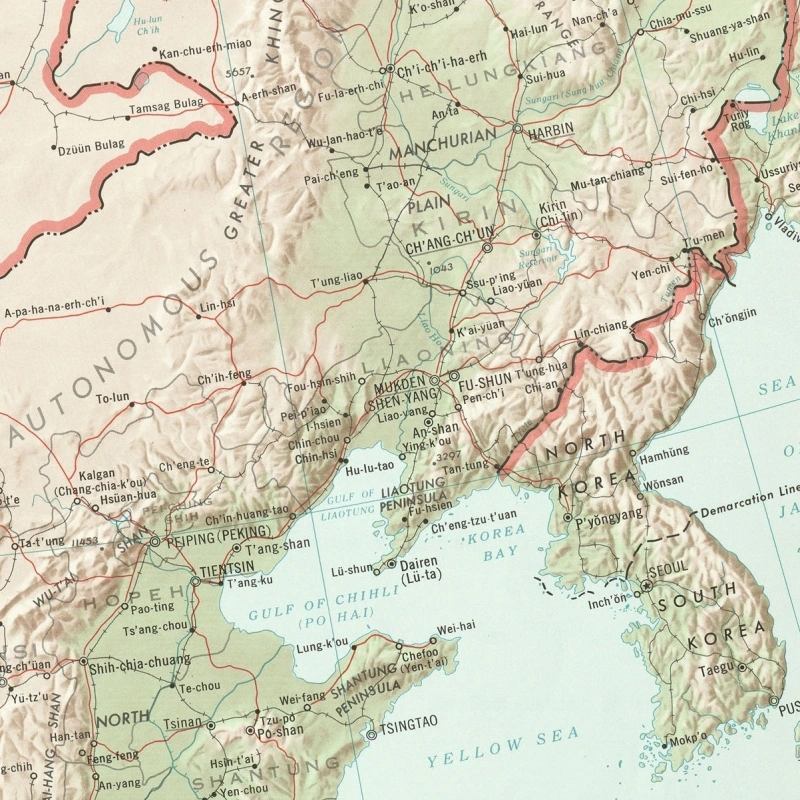
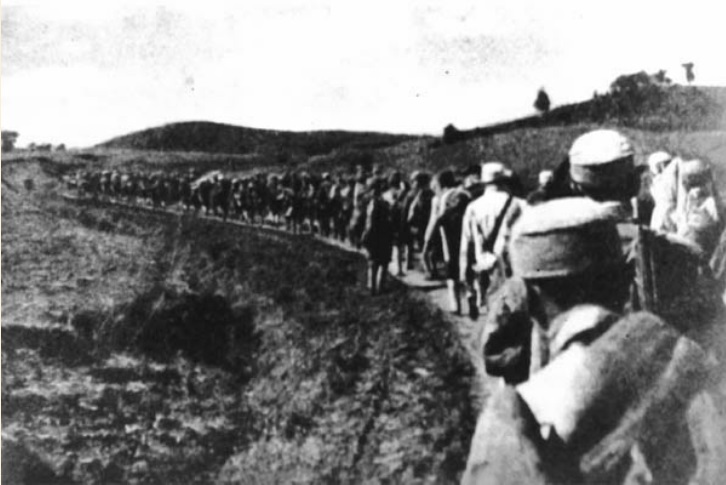
2018 will mark the 70th anniversary of the siege of Changchun, perhaps the greatest atrocity of the Chinese civil war. After Communist troops led by Lin Biao failed in their initial attempt to capture the city, on May 30, 1948, Lin decided to mount a blockade, cutting Changchun off from food and fuel shipments.
The goal was to weaken the Nationalist troops by starving them, and cause enough suffering that the civilian population would stop supporting the troops. The strategy was successful, as the Nationalist forces ultimately surrendered to the Communists in October. But by the time the siege ended, probably around 150,000 people, mostly civilians, had starved to death, and roughly the same number of refugees had fled the city.
Communist troops at the siege of Changchun, 1948.
The event is still little known within China and probably even less so outside it, though in recent years more English-language accounts have become available. Andrew Jacobs of the New York Times wrote an excellent article in 2009, using Chinese published sources and his own interviews with elderly survivors, which is still probably the best short introduction. The article’s observations about the fraught nature of historical memory in China are still very relevant: public commemoration of this anniversary is highly unlikely.
The Hong Kong-based historian Frank Dikötter also devoted the opening chapter of his 2013 book The Tragedy of Liberation: A History of the Chinese Revolution 1945-1957 to the siege. In just six pages, Dikötter defly uses Chinese archival sources to convey the suffering of the people of Changchun. The event serves as a kind of synecdoche for all the violence perpetrated by the Communist Party against its real and imagined enemies, one of the chief themes of his polemical book.
A longer, more detailed and less polemical account of the siege is in Harold M. Tanner’s 2015 book Where Chiang Kai-shek Lost China: The Liao-Shen Campaign, 1948. The book is primarily a military history and so it does an excellent job of putting the siege in the context of the civil war and explaining the decision-making on both sides. For instance, he makes it clear that siege tactics were unusual for the Communists, and that the political leadership including Mao was initially skeptical of Lin’s plan (though they ultimately supported it). But Tanner also does not shy away from the human cost and the tricky historical politics of the siege.
Both books rely heavily on White Snow, Red Blood (雪白血红) a 1989 book by PLA colonel Zhang Zhenglong whose revelations about the siege caused a sensation on its original publication. In a comparison that would become famous, Zhang likened the siege to the bombing of Hiroshima: “The casualties were about the same. Hiroshima took nine seconds; Changchun took five months.”
Zhang’s book was banned on the mainland, though it was reprinted in Hong Kong. Tanner also cites a 1997 book by the historian Liu Tong, The True Record of the War of Liberation in the Northeast (东北解放战争纪实) which he says comes to similar conclusions about the casualties as Zhang’s. It’s not clear if that book has been banned, though it does not seem to be in print in China any longer; Liu has also published several other books on the civil war in the northeast.
Another source on the siege that has recently become available in English, which I have not read, is a firsthand account by survivor Homare Endo, Japanese Girl at the Siege of Changchun. She was seven years old at the time of the siege. Her Japanese manuscript was first published in 1984, and Endo apparently also wrote a Chinese version, according to this interview.
While there is a long list of topics in Chinese history that deserve fuller treatment in English, it seems to me that the siege of Changchun is a deep, complex, and emotional subject very much crying out for a book of its own.
There was an interesting presentation at the AEA meeting in Philadelphia from the team working on the World Wealth & Income Database that included a comparison of how privatization and inequality developed in Russia and China (link for AEA members).
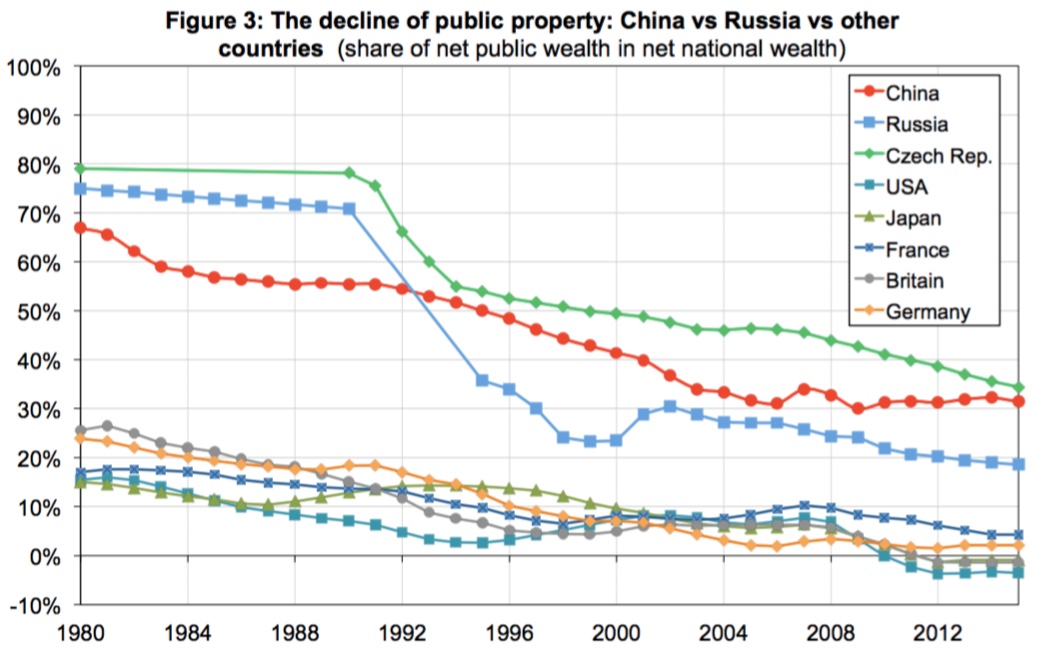
The data work is quite impressive and useful; here for instance is a lovely chart showing the trajectories of privatization across China and Russia, with comparisons to the Czech Republic and the advanced economies:
This doesn’t change the usual understanding that Russia pursued a “big bang” or “shock therapy” approach to the privatization of state enterprises in the early 1990s, while China moved later and more gradually, but it does illustrate it very vividly (Czech appears to have pursued a strategy somewhat intermediate between the two).
Another noticeable trend in the data, which was not really discussed by the authors, is the flatlining of China’s public wealth share after around 2006. This fits nicely with my own observation that SOE reform and privatization came mostly to a halt in the period from 2003-06, partly in response to concerns about insiders illicitly enriching themselves off the privatization process. For instance, the phrase “preventing the loss of state assets” made its way into high-level policy documents for the first time in 2003, and is still being invoked today.
Why Chinese policymakers would want to avoid a Russia-style outcome is nicely captured in another chart on the evolution of inequality:
This data seems to make it pretty clear that the extreme increase in Russian inequality was indeed closely linked to the early 1990s privatization process, as has long been clear from more anecdotal and historical accounts. Other data presented by the authors (Filip Novokmet, Thomas Piketty, Li Yang, Gabriel Zucman) show that private wealth increased in Russia largely at the expense of public wealth–in other words, as a result of the transfer of assets–while in China private wealth increased more steadily as a result of rapid economic growth and housing reform.
I’ve been quite critical of China’s policies for state enterprises for a while now, since I think the lack of progress on privatization has allowed SOEs to become more inefficient and blocked the growth and market access of private firms. So this paper was a useful reminder that in the early 2000s China’s government had good reasons for wanting to be cautious about privatization.
The paper also suggests to me that Russia had two policy failures not just one: yes, privatization was mismanaged, but it also failed to drive broad economic growth in the aftermath of privatization. These two failures were obviously not unrelated but they are also analytically separable.
I don’t think that a resumption of SOE privatization in China would mean that broad-based economic growth would suffer; quite the reverse in fact. Measured inequality would probably increase as a result of more privatization, but I also doubt that current figures are really capturing the inequality produced by corruption and rent-extraction by SOE insiders.
There is more detail on all this in the original WID papers on Russia and China, which I haven’t yet gone through closely.

 The Tangled Woof