How much did outside advice really change things in Russia and China?

Recent polemics against neoliberalism have revived an old debate over the role of the economic advice given to developing countries by the World Bank and IMF. A crude but nonetheless influential interpretation of the relevant economic history holds that Russia’s failed “shock therapy” privatization of SOEs in the 1990s was the result of uncritical acceptance of free-market dogma pushed by the international financial institutions, while China’s successful “gradualist” approach to SOE reform was the result of wise officials ignoring those same institutions and carefully designing policy according to local conditions.

public-wealth

Chart from Novokmet et al. “From Communism to Capitalism: Private Versus Public Property and Inequality in China and Russia”

This interpretation may accord too much importance to the advice given by the international financial institutions, and too little to the domestic politics of the countries actually making the decisions.

John Nellis, a participant in the World Bank’s first mission to the USSR in 1990, has published an account of that period based on his notes taken at the time. It makes for fascinating reading. It’s particularly interesting that the famous Soviet State Planning Committee, or Gosplan, seemed committed early on to a “gradualist” approach to reforming state ownership:

Even here, in the principal basilica of socialist planning, no one questioned that the old system had failed and that a transition to the market, or something approximating a market, was urgently required. But those we met in Gosplan, and many of those we met in other Soviet ministries and central units, thought that the transition would be a gradual, lengthy affair, and that the outcome would be some sort of mixed approach. In this evolutionary process they thought (or hoped) that Gosplan would retain authority to forecast, analyze, assist, guide and even lead reform. …

As for the future of the real sector, the officials’ evolutionary vision was that the massive, multi-divisional state enterprise/ministerial complexes would be broken down into “correctly sized” units. These would then go through a process of “corporatization” and would become joint stock companies, with all shares initially held by the state. These would then undertake a process of finding private partners, Soviet or foreign, who would bring in capital, technology, management expertise, and access to markets. Some percentage of shares would have to be turned over to these partners, but it would at first be a minority share, particularly for foreigners. These processes had just begun to start and, in their view, years would pass before substantial results were seen. Central organs such as Gosplan would guide and assist this evolution. Majority private ownership was a long-term prospect.

This aspiration is not so different from the course that was actually followed by China. (Nellis also notes that a 1988 Soviet law had allowed for the creation of cooperatives, which, much like China’s township and village enterprises in the 1980s, often functioned as de-facto private companies.) The joint World Bank-IMF report that was published after the mission acknowledged that large-scale privatization was effectively impossible, and focused more on how to manage state enterprises effectively.

All this suggests that China’s “gradualist” approach to overhauling state ownership was less a strategy adapted to uniquely Chinese conditions, but more the approach most likely to be favored by a socialist government that wanted to maintain political continuity and control over the reform process. Yet by 1992, the Soviet Union had been dissolved, and the Russian government launched a program of rapid mass privatization using vouchers–a much more radical approach than anything that had been considered in 1990. Nellis asks the obvious question:

The overwhelming majority of persons we spoke to in 1990 were gradualists. They wanted to effect as painlessly and politically acceptable as possible a transition to the market. …

Why did the 1990 joint IFI mission not get a glimpse of the coming emphasis on mass privatization? How did it — we — miss the fact that the government of the Russian Federation would opt for audacity?

The answer, clearly, is the radical change in domestic politics after the vote to dissolve the Soviet Union in 1991. In particular, the failed coup against Gorbachev, which was led by representatives of the same conservative interest groups that had tried to stymie economic reforms. After the failed coup, the reform and privatization of state enterprises was no longer a technocratic matter of economic management, but an urgent political task to dismantle the strength of the interest groups that had led the coup. The new Russian government was driven by an “overriding fear that the communists might try again to regain power,” Nellis writes. And the reshuffle of domestic politics had elevated to decision-making positions people who were not that important in 1990, and had not previously had well-formed views. 

A more recent, if less detailed, summary of the World Bank’s involvement in Chinese SOE reform by Zhang Chunlin serves as something of a companion piece to Nellis. Zhang is currently the lead private sector development specialist at the Bank, and previously worked on Chinese SOE reform both at the Chinese government and the World Bank. He writes that

The Bank’s work in the 1980s focused on the reform of the traditional SOE model itself while maintaining state ownership. Recognizing the need for state direct control over some “important enterprises” such as public utilities, the [1985] report argued that once a suitable economic environment is created through price reform and competition, pursuit of profit should lead most state enterprises in economically appropriate direction. The fundamental problem remains of the proper relationship between the state and the enterprise.

The central theme of the World Bank’s recommendations for China was not the necessity of privatization, but of corporatization: giving state-owned enterprises the legal form of modern corporations. That promised to improve management and decision-making within SOEs. But it also posed the problem of how the state was to exercise its ownership rights to control these firms. Much of the Bank’s work since the 1990s has focused on finding the right institutional structures for effective state ownership, and it has advocated for reducing state ownership in many sectors.

But the radical downsizing and privatization of SOEs that started around 1995 and continued through about 2002 was a domestic decision driven by the dire financial situation at many firms. A World Bank report in 1997 did call for state ownership to “completely withdraw from inherently competitively structured industries where small and medium sized firms predominate,” but it noted that this recommendation “would formalize a process that is already underway.” (And, of course, China did not actually follow this recommendation.)

Zhang also notes that in later years the World Bank contributed to the debate over the creation and structuring of an agency to represent the government’s interests in SOEs, the body now known as Sasac. It’s less clear if this is a contribution the Bank should be proud of: Sasac is widely regarded as a conservative interest group that has worked to strengthen the position of large SOEs, rather than to further their effective reform. But Zhang mainly wants to emphasize the “productive partnership” that the Bank has had with China. “In retrospective, a clear reason why the Bank managed to stay relevant has been its willingness to adapt to China’s own reform strategy,” he writes.

Yet that is perhaps not so different from how the World Bank worked with Russia in the 1990s: it was willing to adapt to both the gradualist preferences of the Soviet leadership in 1990, and the radical program of the new Russian government in 1992. In the case of both Russia and China, the World Bank seems to have mainly tried to help their governments find the best way to implement decisions that had already been reached by domestic political leaders. It’s not clear that the advice of international financial institutions really played a decisive role in making those decisions.




The Dave Hutchinson view of Europe grows increasingly plausible

It’s always dangerous to take a fictional character’s utterances as a stand-in for the author’s views, but this passage from Dave Hutchinson’s Europe in Winter does at least seem like a clear statement of the premise of the book:

Kaunas took a moment to gather his thoughts. “Europe is inherently unstable. It’s been in flux for centuries; countries have risen and fallen, borders have ebbed and flowed, governments have come and gone. The Schengen era was just an historical blip, an affectation.”

Hutchinson’s book, and its two predecessors, are thrillers set in a future world where Europe has fractured into a number of microstates and “polities,” coexisting with recognizable nation-states, the remnants of the European Union, and miscellaneous other transnational actors. It’s a festival of borders and bureaucracy, with lots of convincing detail (for instance, how after the UK dissolves, the spymasters of England spend a lot of time worrying about territorial threats from Scotland and Wales).

This is maybe not too surprising a vision for a novel published in 2016, the year of the Brexit vote. But Europe in Winter is the third book in a series; the first, Europe in Autumn (and still the best I think), was published in January 2014. Hutchinson should, I think, get credit for seeing before many others that the centrifugal theme in European history was not quite played out. And most would agree that evidence in favor of the hypothesis “Europe is inherently unstable” has increased since he wrote those words.

51hpor27zzl

What I’ve been listening to lately

    • Paul Motian – On Broadway Vol. 1,2,3,4,5A staggering musical accomplishment by the late, great Motian, one of the most distinctive drummers in jazz. His transformations of the old warhorses are startling and beautiful. My favorites so far are Vol. 3, where the addition of Lee Konitz to the group elevates it to a new level, and Vol. 4, where Rebecca Martin’s vocals manage to make the standards sound less rather than more traditional.
    • Andrew Cyrille – The Declaration of Musical Independence. Another drummer-led recording, and a surprisingly laid-back one for Cyrille. The real delight here is the rare appearance of Richard Teitelbaum, one of the only true master synthesizer players in jazz (along with, of course, Sun Ra).
    • Wayne Shorter – EmanonThe quartet tracks are vibrant and excellent, but I wanted to like the large-ensemble bits more than I actually did. Even before this won a Grammy, it was amusing to watch jazz reviewers try to avoid saying anything critical about the graphic novel that accompanies the music, since Shorter is after all a living legend. Indeed, the less said about it the better.
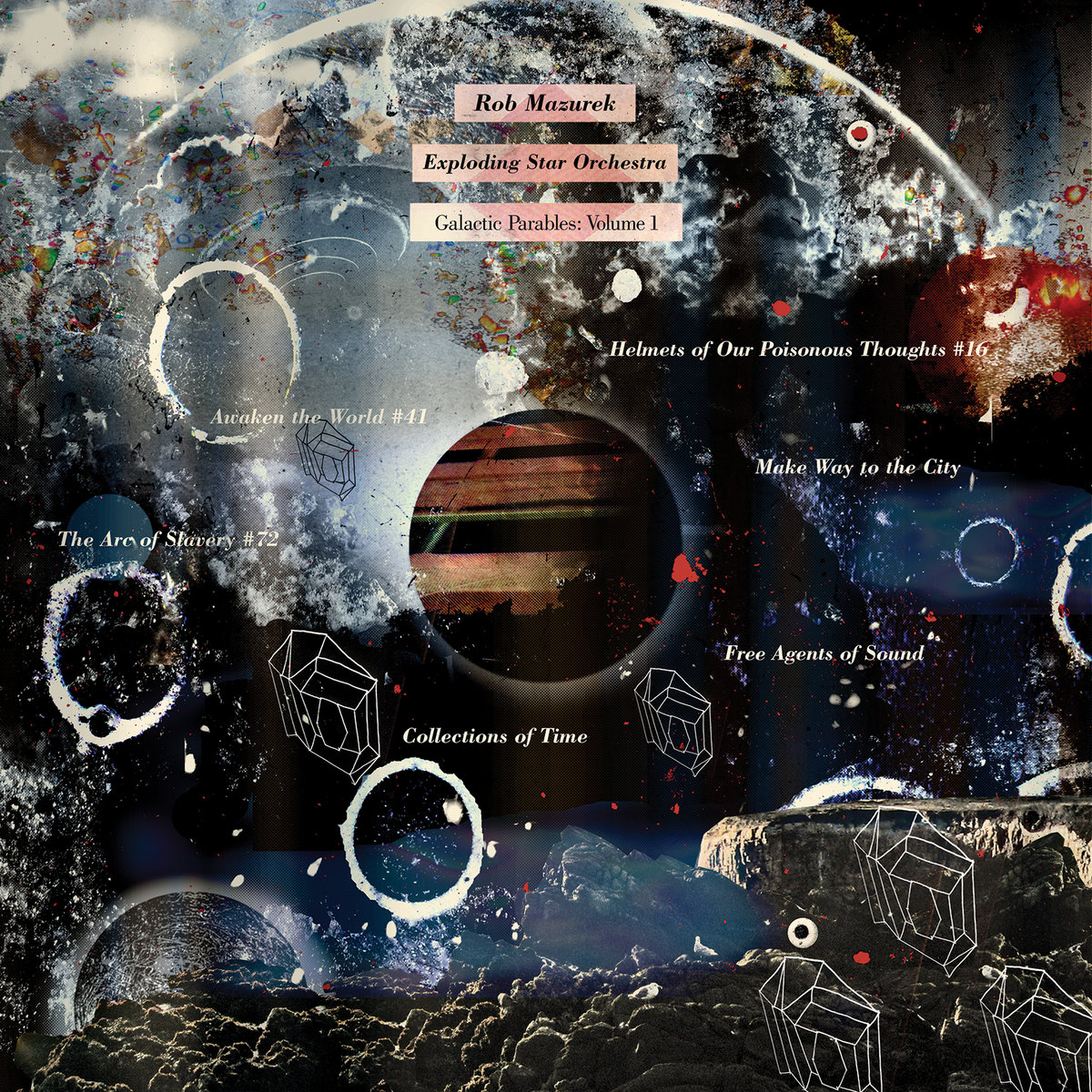
    • Exploding Star Orchestra – Galactic Parables Vol. 1. A powerful concert recording by Rob Mazurek’s great free-jazz big band. The space references are an obvious homage to Sun Ra, and his use of electronically manipulated voices achieves a similar effect to Ra’s chants and exhortations. But the band’s sound is all its own.
    • New Zion Trio – Fight Against Babylon. This piano trio led by Jamie Saft makes a serious and sustained attempt to combine jazz improvisation with Jamaican rhythms. The bass and drums indeed do an amazing job of channeling the minimal, trancelike repetitions of reggae. It’s not completely successful, but there are some transcendent moments here.

The underrated role of fear in economic development

William Overholt’s book China’s Crisis of Success covers a lot of different topics, but one theme that he keeps coming back to is fear.

A lot of what drove China’s daring early economic reforms was fear of falling back into the chaos of the Cultural Revolution. Fear can motivate political leaders to do things that are out of the ordinary, and motivate the population at large to accept them. It is not a coincidence, in Overholt’s view, that the miracles of economic growth in Asia followed national catastrophes:

The societies that have been able to implement the required policies [for rapid economic growth] are all ones that have experienced excruciating trauma and intense fear: Japan after losing World War II; South Korea after the Korean War; Taiwan after the Chinese Civil War; Singapore after its traumatic separation from Malaya (which meant facing two much larger powers, Indonesia and Malaysia); Vietnam after wars with France, the United States and China; and China after a century of foreign humiliation and tens of millions of deaths from domestic strife. …

The policies required for rapid growth entail enormous social dislocations, and political leaders who consider imposing such dislocations reasonably fear for their jobs. They only try when they are terrified of the alternative, and when a population fearful of collapse accepts otherwise unacceptable stresses. These are the political prerequisites of miracle-level growth.

I think there is something to this, even if it’s not the kind of insight that seems particularly easy to run regressions on (parts of Europe after the second world war probably also belong on the list).

Overholt calls China’s current situation a “crisis of success” because it has in fact succeeded in dispelling fear of national collapse. But without that fear, it is harder for political leaders to make disruptive changes to the system, and it is harder to convince interest groups to accept such changes.

One of China’s current problems is that shared national fear of collapse has given way to complacency and some hubris. …

As fear segues into confidence, the willingness of the population to endure terrible stresses dissipates and so does the motivation of the leaders to take great risks.

For this reason he thinks it is becoming difficult for China to continue liberalization that would reduce the role of government intervention and state-owned enterprises in the economy (the book, which came out at end-2017, is somewhat equivocal about this, but in person Overholt nowadays is more decisively pessimistic).

In recent years, advocacy for continued economic liberalization in China has been organized around the idea of the “middle-income trap”: if China does not do XYZ reforms, the argument goes, it will fall into this trap and not realize its full potential. But the middle-income trap is not a disaster or national catastrophe; it’s just things being not as good as they perhaps could be:

The stakes are different now – not war, not chaos, not financial collapse, just slower growth.

Since China’s growth is going to slow anyway, no one can honestly promise China that, if they do XYZ reforms, growth will not slow down. All they can argue is that growth might not slow down as much as it otherwise would. Which is not that compelling of an argument. So fear of the middle-income trap may not be enough to motivate the Communist Party to make politically difficult changes that reduce its ability to direct economic activity.

Fear does seem to be a stronger motivator in environmental policy: families rightfully fear for the health of their children, and political leaders rightfully fear the anger of families. The “fear model” thus suggests China could continue to make progress in reducing pollution, even if future economic liberalization is limited.

41cnty87rel

How plausible is the China in Kim Stanley Robinson’s *Red Moon*?

The premise of Kim Stanley Robinson’s new novel Red Moon is that China has taken the lead in colonizing the moon, leaving America far behind. I am a Robinson fan, and since the theme of China overtaking the US is very much in the air these days, I was interested to pick up the book to get his take on it.

Here is how one character describes China’s decision to establish a lunar base:

At the Twentieth People’s Congress, in 2022, the Chinese Communist Party and its Great Leader President Xi Jinping decided that the moon should be a place for Chinese development, as one part of the Chinese Dream. In the twenty-five years since that resolution was made, much has been accomplished in China’s lunar development.

Later a character explains:

In China, if the Party chooses to do something, then the whole country can be rallied to that cause. One out of every six humans alive, in other words, devoted to the project of establishing a base on the moon. This was far more than needed to do the job! Not every Chinese person was involved, and only a small percentage of China’s capital reserves had to be directed up here, even though it was a pretty big project. But it wasn’t that big, and in the end it was just more infrastructure.

This is not bad! For China to treat a lunar base as an extension of the Belt and Road Initiative, and “just more infrastructure,” is a fairly straightforward extrapolation of recent trends in Chinese political economy. And it has a ripped-from-the-headlines feel, given that in January, China became the first country to land a spacecraft on the far side of the moon. With India and Israel also planning lunar missions, lunar exploration is in fact a good reflection of the shift from bipolar or unipolar world to a multipolar one.

But sharp-eyed readers will have noticed that in the above Robinson says “People’s Congress” when he really means “Party Congress.” Annoying errors like this abound. Even more troubling are the names of the many Chinese characters, which often seem to be invented randomly without reference to the actual Chinese language. The president of China in 2047, for instance, is supposedly named Shanzhai Yifan. Not only is shanzhai not even a Chinese surname, it is (as anyone who uses the internet should know) a slang term meaning something like “cheap knockoff.” So did one of Robinson’s sources play an elaborate joke on him? Or is this just sloppiness?

Being fuzzy about the details of foreign languages and political systems is not a criminal offense for a writer of speculative fiction, who after all is supposed to be speculating rather reporting. But it seems that apparently neither Robinson nor his publisher could be bothered to run the manuscript by an actual Chinese-speaking person before publication. I’m not even a native speaker, and I could have fixed most of these minor issues in a couple hours of work. As a result, the book is something that no Chinese-speaking person could ever take seriously.

The more fundamental problem with the future China in this book is that it’s not really a future China: it’s just today’s China with some of the names changed. And sometimes not even that: in 2047 Chinese people are apparently still sending each other messages on WeChat on their mobile phones, and complaining about the Great Firewall. There’s a whole subplot about a social revolution unfolding in China, in which people’s grievances seem to have been lifted from dated magazine articles: the “breaking of the iron rice bowl” and the hukou system. That subplot is very thinly sketched and happens mostly offstage, and as a result is not even convincing as narrative, even aside from the details.

Red Moon has generally received mixed reviews, as it has other narrative weaknesses besides the poor portrayal of China. I think we’re still waiting for a work of fiction that gets to the heart of how America deals with a rising China — admittedly a pretty demanding task.

For better recent Robinson, I would recommend Aurora, and also Shaman, which I think is underrated, and features some of his best nature writing.

51jxfww3-7l._sx322_bo1204203200_