How Chinese ruined a perfectly good gender-neutral pronoun

One of most distinctive mistakes that native speakers of Chinese make when speaking English is to mix up the gender of the third-person singular pronoun. It is not uncommon for an otherwise fairly fluent speaker, with good accent and correct grammar, to say “she” instead of “he”, or vice versa, and not realize their mistake. It’s a difference that reveals how grammar shapes some habits of thought. English grammar requires you to hold in your mind at all times the gender of the persons you are talking about; Chinese grammar does not.

Spoken Chinese has only a single third-person pronoun, , which is gender-neutral, referring to all genders or none. Since Chinese grammar does not require speakers to mentally keep track of everyone’s gender, they often don’t. So when English forces them to make a choice, they sometimes just take a stab and get it wrong. Of course Chinese people are perfectly capable of learning the different habit of thought required by English grammar, but it’s not automatic.

It is possible to have an extended conversation in Chinese about a person who is not present without ever specifying whether that person is male or female, and indeed for the participants in that conversation to not actually know that person’s gender. This perfectly ordinary experience in Chinese can only be achieved in English by the deliberate use of unusual literary techniques. The example that springs to mind for me is Ann Leckie’s science-fiction novel Ancillary Justice, in which the narrator uses the pronoun “she” to refer to all individuals and doesn’t explicitly indicate their gender. Sometimes the reader can work it out from context, but a lot of the time you just don’t know. That’s weird experience for a speaker of a language with gendered pronouns.

What’s intriguing is that written Chinese is more like English in its use of pronouns than it is like spoken Chinese. There are three characters, all pronounced : 他 translates as “he” in both of the English senses, serving as the masculine third-person pronoun and as the (now contested) default pronoun for a person whose gender is unspecified or unknown; 她 is “she”, the specifically female third-person pronoun; and 它 is “it”, the neuter third-person pronoun usually used for inanimate objects.

Spoken Chinese is perfectly inclusive, referring to all people identically in a way that makes no presuppositions about gender. Written Chinese replicates the traditional hierarchical pattern in English, in which people are referred to as male unless there is a need to specify they are female. Yet the way that Chinese people actually speak–among other things, their distinctive mistakes in using English gendered pronouns–makes it clear they do not think in terms of those characters, and are mentally using only a single gender-neutral pronoun.

In my personal experience, this is one of the clearest demonstrations of a basic principle of linguistics: that spoken language is prior to written language. Of course this is obvious from both our personal and collective history. Every person learns to speak before learning to read and write, and humanity in general had spoken language before written language. But because of the antiquity, universality and cultural prestige of Chinese characters–the way the same writing system is used by speakers of different Chinese languages/dialects–there is sometimes a tendency for Chinese people to think the characters represent the “real” language. They don’t! The real language is what real people really speak.

The puzzle, then, is why written Chinese differs so much from the actual practice of spoken Chinese. A paper from 1997 by language maven David Moser has the answer (thanks to David for a Twitter conversation that inspired me to look up his piece). It turns out that gendered pronouns are a twentieth-century invention, introduced into the language by “reformers” who had been exposed to pronoun usage in other languages:

Prior to the May Fourth Movement [of 1919], there was only one written form for the third-person singular, the gender-neutral character 他. Later, due to the influence of foreign languages and the necessities of translation, prominent figures in the May Fourth Movement such as Lu Xun and Zhou Zuoren began to suggest creating a new character or characters to represent male and female third-person pronouns in the written language. According to Ling Yuanzheng, the first to advocate the use of 她 as the feminine written form while using the existing 他 as the masculine form was the poet and linguist Liu Bannong. Interestingly, though Liu’s proposal elicited much debate as to whether the introduction of any new characters was truly necessary, no one at the time raised the obvious possibility of creating a symmetrical character for the masculine third-person singular as well, thus leaving 他 as a gender-inclusive third-person pronoun.

The Chinese language reformers, instead of preserving the naturally gender-inclusive usage of their own language, instead grafted the hierarchical gender pronoun structure of English on top of it.

David notes that the poet Liu Dabai in the 1930s did try an alternative approach, creating new characters for both specifically male and female pronouns while preserving 他 as gender-neutral. What Liu’s scheme looked like is shown on the left in the graphic below, reproduced from David’s paper: three characters for three pronouns, each visually and semantically corresponding to the Chinese words for person, man and woman. The actual usage of modern Chinese is shown on the right: two characters for two pronouns, one that is primarily male but also gender-neutral, and one that is specifically female.

The whole episode is a fascinating example of the ways one language can influence another: not simply the ordinary one of borrowing vocabulary, but actually changing the grammatical structure. It seems fortunate that in this case the change was confined to the written language, and hasn’t altered the spoken one. Perhaps now that gender-inclusivity is more highly valued than it was a century ago, written Chinese can eventually come back into closer alignment with the spoken language.

Pragmatism as ideology

“Pragmatism” has become an inescapable piece of vocabulary in recent Western political commentary on China, the preferred term to indicate the opposite of whatever it is Xi Jinping has been doing lately. Everyone wants to offer an opinion about whether the newly installed Premier Li Qiang and his colleagues will be “pragmatic.” The optimists point out, correctly, that Li and others have a long track record of doing things to boost the economic development of the regions of which they were in charge.

Although I have used the term myself, this “pragmatism” discourse is starting to bother me. The word is being used to hark back to an idealized past of non-ideological decision-making, when China’s leaders threw off the straitjacket of socialism and focused on practical moves to make the economy function better and improve living standards. This long history is believed to have instilled in officials an approach, a disposition, of not caring too much about ideological questions and caring more about practical concerns–primarily economic growth.

But the contention, or implication, that pragmatism is non-ideological is just propaganda. The position that China’s government should focus all its efforts on raising living standards rather than implementing socialist values is itself an ideology. The opponents of this position in the 1970s and 1980s viscerally understood this. The conservatives argued, quite correctly, that such a change would undo a lot of their hard work and return power to the social elites whose position the Communist revolution had been devoted to overthrowing.

It was the ideological decision to focus primarily on economic growth–made and reinforced by the successive top leaders Hua Guofeng, Deng Xiaoping and Jiang Zemin–that created the space for “pragmatism.” The turn to economic reform in 1978 was explicitly framed as deploying the Communist Party’s political machinery for the goal of boosting growth rather than pursuing class struggle. For local officials to try different approaches and do whatever worked to expand the economy was not just tolerated, it was required.

Today, asking whether individual officials have a “pragmatic approach” is the wrong question. The system in which Chinese officials have been operating encouraged pragmatism, and some officials have been more successful than others in navigating that system. But Xi Jinping has been quite clear that he wants to change that system. As he has repeatedly stated, developing the economy is no longer the Communist Party’s top priority–in part because of the economic success already achieved, in part because the current challenges are different.

A recent Xinhua report on “The value of Xi Jinping’s economic thought” lays out the transition from the Deng-era priorities as clearly as the official buzzwords allow:

The Sixth Plenary Session of the 11th CPC Central Committee held in 1981 pointed out that the principal contradiction in the primary stage of socialism was between the people’s ever growing material and cultural needs and backward social production. This was a scientific conclusion made by the CPC based on the economic and social development stage at that time. The key point is to meet people’s basic material and cultural needs.

In 2017, Xi said in a report to the 19th CPC National Congress that as socialism with Chinese characteristics has entered a new era, the principal contradiction facing Chinese society has evolved to that between unbalanced and inadequate development and the people’s ever growing needs for a better life.

The evolution of the principal contradiction represents a historic shift of overall importance. The transition from providing for people’s basic needs to meeting people’s desire for a better life reflects China’s tremendous progress in economic and social development, as well as the comprehensive upgrading of the people’s needs for a better life.

Meeting the people’s ever growing new needs for a better life is the logical starting point of Xi Jinping Thought on Socialism with Chinese Characteristics for a New Era. Xi Jinping’s economic thought starts from this and has developed into a cohesive, in depth, and systematic economic theory system.

Xi Jinping’s economic thought starts from the principal contradiction facing Chinese society, coordinates needs and wants, focuses on social well being, and establishes the economics that seeks a better life for Chinese people.

It’s true that Xi hasn’t done a great job articulating what “a better life” actually consists of, a failure that has made policymaking more incoherent in recent years. But it is clear that economic growth has been relatively devalued, and a complex of other political concerns, most prominently national security, given more weight (for a fuller explanation, see my post from 2021, “Mobilization and modules: what’s changing in China“). This is indeed, as Xinhua says, a historic shift.

For 2023, the short-term priority is clearly to stabilize the economy. In his speech at the close of the annual legislative session, Xi called for “the economy to achieve effective qualitative improvement and reasonable quantitative growth, and continuously increase China’s economic strength, scientific and technological strength, and comprehensive national power.” A strong economy is certainly part of his vision; but again, economic strength is only part of the picture, not the overall goal.

We should indeed expect the new top administrators in China to be pragmatic in pursuing the goals laid down by Xi, if that means being flexible about tactics and responsive to empirical reality. Nor should we rule out the possibility that they will make decisions that end up being good for economic growth. But that would not mean a return to the “pragmatism” of previous decades, which was the product of an entirely different ideological orientation.

The political economy of financial discipline

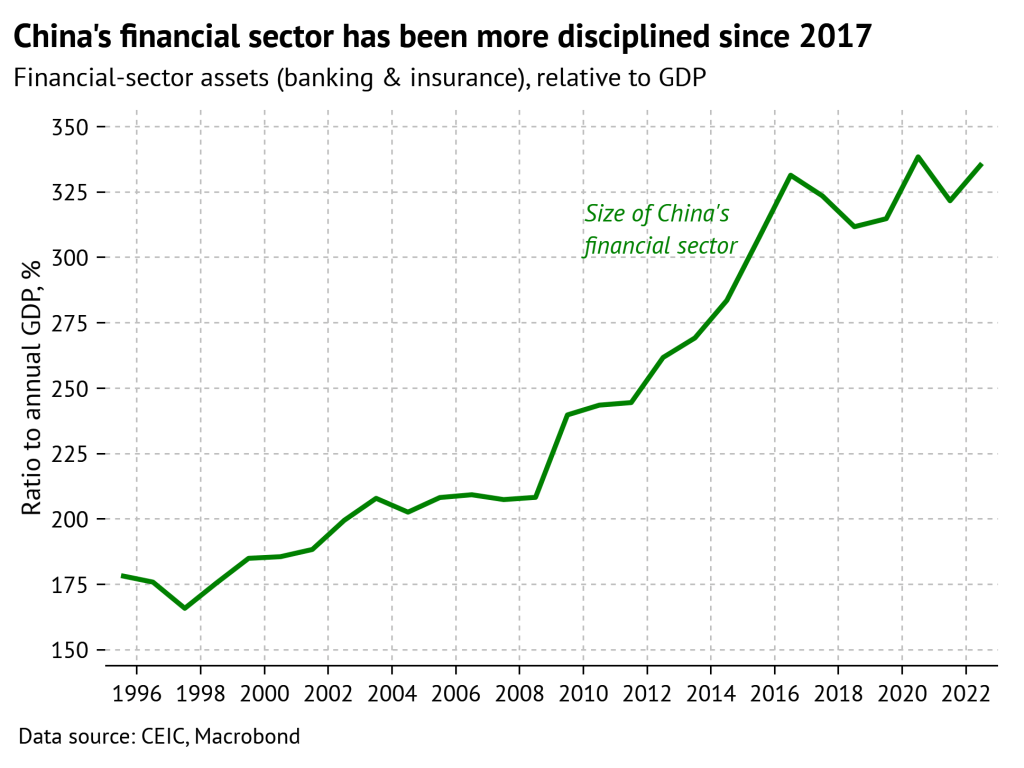
China’s most consequential economic policy of the last several years, aside of course from the Covid lockdowns, was its turn to increased financial discipline. In the decade after the 2008 global crisis, the financial sector had exploded in size, but in 2017 that growth came to, if not quite a halt, then a very obvious inflection point. As the chart below shows, the size of China’s financial sector relative to GDP has been roughly stable since then (the spikes in 2020 and 2022 were due to sharp slowdowns in the growth of the denominator rather than accelerations in the growth of the numerator).

The new direction was signaled at the end of 2016, and then really got going after Xi Jinping made the Politburo attend a study session on financial risk in early 2017. At the meeting he declared that “financial security is an important component of national security,” launching a campaign against financial risk in a way that made it a top political priority rather than a matter of mere technical management. Since then, the government has been remarkably consistent in holding to a tough, conservative stance on monetary policy and financial regulation.

Although no Chinese official would express it this way, essentially what happened in 2017 is that China started doing what the IMF and similar worthies had been telling it to do: control debt, close regulatory loopholes, impose hard budget constraints. This was a pretty unexpected move for Xi, who up until that point had focused his attention more on foreign policy, security issues, propaganda and ideology. It was also a pretty unexpected success for the technocratic types who had been warning about the dangers of rising debt for several years, to little effect.

This episode in Chinese economic policymaking is still not well understood. Why did the people usually identified in the Western press as “market reformers” focus their energy and political capital on this issue of financial discipline? And how were they so successful at getting their agenda adopted at the highest levels? Maybe one day when the principals write their memoirs we will know the real story.

But until then, I have some theories–or, at least, speculations. Even in a top-down system like Xi-era China, major policy decisions usually need buy-in from a range of interest groups. My speculation is that there are two major interest groups that aligned in support of this new agenda of financial discipline.

Let’s call the first group the “reform faction.” These people are indeed concerned that the surge in debt after 2008 has raised the risk of a financial crisis in China. But they also see the easy availability of credit as encouraging the worst features of the Chinese economy: the continued large role of state-owned enterprises, and the corrupt and unhealthy relationship between property developers and local governments. Imposing more financial discipline on these actors will thus help push the economy in the direction of higher productivity and a larger private sector.

Let’s call the second group the “control faction.” Their diagnosis of China’s problems is almost the opposite of the reform faction’s. Rather than seeing easy credit as enabling the dominance of inefficient state enterprises, they see it as enabling the aggressive expansion of corrupt and unaccountable private-sector companies. The huge concentrations of private wealth created by booms in property and the internet undermine China’s governance and challenge the authority of the Party. Imposing more financial discipline on these actors will reduce social and economic polarization and allow for healthier growth.

The ideals of these two factions are almost diametrically opposed. However, both can agree that the lax post-2008 policies caused a lot of problems, and that tighter central control of the financial system will help address these problems. The consensus policy is to impose financial discipline on both the private sector and the state sector, not just one or the other. For me, this model helps account for some of the internal contradictions of the financial crackdown–how it married a seemingly technocratic agenda with a socialist political campaign–as well as for its surprising toughness.

An unholy alliance between the reform faction and the control faction does not sound like an inherently stable configuration. Indeed, the indications are that the balance of interest groups is now shifting. All the top officials who implemented the financial crackdown are headed for retirement due to age. Recent corruption probes have implicated senior officials at the central bank and financial institutions. And the government has just announced a wide-ranging restructuring of the entire financial-regulatory apparatus.

Even if my model is wrong (as it quite likely is), the political economy around financial regulation in China has clearly shifted. Whatever was the actual balance of personalities, interests and agendas that supported the turn to financial discipline in Xi’s second term, it will be different for his third term.

What I’ve been listening to lately

  • Marc Ribot – Plays Solo Guitar Works of Frantz Casseus. Ribot wrote movingly about Casseus, a family friend and his first guitar teacher, in his quasi-memoir Unstrung. The self-described noise guitarist plays these pieces straight, in support of Casseus’ ambition to make a distinctive Haitian contribution to the classical guitar repertoire. They are lovely, rhythmic miniatures.
  • The Temptations – Psychedelic Soul. Obituaries are a sad way to discover new music. In this case Richard Williams’ appreciation of Barrett Strong, who passed in January, led me to the 1968-1972 era of The Temptations and their collaborations with Strong and Norman Whitfield. This work is both extraordinarily creative and sublimely funky; everyone knows “Papa Was A Rolling Stone” but there is so much more great stuff on this collection.
  • Tyshawn Sorey – The Off-Off Broadway Guide to Synergism. This epic live recording topped many best-of-2022 lists, and deservedly so. Drummer Sorey here takes off his avant-composer hat to back his piano trio, and invites elder Greg Osby along for the ride to play standards and modern jazz classics. It’s all absolutely fresh and in the moment.
  • New Kingdom – Paradise Don’t Come Cheap. The golden age of hip-hop in the early 90s was a historic flowering of a new art form: a hundred flowers bloomed, though not all of them lasted. The unique sound of this album had few precedents (their previous album was pretty weak and inconsistent), and was not followed up. But the growled, hallucinatory lyrics atop echoey, bluesy beats still sound intense and compelling.
  • Muhal Richard Abrams – The Hearinga Suite. A sterling example of modern big band music, complex and interesting but not nearly as forbidding as some of Abrams’ earlier, more avant-garde excursions. Abrams deploys the full power of the massed ensemble sparingly, mostly preferring to string together different smaller combinations of instruments. The 1980s-vintage synthesizers now sound a bit dated, but otherwise this music is still remarkably cliché-free.

Re-de-industrialization

China’s government has never been particularly shy about supporting its manufacturing sector, a key engine of growth for decades. Since 2021, though, it has become even more vocal about the importance of manufacturing, officially adopting in its plans the view that manufacturing is a special sector of the economy deserving of special treatment. That view may well be correct, and I have some sympathy for the argument. But the metric the government has chosen to measure its success is likely to prove a disappointment.

A good recent example of the new style of rhetoric around manufacturing is an article published in a recent issue of Seeking Truth, the Communist Party’s theoretical journal, by Jin Zhuanglong, head of the Ministry of Industry and Information Technology (MIIT). It does not break new ground but expresses the current line of thinking quite clearly; here are a few choice passages:

Industrialization is the precondition and foundation of modernization. … For a large country like ours, it will be difficult to achieve the goal of becoming a modernized superpower without a strong and large industrial sector. …

Industry is the main engine of economic growth, and plays a key role in stabilizing the overall macroeconomy. Industry is the main battlefield of technological innovation, it is the sector with the liveliest innovation activities, the most abundant achievements of innovation, the most concentrated applications of innovation, and the strongest innovation spillover effects. According to statistics, industry in the United States accounts for less than 20% of GDP, but 70% of innovation activities rely directly or indirectly on the industrial sector. …

We must hold fast to the real economy, especially the manufacturing sector, consolidate the advantages of a complete industrial system, keep the proportion of the manufacturing sector in GDP basically stable, and avoid the “virtualization” of the economy.

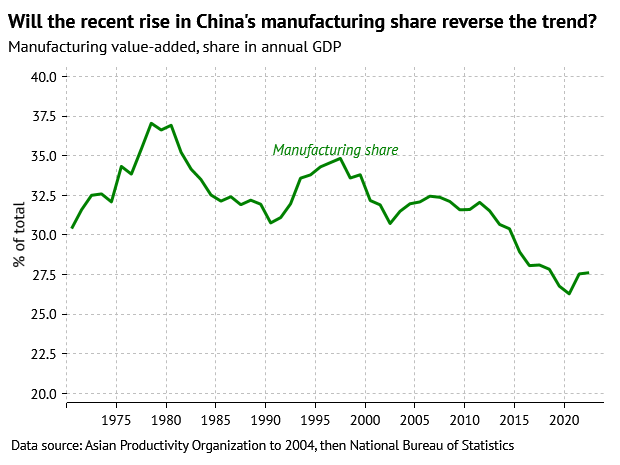
There are a lot of fairly abstract goals outlined in Jin’s article: many things that must be “improved” or “strengthened” in the common parlance of Chinese officialdom. The main one that can be actually measured is the manufacturing share of GDP; the goal of keeping that ratio “basically stable” was written into the 14th five-year plan.

That mandate is why, in the MIIT’s annual work conference in January, Jin proudly reported on the rise in the manufacturing sector’s share of GDP in 2022, to 28%. Such a shift in China’s economic structure is indeed a notable event, reversing a multi-year decline in the relative (not absolute) size of the manufacturing sector, which was over 30% of GDP as recently as 2014. But most of the change happened in 2021, when there was a simultaneous boom in both export manufacturing and in domestic demand, driven by property.

The property boom deflated in dramatic fashion in 2022, with historic declines in construction indicators. And while exports started off strong, by the end of the year they were declining, as China’s major export markets scaled back their spending on goods favored during the pandemic (furniture, electronics). The increase in the manufacturing share for the year as a whole was small, and higher-frequency data show it had actually begun declining by the end of the year.

China’s economic growth is universally expected to accelerate in 2023 thanks to the lifting of Covid restrictions, but a repeat of the 2021 manufacturing boom looks quite unlikely. Real-estate construction could pick up some, and with it demand for manufactured goods like steel, cement, and machinery, but a return to the boom years is not in the cards. While consumer spending in the US is solid, spending patterns are shifting to be less favorable to China (more services, fewer goods). A similar shift is likely to unfold domestically, with consumers splurging on the services, like travel, they have not been able to fully enjoy for three years.

It looks quite probable that manufacturing will lag rather than lead overall economic growth in 2023, resulting in a lower share of GDP. That may be why, at the latest MIIT work conference, stability in the manufacturing share was not mentioned as a specific goal for 2023, which it was for 2022 and 2021. There’s no point in emphasizing goals that are unrealistic.

Looking beyond the peculiar circumstances of 2023, I think it’s more likely than not that de-industrialization, meaning the decline of the manufacturing share of GDP, will resume. Rather than being an indication of the hollowing-out of the Chinese economy, as policymakers seem to fear, such continued structural change would probably be a fairly normal and neutral development.

The success of manufacturing in raising incomes in China naturally leads to some relative decline: as households’ incomes rise they tend to spend more on services, while at the same time Baumol’s cost disease raises the relative prices of services over time. Neither of those trends threatens the international competitiveness of Chinese manufacturing.

The manufacturing share of GDP stayed unusually high in China for decades in part because of typically socialist economic distortions: repressing consumer spending to channel investment into industrial capacity. Trying to maintain such distortions to prevent natural structural change could be quite costly in what is now a much larger, more marketized and globally integrated economy.

To really prop up the manufacturing share in an economy of China’s size would probably require extending the housing boom even further, or consistently undervaluing the currency, neither of which sounds like a great idea. My best guess is that China’s government won’t be able to stop a renewed decline in its manufacturing share of GDP, and, despite its rhetoric, won’t seriously try to.