David Moser recalls the early days of the Chinese jazz scene

David Moser’s piece at The Anthill, “The Book of Changes: twenty-five years in Chinese jazz” is truly delightful and a must-read. Here is one excerpt:

One striking characteristic of Chinese jazz musicians was their uniform reverence for Miles Davis. Almost to a person they preferred the spare, cooler style of Miles to the rapid pyrotechnic displays of other jazz artists. They pointed to his use of empty space and understatement, “saying more with less”, all preferences that, it seemed to me, had a resonance with Chinese visual arts. The best selling jazz album of all time is Miles’s classic Kind of Blue. In the liner notes to the album, pianist Bill Evans compared jazz improvisation to the art of calligraphy. I remember at the time thinking that it was a gratuitous comparison, a trendy invoking of Oriental exoticism. But it turned out my Chinese musician friends also saw commonalities in the two disciplines. The calligrapher, like the jazz artist, spends a lifetime mastering the basic forms in preparation for a spontaneous moment of creation, during which the artist must act in a non-deliberative way to produce one continuous, expressive “line” – for the calligrapher in space, for the jazz player in time – without the option of revising, restarting or rethinking. Each time the result is a unique form reflecting the artist’s mental and emotional state at that moment. Miles’s philosophy of jazz seemed to echo centuries of Chinese aesthetics. He famously told his sidemen, “Don’t play what’s there, play what’s not there.” If that’s not Daoism, what is?

And another:

Our group played nearly every Saturday for four years. The audiences were small but attentive, and I enjoyed the barrage of questions we received after. Puzzled by the long improvised solos, people asked me “How are you musicians able to memorize all those complicated melodies?” I told them that the music was completely ad-libbed, not memorized. “Well, without a score, how can you tell a wrong note from a right one?” Indeed. Or, “If the music is all improvised, then why bother to practice?” And, “How come the trumpet and saxophone all seem to take turns playing, while the drums, bass, and piano play all the time? They should be paid more!”

Many thanks to David for writing all this down. There are also a couple of nice photos showing some musical luminaries in their awkward youth.

Will the New Silk Road be smooth or bumpy?

I feel like too much of the media coverage of China’s New Silk Road initiative (the official slogan is the rather unfelicitous “One Belt, One Road“) focuses on explaining and understanding the intended consequences: What is China’s plan? How much money is it going to spend? How much influence will it win? etc etc. This is understandable, since the whole program is apparently large, probably important, and rather confusing. But now that the basic outlines are increasingly well understood (China wants to spend a lot of money on infrastructure projects in developing countries to boost its geopolitical influence and swell the order books of its SOEs), I think we should put more effort into understanding the potential unintended consequences. After all, if there is any lesson about China’s ambitions that we can learn from history, it is that large amounts of foreign capital flowing into smaller economies can have many unintended consequences.

Using a simple but surprisingly useful rule of thumb–China is like Japan but a few decades later and ten times bigger–we can look to Japan in the early 1970s for some interesting parallels. Japan’s outward investment only really started to take off in the early 1970s, as exchange controls were relaxed and the first wave of resource-driven projects was succeeded by projects aimed at developing markets for Japan’s manufactured goods (sound familiar yet?). The major destinations for its FDI were Europe, North America, and Southeast Asia, and among Asian countries none received more Japanese investment than Indonesia. But the Indonesians did not perceive this as an unequivocally good thing, and in January 1974 a visit by prime minister Kakuei Tanaka sparked massive demonstrations. The so-called Malari riots ended up being a very consequential event for Indonesia, as they sparked a domestic political reshuffling and a turn toward policies favoring local businesses:

Unhappiness over rising food prices, rice shortages, and the growing power of Suharto’s personal assistants had been stewing for more than a year. The number of business ventures undertaken by Chinese businessmen with high-ranking military men continued apace, and it was apparent that the president was clearly taking no action at the widespread corruption. At the same time, foreign capital was flowing in, most obviously by the Japanese, who were courted by Suharto’s financial advisors.

The Japanese had been taking a more high-profile role in the country, providing up to one-third of Indonesia’s foreign economic assistance. An academic noted: Japanese aid was “large and visible, and that much of it was tied to the purchase of goods manufactured in Japan was widely known and criticised. It was assumed…that the principal aim of the aid was to develop markets for Japanese products.” The growing presence of the Japanese in Indonesia sparked resentment against the influx of foreign capital. The fact that many Japanese firms partnered Chinese businesses in ventures gave critics added fuel.

The events are covered in all standard histories of Indonesia; the quote above is from the recent book Liem Sioe Liong’s Salim Group: The Business Pillar of Suharto’s Indonesia, by Richard Borsuk and Nany Chng (an incredibly impressive piece of research about how business and politics actually worked in Indonesia during this period). Of course, the riots were really about domestic political issues, and divisions among the Indonesian elite and between ethnic groups were probably the most significant factor for how the consequences played out. But the protesters were also not imagining things: Japan was putting a huge amount of money into Indonesia, for a while as much as it was putting into all other Asian countries combined.

Japan-FDI-into-Asia

The point is a simple one: big inflows of foreign capital can interact with domestic political issues in highly unpredictable ways.

Alternate economic histories: What if China had not been united?

On a long plane flight I read Philip T. Hoffman’s Why Did Europe Conquer the World?, an admirably clear and concise entry in the genre of big-idea books explaining European dominance. Though there are lots of interesting historical tidbits in the book, Hoffman is mainly trying to present a model that explains why Europeans could conquer so many other peoples. Europeans won because they had better guns (really a shorthand for a whole complex of military technologies), and they developed better guns because they fought a lot with other states that also had guns, and consistently invested lots of resources in making their guns better. This model clearly comes out of the literature on the “fiscal-military state,” the argument that one of the most important elements in Europe’s modernization was the ability of European states to effectively raise money to fight wars.

Hoffman is good at avoiding value judgments, and he never argues or implies that Europeans won because they were more virtuous or innovative or freedom-loving. Indeed you could say that his model shows that “good” states (large, well-governed, peaceful) loose out in the long run to “bad” states (small, chaotic, warlike), because the “bad” states tend to get better at warfare over time. (Large states do not fight frequent wars because their smaller neighbors are usually not foolish enough to think they can attack and win.) The clarity of his model also allows him to make good comparisons, and to think through counterfactuals very logically; see here for an excellent discussion of how Hoffman embraces the idea of historical contigency–that things could easily have turned out differently.

For today’s reading, here is an excerpt where he uses his model to think through an alternate historical path for China. Hoffman’s model leads him to conclude that a large, relatively peaceful state that spends most of its military energy fighting off annoying nomad attacks (eg, China) will end up militarily disadvantaged relative to smaller, more warlike states that frequently fight with near-equals (eg, Britain). Therefore it is logical for him to ask what would have happened if China had been smaller and less peaceful? You may not agree with the conclusions, but the thought process is interesting. The point of departure for his alternate history is that the Mongols do not conquer (and thereby unify) China in the thirteenth century:

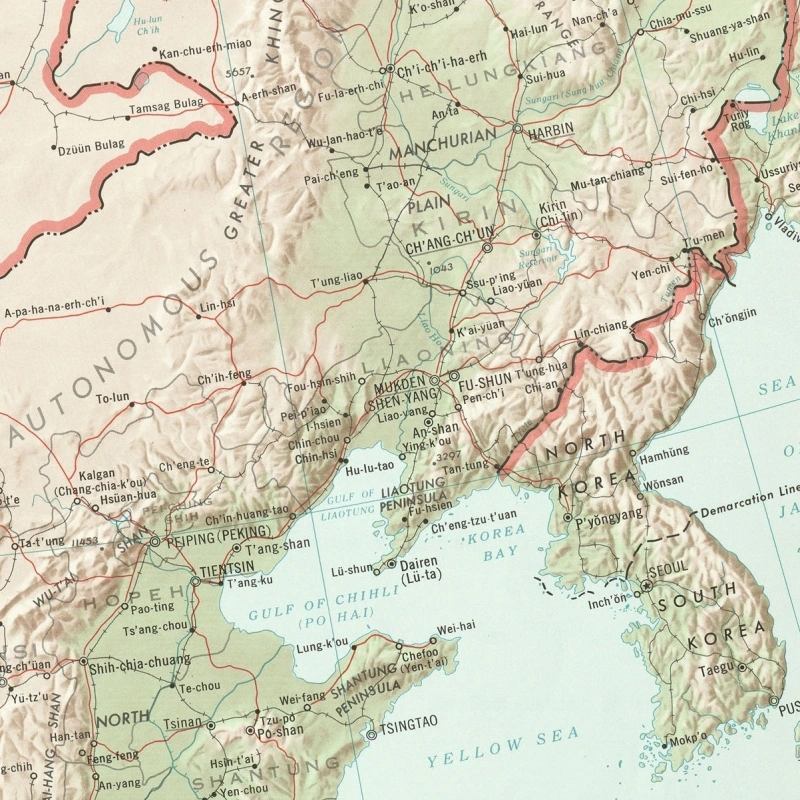
In the early thirteenth century, before the Mongols took over, East Asia was split into three hostile powers locked into a military equilibrium: the western Xia and the Jin to the north, and the southern Song to the south and along the coast. If the Mongols had not shattered this equilibrium (and no other nomadic mega-empire had taken their place), then China might well have remained divided, and the southern Song would have continued to prosper.

Eurasia around 1200 AD, before the Mongol conquests

Since fighting with the western Xia and the Jin would not have stopped, the southern Song would have persisted in developing their commercial taxes and their navy, which had helped them survive a Jin invasion and would have protected both inland waterways and their coastal capital. Over time, one could easily imagine merchant elites in prosperous southern Song cities lobbying (like their mercantile counterparts in western Europe) for a powerful oceangoing navy to protect their burgeoning overseas trade. Gunpowder had been put to military use in China since the tenth century, with the southern Song and the Jin wielding it against one another in their wars and along the way developing gunpowder bombs and what was likely the first fire lance, an ancestor of the modern gun. Without a Mongol conquest, the southern Song and their opponents would have continued to push the gunpowder technology forward, probably even further than the southern Song did in fighting the Mongols. …

What would the outcome have been? Militarily, the southern Song state would have been large by European standards, and it would not have been free of threats from nomads. Hence the southern Song could not have specialized in the gunpowder technology: like the Ottomans and the Russians, they would have had to divide their resources between the gunpowder technology and the older means of dealing with nomads. But they would not have been a hegemon, and with their substantial commercial tax revenues, they could have spent more on the technology and so pushed it further than the Ming or the Qing ever did, all the more so since the Ming and Qing emperors themselves were often (though certainly not always) hegemons too. And since it would have been much easier for southern Song merchants to establish maritime trading centers abroad, the southern Song (like the Russians) would have had less trouble buying the latest version of the technology from western Europeans, should they ever find themselves lagging behind. The end result would likely have been a much stronger state by 1800, one that might have held off the Europeans and the Japanese in the nineteenth century, or at least negotiated with them on more equal terms. …

Would China have also industrialized faster? One might think that seaborne trade would have encouraged industrialization, but there was too little of it to have much of an effect in state as big as the southern Song. And China would still lack England’s cheap coal, or so historians who focus on energy costs would argue. Yet one could imagine a different path to industrialization, one based on a textile industry like that found in the early United States. It would not require cheap coal, although China did have coal deposits, because coal’s importance for industrialization has been exaggerated. In this scenario, the ongoing warfare would have already drawn manufacturing into fortified cities along the coast, raising urban wages and creating concentrations of manufacturing that would help spread new technology. In the long run, industrialization would follow…

Such a southern Song China might not have been the first to industrialize, but it would likely have joined Japan, the United States, and continental Europe in having an industrial revolution not in the twentieth century, but in the 1800s.

The political history of China’s economic growth targets

Growth targets are back and stronger than ever in China’s next Five-Year Plan, for 2016-2020. The plan itself is not finalized–the government has just published its “suggestions” for the final document–but it is pretty clear that the main thrust has already been decided. One of the most striking points in the official narrative is the strong emphasis on maintaining a high rate of GDP growth; to me, unrealistically high. Previously, there had been much discussion about abandoning the GDP growth target in the five-year plan, or replacing them with other indicators more directly related to household welfare (maybe China could even do something crazy like target inflation and unemployment). In the event we seem to have an even stronger emphasis on growth targets–the question is why? To start with, here’s Xi Jinping himself explaining the plan (my translation from the Chinese):

The draft suggestions put forth a goal of maintaining medium-high speed economic growth for the next five years. The main consideration is that in order to achieve the goal for 2020 of doubling our 2010 gross domestic product and per-capita rural and urban incomes, we must maintain the necessary growth rate. In order to double GDP, the bottom line for the average economic growth rate for 2016 to 2020 is 6.5% or higher. … Major domestic and foreign research organizations all think that in the Thirteenth Five-Year Plan period our country’s potential economic growth rate is 6-7%. Taking everything into consideration, it is possible for our country to maintain growth of about 7% in the future, but there are numerous uncertain factors.

It’s interesting how Xi presents the growth target as just a necessary consequence of another, more important goal: doubling 2010 GDP by 2020. And indeed there is no problem with his arithmetic: given how much the economy has grown since 2010, to double that level in 2020 requires annual growth of at least 6.5% after 2015. The GDP-doubling target is itself the specific expression of a general slogan: to make China a “moderately prosperous” (xiaokang) society by 2020. Xi has emphasized this target as one of his “two centenary goals“: achieving prosperity by the 100th anniversary of the Party’s founding in 2021, and achieving modernization and national revival by the 100th anniversary of the founding of the People’s Republic in 2049. Official propaganda under Xi has made a big deal out of these two centenary goals, but in fact they are not that new, and indeed were inherited from previous leaders. Xi’s immediate predecessor, Hu Jintao, said in his speech to the 18th Party Congress in 2012:

We need to have a correct understanding of the changing nature and conditions of this period, seize all opportunities, respond with cool-headedness to challenges, and gain initiative and advantages to win the future and attain the goal of completing the building of a moderately prosperous society in all respects by 2020. Basing ourselves on China’s actual economic and social development, we must work hard to meet the following new requirements while working to fulfill the goal of building a moderately prosperous society in all respects set forth at the Sixteenth and Seventeenth National Congresses of the Party. The economy should maintain sustained and sound development. Major progress should be made in changing the growth model. On the basis of making China’s development much more balanced, coordinated and sustainable, we should double its 2010 GDP and per capita income for both urban and rural residents.

But as Hu emphasized, this was not a goal that he came up with himself–it was one set by his predecessor Jiang Zemin. In 2002, at the 16th Party Congress, Jiang said:

An overview of the situation shows that for our country, the first two decades of the 21st century are a period of important strategic opportunities, which we must seize tightly and which offers bright prospects. In accordance with the development objectives up to 2010, the centenary of the Party and that of New China, as proposed at the Fifteenth National Congress, we need to concentrate on building a well-off society of a higher standard in an all-round way to the benefit of well over one billion people in this period. … On the basis of optimized structure and better economic returns, efforts will be made to quadruple the GDP of the year 2000 by 2020, and China’s overall national strength and international competitiveness will increase markedly.

This was actually a more precise formulation of the growth goal than Jiang had given previously. Here is what he said at the 15th Party Congress in 1997:

Looking into the next century, we have set our goals as follows: In the first decade, the gross national product will double that of the year 2000, the people will enjoy an even more comfortable life and a more or less ideal socialist market economy will have come into being. With the efforts to be made in another decade when the Party celebrates its centenary, the national economy will be more developed and the various systems will be further improved. By the middle of the next century when the People’s Republic celebrates its centenary, the modernization program will have been accomplished by and large and China will have become a prosperous, strong, democratic and culturally advanced socialist country.

There you have it: the original formulation of Xi’s two centenary goals was actually made in 1997. But it is also clear that the history goes back even further, as those goals were very directly inspired by a previous declaration from Deng Xiaoping himself, in remarks on April 30, 1987:

Our goal for the first step is to reach, by 1990, a per capita GNP of US$500, that is, double the 1980 figure of $250. The goal for the second step is, by the turn of the century, to reach a per capita GNP of $1,000. When we reach that goal, China will have shaken off poverty and achieved comparative prosperity. When the total GNP exceeds $1 trillion, the national strength will increase considerably, although per capita GNP will still be very low. The goal we have set for the third step is the most important one: quadrupling the $1 trillion figure of the year 2000 within another 30 to 50 years. That will mean a per capita GNP of roughly $4,000 — in other words, a medium standard of living. That target may not seem high, but it is a very ambitious goal for us, and it won’t be easy to achieve.

We are now confident that we can attain our first goal ahead of schedule, this year or next. That doesn’t mean it will be easy to reach the second goal, but I think we can do it. Our third goal will be much harder to reach than the first two. Our experience over the last eight years or so shows that the road we have taken is the right one. But it is only after the third step that we shall really be able to show the superiority of socialism over capitalism — that’s something we can’t prove at the moment. We shall have to work hard for another 50 or 60 years. By then, people of my age will be gone, but I have no doubt that the younger generations will reach the third goal.

(Deng also made a slightly different statement of those goals on April 26 of the same year). This formula became known as the “three-step” development strategy, and Jiang’s version in 1997 as the “new three steps.” Deng also originated the term xiaokang, now conventionally translated as “moderately prosperous,” which he chose to convey a modest aspiration for ordinary people to have a better life.

This historical context makes it easier to understand why these GDP targets are politically so important: they are a way by which successive Chinese leaders have tied themselves to the legacy of Deng Xiaoping, and thereby increased their own legitimacy. By saying he is committed to the goal of doubling GDP by 2020, Xi Jinping makes it clear that he is carrying on the weighty tasks undertaken by his predecessors, and is continuing the great legacy of the Communist Party. In other words, there is no real economic justification for picking a certain rate of GDP growth to target; it is all about the political symbolism (all that stuff you read about China needing to grow 7% a year to prevent social unrest is total nonsense).

This kind of political symbolism was a mostly harmless feature of Chinese politics in earlier years, because the growth potential of the economy was so high that setting these arbitrary growth targets had little impact on actual economic policy. Until very recently, there has rarely been a year in which actual GDP growth did not exceed the target by a wide margin. China’s problem now is that its growth potential is declining, and failing to meet the growth targets has become a real risk (indeed, a near-certainty). Reformers in Deng’s day promoted fast growth as a way to break free of the legacy of the planned economy; in today’s China, reformers worry that targeting fast growth creates too many costs, environmental and otherwise, and gets in the way of structural changes that would improve welfare over the longer term (even if few are willing to publicly challenge the view that potential growth is still 7%). So the growth targets for 2016-2020 will have a greater and more malign influence on policymaking, because they will start to actually affect decisions on a regular basis.

growth-targets

Was it inevitable for China to end up in this trap, where it is held hostage to unrealistic growth targets inherited from previous generations of political leaders? Of course not. If you look at Deng’s original formulation, it was quite vague about the longer term: he did call for quadrupling the GDP of 2000, but said it might take anywhere from 30 to 50 years. When Jiang initially set his goal for the Party’s centenary in 2021, he did not say that GDP had to exactly quadruple by that date, only that it should rise substantially. It was only later on that Jiang formalized the goal into a quadrupling of GDP over the 20-year period. Even then, his successors could have easily shifted the rhetoric: for instance, retaining the goal of achieving “moderate prosperity” by 2020, but dropping the precise definition in terms of GDP. But China’s leaders have been so desperate to gain the political legitimacy that comes from a link to Deng’s legacy that they have been unable to make even such modest changes.

Rocket scientists, secret cities and runaway brides: the stories behind the one-child policy

mei-fong-one-child

Congratulations to my old friend and colleague Mei Fong, whose new book One Child is out just in time to mark China’s transition out of the one-child policy era into the new two-child policy. It’s not a dry piece of demographic analysis, but has vivid and heartfelt reporting that digs out the many fascinating stories behind the slogans. The rocket scientists who designed the policy, the town where a two-child policy was pursued in secret, the personal stories of officials who enforced the policy–it’s all here. Plus there are close-up views of the complexities of sex, fertility and family in today’s China: we see rural villages empty of women, visit sex doll factories and hospices, meet surrogate mothers and adopted children. The ebook is out now, print edition coming in January.

Propaganda for propaganda

I’ve been noticing the neighborhood propaganda billboards a lot more of late–perhaps because there are more of them in the neighborhood I’ve been living in for the past year compared to previous places I’ve lived in Beijing, perhaps because the propaganda campaigns are just more intense these days. But this one really caught my eye today: it’s part of the inescapable campaign for the “socialist core values” about which the less said the better (the four values promoted in this particular one are freedom, equality, fairness and rule by law). What I like about this one is that it’s a propaganda billboard featuring people reading a propaganda billboard; in other words it’s propaganda aimed at getting you to view more propaganda. That’s pretty self-referential for a propaganda campaign that otherwise demonstrates very little self-awareness.

propaganda800

The Russian origins of Chinese economic reform

DXP   

One of the more interesting arguments in Pantsov and Levine’s new biography of Deng Xiaoping is that China’s post-1978 economic reforms should be understood not as a rejection of Soviet-style Communism, but as a development of a different tradition of economic thought within Communism. Specifically, they argue that many of the features of the 1980s reforms were directly inspired by the “New Economic Policy” practiced in Soviet Russia in the mid-1920s. Here’s what they say in the introduction:

The theory of reform and opening that Deng developed several years after Mao’s death, in the late 1970s and early 1980s, did not originate with him. It was rooted in the Russian Bolshevik Nikolai I. Bukharin’s interpretation of Lenin’s New Economic Policy aimed at developing a market economy under the control of the Communist Party. Deng studied this concept in the mid-1920s in Moscow during his sojourn as a student at a Comintern school and began implementing it as soon as he solidified power.

The central idea of the NEP, so far as I can make out, was to back away from full-scale state ownership and planning, and allow market transactions and some private enterprise in the context of an economic system still dominated by the Communist Party. This is indeed pretty much the formula that Deng pursued after he came to power. And of course Deng, who studied in Moscow during the period of the NEP, would have been well aware of these ideas. He even mentioned the NEP in passing in August 1985 in a conversation with Robert Mugabe:

What, after all, is socialism? The Soviet Union has been building socialism for so many years and yet is still not quite clear what it is. Perhaps Lenin had a good idea when he adopted the New Economic Policy. But as time went on, the Soviet pattern became ossified. We were victorious in the Chinese revolution precisely because we applied the universal principles of Marxism-Leninism to our own realities.

Pantsov and Levine somewhat misleadingly paraphrase this quote as Deng saying that “he openly acknowledged that ‘perhaps’ the most correct model of socialism was the New Economic Policy of the USSR.” Part of what Pantsov and Levine are trying to do with this, as in much of their book, is to counterbalance some of the hagiography of Deng and cut his historical status down to size. But I’m not sure how much difference it makes to our evaluation of Deng where he got his ideas from–everybody gets their ideas from somewhere, and we usually expect national political leaders to be good decision-makers rather than original intellectuals (that’s a staff job). And it was common for many of China’s early economic reforms to be justified by references to canonical Communist texts (here’s another example), which made them easier to digest.

Nonetheless, it is clear that there was a groundswell of interest in Bukharin and the NEP during the early reform period, an interesting phenomenon of which I was previously unaware:

In 1981 Chinese scholars began publishing their own articles on Bukharin. Over a period of two years, no fewer than thirty-six articles appeared in various PRC journals on his life and works. One of the first articles, by the historian Zheng Yifan, a 1959 graduate of Leningrad University, which was published in the first issue of Shijie Lishi (World History), caused quite a stir. Zheng flatly stated that Bukharin was a Marxist theorist and economist, and that everything Stalin had said about him was false. In this connection, he noted in particular the truth of Bukharin’s slogan addressed to Russian peasants: “Enrich yourselves, accumulate, develop your farms.” Understandably, he did not compare this slogan with Deng’s well-known idea that it was good to be rich, but everyone knew what he meant. Naturally, the majority of articles addressed Bukharin’s economic views. Chinese social scientists recognized that they “were relevant today.” They appreciated Bukharin’s acknowledgment that socialism in the USSR was “backward in form,” his defense of prosperous peasants, his insistence that the growth of industry directly depended on the growth of agriculture, his support of the harmonious combination of planned and market regulations, and his recognition of the important role of the law of value in commodity-financial relations under socialism.

This context also I think helps us better understand the changing ideas about the economy in the first half century of the People’s Republic. The long struggle over economic policy in China was clearly not one between proponents of the planned economy and backers of a Western market economy. It makes much more sense to see it as a battle among Communists over competing interpretations of Marxism-Leninism.

Andrew Walder’s recent book China Under Mao: A Revolution Derailedwhich I highly recommend, argues that Mao’s economic policies in the 1950s were based on an early and extreme interpretation of Marxism-Leninism. But Mao’s ideas were already viewed as outdated by other Communist states, who were already moving toward a less rigid version of the planned economy. Deng Xiaoping, and other figures such as Chen Yun, were clearly part of a different tradition within Communism that was less strictly ideological and more concerned with improving living standards. Deng and other reform-era leaders were not Western liberals in disguise working secretly within the system; they were committed Communists who argued for the superiority of their version of Marxism.