Can China deliver a consumer-focused fiscal stimulus?

Ben Bernanke has weighed in with an interesting intervention on China, arguing that fiscal policy targeted at household consumption could offer a way out of the current economic problems:

An alternative worth exploring is targeted fiscal policy, by which I mean government spending and tax measures aimed specifically at aiding the transition in China’s growth model. (Spending on traditional infrastructure like roads and bridges is not what I have in mind; in the Chinese context, that’s part of the old growth model.) For example, as China observers have noted, the lack of a strong social safety net—the fact that Chinese citizens are mostly on their own when it comes to covering costs of health care, education, and retirement—is an important motivation for China’s extraordinarily high household saving rate. Fiscal policies aimed at increasing income security, such as strengthening the pension system, would help to promote consumer confidence and consumer spending. Likewise, tax cuts or credits could be used to enhance households’ disposable income, and government-financed training and relocation programs could help workers transition from slowing to expanding sectors. Whether subsidies to services industries are appropriate would need to be studied; but certainly, unwinding existing subsidies to heavy industry and state-owned enterprises, together with efforts to promote entrepreneurship and a more-level playing field, would be constructive.

There are a few things to say about this. First and to be clear, I agree. It would generally be a good thing to switch fiscal priorities from off-budget spending on infrastructure to on-budget spending that supports consumption. But that’s part of the problem: people have been giving China this particular bit of advice for years. And in fact the government has not ignored this advice, and has steadily raised spending on social programs (universal healthcare coverage was more or less achieved in 2011).

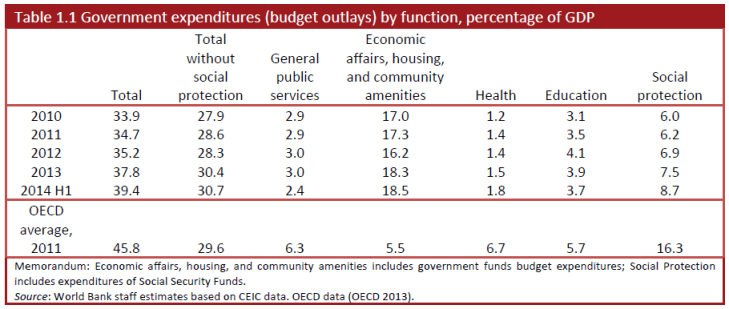
Of course, China could do still more. But it may not be that simple for them to do a lot more than they are already doing. China has a fiscal system that is strongly biased toward delivering investment rather than streams of benefits to consumers. It’s worth stopping to think for a bit about just how unusual this is, as most governments around the world are the exact opposite: they are primarily bureaucracies for delivering social programs, not designing investment projects. The World Bank office a while back made a fascinating comparison of China’s fiscal spending patterns with those of OECD countries. The results are summarized in the excerpt and table below:

A large share of government spending supports capital expenditures in transport, housing, and other economic activities, as gaps in providing core public services remain wide. While the size of government expenditures (public finance budget, government fund budget, and social security budget) remains similar to the OECD average, the composition of expenditures differs substantially. First, spending on general public services is under half the OECD average. It is declining due to continuing efforts to reduce wasteful public outlays: in the first half of 2014 it accounted for only 2.4% of GDP, down from 3.0% in 2013. Second, despite gradual increases, expenditures on social services (health, education, and social protection) are far lower than in the OECD countries. Third, outlays on economic affairs, housing, and community amenities are about three times as high as the OECD average.
China-OECD-WB-fiscal

Note that this bias toward investment spending is very strong in the official government budget–even before any of local governments’ massive off-budget spending on infrastructure is accounted for. So while I don’t think it’s wrong to urge China to shift the composition of its fiscal spending, I also think it’s important to recognize that this might be difficult to do quickly. They have a set of institutions and priorities that are well established and deeply rooted, and making a big shift in those would require both a different way of thinking and extensive practical changes. It’s certainly not impossible, but it’s also not easy.

A final point is that even if they do move to a consumer-focused fiscal stimulus, it might not deliver that much net impact on growth. This is simply because of the size of existing infrastructure-based fiscal stimulus: the IMF estimates that once off-budget local government spending is included, the annual fiscal deficit is on the order of 10% of GDP (compared to an on-budget deficit of 2-3%). Given the already-huge size of infrastructure spending, it seems more likely that consumer-focused spending would replace it rather than add to it over time. This would be a good way to soften the impact of reducing infrastructure spending; it also seems likely that the multipliers from a consumption stimulus would be higher than infrastructure spending at this point, as infrastructure is probably reaching diminishing returns. But expenditure-switching seems more like a strategy for allowing China to wind down its enormous fiscal deficits than one for delivering a lot of additional fiscal stimulus.

Why are Chinese policymakers so fixated on Japanese toilet seats?

The saga begins almost exactly a year ago, when the press was filled with stories of Chinese tourists to Japan returning laden down with fancy Japanese toilet seats. For anyone who has ever actually used one of these wonderful Japanese devices, there is no mystery at all why you might want one in your home. But the story apparently struck a nerve, and the local press, loath to pass up a Japan-bashing opportunity, repeatedly chided Chinese for not buying the domestic varieties. Premier Li Keqiang was even asked about the issue in a public forum; his reported comments were pretty balanced, praising the wide variety of choices that Chinese consumers have but also expressing hope that domestic companies could make products just as good. All pretty standard stuff, and it seemed like one of those little media storms that would simply die down on its own.

But no. The Japanese toilet seat meme has only grown stronger and more powerful. The propaganda campaign around Xi Jinping’s latest economic slogan–“supply-side reform”–has embraced the tale of the Japanese toilet seat as one of its main talking points. Since it was officially launched in December, the media blitz on “supply-side reform” has become inescapable. Famous Chinese economists now repeatedly invoke the Japanese toilet seat. Foreign journalists in Beijing are getting a steady stream of briefings from government officials and/or scholars explaining to them why the new mantra of “supply-side reform” is so great. The Japanese toilet seats come up every single time. I can also testify that the Japanese toilet seats have come up in every private conversation I have had about this “supply-side reform” slogan.

The Economist made a valiant recent attempt to explain this new Chinese concept of “supply-side reform,” though the article ends up describing the ideal program of some liberal economists rather than the actual plan adopted by the government (there is so far little indication that it has anything to do with Reagan or Thatcher). Which is understandable since it is hard to see many changes in actual policies that have resulted from the supply-side sloganeering. But taken on its own terms, the rhetoric of “supply-side reform” argues that the current problems of the Chinese economy arise not from a deficiency of demand, but from a failure of companies to adapt to the changing structure of demand. Here is one official explanation (my translation):

In recent years, the fact that Chinese people are traveling abroad to buy toilets, rice cookers and other appliances has become a hot topic, and has even disturbed the Premier. All these changes reflect the new changes in people’s demand for consumer goods: the demands of our people are changing, upgrading, with demand for high-quality consumer goods increasing. The production capacity that has formed over the years is no longer adapted to this changed demand: there is too much ineffective supply and not enough effective supply. For example, on the one hand the price of steel has fallen so that it costs the same as cabbage, while on the other hand we still need to import ballpoint pens.

(There is a variation on the theme that uses ballpoint pens rather than Japanese toilet seats as the example of alleged Chinese inferiority.) There is some surface plausibility to this account–who would deny that China’s state-owned enterprises are not adapting very quickly to changing economic realities? But as the ever-acerbic Yu Yongding pointed out in a recent interview, the concept of a shortage of “effective supply” makes absolutely no sense as a macroeconomic diagnosis of China today. If there is really not enough supply, then China should be experiencing trade deficits and inflation; instead it has a rising trade surplus and almost no inflation. My translation:

The meaning of insufficient effective demand is very clear. What is the meaning of insufficient effective supply? It seems to mean “selling the wrong things”: no one is buying the stuff that is being produced, and the stuff that people are buying has not been produced. …If there is insufficient supply, whether it is “effective” or “ineffective”, prices should rise. However, what we see is 46 consecutive months of negative growth in the PPI, and the GDP deflator going from positive to negative. It is very difficult to explain these phenomena as “insufficient effective supply.” Again, if we look at the most serious case of excess capacity–the steel industry–we see that the prices of steel products have fallen sharply and profits are shrinking. But it is obvious that this is caused by insufficient demand rather than “insufficient effective supply.” If there is insufficient effective supply of a product, then the price of this product should rise. I ask you: what products are these exactly?

So the example of the Japanese toilet seat is indeed very telling, but probably not for the reasons the officials who invoke it seem to think. To look at Chinese people buying this thoroughly Japanese product and see a woeful tale of domestic industrial failure betrays a particular kind of mindset–one that takes autarky as the norm and views trade as a form of weakness. The thinking seems to be that the economy can be rescued by redirecting to domestic companies the money that Chinese consumers spend on their vacations abroad. It’s hard to imagine any of the Western economists who would call themselves supply-siders making such an argument.

The Japanese toilet seat is in fact a perfect example of why you want to have trade in the first place. Japanese people , for their own reasons, have developed this unique tradition of extremely complex and comfortable toilet equipment. Instead of having to replicate the whole variety of cultural and institutional factors that led to Japan’s development of super-luxurious toilets, Chinese consumers who want a more pleasant bathroom experience can just buy one. It’s less about Japanese goods being superior to Chinese goods, and more about Japanese goods being different from Chinese goods.

One of the most interesting things about this whole “supply-side reform” push is how skeptically it has been received. Proponents of the “supply-side” slogan–a term that clearly pays homage to Western free-market ideology–are having to repeatedly fend off charges that they are plotting the return of central planning by another name (see this long piece in the People’s Daily). Perhaps they do not understand that the stories they tell about the Chinese economy are part of the reason those suspicions arise. The obsession with the Japanese toilet seat does not show a sincere desire to rid the economy of regulatory distortions, but rather a distrust of trade and market outcomes and a conviction that the bureaucracy knows better.

Is China’s slowdown really so hard to understand?

I have to confess to some frustration with some of the recent commentary on China coming from academic economists. Usually I value the perspectives from the academy as helping draw some needed attention to longer-term issues and away from the short-term noise that dominates the media and financial-market debates. But I think on China there is a tendency for some people to look past “simple” issues like the business cycle and housing in favor of discussing only complicated structural issues. Again, usually I’m all in favor of complex, historically nuanced explanations–but you can go too far with this stuff. Sometimes it’s really not that complicated.

Exhibit A is a survey of “top UK-based macroeconomists” about their expectations for China’s future growth. Many of the economists surveyed expect China’s GDP growth to be lower than 6% for several years, I view I agree with. The survey also asked for economists to give the reasons why they expect this slower growth, and here is what they came up with: “less space for catch-up growth,” “adverse demographic dynamics,” “problems in the financial sector,” “diminishing flows of rural-urban migrants,” “the ‘intentional’ rebalancing from high-growth industry to moderate-growth services,” “risks from ‘secular stagnation’ in developed economies.”

Exhibit B is a recent piece by Jeffrey Frankel, in which he lists no fewer than six economic forces behind China’s slowdown. Like the respondents to the UK survey, he also cites less space for catch-up growth, adverse demographic dynamics, diminishing flows of rural-urban migrants, and the rebalancing to services, while adding “diminishing return to capital” to the list (he leaves off secular stagnation in developed economies).

What I found amazing about these analyses is that they fail to even mention the most straightforward and direct explanation of why China’s growth is much slower today than it was in say, 2010 or 2007. It’s not like it’s a secret. From about 2003 to about 2010 China had the biggest construction boom of modern times and probably in all of human history. Then in 2011-12 the construction boom ended. That’s it. Really, that’s all you need to know. Well, you might need one more fact: housing and construction account for as much of a third of China’s GDP, once all their indirect linkages to other sectors are considered. I think a housing downturn explains very well the timing, severity and distribution of the economic slowdown that has actually occurred.

The long-term structural explanations favored by many academic economists–like the “middle-income trap,” demographics, etc–by contrast simply do not explain what China has been going through over the past few years. It’s possible that the diminishing return on capital argument is intended as a fancy way of accounting for the obvious downturn in housing investment. But here I have to agree with Michael Pettis when he says that “the deceleration in Chinese growth moreover has been far too rapid to be explained by any normal decline in marginal returns on capital as investment rises.”

As I have previously argued on this blog, the regional pattern of the slowdown is in fact very important. If China were really falling victim to the exhaustion of catch-up growth potential, then it would be experiencing a gradual slowdown, and the provinces slowing down would be those who had caught up the most. And this is not true; the high-income provinces are doing well while low-income provinces are hurting.

I have never really believed in the idea of the middle-income trap, and I increasingly feel that it is actually counter-productive in current discussions about China. If you think China is succumbing to the middle-income trap (in any of the various manifestations mentioned above) then you think China’s problems are complex and long-term in nature, and the proper response is a set of carefully calibrated structural and institutional reforms. If growth ends up worse than expected, you put the blame on the government for not taking the right policy prescriptions.

But if you agree with me that China is experiencing a lengthy downturn in housing construction that followed a lengthy boom in housing construction, then current rates of GDP growth are not primarily the result of the government’s failure to do structural reforms. That’s not to say structural reforms are not important–I do think the government should be liberalizing service sectors and taking other measures to improve the growth potential of the economy. The benefits of those reforms will however only show up further down the line, once the cyclical pressures from the downturn in housing have let up somewhat. None of the various structural reforms being debated today will do anything to change the fact that in the near term, China does not need to build a lot more housing. And that therefore business for companies related to housing construction (and there’s lots of those) will be poor.

Manchuria rediscovers the resource curse

The unwinding of the boom in China’s resource-dependent provinces is leading to some introspection as to what went wrong. In a way, the explanation is not that complicated. The troubled provinces tend to be big producers of energy (mainly coal) and metals (mainly steel); prices for these goods are collapsing and demand is falling as China’s housing boom peters out. Therefore the slowdown is much, much worse in the northern and northeastern provinces that specialize in these industries.

The China Economic Times, one of the wonkier Chinese newspapers, has lately been running a nice series of in-depth reports on these economically troubled provinces. I particularly enjoyed this piece by reporter Zhang Yiming, which focuses less on the immediate troubles of the coal and steel sectors and more on the longer-term question of why the Northeast in particular is so vulnerable to these troubles. I like that the author seems to have rediscovered the concept of the “resource curse,” much debated in the economic literature, by just talking to a lot of people in the former Manchuria. The piece is short enough to translate and share:

The Northeast is a vast territory rich in resources, whether we are talking about grain, forests or various kinds of minerals, but these resources have not been effectively developed.

The Northeast produces much grain, but large quantities of its grain are shipped to the south where they are processed into finer products, such as Cantonese moon cakes, that are then sold back to the Northeast. Another example is the Northeast’s timber, much of which is shipped to the south and made into high-end furniture, which then returns to the Northeast to be sold. The Northeast also produces a lot of animal fur, and Northeastern people have a tradition of wearing mink coats. But most of the mink coats Northeasterners buy are made in the south, such as Guangdong, Zhejiang and other coastal areas.

There are many similar cases. Although the resources are located in the Northeast, they are not effectively converted [into finished goods], but are sold at a low price to the resource-poor south. After extensive processing by southern factories and transformation into high value-added products, they are bought back by Northeast people at a high price. In this way the Northeast is stuck at the low end of the industrial chain, while the most profitable and most efficient parts of the chain stay in the south. Local people say that “those shrewd southerners have taken all the money.” From the perspective of a southern businessperson who lacks resources, all of the Northeast’s resources are very valuable in the south, as they can yield all kinds of products and form a complete industrial chain.

The China Economic Times‘ research group in its local surveys found that there are many reasons for this situation in the Northeast. One issue is the lack of appropriate local conditions, while another issue is the lack of local spending power, and these issues are closely related. For example, processing mink pelts into mink coats requires sophisticated technology and skills, and there is a lack of local personnel with the right skills. Some local mineral resources and chemical raw materials, due to the lack of a local downstream industry, can only be sold to companies in the south.

Local people know that if they can process these resources it will bring profits and create much more value, but there are few people doing this kind of work and most people lack the drive to change the status quo. Locals generally agreed that that they can earn considerable amounts of money by selling resources, so there is no need to spend a lot of time and energy in an effort to change the status quo. This issue is clearly shown in the development of the local private sector.

State-owned enterprises make up a large share of the Northeast’s old industrial base. In recent years, the private sector has vigorously developed, and the share of state-owned enterprises has gradually declined. But the growth of the private sector is not as fast as locals imagine. We observed that most private-sector companies are closely related to the exploitation of natural resources. Few are in the higher-value-added parts of the industrial chain, even in high-tech industries.

Given that currently the Northeast lacks the capacity for doing high-end processing, studying and introducing skills from the south is a viable option. But the China Economic Times research group found that southerners who come to the Northeast often do not fit in. The majority who do stay work closely with the leading local state-owned enterprises, and those tend to be in the upstream part of their sectors.

It is an obvious fact is that the reasons why businesspeople from the south do not stay in the Northeast is closely related to the business environment, as it is difficult for outsiders to get accustomed to the bureaucratic environment in a short time. Also, Northeast people are relatively lacking in market knowledge, especially in comparison with people from the south. Because the Northeast has so many resources, people are easily contented with what they have, and are unwilling  to spend lots of time on improving and extending the industrial value chain.

To change this status quo of low-efficiency resource development requires a lot of time and effort to change people’s thinking, and these kind of changes obviously cannot happen overnight.

A failure to invest in manufacturing and other industries during resource booms is indeed one of the mechanisms by which the resource curse is thought to operate, and there is certainly anecdotal evidence that this is part of what has been going in the China’s Northeast. The consensus in the economics literature seems to be that resource curse effects exist, but are highly dependent on institutions: Norway and the United States have lots of natural resources but have turned out pretty well. On the other hand, there is some evidence that resource-curse effects operate at the regional level even within economies that, as a whole, have escaped its worst effects (for instance, here is a paper on the Appalachian region of the US).

China usually tends to feature in this literature as one of the resource-poor Asian economies that was forced to become competitive in manufacturing because it could not rely on natural resources. This view obviously needs to be nuanced, and a regional perspective is helpful. China is in fact a huge producer of energy and other natural resources; it just happens to consume virtually all of its production domestically, and import a lot more besides. The main reason that a major resource endowment did not end up dominating the domestic economy is probably that China is just too darn big, and those resources are so unevenly spread across the country. China’s southern coast is indeed largely a resource-poor region forced to rely on its own manufacturing skills, but some other parts of the country do look like they are suffering from a variety of the resource curse.

China’s size matters. But do we understand just how it matters?

After many years of working on China, I can still be surprised by just how big it is. It’s simple to say “China is huge,” but harder to really think through what it means. Nonetheless, a lot of people seem to think that size does not matter in any fundamental sense–the example I have in mind is the gent who years ago told me that “China is just Japan 20 years later and 10 times bigger,” which in fact is a surprisingly powerful rule of thumb. But I have to say that I suspect that some things do work differently in China because of its size, and that this is not well understood because we have no comparable examples to work with. We might call this the view, sometimes attributed to Stalin, that “quantity has a quality all its own.”

This question came to mind again after I read some interesting comments in a recent paper by the excellent Carsten Holz, the world’s foremost expert on Chinese statistics as well as a generally very thoughtful guy. The paper is not mostly about this question of size but he discusses it in passing:

China’s size is a new phenomenon in the study of developing economies. South Korea tried to develop a broad industrial base but soon began to specialize. Taiwan quickly abandoned plans for broad-based economic growth and focused on developing areas of comparative advantage, in many instances serving niche markets around the world. However, for China there are as yet no signs of significant specialization.

Across virtually all industries in China, the optimal firm size—the firm size with lowest per-unit production costs—is below market demand. I.e., there is sufficient market demand in every sector of the economy for several firms to co-exist and compete. The prospect of historically unprecedented domestic market size may yet lead to innovations in optimal firm size at lower per-unit production costs than hitherto experienced around the world.

Viewed from an international perspective, focusing on comparative advantage makes little sense for China: world demand may simply not be big enough to support any substantial degree of specialization in China. For example, for some electronics products China may already be the dominant world supplier, without, however, the electronics manufacturing industry dominating the Chinese manufacturing sector. In this case, world demand has driven specialization in production by China, except that in the Chinese economy the resulting degree of specialization is barely noticeable. As a result, one can expect to see ongoing investment across virtually every sector of the Chinese economy.

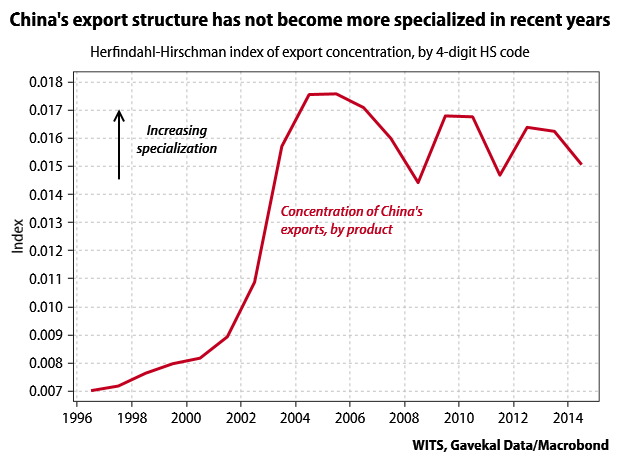
I found this a very striking idea, as one of the (many) things about China’s economy that has puzzled me in recent years is the apparent lack of specialization in its exports. There was fairly dramatic structural change in China’s exports up until about 2007, but since then the export structure has been largely stable. Exports have been growing, and China’s global market share has been rising until very recently. So China has generally been steadily becoming a more successful exporter. But as this has happened it has not shown much sign of becoming more specialized in particular types of products, which is usually one of the things that happens in countries that are successful exporters.

I had speculated that global demand was a limiting factor here: in the aftermath of the financial crisis, global demand for the kinds of things that China wants to specialize in–capital goods and equipment–has probably not expanded rapidly enough for China to have exported a lot more of those goods. But perhaps, as Carsten suggests, the issue is more fundamental, and one we have not really encountered before: China’s export industries might already large enough, relative to total world demand, that even a very successful export performance will not show up as much specialization. This is one to ponder further.

export share

Update. Here is a more precise measure of export specialization — a simple Herfindahl-Hirschman index of concentration, calculated at the 4-digit HS level (it’s the sum of the squares of the share of each product in the total). This actually shows export concentration has been bouncing around in a range since around 2003-04, so it looks less like a cyclical post-crisis phenomenon.

HHI-exports-product

What will China do about its zombie companies?

One of the more interesting developments in official Chinese discussions about the economy has been the appearance of the term “zombie companies”; Premier Li Keqiang himself has repeatedly used the term. It’s a loose shorthand for a problem that everyone knows about but is difficult to precisely define: money-losing companies that seem to stay alive far longer than economic fundamentals warrant. This problem is particularly acute in the commodity sectors: a global supply glut has driven down prices of iron ore and coal to multi-year lows, levels where China’s relatively low-quality and high-cost mines have difficulty being competitive. And yet they continue operating despite losing money, because it is easier to keep producing than to completely shut down. An excellent story this week in the China Economic Times on the woes of the coal heartland of Shanxi quoted one executive saying, “If we produce a ton of coal, we lose a hundred yuan. If we don’t produce, we lose even more.”

The incentive problem is very clear. If many companies shut down, output would fall and prices would rise, and the remaining companies would be more profitable. However every company wants to be one of the companies that is left standing rather than one of the companies that shuts down, and so they do everything they can to continue operating. They can also usually count on help from banks and local governments, who want to avoid the financial and social impact of a large employer closing. This is why there are increasing calls for the central government to break the logjam and organize the closure of excess capacity that market mechanisms should be producing. Indeed, I translated on this blog a very interesting proposal from the State Council’s Development Research Center on how to do exactly that.

The fact that top leaders are now talking openly about zombie companies could indicate some progress on this issue. So here’s another relevant translation: a recent interview with Feng Fei, a senior industrial official. Feng is also one of China’s top scholars of industrial policy, and in fact spent many years at the DRC. In October he was elevated to one of the vice-minister jobs at the Ministry of Industry and Information Technology, which has bureaucratic responsibility for most of the sectors with lots of zombie companies. His interview with Caijing magazine is short but to the point. He diagnoses the problem and its consequences very clearly, but hedges a bit when asked what the government is going to do. However he seems to indicate that the current preference is to deal with zombie companies by encouraging stronger companies to take them over–which I think is not as good a solution as the one the DRC has already proposed.

Reporter: Why is the exit of “zombie companies” being discussed now? What is the background to this question?

Feng Fei: There is not yet a consensus view about “zombie companies.” My understanding is that “zombie companies” refer to companies that have been losing money for a long time, and which have no hope of turning around or smoothly exiting the market. Currently the problem of “zombie companies” is very prominent, and this is related to three major issues in the economy.

First, China’s economic growth has entered a “new normal.” Downward pressure on the economy has increased, and the external environment for business is getting tougher. There are some companies whose technology, management and so forth are relatively poor, and who are finding it difficult to adapt to the new situation and to market changes, and as a result have fallen into serious trouble.

Second, there is serious excess capacity in some industries, resulting in a continuous decline in product prices and a fall in corporate profits. There are some sectors in which all companies are losing money, and operations are very difficult. For instance, in the third quarter of this year, the steel industry’s profit margin on sales was only 0.05%, and the sector’s total profits declined 97.5%; nearly half of the companies in the sector are loss-making.

Third, the market system is not robust: there are still some institutional obstacles that result in “zombie companies” finding it difficult to exit according to market rules.

Reporter: In more specific terms, what harm do “zombie companies” bring to China’s economy?

Feng Fei: The existence of a large number of “zombie companies” hinders China’s economic transformation and the upgrading of its industrial structure, and also increases macroeconomic risks.

First, these companies are holding on to a lot of resources, hindering the effective resolution of excess capacity. “Zombie companies” have low profitability, but take up a lot of land, capital, energy, labor and other resources, and prevent these resources from flowing to more profitable sectors, resulting in a serious waste of resources. You could even say that if “zombie companies” do not exit the market, the problem of excess capacity cannot be fundamentally solved, and it will be very difficult to achieve structural adjustment and industrial upgrading. Only if enough companies exit will there be enough companies entering.

Second, it undermines the market principle of survival of the fittest. Because of social stability considerations and other issues, there are efforts to preserve “zombie companies” and give them blood transfusions. This results in unfair competition, and could even cause a Gresham’s Law phenomenon [in which the bad drives out the good].

Third, it may lead to financial risks. “Zombie companies” have a lot of debt, which if not dealt with in a timely manner will result in an increase in banks’ non-performing loans. When you add in the complex chain of inter-enterprise debt, the problem becomes serious, and could lead to systemic risk. Therefore the State Council is paying great attention to this issue, and has required [us] to handle the “zombie companies” issue.

Reporter: If it is so urgent for “zombie companies” to exit the market, why has this been a difficult issue for so long? Why is it hard to establish a mechanism for market exit?

Feng Fei: “Zombie companies” can be dealt with in two ways, through market-oriented mergers and restructuring, or bankruptcy according to law. The handling of “zombie companies” will be more through restructuring, and less through bankruptcy, and will also ensure social stability. In terms of these methods, China has considered the design of the system, but has faced some difficulties and problems in terms of actual operation, and a complete system for market exit has not yet been formed.

First, in the restructuring and bankruptcy processes, there are difficulties with the placement of workers, the debt burden, and historical issues, which increase the cost of restructurings and bankruptcies. This is an obstacle to “zombie companies” exiting the market.

Second, some local governments interfere in the normal process of bankruptcy and market exit because of considerations related to preserving jobs, maintaining social stability, or the worries of banks and other creditors about bad debts.

Third, China’s “Bankruptcy Law” needs to be further clarified and refined. Although it has already been revised several times to adapt to the market economy, there are still some regulations that are more like general principles.

Fourth, in the context of increasing downward pressure on the economy, many sectors do not have a clear outlook, and firms face financing difficulties, which means they have little interest in pursuing mergers and corporate restructuring.

Finally, the current economic situation increases the risk and the consequences of corporate bankruptcies, which means that many parts of society are very wary toward bankruptcies and restructuring.

Reporter: According to the State Council, the Ministry of Industry and Information Technology is in charge of researching and promulgating policies on “zombie companies.” What is your plan for this work?

Feng Fei: MIIT will step up its research and survey work, find out the true situation, and figure out the major difficulties and problems in “zombie companies” exiting the market. In conjunction with relevant departments, we will research policy measures to handle “zombie companies,” improve the market, legal and policy environment, and improve the exit mechanisms for “zombie companies.”

The exit of “zombie companies” requires a proper relationship between the government and the market. The role of government is mainly to provide the necessary support for displaced workers, not to rescue companies, and to make the exit as smooth and quick as possible. At the same time, we will adhere to the policy of “more mergers, fewer bankrutpcies,” so that more exits of “zombie companies” happen through mergers and restructuring. This will result in appropriate placement of workers, reduce the impact on society, reduce the economic risk, and raise the quality and efficiency of economic development.

Lessons from Douglass North, plus an amazing GDP chart

I was sad to hear of the passing of the great Douglass North earlier this week (there are obituaries from the Economist, New York Times and Washington University in St. Louis, the last focusing on his teaching). While I cannot claim deep knowledge of North’s whole body of work, I loved his book Violence and Social Orders, co-authored with John Joseph Wallis and Barry R. Weingast. Amazingly enough, the book completely lives up to its subtitle: A Conceptual Framework for Interpreting Recorded Human History. North was a social scientist who, like Gellner and Levi-Strauss, aimed straight for the big questions about what modern life is; most economists do not even know how to ask those questions let alone answer them.

The book is difficult to summarize simply so I won’t try–but one of the lessons I learned from it is in fact pretty simple. The difference between good institutions and bad institutions in terms of economic growth is not that good institutions generate higher growth. Rather, countries with good institutions are flexible and better at responding to changing conditions, so they have fewer and shallower economic downturns. That results in a higher rate of trend growth over the long term. It’s a powerful and intuitive idea: the important thing is not finding the secret sauce for economic growth, but avoiding and recovering from mistakes. Here is the relevant passage:

An underappreciated feature of the different patterns of social orders relates to why poor countries stay poor. Economic growth, measured as increases in per capita income, occurs when countries sustain positive growth rates in per capita income over the long term. Over the long stretch of human history before 1800, the evidence suggests that the long-run rate of growth of per capita income was very close to zero. A long-term growth rate of zero does not mean, however, that societies never experienced higher standards of material well-being in the past. A zero growth rate implies that every period of increasing per capita income was matched by a corresponding period of decreasing income. Modern societies that made the transition to open access, and subsequently became wealthier than any other society in human history, did so because they greatly reduced the episodes of negative growth. …

Strikingly, the richest countries are not distinguished by higher positive growth rates when they do grow. In fact, the richest countries have the lowest average positive growth rates by a substantial amount. …When they grow, poor countries grow faster than rich countries. They are poor because they experience more frequent episodes of shrinking income and more negative growth during the episodes. Countries below $20,000 income do not exhibit a strong relationship between income and positive growth rates. The same is not true for the relationship between income and negative growth rates. …The poorest countries experience both more years of negative income growth and more rapid declines during those years…

All societies are subject to random and unpredictable changes in the world around and within them. Changes in external factors like climate, relative prices, and neighboring groups as well as changes in internal factors like the identity and character of leaders, internal feuds and disputes, and relative prices all contribute to persistent alterations in the circumstances with which societies must cope. The variations in the economic performance of limited and open access societies over time reflect the inherent ability of the two social orders to deal with change. …There is no teleology implied by the framework. Nonetheless, the framework illuminates why open access societies are better than natural states at dealing with change.

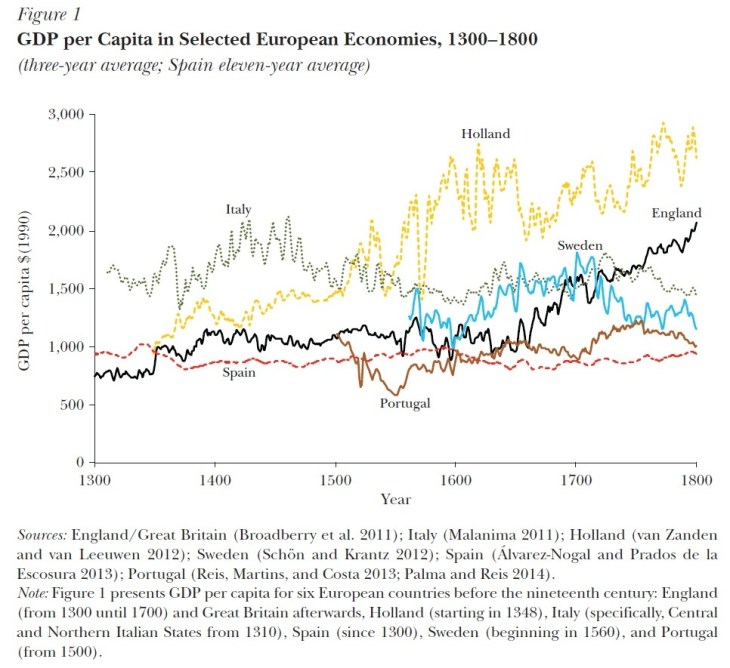
The latest historical economic research in fact seems to strongly support North’s thesis. The new issue of the Journal of Economic Perspectives has a nice review article on recent work compiling long-term GDP series for several European countries. There is only one chart but boy is it a doozy–just think of all the years of scholarly effort that went into creating these data series:

seven-centuries

The chart seems to very much supports North’s thesis: historically there were indeed many episodes of growth, but they were usually followed by significant reversals. At least, until the Industrial Revolution in England came along and delivered much more consistent gains. Here are the authors, Roger Fouquet and Stephen Broadberry:

The new data shows trends in GDP per capita in the key European economies before the Industrial Revolution, identifying episodes of economic growth in specific countries, often lasting for decades. Ultimately, these periods of growth were not sustained, but they noticeably raised GDP per capita. It also shows that many of these economies experienced periods of substantial economic decline. Thus, rather than being stagnant, pre-nineteenth century European economies experienced a great deal of change. …

The paper tentatively finds that the likelihood of being in a phase of growth increased and the risk of being in a phase of decline decreased in the nineteenth and twentieth centuries. …Between the fifteenth and eighteenth century, there was an average of two economic downturns per country per century, while the nineteenth and twentieth centuries experienced less than one economic downturn per country per century. In the fifteenth and sixteenth centuries, economic downturns occurred about 8 percent of the time; in the seventeenth and eighteenth centuries, they were experienced 4–5 percent of years; and, in the nineteenth and twentieth centuries, downturns occurred 2–3 percent of the time. Thus, there appears to have been a modest reduction in the likelihood of experiencing downturns over the centuries from the fifteenth century. …Explaining the source of these differences could prove to be important for understanding how economies managed to generate sustained economic growth.

Looks like North was onto something.

The political history of China’s economic growth targets

Growth targets are back and stronger than ever in China’s next Five-Year Plan, for 2016-2020. The plan itself is not finalized–the government has just published its “suggestions” for the final document–but it is pretty clear that the main thrust has already been decided. One of the most striking points in the official narrative is the strong emphasis on maintaining a high rate of GDP growth; to me, unrealistically high. Previously, there had been much discussion about abandoning the GDP growth target in the five-year plan, or replacing them with other indicators more directly related to household welfare (maybe China could even do something crazy like target inflation and unemployment). In the event we seem to have an even stronger emphasis on growth targets–the question is why? To start with, here’s Xi Jinping himself explaining the plan (my translation from the Chinese):

The draft suggestions put forth a goal of maintaining medium-high speed economic growth for the next five years. The main consideration is that in order to achieve the goal for 2020 of doubling our 2010 gross domestic product and per-capita rural and urban incomes, we must maintain the necessary growth rate. In order to double GDP, the bottom line for the average economic growth rate for 2016 to 2020 is 6.5% or higher. … Major domestic and foreign research organizations all think that in the Thirteenth Five-Year Plan period our country’s potential economic growth rate is 6-7%. Taking everything into consideration, it is possible for our country to maintain growth of about 7% in the future, but there are numerous uncertain factors.

It’s interesting how Xi presents the growth target as just a necessary consequence of another, more important goal: doubling 2010 GDP by 2020. And indeed there is no problem with his arithmetic: given how much the economy has grown since 2010, to double that level in 2020 requires annual growth of at least 6.5% after 2015. The GDP-doubling target is itself the specific expression of a general slogan: to make China a “moderately prosperous” (xiaokang) society by 2020. Xi has emphasized this target as one of his “two centenary goals“: achieving prosperity by the 100th anniversary of the Party’s founding in 2021, and achieving modernization and national revival by the 100th anniversary of the founding of the People’s Republic in 2049. Official propaganda under Xi has made a big deal out of these two centenary goals, but in fact they are not that new, and indeed were inherited from previous leaders. Xi’s immediate predecessor, Hu Jintao, said in his speech to the 18th Party Congress in 2012:

We need to have a correct understanding of the changing nature and conditions of this period, seize all opportunities, respond with cool-headedness to challenges, and gain initiative and advantages to win the future and attain the goal of completing the building of a moderately prosperous society in all respects by 2020. Basing ourselves on China’s actual economic and social development, we must work hard to meet the following new requirements while working to fulfill the goal of building a moderately prosperous society in all respects set forth at the Sixteenth and Seventeenth National Congresses of the Party. The economy should maintain sustained and sound development. Major progress should be made in changing the growth model. On the basis of making China’s development much more balanced, coordinated and sustainable, we should double its 2010 GDP and per capita income for both urban and rural residents.

But as Hu emphasized, this was not a goal that he came up with himself–it was one set by his predecessor Jiang Zemin. In 2002, at the 16th Party Congress, Jiang said:

An overview of the situation shows that for our country, the first two decades of the 21st century are a period of important strategic opportunities, which we must seize tightly and which offers bright prospects. In accordance with the development objectives up to 2010, the centenary of the Party and that of New China, as proposed at the Fifteenth National Congress, we need to concentrate on building a well-off society of a higher standard in an all-round way to the benefit of well over one billion people in this period. … On the basis of optimized structure and better economic returns, efforts will be made to quadruple the GDP of the year 2000 by 2020, and China’s overall national strength and international competitiveness will increase markedly.

This was actually a more precise formulation of the growth goal than Jiang had given previously. Here is what he said at the 15th Party Congress in 1997:

Looking into the next century, we have set our goals as follows: In the first decade, the gross national product will double that of the year 2000, the people will enjoy an even more comfortable life and a more or less ideal socialist market economy will have come into being. With the efforts to be made in another decade when the Party celebrates its centenary, the national economy will be more developed and the various systems will be further improved. By the middle of the next century when the People’s Republic celebrates its centenary, the modernization program will have been accomplished by and large and China will have become a prosperous, strong, democratic and culturally advanced socialist country.

There you have it: the original formulation of Xi’s two centenary goals was actually made in 1997. But it is also clear that the history goes back even further, as those goals were very directly inspired by a previous declaration from Deng Xiaoping himself, in remarks on April 30, 1987:

Our goal for the first step is to reach, by 1990, a per capita GNP of US$500, that is, double the 1980 figure of $250. The goal for the second step is, by the turn of the century, to reach a per capita GNP of $1,000. When we reach that goal, China will have shaken off poverty and achieved comparative prosperity. When the total GNP exceeds $1 trillion, the national strength will increase considerably, although per capita GNP will still be very low. The goal we have set for the third step is the most important one: quadrupling the $1 trillion figure of the year 2000 within another 30 to 50 years. That will mean a per capita GNP of roughly $4,000 — in other words, a medium standard of living. That target may not seem high, but it is a very ambitious goal for us, and it won’t be easy to achieve.

We are now confident that we can attain our first goal ahead of schedule, this year or next. That doesn’t mean it will be easy to reach the second goal, but I think we can do it. Our third goal will be much harder to reach than the first two. Our experience over the last eight years or so shows that the road we have taken is the right one. But it is only after the third step that we shall really be able to show the superiority of socialism over capitalism — that’s something we can’t prove at the moment. We shall have to work hard for another 50 or 60 years. By then, people of my age will be gone, but I have no doubt that the younger generations will reach the third goal.

(Deng also made a slightly different statement of those goals on April 26 of the same year). This formula became known as the “three-step” development strategy, and Jiang’s version in 1997 as the “new three steps.” Deng also originated the term xiaokang, now conventionally translated as “moderately prosperous,” which he chose to convey a modest aspiration for ordinary people to have a better life.

This historical context makes it easier to understand why these GDP targets are politically so important: they are a way by which successive Chinese leaders have tied themselves to the legacy of Deng Xiaoping, and thereby increased their own legitimacy. By saying he is committed to the goal of doubling GDP by 2020, Xi Jinping makes it clear that he is carrying on the weighty tasks undertaken by his predecessors, and is continuing the great legacy of the Communist Party. In other words, there is no real economic justification for picking a certain rate of GDP growth to target; it is all about the political symbolism (all that stuff you read about China needing to grow 7% a year to prevent social unrest is total nonsense).

This kind of political symbolism was a mostly harmless feature of Chinese politics in earlier years, because the growth potential of the economy was so high that setting these arbitrary growth targets had little impact on actual economic policy. Until very recently, there has rarely been a year in which actual GDP growth did not exceed the target by a wide margin. China’s problem now is that its growth potential is declining, and failing to meet the growth targets has become a real risk (indeed, a near-certainty). Reformers in Deng’s day promoted fast growth as a way to break free of the legacy of the planned economy; in today’s China, reformers worry that targeting fast growth creates too many costs, environmental and otherwise, and gets in the way of structural changes that would improve welfare over the longer term (even if few are willing to publicly challenge the view that potential growth is still 7%). So the growth targets for 2016-2020 will have a greater and more malign influence on policymaking, because they will start to actually affect decisions on a regular basis.

growth-targets

Was it inevitable for China to end up in this trap, where it is held hostage to unrealistic growth targets inherited from previous generations of political leaders? Of course not. If you look at Deng’s original formulation, it was quite vague about the longer term: he did call for quadrupling the GDP of 2000, but said it might take anywhere from 30 to 50 years. When Jiang initially set his goal for the Party’s centenary in 2021, he did not say that GDP had to exactly quadruple by that date, only that it should rise substantially. It was only later on that Jiang formalized the goal into a quadrupling of GDP over the 20-year period. Even then, his successors could have easily shifted the rhetoric: for instance, retaining the goal of achieving “moderate prosperity” by 2020, but dropping the precise definition in terms of GDP. But China’s leaders have been so desperate to gain the political legitimacy that comes from a link to Deng’s legacy that they have been unable to make even such modest changes.

What if innovation requires irrationality?

I recently finished The Knockoff Economy: How Imitation Spurs Innovation by Kal Raustiala and Christopher Jon Sprigman, as part of my periodic attempt to educate myself on productivity issues. I decided to tackle to my to-read list from the bottom rather than the top for a change, and since this book had been sitting there for at least two years, it was the winner. It’s very good and clearly written, and a lot of their arguments have become more mainstream since it was published in 2012.

There are many interesting tidbits throughout, but one I found very intriguing came at the very end, in a coda not closely related to the main substance of the book. Here is an excerpt of the relevant section:

Conventional thinking about innovation and IP relies on the concept of a rational innovator. It assumes that innovators calculate, either explicitly or implicitly, the cost of creation versus the size of the return they will likely enjoy. A writer might anticipate a certain advance from her publisher; a musician might estimate the sales of a new song. This expected return shapes how much effort they pour into creation and what kinds of creation they pursue. Abundant research in economics and psychology, however, suggest that their judgments are often likely to be wrong—and systematically so.

As many studies have found, individuals are very bad at assessing their own future prospects. They have a pronounced optimism bias. They think they will succeed where others have not, and they heavily discount the prospect of failure. Nearly all newlyweds, for example, believe they will not get divorced, when in fact a large minority will—and often within a few years. Likewise, students wildly overestimate their likely grades, even in the face of stiff competition. Like the residents of Lake Wobegon, we all want to believe we are above average. … Optimism bias, in short, leads many innovators to think they will gain a greater return from their intellectual creations than they actually do.

Why is this important to understanding the interaction between copying and creativity? Because optimism bias likely acts as a subsidy for innovation. Creators who have an unduly strong belief in their ultimate prospects for success should be willing to invest more in their creativity. And this increased willingness to invest is likely, in turn, to lead to increased creative output as compared with a world in which creators rationally calculated the odds—odds that may include expected losses from copying.

There is another important, and related, factor that skews how innovators assess their expected return on innovation. Many contemporary markets for creative goods are what economists call “winner take all” or “tournament” markets. In these markets, a huge reward goes to a few at the very top—the superstars—while much less goes to those just below them. This dynamic is easy to see in areas like professional sports: just think about Major League Baseball, where the very best players receive enormous salaries, while those who are merely excellent languish on AAA farm teams, earning a tiny fraction of what the true stars do.

Tournament markets amplify small differences in performance into enormous disparities in reward. Given this basic dynamic, we might expect people to shy away from competing in markets like these—the risk of failure is great, competition can be very intense, and the difference between success and failure hard to determine until years of effort have been invested. Yet we see large numbers of individuals competing to become a sports star, a national politician, a CEO, or, most important for our purposes, a musician, writer, or inventor of the next huge Web concept. Many markets for creative goods are tournament-like. A hit song can yield huge sums for the right creative artist. Yet the vast majority of songs go nowhere, commercially speaking. Likewise, books and screenplays can rake in enormous revenues if they are truly successful, but New York and Los Angeles are awash in the tens of thousands of authors who tried and failed. …

Like optimism bias, tournaments induce more investment than is rational. So both optimism bias and tournament markets push innovators toward high levels of innovation. …The important point is that both of these effects exaggerate anticipated benefits. And it follows that exaggerated expectations of benefit will tend to keep innovation buoyant, beyond what a rational calculation of return would predict.

In other words, pursuing innovation to some extent depends on having irrational expectations about the future. To me, this ties very neatly into David Graeber’s bureaucratic theory of technological stagnation: he argues that the more research is driven by corporate bureaucratic practices that require precise estimation of the outcomes and benefits of said research, the less innovation actually happens. This contention directly challenges William Baumol’s idea of the “free-market innovation machine”: that sustained rapid economic growth is possibly precisely because innovation can be turned into a routine organized activity, and does not have to depend on random flashes of insight.

It does seem clear that once innovation becomes a routine corporate activity with a budget and cost-benefit analysis, then that cost-benefit analysis should be more accurate than what individual people do in their heads with all the usual cognitive biases and errors. But if the incentive to innovate depends on systematically over-estimating the potential benefit of innovation, then doing an accurate cost-benefit analysis will not in fact be a good thing. It may lead to less wasted effort at the individual or firm level, but could also mean less innovative activity in aggregate.

To be clear, this is not at all what Raustiala and Sprigman argue–to the contrary, they think that the irrationality of innovation in fact makes it more resilient to bad regulation or intellectual property-rights violation, and therefore is a reason to be more not less optimistic about the future of innovation. And I don’t completely believe the bureaucratic theory of technological stagnation either (Baumol is a genius and more likely to be right than Graeber). It is worth thinking about though.

The Russian origins of Chinese economic reform

DXP   

One of the more interesting arguments in Pantsov and Levine’s new biography of Deng Xiaoping is that China’s post-1978 economic reforms should be understood not as a rejection of Soviet-style Communism, but as a development of a different tradition of economic thought within Communism. Specifically, they argue that many of the features of the 1980s reforms were directly inspired by the “New Economic Policy” practiced in Soviet Russia in the mid-1920s. Here’s what they say in the introduction:

The theory of reform and opening that Deng developed several years after Mao’s death, in the late 1970s and early 1980s, did not originate with him. It was rooted in the Russian Bolshevik Nikolai I. Bukharin’s interpretation of Lenin’s New Economic Policy aimed at developing a market economy under the control of the Communist Party. Deng studied this concept in the mid-1920s in Moscow during his sojourn as a student at a Comintern school and began implementing it as soon as he solidified power.

The central idea of the NEP, so far as I can make out, was to back away from full-scale state ownership and planning, and allow market transactions and some private enterprise in the context of an economic system still dominated by the Communist Party. This is indeed pretty much the formula that Deng pursued after he came to power. And of course Deng, who studied in Moscow during the period of the NEP, would have been well aware of these ideas. He even mentioned the NEP in passing in August 1985 in a conversation with Robert Mugabe:

What, after all, is socialism? The Soviet Union has been building socialism for so many years and yet is still not quite clear what it is. Perhaps Lenin had a good idea when he adopted the New Economic Policy. But as time went on, the Soviet pattern became ossified. We were victorious in the Chinese revolution precisely because we applied the universal principles of Marxism-Leninism to our own realities.

Pantsov and Levine somewhat misleadingly paraphrase this quote as Deng saying that “he openly acknowledged that ‘perhaps’ the most correct model of socialism was the New Economic Policy of the USSR.” Part of what Pantsov and Levine are trying to do with this, as in much of their book, is to counterbalance some of the hagiography of Deng and cut his historical status down to size. But I’m not sure how much difference it makes to our evaluation of Deng where he got his ideas from–everybody gets their ideas from somewhere, and we usually expect national political leaders to be good decision-makers rather than original intellectuals (that’s a staff job). And it was common for many of China’s early economic reforms to be justified by references to canonical Communist texts (here’s another example), which made them easier to digest.

Nonetheless, it is clear that there was a groundswell of interest in Bukharin and the NEP during the early reform period, an interesting phenomenon of which I was previously unaware:

In 1981 Chinese scholars began publishing their own articles on Bukharin. Over a period of two years, no fewer than thirty-six articles appeared in various PRC journals on his life and works. One of the first articles, by the historian Zheng Yifan, a 1959 graduate of Leningrad University, which was published in the first issue of Shijie Lishi (World History), caused quite a stir. Zheng flatly stated that Bukharin was a Marxist theorist and economist, and that everything Stalin had said about him was false. In this connection, he noted in particular the truth of Bukharin’s slogan addressed to Russian peasants: “Enrich yourselves, accumulate, develop your farms.” Understandably, he did not compare this slogan with Deng’s well-known idea that it was good to be rich, but everyone knew what he meant. Naturally, the majority of articles addressed Bukharin’s economic views. Chinese social scientists recognized that they “were relevant today.” They appreciated Bukharin’s acknowledgment that socialism in the USSR was “backward in form,” his defense of prosperous peasants, his insistence that the growth of industry directly depended on the growth of agriculture, his support of the harmonious combination of planned and market regulations, and his recognition of the important role of the law of value in commodity-financial relations under socialism.

This context also I think helps us better understand the changing ideas about the economy in the first half century of the People’s Republic. The long struggle over economic policy in China was clearly not one between proponents of the planned economy and backers of a Western market economy. It makes much more sense to see it as a battle among Communists over competing interpretations of Marxism-Leninism.

Andrew Walder’s recent book China Under Mao: A Revolution Derailedwhich I highly recommend, argues that Mao’s economic policies in the 1950s were based on an early and extreme interpretation of Marxism-Leninism. But Mao’s ideas were already viewed as outdated by other Communist states, who were already moving toward a less rigid version of the planned economy. Deng Xiaoping, and other figures such as Chen Yun, were clearly part of a different tradition within Communism that was less strictly ideological and more concerned with improving living standards. Deng and other reform-era leaders were not Western liberals in disguise working secretly within the system; they were committed Communists who argued for the superiority of their version of Marxism.