The practitioner’s view of economic development: “We do what we must and then adjust as we go along”

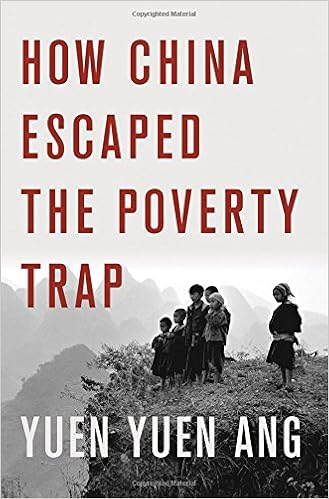
The new book by Yuen Yuen Ang, How China Escaped the Poverty Trap, has some nice passages that give some of the flavor of how Chinese government officials went about developing their local economies. This practitioner’s perspective is often quite distant from the questions that animate scholars of economic development. Here is a sample:

My interviews with local bureaucrats in China deliberately included a question that has long been debated in academic circles: In your locality, do you think it was effective governance that led to growth or growth that enabled the governance to improve? The bureaucrats were consistently astonished by the naiveté of the question. To them, the answer is obvious: causation runs both ways. One regular cadre in a city-level agency, who had no scholarly training whatsoever, gave a memorably insightful reply:

“The economy and the bureaucracy interact and change together. If the economy is poor, then, inevitably, it will be difficult to improve governance. …In reality we do what we must and then adjust as we go along… There must be a process. It’s impossible for a government to reform overnight.”

More bluntly, another bureaucrat bureaucrat griped that the question posed was flawed. In his words, “To say that we should grow the economy and then improve the business environment, or vice versa, are both misguided. Obviously, we must pursue both at the same time, like the pursuit of material and spiritual development.”

These replies suggest that development as a coevolutionary process is a plain reality to many practitioners and probably lay observers too. It is no wonder that they dismissed the question as academic. …

How did development actually happen in Forest Hill? Did the city’s leaders heed the advice of international experts to establish good governance as a first step of development, namely, by furnishing secure property rights to private entrepreneurs and resolutely eradicating corruption? Or did it model itself after the developmental states of East Asia, by establishing technocratic state agencies and channeling resources toward targeted industries? Alternatively, did the city make do with “good enough governance,” delivering only minimal government performance and waiting until it had become sufficiently wealthy before improving governance? The answer to all three hypotheticals is no.

Ang’s own theory of China is a variant on the “regionally decentralized authoritarianism” or Chinese-style federalism argument, which puts the emphasis on the striving of local officials to generate growth. In particular, her book has some good detail on the systems for motivating and evaluating local government officials. But she also, correctly in my view, emphasizes how the pressure on local officials to generate growth ends up having very different outcomes depending on the characteristics of different localities.

The core of the book is a set of detailed narratives of a few different localities in China. These emphasize that government officials did not follow a consistent strategy, or gradually perfect institutions, but instead continuously adapted in response to changes in the economy. Rather than a one-way causation from institutions to economic outcomes, or vice versa, there is a constant feedback between the two. These accounts are well done and pretty convincing for the take-off period of the 1980s and 1990s. The Why Nations Fail crowd has never really managed to provide a decent account of Chinese economic development (which is a bit like having a theory of linguistics that fails to explain the grammar of English), and accounts like this that tackle the detail of China’s actual institutions are good to have as a corrective.

Still, Ang’s narratives get a bit less detailed and convincing as they move into the 2000s. For a book about economic development there is sometimes a vagueness about what has actually happened in China’s economy over the past decade and a half. The impact of the rise of township-and-village enterprises in the 1980s and the privatization of state-owned enterprises in the 1990s are well covered. Yet there is almost no discussion of the growth in foreign investment and exports that followed China’s entry into the World Trade Organization in 2001, or of the enormous real-estate boom that got started around 2003 and is still running, or of the global financial crisis of 2008 and the subsequent surge in infrastructure spending. The focus of the book is, as the title indicates, on the early stages of China’s growth boom, so these are not crippling omissions. But digging into these developments more would help answer the broader question of whether the feedback between economic change and bureaucratic decision-making in China has always been as positive as it was in the early stages of its growth take-off.
The American left has a surprising new enthusiasm for states’ rights

Many traditional US political alignments are being scrambled by Donald Trump’s election. We may soon be able to add to that list another one: the usual partisan attitudes towards the federal and local governments.

Trump’s victory in the Electoral College, despite his receiving about 2 million fewer votes than Hillary Clinton, has highlighted once again the way the US political system is designed to give power to places where relatively few people live. A recent NY Times piece has a good rundown of the history of this system:

The Electoral College is just one example of how an increasingly urban country has inherited the political structures of a rural past. Today, states containing just 17 percent of the American population, a historic low, can theoretically elect a Senate majority, Dr. Lee said. …

When the framers of the Constitution were still debating the shape of institutions we have today, 95 percent of America was rural, as the 1790 census classified the population. The Connecticut Compromise at the time created the Senate: one chamber granting equal voice to every state to counterbalance the House, where more populous states spoke louder.

And they made sure the compromise stuck. Today, equal state representation in the Senate is the only provision in the Constitution that remains singled out for protection from the amendment process; no state can lose its full complement of senators without its permission.

But even as a deliberately undemocratic body, the Senate has slipped further out of alignment with the American population over time. The Senate hasn’t simply favored sparsely populated states; politicians in Washington created sparsely populated states to leverage the Senate’s skewed power. … Republicans in Congress passed the 1862 Homestead Act, offering free land to settlers who would move to territories that would eventually become states — creating more Senate seats and Electoral College votes for a Republican Party eager to keep government control away from Southern Democrats. They even managed to divide the Dakota Territory into two states, worth twice the political power.

Population density explains a lot about recent voting patterns: low-density places tend to vote Republican, and high-density places tend to vote Democratic. So this quirk of the US system has large electoral consequences. The US population is also becoming steadily more concentrated in large urban areas. According to Census Bureau data, the share of the US population that lives in the 20 largest metropolitan areas (of which four are in California) has risen from 37.7% in 2010 to 38.2% in 2015, a steady pace of one-tenth of a percentage point per year. If this trend continues, and I don’t see why it will not, the structural disadvantage of Democrats in the Senate and Electoral College will only increase. So it will probably become harder and harder for Democrats to achieve unified control of the federal government.

This is a challenge to both parties’ recent self-image: Republicans have been the party of states rights’ and local autonomy, campaigning against federal overreach, while Democrats have been the party of federally guaranteed civil and political rights, campaigning against entrenched local inequality and discrimination. But with the federal government firmly in Republican hands for the next few years, and possibly longer, Democrats seem to be having a change of heart about the role of local governments. Democrats are now praising local governments’ sovereignty and autonomy as a way to preserve important rights and values–in much the same way that Republicans traditionally have.

Some of the public statements by Democrats since the election seem to me quite extraordinary in the historical context of their party. Brad DeLong’s recent declaration that “The sovereign equal dignity of the states is our friend, whatever happens at the national level” is one good example. There have also been many statements from Democratic local officials about their lack of interest in cooperating with any Trump administration crackdown on illegal immigrants. Probably the most striking speech was from New York City Mayor Bill de Blasio:

And part of what’s important to remember is our own power in this moment here in New York City and in cities around the country, because in the confusion something important has gotten lost. There is not a national police force. You don’t go to federal schools to get your children an education. No. We in the City of New York, we protect our people with the NYPD. We provide education to our children with our New York City public schools. We provide healthcare with our public hospitals; and all over the country the same. Our constitution says it – that so much of what is decided in the governance of our people is decided at the local level, according to the values of the people who are governed. In the Declaration of Independence there is one of the most simple and powerful passages – it says, governments are instituted deriving their just powers from the consent of the governed. We don’t consent to hatred.

And we will fight anything we see as undermining our values. And here is my promise to you as your mayor – we will use all the tools at our disposal to stand up for our people.

If all Muslims are required to register, we will take legal action to block it.

If the federal government wants our police officers to tear immigrant families apart, we will refuse to do it.

If the federal government tries to deport law-abiding New Yorkers who have no representation, we will step in. We will work and build on the work of the City Council to provide these New Yorkers with the lawyers they need to protect them and their families.

If the Justice Department orders local police to resume stop and frisk, we will not comply.

In the 1960s the racist right was defying the federal government in order to preserve segregation; in the 2010s, the multicultural left is threatening to defy the federal government in order to preserve immigrant- and minority-friendly policies. That is a pretty amazing turn of the historical wheel–even more so when you recall that the Democratic Party has been the home of both the 1960s segregationists and the contemporary integrationists.

This shift also suggests that local sovereignty will be an enduring part of the American political system, even given the massive increase in the federal government’s power since the 1920s, as both left and right can find reasons to support it when they are out of power at the federal level.

Zhao Lingmin on the roots of Chinese elite support for Trump

A definitive overview of this question is over at Ma Tianjie’s Chublic Opinion, but one of the sources in that piece I thought was worth digging into a bit more. It’s a column by Zhao Lingmin, originally published on the FT Chinese site back in October, that focuses on what the enthusiasm for Trump says about Chinese society. My translation follows:

Compared to his American supporters, Trump’s Chinese supporters have two notable differences. One, they have “true love” for Trump. Even though some Americans do not like Trump personally, or even despise him, they have still decided to vote for Trump because of their anger at the status quo. Trump’s supporters in China are not deciding who to vote for, and there are no real interests at stake; many of them simply like Trump himself. Second, it is widely recognized that some of Trump’s supporters in the US are not of high social status and belong to the lower middle class, so Hillary Clinton could say that half of them are “deplorables,” or “people who feel that the government has let them down, the economy has let them down.”

But among Trump supporters in China, there are some successful people and members of the elite: they are well-educated, rational, with high social status. On this point, you only have to look at WeChat or Zhihu; in those places public criticism of Trump’s remarks is rare, and there are a lot of people who excuse them or give them a positive spin.

Why is the Chinese elite not like the American elite in opposing Trump? There are different national conditions, there are differences of opinion, but in my opinion the most important difference between the two countries’ elites is the different environments they have grown up in. This has led some Chinese elites to endorse Trump’s views on political correctness, terrorism, Islam, and other issues.

Trump has been most criticized for his undisguised degradation and humiliation of immigrants, Muslims, and women, which for many American elites, whose awareness of equal rights comes from their baptism in the civil rights movement, is completely unacceptable. The recent revelation of the recording in which Trump insults women touched the bottom line of American society, and made some of the rest of the elite draw the line. By contrast, some of China’s elite, having risen up in an atmosphere of social Darwinism, do not find Trump’s statements so offensive as to cause anger and condemnation—although they do not quite endorse them either.

The past 30 years of China’s economic growth and social development began after a period of chaos [i.e., the Cultural Revolution], and there was no Enlightenment-like intellectual movement. Government officials, in order to mobilize reform, exaggerated the evils of the old benefit system as “everyone eating from one big pot,” which, with the assistance of some scholars, led to an almost complete social consensus that a market economy means completely free competition. With no restraint from ethics or rules, the “law of the jungle” that the weak are prey to the strong became nearly universal in society. Amid all the worship of the strong and disdain for the weak, an atmosphere of care and equal treatment of disadvantaged groups has not formed. Therefore “political correctness,” which is for the protection of vulnerable groups, basically does not exist in Chinese society, and the language of discrimination, objectification of women, and mockery of disabled people is everywhere.

This way of thinking is further reinforced among some Chinese elites: they succeed because they are better able to adapt to and dominate this kind of environment. In this process, they are hurt by others, they hurt others, and gradually they develop a heart of stone and a feeling of superiority—that their success is due to their own efforts and natural abilities, and the losers in competition must be those who don’t work hard because they are lazy or have some other problems. Therefore, they believe in free competition and personal striving even more than ordinary people, and also feel more strongly that poor people deserve their low position, are more wary of the abuse of welfare by lazy people, and are more supportive of Trump’s attacks on political correctness.

Many Chinese elites feel that the Democratic Party and the left represented by Hillary Clinton has turned a blind eye to the many problems of the black community, such as single mothers and the high crime rate, and put the blame on society rather than black people’s own issues. In order to protect the rights of transgender people, they have gone so far as to ignore public safety and allow them to freely choose whether to use male or female toilers. In the face of this obsession with political correctness, Trump has the courage to face reality and is willing to risk offending people in order to tell the truth—this is honest and admirable.

As for Trump’s insulting remarks about women, the Chinese elite also thinks that this is not such a big deal. You could say that many male members of the Chinese elite are the biggest beneficiaries of the current imbalance between men and women in China. The deformed marriage market has made them insufferably arrogant, and in terms of objectifying and demeaning women they are much worse than ordinary people. In the case of a male journalist who raped a female intern, most of the male colleagues supported him, and maintained that the woman was taking revenge on him for refusing her. In the case of a male professor who was suspended for molesting female students, many colleagues and students argued that the punishment was excessive, and some even doubted the female students’ mental state. In fact, a not inconsiderable number of men do not think there was anything fundamentally wrong with the actions of the journalist and the professor. People who have grown up in this kind of social atmosphere naturally cannot understand why Trump has been universally condemned for some dirty talk.

In addition, the vigilance against Islamic extremism displayed in Trump’s speeches is quite similar to the worldview of many of China’s elite. Since 9/11, “Islamophobia” has become a worldwide phenomenon, and China is no exception. Chinese Islamophobia has domestic causes, but it also cannot be separated from the impact of international events, particularly the refugee crisis and frequent terrorist attacks in Europe over the last couple of years. This has made many people shake their head at the European left, and think that Muslims are just using their high birth rate to occupy Europe and destroy the foundations of European civilization. European intellectuals and elites are so burdened by multicultural policies and political correctness that they cannot reject any plea from the refugees, do not dare to point out any of the issues with refugees, and even downplay crimes committed by refugees. Such naivety and wishful thinking in the end is nothing but nourishing a snake in one’s own bosom. Because of these views, Trump’s talk about banning Muslims and attacking terrorists is more welcomed by Chinese people than Hillary Clinton’s rhetoric about inclusiveness and cooperation.

Looking at the personal style of the two candidates, American elites do not like the fact that Trump’s speech is often illogical, vulgar and extreme. But in China’s imperfect market system, many elites come from rough backgrounds. Furthermore, decades of revolutionary ideology have made the whole society valorize coarseness, slovenliness, and lack of hygiene. This makes many people see Trump’s vulgarity and inconsistency as amusing, straightforward and honest. Hillary Clinton’s image as an orthodox politician, by contrast, leaves many people cold.

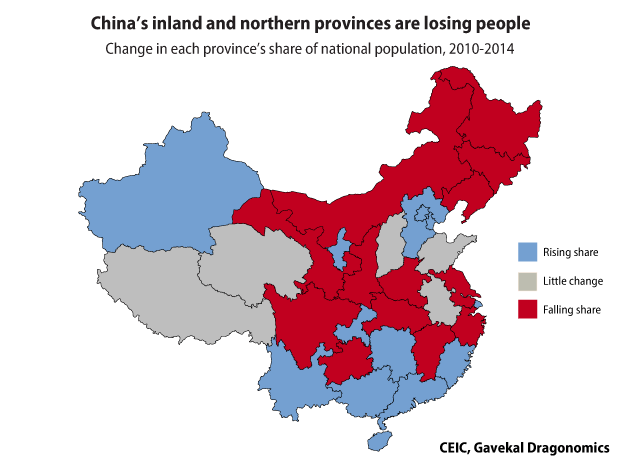
China’s Northeastern Rust Belt is headed for demographic crisis

We’ve been hearing a lot about the economic and political problems of America’s Rust Belt lately, so perhaps this is a good time to take a closer look at the slow-motion crisis that is unfolding in China’s northeastern Rust Belt. The Chinese newspaper Diyi Caijing (aka Yicai Media or China Business News) has over the past two months run a four-part series about the emerging demographic problems in the Northeast, and I think it pulls together what is known about the issue quite well.

This is harder than it might sound: a number of Northeastern cities have stopped publishing population figures in recent years, and data from the 2015 mid-cycle census update has not yet been published. But it seems more likely than not that the severe economic slowdown in the Northeast over the past couple of years has worsened the demographic trends that were already underway. When more data becomes available, which is likely to happen in 2017, the extent of the problem should become quite obvious. (For previous coverage of related issues, see: my maps of six decades of population flows in China; some history of the mass migration into the Northeast in the early 20th century; and portraits of industrial decay outside the Northeast)

Below I translate excerpts from all four articles, which I’ve reorganized a bit by topic (the original reports are here: Part 1, Part 2Part 3Part 4).

The first big problem is a dramatic decline in the birthrate:

The Northeast has a low birthrate, and population growth is stagnating. As early as 1982, the the total fertility rate in the three provinces of Liaoning, Jilin and Heilongjiang had fallen below the global replacement rate [of 2.33], to 1.773, 1.842 and 2.062 respectively, noticeably below the national average of 2.584. Afterward, as the one-child policy was implemented, the total fertility rate of the Northeast fell below 1.0, and in 2010, the the sixth population census showed that it was only 0.75.

What’s behind this fertility situation? There are a lot of state-owned enterprises in the Northeast, and they strictly implemented the one-child policy, so there were not many excess births.

As the “first born” of the People’s Republic, industrialization was earlier and more extensive in the Northeast than in other places. Large state-owned enterprises across the three northeastern provinces provided people with an enviable “iron rice bowl,” but also more stringent birth control. A 58-year-old Harbin taxi driver, Mr. Zhu, told this reporter that in those years, when he used to work at a state enterprise, the pay was high, the benefits were pretty good; he had a lot of face and more confidence in finding a partner. Everyone valued those state-enterprise jobs, so very few people were willing to lose the iron rice bowl in order to have more children than allowed. Even in the countryside, because of the large numbers of state farms and state forests, people needed to keep their iron rice bowls, so very few dared to violate the family-planning rules.

“All these years, among my colleagues, relatives, friends, there is not one who violated the family planning policy. Doing that would mean unemployment, so who would dare?” Mr. Zhu said.

Aside from the family-planning policy, a high urbanization rate is another important factor depressing the fertility rate in the Northeast. Research shows that the fertility rate is inversely related to the urbanization rate–the higher the urbanization rate, the lower the fertility rate. Urbanization in the Northeast preceded rest of the nation by decades. Statistics show that in 1975 the national urbanization rate was 17%, but in the Northeast it was already 35%; in 1990 the national rate was 26% and the Northeast was 48%; in 2010, the national rate reached 50%, but the Northeast was already 58%.

The second big problem is an exodus of people to other provinces:

The Northeast was once a place that attracted a major inflow of people–the “Chuang Guandong” [the massive migration of Han Chinese to Manchuria from the late 19th century through the 1940s] has even today left a deep impression in many people’s memories. But a net inflow of population is now history. According to the Liaoning Blue Book published by the Liaoning Academy of Social Sciences, the fifth population census of 2000 showed there had been a net inflow of 360,000 people into the three northeastern provinces over the previous ten years, but the sixth population census ten years later showed there had been a net outflow of 2 million people.

Luo Dandan, a researcher at the Heilongjiang Academy of Social Sciences, has spent years following up those survey results, and says that the outflow of people from the three northeastern provinces has sped up in recent years. Looking at individual cities, the trend of population outflow is also very obvious. Figures from the municipal statistics bureau of Qiqihar [in Heilongjiang province] show that city had net outmigration of 37,779 people in 2014; the figure was 25,381 people in 2013, so the the outflow is accelerating.

Luo says that in peacetime most population movements are for economic reasons, and that it is uneven economic development in different regions that drives workers to move to places with better job opportunities and higher wages. According to the National Bureau of Statistics, the average urban wage in the Northeast was 57,319 yuan in 2015, below the national average of 62,029 yuan.

Such an obvious gap in income levels drives many young people and technical personnel to choose to “migrate to the southeast like the peacock.” According to a cadre in the Heilongjiang province human resources and social security system, the outflow of university graduates is a major concern for him. Every year in the graduation period of May and June, the hotels near the Harbin Institute of Technology are fully booked with recruiters from Zhejiang and other coastal provinces.

The combined result of these two trends is a population that is aging rapidly:

Because the birthrate is low, the aging of the population in the Northeast is quite serious. According to Liu Kegu, a former vice-governor of China Development Bank, the median age of China’s population was 38 in 2015; but in the Northeast, it was 43, a level that the whole country is not expected to reach until 2027. One direct impact of an aging population is the burden of pensions. The dependency ratio of corporate pensions (the ratio of the number of workers in the pension program to the number receiving a pension) is 1.55 in the Northeast, far below the national average of 2.88. Liaoning is 1.79, Jilin is 1.53, and Heilongjiang at 1.33 is the lowest in the nation.

The low fertility rate has created a serious problem of fewer young people. Demographic statistics show that the Northeast’s share of youthful workers aged 20-39 has fallen from 10% in 1982 to 8.1% in 2010. And in 2010 the Northeast’s share of the population aged 0-19 was 6%, which means that in 2030 the Northeast’s share of the 20-39 youthful workforce will be 6% of the national total.

Zhou Tianyong of the Central Party School argues that this age group is the main economic force in the population, so the decline in the numbers of this group will have a great impact on the economy through labor supply, consumption, investment and other factors.

Another manifestation is the aging of the workforce. In terms of absolute numbers, the working-age population in the Northeast is still quite substantial, but one-third of this population is aged 45-64, so the aging of the workforce is indeed serious.

Population movement also further exacerbates the aging of the population in the Northeast. The Northeast has experienced a net out-migration of population for 20 years, and more than 60% of Northeasterners who leave do so for economic or business reasons. An official report has warned that, because of the fertility level and migration trends in the Northeast, the region is already locked into a trajectory of rapid population loss.

Is there anything to be done? The recent economic troubles have in fact gotten a lot of official attention, and the central government is backing a new version of the “Revitalize the Northeast” campaign. But it does not seem like the demographic aspects are being discussed much:

This reporter has attended many meetings on “Revitalizing the Northeast,” and heard many Northeastern governors and mayors discuss the road to revitalization, but unfortunately not one mentioned that the Northeast is facing a population crisis.

population-shift-2010-14

Still waiting for signs of real centralization in China

We’ve been hearing a lot lately about Xi Jinping’s “consolidation of power” within the Communist Party. But it is still far from clear whether all this consolidation has led to any fundamental change in the relationship between the central authorities and China’s many local governments. One commentator interprets Xi’s consolidation of authority, most recently in arranging for his own designation as the “core” of the leadership, as a way of ensuring that local-level cadres know that they need to follow Xi’s priorities and not anyone else’s. The most sympathetic account of Xi’s concentration of authority is that it is driven by his need to overcome local resistance to wide-ranging institutional and economic reforms (I don’t subscribe to this view myself, but it is held by some reasonable people).

These may indeed be among Xi’s intentions, but it’s hard to get a window on the Party’s internal operations to tell how successful he has been in carrying them out. Following the money is one alternative to reading the tea leaves: the institutions that drive the flows of money between central and local governments are certainly one very important aspect of how centralized, or not, China’s system might be. So here’s a chart to illustrate:

central-local

In the chart, the central government’s “own spending” is that financed by taxes collected at the central level, while local government “own spending” is that financed by taxes collected at the local level. The remainder is spending by local governments financed by taxes collected at the central level and then transferred to local governments. These transfers are one of the most important parts of China’s fiscal system, but they are often skipped over in discussions of central-local finances (I think in part because the statistics on them are somewhat fiddly and not easily available). Perhaps because of this gap, there is a widespread view that the main problem in China’s fiscal system is excessive centralization of revenues; as I have argued before, this view is totally wrong. In fact, as the chart shows the successful (and very necessary) fiscal centralization in 1995 has steadily and gradually eroded. And there has no been no notable reversal of this trend under Xi Jinping.

Arguably what is needed now is another round of rationalization and centralization of the fiscal system: the explosion of off-balance-sheet local government debt is one indication that actual decentralization is much more advanced than shown in my chart. This is one reason why I was  quite excited when Lou Jiwei was appointed finance minister in 2013. China has long been poorly served by its finance ministers, most of whom have been tax-maximizing bureaucrats rather than systematic economic thinkers. Lou by contrast has a clear view of the whole economy, and is known for his controversial public comments on matters like food imports and social benefits that most public officials will not touch. I’m sad to see him go now, since there is still a shortage of straight-talking economic thinkers at high levels of government. But while he has made progress on some important technical reforms, there has not really been a fundamental reshaping of central-local fiscal relations. Institutional inertia is probably the simplest explanation, but some blame probably also has to go to those in the system who have been arguing for even more fiscal decentralization.

So while we may be seeing attempts at various types of re-centralization in China, both in terms of political imagery and fiscal structure, it’s not clear yet that these attempts are succeeding, or must necessarily succeed. China in fact seems to be a good example of a thesis by the economic historian Charles Kindleberger about how the balance of power between central and local authorities tends to evolve:

Under normal circumstances, however defined, but with economic and social change occurring slowly, there is a strong preference for pluralism [Kindleberger’s term for local control]. Lesser units can experiment, adjust to local conditions, including tastes, compete with other cities and towns to their mutual benefit (as a rule). There is a possibility that local units give the individual more freedom, but this last in many communities is not guaranteed.

When a society is confronted with crisis, such as [war, depression, inflation], it is usually desirable, and in some cases necessary, to shift power to the center, especially if it has been widely dispersed. Such shifting, however, is not readily accomplished, and may not be possible at all because of institutional inertia.

The quote is from his Centralization versus Pluralism: a historical examination of political-economic struggles and swings within some leading nations, a somewhat obscure work that I did not know about until Perry Mehrling wrote about it in a different context.

The most famous Swede of his age

…was someone I had not previously heard of. I can’t resist posting another excerpt from Jürgen Osterhammel’s The Transformation of the World: A Global History of the Nineteenth Century,  one of the many fascinating bits of knowledge that are everywhere in this masterpiece. (And no, I’m still not finished. It is really long).

In the subsequent generation, Sven Hedin, having started his long career in 1894 with a research trip to Central Asia, became the most famous Swede of his age, with unfettered access to monarchs and heads of government in both West and East and adorned with countless decorations, gold medals, and honorary doctorates.

Hedin’s life encapsulates the contradictions of Europe’s relationship with Asia. Convinced of the general superiority of the West over the East, Hedin was an excellent linguist and scholar and at the same time a Swedish (and, from personal choice, German) nationalist and militarist, a man of the political Right, who enjoyed taking part in geopolitical fantasizing about a “power vacuum” in the heart of Asia.

But he was also one of the first Westerners to take contemporary Chinese science seriously and to cooperate with Chinese experts. He is held in high esteem in China today: a not atypical posthumous reputation, since quite a few European explorers, despite their activity in the service of empire, have been integrated into the collective memory of postimperial countries.

Osterhammel notes that there is no English-language biography of Hedin; I for one would read one. In the meantime, there is a reasonably extensive Wikipedia page.

Sven Hedin

Sven Hedin

The Politburo wants to fight regional inequality, but does it have the right tools?

A few months ago I noted that there was an unusually clear divide in how Chinese officials were talking about the renewed widening in regional inequality as overall growth slows. Many officials, up to and including Xi Jinping himself, see this phenomenon as a clear challenge to the Party’s egalitarian aspirations that must be fought with ever-greater infusions of money and government involvement. But some economic liberals, such as the “authoritative personage” sometimes featured in the pages of the People’s Daily, see the divergence as an unavoidable process as the economy reorganizes itself in the aftermath of an unsustainable investment boom.

Xi Jinping visits a poor area in Qinghai

Now the issue has gone all the way to the top, featuring prominently in the communique from the Politburo Standing Committee’s quarterly meeting on the economy. Two passages jumped out at me from the usual parade of slogans:

Economic trends continued to diverge, with large gaps in growth among regions, sectors and firms; there are still many conflicts and problems in the operation of the economy. (original: 经济走势继续分化,地区、产业、企业之间增长情况差异较大,经济运行中的矛盾和问题仍然较多。) …

The meeting held that a proactive fiscal policy should be effectively implemented, assuring appropriate fiscal expenditures, and increasing the level of support to extremely poor areas and provinces in difficulties. (original: 会议指出,要有效实施积极的财政政策,保证财政合理支出,加大对特困地区和困难省份支持力度。)

Neither a reference to regional divergence, nor an instruction to increase support to troubled regions, were in the statements issued after the previous Politbuto meetings on the economy in April and July. So it seems that this issue is moving higher up the agenda, and that the laissez-faire approach for dealing with it has been rejected.

Is this the right approach? There is already a fair amount of central government support to the poorer provinces, and while it’s hard to assess exactly how much redistribution is happening, it is probably the case that there is less redistribution in middle-income China than in higher-income countries. So there is probably a case for increasing redistribution over time anyway. My question is more about how the redistribution happens: in China a lot seems to happen through centrally-funded investment projects or grants to local governments.

In the US, by contrast, regional redistribution seems to happen mostly as the automatic consequence of the combination of a progressive income tax and social welfare benefits: in regions with more high-income households, those households pay in more taxes and receive less in benefits, while the reverse is true in regions with fewer high-income households (see this short paper from the San Francisco Fed for a useful summary). Both the federal income tax and federal benefits are direct interactions between the federal government and households, while in the Chinese system it’s much more about moving money between the central and provincial governments, as well as using off-balance-sheet spending by state-owned enterprises.

The Chinese style of regional redistribution may have some undesirable consequences: there’s a high correlation at the provincial level between receiving more fiscal transfers from the central government, and having an economy more dominated by state firms. This pattern probably does not help the receiving provinces become more economically self-sustaining over time. So while increasing redistribution could be a reasonable response to current conditions, there’s more than one way to do that. And ramping up government-sponsored investment projects even further is not necessarily the best way. Indeed, I suspect dislike of these potentially wasteful and corrupt projects is one reason why economic liberals are not so enthusiastic about regional redistribution as a policy priority.

An alternative would be do to more redistribution directly to households, through the tax and social welfare system. Indeed, Brad Setser (albeit in a rather different context, continuing our conversation about investment and savings) proposes a deficit-financed restructuring of the social welfare system, involving lowering (very high) social insurance contributions while increasing (still low) public health insurance benefits.

He’s not the first to suggest that a redesign of the tax and benefit system in China could help deliver some short-term stimulus as well as address some longer-term structural problems (such as the hukou system and regional inequality). That would seem to make this a potentially very attractive option. And I agree that, while there are a lot of moving parts, such a policy shift could potentially be very beneficial. Yet it says something about the current impoverished state of public policy debate in China that there is, as best as I can tell anyway, not a lot of serious public discussion of such a change.

What I’ve been listening to lately

A double helping of old country:

  • The Carter Family – Volume 2: 1935-1941. Commentary on roots music tends to favor the old–the earlier and scratchier the recording the better, the closer it is to the mythological source. The Carter Family’s 1928-29 recordings, featured on the Anthology of American Folk Music, are officially legendary. But these later ones are often more listener-friendly, with better sound quality and more assured performances. An amazing wealth of songs.
  • The Delmore Brothers – Classic Cuts 1933-41. Another treasury of classic country tunes, sometimes a bit bluesy, sometimes almost a proto-bluegrass. The very pure, clear and uninflected vocals actually take some getting used to, so far is their style from the extroverted emotionalism that has been the norm in more recent decades of popular music.

Plus the usual jazz miscellany:

  • Jimmy Giuffre – The Life Of A Trio: Sunday. Jimmy Giuffre has been developing his particular version of jazz minimalism since the late 1950s, and always getting better along the way. These 1989 recordings reconvene his famous 1961 trio with Paul Bley on piano and Steve Swallow on bass; the result is strong and fresh and not at all a nostalgia session.
  • Ran Blake – Short Life Of Barbara Monk. An overlooked classic from the unheralded year of 1986. The lineup is solidly traditional–tenor sax, piano, bass drums–but the approach is fascinatingly untraditional and melodic.
  • Lee Morgan – The Procrastinator. A standout 1967 Blue Note session with an unbeatable lineup–Wayne Shorter and Bobby Hutcherson–and great tunes. This brand of advanced hard bop is for many people the absolute pinnacle of jazz. I’m not one of them–for me, Duke Ellington and Sun Ra will always be the top–but it’s recordings like this that make that taste an understandable one.

Can our imagination cope with the inevitability of inequality?

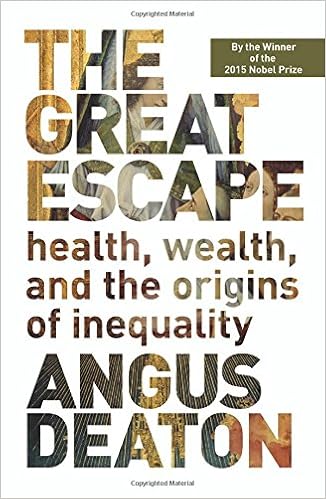
Still catching up with last year’s Nobel Prize winners, I recently read Angus Deaton’s book The Great Escape: Health, Wealth and the Origins of Inequality. It is marvelously clearly written, and covers the history of improving health and economic growth in a distinctive way.

One of the book’s strongest insights is right there in the title. It is one of those ideas that seems so simple at first that it is almost trivial, but in fact becomes more and more powerful on further reflection. As Deaton puts it: “inequality is the handmaiden of progress.” Or, “a better world makes for a world of differences.” It is in the nature of progress that it creates inequality between those who benefit first and everyone else:

Escapes leave people behind, and luck favors some and not others; it makes opportunities, but not everyone is equally equipped or determined to seize them. So the tale of progress is also the tale of inequality. … Not everyone gets rich at the same time, and not everyone gets immediate access to the latest life-saving measures, whether access to clean water, to vaccines, or to new drugs for preventing heart disease.

Even if progress continues in the future, which Deaton is cautiously optimistic it will, this will inevitably produce new inequalities (even if old ones are also reduced).

This theme is also at the center of a recent and quite interesting short essay by Michael Lind, in which he argues that the ways we imagine the future have consistently failed to take account of this fact that progress is inseparable from inequality:

Science fiction traditionally has had the task of providing us with alternative visions of the future. For the most part, it has done a terrible job. The main reason for its failure is that it assumes global uniformity. …

The last time all human beings were more or less at the same level of technology and social organization was the Paleolithic Era. …By 2100 or 2200, most people on earth may be urbanites equipped with modern technology, not peasant farmers. But even in an industrialized world of wage workers and cities, the gaps between rich and poor regions are likely to remain enormous. Even as some backward areas catch up, innovative regions will shoot ahead.

The essay argues that futures that are imagined as uniform have often proved a completely unreliable guide to the actual course of events. In reality, progress produces differences among countries, which in turn create great-power rivalries, wars, and migration–all unavoidable features of our contemporary world. Thinking about progress as uniform is not just incomplete, but fundamentally misleading.

But Lind of course is really talking about politics not just the literary genre of science fiction. The example he closes with is the world government so often imagined in science fiction, with its real-life echoes in idealistic international schemes like the United Nations and the European Union. World government has of course become steadily less likely not more likely over time, and the assumption that the natural course of progress is for more homogeneity and more integration has also been sorely tested of late.

Both Lind’s essay and Deaton’s book (particularly the first half) are very much worth reading and pondering.

Jürgen Osterhammel unearths the “prehistory of the present day”

I tend to like my nonfiction books compact in size and focused in argument–as an old hack I prefer prose that is tight–but two of my favorite reads this year have radically defied this rule. Robert Tombs’ The English and Their History, which I started last year but did not finish until January, is a thousand pages in length in the print edition, basically every one of which is delightfully written and filled with interesting information (the book has been widely praised already but continues to win fans, such as Dan Wang).

The latest tome that has engrossed me almost despite myself is Jürgen Osterhammel’s The Transformation of the World: A Global History of the Nineteenth Centurywhich I bought on a whim when it made a (rather surprising) appearance as Kindle daily deal. His approach is really the exact opposite of Tombs’: narrative is rejected more or less entirely in favor of a thematic and topical approach. This strategy in fact helps keep the book consistently interesting, despite its enormous length (I’m only about two-thirds through): the treatment of each topic and subtopic is quite focused, with well-chosen facts and balanced judgments delivered in snappy sentences.

One of the book’s themes is, as he says early on, that “the nineteenth century belongs to the prehistory of the present day.” This is far from the only theme, and indeed some of the my favorite parts of the book focus on aspects of the 19th century that are quite different from 20th- and 21st-century experience (the chapter on frontiers is a particular highlight). But it is one of the delights of the book to repeatedly come across little origin stories of various aspects of modern life. Here a few examples, starting with basic stuff like foreign policy:

In the nineteenth century it is possible to speak for the first time of an international politics that sets aside dynastic considerations and obeys an abstract concept of raison d’état. It presupposes that the normal unit of political and military action is not a princely ruler’s arbitrary patrimonium but a state that defines and defends its own borders, with an institutional existence not dependent on any particular leadership personnel.

And economic and social statistics:

The nineteenth century can be seen as the century of counting and measuring. The idea of an all-embracing taxonomy now grew into a belief that the power of number—of statistical processing or even “social mathematics,” as the Marquis de Condorcet, a bright star of the late Enlightenment, put it—could open up truth itself to human reason. It was in the nineteenth century that societies measured themselves for the first time and archived the results.

Also major social phenomena like mass migration:

No other epoch in history was an age of long-distance migration on such a massive scale. Between 1815 and 1914 at least 82 million people moved voluntarily from one country to another, at a yearly rate of 660 migrants per million of the world population. The comparable rate between 1945 and 1980, for example, was only 215 per million. …Diaspora formation as a result of mass migration was ubiquitous in the nineteenth century. Only the French stayed at home.

And branded consumer goods:

The 1880s saw the birth and marketing of the branded product, with strategies planned like military operations. Singer’s sewing machine and Underberg’s herb liqueur in its characteristic bottle were present at the dawn of brand-centered marketing. It could develop because the serial production of articles of mass consumption was now a technical possibility. … Branded goods rapidly spread around the world, so that by the early years of the new century the petroleum lamp burning oil from Rockefeller’s Standard Oil Company, along with Western artificial fertilizer and cigarettes, could be found in remote Chinese villages.

Suburbs:

Suburbanization, understood as a process whereby outlying areas grew faster than the inner core and commuting became a normal part of life, began in Britain and the United States around 1815. It would eventually be taken to extremes in the United States and Australia, whereas Europeans would never develop such a fondness for living outside the city center. … The technically advanced suburb of 1910 still feels close to us today: we describe it without hesitation as “modern.” In comparison, the pedestrian city of the early nineteenth century was positively medieval.

Beach vacations:

By 1840 the bathing resort had taken shape in England and Wales, with most of the characteristic features that we still see today. The prototype was Blackpool on the West Coast, whose 47,000 permanent residents catered (in 1900) for more than 100,000 vacationers. …Subsequently the seaside resort owed its growth to increased leisure time, greater affordability, and good railway and highway connections. By the turn of the century there were coastal resorts of more or less the same kind all around the central Atlantic and the Mediterranean, on the shorelines and islands of the Pacific, on the Baltic Sea, in the Crimea, and in South Africa.

And a phenomenon that I did not even think of as particularly modern, the dominance of coastal cities:

The nineteenth century was the golden age of ports and port cities—or more precisely, of large ports, since only a few could handle the huge quantities involved in the expansion of world trade. In Britain, exports in 1914 were concentrated in twelve port cities, whereas at the beginning of the nineteenth century a large number of cities had been involved in shipping and overseas trade. … It is probably the case that in every historical era before the nineteenth century, most of the largest cities and main centers of power or cultural splendor were not situated on the coast: Kaifeng, Nanjing, and Beijing; Ayudhya and Kyoto; Baghdad, Agra, Isfahan, and Cairo; Rome, Paris, Madrid, Vienna, and Moscow; and not least, Mexico City.

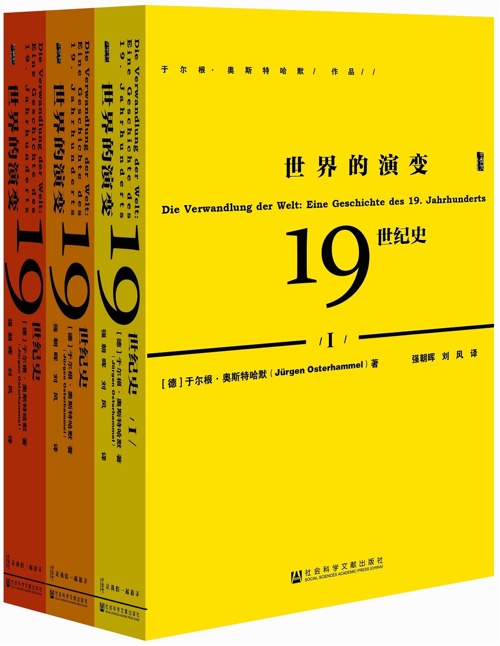
But this barely begins to convey the huge scope and wonderful variety of the book. A Chinese translation will be published in November, allowing me to recommend it to more friends.

osterhammel-chinese