What will China do about its zombie companies?

One of the more interesting developments in official Chinese discussions about the economy has been the appearance of the term “zombie companies”; Premier Li Keqiang himself has repeatedly used the term. It’s a loose shorthand for a problem that everyone knows about but is difficult to precisely define: money-losing companies that seem to stay alive far longer than economic fundamentals warrant. This problem is particularly acute in the commodity sectors: a global supply glut has driven down prices of iron ore and coal to multi-year lows, levels where China’s relatively low-quality and high-cost mines have difficulty being competitive. And yet they continue operating despite losing money, because it is easier to keep producing than to completely shut down. An excellent story this week in the China Economic Times on the woes of the coal heartland of Shanxi quoted one executive saying, “If we produce a ton of coal, we lose a hundred yuan. If we don’t produce, we lose even more.”

The incentive problem is very clear. If many companies shut down, output would fall and prices would rise, and the remaining companies would be more profitable. However every company wants to be one of the companies that is left standing rather than one of the companies that shuts down, and so they do everything they can to continue operating. They can also usually count on help from banks and local governments, who want to avoid the financial and social impact of a large employer closing. This is why there are increasing calls for the central government to break the logjam and organize the closure of excess capacity that market mechanisms should be producing. Indeed, I translated on this blog a very interesting proposal from the State Council’s Development Research Center on how to do exactly that.

The fact that top leaders are now talking openly about zombie companies could indicate some progress on this issue. So here’s another relevant translation: a recent interview with Feng Fei, a senior industrial official. Feng is also one of China’s top scholars of industrial policy, and in fact spent many years at the DRC. In October he was elevated to one of the vice-minister jobs at the Ministry of Industry and Information Technology, which has bureaucratic responsibility for most of the sectors with lots of zombie companies. His interview with Caijing magazine is short but to the point. He diagnoses the problem and its consequences very clearly, but hedges a bit when asked what the government is going to do. However he seems to indicate that the current preference is to deal with zombie companies by encouraging stronger companies to take them over–which I think is not as good a solution as the one the DRC has already proposed.

Reporter: Why is the exit of “zombie companies” being discussed now? What is the background to this question?

Feng Fei: There is not yet a consensus view about “zombie companies.” My understanding is that “zombie companies” refer to companies that have been losing money for a long time, and which have no hope of turning around or smoothly exiting the market. Currently the problem of “zombie companies” is very prominent, and this is related to three major issues in the economy.

First, China’s economic growth has entered a “new normal.” Downward pressure on the economy has increased, and the external environment for business is getting tougher. There are some companies whose technology, management and so forth are relatively poor, and who are finding it difficult to adapt to the new situation and to market changes, and as a result have fallen into serious trouble.

Second, there is serious excess capacity in some industries, resulting in a continuous decline in product prices and a fall in corporate profits. There are some sectors in which all companies are losing money, and operations are very difficult. For instance, in the third quarter of this year, the steel industry’s profit margin on sales was only 0.05%, and the sector’s total profits declined 97.5%; nearly half of the companies in the sector are loss-making.

Third, the market system is not robust: there are still some institutional obstacles that result in “zombie companies” finding it difficult to exit according to market rules.

Reporter: In more specific terms, what harm do “zombie companies” bring to China’s economy?

Feng Fei: The existence of a large number of “zombie companies” hinders China’s economic transformation and the upgrading of its industrial structure, and also increases macroeconomic risks.

First, these companies are holding on to a lot of resources, hindering the effective resolution of excess capacity. “Zombie companies” have low profitability, but take up a lot of land, capital, energy, labor and other resources, and prevent these resources from flowing to more profitable sectors, resulting in a serious waste of resources. You could even say that if “zombie companies” do not exit the market, the problem of excess capacity cannot be fundamentally solved, and it will be very difficult to achieve structural adjustment and industrial upgrading. Only if enough companies exit will there be enough companies entering.

Second, it undermines the market principle of survival of the fittest. Because of social stability considerations and other issues, there are efforts to preserve “zombie companies” and give them blood transfusions. This results in unfair competition, and could even cause a Gresham’s Law phenomenon [in which the bad drives out the good].

Third, it may lead to financial risks. “Zombie companies” have a lot of debt, which if not dealt with in a timely manner will result in an increase in banks’ non-performing loans. When you add in the complex chain of inter-enterprise debt, the problem becomes serious, and could lead to systemic risk. Therefore the State Council is paying great attention to this issue, and has required [us] to handle the “zombie companies” issue.

Reporter: If it is so urgent for “zombie companies” to exit the market, why has this been a difficult issue for so long? Why is it hard to establish a mechanism for market exit?

Feng Fei: “Zombie companies” can be dealt with in two ways, through market-oriented mergers and restructuring, or bankruptcy according to law. The handling of “zombie companies” will be more through restructuring, and less through bankruptcy, and will also ensure social stability. In terms of these methods, China has considered the design of the system, but has faced some difficulties and problems in terms of actual operation, and a complete system for market exit has not yet been formed.

First, in the restructuring and bankruptcy processes, there are difficulties with the placement of workers, the debt burden, and historical issues, which increase the cost of restructurings and bankruptcies. This is an obstacle to “zombie companies” exiting the market.

Second, some local governments interfere in the normal process of bankruptcy and market exit because of considerations related to preserving jobs, maintaining social stability, or the worries of banks and other creditors about bad debts.

Third, China’s “Bankruptcy Law” needs to be further clarified and refined. Although it has already been revised several times to adapt to the market economy, there are still some regulations that are more like general principles.

Fourth, in the context of increasing downward pressure on the economy, many sectors do not have a clear outlook, and firms face financing difficulties, which means they have little interest in pursuing mergers and corporate restructuring.

Finally, the current economic situation increases the risk and the consequences of corporate bankruptcies, which means that many parts of society are very wary toward bankruptcies and restructuring.

…

Reporter: According to the State Council, the Ministry of Industry and Information Technology is in charge of researching and promulgating policies on “zombie companies.” What is your plan for this work?

Feng Fei: MIIT will step up its research and survey work, find out the true situation, and figure out the major difficulties and problems in “zombie companies” exiting the market. In conjunction with relevant departments, we will research policy measures to handle “zombie companies,” improve the market, legal and policy environment, and improve the exit mechanisms for “zombie companies.”

The exit of “zombie companies” requires a proper relationship between the government and the market. The role of government is mainly to provide the necessary support for displaced workers, not to rescue companies, and to make the exit as smooth and quick as possible. At the same time, we will adhere to the policy of “more mergers, fewer bankrutpcies,” so that more exits of “zombie companies” happen through mergers and restructuring. This will result in appropriate placement of workers, reduce the impact on society, reduce the economic risk, and raise the quality and efficiency of economic development.
The best books I read in 2015

Here are my favorites out of the books that I read for the first time in 2015, regardless of date of publication (the same rules as previous instalments). This year I (in hindsight anyway) favored fiction about poor white people living in harsh conditions; in non-fiction there were some very good China books, which I do not often recommend. The lists are alphabetical by author, since I find it hard to rank books.

Nonfiction

  • The Night of the Gun, by David Carr. It was only after this legendary journalist died early this year that I discovered he had written a memoir. I generally don’t have much time for memoirs, but this one grabs you from the opening and never lets go. In an an unflinchingly honest investigation into his own past, he destroys all the convenient fictions about his past that he himself had come to believe. Few people have ever been better at calling bullshit.
  • The Utopia of Rules, by David Graeber. Graeber is the only current example I know of a public intellectual who is an anthropologist (a species whose influence has always lagged economists, historians and sociologists). He’s a clear and vigorous writer, and is good at mining the minutiae of daily life for broader insights. These essays are always thought-provoking, though there is always plenty to disagree with.
  • Exit, Voice and Loyalty, by Albert O. Hirschman. A legendary work of social science that fully lives up to its reputation–there are more ideas per page than in anything else I read this year. This 1970 book contains, among other things, a startlingly prescient analysis of how American political parties work, and reflections on the relationship between producers and consumers that provide a ready-made conceptual framework for understanding internet commerce. I’m still digesting it.
  • Why Did Europe Conquer the World?, by Philip T. Hoffman. An admirably clear and concise entry in the genre of big-idea books explaining European dominance. Though there are lots of interesting historical tidbits in the book, it is less a narrative than the presentation of a model that that explains why Europeans could conquer so many other peoples. The clarity of his model also allows him to make good comparisons and to think through counterfactuals very logically. More history should be written like this.
  • Meditations, by Marcus Aurelius. Okay, I know it’s a bit corny to put Meditations on a list like this, but it fits: I had not read it before, and it is certainly one of the best things I read this year. I doubt I have much to add to the centuries of commentary on this work already out there, but it’s instantly clear why this book is a classic: its immediacy and directness are almost shocking. I read the fairly new Gregory Hays translation, which is very clear and contemporary sounding; I’d be interested to see if other translations read very differently.
  • In Manchuria, by Michael Meyer. It’s a real pleasure to see a popular and nicely written book on my favorite part of China. It mixes memoir and reporting on rural conditions with a quixotic attempt to recover the mostly-forgotten history of northeast China. A reminder of how many stories about China still remain to be told.
  • China Under Mao, by Andrew Walder. An excellent and very clearly written analytical history of China under socialism. Despite the title, it is not a book about Mao per se, but really an effort to understand the economic and social systems that the Communist Party created under Mao’s leadership, and of the problems those systems in turn created. The account of the early days of Communist rule and the gradual transition to the planned economy is excellent, as is the comparison of how China fit into the development of other Communist states globally.

Fiction

  • Fourth of July Creek, by Smith Henderson. A vivid and emotionally intense novel about some rather bleak lives in rural Montana (what we used to call poor white trash). There are a couple of larger plot threads, involving a survivalist who may be a terrorist, and the protagonist’s search for his lost daughter, that flirt with the conventions of the thriller. But these help give structure to the daily struggles of our characters rather than distract from them.
  • Get Shorty, by Elmore Leonard. Joan Acocella’s retrospective of Leonard’s career was the prod for me to check out this universally-praised writer, and her recommendations did not disappoint. An endlessly amusing novel whose twists repeatedly threaten to turn into an ordinary mystery plot, but thankfully never quite do so.
  • Aurora, by Kim Stanley Robinson. A very unusual book: an epic piece of hard science fiction about why space flight is a bad idea. The polemical component of the book leaves it open to nitpicking from space geeks, but it is nonetheless a compelling and emotionally authentic story. Robinson is certainly on a roll of late–after a few books I found somewhat uninspiring, he has in short succession delivered both this book and Shaman, which was on my best-books list last year (Shaman I think has been underpraised relative to Aurora; it is a less polemical and better book).
  • Air: Or, Have not Have, by Geoff Ryman (late addition). A moving and vivid portrait of how an unpredictable new technology changes village life. A rare example of that tiny genre, science fiction for development economists.
  • The Greenlanders, by Jane Smiley. An unforgettable portrait of a people on the brink of social breakdown and environmental disaster, this 1988 novel is easily one of the best things I have ever read. Both the subject and the style recall the great medieval Nordic sagas, with their dry humor and matter-of-fact approach to death and dismemberment. Smiley pulls off the difficult trick of not having a single protagonist–the focus of the narrative moves among a number of different though related figures–without confusing the reader or losing the thread. We see the ups and downs in a family’s daily life, and how small events ramify into years-long feuds with enormous consequences. Altogether completely engrossing and convincing, historical fiction at its best. I don’t think I really have the same taste in books as Jonathan Franzen, but it’s nonetheless interesting that in 2012 he called this the best American novel of the last 20 years.
  • The Color of Money, by Walter Tevis. I have no memory of seeing the 1986 film with Tom Cruise and Paul Newman so I came to the book fresh. The story arc is simple: aging pool player tries to get his mojo back. But there are lots of surprises along the way, and the emotional struggles are as compelling as the action in the poolhall. Tevis had a fondness for the novel of competition–his The Hustler (also pool) and The Queen’s Gambit (chess) have the same structure–but this one is the best of the lot.
  • Annihilation, Authority, and Acceptance, by Jeff VanderMeer (aka the Southern Reach trilogy). Stunning and truly unique works of imagination. They are clearly inspired by H.P. Lovecraft, but unlike Lovecraft they are actually good: hallucinatory but also emotionally powerful, and distinguished by a close and loving attention to the landscape (which is unnamed but clearly the coast of the Florida panhandle).
  • 361, by Donald Westlake. I thought I had already read most of the classics of hard-boiled crime fiction, but occasionally I still find a great one. It’s hard to describe without giving too much away, so I won’t.

Genre fiction runners-up

All of these books I quite enjoyed and would happily recommend for a read on the beach or a plane ride, but they each had some weaknesses that don’t allow me to in conscience say they were among the best things I read this year.

  • The Library at Mount Char, by Scott Hawkins. Ancient gods walk among us, and they are mean.
  • Radiant State, by Peter Higgins. A warped retelling of the rise of Stalin, with golems, aliens, witches and suchlike.
  • Europe in Autumn, by Dave Hutchinson. Political thriller in a divided future Europe.
  • Seveneves, by Neal Stephenson. Classic problem-solving science fiction with plenty of orbital mechanics: what to do when the Moon blows up?

Looking back on my first year of blogging

This blog went live to the public approximately a year ago this week. What have I learned?

The main lesson is that blogging is good fun, as I always suspected. I was a newspaper journalist during the golden age of blogging, ca. 2005-10, and hence not really allowed to have a personal blog (I have however archived some of my favorite pieces from my Wall Street Journal days on this blog).

While these days I am no longer forbidden from blogging (thanks boss), I still edit and write thousands of words a week for my day job. So I don’t really have the capacity to do high-frequency blogging, but it’s still been great to have a venue for writing different kinds of things. A change is a good as a rest, as they say, and changing gears to do a bit of blogging in fact relaxes and clears the brain. The mainstream of this blog has still ended up being the Chinese economy, since that’s what is in my head most of the time. But I have tried to maintain some variety, since the main purpose of this blog is entertaining myself.

In fact, the two posts that got far and away the most traffic this year were probably the my least typical and most offbeat ones–which is in fact very pleasing. I had lots of fun writing those pieces; they had been bouncing around in my head for a long time looking for an outlet, which the blog finally provided. The winners were:

Some of my wonkier economic discussions about China also got decent traffic, though not the same order of magnitude as those top two:

But there was of course lots of stuff on the blog that I thought was great but which, strangely, the collective wisdom of the internet disdained. It is sad and baffling to me that Lost masterpieces of jazz-gamelan fusion resurface was not more popular. Come on people, this is important stuff! It’s what I want from the internet anyway.

On the other end of the spectrum, one of my more substantive pieces about the Chinese economy (On regional gaps, the growth slowdown and the missing middle-income trap) did not generate much in the way of traffic or comments–a disappointment as I was looking for more feedback. Maybe I should have worked harder to come up with a catchier title.

Another lesson I have learned, like many small internet publishers before me, is the importance of the aggregators. For this blog, the two most reliable drivers of traffic have been Bill Bishop and his Sinocism newsletter, and Tyler Cowen at the Marginal Revolution blog. Thanks for the links guys, I owe you both a beer.

David Moser recalls the early days of the Chinese jazz scene

David Moser’s piece at The Anthill, “The Book of Changes: twenty-five years in Chinese jazz” is truly delightful and a must-read. Here is one excerpt:

One striking characteristic of Chinese jazz musicians was their uniform reverence for Miles Davis. Almost to a person they preferred the spare, cooler style of Miles to the rapid pyrotechnic displays of other jazz artists. They pointed to his use of empty space and understatement, “saying more with less”, all preferences that, it seemed to me, had a resonance with Chinese visual arts. The best selling jazz album of all time is Miles’s classic Kind of Blue. In the liner notes to the album, pianist Bill Evans compared jazz improvisation to the art of calligraphy. I remember at the time thinking that it was a gratuitous comparison, a trendy invoking of Oriental exoticism. But it turned out my Chinese musician friends also saw commonalities in the two disciplines. The calligrapher, like the jazz artist, spends a lifetime mastering the basic forms in preparation for a spontaneous moment of creation, during which the artist must act in a non-deliberative way to produce one continuous, expressive “line” – for the calligrapher in space, for the jazz player in time – without the option of revising, restarting or rethinking. Each time the result is a unique form reflecting the artist’s mental and emotional state at that moment. Miles’s philosophy of jazz seemed to echo centuries of Chinese aesthetics. He famously told his sidemen, “Don’t play what’s there, play what’s not there.” If that’s not Daoism, what is?

And another:

Our group played nearly every Saturday for four years. The audiences were small but attentive, and I enjoyed the barrage of questions we received after. Puzzled by the long improvised solos, people asked me “How are you musicians able to memorize all those complicated melodies?” I told them that the music was completely ad-libbed, not memorized. “Well, without a score, how can you tell a wrong note from a right one?” Indeed. Or, “If the music is all improvised, then why bother to practice?” And, “How come the trumpet and saxophone all seem to take turns playing, while the drums, bass, and piano play all the time? They should be paid more!”

Many thanks to David for writing all this down. There are also a couple of nice photos showing some musical luminaries in their awkward youth.

Lessons from Douglass North, plus an amazing GDP chart

I was sad to hear of the passing of the great Douglass North earlier this week (there are obituaries from the Economist, New York Times and Washington University in St. Louis, the last focusing on his teaching). While I cannot claim deep knowledge of North’s whole body of work, I loved his book Violence and Social Orders, co-authored with John Joseph Wallis and Barry R. Weingast. Amazingly enough, the book completely lives up to its subtitle: A Conceptual Framework for Interpreting Recorded Human History. North was a social scientist who, like Gellner and Levi-Strauss, aimed straight for the big questions about what modern life is; most economists do not even know how to ask those questions let alone answer them.

The book is difficult to summarize simply so I won’t try–but one of the lessons I learned from it is in fact pretty simple. The difference between good institutions and bad institutions in terms of economic growth is not that good institutions generate higher growth. Rather, countries with good institutions are flexible and better at responding to changing conditions, so they have fewer and shallower economic downturns. That results in a higher rate of trend growth over the long term. It’s a powerful and intuitive idea: the important thing is not finding the secret sauce for economic growth, but avoiding and recovering from mistakes. Here is the relevant passage:

An underappreciated feature of the different patterns of social orders relates to why poor countries stay poor. Economic growth, measured as increases in per capita income, occurs when countries sustain positive growth rates in per capita income over the long term. Over the long stretch of human history before 1800, the evidence suggests that the long-run rate of growth of per capita income was very close to zero. A long-term growth rate of zero does not mean, however, that societies never experienced higher standards of material well-being in the past. A zero growth rate implies that every period of increasing per capita income was matched by a corresponding period of decreasing income. Modern societies that made the transition to open access, and subsequently became wealthier than any other society in human history, did so because they greatly reduced the episodes of negative growth. …

Strikingly, the richest countries are not distinguished by higher positive growth rates when they do grow. In fact, the richest countries have the lowest average positive growth rates by a substantial amount. …When they grow, poor countries grow faster than rich countries. They are poor because they experience more frequent episodes of shrinking income and more negative growth during the episodes. Countries below $20,000 income do not exhibit a strong relationship between income and positive growth rates. The same is not true for the relationship between income and negative growth rates. …The poorest countries experience both more years of negative income growth and more rapid declines during those years…

All societies are subject to random and unpredictable changes in the world around and within them. Changes in external factors like climate, relative prices, and neighboring groups as well as changes in internal factors like the identity and character of leaders, internal feuds and disputes, and relative prices all contribute to persistent alterations in the circumstances with which societies must cope. The variations in the economic performance of limited and open access societies over time reflect the inherent ability of the two social orders to deal with change. …There is no teleology implied by the framework. Nonetheless, the framework illuminates why open access societies are better than natural states at dealing with change.

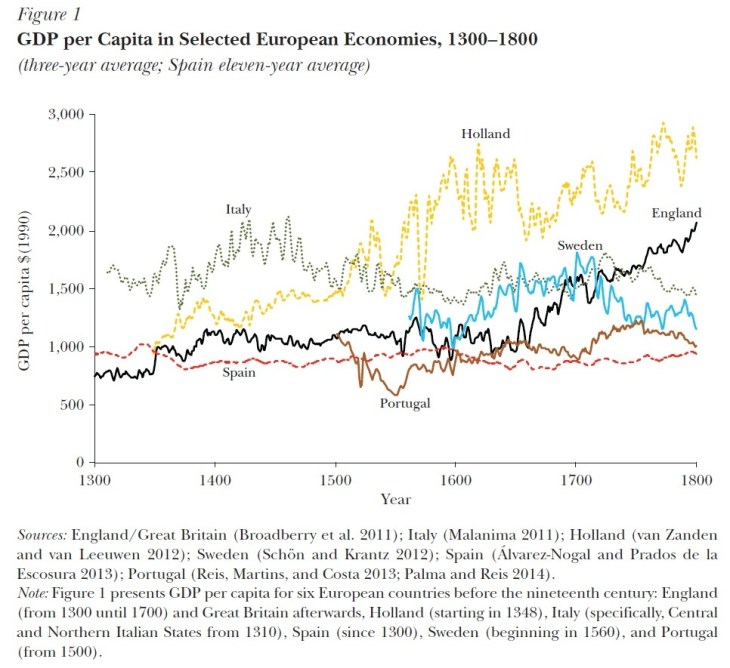
The latest historical economic research in fact seems to strongly support North’s thesis. The new issue of the Journal of Economic Perspectives has a nice review article on recent work compiling long-term GDP series for several European countries. There is only one chart but boy is it a doozy–just think of all the years of scholarly effort that went into creating these data series:

seven-centuries

The chart seems to very much supports North’s thesis: historically there were indeed many episodes of growth, but they were usually followed by significant reversals. At least, until the Industrial Revolution in England came along and delivered much more consistent gains. Here are the authors, Roger Fouquet and Stephen Broadberry:

The new data shows trends in GDP per capita in the key European economies before the Industrial Revolution, identifying episodes of economic growth in specific countries, often lasting for decades. Ultimately, these periods of growth were not sustained, but they noticeably raised GDP per capita. It also shows that many of these economies experienced periods of substantial economic decline. Thus, rather than being stagnant, pre-nineteenth century European economies experienced a great deal of change. …

The paper tentatively finds that the likelihood of being in a phase of growth increased and the risk of being in a phase of decline decreased in the nineteenth and twentieth centuries. …Between the fifteenth and eighteenth century, there was an average of two economic downturns per country per century, while the nineteenth and twentieth centuries experienced less than one economic downturn per country per century. In the fifteenth and sixteenth centuries, economic downturns occurred about 8 percent of the time; in the seventeenth and eighteenth centuries, they were experienced 4–5 percent of years; and, in the nineteenth and twentieth centuries, downturns occurred 2–3 percent of the time. Thus, there appears to have been a modest reduction in the likelihood of experiencing downturns over the centuries from the fifteenth century. …Explaining the source of these differences could prove to be important for understanding how economies managed to generate sustained economic growth.

Looks like North was onto something.

Will the New Silk Road be smooth or bumpy?

I feel like too much of the media coverage of China’s New Silk Road initiative (the official slogan is the rather unfelicitous “One Belt, One Road“) focuses on explaining and understanding the intended consequences: What is China’s plan? How much money is it going to spend? How much influence will it win? etc etc. This is understandable, since the whole program is apparently large, probably important, and rather confusing. But now that the basic outlines are increasingly well understood (China wants to spend a lot of money on infrastructure projects in developing countries to boost its geopolitical influence and swell the order books of its SOEs), I think we should put more effort into understanding the potential unintended consequences. After all, if there is any lesson about China’s ambitions that we can learn from history, it is that large amounts of foreign capital flowing into smaller economies can have many unintended consequences.

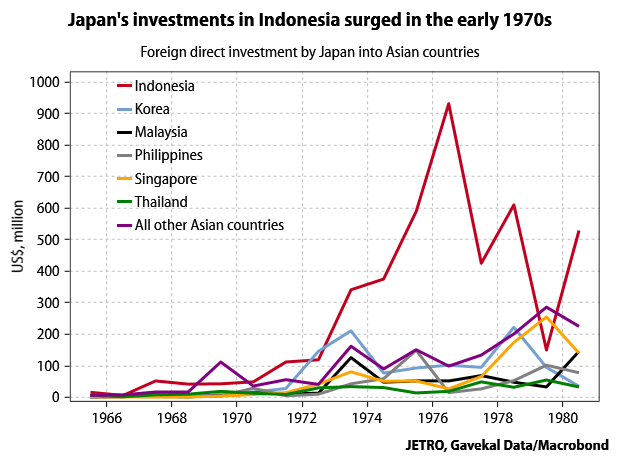
Using a simple but surprisingly useful rule of thumb–China is like Japan but a few decades later and ten times bigger–we can look to Japan in the early 1970s for some interesting parallels. Japan’s outward investment only really started to take off in the early 1970s, as exchange controls were relaxed and the first wave of resource-driven projects was succeeded by projects aimed at developing markets for Japan’s manufactured goods (sound familiar yet?). The major destinations for its FDI were Europe, North America, and Southeast Asia, and among Asian countries none received more Japanese investment than Indonesia. But the Indonesians did not perceive this as an unequivocally good thing, and in January 1974 a visit by prime minister Kakuei Tanaka sparked massive demonstrations. The so-called Malari riots ended up being a very consequential event for Indonesia, as they sparked a domestic political reshuffling and a turn toward policies favoring local businesses:

Unhappiness over rising food prices, rice shortages, and the growing power of Suharto’s personal assistants had been stewing for more than a year. The number of business ventures undertaken by Chinese businessmen with high-ranking military men continued apace, and it was apparent that the president was clearly taking no action at the widespread corruption. At the same time, foreign capital was flowing in, most obviously by the Japanese, who were courted by Suharto’s financial advisors.

The Japanese had been taking a more high-profile role in the country, providing up to one-third of Indonesia’s foreign economic assistance. An academic noted: Japanese aid was “large and visible, and that much of it was tied to the purchase of goods manufactured in Japan was widely known and criticised. It was assumed…that the principal aim of the aid was to develop markets for Japanese products.” The growing presence of the Japanese in Indonesia sparked resentment against the influx of foreign capital. The fact that many Japanese firms partnered Chinese businesses in ventures gave critics added fuel.

The events are covered in all standard histories of Indonesia; the quote above is from the recent book Liem Sioe Liong’s Salim Group: The Business Pillar of Suharto’s Indonesia, by Richard Borsuk and Nany Chng (an incredibly impressive piece of research about how business and politics actually worked in Indonesia during this period). Of course, the riots were really about domestic political issues, and divisions among the Indonesian elite and between ethnic groups were probably the most significant factor for how the consequences played out. But the protesters were also not imagining things: Japan was putting a huge amount of money into Indonesia, for a while as much as it was putting into all other Asian countries combined.

Japan-FDI-into-Asia

The point is a simple one: big inflows of foreign capital can interact with domestic political issues in highly unpredictable ways.

Alternate economic histories: What if China had not been united?

On a long plane flight I read Philip T. Hoffman’s Why Did Europe Conquer the World?, an admirably clear and concise entry in the genre of big-idea books explaining European dominance. Though there are lots of interesting historical tidbits in the book, Hoffman is mainly trying to present a model that explains why Europeans could conquer so many other peoples. Europeans won because they had better guns (really a shorthand for a whole complex of military technologies), and they developed better guns because they fought a lot with other states that also had guns, and consistently invested lots of resources in making their guns better. This model clearly comes out of the literature on the “fiscal-military state,” the argument that one of the most important elements in Europe’s modernization was the ability of European states to effectively raise money to fight wars.

Hoffman is good at avoiding value judgments, and he never argues or implies that Europeans won because they were more virtuous or innovative or freedom-loving. Indeed you could say that his model shows that “good” states (large, well-governed, peaceful) loose out in the long run to “bad” states (small, chaotic, warlike), because the “bad” states tend to get better at warfare over time. (Large states do not fight frequent wars because their smaller neighbors are usually not foolish enough to think they can attack and win.) The clarity of his model also allows him to make good comparisons, and to think through counterfactuals very logically; see here for an excellent discussion of how Hoffman embraces the idea of historical contigency–that things could easily have turned out differently.

For today’s reading, here is an excerpt where he uses his model to think through an alternate historical path for China. Hoffman’s model leads him to conclude that a large, relatively peaceful state that spends most of its military energy fighting off annoying nomad attacks (eg, China) will end up militarily disadvantaged relative to smaller, more warlike states that frequently fight with near-equals (eg, Britain). Therefore it is logical for him to ask what would have happened if China had been smaller and less peaceful? You may not agree with the conclusions, but the thought process is interesting. The point of departure for his alternate history is that the Mongols do not conquer (and thereby unify) China in the thirteenth century:

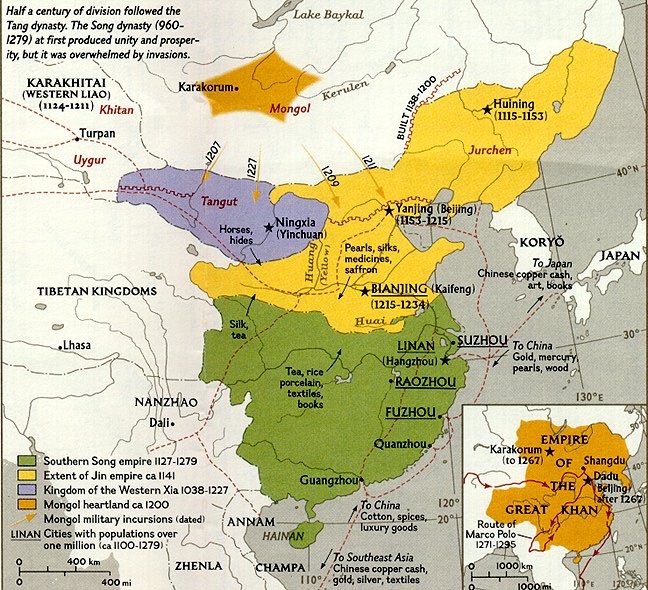
In the early thirteenth century, before the Mongols took over, East Asia was split into three hostile powers locked into a military equilibrium: the western Xia and the Jin to the north, and the southern Song to the south and along the coast. If the Mongols had not shattered this equilibrium (and no other nomadic mega-empire had taken their place), then China might well have remained divided, and the southern Song would have continued to prosper.

Since fighting with the western Xia and the Jin would not have stopped, the southern Song would have persisted in developing their commercial taxes and their navy, which had helped them survive a Jin invasion and would have protected both inland waterways and their coastal capital. Over time, one could easily imagine merchant elites in prosperous southern Song cities lobbying (like their mercantile counterparts in western Europe) for a powerful oceangoing navy to protect their burgeoning overseas trade. Gunpowder had been put to military use in China since the tenth century, with the southern Song and the Jin wielding it against one another in their wars and along the way developing gunpowder bombs and what was likely the first fire lance, an ancestor of the modern gun. Without a Mongol conquest, the southern Song and their opponents would have continued to push the gunpowder technology forward, probably even further than the southern Song did in fighting the Mongols. …

What would the outcome have been? Militarily, the southern Song state would have been large by European standards, and it would not have been free of threats from nomads. Hence the southern Song could not have specialized in the gunpowder technology: like the Ottomans and the Russians, they would have had to divide their resources between the gunpowder technology and the older means of dealing with nomads. But they would not have been a hegemon, and with their substantial commercial tax revenues, they could have spent more on the technology and so pushed it further than the Ming or the Qing ever did, all the more so since the Ming and Qing emperors themselves were often (though certainly not always) hegemons too. And since it would have been much easier for southern Song merchants to establish maritime trading centers abroad, the southern Song (like the Russians) would have had less trouble buying the latest version of the technology from western Europeans, should they ever find themselves lagging behind. The end result would likely have been a much stronger state by 1800, one that might have held off the Europeans and the Japanese in the nineteenth century, or at least negotiated with them on more equal terms. …

Would China have also industrialized faster? One might think that seaborne trade would have encouraged industrialization, but there was too little of it to have much of an effect in state as big as the southern Song. And China would still lack England’s cheap coal, or so historians who focus on energy costs would argue. Yet one could imagine a different path to industrialization, one based on a textile industry like that found in the early United States. It would not require cheap coal, although China did have coal deposits, because coal’s importance for industrialization has been exaggerated. In this scenario, the ongoing warfare would have already drawn manufacturing into fortified cities along the coast, raising urban wages and creating concentrations of manufacturing that would help spread new technology. In the long run, industrialization would follow…

Such a southern Song China might not have been the first to industrialize, but it would likely have joined Japan, the United States, and continental Europe in having an industrial revolution not in the twentieth century, but in the 1800s.

The political history of China’s economic growth targets

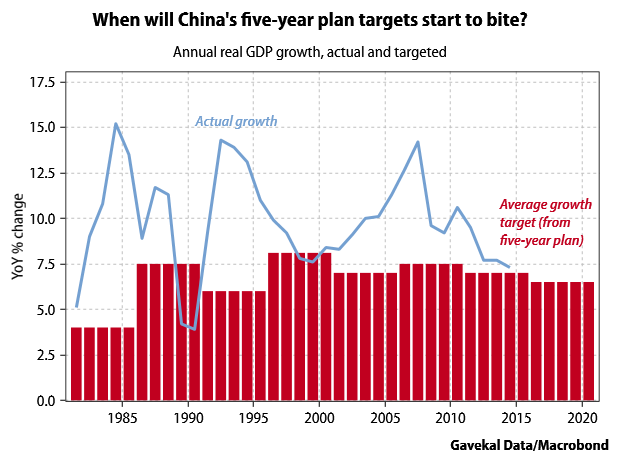
Growth targets are back and stronger than ever in China’s next Five-Year Plan, for 2016-2020. The plan itself is not finalized–the government has just published its “suggestions” for the final document–but it is pretty clear that the main thrust has already been decided. One of the most striking points in the official narrative is the strong emphasis on maintaining a high rate of GDP growth; to me, unrealistically high. Previously, there had been much discussion about abandoning the GDP growth target in the five-year plan, or replacing them with other indicators more directly related to household welfare (maybe China could even do something crazy like target inflation and unemployment). In the event we seem to have an even stronger emphasis on growth targets–the question is why? To start with, here’s Xi Jinping himself explaining the plan (my translation from the Chinese):

The draft suggestions put forth a goal of maintaining medium-high speed economic growth for the next five years. The main consideration is that in order to achieve the goal for 2020 of doubling our 2010 gross domestic product and per-capita rural and urban incomes, we must maintain the necessary growth rate. In order to double GDP, the bottom line for the average economic growth rate for 2016 to 2020 is 6.5% or higher. … Major domestic and foreign research organizations all think that in the Thirteenth Five-Year Plan period our country’s potential economic growth rate is 6-7%. Taking everything into consideration, it is possible for our country to maintain growth of about 7% in the future, but there are numerous uncertain factors.

It’s interesting how Xi presents the growth target as just a necessary consequence of another, more important goal: doubling 2010 GDP by 2020. And indeed there is no problem with his arithmetic: given how much the economy has grown since 2010, to double that level in 2020 requires annual growth of at least 6.5% after 2015. The GDP-doubling target is itself the specific expression of a general slogan: to make China a “moderately prosperous” (xiaokang) society by 2020. Xi has emphasized this target as one of his “two centenary goals“: achieving prosperity by the 100th anniversary of the Party’s founding in 2021, and achieving modernization and national revival by the 100th anniversary of the founding of the People’s Republic in 2049. Official propaganda under Xi has made a big deal out of these two centenary goals, but in fact they are not that new, and indeed were inherited from previous leaders. Xi’s immediate predecessor, Hu Jintao, said in his speech to the 18th Party Congress in 2012:

We need to have a correct understanding of the changing nature and conditions of this period, seize all opportunities, respond with cool-headedness to challenges, and gain initiative and advantages to win the future and attain the goal of completing the building of a moderately prosperous society in all respects by 2020. Basing ourselves on China’s actual economic and social development, we must work hard to meet the following new requirements while working to fulfill the goal of building a moderately prosperous society in all respects set forth at the Sixteenth and Seventeenth National Congresses of the Party. The economy should maintain sustained and sound development. Major progress should be made in changing the growth model. On the basis of making China’s development much more balanced, coordinated and sustainable, we should double its 2010 GDP and per capita income for both urban and rural residents.

But as Hu emphasized, this was not a goal that he came up with himself–it was one set by his predecessor Jiang Zemin. In 2002, at the 16th Party Congress, Jiang said:

An overview of the situation shows that for our country, the first two decades of the 21st century are a period of important strategic opportunities, which we must seize tightly and which offers bright prospects. In accordance with the development objectives up to 2010, the centenary of the Party and that of New China, as proposed at the Fifteenth National Congress, we need to concentrate on building a well-off society of a higher standard in an all-round way to the benefit of well over one billion people in this period. … On the basis of optimized structure and better economic returns, efforts will be made to quadruple the GDP of the year 2000 by 2020, and China’s overall national strength and international competitiveness will increase markedly.

This was actually a more precise formulation of the growth goal than Jiang had given previously. Here is what he said at the 15th Party Congress in 1997:

Looking into the next century, we have set our goals as follows: In the first decade, the gross national product will double that of the year 2000, the people will enjoy an even more comfortable life and a more or less ideal socialist market economy will have come into being. With the efforts to be made in another decade when the Party celebrates its centenary, the national economy will be more developed and the various systems will be further improved. By the middle of the next century when the People’s Republic celebrates its centenary, the modernization program will have been accomplished by and large and China will have become a prosperous, strong, democratic and culturally advanced socialist country.

There you have it: the original formulation of Xi’s two centenary goals was actually made in 1997. But it is also clear that the history goes back even further, as those goals were very directly inspired by a previous declaration from Deng Xiaoping himself, in remarks on April 30, 1987:

Our goal for the first step is to reach, by 1990, a per capita GNP of US$500, that is, double the 1980 figure of $250. The goal for the second step is, by the turn of the century, to reach a per capita GNP of $1,000. When we reach that goal, China will have shaken off poverty and achieved comparative prosperity. When the total GNP exceeds $1 trillion, the national strength will increase considerably, although per capita GNP will still be very low. The goal we have set for the third step is the most important one: quadrupling the $1 trillion figure of the year 2000 within another 30 to 50 years. That will mean a per capita GNP of roughly $4,000 — in other words, a medium standard of living. That target may not seem high, but it is a very ambitious goal for us, and it won’t be easy to achieve.

We are now confident that we can attain our first goal ahead of schedule, this year or next. That doesn’t mean it will be easy to reach the second goal, but I think we can do it. Our third goal will be much harder to reach than the first two. Our experience over the last eight years or so shows that the road we have taken is the right one. But it is only after the third step that we shall really be able to show the superiority of socialism over capitalism — that’s something we can’t prove at the moment. We shall have to work hard for another 50 or 60 years. By then, people of my age will be gone, but I have no doubt that the younger generations will reach the third goal.

(Deng also made a slightly different statement of those goals on April 26 of the same year). This formula became known as the “three-step” development strategy, and Jiang’s version in 1997 as the “new three steps.” Deng also originated the term xiaokang, now conventionally translated as “moderately prosperous,” which he chose to convey a modest aspiration for ordinary people to have a better life.

This historical context makes it easier to understand why these GDP targets are politically so important: they are a way by which successive Chinese leaders have tied themselves to the legacy of Deng Xiaoping, and thereby increased their own legitimacy. By saying he is committed to the goal of doubling GDP by 2020, Xi Jinping makes it clear that he is carrying on the weighty tasks undertaken by his predecessors, and is continuing the great legacy of the Communist Party. In other words, there is no real economic justification for picking a certain rate of GDP growth to target; it is all about the political symbolism (all that stuff you read about China needing to grow 7% a year to prevent social unrest is total nonsense).

This kind of political symbolism was a mostly harmless feature of Chinese politics in earlier years, because the growth potential of the economy was so high that setting these arbitrary growth targets had little impact on actual economic policy. Until very recently, there has rarely been a year in which actual GDP growth did not exceed the target by a wide margin. China’s problem now is that its growth potential is declining, and failing to meet the growth targets has become a real risk (indeed, a near-certainty). Reformers in Deng’s day promoted fast growth as a way to break free of the legacy of the planned economy; in today’s China, reformers worry that targeting fast growth creates too many costs, environmental and otherwise, and gets in the way of structural changes that would improve welfare over the longer term (even if few are willing to publicly challenge the view that potential growth is still 7%). So the growth targets for 2016-2020 will have a greater and more malign influence on policymaking, because they will start to actually affect decisions on a regular basis.

growth-targets

Was it inevitable for China to end up in this trap, where it is held hostage to unrealistic growth targets inherited from previous generations of political leaders? Of course not. If you look at Deng’s original formulation, it was quite vague about the longer term: he did call for quadrupling the GDP of 2000, but said it might take anywhere from 30 to 50 years. When Jiang initially set his goal for the Party’s centenary in 2021, he did not say that GDP had to exactly quadruple by that date, only that it should rise substantially. It was only later on that Jiang formalized the goal into a quadrupling of GDP over the 20-year period. Even then, his successors could have easily shifted the rhetoric: for instance, retaining the goal of achieving “moderate prosperity” by 2020, but dropping the precise definition in terms of GDP. But China’s leaders have been so desperate to gain the political legitimacy that comes from a link to Deng’s legacy that they have been unable to make even such modest changes.

Rocket scientists, secret cities and runaway brides: the stories behind the one-child policy

mei-fong-one-child

Congratulations to my old friend and colleague Mei Fong, whose new book One Child is out just in time to mark China’s transition out of the one-child policy era into the new two-child policy. It’s not a dry piece of demographic analysis, but has vivid and heartfelt reporting that digs out the many fascinating stories behind the slogans. The rocket scientists who designed the policy, the town where a two-child policy was pursued in secret, the personal stories of officials who enforced the policy–it’s all here. Plus there are close-up views of the complexities of sex, fertility and family in today’s China: we see rural villages empty of women, visit sex doll factories and hospices, meet surrogate mothers and adopted children. The ebook is out now, print edition coming in January.

Propaganda for propaganda

I’ve been noticing the neighborhood propaganda billboards a lot more of late–perhaps because there are more of them in the neighborhood I’ve been living in for the past year compared to previous places I’ve lived in Beijing, perhaps because the propaganda campaigns are just more intense these days. But this one really caught my eye today: it’s part of the inescapable campaign for the “socialist core values” about which the less said the better (the four values promoted in this particular one are freedom, equality, fairness and rule by law). What I like about this one is that it’s a propaganda billboard featuring people reading a propaganda billboard; in other words it’s propaganda aimed at getting you to view more propaganda. That’s pretty self-referential for a propaganda campaign that otherwise demonstrates very little self-awareness.

propaganda800