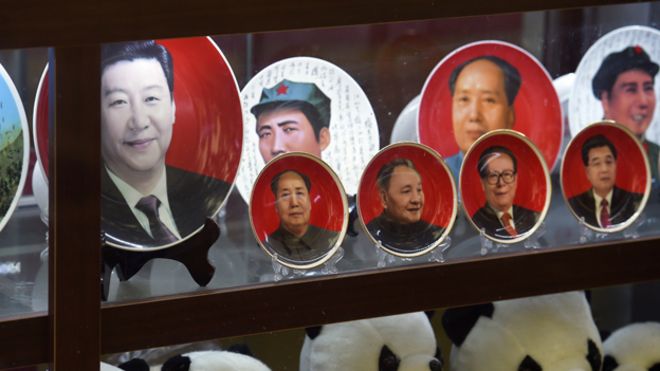
What Xi Jinping really said about Deng Xiaoping and Mao Zedong

It’s been hard to escape the Xi-is-the-new-Mao meme of late, especially with the anniversary of the Cultural Revolution offering an occasion for historical reflection. Andy Browne’s piece in the WSJ is one of the better overviews of the question, noting high up the many important ways in which Xi is not the new Mao; Andrew Nathan’s article in the New York Review of Books is also very much worth reading. Both authors point out an important statement by Xi on the legacies of Mao Zedong and Deng Xiaoping; here is Browne, whose shocked reaction was probably shared by many:

He has declared that it is just as unacceptable to negate Mao’s 30 years in power as it is to speak critically of the 30 years that followed under Deng. He has set side-by-side, on equal footing, a period marked by spasms of mass killing and destruction and an overwhelmingly peaceful era that saw the greatest economic progress in human history.

This naturally piqued my curiosity, so I looked up the original remarks by Xi, which he made on January 5, 2013 in a speech entitled “Some Questions on Maintaining and Developing Socialism with Chinese Characteristics.” The speech is indeed very interesting for how Xi positions himself relative to the legacies of Deng and Mao. There is an official summary from Xinhua which covers the main points, including the statement that Browne and Nathan focus on: “we cannot use the historical period after reform and opening to deny the historical period before reform and opening, nor can we use the historical period before reform and opening to deny the historical period after reform and opening” (不能用改革开放后的历史时期否定改革开放前的历史时期,也不能用改革开放前的历史时期否定改革开放后的历史时期). But I also dug up the full text of the speech, which though not online is in an official book of Party documents (十八大以来重要文献选编), and this has more context and some very direct language, which makes it easier to understand what Xi is getting at. Here is my translation of the most relevant section of the speech:

For our Party leading the people in building socialism, there are two historical periods: before “reform and opening” and after “reform and opening.” These are two interrelated periods that also have major differences, but the essence of both periods is that our Party was leading the people in the exploration and practice of building socialism. “Socialism with Chinese characteristics” was created in the new historical period of “reform and opening,” but it was created on the basis of New China having already established the basic socialist system and carried out more than twenty years of work. A correct understanding of this problem requires grasping three points.

First, if our Party had not taken the decision in 1978 to carry out “reform and opening,” and to unswervingly push forward “reform and opening,” socialist China would not be in the good situation it is today–it is even possible it could have faced a serious crisis like the Soviet Union and Eastern Europe. At the same time, if in 1949 New China had not been established in a socialist revolution, and accumulated important ideas, materials and institutional conditions, gaining both positive and negative experiences, it would have been very difficult for reform and opening to proceed smoothly.

Second, although the ideological direction, policies and practice of building socialism in these two historical periods were very different, these two periods are not separate from each other, and are not at all fundamentally opposed. Our Party has in the process of building socialism proposed many correct positions, but at the time they were not properly implemented; they were only fully implemented only after “reform and opening,” and we will continue to adhere to them and develop them in the future. Marx said long ago: “Men make their own history, but they do not make it as they please; they do not make it under self-selected circumstances, but under circumstances existing already, given and transmitted from the past.”

Third, there must be a correct evaluation of the historical period before “reform and opening.” We cannot use the historical period after “reform and opening” to deny the historical period before “reform and opening,” nor can we use the historical period before “reform and opening” to deny the historical period after “reform and opening.” The practice and exploration of socialism before “reform and opening” built up the conditions for the practice and exploration of socialism after “reform and opening;” the practice and exploration of socialism after “reform and opening” is to maintain, reform and develop the previous period. …

The reason I emphasize this question is because this is a major political issue that, if not handled properly, will have serious political consequences. The ancients said: “To destroy the people of a country, first go at their history.” Hostile forces at home and abroad often write articles about the history of the Chinese revolution and the history of New China–they stop at nothing in attacking, vilifying and slandering, but their ultimate purpose is to confuse people and to incite the overthrow of the Chinese Communist Party and our country’s socialist system. Why did the Soviet Union disintegrate? Why the Soviet Communist Party fall from power? One important reason is that in the field of ideology the struggle was very intense–fully negating the history of the Soviet Union and the Communist Party, negating Lenin, negating Stalin, promoting historical nihilism and confused thinking. Party organizations at all levels hardly did anything, and the army was not under the leadership of the Party. In the end, the Soviet Communist Party, this great Party, was scattered, and the Soviet Union, this great socialist country, fell to pieces. This is a cautionary tale!

Comrade Deng Xiaoping pointed out:  “On no account can we discard the banner of Mao Zedong Thought. To do so would, in fact, be to negate the glorious history of our Party. On the whole, the Party’s history is glorious. Our Party has also made big mistakes in the course of its history, including some in the three decades since the founding of New China, not least, so gross a mistake as the ‘Cultural Revolution’. But after all, we did triumph in the revolution. It is since the birth of the People’s Republic that China’s status in the world has been so greatly enhanced. It is since the founding of the People’s Republic that our great country, with nearly a quarter of the world’s population, has stood up — and stood firm — in the community of nations.” He also stressed: “The appraisal of Comrade Mao Zedong and the exposition of Mao Zedong Thought relate not only to Comrade Mao personally but also to the entire history of our Party and our country. We must keep this overall judgement in mind.”

This is the vision and thinking of a great Marxist statesman. Think for a moment: if at that time we had fully negated Comrade Mao Zedong, could our Party still stand firm? Could our country’s socialist system stand firm? If it does not stand firm, then the result is chaos. Therefore, correctly handling the relationship between socialism before and after “reform and opening” is not just a historical issue, in fact it is mainly a political issue. I suggest that everyone take out the “Resolution on Certain Questions in the History of Our Party Since the Founding of the People’s Republic of China” and read it again.

I think it is not quite right to read this as Xi glorifying everything about Mao, and saying China made just as much progress during the Great Leap Forward as it did after 1978. What Xi is saying is that the legitimacy of the Communist Party China rests on the whole history of its rule, and that if the legitimacy of Party rule is questioned for one historical period, then it can be questioned for other historical periods. Deng felt the same way, and what Xi is doing in this speech is forcefully repeating Deng’s own evaluation of Mao. The 1981 resolution on Party history that Xi cites is best known for how it assigned primary blame for the Cultural Revolution to Mao personally. But the resolution’s overall assessment of Mao is rather balanced, and Deng himself insisted on this. The quotes from Deng that Xi mentions are remarks Deng made during the drafting of the resolution, and some other Deng comments from the same source make the point very clear:

Comrade Mao Zedong was not an isolated individual, he was the leader of our Party until the moment of his death. When we write about his mistakes, we should not exaggerate, for otherwise we shall be discrediting Comrade Mao Zedong, and this would mean discrediting our Party and state. … What we have achieved cannot be separated from the leadership of the Chinese Communist Party and Comrade Mao Zedong. It is precisely this point that many of our young people don’t sufficiently appreciate.

The parallel that both Deng and Xi very clearly had in mind is the Soviet Union, and the backlash against Stalin that began with Khrushchev’s famous “secret speech” acknowledging Stalin’s crimes. Chinese leaders clearly view the “negation” of Stalin that Khrushchev began as fatally undermining the legitimacy of the Soviet Party, and leading inevitably to its collapse in subsequent decades. And they are not alone in this judgment. Here is the historian Orlando Figes on the impact of Khrushchev’s 1956 speech, from his excellent Revolutionary Russia, 1891-1991: A History:

The speech changed everything. It was the moment when the Party lost authority, unity and self-belief. It was the beginning of the end. The Soviet system never really recovered from the crisis of confidence created by the speech. How could people continue to believe in a revolution that had killed so many in the people’s name? In leaders who had told so many lies? For the first time the Party was admitting that it had been wrong— not wrong in a minor way but catastrophically. How could it rebuild its credibility?

Exactly. I do not see much daylight between Xi Jinping and Deng Xiaoping in terms of their positions on Mao Zedong and Communist Party history. Xi is very much following in Deng’s footsteps here, though he may be departing from Deng’s legacy in other ways.
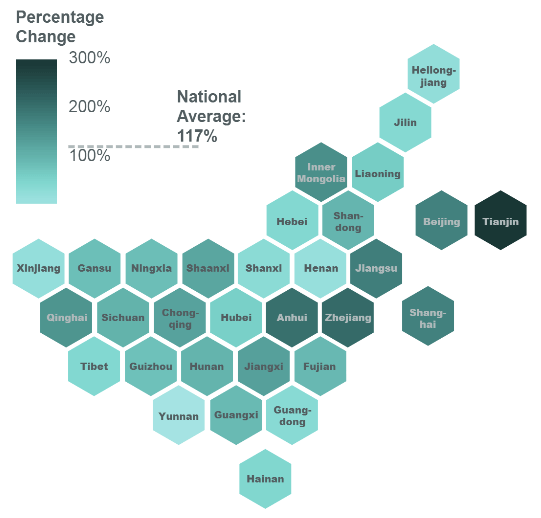
A new variation on the hex grid tile map of China

Many things, blogging and otherwise, to catch up on after a good holiday. First off, I’m overdue in acknowledging a nice use of my proposed hex grid tile map of Chinese provinces by Claire Chang Liu, posted in the comments on the original post. The below is an excerpt from her data visualization project on Chinese migration, with the tile map illustrating the percentage change in each province’s floating population between 2000 and 2010.

Claire-hex-grid

Claire also moves Xinjiang, Qinghai and Tibet down one row compared with my original proposal. Personally I have to say I still like having Xinjiang stick up a bit, it helps maintain the classic chicken-shaped outline of China. But mainly I’m glad the hex tile map is getting a bit of use.

hex-map-simple

Benedict Anderson on the classical heritage and nationalism in Europe vs Asia

I enjoyed reading Benedict Anderson’s short memoir A Life Beyond Boundaries. I did a lot of Southeast Asia at university and so read many things by Anderson and his colleagues at Cornell, so it was a treat to learn some of the history and personalities behind those classic works. It’s mostly an academic rather than personal memoir, but the theme of learning different languages and understanding different cultures runs throughout, starting from his classical British public-school education.

In the conclusion Anderson uses an elder scholar’s privilege to speculate about grand historical themes, and suggests some ways in which Europe’s classical heritage differs dramatically from the cultures he has studied in Asia. He thinks that these differences make Europe somewhat less susceptible to narrow nationalism than Asia–which may not be what recent news headlines from Europe immediately bring to mind, but is still an interesting idea. Here’s the passage:

The Roman Empire was the only state ever to rule a large part of today’s Europe for a long period – even if this era is extremely remote in time. But it was not a ‘European’ state, since it controlled the entire Mediterranean littoral, a large part of today’s Egypt and Sudan, and much of the Middle East, and it did not rule Ireland, Scandinavia or much of northeastern Europe. Furthermore, over time, it drew its emperors from many parts of the Mediterranean world. No European state or nation has had any chance of claiming exclusive inheritance from this extraordinary polity, nor has any of Christianity’s multiple sects. The Empire is not available for nationalist appropriation, not even by Italy. Here there is a huge contrast with China and Japan, and probably also India, where antiquity is easily nationalized. …

Even better, a substantial part of the extraordinary philosophical and literary production of Graeco-Roman Antiquity survived into early modern times, thanks to monkish copyists in the West, but also to Greek-speaking Christian Arab scribes under the rule of Byzantium. As time passed, their translations into Arabic allowed Muslim thinkers in the ‘Maghreb’ and Iberia to absorb Aristotelian thought and pass it on to ‘Europe’. This inheritance offered ‘Europe’ intellectual access to worlds (Greek and Roman) which in profound ways were alien to Christian Europe: polytheistic religious beliefs, slavery, philosophical scepticism, sexual moralities contrary to Christian teachings, ideas about the formation of personhood from the bases of law and so on. Direct access to these worlds depended on a mastery of two languages which for different reasons were both difficult and alien. … Better still, [they] gradually became ‘dead’. That is, neither ancient Greek nor ancient Latin belonged to any of the countries in Europe.

For all these reasons (and others I have not mentioned), Graeco-Roman antiquity brought Difference and Strangeness to European intellectual and literary life right through till the middle of the twentieth century. Just as in fieldwork, this awareness of Difference and Strangeness cultivated intellectual curiosity and enabled self-relativization. There were city-states and democracy in ancient Greece. The Roman Empire was much larger than any other state in European history, and as its ruins were spread almost all over Europe, one could recognize its greatness no matter where one might be. The literature, medicine, architecture, mathematics and geography of Graeco-Roman antiquity were clearly more sophisticated than those of medieval Europe. And all of them were products of pre-Christian civilizations, products which had pre-dated the appearance of ‘messianic time’. While China and Japan tried to bar Difference and Strangeness with their ‘closed-door’ policies, Europe came to hold antiquity in high regard and adopted it self-consciously as its intellectual heritage. …

Before the late seventeenth century, when some French intellectuals began to claim the superiority of their civilization, none of the European countries denied that the civilization of antiquity was superior to its own, and they competed against each other to learn more about it in order to be civilized. Whether in wartime or peacetime, no country could boast that it was the centre of civilization, a European version of ‘sinocentrism’ as it were, and throw its head back declaring it was no. 1. Innovation, invention, imitation and borrowing took place incessantly between different countries in the fields of culture (including the knowledge of antiquity), politics, global geography, economics, technology, war strategy and tactics, and so on.

Nothing like this existed in East Asia, nor even South Asia. In East Asia, China and Japan both set up their geographical and cultural boundaries and often attempted to shut out the ‘barbaric’ outside world with drastic closed-door policies. The necessity of competition with other countries over politics, economics, technology and culture was only scarcely felt. Southeast Asia was probably the closest parallel to Europe. It was diverse in terms of culture, language, ethnicity and religion. Its diversity was further magnified by the historical lack of a region-wide empire (which was associated with frequent political turmoil), and later by the colonial rule of various Western powers. It also resembled Europe in its openness to the outside world through trade.

Probably the best single part of the short memoir is the chapter on comparison and translation; you can read much of that in a long excerpt over at the London Review of Books.

The salt monopoly and the purpose of state-owned enterprises

For those interested in the intersection of obscure Chinese industries, regulatory politics and ancient history (you know who you are), the top story of the week is without question the long-awaited announcement of some reforms to liberalize China’s salt monopoly (here’s a news story and the original Chinese document).

China’s salt monopoly is one of the best examples of a more general principle: state-owned enterprises are often used as a substitute for regulation. Where institutions are weak and compliance difficult to enforce, as they are in most developing countries, state-owned enterprises can be a reasonably effective way to accomplish policy goals. Rather than create a whole complex of rules and try to convince people to follow them, the government can just tell an SOE what to do. The policy goal the salt monopoly accomplished for China was ensuring that salt was iodized, an important public health measure. Although news stories love to emphasize the salt monopoly’s ancient roots, in fact its latest iteration is only a couple of decades old, and was the result of a conscious decision to revive the monopoly to achieve this specific goal.

china-national-salt

My favorite account of this history is a classic WSJ piece by Leslie Chang from June 2001. I’m quoting from the piece at length because I cannot find it on the WSJ website, probably because it is so old. As she makes clear, the monopoly was able to achieve the public health goal, though this did not come without costs and distortions. And making the transition away from the SOE model to a more sustainable system is quite tricky, as the long debate over reforming the salt industry shows.

LIZI, China — Pei Nuwa touches her neck where she has a swelling the size of a small melon. She remembers a time when almost every extended family in this farming village had someone with a goiter like hers.

“The ones who had it have all died, and now the young people and the children don’t have this,” says Ms. Pei, a 67-year-old who has tiny eyes and skin wrinkled like parchment.

Ms. Pei doesn’t know why goiters became rare, but the answer is sitting in a clear plastic bag on a grimy counter in her single-room house. It is iodized salt. Minute amounts of iodine consumed regularly — the equivalent of just a teaspoonful over a lifetime — can prevent goiter and other thyroid-related disorders.

How this bag of salt arrived in this farming hamlet in the northwestern province of Gansu represents a triumph of public health. Five years ago [i.e., 1996], only a third of the Chinese population, then 1.2 billion, consumed iodized salt. The lack of iodine in the diet caused a range of health problems, from goiters to the severe mental retardation known as cretinism to lower IQs, among a generation living in rural areas. Today [i.e., 2001], more than 90% of Chinese eat iodized salt.

But this success also underscores the halfway nature of economic reform and decentralization in China. While Beijing has quietly shifted the responsibility and funding for key social services such as education and health care to provincial governments, there are no self-regulating mechanisms or built-in incentives that force officials to carry out their duties. …

To ensure that millions got iodized salt, Beijing officials reinstated a national salt monopoly that had existed in some form for more than 2,000 years, until private operators emerged about a decade ago. The state fixed salt prices to restore the industry to profitability and wrote laws that criminalized the sale of private salt. Hundreds of private salt producers were closed, and the remaining operators were consolidated into giants that formed the monopoly. The state also put together a 400,000-person bureaucracy to run the operation, including a 25,000-strong “Salt Police” with officers in gold-braided uniforms.

The original salt monopoly was set up in 117 B.C. during the Han dynasty. For nearly two millennia, the imperial family controlled the lucrative monopoly, one of the empire’s biggest sources of revenue. Salt financed campaigns of expansion, built the fabulous villas of the merchants of Yangzhou and inspired one of the most famous policy debates of the imperial era. In 81 B.C., supporters of a monopoly in iron and salt argued that it would serve the public good, while opponents said it would stifle individual enterprise.

The monopoly’s current revival stemmed from public-health concerns. By the 1980s, Chinese officials had made headway in fighting iodine deficiency by providing iodine injections in villages with a high incidence of goiter. But the same years brought economic liberalization and an explosion of private enterprise, including manufacturers flooding the market with usually cheaper noniodized salt. By the early 1990s, this unregulated salt trade, combined with little official oversight, was erasing the public-health gains of the command-economy days. In Gansu, consumption of iodized salt dropped to just over 60% in 1991 from 90% two years earlier. …

The network of control and the costs have a downside: They heighten the appeal of smuggling illegally produced salt, which can be sold more cheaply and without paying taxes. In a case two years ago, a group of salt smugglers from neighboring Ningxia beat up five salt policemen who caught them trying to ship three tons of rock salt into the province. The ringleader is still at large. Another case involved a high-speed car chase, the confiscation of six tons of unlicensed salt, fines and jail time for the perpetrators. In faraway Hebei, several officials were recently brought in for round-the-clock questioning in connection with widespread sales of private salt. …

Health experts say that system’s functioning depends on whether official attention — and the monopoly — can be sustained. Some are troubled by recent state media reports linking monopoly-affiliated companies with smuggling, which could feed arguments that the monopoly should be dismantled. Its supporters say the market should be opened to competition, but only after good production methods and habits are ingrained. “China needs to maintain this monopoly for at least 10 more years,” says Ray Yip, a Unicef adviser in Beijing. “After that, it will be safe.”

A bit more than 10 years, it turns out. This seems like good news at the margin, though it certainly does not look like China is now ready to let a regulatory apparatus replace the policy functions of its SOEs across the rest of the economy. In many strategic areas, like energy and telecommunications, regulation-by-SOE seems to be as strong as ever.

The next book I want to read about the Chinese internet

Like most people I’ve talked to, I enjoyed reading Duncan Clark’s Alibaba: The House That Jack Ma Built. The book starts off with a bit too much entrepreneur hero worship, but quickly finds its rhythm and ends up being a very engaging tale of the Chinese internet’s early days. I lived through some of the events Duncan relates (as a technology reporter for Dow Jones in 2001-2003), and enjoyed being reminded of some now-forgotten figures of those bubbly times. The book is easy to recommend for those who don’t know the story of Alibaba’s rise (i.e. most people outside China), and for getting a sense of the wacky world of the Chinese internet.

Still, most of the action of the book takes place before 2012, and I think another book will be needed to properly tell the story of the more recent development of the Chinese internet. Alibaba’s story has gotten more complicated since 2012, and it is becoming less easy to fit into easily digestible archetypes about heroic entrepreneurs. Duncan acknowledges this in his closing paragraphs:

Jack’s fame stems from the story of how a Chinese company somehow got the better of Silicon Valley, an East beats West tale worthy of a Jin Yong novel. His continued success, though, is becoming a story of South versus North— of a company with roots in the entrepreneurial heartland of southern China testing the limits imposed by the country’s political masters in Beijing.

Since Xi Jinping became president of China in 2012, high-profile entrepreneurs have found themselves increasingly subject to scrutiny and sanction from the Chinese government. One high-profile real estate entrepreneur, Vantone Holdings’s Feng Lun, even blogged— then later deleted— the following message: “A private tycoon once said, ‘In the eyes of a government official, we are nothing but cockroaches. If he wants to kill you, he kills you. If he wants to let you live, he lets you live.’” …

Jack is already the standard-bearer for China’s consumer and entrepreneurial revolution. Now he is advancing on new fronts, such as finance and the media, that have long been dominated by the state.

Forged in the entrepreneurial crucible of Zhejiang and fueled by his faith in the transformative power of the Internet, Jack is the ultimate pragmatist. By demonstrating the power of technology to assist a government confronted with the rising expectations of its people for a better life— from the environment, education, and health care to continued access to economic opportunity— Jack aims to create the space for him to fulfill even greater ambitions.

So what should the next book about the Chinese internet cover? In part it must necessarily be less about the startup phase and more about strategic positioning of the three giants of the Chinese internet–Baidu, Alibaba, Tencent–in the same way that writing about the English-language internet has to be about the strategic positioning of Google, Amazon, Apple, Facebook, etc (out of the Chinese trio, Alibaba has the more charismatic leader, but Tencent is just as interesting a company, and deserves a book of its own).

And in part it has to tell the story of the complicated relationship between the government and the internet companies, which, it seems safe to say, is not like what we see anywhere else. Alibaba’s Alipay online payment service (run by a separate company called Ant Financial) is on its way to becoming a de-facto state-owned enterprise, as major state institutions have put lots of money in its last two rounds of venture capital fundraising. Part of Alibaba is in turn investing in state-owned enterprises as it tries to show how its technology can be of service to the state. Jack Ma and the heads of the other are now regularly called to appear at government meetings on internet policy, which tend to emphasize security issues and state control. The story behind all these events will certainly not be easy to dig out, since no one involved has much incentive to be forthcoming. But that’s the story that needs to be told.