Regional convergence has stalled, says The Economist

John Parker of The Economist talked to me for a story on regional inequality in China, which is now out in the latest edition. It’s a nice overview of some of the questions I’ve written about on this blog, here’s a sample:

There are three reasons why convergence has stalled. The main one is that the commodity boom is over. Both coal and steel prices fell by two-thirds between 2011 and the end of 2015, before recovering somewhat this year. Commodity-producing provinces have been hammered. Gansu produces 90% of the country’s nickel. Inner Mongolia and Shanxi account for half of coal production. In all but four of the 21 inland provinces, mining and metals account for a higher share of GDP than the national average.

Commodity-influenced slowdowns are often made worse by policy mistakes. This is the second reason for the halt in convergence. Inland provinces built a housing boom on the back of the commodity one, creating what seemed at the time like a perpetual-motion machine: high raw-material prices financed construction which increased demand for raw materials. When commodity prices fell, the boom began to look unsustainable. …

Investment by the government is keeping some places afloat. Tibet, for example, logged 10.6% growth in the first half of this year, thanks to net fiscal transfers from the central government amounting to a stunning 112% of GDP last year. Given the region’s political significance and strategic location, such handouts will continue—Tibet’s planners admit there is no chance of the region getting by without them for the foreseeable future.

Tibet is an extreme example of the third reason why convergence is ending. Despite oodles of aid, both it and other poor provinces cannot compete with rich coastal ones. In theory, poorer places should eventually converge with rich areas because they will attract businesses with their cheaper labour and land. But it turns out that in China (as elsewhere) these advantages are outweighed by the assets of richer places: better skills and education, more reliable legal institutions, and so-called “network effects”—that is, the clustering of similar businesses in one place, which then benefit from the swapping of ideas and people.


Daring to sympathize with China’s unhappy police

China’s Unhappy Police” is a perfectly-named and very interesting paper by Suzanne Scoggins and Kevin J. O’Brien, reporting the results of numerous interviews with low-level cops in China (link courtesy of Omnivore). It’s an unusually sympathetic account of a group that does not get a lot of sympathy. Some excerpts:

Facing piles of tedious, repetitive work, young police report that life on the force is not what they anticipated. Fresh recruits in their early 20s typically start out full of hope, imagining that they are taking up positions as brave law enforcers who will command prestige, get to wear a sharp uniform, and maybe, if they are lucky, fire a gun. They tend to be aware of the long hours and dangers of the job, but few are prepared for the monotony of street-level policing. When on patrol, they often spend hours parked on street corners with little to do.

Instead of fighting crime, many also find themselves occupied with matters unrelated to law enforcement. Members of the public often do not know what falls within their job description, and officers say they must respond to every phone request, no matter how insignificant. This means that street-level cops may be summoned to find lost cows in the middle of the night, search for missing dogs, or retrieve forgotten QQ numbers (login information for a popular social network). Despite being fix-it men for a host of community problems, young police complain that they have far less authority than they expected. “I can tell someone on the street to stop,” explained one officer, “but they don’t care. They just start arguing with me.” …

The trials of street-level officers have only worsened in recent years as they face new demands and reforms that tie their hands. Older cops complain bitterly about procedural changes that make it harder to conduct investigations and interrogate suspects. Officers of all ages lament a 1994 rule that forbids them from carrying guns (except under extraordinary circumstances) and often attribute some of their limited authority to being under-armed. Police are also unhappy about stepped-up reporting requirements. Chinese street cops, like those in many countries, are frustrated by the number, length, and complexity of the reports they must file with their superiors and the Ministry. Beset with busywork and pinned to their desks, officers argue they have insufficient time to attend to more important tasks such as conducting investigations. Finally, attacks on police have increased both in violence and frequency, undercutting the belief many hold that they are respected and, when needed, feared by the public. …

Like unhappy employees everywhere, discontented officers look for ways to avoid work. Some shirking is easy to observe. Parked patrol cars filled with dozing officers are a common sight on Chinese street corners. But most shirking occurs in the station house. Although none of our respondents admitted to evading their responsibilities, some commented on goldbricking by their co-workers. “The old guys do what they like,” explained one officer. “They don’t care about new rules [forbidding government workers from drinking alcohol during lunchtime]. They just close their office door after lunch and go to sleep.” While officers may prefer lunchtime boozing over afternoon work for any number of reasons, a group of older cops cited the stress that comes with the job when asked about their midday imbibing. “Drinking is the only pleasure we police have,” said one, as the others roared in agreement and continued enjoying just the sort of alcohol-infused banquet they had been told to eschew.

Shirking can also take on more creative forms. “Protocols are not specific,” explained one young officer. “One day I went to bust up a small hair salon, and when the boss fled, I ran a long way until I finally caught him. My colleagues laughed at me and said I was crazy [to chase the man]. We get paid so little and procedures don’t say what to do when criminals run.”

The general lesson, as in so many cases, is that China is messier than you might think:

China is often thought of as a well-funded and tightly organized security state, with a full palette of formal and informal agencies to maintain social order. Front-line police are only one part of that apparatus, but their unhappiness and weak job performance suggests a certain brittleness that may signal problems elsewhere. Since 1989, the Party has proven quite adept at managing or at least suppressing social unrest, but dissatisfaction and mismanagement of the lower levels of the security state speaks to abiding weaknesses that merit more attention. What ground-level agents of state power have to say matters. As our interviews reveal, the life of a front-line cop is filled with uncertainty, hardship, and feelings of powerlessness. Their accounts, self-serving as they may be, show them in a new light: as overburdened, under-armed and unhappy men and women trying to make the most of a difficult job.

Those waiting for the demise of the nation-state may be waiting for a while

Robert Shiller makes a valiant attempt to push back against the current climate of pessimism and nationalism in a recent Project Syndicate piece, arguing that increasing empathy will eventually reduce the political and emotional salience of the nation-state:

For the past several centuries, the world has experienced a sequence of intellectual revolutions against oppression of one sort or another. These revolutions operate in the minds of humans and are spread – eventually to most of the world – not by war (which tends to involve multiple causes), but by language and communications technology. Ultimately, the ideas they advance – unlike the causes of war – become noncontroversial.

I think the next such revolution, likely sometime in the twenty-first century, will challenge the economic implications of the nation-state. It will focus on the injustice that follows from the fact that, entirely by chance, some are born in poor countries and others in rich countries. As more people work for multinational firms and meet and get to know more people from other countries, our sense of justice is being affected. …

Ultimately, the next revolution will likely stem from daily interactions on computer monitors with foreigners whom we can see are intelligent, decent people – people who happen, through no choice of their own, to be living in poverty. This should lead to better trade agreements, which presuppose the eventual development of orders of magnitude more social insurance to protect people within a country during the transition to a more just global economy.

To put this in the terms of Dani Rodrik’s globalization trilemma, the argument is that the natural direction of human history is to choose economic integration and democratic politics over the nation-state. It seems that this was Rodrik’s own hope when he originally formulated the trilemma, though recent events like the UK’s vote for Brexit have made that direction seem much less inevitable. Shiller seems to think of political change as a kind of widening circle of intellectual empathy: over time, the boundary of empathy widens from your immediate neighbors, to include people of different races, different religions and eventually different nations.

I think this is an insufficiently anthropological approach that neglects how actual social institutions create more powerful ties than an abstract sympathy. Re-reading this year Benedict Anderson’s wonderful book on nationalism, Imagined Communities (it still ranks as one of the best reads of any academic book ever) has reinforced my feeling that this kind of purely intellectual approach neglects the very things that have made the nation-state a powerful and persistent institution. The nation-state is not an arbitrary oppressive illusion that people will see through once they become sufficiently advanced. Rather, it is a specific social institution like any other; to quote Anderson:

All communities larger than primordial villages of face-to-face contact (and perhaps even these) are imagined. Communities are to be distinguished, not by their falsity/genuineness, but by the style in which they are imagined.

The nation is imagined but it is not imaginary; it is founded in actual shared experiences, real relationships and established institutions, and these generate an emotional attachment. Anderson again:

Regardless of the actual inequality and exploitation that may prevail in each, the nation is always conceived as a deep, horizontal comradeship. Ultimately it is this fraternity that makes it possible, over the past two centuries, for so many millions of people, not so much to kill, as willingly to die for such limited imaginings.

For the nation-state to become politically irrelevant in the way Shiller suggests, it is not enough for people to be polite to the foreigners they see on their computer screens. Rather, the nation-state would have to be superseded by another “imagined community.” And this is a little difficult to (ahem) imagine.

What new social institutions are now creating shared experiences that could eventually supersede the nation-state? Many early nationalisms were based on shared experiences of imperialism and colonialism. So it makes some sense to argue that the nation-state’s successor is being bred by the experiences produced by the contemporary strain of global capitalism.

The multinational corporation is the example favored by Shiller; another obvious one is the European Union. The much-remarked age difference in the UK’s Brexit vote–youth overwhelmingly voting to remain–could perhaps be an early sign of changing attachments. A new generation, raised in the reality of a united Europe and taking pan-European travel and job opportunities as their rightful birthright, perhaps is indeed starting to imagine a community that supersedes the nation-state.

But is a multinational Europe (or Nafta, or whatever) in fact a community, or just a much wider field on which individuals pursue economic self-interest and career advancement? Do the participants in these multinational zones really see themselves as a community–are they forming emotional relationships rather than just engaging in arms-length market exchanges? I am not saying the answer is obviously no, but neither is it obviously yes.

I suspect it will not be until something more than economic self-interest binds together the emerging multinational class that the nation-state will be finally replaced by some other institution. I think this comment of Anderson’s is still an effective riposte to Shiller’s argument, despite having been made back in 1983:

In themselves, market-zones, ‘natural’-geographic or politico-administrative, do not create attachments. Who will willingly die for Comecon or the EEC?

Which Chinese people are more likely to marry foreigners?

Here is a fun piece of Chinese data journalism that got sent my way–somebody added up the total number of marriages between Chinese and foreigners over the past ten years, and then broke it down by province. I don’t have access to the underlying data but I can reproduce the main chart below, which shows marriages with foreigners as a percent of total marriages in each province:

foreign-marriages

The top 10 provinces are, in order: Fujian, Shanghai, Hainan, Guangdong, Zhejiang, Liaoning, Heilongjiang, Beijing, Yunnan, Jilin. Give how many mixed couples are in my social universe, the opportunity for doing a little armchair sociology here is downright irresistible. Theories for what each of these provinces are doing in the top ten:

Fujian, Hainan, Guangdong, Zhejiang. Pretty obvious — these provinces are the historical origin of most of the overseas Chinese diaspora, and have substantial populations of overseas Chinese returnees as well. It’s very likely that a lot of these marriages between PRC citizens and non-PRC citizens are marriages between two ethnic Chinese.

Beijing, Shanghai. Also not that hard — Beijing and Shanghai are where most of the foreigners in China live, so not too surprising that more marriages between foreigners and Chinese would happen as a result. Yunnan as a border province with a lot of cultural ties to Southeast Asia also has a fairly large foreign population, so the same explanation applies. Here is a quick plot of some data from the 2010 census to illustrate:

foreign-population

Liaoning, Heilongjiang, Jilin. Hey, what are the three northeastern provinces doing on this list? The original article also notes that while it is not surprising for the more economically developed and more internationally oriented provinces to have more marriages with foreigners, it is “quite surprising” for the former Manchuria to show up with such a high ranking. This is a little unfair to Liaoning: as the chart above shows, the foreign share of the population in Liaoning is higher than the national average. My guess is that this is due to the substantial investments by Japanese and Korean firms in Dalian.

But yeah, it’s definitely a bit surprising for these somewhat isolated and economically troubled provinces to be matching or beating China’s most cosmopolitan places. My circle of friends in fact includes a not inconsiderable number of men (both Chinese and foreign) married to northeastern women; I had always enjoyed this as a happy coincidence and did not suspect it might actually reflect some broader social trend.

My informants suggest that the economic troubles of the northeast could in fact be the explanation. As a result of the relative stagnation in the northeast, there has been a lot of out-migration over the past decade as people seek better opportunities elsewhere. (One point of detail is that China’s hukou system means that a Chinese-foreign couple who register their marriage in Jilin don’t necessarily actually live in Jilin; they could live elsewhere but have to return to the Chinese spouse’s home province to register the marriage.) So for the other provinces mixed marriages seem more likely to be a result of “pull” factors–more people mixing socially with foreigners–but for the northeast it could be “push” factors where a bad economy drives people out of their native social milieu. That makes some sense, though I’m open to other theories.

What not to expect from Chinese SOE reform

Just what can we realistically expect in terms of state-owned enterprise reform in China?

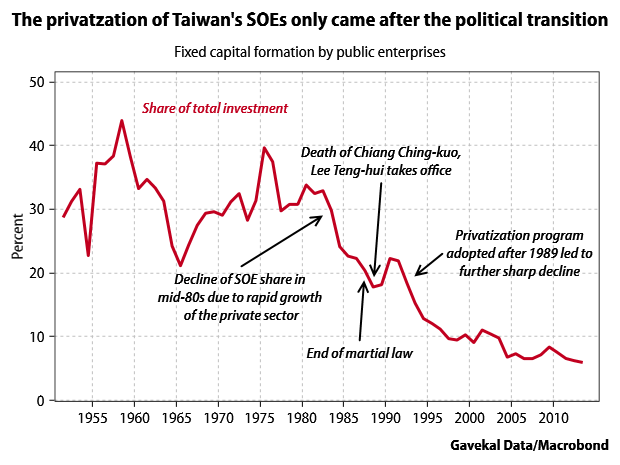
For those who take the once-standard view that China is following the “Asian developmental state” model of Japan, South Korea, and Taiwan, then substantive SOE reform and privatization should in fact be coming along any day now. Those other Asian economies also had large state sectors originally; Robert Wade’s 1990 book on Taiwan, Governing The Market, notes that “from the early 1950s onward Taiwan has had one of the biggest public enterprise sectors outside the communist bloc and Sub-Saharan Africa.” Wade defended the performance of Taiwan’s SOEs, but his book was published just as a major privatization program was pushed through. Taiwan, rather unusually, has good and transparent data about the size of SOEs in its economy, which makes for an interesting chart:
Taiwan-SOEs-politics

South Korea had an SOE sector whose relative size was not that dissimilar from Taiwan’s, and actually began privatization even earlier. I have cobbled these data together from a few different sources, so I wouldn’t pretend to a huge amount of precision, but the trend is still pretty informative:

Korea-SOEs

Major privatizations of SOEs in South Korea took place in the early to mid-1980s, when its per-capita GDP was $7,000-$9,000 at purchasing power parity. Taiwan’s privatization came later and at substantially higher incomes, around $17,000-$18,000 at PPP. China’s per capita GDP is around $13,000-$15,000 now. So if we’re just thinking in terms of income levels, China is more or less at the point when substantial SOE privatization happened elsewhere. But income levels are pretty obviously not the driving factor; SOE privatization in both South Korea and Taiwan was very much part and parcel of their political transitions toward democracy. And such a transition does not seem to be at all imminent in China.

A couple of conclusions seem to follow from this observation. One, the “Asian developmental state” framework, which was indeed helpful for analyzing China in its high-growth phase, seems to be outliving its usefulness. A different perspective that takes China’s socialist heritage more seriously, perhaps looking more at transition economies, could be useful. Two, expectations for SOE reform should be realistic about the existing political framework. Privatizing PetroChina and similar high-profile SOEs just does not seem conceivable in the current system (the privatizations of the late 1990s, under the “grasp the large, release the small” slogan, focused on locally-owned and nonstrategic firms).

In the paper I did a couple of years back on SOE reform, I was very careful not to aim for Washington Consensus-style idealized outcome, but to focus on what seemed plausible and possible in the Chinese context (and what I proposed had in fact been done before). So I consider myself to have pretty realistic expectations about what kind of SOE reform is plausible.

Yet even relative to modest expectations, reform has disappointed. It’s hard to overstate how depressed most China-watchers have become about the state of state-owned enterprise reform. After some promising signals in 2013 that seemed to indicate an openness to a new approach, it has just been one disappointment after another. Instead of more privatization and more professional management, there is instead a renewed love affair with forced mergers of large SOEs, a heightened emphasis on SOEs as instruments of government industrial policy, an increase in the Communist Party’s role in company management, and a proliferation of new “anticorruption” procedures to limit decision-making by SOE executives.

In a characteristically clear and concise post, Nick Lardy argues that the latest fashion for consolidation is a bad move:

These mega mergers may satisfy the ambition of the Chinese Communist Party to have more prominent national champions, but they aren’t likely to improve the efficiency of SOEs.

Barry Naughton, in one of his always-useful overviews of the policymaking process, similarly notes that:

There is a remarkable degree of consensus that [SOE reform] has, at a minimum, progressed too slowly and, at a maximum, failed altogether.

And the more I read from domestic commentators about the current SOE “reform” process, the more discouraged I get. Here are some excerpts from an interview with Yu Jing of CASS that give a flavor of the current conservative tone:

The basic idea of the previous round of [SOE] reform was to give full play to the role of the market, and accelerate integration with the more developed and more advanced global market system. Today, however, the international and domestic economic environment is not that optimistic, so a violent market reform could not only fail to achieve the goal of economic stability, but could even increase risk. …

The previous system for supervising state-owned enterprises had many regulations based on general principles; the current regulations have more attention to detail and focus on implementation. In the future, we still need to continually improve the system for supervising state-owned enterprises, and deal with the numerous problems that have been exposed. We need to have targeted constraints, and change the old method of after-the-fact supervision, so that the state-owned enterprise system can steadily improve. …

Future SOE reform will put greater emphasis on standards and norms, there will be more and more constraints on enterprises. For the top management of SOEs, they will face more difficult challenges in leading China’s large companies in a marketized and international direction, they will have to assume a more important historical responsibility. …

We should understand that the ultimate goal of SOE reform is–under the prerequisite of regularizing the operations and behavior of SOEs–to stimulate the vitality of SOEs, and to build a system that is more transparent, more standardized, and more in keeping with development of modern corporate culture.

The emphasis on avoiding risk is almost overwhelming. The “prerequisite” in the last sentence seems more important than the nod to “vitality”: SOE reform is not about making SOEs more like private-sector companies, but making them more like the government bureaucracy, where managers implement policy priorities while following detailed codes of conduct. This makes some sense if the priority is to avoid corruption at SOEs. And more checks and balances could reduce wasteful investment. But it does not seem like a recipe for raising the state sector’s extremely low return on capital.

The folks at the IMF, who have to come up with constructive suggestions rather than just complain, been reduced to suggesting that the government “pilot” serious SOE reform at one or two companies (implicitly making the point that the current approach is not going to solve the actual problems, so starting afresh is necessary). Here is Markus Rodlauer in a conference call after the IMF’s last Article IV report on China:

We have a view that it would be very helpful for China, both domestically and internationally to demonstrate a strong start to a new approach to state-owned enterprises. And the new approach, as we described it in the report, is comprehensive that addresses both the financing side of it, the debt side of it, the enterprise restructuring side of it, the social side of it, the employment consequences, altogether in a coherent way. And making a strong start with 1 or 2 or 3 large enterprises, to do it in the right way, then you also allow private investors, and even foreign investors to come in and play a role.

I think that’s a good suggestion, and I hope it gets traction, but it does seem like a sign of how far expectations for SOE reform have fallen.

How a Shandong grocery store’s accounts unlocked China’s 19th century economic history

History buffs should enjoy this account by Debin Ma and Weipeng Yuan of the rediscovery of the ledgers of a 19th century Chinese grocery store, which have turned out to be one of the key sources for the economic history of the period:

In a widely used statistical manual for Chinese economic history compiled in 1955 by Professor Yan Zhongping and ten other eminent economic historians, two tables and a figure are included that provide relatively continuous annual series of copper cash/silver exchange rates and two price indices for agricultural and handicraft goods (in copper cash) respectively for the period of 1798-1850.

These three pages of highly condensed statistical series stand out as a glaring anomaly in the dark alley of Chinese historical statistics. Despite the brevity of the explanation, they have not escaped the attention of researchers: the Ningjin series appeared frequently in some of the most influential works on China’s pre-modern monetary sector and often served as the key (or only) systematic data series for evaluating China’s balance of payment crisis caused by silver outflow, leading eventually to the fateful Opium War of 1842 – a watershed event in modern Chinese history.

Embedded in the footnotes to these two tables are brief explanations of the statistical methodology of constructing the exchange rate series and the number of items included in the construction of these price indices. They also indicated that the original data were extracted from a grocery store called Tong Taisheng, located in the town of Daliu of Ningjin county in the northern part of Zhili province.

Tong Taisheng was managed for several generations by the Rong family. But the store, despite its long history, is not mentioned at all the present-day official archives of Ningjin county (in what is now Shandong province). The ledgers–more than 400 handwritten volumes–survive only because they were donated to the national archives in 1935 by a descendant of the Rong family, who was himself a historian. But the donor, Rong Mengyuan, never made use of this amazing material for any of his own historical research! Perhaps because he did not want to publicize his “capitalist” family background, and perhaps because as a loyal Marxist he was genuinely ashamed of it:

Like countless others, Rong Mengyuan re-emerged from his intellectual exile and re-established himself as an authority on Chinese historical archives with a prolific publication record in the 1980s. The new era saw a revival of academic interest in traditional China’s indigenous commercial tradition and in the explorations of private merchant business archives, often filled with tales of valuable archives discovered or rescued by sheer accident while others were lost through continued neglect.

While generations of scholars are set to benefit from the rediscovery of Tong Taisheng and other archives, when Rong Mengyuan passed away in 1985, he himself may have harboured no pride or interest in his connection with that pile of family archives he donated five decades earlier. It is curious to note that throughout the 1980s Rong Mengyuan remained a loyalist to an ideology of a bygone age and his writings then continued to be infused with the stridently leftist rhetoric of identity politics.

The full piece “Discovering economic history in footnotes” is not overly long or technical, and well worth a read.

tts-ledger

About that China infrastructure paper that is making the rounds

A couple of people have asked what I think about this paper on Chinese infrastructure that is making the rounds, which claims that China “is headed for an infrastructure-led national financial and economic crisis.” It’s rather an obnoxious paper to read, in that it aggressively attacks a straw-man position that few people actually hold, and makes grand macro claims about China based on rather equivocal micro data. The general conclusion is certainly not wrong, though it is a fairly widely held view: China is very likely over-investing in infrastructure, and this is going to have negative consequences for its future growth and debt dynamics. But the actual content of the paper does not do as much to support this view as the authors claim. Here I will try to explain what I think is wrong with the paper, and outline the real reasons why China’s infrastructure investment is problematic.

The core of the paper is an examination of the performance of individual infrastructure projects in China, which the authors compare to projects undertaken in other countries. (The paper’s dataset is exclusively composed of infrastructure projects in China funded by the Asian Development Bank and the World Bank. One might therefore wonder whether the findings say more about the procedures of these multilateral institutions than about China’s unique circumstances. But let’s not quibble.) They find that infrastructure projects in China often cost more and take longer to complete than expected, and that planners often do not accurately forecast demand for the completed projects. Yet these seem to be general problems of large construction and engineering projects around the world:

Actual costs were on average 30.6 per cent higher than estimated costs, with a median of 18.5 per cent indicating that the distribution of costs had a heavy skew to the right (i.e. going over budget). … We found no significant differences in cost overruns between China and rich democracies—i.e. on our sample China’s cost performance is no better or worse than that of rich democracies. …

Similarly, in terms of schedule overrun China performed better than rich democracies. The average schedule overrun in rich democracies was +42.7 per cent (median = +23.0 per cent) compared to Chinese projects’ average of +5.9 per cent (median = 0.0 per cent). Only one in every two projects encountered a schedule delay in China compared to seven out of 10 in rich democracies. …

In the reports we studied for China, the typical BCR [benefit-cost ratio] for transport projects was 1.4 to 1.5, which is broadly in line with many other physical infrastructure assets such as large dams, road, rail, bridge, or tunnel capital investments. In other words, planners expected the net present benefits to exceed the net present costs by about 40–50 per cent.

The authors’ data on individual infrastructure projects tell us that China is basically no worse and no better than the rest of the world in terms of managing infrastructure projects–just like everywhere else, they often run behind schedule and over budget. This is certainly useful information but does not seem like a shocking finding. But if China is no better and no worse than the rest of the world at planning and executing infrastructure projects, it is hard to see how this would lead it into an infrastructure-driven financial crisis. The problem must therefore surely be that China is spending far too much on infrastructure, so that the ordinary problems of project mismanagement are magnified by the scale of its spending.

At this point in the paper I naturally expected the authors to show that China was in fact spending much, much more than other countries on infrastructure. But they don’t. In fact they present absolutely no statistical information about the level or growth rate of infrastructure spending in China. I know, I couldn’t really believe it either. What they do instead is present the usual numbers about the rapid growth of total investment and debt in China, such as the figures on gross fixed capital formation in the national accounts. It should hardly need pointing out that gross fixed capital formation is not the same thing as infrastructure spending; infrastructure is only one component of gross fixed capital formation, most of which is housing and business capital expenditure. (Putting a hard number on China’s infrastructure spending is indeed tricky, but not impossible. According to estimates by the former OECD economist Richard Herd, government and infrastructure sectors have usually accounted for 20-30% of gross fixed capital formation over the past couple of decades.) Since the authors do not establish that China is spending a lot on infrastructure in the aggregate, the conclusion that China’s macro problems from infrastructure spending are much greater than other countries simply does not follow from the micro evidence they present. It would certainly be useful to compare rates of infrastructure investment across countries, but this paper does not do that.

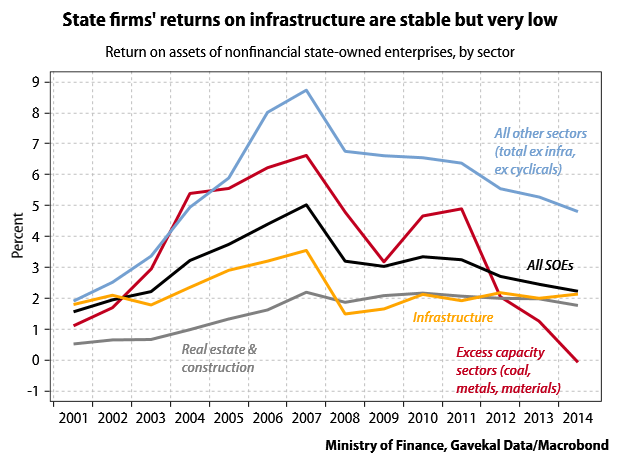
So does that mean infrastructure spending is not an issue for China? Not at all, the issue is very much a real one. I would express it much more simply however: Chinese infrastructure projects generate low financial returns, but have to repay debts at interest rates that are far too high. Here are two numbers to illustrate the point: the average return on assets of state-owned enterprises in infrastructure sectors is around 2%, but the average interest rate that state-owned enterprises pay on their debt is around 5%. It is pretty clear this is not a financially sustainable situation–and note that this is true regardless of what you may think about the broader economic benefits of infrastructure projects, since what matters is the financial returns realized by the project sponsors. And the magnitude is sizable: 6-7 trillion yuan a year, based on Herd’s figures.

soe-roa

It’s an important peculiarity of the Chinese system that so much of its infrastructure is provided by state-owned enterprises, rather than directly by the government. The reasons for this are not totally clear–maybe it helps expedite stimulus spending, or keeps measured government debt low. But the consequences are pretty clear: by channeling a lot of essentially public-sector borrowing through financing channels normally used by private companies, China has created a large financial problem. Since the returns on infrastructure projects are on average not high enough to repay the debt SOEs take out to fund them, if the government does not want the projects to default then it needs to restructure the debt into lower-cost government obligations. This is exactly what is happening now. And since infrastructure investment is still growing by around 20% annually, and returns on infrastructure investment could plausibly fall even further (capacity utilization at thermal power plants is already at a 20-year low due to excess capacity), China will be dealing with this infrastructure debt problem for a while.

Saying rude things about ‘supply-side structural reform’

…is not that common in China, where the drumbeat of propaganda for the government’s latest economic slogan has become nearly deafening. Tiff Roberts of Bloomberg however manages to quote a number of people, including me, who are generally un-enthused about what is happening, in a piece entitled “China’s ‘Supply Side’ Is a Far Cry From Reagan’s“:

No one expects the macroeconomic textbook definition of supply side in Xi’s China—the theory that inspired Ronald Reagan’s economic policies in the 1980s. Reagan’s version had as its goal freeing up the economy by cutting taxes and regulations in the hope that companies would invest and produce more, driving growth. Xi’s “supply-side structural reform” is a grab bag of policies, focused on cutting excess capacity, shuttering a limited number of “zombie” companies, and subsidizing favored and often inefficient industries, says Barry Naughton, an expert on the Chinese economy at the University of California at San Diego. The point isn’t to encourage supply but, for the most part, to curtail it. …

Provincial bosses, however, are eager to appear enthusiastic about the slogan. With a once-every-five-years party congress coming in the fall of 2017, they’re vying to show they’re on board with the policy; they hope that will help them win a promotion when China shuffles much of its senior leadership. Hebei, home to about one-quarter of China’s total steel production; Heilongjiang, part of China’s northeastern industrial rust belt; and coastal Shandong have all recently issued supply-side plans, including capacity reduction targets and tax breaks for new industries such as electric vehicles and eco-friendly agriculture. Guangdong, better known for making toys than steel, outdid others with a six-part, 42-page document, complete with a vision statement.

There is more discussion of what Chinese-style “supply-side reform” is and is not in the full piece.

Good China stories that I missed in the summer doldrums

Even with all the reading about China that I do, some stuff still slips through the cracks. It’s been a fairly slow summer news wise, so lately I’ve been challenging people to tell me about some interesting stories. Here are a few good pieces that I missed when they first came out–thanks to various journalist friends for passing these on.

Local officials judged by the people on a new reality TV show

Towns built on exhausted coal mines are sinking into the earth

Increased openness is finally making the scope of China’s child sexual abuse problem clear

How one Chinese welder navigated the economic slowdown

Robotics parks are springing up like mushrooms after the rain

Bonus link: amazing photos of China in 1956

The Hirschman explanation for China’s egalitarian turn

Of late there has been a strong egalitarian theme in Chinese policymaking, evident in things like Xi Jinping’s increased use of terms like “common prosperity;” the stepped-up program of aid for the northeast, the region worst-hit by the economic slowdown; and a pledge to eliminate absolute poverty by 2020. This trend to me is quite striking and already the subject of some domestic debate. Previously I have chalked this kind of thing up to Xi Jinping’s tendency to present himself as the leader who will complete the epochal tasks set by the great figures in China’s political history: such equalizing policies are part of the Maoist tradition, but were also endorsed by Deng Xiaoping.

Re-reading Albert Hirschman’s classic essay “The Changing Tolerance for Income Inequality in the Course of Economic Development” (in The Essential Hirschman), I see that it can offer an alternative theory. In this piece Hirschman made that the argument that:

In the early stages of rapid economic development, when inequalities in the distribution of income among different classes, sectors, and regions are apt to increase sharply, it can happen that society’s tolerance for such disparities will be substantial.

The tolerance for inequality comes about through what he called the “tunnel effect”:

Suppose that I drive through a two-lane tunnel, both lanes going in the same direction, and run into a serious traffic jam. No car moves in either lane as far as I can see (which is not very far). I am in the left lane and feel dejected. After a while the cars in the right lane begin to move. Naturally, my spirits lift considerably, for I know that the jam has been broken and that my lane’s turn to move will surely come any moment now. Even though I still sit still, I feel much better off than before because of the expectation that I shall soon be on the move.

In other words, people can see the economic success of others as a good thing rather than a bad one, as it may be a sign that they themselves will eventually be successful. But this is not always the case, of course:

For the tunnel effect to be strong (or even to exist), the group that does not advance must be able to empathize, at least for a while, with the group that does. In other words, the two groups must not be divided by barriers that are or are felt as impassable. … In passably homogeneous societies where resources are largely owned domestically, the tolerance for economic inequalities may be quite large as no language, ethnic, or other barrier keeps those who are left behind from empathizing with those who are “making it.”

China would seem to qualify on those criteria. But here we get to the key point. For the tunnel effect to produce social tolerance for inequality, people also have to believe that economic success is not just the result of connections and arbitrary government policies:

If decision making is perceived to be largely decentralized, individual advances are likely to be attributed to chance, or possibly to merit (or demerit). When decision making is known to be centralized, such advances will be attributed to unfair favoritism or, again, to merit. To the extent that merit is not a likely attribution, decentralized decision making, which permits success of others to be explained by chance, is therefore more conducive to giving full play to the tunnel effect. It is indeed characteristic of market economies. Centralized-decision-making economic systems have come typically into the world because of excessive inequalities existing in, or arising under, decentralized systems.

It is interesting to note that they will strain to be more egalitarian not just because they want to, but also because they have to: centralization of decision making largely deprives them of the tolerance for inequality that is available to more decentralized systems.

So Hirschman’s model would suggest that China’s government pursues egalitarian policies because officials know it is important to keep up the general population’s tolerance for inequality, and not have it turn to a corrosive cynicism that economic opportunity is just due to corruption. That realization would certainly be consistent with the general tenor of Xi Jinping’s apparently never-ending anti-corruption campaign.

Albert Hirschman

Albert Hirschman