The continuing relevance of Kornai for China

It’s feeling like something of a Kornai moment to me: not long after finishing a nice book covering Kornai’s influence on China of the 1980s, I have stumbled across an excellent discussion of Kornai’s ideas apply to China today.

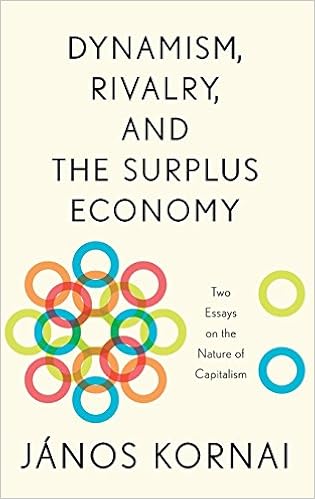
In the latest issue of the Journal of Economic Literature, Xu Chenggang reviews János Kornai’s Dynamism, Rivalry, and the Surplus Economy. Kornai calls the 2013 book a sequel of sorts to his 1992 classic The Socialist System, as it lays out a conceptual framework for understanding capitalism in contrast to socialism. But Xu also uses the review to think through China’s current situation in the context of Kornai’s framework, especially the key concept of the soft budget constraint:

Two pairs of concepts highlight the analytical framework for contrasting capitalism to socialism: shortage economy versus surplus economy and soft budget constraint (SBC) versus hard budget constraint (HBC). Compared with the distinctive feature of socialism called chronological shortage, which was first pointed out by the author in the 1970s, capitalism is characterized as chronological surplus, which means excess supply, including excess capacity and excess inventories, and labor unemployment. …

One of the major challenges beyond understanding “pure” systems is the hybrid system, which covers most of the economies in the world. China presents an interesting case of such a challenge. The pre-reform socialist China was a shortage economy, which is exactly consistent with Kornai’s predictions. Since the reform, China transformed into a particular type of hybrid system, that is, state capitalism, similar to that in Vladimir Lenin’s New Economic Policy. …

The Chinese economy is a super-surplus economy featured by massive over-capacity, which exceeds the over-capacity problem in all leading capitalist economies in the world. Such an extraordinary over-capacity problem is concentrated in the state sector with SBC. The SBC syndrome and the “forced growth” behavior of the SOEs create shortage under the socialist system. This phenomenon raises the issue of why SBC under state capitalism is associated with surplus. …

In contrast to private firms in capitalism, state firms under state capitalism continually produce and expand unwanted and obsolete products because they are protected by SBC (i.e., no “destruction” policy). The monopolistic power and government protection provide SOEs with the privilege of heavily subsidized capital. They imitate other innovations at extremely low costs because of favorable technology transfer deals from advanced multinational firms that are supported by the government and the monopolized super-large scale of the market (e.g., high-speed train technology). …

In socialism, SBC and lack of competition create shortage. Moreover, SBC is a mechanism that hampers competition. Indeed, market competition was weak in the Central and Eastern Europe and Former Soviet Union (CEE–FSU) reformed economies when central planning was replaced by market mechanisms. Different from CEE–FSU reforms, the large-scale entry of nonstate firms, particularly private firms, makes market competition the norm in the Chinese economy. Even SOEs, which are subject to SBC, are driven to fierce market competition and regional competition.

When high-powered incentives associated with these competitions are given to the CEOs of SOEs for market share or for profits and when SBC serves as insurance against insolvency, SOEs are induced to take bold risks in competition for market shares. This situation seems to be the force that produces extraordinary surplus. Thus, the coexistence of fierce product market competition and severe SBC could trigger more drastic over-capacity problems.

This phenomenon in which SBC under fierce competition may exacerbate surplus can also be observed in leading capitalist economies. Examples include the bad loan problems in Japan and the sub-prime mortgage problem in the United States. If the essential mechanism of SBC is the moral-hazard problem created by the removal of bankruptcy threat (broader than bailing out by an ex ante identifiable agent), the sub-prime mortgage scheme in the United States can be regarded as a sophisticated variation of SBC in advanced capitalism.

Like most of Xu’s work, the whole review is worth a read. I also happen to think that Xu’s 2011 article “The Fundamental Institutions of China’s Reforms and Development” is one of the single best things ever written about the Chinese economy; it and other pieces are at Xu’s profile and bibliography page.
What happened to the Chinese arguments for inland infrastructure investment?

There is a pretty overwhelming consensus these days that China is wasting huge amounts of money by building lots of unneeded infrastructure projects in its less-populated inland provinces. A lot has been written on this theme since the 2009 mega-stimulus that launched the infrastructure spending boom, but one of the more recent examples is this piece by Trefor Moss in The Wall Street Journal; here’s a sample:

While President Donald Trump says the U.S. urgently needs to invest in its decaying transport systems, China, if anything, faces the opposite problem of profligate infrastructure spending, according to some economists. Yet after years spent building airports, roads and railways, Beijing outlined plans for more of the same in a recent policy paper.

Under the plan, China would have 260 commercial airports by the end of the decade, up from 207 in 2015. Additions include a second major airport in Beijing at a cost of $11.7 billion, and a second airport for the western city of Chengdu for $10.2 billion. …

Three-quarters of Chinese airports—and virtually all the country’s regional airports—lose money, the then-chief of the civil aviation authority, Li Jiaxiang, said in 2014, in the agency’s most recent public comment on the issue. The agency spent $191 million last year subsidizing loss-making airports.

Airports in far-flung parts of western China are especially vulnerable. The $57-million Libo airport in Guizhou, for example, drew media attention in 2009 for handling just 151 passengers, yet the zombie facility hasn’t been allowed to close.

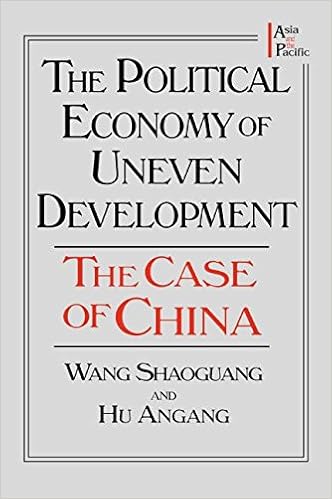
In this context it was interesting for me to recently read an older book that makes a strongly argued case for doing lots of infrastructure investment in inland provinces, with plenty of statistical evidence and full consideration of the relevant economics literature. The book is The Political Economy of Uneven Development: The Case of China by Wang Shaoguang and Hu Angang; it was published in 1999 but is a translated and revised version of a Chinese book composed in 1995. Therefore it very much predates the launch of China’s “develop the West” drive in 1999, and indeed the book seems to be a key source for the intellectual arguments driving that program and subsequent efforts to close the gap between the coast and the inland.

I would summarize Wang and Hu’s main arguments as follows:

  • There is no natural trend for regional disparities to be narrowed through a process of convergence. Market forces do not necessarily cause factors of production to spread evenly around the economy, but can concentrate them in areas that possess initial advantages. And in fact, regional inequality in China in the early 1990s was rising sharply.
  • Regional inequality in China was already extremely high by any international standard, which poses risks to national unity and political stability. (“The China of 1994 would undoubtedly have higher levels of regional inequality [if properly measured using units of similar size] than did Yugoslavia in 1988, just a few years before its disintegration.”)
  • The different endowments of China’s provinces–geography, economic structure, human capital, etc.–are either a function of differences in per-capita GDP or have no statistically significant relationship with per-capita GDP. In fact the numerous historical, geographical and cultural differences among provinces are less important than gaps in transportation infrastructure.
  • Differences in economic growth rates across China’s provinces are mainly driven by differences in investment, and differences in investment are mainly driven by differences in provinces’ local savings. Since local savings levels are themselves determined by the level of economic development, higher-income provinces have a natural tendency to grow faster.
  • These natural advantages could be offset by a capable and committed government that organized inter-provincial capital flows. But policies in the 1980s and early 1990s lead to fiscal decentralization and favoritism for the rich coastal provinces, aggravating rather than alleviating regional inequality.
  • The solution then is for the central government to stop unnecessarily favoring coastal provinces, and instead organize large fiscal transfers and investment programs in inland provinces in order to compensate for their lower savings, boost their growth and put them on a more equal footing with the coastal provinces.

Compared to most academic policy recommendations, these were almost unbelievably influential: two decades of large investment programs for inland provinces have followed. Yet the regional gaps that so worried Wang and Hu have not closed; indeed recently they have widened again. I would be surprised if many people these days would argue that the problem with inland provinces is that they aren’t getting enough infrastructure investment.

So what went wrong? I can think of a few possibilities, which are not mutually exclusive:

  • The differences in endowments among provinces were more consequential than expected, and could not be equalized simply by building more transportation infrastructure in poorer inland provinces. Coastal provinces’ real advantages may have been less about geography, infrastructure and transport costs, and more about greater access to social and business networks abroad, stronger entrepreneurial experience and traditions, and higher levels of education and human capital. Lowering transportation costs for the inland provinces helps, but it isn’t everything.
  • All investment is not created equal — public-sector investment in infrastructure and private-sector investment in manufacturing are not substitutes. Boosting public-sector investment in the inland provinces may have added to their GDP in the short run, but it did less to change their growth potential and economic structure than private-sector investment would have. High rates of public investment also risk entrenching dependency rather than ending it, in much the same way that huge amounts of foreign aid are not always helpful for poor countries.
  • The infrastructure investment boom was in practice not a centrally-organized transfer of capital designed to narrow regional gaps, but more of a nationwide epidemic of soft budget constraints.

Japan’s WWII war machine did not have enough machines

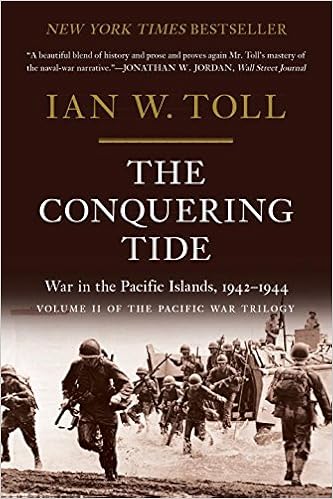
It is not a stirring description of valor in battle, but the following passage from Ian Toll’s The Conquering Tide: War in the Pacific Islands, 1942-1944the sequel to his excellent Pacific Crucible, nonetheless stayed with me for a while:

Japanese war planners had hoped to produce 40,000 new military aircraft in 1944, but the production rate was barely half that level in the fall of 1943. Aviation plants were straining under the pressure of material shortages, maladroit logistics, and a paucity of trained machinists and engineers. Shipping losses bit deeply into deliveries of Malaysian and Jakartan bauxite, the industry’s chief source of aluminum alloys. The Mitsubishi complex in Nagoya had expanded steadily, employing 43,000 workers by the end of 1943, but it had turned out only 1,029 new Zeros in 1943, fewer than half the number demanded by the military services. The Japanese aircraft industry had relied to a disproportionate extent on a small, overworked coterie of talented craftsmen and technicians, and was never optimized for mass production. Belated efforts to introduce standard production-line techniques brought some improvement, but neither Mitsubishi nor the other major aircraft suppliers (Nakajima, Aichi, Kawasaki, Tachikawa, Yokosuka) managed to ramp up output fast enough to fill the military’s ballooning wartime orders.

When a government inspector passed through the Nagoya works in late 1943, he was surprised to learn that newly manufactured Zeros were still being hauled away from the plant by teams of oxen. There was no airfield adjoining the Mitsubishi plant. The new units had to be transported overland to Kagamigahara, twenty-four miles away, where the navy would accept delivery. The aircraft were too delicate to transport on trucks, and the railheads were not convenient. Twenty oxen had died, and the remaining thirty were verging on complete exhaustion. Feed had been obtained on the black market, but the supply was not reliable. Essential wartime deliveries of replacement aircraft thus hung on the fate of a diminishing herd of underfed beasts. Mitsubishi engineers at length discovered that Percheron horses could haul the aircraft to Kagamigahara faster and required less to eat. These ludicrous exertions, when compared at a glance to the arrangements at Boeing, Douglas, or Grumman, tell most of the story of Japan’s defeat.  …

Writing years after the war, Jiro Horikoshi observed that his country could not draw from the deep wellsprings of engineering and technical expertise that existed in the United States. There was nothing in Japan to compare with America’s sprawling complex of universities, research laboratories, design firms, and heavy industries. Japan had a small circle of gifted engineers employed by the navy, the army, and about a dozen industrial firms. Owing to rivalries between the army and the navy and between rival companies and cartels (zaibatsu), much of their work was duplicative and wasteful. All too often their talents were squandered on impractical, profligate, stop-and-start projects that never got off the ground (in some cases, literally). They were resourceful and dedicated, but there were not enough of them. Horikoshi and his colleagues drove themselves to the verge of complete exhaustion and collapse, until the doctors and bosses ordered them to rest. “Such poor management of technical policy created the situation where we had no other choice but to rely on the Zeros [a lightweight plane that US pilots were shooting down in increasing numbers] from the beginning of the war until its end,” Horikoshi wrote, “and this, in turn accelerated Japan’s defeat.”

The image of the starving oxen pulling planes indeed captures so much of the tragic waste that was Japan’s attack on the US.

Toll’s book is really a narrative history of key military engagements, not primarily an economic or social history–but it’s nuggets like this, along with digressions on topics like Hawaiian social history and shore leave in Australia, that help make the book continuously interesting and far from narrowly focused. It’s vividly written and a marvel in clarity, no simple task given the mass of names and the obscure and complicated geography it covers.

The lasting influence of “Kornai fever” in China

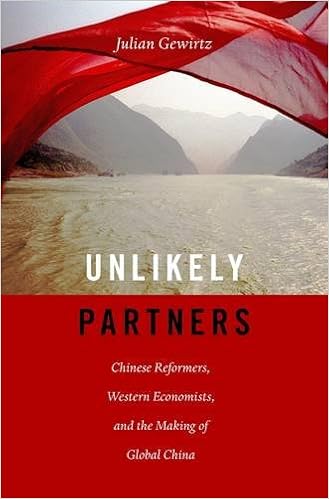
Julian Gewirtz’s new book, Unlikely Partners: Chinese Reformers, Western Economists, and the Making of Global Chinahas gotten rave reviews from plenty of people smarter and more important than me, but I am happy to add my voice to the chorus. It is an excellent general history of economic policymaking in the first fifteen or so years of the reform era (1978-1993), focusing particularly on the intellectual exchanges between a group of Chinese intellectuals and various foreign economists. The “western” in the title should be interpreted very broadly, as the stars of the story are in fact mostly lesser-known scholars from what used to be called the Eastern Bloc.

At the center of this tale is the great Hungarian economist János Kornai, who incisively analyzed the nature and problems of socialist economies. With detailed research and interviews, Gewirtz nicely uncovers the chain of encounters that led to Kornai’s ideas getting wide exposure in China:

Kornai’s major idea presented at the [1981] Athens conference was his analysis of the “soft budget constraint.” This crucial concept showed that, under a planned economy, the firm “is not limited by fear or loss of failure”–in more practical terms, loss-making in the firm’s finances does not bring negative consequences to the firm. … Kornai’s presentation drew a sharp rebuke from V.R. Khachaturov, president of the Soviet Economic Assoication and a vehement supporter of the socialist planned economy. … But an unlikely voice, not heard previously in the conference discussions, spoke up in Kornai’s favor: Wu Jinglian. “In his paper, Professor Kornai had analyzed the functioning of a specific model of a socialist economy. Chinese experience made it easy to understand his analysis,” Wu said. Chinese economists had observed these issues, especially the “paternalistic relationship” of the government and enterprises, “serious waste” in enterprise management, and “the disappearance of the function of prices as carriers of information about supply and demand.” Wu praised Kornai for providing a rigorous conceptual apparatus. …

While at Yale University’s Department of Economics in 1983-1984, the 53-year-old Wu had read Kornai’s Economics of Shortage. Returning to China in 1984, Wu stashed a copy of Kornai’s book in his luggage and, at home, excitedly circulated sections of the book among friends and colleagues. In the minds of this small, elite group of Chinese economists, Janos Kornai seemed like an unexpected friend. …

[in 1985] Kornai had come to China as part of a distinguished group of economists from Europe and North America who would gather with many of China’s leading economists and economic policy makers. … The ostensible topic of his presentation was “could Western policy instruments (especially monetary and fiscal policies) be effective in socialist countries?” Kornai’s career, built on applying sophisticated economic analysis to the economic problems of socialist countries, clearly suggested an affirmative answer to this question–although this idea was relatively new to China. Since arriving in Beijing, Kornai had been listening carefully to discussions of China’s problems, including economic “overheating” and fears of inflation, as well as to the Chinese economists’ sense that they did not have in mind a goal model for the reform. Listening to such discussions, he wrote in his memoirs, “I felt…that I was at home in China, despite the distance and the historical and cultural differences. All the phenomena that came up and the cares and woes were familiar.” …

Kornai’s ideas, transmitted through diverse channels, flooded into Chinese debates, including the 1986 publication of the Chinese translation of Economics of Shortage. Dozens of articles in periodicals introduced an even wider readership to what Dushu, then a prominent liberal magazine, called the “enlightening” views of Kornai, whom they dubbed “the economic theorist that reform cried out for.” “Kornai fever” would go onto fuel sales of over 100,000 copies of the Hungarian economist’s book. Kornai was mentioned hundreds of times in academic and research journals in the period 1986-1989, including in regional and provincial journals in areas as varied as Guangxi, Hubei, Anhui, and Heilongjiang. …

These authors placed particular emphasis on two related aspects of the book: why the shortage economy was innate to socialism and how enterprise behavior under socialism created shortage phenomena—focusing, as a result, on Kornai’s arguments about the “soft budget constraint” and “paternalism.” These ideas, which the reviewers defined as priorities to address in future reforms in China, would remain the most salient aspects of Kornai’s thought for Chinese economists.

This jibes with my own experience; I discovered Kornai’s work from Chinese references to the term “soft budget constraint” in writings on state-owned enterprise reform. But while the soft budget constraint is brilliantly useful conceptual tool, being able to identify the problem of soft budget constraints has not enabled China to solve it. In fact the simplest diagnosis of the problems of the post-2008 Chinese economy is probably that budget constraints, which had been getting harder, became a lot softer.

Kornai’s most important contribution may actually have been to articulate the idea a market economy could still be regulated or managed by the government through indirect means–the fiscal and monetary policies used in Western economies–rather than the direct planning characteristic of socialism.

There is much testimony that Kornai’s presentation on this theme at the 1985 Bashan conference helped many Chinese reformers clarify the direction in which they wanted to head. They knew that they didn’t want a planned economy any more, but they were also very uncomfortable with the idea of an economy completely driven by random market forces. Kornai’s presentation helped square the circle, and Gewirtz shows how the deceptively simple concept of a “market economy with macroeconomic management” eventually became an official goal and (more or less) a reality. Kornai himself recognized how unlikely this whole chain of events was:

It’s very strange that in my own little country [I was ignored] most of the time, and in this giant country I was able to speak at a certain historical moment when one billion people wanted to hear exactly what I wanted to say. That was a very rare moment, and good luck.

Who lost the battle for Manchuria?

A lot of mythology surrounds the Chinese Communist Party’s peasant origins and guerrilla tactics. But the Communist victory over the Nationalists in the civil war was not a mass uprising around the country, but a military campaign that started with victories in northeast China–Manchuria–and moved south from there. (There are some historical echoes, as when the Mongols and, later, the Manchus, conquered China, they also came from the northeast.) Here is Andrew Walder in his China Under Mao:

Victory was actually attained through conventional warfare fought between large modern armies, involving massive mobilization of material and human support for each side. Guerrilla warfare permitted the CCP to survive and expand during the Japanese invasion, but this survival strategy placed minimal demands on peasants to supply Communist partisans with food, material support, and recruits. Once the civil war began, the CCP abandoned guerrilla operations. As its armies poured into Manchuria after Soviet forces occupied the territory, Mao turned to a strategy of total mobilization for revolutionary war. The Red Army, renamed the People’s Liberation Army (PLA) in 1945, grew from 475,000 in 1944 to 2.8 million by 1948. …

The final years of the civil war resembled the Soviet army’s conquest of Eastern Europe in the last phases of World War II. The PLA rolled south from Manchuria and adjacent regions of North China, conquering vast regions that had never before been under CCP control, and regions like Tibet and Xinjiang that had not been governed by any Chinese state since the fall of the Qing dynasty.

Since the Communist victory was truly a military victory, many have looked to military causes to explain it. Chiang Kai-shek himself, in a book published after the war, focused attention on a series of events in 1946, around the city of Siping in Jilin province. Communist forces had occupied the city but were then dislodged by the Nationalists; at the same time, however, both parties were negotiating with the American envoy George Marshall, and a ceasefire was declared shortly afterward the Communist troops fled Siping. Chiang of course agreed to the ceasefire but in hindsight felt it was a mistake that allowed the Communists to regain the initiative:

This was a war that Chiang had lost in 1949, but which might have come out very differently, Chiang argued, if the Second Battle of Siping and its aftermath had been handled differently. The battle itself, Chiang said, had been “another decisive battle against the Communist troops.” As he described it, the three hundred thousand men under Lin Biao’s command had been utterly defeated: “More than half the Communist effectives became casualties.” Reports from the front, he said, “all agreed that barring some special international complications the Chinese Communists would not be able to fight anew after the terrific punishment they had just taken at the hands of the Government forces.”

Then there came the ceasefire and the suspension of [Nationalist general] Du Yuming’s pursuit of the Communist forces. Chiang believed that if his armies had continued their pursuit, “Communist remnants in northern Manchuria would have been liquidated.” Without a base area in northern Manchuria, the remaining Communist forces in Manchuria would have been deprived of Soviet support and “a fundamental solution to the problem of Manchuria would have been at hand.” Instead, “the morale of Government troops in Manchuria began to suffer” and Lin Biao rebuilt his forces in northern Manchuria. “The subsequent defeat of Government troops in Manchuria in the winter of 1948,” said Chiang, “was largely due to the second ceasefire order.” In this view, Siping was the decisive battle that could have been— if only a ceasefire, negotiated by George Marshall, had not intervened. Defeat had been snatched from the jaws of victory.

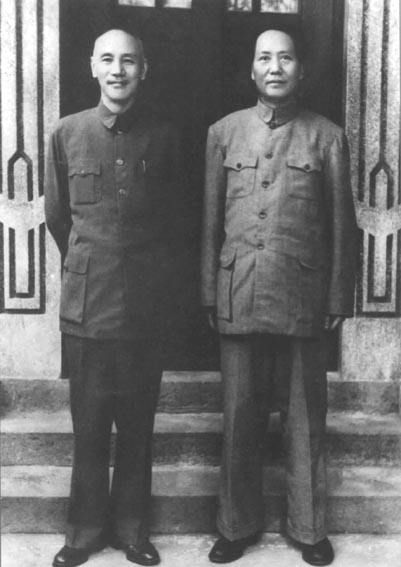
Chiang Kai-shek and Mao Zedong in 1945

Chiang Kai-shek and Mao Zedong in 1945

That is from Harold M. Tanner’s The Battle for Manchuria and the Fate of China: Siping, 1946, which reconstructs the events leading up to and following the battle, and tries to answer the question of whether Siping was truly the turning point that ensured Communist victory in the civil war. While Senator Joseph McCarthy also blamed Marshall’s intervention for “losing China,” a number of more reputable historians have also seen Siping as a key turning point. Tanner however concludes that Chiang’s hope was a false one, in part because the Soviet Union was quietly but effectively supporting the Communists, and both the Nationalists and the Americans were afraid of getting into a direct confrontation with the Soviets:

The Truman administration had decided that while the United States would support Chiang Kai-shek, there would be limits to the extent of that support. Chiang desperately wanted the United States to take a more active role in supporting his government and his army in their struggle against what Chiang portrayed as the Soviet Union’s imperialist designs on Chinese territory. The Truman administration, however, was determined not to get directly involved in the Chinese Civil War, and especially not to challenge the Soviet Union by getting drawn into the struggle in Manchuria.

America was willing to transport Nationalist armies and to supply substantial amounts of weapons and ammunition, but, as we have seen above, American equipment alone could not give the Nationalists a substantial advantage on the battlefields of Manchuria. Even if the United States had been willing to do so, extending unlimited military aid to an army that was pursuing a fundamentally flawed strategy and a government that was proving incapable of winning the political struggle is not likely to have changed failure into success. In any event, the United States did not have unlimited resources to expend on Chiang’s government. Truman’s decision to limit support for Chiang was based on his assessment of American interests and capabilities, including American commitments elsewhere around the globe, and the very real possibility that American embroilment in China could lead to conflict with the Soviet Union.

Marshall’s decision to push for a ceasefire in June 1946 was made in this context, as well as on the basis of his assessment (backed up by the intelligence reports available to him) that the Nationalist Army was simply not capable of achieving victory in Manchuria. Chiang agreed to the ceasefire not only because Marshall was pressuring him to do so (although this was certainly an important factor), but also because he was aware of the limitations of his own armies, the challenges of further operations in North Manchuria, and the possibility that military operations north of the Songhua could elicit a dangerous reaction from the Soviet Union.

The Communist victory in China’s civil war, in this analysis, is ultimately the result of the Cold War and thus of how the Second World War ended. In fact, Peng Shuzhi, a Chinese Trotskyist, made much the same argument back in 1952:

Placed in an unfavorable position in the international situation created by the Second World War, American imperialism was obliged to abandon its aid to Chiang and its interference with Mao. At the same time, the Soviet Union, which had secured a superior position in Manchuria at the end of the war, inflicted serious damage to Chiang’s government and offered direct aid to the CCP. This enabled the latter to modernize its backward peasant army. Without this combination of circumstances, the victory of a party like the CCP, which relied purely on peasant forces, would be inconceivable.

For example, if Manchuria had not been occupied by the Soviet Union but had fallen entirely under Chiang’s control, Chiang Kai-shek would have utilized the economic resources and the Japanese arms in Manchuria to cut off direct connection between the CCP and the Soviet Union. This would have blocked the USSR’s armed support to the CCP. Similarly, the situation would have been quite different if direct intervention against the CCP by American imperialism had been possible. Under either of these two circumstances the victory of Mao Tse-tung would have been very doubtful.

To approach this from another direction, we could recall the defeat of the CCP’s peasant army in the Kiangsi period, 1930-35, when the bourgeois KMT’s power was considerably stabilized as a result of continual aid from imperialism, while the CCP was isolated from the Soviet Union. From this we can also derive sufficient reason to justify the conclusion that today’s victory of the CCP is entirely the result of the specific conditions created by the Second World War.

The Soviet Union’s pivot to Asia

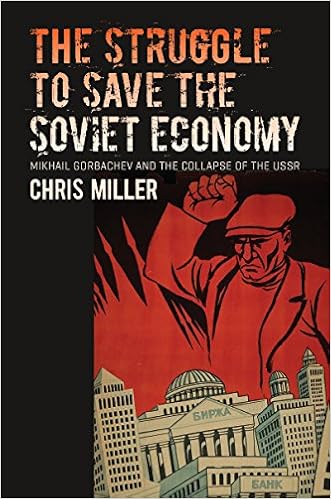
I very much enjoyed Chris Miller’s new book The Struggle to Save the Soviet Economy, which explains just how and why the Soviet Union’s economic problems became overwhelming in its last decade of existence. I was too young when the USSR broke up to do much more than just register the news headlines, so the book helped me get a better understanding of the events leading up to its collapse. One of Miller’s themes is that perestroika was not in fact an ill-considered attempt to rapidly introduce Western neoliberal economics, but rather an attempt to emulate the reforms that China was implementing so successfully at the time:

The stagnation and crises of the 1970s and 1980s in Eastern Europe and in the West convinced Soviet leaders that they needed to look elsewhere for models of reform. The rapidly growing economies on the USSR’s eastern border were the obvious place to turn. Most historians have overlooked perestroika’s Asian roots, but they were clear to contemporaries. Leading economist and Gorbachev adviser Stanislav Shatalin, for example, was asked by a journalist which of the world’s economic models the Soviet Union should emulate. Should it copy the West, or learn lessons from its Eastern European socialist allies? The question of international orientation had vexed Russia since Peter the Great, but like many perestroika-era intellectuals, Shatalin believed it was time for something new. “We need to be more attentive to the experiences of Japan, South Korea, and China,” he said. “It is time to unite the Slavophiles and Westernizers, and turn our face to the east.” …

One irony, many Soviet officials noted, was that China’s policies were not actually new. Not only was Deng’s policy of “reform and opening” similar to Lenin’s New Economic Policy, it also mirrored changes to economic governance mechanisms that some Eastern European countries like Hungary tested in the 1960s and 1970s. …But the Soviet officials who embraced China as a model did so not because they thought Beijing’s policies were unique, but because they believed that China provided compelling evidence of what such reforms could accomplish.

Miller’s argument is not that Gorbachev’s reforms were too aggressive or poorly designed, but rather that their effectiveness was undermined by heavy opposition from entrenched interests in the bureaucracy. With the budget in crisis and inflation spiraling, the incomplete reforms could not stabilize the economy and so it collapsed. (This view is similar to the argument made by Jeffrey Sachs and Wing Thye Woo in their classic 1994 article “Structural Factors in the Economic Reforms of China, Eastern Europe, and the Former Soviet Union”). For me, the book had just the right balance of analytical coherence, narrative drive and use of original sources; a great read and now a late addition to my best books of 2016 list.

Another virtue of Miller’s book is how it gives a sense of the socialist countries compared ideas and borrowed from each other, forming a common and distinctive intellectual universe. For more on this kind of cross-pollination, see a previous post on the influence of the New Economic Policy of the 1920s on Chinese economic reforms of the 1980s, and my short account of how China first looked to Eastern Europe for reform ideas before turning to Japan and Korea.

The best books I read in 2016

These are my favorites of the books that I read during 2016, which are not necessarily books published in 2016 (the same rules as in previous installments). History and Russia were the main themes this year; I did read a fair number of China and economics books, but most of those ended up being fine and useful rather than books I wanted strongly to recommend. I also read less fiction this year than I usually do; not sure why.

Here they are, more or less in the order I read them:

Nonfiction

  • Robert Tombs, The English and Their History. Almost every one of its thousand or so pages is delightfully written and filled with interesting information. I particularly enjoyed the clever structure: after covering each era, Tombs writes a chapter on how it was understood by its contemporaries, later historians, and current research. It’s a wonderful device for disposing of myths and delivering clarity.
  • Lars Mytting, Norwegian Wood: Chopping, Stacking and Drying Wood the Scandinavian Way. Essentially an ethnography of home energy consumption in Norway. It’s hard for me to explain why that is so interesting, but it is.
  • Patti Smith, Just Kids. I never had much time for Patti Smith’s music, so took me a while to pick up this widely-praised memoir; in fact she is a lovely writer with a great eye for detail. The portrait of struggling artists in 1970s New York avoids the obvious pitfalls of self-absorption and name-dropping with its honesty.
  • Mark Miodownik, Stuff Matters: Exploring the Marvelous Materials That Shape Our Man-Made WorldAn exemplary work of popular science writing, exposing the fascinating processes underlying lots of, well, stuff. The section on chocolate is a highlight, so are the ones on cement and steel.
  • Benedict Anderson, A Life Beyond Boundaries: A Memoir. A delightful short book with many reflections on Asia, translation and comparative scholarship. I also re-read his Imagined Communities this yearwhich still ranks as both a great read and wonderful piece of boundary-crossing scholarship (more discussion here and here).
  • Charles Clover, Black Wind, White Snow: The Rise of Russia’s New Nationalism. A fascinating piece of intellectual and political history, from the scribblings of Russian aristocrats to the speeches of Putin, that has only become more relevant since its publication. Check out this excerpt for a taste.
  • René Girard, I See Satan Fall Like Lightning. Perhaps the strangest, most unusual book I have read all year–as well as the one with the best title. Then again, I don’t read a lot of Biblical exegesis-cum-philosophical anthropology, if that is even a category with more than one member. Great social insights from a unique mind (more discussion here).
  • Jürgen Osterhammel, The Transformation of the World: A Global History of the Nineteenth Century. Started on a whim, this book ended up taking over my life for much longer than I anticipated. Exhausting and rewarding in equal measures, it is without peer as a feast of scholarship and knowledge. One of its many themes is how much of the twentieth-century world was born in the nineteenth century, but it defies schematic summary.
  • Enrico Moretti, The New Geography of Jobs. A very clear explanation of the causes and implications of the one of the more important socio-economic facts of the moment: that “the knowledge economy has an inherent tendency toward geographical agglomeration.” Recent political events suggest that the social downsides of geographical polarization deserve more attention than he gave them in this 2012 book, but I still found it very helpful.
  • Chris Miller, The Struggle to Save the Soviet EconomyA vivid analytical narrative of the last decade or so of the USSR, focusing on the drivers of Gorbachev’s reforms and the factors that ultimately thwarted them. Another interesting theme is how Soviet leaders viewed China’s contemporary reforms.

Fiction

  • N.K. Jemisin, The Fifth Season. A truly surprising and interesting fantasy novel, a species that has become almost extinct in this age of endless variations on the same genre tropes.
  • Eka Kurniawan, Beauty is a Wound. A surreal but always compelling portrait of the tumultuous twentieth century in one Indonesian city; bears comparison to One Hundred Years of Solitude. 
  • Madison Smartt Bell, Straight Cut. A standout noir novel from an unlikely source; reminiscent of the European-expatriates-in-peril stories of Patricia Highsmith.
  • Philipp Meyer, The Son. Three generations of Texans and their frontier legacy of violence; it captures well how one person’s desire for freedom can destroy another’s.
  • John James, Votan. Extravagantly praised by Neil Gaiman, and in fact extremely good and really unlike anything else. A cynical Greek merchant uses primitive mythology to swindle some Germanic tribes, but it becomes increasingly unclear who is using whom; a must for anyone who enjoys the Norse myths.
  • Ted Chiang, Stories of Your Life and Others. Quite simply, one of the best science-fiction short-story collections ever published. Apparently the movie Arrival is based on the title story, which is stunning because it is one of the least visual and most obviously unfilmable narratives I have ever read.
  • Amor Towles, A Gentleman in Moscow. An absolutely charming story of a disgraced Russian aristocrat whose house arrest during the revolution turns out to be the best thing that ever happens to him.
  • Willa Cather, Death Comes for the Archbishop. Strangely titled, since it is actually about the life of a bishop. A mostly plotless but very moving account of French missionaries in New Mexico, sharply evoking loneliness, culture clash, fulfillment.
  • Ursula K. LeGuin, The Found and the Lost: The Collected Novellas. A feast of excellent and mostly recent writing from LeGuin, much of which was new to me (most of the good stuff in the anthologies of her short stories published a couple of years ago I had already read). I also enjoyed Eleanor Arnason’s Ring of Swords, which was recommended by LeGuin herself, and is quite LeGuin-ean in its attention to comparative social structures.

The practitioner’s view of economic development: “We do what we must and then adjust as we go along”

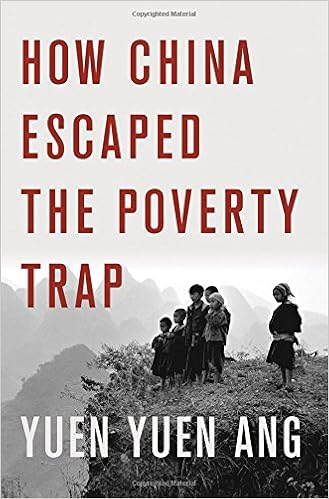
The new book by Yuen Yuen Ang, How China Escaped the Poverty Trap, has some nice passages that give some of the flavor of how Chinese government officials went about developing their local economies. This practitioner’s perspective is often quite distant from the questions that animate scholars of economic development. Here is a sample:

My interviews with local bureaucrats in China deliberately included a question that has long been debated in academic circles: In your locality, do you think it was effective governance that led to growth or growth that enabled the governance to improve? The bureaucrats were consistently astonished by the naiveté of the question. To them, the answer is obvious: causation runs both ways. One regular cadre in a city-level agency, who had no scholarly training whatsoever, gave a memorably insightful reply:

“The economy and the bureaucracy interact and change together. If the economy is poor, then, inevitably, it will be difficult to improve governance. …In reality we do what we must and then adjust as we go along… There must be a process. It’s impossible for a government to reform overnight.”

More bluntly, another bureaucrat bureaucrat griped that the question posed was flawed. In his words, “To say that we should grow the economy and then improve the business environment, or vice versa, are both misguided. Obviously, we must pursue both at the same time, like the pursuit of material and spiritual development.”

These replies suggest that development as a coevolutionary process is a plain reality to many practitioners and probably lay observers too. It is no wonder that they dismissed the question as academic. …

How did development actually happen in Forest Hill? Did the city’s leaders heed the advice of international experts to establish good governance as a first step of development, namely, by furnishing secure property rights to private entrepreneurs and resolutely eradicating corruption? Or did it model itself after the developmental states of East Asia, by establishing technocratic state agencies and channeling resources toward targeted industries? Alternatively, did the city make do with “good enough governance,” delivering only minimal government performance and waiting until it had become sufficiently wealthy before improving governance? The answer to all three hypotheticals is no.

Ang’s own theory of China is a variant on the “regionally decentralized authoritarianism” or Chinese-style federalism argument, which puts the emphasis on the striving of local officials to generate growth. In particular, her book has some good detail on the systems for motivating and evaluating local government officials. But she also, correctly in my view, emphasizes how the pressure on local officials to generate growth ends up having very different outcomes depending on the characteristics of different localities.

The core of the book is a set of detailed narratives of a few different localities in China. These emphasize that government officials did not follow a consistent strategy, or gradually perfect institutions, but instead continuously adapted in response to changes in the economy. Rather than a one-way causation from institutions to economic outcomes, or vice versa, there is a constant feedback between the two. These accounts are well done and pretty convincing for the take-off period of the 1980s and 1990s. The Why Nations Fail crowd has never really managed to provide a decent account of Chinese economic development (which is a bit like having a theory of linguistics that fails to explain the grammar of English), and accounts like this that tackle the detail of China’s actual institutions are good to have as a corrective.

Still, Ang’s narratives get a bit less detailed and convincing as they move into the 2000s. For a book about economic development there is sometimes a vagueness about what has actually happened in China’s economy over the past decade and a half. The impact of the rise of township-and-village enterprises in the 1980s and the privatization of state-owned enterprises in the 1990s are well covered. Yet there is almost no discussion of the growth in foreign investment and exports that followed China’s entry into the World Trade Organization in 2001, or of the enormous real-estate boom that got started around 2003 and is still running, or of the global financial crisis of 2008 and the subsequent surge in infrastructure spending. The focus of the book is, as the title indicates, on the early stages of China’s growth boom, so these are not crippling omissions. But digging into these developments more would help answer the broader question of whether the feedback between economic change and bureaucratic decision-making in China has always been as positive as it was in the early stages of its growth take-off.

The most famous Swede of his age

…was someone I had not previously heard of. I can’t resist posting another excerpt from Jürgen Osterhammel’s The Transformation of the World: A Global History of the Nineteenth Century,  one of the many fascinating bits of knowledge that are everywhere in this masterpiece. (And no, I’m still not finished. It is really long).

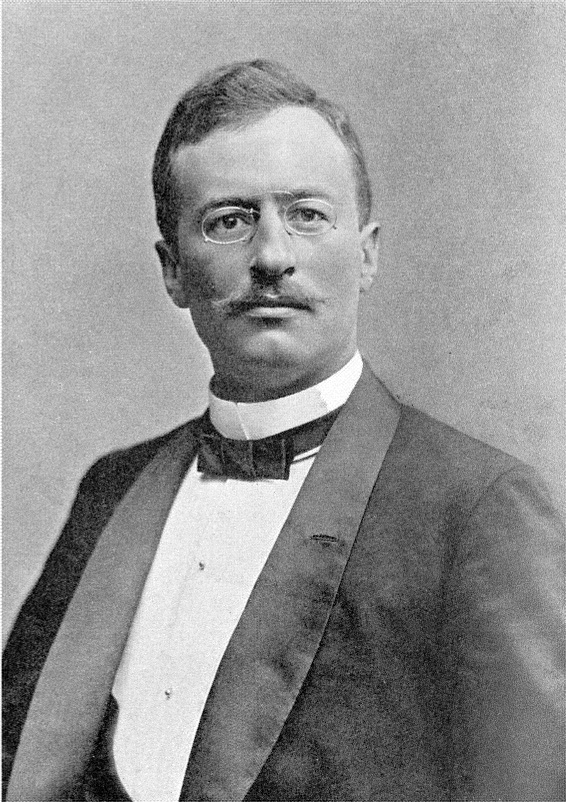
In the subsequent generation, Sven Hedin, having started his long career in 1894 with a research trip to Central Asia, became the most famous Swede of his age, with unfettered access to monarchs and heads of government in both West and East and adorned with countless decorations, gold medals, and honorary doctorates.

Hedin’s life encapsulates the contradictions of Europe’s relationship with Asia. Convinced of the general superiority of the West over the East, Hedin was an excellent linguist and scholar and at the same time a Swedish (and, from personal choice, German) nationalist and militarist, a man of the political Right, who enjoyed taking part in geopolitical fantasizing about a “power vacuum” in the heart of Asia.

But he was also one of the first Westerners to take contemporary Chinese science seriously and to cooperate with Chinese experts. He is held in high esteem in China today: a not atypical posthumous reputation, since quite a few European explorers, despite their activity in the service of empire, have been integrated into the collective memory of postimperial countries.

Osterhammel notes that there is no English-language biography of Hedin; I for one would read one. In the meantime, there is a reasonably extensive Wikipedia page.

Sven Hedin

Sven Hedin

Can our imagination cope with the inevitability of inequality?

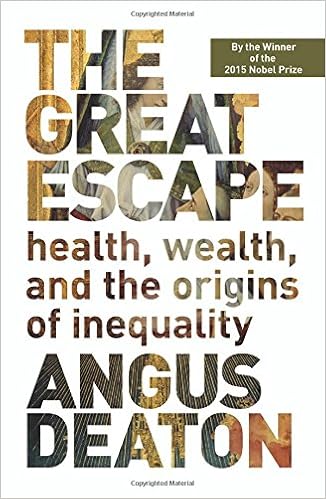
Still catching up with last year’s Nobel Prize winners, I recently read Angus Deaton’s book The Great Escape: Health, Wealth and the Origins of Inequality. It is marvelously clearly written, and covers the history of improving health and economic growth in a distinctive way.

One of the book’s strongest insights is right there in the title. It is one of those ideas that seems so simple at first that it is almost trivial, but in fact becomes more and more powerful on further reflection. As Deaton puts it: “inequality is the handmaiden of progress.” Or, “a better world makes for a world of differences.” It is in the nature of progress that it creates inequality between those who benefit first and everyone else:

Escapes leave people behind, and luck favors some and not others; it makes opportunities, but not everyone is equally equipped or determined to seize them. So the tale of progress is also the tale of inequality. … Not everyone gets rich at the same time, and not everyone gets immediate access to the latest life-saving measures, whether access to clean water, to vaccines, or to new drugs for preventing heart disease.

Even if progress continues in the future, which Deaton is cautiously optimistic it will, this will inevitably produce new inequalities (even if old ones are also reduced).

This theme is also at the center of a recent and quite interesting short essay by Michael Lind, in which he argues that the ways we imagine the future have consistently failed to take account of this fact that progress is inseparable from inequality:

Science fiction traditionally has had the task of providing us with alternative visions of the future. For the most part, it has done a terrible job. The main reason for its failure is that it assumes global uniformity. …

The last time all human beings were more or less at the same level of technology and social organization was the Paleolithic Era. …By 2100 or 2200, most people on earth may be urbanites equipped with modern technology, not peasant farmers. But even in an industrialized world of wage workers and cities, the gaps between rich and poor regions are likely to remain enormous. Even as some backward areas catch up, innovative regions will shoot ahead.

The essay argues that futures that are imagined as uniform have often proved a completely unreliable guide to the actual course of events. In reality, progress produces differences among countries, which in turn create great-power rivalries, wars, and migration–all unavoidable features of our contemporary world. Thinking about progress as uniform is not just incomplete, but fundamentally misleading.

But Lind of course is really talking about politics not just the literary genre of science fiction. The example he closes with is the world government so often imagined in science fiction, with its real-life echoes in idealistic international schemes like the United Nations and the European Union. World government has of course become steadily less likely not more likely over time, and the assumption that the natural course of progress is for more homogeneity and more integration has also been sorely tested of late.

Both Lind’s essay and Deaton’s book (particularly the first half) are very much worth reading and pondering.