A European inspiration for Chinese decentralization

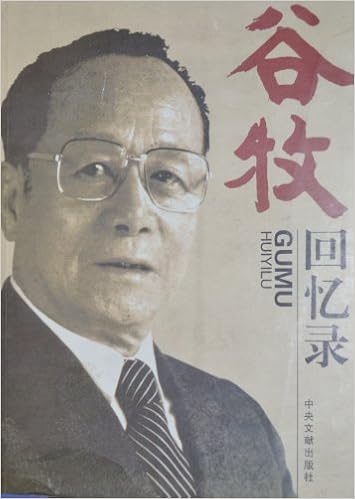
A lot happened in China in 1978, the year conventionally used as the starting point for the reform era. One of the many fascinating events of that year was the five-week journey of a group of Chinese officials, led by Vice Premier Gu Mu, to France, Germany, Switzerland, Belgium, and Denmark. Today, when such visits are a regular occurrence, it is hard to comprehend the significance of this trip, and just how much it must have blown the minds of the Chinese officials. Gu and other officials saw first hand, and for the first time, just how advanced Western technology was and how high living standards were in these countries.

Ezra Vogel, in chapter 7 of his Deng Xiaoping and the Transformation of China, compares the overseas trips that Chinese leaders made in 1978 to the Iwakura Mission of 1871-73, which helped inspire Japan’s modernization. Gu Mu’s authorized memoirs also discuss this trip, and in the book he actually reproduces a large section of the subsequent report he wrote for the Party leadership (I picked up a copy of the English translation of his memoirs at the Foreign Languages Bookstore in Beijing).

His report made a big impression, and is usually credited with helping inspire the high-level decisions made soon after to open China up to foreign trade and develop science and technology. But Gu’s report also discusses several other issues, and I was particularly interested in the part where he argues for decentralizing authority on economic matters to local governments. This was inspired by what he saw in Europe: for instance, Gu remarks on his meeting with the governor of the German state of Bavaria, who offered him a handshake agreement for a $5 billion loan over dinner.

Decentralization would become one of the most distinctive features of China’s reform era, and local governments’ freedom to pursue economic growth is usually given a lot of credit for China’s subsequent success. So it’s worth reading Gu’s arguments in full:

On the improvement of the economic management system. The key to this question is how, under the uniform planning of the central authority, to allow local governments to accomplish more. Chairman Mao once said, one of the important reasons why the economy of European countries had developed so fast was that their countries were comparatively small. The central and local governments had division of power and could handle affairs flexibly. What we saw during our visit bears this out.

For example, in West Germany, the local governments at the state level enjoy relatively wide power. Many affairs can be handled once decided by a state government. This is beneficial to economic growth. Rhineland State only has a population of 3.6 million and it has a revenue of 10 billion DM (about 8 billion renminbi) for the state government to handle. Apart from administrative expenditure, this revenue is used in developing agriculture, local transport, education, urban construction, environmental protection and so on. Industrial construction is invested by capitalists and not included.

We have provinces and municipalities that are larger than some European countries, but their authority in managing the economy is very limited and hence they lack initiative. In planning, finance and managing materials, provinces and municipalities have not become real actors. The local governments do not have much power. For many affairs they have to come to Beijing. Often to address a single problem they have to go to several departments and wait several months without a result. This state of superstructure makes our socialist state machine seem inflexible and poorly adapted to the development of economic foundations.

If this problem is not solved and if we do not give full play to the initiative of local governments under the uniform planning of the central authority, our economy will lack vigor and there will be no high-speed economic development worth talking about.

This is a useful reminder that decentralization is not an immutable feature of the Chinese system, or something that happened automatically just because China is a very large country. Clearly Gu saw that in the 1970s the Chinese system was too centralized to be efficient, and that it needed to be more decentralized. (Jae-Ho Chung’s book Centrifugal Empire: Central-Local Relations in China also argues that the Maoist emphasis on local autonomy in the 1970s was largely rhetorical, with most localities compelled to follow the same political campaigns and economic priorities.)

It’s fascinating to learn that one of the most distinctive features of China’s economic model was, at least in part, inspired by the example of Europe. This history seems particularly relevant now, given that China’s current leadership is often focused on the problems decentralization has created, and looking for ways to push the pendulum back the other way (see this post from 2017 on the recent shift away from decentralization and its potential implications).
Three ways of looking at China and its history

A friend recommended I read Rana Mitter’s Modern China: A Very Short Introduction, and being a big fan of the Very Short Introduction series I was happy to do so. I’m glad I did: although the book surveys some fairly familiar material, it also puts forth some interesting historical ideas. What I found most useful is Mitter’s suggestion that our interpretations of modern Chinese history usually fall into one of three categories (the following are my terms not his):

Traditionalist. This is the view that “China has not essentially changed” despite the upheavals of the 20th century: that Mao and Deng were “new emperors” (as one book put it), that China is fundamentally Confucian and still on the same trajectory as in the rest of its supposed 5,000 years of history. This interpretation is quite common in popular discussions of China, and is implicitly invoked every time someone calls it “The Middle Kingdom” or talks about how Chinese foreign policy is still taking tips from Sun Tzu’s Art of War.

Socialist. This is the view that 1949 is the dividing line in Chinese history, and that the Communist victory in the civil war changed everything. Mitter associates this view mostly with romantic leftists of the 1960s, who were sympathetic to the Chinese revolution and willing to give Mao the benefit of the doubt. But there is a more contemporary version that also has a lot of currency, which emphasizes the present-day continuities with state socialism: how China remains politically authoritarian and how state-owned enterprises still play a major role in the economy.

Nationalist. This is Mitter’s own view: that the true dividing line in Chinese history is 1911, when the Qing dynasty was overthrown, not 1949. Since then Chinese politics has a “mass politics where there was a social contract between government and citizen” in which nationalism provides the major source of legitimacy. Both the Nationalists and the Communists sought national sovereignty, a strong state and economic development: Mitter sees both parties as engaged in “one long modernizing project.”

The standard academic thing to do would be to admit the obvious point that all three views have elements of truth and call for a nuanced combination: clearly some elements of Chinese traditional culture are still relevant, clearly it matters that the Communists and not the Nationalists have been in power since 1949, and clearly nationalism is a central issue in Chinese politics. So it’s nice that Mitter does not do this, and plants his flag firmly in the last camp. One of the more interesting passages in the book is his assertion that:

The Communist Party of today has essentially created the state sought by the progressive wing of the Nationalists in the 1930s rather than the dominant, radical Communists of the 1960s. One can imagine Chiang Kai-shek’s ghost wandering round China today nodding in approval, while Mao’s ghost follows behind him , moaning at the destruction of his vision.

There’s definitely something to this, but ultimately I’m not sure that I buy it. As regular readers will recognize, the legacy of Chinese socialism has been one of the major themes of this blog since I started writing it. So it’s probably no surprise that, if forced to choose among those three views of Chinese history, I might have to choose door #2, the socialist one.

These days it seems like it is not China’s similarities to other modern nations and economies that are most salient, but its differences. And if you interrogate the source of those differences, a lot of the time the answer is socialism and not Chinese traditional culture.

Is state ownership turning into a core interest for China?

Since the breakdown of the US-China trade talks earlier this month, it has often seemed as if Chinese officialdom and state-controlled media have been speaking off of a single script of pure nationalist outrage. But in fact the trade tensions have exposed some interesting differences in views across the system. Consider this part of a Xinhua commentary published on Saturday (you can read the Chinese text or an English summary):

At the negotiating table, the US government made many outrageous demands of China, including restricting the operation and development of state-owned enterprises. Obviously, this goes beyond the scope of trade negotiations and touches on China’s basic economic system. This shows that behind the US trade war with China is an attempt to violate China’s economic sovereignty and force China to harm its own core interests.

Some commentators have noted how the expression “core interests,” previously only attached to territorial issues, has now been applied to state-owned enterprises. But those who track such minutiae will notice that this commentary is signed by two journalists; Xinhua commentaries used to articulate official views are typically written by committee and do not carry a real person’s byline. The more official series of People’s Daily commentaries on the trade war has, as best I can tell, not mentioned state-owned enterprises at all. So my interpretation of this Xinhua piece would be that there are definitely people in the Chinese system who share these views, but the government has probably not (yet) decided to adopt this as its official position.

Now compare this “China has a state-owned economy and we’re proud of it” take with a recent speech from Guo Shuqing, who as Party secretary of the People’s Bank of China and head of the China Banking & Insurance Regulatory Commission is the government’s top-ranking financial official. Guo’s talk on the trade war (Chinese text and English summary) covered a lot of ground, but he also addressed the issue of state ownership:

In recent years, there has been an opinion expressed abroad that China’s rapid economic development is the result of “state monopoly capitalism.” But this kind of talk has no basis. In fact, the composition of China’s economy has become increasingly diversified, and the market share of state-owned enterprises has continuously declined. Including the economic activity of government, the state-owned economy accounts for less than 40% of GDP. Many state-owned enterprises are listed on foreign or domestic stock exchanges, and in fact are joint-stock enterprises; 100% purely state-owned enterprises are rare. Large state-owned enterprises have a large number of subsidiaries whose controlling shareholders are private enterprises. And even the central state-owned enterprises compete with each other. Today, private and foreign investors can enter almost all industries and sectors without any restrictions or barriers.

The tone here is quite different: yes, we have state enterprises, but they are a small and declining part of the economy, and it is more important that there is market competition among all companies. These defensive statements probably are not really completely, objectively true (though I think Guo’s estimate of the state-owned share of GDP is probably not too far off). Guo is what foreigners usually call a “reformer” in the Chinese system, and in a different context I’m sure he would frankly discuss the fact that both foreign and domestic private companies face many barriers. Indeed, at the moment Guo is spearheading a political campaign to increase private-sector firms’ access to bank credit, a campaign whose very existence makes it clear that there is not at all a level playing field.

But I think Guo is here engaging in a strategy that is common for those who want to nudge the Chinese system in a more market-oriented direction: they tend to describe things are being more competitive and market-driven than they actually are, so that marginal change in that direction seems unremarkable and logical. If you pound the table and call China’s state-owned enterprises a core interest of the nation, it becomes quite difficult to change them. If you say, China is mostly a market economy already, then gradually reducing the role of SOEs over time seems pretty unthreatening.

One of the dangers I see in the US-China trade war is that it could become politically more and more difficult for people like Guo to both defend China’s system against foreign attacks, and continue to nudge it in a different direction. “The Americans want us to get rid of state enterprises, and by gosh they’re right” is a much less likely response to US pressure than “How dare those Americans tell us to get rid of our state enterprises?” And that’s true even among people who might not otherwise be disposed to cheer on SOEs.

As is so often the case, Sheng Hong of the Unirule Institute (a libertarian-leaning think tank now mostly banned in China) sees the fundamental political issue quite clearly. Here are a few lines from his recent blog post (I have retranslated the Chinese, since the English version is a bit clunky):

State-owned enterprises account for 10% of exports, so the remaining 90% are made by private and foreign-invested enterprises. Therefore the vast majority of Trump’s tariffs are being imposed on private and foreign enterprises who do not receive government subsidies. This does not correct a market distortion, but actually punishes companies that follow market rules, which makes the market more distorted. …

In order to punish the unfair trade of a small group of companies, Trump has harmed all Chinese companies, and especially private companies. This has caused their feelings to run high and united them in their hatred [of the US], so that in a nationalist fervor they are now supporting their own country’s state-owned enterprises.

In other words, the trade war seems very likely to increase popular support for state-owned enterprises, and push more Chinese people into the view that they do actually represent a core interest of the Chinese nation. And that is probably not in the longer-term interests of the US.

I expect a US trade hawk would likely respond to this by saying that waiting around for China to decide on its own to slim down state-owned enterprises has not worked out for the last decade or so, and the harm this has done justifies putting pressure on China to change more quickly. And they would have a pretty good point. Which is unfortunately why it is now seems hard to be optimistic about the politics on either side.

The difference between the new and old Cold Wars

The deteriorating US relationship with China is more and more frequently being called a “cold war” and compared to the long-lasting rivalry with the Soviet Union. Even before the latest breakdown in US-China trade talks, it seemed like negotiations would at best produce a settlement of specific economic issues, and leave the broader relationship pretty frosty.

But a true “cold war” with China, if the administration does decide to go down that route, is in practice unlikely to play out in the same way as the US-USSR confrontation. This is for the simple reason that the US and Chinese economies are already intertwined to an enormous degree. By contrast, the US basically did not trade at all with the Soviet Union, and trade with its successor states has remained quite minimal. I find the simple chart below to quite striking. So for the US, a cold war with China is much more economically risky than isolating the Soviet Union ever was.

Another way to look at the US trading relationship with China is not to compare it not with historic rivals, but with other major trade blocs. It is a simple but important point that the majority of US trade is with friends and allies: Canada and Mexico, Europe, and the Asian democracies of Japan, South Korea, and Taiwan. The US has allies in the Middle East, but these alliances can be somewhat uncomfortable ones given the autocratic nature of the governments (Turkey, Egypt, Saudi Arabia). In any case the US economic integration with the Middle East is really quite small. China stands out for how it is, at the same time, both a political rival to and economically integrated with the US.

So from one perspective, the US economic relationship with China is too large and important to be casually endangered, even if it does need repairing. From another perspective, China is too different politically from the US to be permitted this degree of economic integration. I don’t know which perspective will end up dominating.

Yasheng Huang on historic human capital in China and India

The always interesting MIT professor Yasheng Huang has done a long podcast for the University of Pennsylvania’s China series. He starts off by criticizing people who compare China and India to argue that China’s authoritarian state capitalism is better for growth than democracy, and dives into economic history to explain why that isn’t right (quotes are from my notes, lightly edited for readability):

If you want to make an apples-to-apples China and India comparison, you need to control for other differences between the two countries. And the basic thing you need to control for is the quality and quantity of human capital. I would argue that unambiguously, China has done a thousand times better than India in terms of human capital development: public health, public education. Historically speaking, in part because of the exam system, China has always had a very strong tradition of literacy, being able to read and write. There is some evidence to suggest that China’s mass literacy in the 17th and 18thh centuries was comparable to that in Britain. This is going way back. I do see that as a huge strength.

A lot of the growth differences between India and China and India are really explained by that. So there is a fundamental attribution error that many people have committed. When they look at the differences between China and India they say, one is a democracy and one is an authoritarian system, one has better GDP growth and the other has worse. Little do they know that there are other differences. It’s these other differences that explain the growth difference between China and India. I would say that human capital explains 80% of the differences. Maybe we should take that more seriously.

China has always had something behind its back to have good, solid economic performance. Even in the 16th and 17th centuries they had pretty good performance by the standard of that time. In that sense, I’m not a free market fundamentalist. I see the state as being absolutely critical in building the human capital base. This is what the Chinese did historically, and also what the Chinese did during the Communist period, and also what the Chinese state is doing today. For that I give them an A-plus, I celebrate their achievements.

Huang said he is working on a new book that will investigate these historical foundations to China’s growth today (and also said he is working on an updated edition of his well-known bookCapitalism with Chinese Characteristics to incorporate post-2008 events).

There is perhaps a tinge of motivated reasoning here, as Huang is clearly looking for ways to explain China’s economic growth miracle without giving the credit to Chinese state capitalism. But I’m sympathetic to the idea that pre-1949 China, rather than being the backward feudal hellhole of Communist propaganda, was in fact pretty well equipped for modern economic growth–at least, once it could manage to put an end to foreign invasion, civil war, and aggressively backward government policy. Indeed, Huang’s arguments echo points made by the great economic historian Dwight Perkins, who also emphasized the importance of pre-20th-century China’s functional bureaucracy and solid education:

China’s capital city had a population of over one million people as early as the Song Dynasty, if not before, and supplying such a city required tens of thousands of merchants, transport workers and the like. Commerce on this scale requires records, and to use records an individual must be able to read at least numbers and some characters.

We do not yet have a reliable estimate of the level of literacy in 19th century China, but among males a basic level of literacy could have been as high as 30-45%. Among the highest income 5-10% of the population, literacy must have been nearly universal, and for many at this level literacy went way beyond basic.

A relatively high level of literacy by pre-modern standards did not lead to sustained economic growth prior to the 20th century, but it did lay the foundation for the creation of a modern high-quality education system, at least when one compares the education system that existed in China in 1949 with what one found in much of the developing world on the eve of that world’s attainment of independence from colonial domination.

(The source is Perkins’ The Economic Transformation of China, pp. 7-8.)

The challenge, of course, is to produce more rigorous measures of historic human capital and educational achievement that could test these impressions. It will be interesting to see what Huang comes up with.

The Belt and Road is about domestic interest groups, not development

Andreas Fulda on Twitter pointed out a useful new piece on China’s controversial Belt and Road Initiative by CSIS research Mark Akpaninyie. It seems that Mark and I have been thinking along similar lines, and the resulting online exchange helped me clarify my thinking.

It’s become increasingly clear that the “debt-trap diplomacy” meme started by Indian commentator Brahma Chellaney is not an accurate description of how the Belt and Road actually operates, despite the fervent embrace of this idea by China hawks. Basically, China is not actually organized enough to come up with such a clever and nefarious plan, and there is no evidence that there is a deliberate strategy to trap other countries in debt. A detailed examination of debt transactions by Rhodium Group also found that in many cases borrowers were able to get China to write off or renegotiate their loans.

The flaw in the debt-trap diplomacy theory, and with many other analyses, is that it mistakes the Belt and Road for a for a “highly centralized and coordinated” initiative. In reality, it is more of a slogan attached to the decentralized actions of state-owned enterprises and banks. Here is how Mark Akpaninyie describes it:

Little evidence actually suggests that Beijing coordinates a unified strategy to lure the developing world into unsustainable debt.

Instead of a state-led strategy, Chinese firms — motivated by profit and abetted by a toxic combination of bureaucratic disorganization, incompetence, and negligence at the state level — have exploited poor nations, which are dependent on cheap, and sometimes bad, loans. These companies, knowingly or unknowingly, persuade countries to pursue projects where benefits to the firms far outpace the benefits of the host nation. …

This practice does not trap recipient countries into taking on unsustainable debt. Instead, it allows Chinese companies to profit from often crooked deals building much-needed infrastructure in some of the world’s poorest countries, exploiting the undersupply of financing and these countries’ appetite for infrastructure projects.

The broader point here is that looking at the Belt and Road through the lens of “grand strategy” or “geopolitics,” as so many commentators do, or even portraying it as some kind of new philosophy of economic development, is quite misleading. All of these grand concepts are justifications invented after the fact for a pattern of actions that was already well underway before Xi Jinping made his 2013 speech about the Belt and Road.

The Belt and Road is really the expansion of a specific part of China’s domestic political economy to the rest of the world. That is the nexus between state-owned contractors and state-owned banks, which formed in the domestic infrastructure building spree construction that began after the 2008 global financial crisis (and has not yet ended).

Local governments discovered they could borrow basically without limit to fund infrastructure projects, and despite many predictions of doom, those debts have not yet collapsed. The lesson China has learned is that debt is free and that Western criticisms of excessive infrastructure investment are nonsense, so there is never any downside to borrowing to build more infrastructure. China’s infrastructure-building complex, facing diminishing returns domestically, is now applying that lesson to the whole world.

In Belt and Road projects, foreign countries simply take the place of Chinese local governments in this model (those who detect a neo-imperial vibe around the Belt and Road are, in this sense, onto something). Even the players are the same. In the 1990s, China Development Bank helped invent the local-government financing vehicle structure that underpinned the massive domestic infrastructure boom. Now, China Development Bank is one of the biggest lenders for overseas construction projects.

Those who defend the Belt and Road against the charge of debt-trap diplomacy are technically correct. But those same defenders also tend to portray the lack of competitive tenders and over-reliance on Chinese construction companies in Belt and Road projects as “problems” that detract from the initiative’s promise. They miss the central role of the SOE infrastructure-complex interest group in driving the Belt and Road. Structures that funnel projects funded by state banks to Chinese SOEs aren’t “problems” from China’s perspective–they are the whole point.

The fact that this model was dubbed the “Belt and Road Initiative” and turned into a national grand strategy by Xi Jinping effectively gave the SOE infrastructure complex carte blanche to pursue whatever projects they can get away with. These projects were no longer just money-makers for SOEs, but became a way to advance China’s national grand strategy–thereby immunizing them from criticism and scrutiny.

None of this means that the Belt and Road will not change or evolve. But I suspect that the trajectory it will follow will be similar to that followed by local-government infrastructure projects in recent years. The central government does actually worry about excess debt and bad projects, and so the building and funding of infrastructure have become gradually subject to more discipline and central scrutiny. But this has been done in a way that does not shock the entrenched domestic interest groups, and overall economic growth, too badly.

After last week’s forum, it does look like the Belt and Road is also on the way to becoming a bit more organized. But given the driving role that domestic interest groups have always played, hopes that it will be turn into a benevolent and technocratic global economic-development program are going to be disappointed.

Rediscovering the importance of export discipline

The new IMF working paper on industrial policy, by Reda Cherif and Fuad Hasanov, has gotten a lot of notice, and indeed it is very clear, comprehensive, and useful. But for anyone who has already done some reading on the history of successful Asian economies, particularly Taiwan and South Korea, it is not exactly surprising stuff. Here for instance is their quick summary of the key characteristics of these economies’ successful industrial policies:

  • Intervene to create new capabilities in sophisticated industries: Pursue policies to steer the factors of production into technologically sophisticated tradable industries beyond the current capabilities to swiftly catch up with the technological frontier.
  • Export, export, export: A focus on export orientation as any new industrial product was expected to be exported right away with the use of market signals from the export market as a feedback for accountability. As conditions changed, both the state and the firms adapted fast.
  • Cutthroat competition (at home and abroad) and strict accountability: No support was given unconditionally although performance assessment was not necessarily based on short term profits. While specific industries may get support, intense competition among domestic firms was highly encouraged in domestic and international markets.

The combination of a focus on exports with tough competition sounds a lot like what Joe Studwell, in his 2013 book How Asia Works (which is not cited in the IMF paper’s bibliography), called “export discipline.” His explanation is clearer and punchier:

Governments in all the major economies of east Asia tried at some stage to nurture domestic manufacturers. That those in north-east Asia succeeded, while those in south-east Asia failed miserably, turned on a small number of policy differences. By far the most important of these was the presence – or absence – of what I call ‘export discipline’.

This term refers to a policy of continually testing and benchmarking domestic manufacturers that are given subsidies and market protection by forcing them to export their goods and hence face global competition. It is their level of exports that reveals whether they merit state support or not. …

Where export discipline has not been present, development policy has become a game of charades, with local firms able to pretend that they have been achieving world-class standards without having to prove it in the global market place. In south-east Asia, the energies of entrepreneurs were directed towards fooling politicians rather than exporting.

I would still recommend Chapter 2 of How Asia Works as the definitive comparison of successful and unsuccessful industrial policies in Asia.

The point of such a comparison is to move beyond sterile debates over whether industrial policy can ever work, since in fact basically all countries have some kind of policy for promoting particular industries. As Cherif and Hasanov put it, “The key question is, if many countries have been conducting industrial policy anyway, what should the right way to do this be.” The presence or absence of export discipline should be a useful way to evaluate whether industrial policy is likely to be successful.

Even within Asia this lesson is not as widely appreciated as it perhaps could be. For instance, former Chinese finance minister Lou Jiwei recently made a surprisingly harsh public criticism of Made In China 2025 (for which he has apparently been forced into early retirement). He called it a waste of taxpayers’ money and an unwarranted intrusion of government: “those industries are not predictable and the government should not have thought it had the ability to predict what is not foreseeable.”

While I have a lot of respect for Lou, I’m not sure this is the strongest criticism of Made in China 2025. It’s not clear that “the market” would necessarily pick different industries as being desirable to invest in now: the ideas that people have about what technologies are going to be important in the future don’t seem to be that different across the public and private sectors. The Chinese government have have a plan to promote artificial intelligence, but private venture capital firms are also throwing plenty of money at that sector as well. Semiconductors are one of the key sectors targeted by The Made In China 2025, and I don’t think many people are seriously arguing that semiconductors won’t be important in the future.

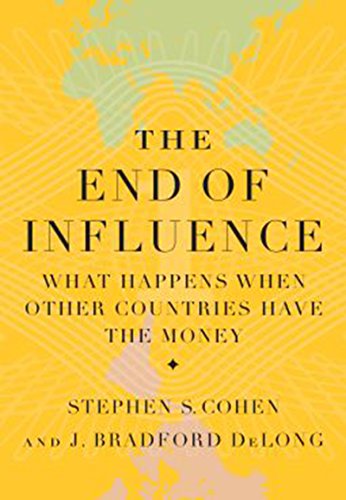
This is not to say that venture capital investors are necessarily going to be right about the future either, just that both government officials and venture investors can read the same things and are influenced by the same conventional wisdom. This point is not original to me: I picked it up from Brad DeLong’s 2010 book with Stephen Cohen, The End of Influence:

Americans like to say scornfully that industrial policy is about “governments picking winners.” Picking winner industries is not that hard—even for governments. Most countries trying to climb the ladder of quality and industrial sophistication through selective promotion compiled pretty much the same lists at the same time. Even at the leading edge of the technological frontier, the industries that governments are tempted to promote are largely the same ones picked by the analysts and brokers at investment firms such as Merrill Lynch, Nomura, or Rothschild’s.  …

Picking “winner industries” is not the hard part; winning is. It is difficult to create actual winners, companies that develop into successful competitors.

And that, of course, is where export discipline comes in.

51lp6baqvzl

How much did outside advice really change things in Russia and China?

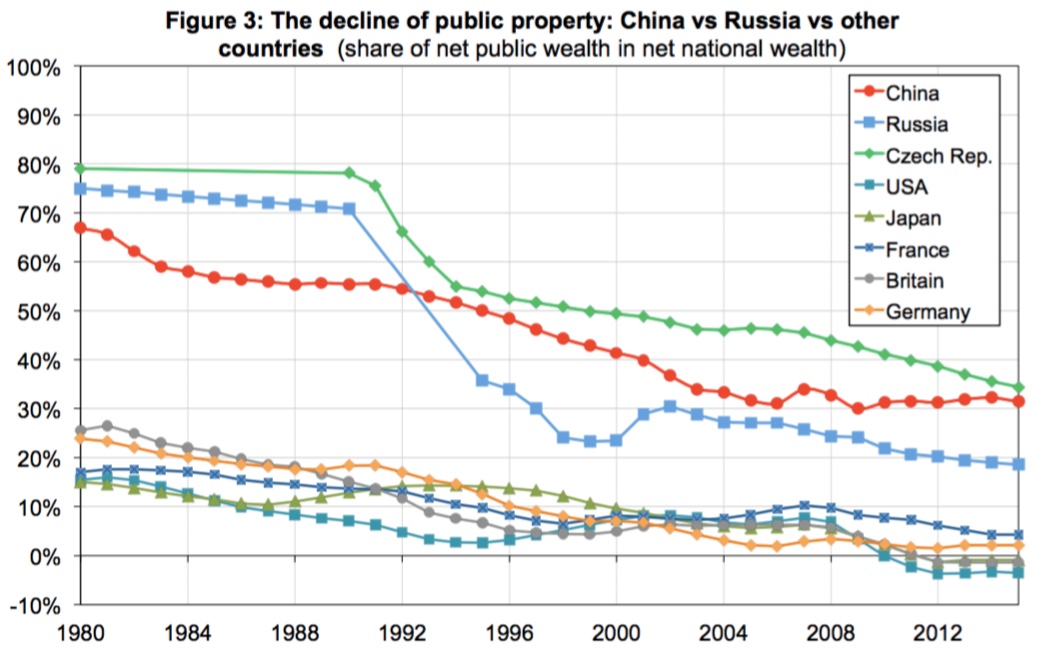
Recent polemics against neoliberalism have revived an old debate over the role of the economic advice given to developing countries by the World Bank and IMF. A crude but nonetheless influential interpretation of the relevant economic history holds that Russia’s failed “shock therapy” privatization of SOEs in the 1990s was the result of uncritical acceptance of free-market dogma pushed by the international financial institutions, while China’s successful “gradualist” approach to SOE reform was the result of wise officials ignoring those same institutions and carefully designing policy according to local conditions.

public-wealth

Chart from Novokmet et al. “From Communism to Capitalism: Private Versus Public Property and Inequality in China and Russia”

This interpretation may accord too much importance to the advice given by the international financial institutions, and too little to the domestic politics of the countries actually making the decisions.

John Nellis, a participant in the World Bank’s first mission to the USSR in 1990, has published an account of that period based on his notes taken at the time. It makes for fascinating reading. It’s particularly interesting that the famous Soviet State Planning Committee, or Gosplan, seemed committed early on to a “gradualist” approach to reforming state ownership:

Even here, in the principal basilica of socialist planning, no one questioned that the old system had failed and that a transition to the market, or something approximating a market, was urgently required. But those we met in Gosplan, and many of those we met in other Soviet ministries and central units, thought that the transition would be a gradual, lengthy affair, and that the outcome would be some sort of mixed approach. In this evolutionary process they thought (or hoped) that Gosplan would retain authority to forecast, analyze, assist, guide and even lead reform. …

As for the future of the real sector, the officials’ evolutionary vision was that the massive, multi-divisional state enterprise/ministerial complexes would be broken down into “correctly sized” units. These would then go through a process of “corporatization” and would become joint stock companies, with all shares initially held by the state. These would then undertake a process of finding private partners, Soviet or foreign, who would bring in capital, technology, management expertise, and access to markets. Some percentage of shares would have to be turned over to these partners, but it would at first be a minority share, particularly for foreigners. These processes had just begun to start and, in their view, years would pass before substantial results were seen. Central organs such as Gosplan would guide and assist this evolution. Majority private ownership was a long-term prospect.

This aspiration is not so different from the course that was actually followed by China. (Nellis also notes that a 1988 Soviet law had allowed for the creation of cooperatives, which, much like China’s township and village enterprises in the 1980s, often functioned as de-facto private companies.) The joint World Bank-IMF report that was published after the mission acknowledged that large-scale privatization was effectively impossible, and focused more on how to manage state enterprises effectively.

All this suggests that China’s “gradualist” approach to overhauling state ownership was less a strategy adapted to uniquely Chinese conditions, but more the approach most likely to be favored by a socialist government that wanted to maintain political continuity and control over the reform process. Yet by 1992, the Soviet Union had been dissolved, and the Russian government launched a program of rapid mass privatization using vouchers–a much more radical approach than anything that had been considered in 1990. Nellis asks the obvious question:

The overwhelming majority of persons we spoke to in 1990 were gradualists. They wanted to effect as painlessly and politically acceptable as possible a transition to the market. …

Why did the 1990 joint IFI mission not get a glimpse of the coming emphasis on mass privatization? How did it — we — miss the fact that the government of the Russian Federation would opt for audacity?

The answer, clearly, is the radical change in domestic politics after the vote to dissolve the Soviet Union in 1991. In particular, the failed coup against Gorbachev, which was led by representatives of the same conservative interest groups that had tried to stymie economic reforms. After the failed coup, the reform and privatization of state enterprises was no longer a technocratic matter of economic management, but an urgent political task to dismantle the strength of the interest groups that had led the coup. The new Russian government was driven by an “overriding fear that the communists might try again to regain power,” Nellis writes. And the reshuffle of domestic politics had elevated to decision-making positions people who were not that important in 1990, and had not previously had well-formed views. 

A more recent, if less detailed, summary of the World Bank’s involvement in Chinese SOE reform by Zhang Chunlin serves as something of a companion piece to Nellis. Zhang is currently the lead private sector development specialist at the Bank, and previously worked on Chinese SOE reform both at the Chinese government and the World Bank. He writes that

The Bank’s work in the 1980s focused on the reform of the traditional SOE model itself while maintaining state ownership. Recognizing the need for state direct control over some “important enterprises” such as public utilities, the [1985] report argued that once a suitable economic environment is created through price reform and competition, pursuit of profit should lead most state enterprises in economically appropriate direction. The fundamental problem remains of the proper relationship between the state and the enterprise.

The central theme of the World Bank’s recommendations for China was not the necessity of privatization, but of corporatization: giving state-owned enterprises the legal form of modern corporations. That promised to improve management and decision-making within SOEs. But it also posed the problem of how the state was to exercise its ownership rights to control these firms. Much of the Bank’s work since the 1990s has focused on finding the right institutional structures for effective state ownership, and it has advocated for reducing state ownership in many sectors.

But the radical downsizing and privatization of SOEs that started around 1995 and continued through about 2002 was a domestic decision driven by the dire financial situation at many firms. A World Bank report in 1997 did call for state ownership to “completely withdraw from inherently competitively structured industries where small and medium sized firms predominate,” but it noted that this recommendation “would formalize a process that is already underway.” (And, of course, China did not actually follow this recommendation.)

Zhang also notes that in later years the World Bank contributed to the debate over the creation and structuring of an agency to represent the government’s interests in SOEs, the body now known as Sasac. It’s less clear if this is a contribution the Bank should be proud of: Sasac is widely regarded as a conservative interest group that has worked to strengthen the position of large SOEs, rather than to further their effective reform. But Zhang mainly wants to emphasize the “productive partnership” that the Bank has had with China. “In retrospective, a clear reason why the Bank managed to stay relevant has been its willingness to adapt to China’s own reform strategy,” he writes.

Yet that is perhaps not so different from how the World Bank worked with Russia in the 1990s: it was willing to adapt to both the gradualist preferences of the Soviet leadership in 1990, and the radical program of the new Russian government in 1992. In the case of both Russia and China, the World Bank seems to have mainly tried to help their governments find the best way to implement decisions that had already been reached by domestic political leaders. It’s not clear that the advice of international financial institutions really played a decisive role in making those decisions.


The underrated role of fear in economic development

William Overholt’s book China’s Crisis of Success covers a lot of different topics, but one theme that he keeps coming back to is fear.

A lot of what drove China’s daring early economic reforms was fear of falling back into the chaos of the Cultural Revolution. Fear can motivate political leaders to do things that are out of the ordinary, and motivate the population at large to accept them. It is not a coincidence, in Overholt’s view, that the miracles of economic growth in Asia followed national catastrophes:

The societies that have been able to implement the required policies [for rapid economic growth] are all ones that have experienced excruciating trauma and intense fear: Japan after losing World War II; South Korea after the Korean War; Taiwan after the Chinese Civil War; Singapore after its traumatic separation from Malaya (which meant facing two much larger powers, Indonesia and Malaysia); Vietnam after wars with France, the United States and China; and China after a century of foreign humiliation and tens of millions of deaths from domestic strife. …

The policies required for rapid growth entail enormous social dislocations, and political leaders who consider imposing such dislocations reasonably fear for their jobs. They only try when they are terrified of the alternative, and when a population fearful of collapse accepts otherwise unacceptable stresses. These are the political prerequisites of miracle-level growth.

I think there is something to this, even if it’s not the kind of insight that seems particularly easy to run regressions on (parts of Europe after the second world war probably also belong on the list).

Overholt calls China’s current situation a “crisis of success” because it has in fact succeeded in dispelling fear of national collapse. But without that fear, it is harder for political leaders to make disruptive changes to the system, and it is harder to convince interest groups to accept such changes.

One of China’s current problems is that shared national fear of collapse has given way to complacency and some hubris. …

As fear segues into confidence, the willingness of the population to endure terrible stresses dissipates and so does the motivation of the leaders to take great risks.

For this reason he thinks it is becoming difficult for China to continue liberalization that would reduce the role of government intervention and state-owned enterprises in the economy (the book, which came out at end-2017, is somewhat equivocal about this, but in person Overholt nowadays is more decisively pessimistic).

In recent years, advocacy for continued economic liberalization in China has been organized around the idea of the “middle-income trap”: if China does not do XYZ reforms, the argument goes, it will fall into this trap and not realize its full potential. But the middle-income trap is not a disaster or national catastrophe; it’s just things being not as good as they perhaps could be:

The stakes are different now – not war, not chaos, not financial collapse, just slower growth.

Since China’s growth is going to slow anyway, no one can honestly promise China that, if they do XYZ reforms, growth will not slow down. All they can argue is that growth might not slow down as much as it otherwise would. Which is not that compelling of an argument. So fear of the middle-income trap may not be enough to motivate the Communist Party to make politically difficult changes that reduce its ability to direct economic activity.

Fear does seem to be a stronger motivator in environmental policy: families rightfully fear for the health of their children, and political leaders rightfully fear the anger of families. The “fear model” thus suggests China could continue to make progress in reducing pollution, even if future economic liberalization is limited.

41cnty87rel

How plausible is the China in Kim Stanley Robinson’s *Red Moon*?

The premise of Kim Stanley Robinson’s new novel Red Moon is that China has taken the lead in colonizing the moon, leaving America far behind. I am a Robinson fan, and since the theme of China overtaking the US is very much in the air these days, I was interested to pick up the book to get his take on it.

Here is how one character describes China’s decision to establish a lunar base:

At the Twentieth People’s Congress, in 2022, the Chinese Communist Party and its Great Leader President Xi Jinping decided that the moon should be a place for Chinese development, as one part of the Chinese Dream. In the twenty-five years since that resolution was made, much has been accomplished in China’s lunar development.

Later a character explains:

In China, if the Party chooses to do something, then the whole country can be rallied to that cause. One out of every six humans alive, in other words, devoted to the project of establishing a base on the moon. This was far more than needed to do the job! Not every Chinese person was involved, and only a small percentage of China’s capital reserves had to be directed up here, even though it was a pretty big project. But it wasn’t that big, and in the end it was just more infrastructure.

This is not bad! For China to treat a lunar base as an extension of the Belt and Road Initiative, and “just more infrastructure,” is a fairly straightforward extrapolation of recent trends in Chinese political economy. And it has a ripped-from-the-headlines feel, given that in January, China became the first country to land a spacecraft on the far side of the moon. With India and Israel also planning lunar missions, lunar exploration is in fact a good reflection of the shift from bipolar or unipolar world to a multipolar one.

But sharp-eyed readers will have noticed that in the above Robinson says “People’s Congress” when he really means “Party Congress.” Annoying errors like this abound. Even more troubling are the names of the many Chinese characters, which often seem to be invented randomly without reference to the actual Chinese language. The president of China in 2047, for instance, is supposedly named Shanzhai Yifan. Not only is shanzhai not even a Chinese surname, it is (as anyone who uses the internet should know) a slang term meaning something like “cheap knockoff.” So did one of Robinson’s sources play an elaborate joke on him? Or is this just sloppiness?

Being fuzzy about the details of foreign languages and political systems is not a criminal offense for a writer of speculative fiction, who after all is supposed to be speculating rather reporting. But it seems that apparently neither Robinson nor his publisher could be bothered to run the manuscript by an actual Chinese-speaking person before publication. I’m not even a native speaker, and I could have fixed most of these minor issues in a couple hours of work. As a result, the book is something that no Chinese-speaking person could ever take seriously.

The more fundamental problem with the future China in this book is that it’s not really a future China: it’s just today’s China with some of the names changed. And sometimes not even that: in 2047 Chinese people are apparently still sending each other messages on WeChat on their mobile phones, and complaining about the Great Firewall. There’s a whole subplot about a social revolution unfolding in China, in which people’s grievances seem to have been lifted from dated magazine articles: the “breaking of the iron rice bowl” and the hukou system. That subplot is very thinly sketched and happens mostly offstage, and as a result is not even convincing as narrative, even aside from the details.

Red Moon has generally received mixed reviews, as it has other narrative weaknesses besides the poor portrayal of China. I think we’re still waiting for a work of fiction that gets to the heart of how America deals with a rising China — admittedly a pretty demanding task.

For better recent Robinson, I would recommend Aurora, and also Shaman, which I think is underrated, and features some of his best nature writing.

51jxfww3-7l._sx322_bo1204203200_