Does the state still love state-owned enterprises even after they’re not state-owned anymore?

That is the question raised in an interesting new NBER paper on the aftereffects of China’s privatization of SOEs in the late 1990s: “Can a Tiger Change Its Stripes? Reform of Chinese State-Owned Enterprises in the Penumbra of the State,” by Ann Harrison and four coauthors.

They report that in 2013, 45% of industrial SOEs received government subsidies, but only 15% of private industrial firms received them. Privatized SOEs, however, are different: 25-35% receive subsidies, much more than firms that were always private. Similar results show up in access to finance: privatized SOEs pay higher interest rates than current SOEs firms but lower interest rates than firms that had always been private.

nber25475-fig3

Their hypothesis is that “allocation of government support in the form of subsidies, tax breaks or low interest loans favors both SOEs and former SOEs.” They conclude that while SOEs do change their behavior after being privatized, the government does not change its behavior toward those companies: “former SOEs retain ready access to large loans, concessionary interest rates, and outright subsidies.”

But why should this be the case? The paper is curiously silent on this.

The whole point of the SOE privatization over 1998-2003 (after that, privatization basically stopped) was so that the government would not have to keep giving free money to money-losing SOEs. Privatizing the SOEs, and then continuing to give them lots of free money, rather seems like the worst of both worlds. So it seems rather unlikely that this pattern is the result of a deliberate, centralized policy choice.

My hypothesis would be: it’s about people. Let me propose that the managers of SOEs understand the government pretty well and are pretty good at extracting benefits from the system. Since, after all, that is a good part of their job.

Furthermore, the managers of privatized SOEs are often going to be the same people who managed the firm when it was state-owned. One survey of SOE privatizations found that sales to insiders (aka management buyouts) were by far the most common type of deal, accounting for 47% of their sample.

Therefore, privatized SOEs are often going to be run by people who have established relationships with government officials and managers of state banks. It stands to reason that they are going to be better at working those relationships than the executive of a run-of-the-mill private company. And that companies that have been able to obtain subsidies in the past would know best how to continue obtaining those subsidies in the future.

On the financial front, this behavior by state banks is not irrational. If a state bank has an established relationship with an SOE, that relationship doesn’t just evaporate once the SOE is privatized. The bank will still have a lot of knowledge about its customer, and have a history that makes it more comfortable continuing to lend on favorable terms.

So the persistence of favorable treatments for SOEs after privatization is probably mostly about the persistence of relationships–and firms’ understandable unwillingness to relinquish established sources of commercial advantage.

A preview of Nick Lardy’s new book *The State Strikes Back*

A new Nick Lardy book comes along regularly every few years, and each one is an event for the China-watching community. Anyone who cares about the Chinese economy will find The State Strikes Back: The End of Economic Reform in China? interesting and provocative. This is a preview, not a review, since the book is not officially out until next week and so my Kindle pre-order hasn’t downloaded yet. But I saw his book talk in Seattle last night, where he gave a characteristically clear and concise summary of the argument (he also has an op-ed in the FT.)

The new book has to be understood in the context of Lardy’s previous book from 2014, Markets Over Mao: The Rise of Private Business in China. In that book he argued that it was the rise of increasingly efficient and productive private-sector companies that has driven China’s economic growth over the last four decades, not state-owned enterprises, government planning and industrial policy. In contrast to the view in some quarters that China remains a fundamentally state-controlled economy, he laid out all the ways in which markets have been liberalized and competition increased since 1978.

A lot of the key changes in the relationship between the state and private sector happened in the 1980s and 1990s, and are well explained in that book. But Lardy also engaged with the argument that, as he put it, “state-owned firms returned to prominence of the decade of leadership of President Hu Jintao and Premier Wen Jiabao (2003-12)”.

While acknowledging that the Hu-Wen government wanted to make state enterprises and industrial planning play a a bigger role in the economy, he argued that the data showed they had not succeeded. In fact, the private sector’s share of economic aggregates had continued to increase, not because of continued privatization but because private firms are more efficient and grow faster than SOEs. This process was aided by a substantial increase in private firms’ access to bank credit.

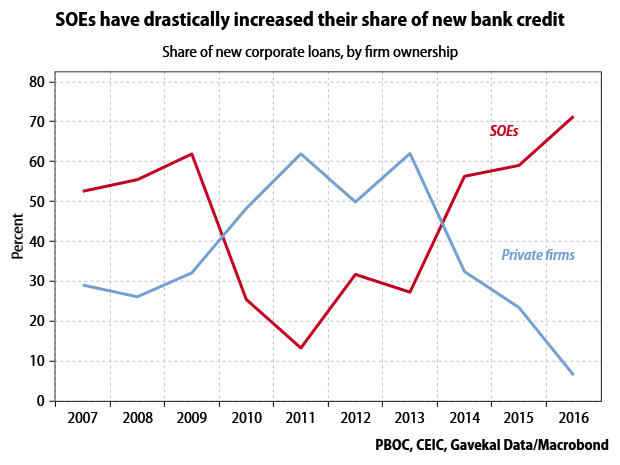
The main point of Lardy’s new book, based on his slides and talk, is that the positive trends he had emphasized in his last book are now going in reverse. The data now show that private firms’ access to bank credit has sharply declined, and that their share of various economic aggregates is also falling. He puts particular emphasis on the drop in lending to private firms:

soe-private-loans

(Note: Lardy has a chart like this in his slides, but this is my chart not his. It is based on the same underlying data but my estimates come out slightly different.)

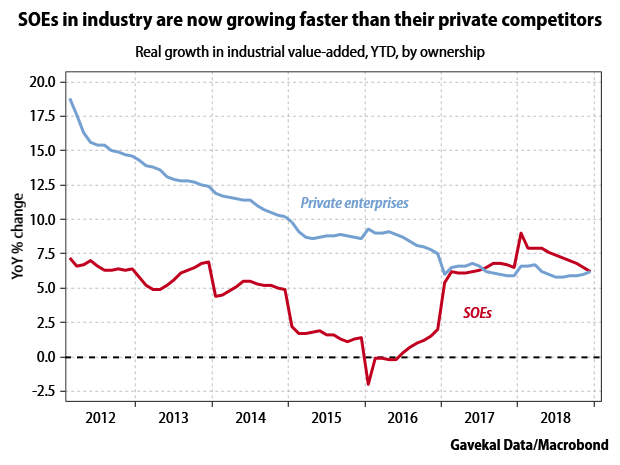
The big decline in bank lending to the private sector (the absolute volume of new loans to private companies shrank, not just the share) had major consequences. It forced private firms to rely even more on shadow finance. But in 2016 the government also decided (correctly) that the rapid expansion of shadow finance posed systemic risks. The tightening of regulation led to an outright decline of shadow financing in 2018, putting many private firms into dire financial straits. The financial pressure on private firms has allowed their state competitors to expand at their expense: SOEs in industry are growing faster than their private competitors. Lardy said this is the first time this has happened since 1978.

iva-soe-private

(Again, this is a re-creation of one of Lardy’s charts using public data.)

Lardy thinks all this is bad for China. He is right! He also puts most of the blame on the policies of Xi Jinping–tolerating SOE inefficiency, encouraging the creation of larger SOEs, tightening Party control over private firms–since these trends in the data did not show up until a few years into his administration.

Essentially, both of Lardy’s recent books are about the use of economic data to support a narrative about the direction of reform in China. In Markets Over Mao, he argued that the data did not support a narrative of the resurgence of the state sector, and in fact supported a narrative of the rise of the private sector to new heights. I think it is fair to say that a number of people felt that Lardy in that book was too forceful in downplaying trends that were in fact important, but perhaps were difficult to tease out in the aggregate economic data. Now, Lardy is arguing that the data support a narrative that the state is resurgent and the private sector is losing out. Since this is a recent reversal of a positive long-term trend, he thinks that if China changes course it could significantly boost its economic growth rate, by as much as 2 percentage points.

My own view is more that economic policy under Xi Jinping represents an intensification of trends that were already playing out under Hu Jintao. I think this is pretty clear if you pay attention to China’s official rhetoric and try to understand the underlying political economy. Since I think the problems go back further than 2015, I am less optimistic than Lardy about China’s longer-term growth prospects (thanks to Greg Ip of the WSJ for including a summary of my views in his latest piece).

I also think that it is tricky to tell a clear story about the rise or fall of the state sector using the official economic data–having spent a lot of time and effort trying to do that myself. As someone who very much appreciates Lardy’s careful work with Chinese data, let me offer a couple of caveats to the charts above, in the spirit of seeking truth from facts.

First, on the bank lending data. Lardy is right to highlight the sharp downturn in lending to private companies in 2015-16. But it is not clear to me that this is a result of government policy to favor SOEs. Recall that there was a pretty serious economic downturn in 2014-15. It would make sense for banks to respond to that by trying to reduce the risk in their loan books, and one obvious way to do that would be to curtail lending to smaller and riskier companies, i.e. private ones. (The fact that SOEs are seen as less risky than private companies is a structural problem, but it’s nonetheless true that banks are correct to make this judgment given the realities of China’s political economy.) In other words, the change may have been more cyclical than structural.

There is some preliminary evidence that supports this interpretation. The data that Lardy and I use to calculate lending to state and private firms is released with a long lag, and recent figures aren’t out yet. But banking officials disclosed last year that lending to private firms totaled 30.4 trillion renminbi as of September 2018. This is equivalent to 38% of outstanding corporate loans–which is roughly the same level as in 2013, and a big increase from the 32% in 2016 (again, this is the share of outstanding loans; the chart above is the share of new loans made each year). This suggests that new loans to private firms rebounded in 2017-18 (probably more in 2017) as the economy recovered.

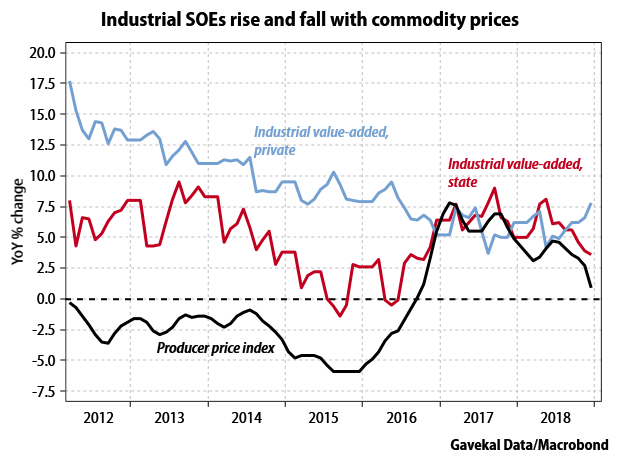
Second, on the industrial data. The fact that industrial SOEs are increasing their value-added faster than private companies is certainly notable. But SOEs and private companies tend to operate in different industries, so it can be hard to tease out the difference between sector effects and ownership effects. Industrial SOEs are concentrated in upstream, commodity-producing sectors, while private firms are more in downstream manufacturing sectors. It seems quite likely to me that the big decline in SOE value-added in 2015-16, and its rebound in 2017-18, have the same source: swings in commodity prices that had big effects on their profitability (value-added is basically profits plus labor compensation). The chart below uses monthly rather than year-to-date data, and we can see that the growth in SOE value-added has recently fallen back below that of private firms as steel and oil prices have come down.

iva-ppi

Lardy is right that the fact that in these charts the red line (SOEs) is above the blue line (private firms) is significant and concerning. But if this year or next the blue line moves back above the red line, will that mean China’s private sector is out of the woods, and all is fine? I suspect not.

51elq7mgmxl


What will it take to lower China’s investment rate?

The below is from Paul Krugman’s latest on China, an argument also strongly endorsed by Brad Setser:

China really can’t keep investing 40-plus percent of GDP. It needs to shift over to higher consumption, which it could do by returning more profits from state-owned enterprises to the public, strengthening the social safety net, and so on. But it keeps not doing that.

Myself, I think it’s weird that people who want China to invest less tell it to do all these structural reforms rather than just, you know, invest less.

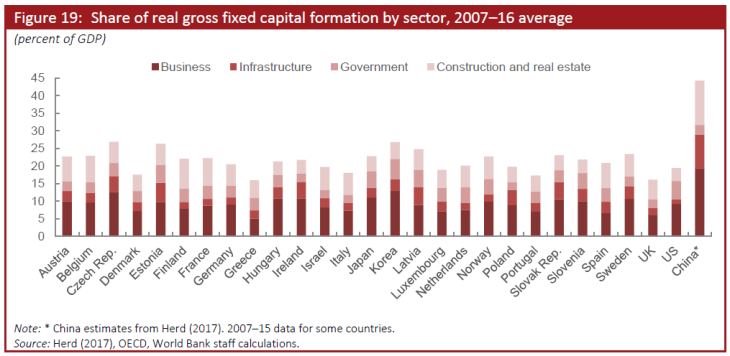
They miss the point that much of the low-return investment in China is done by the government and the state sector: it’s all those local infrastructure projects. That’s really where the buildup of excess investment is happening, not so much in the private business sector (which faces hard budget constraints and often tough access to credit). According to the World Bank’s latest China Economic Update, China’s public investment has averaged 16% of GDP since 1978, while OECD countries spend about 3.7% of GDP.

herd-wb-gfcf-chart

So if the government wanted to make a policy choice to invest less, it can just directly make the state sector invest less in those crappy low-return projects. It doesn’t have to overhaul social policy first.

The point of strengthening the social safety net, in this framework, is to reduce precautionary household savings. But high household savings don’t directly lead to excess investment. They do help keep the banking system liquid which enables a lot of borrowing by SOEs.

But trying to impose financial discipline on SOEs by improving the safety net and lowering household savings is pretty indirect. The central government could just require investment projects by SOEs and local governments to clear more hurdles.

Fundamentally, the reason that China invests a lot is that the government has made a decision to keep public-sector investment high in order to boost aggregate demand. If/when that changes, the investment rate will come down. And so will growth. Which is why China is not in a rush to make that call.

The hard choice that China has to make is not whether to undertake complex and difficult technical reforms to social policy. The hard choice is to decide when the efficiency losses from forced high investment start to outweigh the benefits of the boost to aggregate demand.

Some people are interpreting the government’s recent pledges to avoid “flood- like” (大水漫灌) stimulus as a sign that they have in fact reached this conclusion, and want to wean the economy off low-return infrastructure projects. Maybe a bit, at the margin. But the leadership is also going to a lot of trouble to create new funding mechanisms to ensure local infrastructure projects can continue, so it seems clear they don’t want this shift to happen right now.

Redirecting some fiscal resources from investment to consumption (i.e. more social programs) could certainly help soften the blow. But this is a compelling argument only to macro people; the Chinese interest groups that would lose out from less public investment are not going to feel compensated if more social benefits go to households.

Xi vs. Stalin: What drives the reversal of economic reforms?

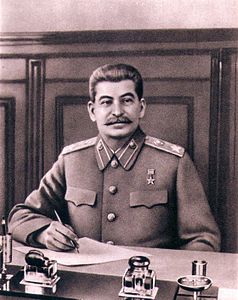
In the parlor game of finding historical analogies for present leaders, Chinese leader Xi Jinping is often compared to Mao Zedong. This is not very apt: Xi is an organization man, whose overriding desire for order is quite different from Mao’s love of chaos. After spending some time with Stephen Kotkin’s Stalin biography, StalinParadoxes of Power 1878-1928, I am surprised more people do not compare Xi to Stalin (though of course some have). Both men rose in an authoritarian system formally run by a collective leadership, and shifted it in the direction of more personalized rule for themselves and tighter political controls on everyone else.

238px-Stalin_office

Stalin, of course, also unleashed a historic economic catastrophe upon the Soviet Union, when he abandoned the market-tolerating New Economic Policy and embarked on a crash course of agricultural collectivization and forced industrialization. Xi has not done that! His endorsement of industrial policy and favoring of state enterprises has disappointed many liberal economists. He wants a strong state, has re-emphasized Marxist ideology and clamped down on public policy debate. But it is also worth remembering that he has allowed technocrats to liberalize the exchange-rate regime and tighten up financial regulation, two long-needed reforms.

Nonetheless, the slowing economy has recently led to more public discontent with Xi’s policies. Xiang Songzuo, the former chief economist of Agricultural Bank of China, is one of those arguing that there is a connection between Xi’s aggressively Marxist rhetoric and weaker growth: he thinks a loss of confidence and fear of expropriation among private entrepreneurs is aggravating problems caused by the buildup of debt and misallocation of investment (see this translation of a speech he gave in December). Some foreign commentators are also warning that there is a “big danger that China will re-nationalize much of its economy.”

So it seems worth posing this question: what caused Stalin to abandon pro-market policies, and could similar factors be at play in Xi’s China?

Continue reading →

The origins of the Communist party-state dual structure

One of the many fascinating tidbits scattered through Stephen Kotkin’s Stalin: Paradoxes of Power 1878-1928the excellent first volume of his Stalin biography, is an explanation of where the unique “party-state” Communist political structure comes from.

In China today, as in the Soviet Union in the past, the Communist Party and the government exist as parallel, intertwined institutions, with Party clearly politically superior even as government bodies do most of the practical work. In the Soviet case, this resulted from the fact that the Bolsheviks had seized power as a minority party but were nonetheless attempting to exercise absolute control over the entire country:

Party thinking equated Bolshevism with the movement of history and thereby made all critics into counterrevolutionaries, even if they were fellow socialists. Meanwhile, in trying to manage industry, transport, fuel, food, housing, education, culture, all at the same time, during a time of war and ruin, the revolutionaries came face to face with their own lack of expertise, and yet the solution to their woes struck them with ideological horror: They had to engage the class enemy—“bourgeois specialists”—inherited from tsarist times, who often detested socialism but were willing to help rebuild the devastated country. …

But the cooperative tsarist experts were not trusted even if they were loyal, because they were “bourgeois.” Dependency on people perceived as class enemies shaped, indeed warped, Soviet politics and institutions. The technically skilled, who were distrusted politically, were paired with the politically loyal, who lacked technical competence, first in the army and then in every institution, from railroads to schools. The unintentional upshot—a Communist watchdog shadowing every “bourgeois expert”—would persist even after the Reds were trained and became experts, creating a permanent dualist “party-state.” …

“The institution of commissars” in the Red Army, Trotsky had explained of the political watchdogs, was “to serve as a scaffolding. . . . Little by little we shall be able to remove this scaffolding.” That dismantling never happened, however, no matter how often commissars themselves called for their own removal.

China went through a similar dynamic as the Communist Party took over government and nationalized companies after 1949: Party figures were installed to oversee managers and technical experts. As in the USSR, this dual party-state structure persisted long after its immediate justification had passed, even when the majority of government officials and company leaders had become Party members. In other words, the Communist Party has continued to treat its own country as a hostile environment that could not be trusted.

The fact that the dual Party-state structure is, essentially, institutionalized mistrust, is one reason why this system is hard to defend on principle. Chinese scholars have been discussing the need for the Communist Party to adapt from being a “revolutionary” party to a “governing” party for decades. In the liberalizing 1980s, there was the beginning of a movement to formally separate the Party and government, but this was reversed in the post-1989 return to conservative politics. Xi Jinping also seems to want to clarify the relationship between the role of the Party and government. But he has taken the opposite approach: formalizing the Party’s leadership over the government (see my previous post on this topic).

51J5DhwkpLL._SX324_BO1204203200_

Ideology and the sources of policy error

Stephen Joske has an essay at War on the Rocks that makes a good point about the possibility of a Chinese financial crisis:

We commonly hear that China cannot have a financial crisis because the government owns all the banks and can control them. … In theory, government control is good for stability. In practice, however, two things have to happen to avoid a crisis: First, the government has to use its power to make the right policy choice, and second, it has to avoid making a Lehman-style regulatory mistake. …

While the government owns the banks, that does not stop officials from making regulatory mistakes. We have already seen regulatory mistakes such as mishandling of RMB market volatility in 2015. We have also seen well-handled, timely, and complex crisis management failing financial companies. But that does not mean they always handle every crisis well and will continue to do so. The law of probability indicates that eventually something will go wrong and, like every other country, China will have a financial crisis.

It is a fair point that humans are fallible and will eventually make a mistake, and we should not presume that the Chinese financial authorities are more or less fallible than all other humans.

But I think it is a bit of a cop-out to just say, oh, policy errors happen, and not to inquire more deeply into the actual causes of policy error. I think if we look at the recent history of financial policy mistakes, many them were in fact not driven by random errors but by ideology.

It is hard to separate the US policy errors in the global financial crisis from the strong ideological value placed on the government abstaining from intervening in markets. The day after Lehman Brothers failed, then-St. Louis Fed president Andrew Bullard said: “By denying funding to Lehman suitors, the Fed has begun to reestablish the idea that markets should not expect help at each difficult juncture.”

There would have been technical and legal difficulties to mounting a rescue of Lehman, but these could certainly have been surmounted if officials had been really worried about the impact of a failure on the financial system. They were not that worried (which in hindsight was clearly an error) and were preoccupied with sending signals about the correct relationship between the government and the financial system.

Most financial crises take the form of a “run on the bank,” even if the bank is not called a bank and those doing the running are not retail depositors. When investors no longer wish to hold bank liabilities, the bank cannot fund itself and experiences a liquidity crisis. But if investors know or believe that the government will rescue the financial institution, they are less likely to be so fearful of failure as to stop holding its liabilities, and less likely to fear that the problems of one institution will spread to others.

So a system in which the government is ideologically committed to maintaining a separation between the public sector and a private financial sector, and a system in which the government is ideologically committed to maintaining the union of the public sector and the financial sector, are not at all equivalent in terms of financial risk. In the former, there is much more of a risk that private investors will become worried about the failure of banks and stop funding them. (The latter, of course, has the problem that banks will tend to abuse government support and take more risk than they should.)

So it seems to me that, while Chinese officials are not more or less fallible than other humans, they do operate in a system that tends to minimize one major source of the policy errors that tend to lead to financial crises. Simply put, Chinese officials are more likely to err in favor of providing government support to a failing institution than in favor of denying it. This does not mean that Chinese banks cannot fail–it seems quite likely to me that some smaller institutions will eventually go under–but that such failures are much less likely to cause contagion and a crisis of confidence in the financial system.

Arguably Chinese financial policy is in fact less ideological than American. That may seem a strange thing to say about a system in which ideology is highly formalized and there is a large institutional structure for ensuring compliance with ideology. But the ideology of the Communist Party is inflexible only about ends, rather than means. Continuation of Party rule and its ability to direct social and economic development cannot be questioned.

But China is fairly flexible about the means employed to achieve those ends. American political ideology by contrast puts strong constraints on means: there are often intense arguments about why various things cannot be done or should be done in order to maintain the self-image of the US as a free-market economy.

The US-China trade war as a conflict of values

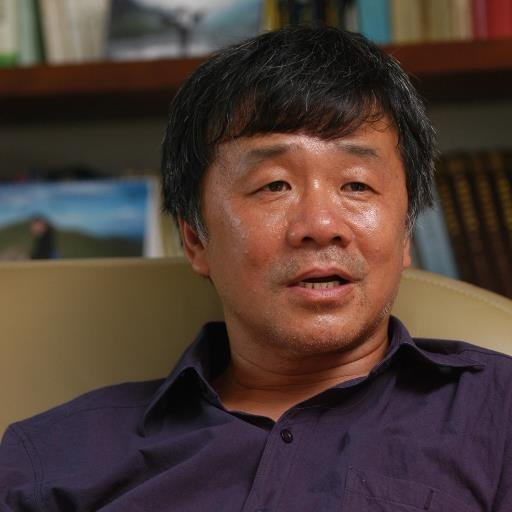
The tariffs that the Trump administration has imposed on Chinese goods are seen by the Chinese government as unprovoked and unjustified assaults. So there are few opinions more unwelcome right now than that China brought the trade war on itself. Yet that is more or less what a couple of Chinese liberal intellectual are saying openly: that trade conflict with the West is the inevitable result of China’s promotion of a state-centered development model.

One of these voices is Sheng Hong of the well-known Unirule Institute, who published an interesting article on US-China relations on FT Chinese on October 19. The Unirule website has helpfully provided an English translation, but I have re-translated the portions below myself for greater clarity:

China’s reform and opening up is the guarantee of strategic cooperation between China and the US. Such strategic cooperative relations would never have been possible if China was still stuck in the Cultural Revolution, when it practiced class struggle and a planned economy domestically, and exported revolution abroad. Reform and opening up not only brought people economic freedom, but also changes in the political structure. The emancipation of thought has to some extent loosened controls over the freedom of speech, and the freedom of the market economy has allowed people to throw off the shackles of their work units. As the market played a greater role in more areas it reduced government’s direct control over society. Implementing market regulation relied on a just legal system. Only a China that is in this way progressing toward marketization, rule of law and democratization can be accepted by the US on a strategic level, and create the framework for strategic cooperation with the US.

Without a doubt, reform and opening up eliminated the ideological conflict between China and the US, as well as the whole Western world, and gradually brought convergence in terms of values. … Some of the so-called “socialist core values” promoted by the Chinese Communist Party overlap with values recognized by the US and the western world, for instance freedom, democracy, rule of law, equality and justice; while other values, such as civilization, harmony, integrity and dedication, are not in conflict with the values of the US and the western world.

We must clearly recognize that such convergence of values is the basis for strategic cooperation between the US and China. Only through a convergence of values can China be deemed a factor of peace and stability in international relations, and be seen as a trustworthy nation with which close cooperation is possible, rather than one that proclaims the overthrow of the capitalist world and does not renounce the use of violence. Only such a country that advocates peaceful means to resolve disputes between nations,  and does not resort to the threat or use of force, can provide the world with a stable and just international order.

Therefore, China’s reform and opening-up and the China-US strategic cooperation are two inter-related things. That is to say, there is no strategic cooperation without reform and opening-up, nor is there reform and opening up without China-US strategic cooperation. … China should not, and cannot, seek hegemony over the world by going against the rules of civilization accepted by China and most of the countries in the world. Only on the basis of respecting the consensus rules of human civilization can China overcome the mistakes and deviations of the US, and become a civilizational center with moral legitimacy and great economic strength. Today, China faces the risk of leaving the path of reform and opening up, which would risk the loss of strategic cooperative relations with the US. Such a result would be a complete failure.

ShengHong

Sheng Hong

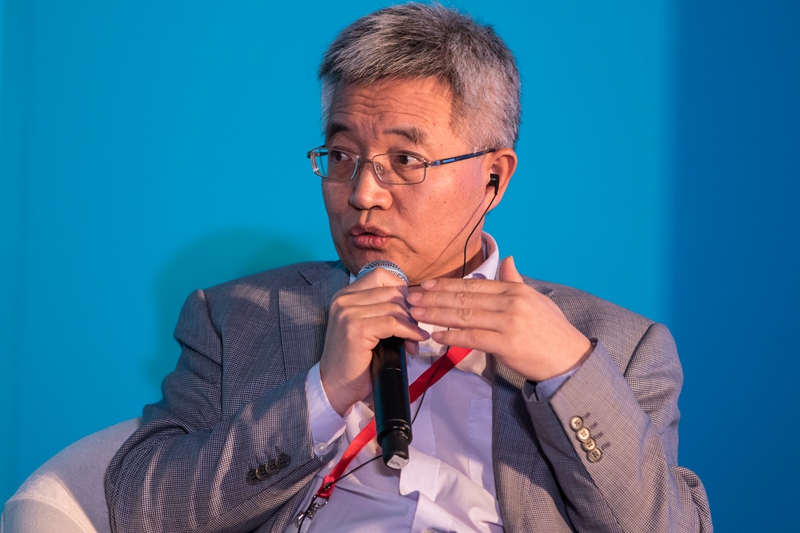
Somewhat similar sentiments appear in an October 14 speech by Zhang Weiying, a prominent liberal economist at Peking University (liberal in the Chinese sense of favoring free-market policies; Zhang is more of a Hayekian libertarian). The following is my translation of some portions of a summary that was posted on the website of the National School of Development (it was later removed after attracting press coverage).

The rapid development of China’s economy and the improvement of people’s living standards over the past 40 years are facts denied by no one, but there is still controversy over how to understand and interpret these facts. At present, there are two interpretations of China’s growth in the past few decades, the theory of the “Chinese model” and the theory of the “universal model.” The former holds that China’s economic development benefited from a unique Chinese model, with a strong government, many large state-owned enterprises, and wise industrial policy.

The latter holds that China’s remarkable achievements are, just as with the rise of Britain, France, postwar Germany, Japan and the Asian tigers, based on the power of the market and the creative and risk-taking entrepreneurial spirit. China also made use of the technologies accumulated by Western developed countries over the past three hundred years. As I explained in an article published early this year, China has in the past 40 years of reform and opening up experienced the three industrial revolutions that took the Western world 250 years. The latecomer’s advantage means that we have avoided many detours and directly share the technological achievements that others have already obtained through experiments of great cost. …

The above evidence shows that the theory of the “Chinese model” is seriously inconsistent with the facts. China’s high growth over the past 40 years has come from marketization, entrepreneurship and the technology accumulated by the West over three hundred years. The bigger problem is that using the “Chinese model” to explain the achievements of the past 40 years is not beneficial for China’s future development.

Domestically, misleading yourself means a future of self-destruction. Blindly emphasizing the unique Chinese model means going down the road of strengthening state-owned enterprises, expanding government power, and relying on industrial policy. This will lead to a reversal of the reform process, the abandonment of our predecessors’ great cause of reform, and ultimately economic stagnation.

Externally, misleading the world leads to confrontation. From the Western perspective, the “China model” theory makes China into an alarming outlier, and must lead to conflict between China and the Western world. The unfriendly international environment we face today is not unrelated to the mistaken interpretation of China’s achievements over the past 40 years by some economists (both Chinese and foreign). In the eyes of Westerners, the so-called “China model” is “state capitalism,” which is incompatible with fair trade and world peace and must not be allowed to be advance triumphantly without impediment.

291205348hwf

Zhang Weiying

In some ways it is not surprising to hear such statements from Sheng and Zhang, whose views are well established, and also far out of the mainstream of Chinese intellectual opinion. What is interesting is that these views are coming out at this moment–although since the comments of both authors are regularly scrubbed from the Chinese internet, it is hard to know how much impact they have.

Seizing the moment for artificial intelligence: my take on the US-China rivalry

Today I am republishing a piece originally written for Gavekal Dragonomics clients a few months ago, on the US-China rivalry in artificial intelligence. Usually these pieces stay behind the paywall, but with our partner company Evergreen Gavekal we’re making it available for a general audience.

I wrote this piece as a way of sorting out of my own thinking on how to place recent technological trends in the broader story of China’s economic development. I make no claim to be an expert on artificial intelligence: these are just the thoughts of a China watcher trying to absorb what the technologists are saying.

The full text follows below, or you can download the PDF:


Seizing The Moment For Artificial Intelligence

by Andrew Batson (originally published May 3, 2018)

In the escalating trade dispute between the US and China, technology has increasingly become the key issue, overwhelming more traditional economic topics like tariffs, deficits and currency valuations. Both countries see their economic future as depending on their success in high technology, and each is worried they will lose out to the other. One of the most intense areas of focus is artificial intelligence, where recent rapid breakthroughs have captivated investors and the media—and where China has emerged as the main US rival.

In this piece, I will try to provide some nontechnical answers to the questions of the moment: What is artificial intelligence anyway, and why is it a hot topic? Why does China seem to be doing so well in artificial intelligence? And how should we think about the rivalry between the US and China to develop this technology? In brief, I think China will do well in artificial intelligence, in part because the technology is now in a phase that plays to its strengths. But it does not make sense to think of the US and China being engaged in an artificial-intelligence “race” along the lines of the US-Soviet space race.

Machines don’t think, but can do useful stuff

A common-sense definition of artificial intelligence, what a layman might understand the term to mean on the basis of reading the news and watching television, is probably something along the lines of: machines that can think like human beings. Artificial intelligence in this sense does not exist, and according to most researchers in the field there is no prospect of it coming into existence any time soon. There are enormous philosophical and technical challenges in understanding how human minds work and replicating those processes in software, and most of these challenges have not been solved.

A more precise definition of artificial intelligence, closer to that used in the industry, would be: the development of computer systems that can perform tasks associated with human intelligence, such as understanding speech, playing games, or driving cars. In a way the term is misleading, because what is being mimicked is not human intelligence itself, but the practical results of intelligence being applied in specific contexts. Artificial intelligence in this narrow sense does very much exist, and its progress is now attracting feverish interest from business, venture capitalists, governments and the media.

The turning point seems to have come around 2014-15. Since then, software programs have been able to match or exceed human performance in tasks that previously could not be reliably performed by machines: recognizing faces, transcribing spoken words, playing complex games. One landmark that had particular resonance in China was the 2016 victory of Google’s AlphaGo software over a master South Korean player of the board game Go (known as weiqi in Chinese); AlphaGo subsequently also defeated China’s top-ranked player. While chess programs have been beating human masters for years, Go is much more complex; the number of potential board positions is traditionally estimated at 10172, more than the number of atoms in the universe.

How are these feats possible? Most of what is referred to as “artificial intelligence” in the media is a subset of the field known as machine learning, and in particular a subset of machine learning called deep learning. All software works by following clearly specified instructions, known as algorithms, on how to perform a specific task. In machine learning, the algorithms are not fixed in advance, but evolve over time by building data-driven models.

Usually the type of software used in machine learning is called a neural network, because its structure is loosely inspired by the connections between neurons in a human brain. The network takes an input signal and repeatedly processes it into something more useful; what makes the learning “deep” is that there are a large number of “layers” that process the signal. The use of these techniques means that an algorithm can improve its performance of a task by repeated exposure to data. They are particularly useful where writing algorithms the traditional way—by specifying all possible details and eventualities in advance—is cumbersome or impossible. The concept of machine learning dates to the 1960s, and much of the original work underlying today’s approach of deep learning dates to the 1980s and 1990s.

More power, more data

The rapid improvement in the results of specific machine-learning applications in recent years is thus not a result of fresh theoretical breakthroughs. Rather, it has happened because advances in computing power have allowed machine-learning algorithms to run much faster, and the increased availability of very large amounts of structured data have given them much more to work with. The lesson has been that lots of processing of lots of data is required for the algorithms to be effective in finding patterns. This in itself is a sign that machine learning is not very much like human learning: humans can learn quickly from small numbers of examples, by building internal mental models. Machine learning by contrast is a massive and repetitive number-crunching exercise of building up statistical regularities.

Researchers in the field sometimes describe machine-learning algorithms as being “narrow” and “brittle.” Narrow means that an algorithm trained to solve one problem in one dataset does not develop general competencies that allow it to solve another problem in another dataset; an algorithm has to be trained separately for each problem. The Go-playing algorithm is not also capable of analyzing MRI scans. Brittle means that the algorithm only knows its dataset, and can break down if confronted with real-world situations not well represented in the data it learned from. An often-used example is facial-recognition software that is trained on databases consisting largely of photos of white men, which then fails to accurately recognize faces of black women.

But while it is important to understand that machine learning is not a magic wand, it would also not do to underestimate its potential. Machine learning is essentially a way of building better algorithms. That means it could be applied to almost any process that already uses software—which, in today’s world, is quite a lot—as well as many new processes that could not be effectively automated before. The most obvious example is self-driving cars, which can already operate in restricted contexts and could be in general use within a decade. Machine learning is already being used to spot patterns that previously required trained human expertise, such as recognizing financial fraud or early-stage cancers. Because of this broad applicability, enthusiasts call machine learning a “general purpose technology” that, like electricity a century ago, can boost productivity across every part of the economy.

Throwing resources at the problem

The key point is that machine learning has now moved from a pure research phase into a practical development phase. According to Oren Etzioni of the Allen Institute for Artificial Intelligence, all of the major recent successes in machine learning have followed the same template: apply machine-learning algorithms to a large set of carefully categorized data to solve problems in which there is a clear definition of success and failure.

All parts of this procedure are quite resource-intensive. Huge amounts of computing power are required to run the algorithms. The algorithms need huge quantities of data to find patterns. That data must also be first carefully structured and labeled so that the algorithms can draw the right conclusions—for instance, labeling pictures of objects to train an image-recognition algorithm—a process that is extremely labor-intensive. The repeated training and refining of the algorithms also requires a lot of labor by highly skilled workers, whose numbers are necessarily limited. But the reason for the excitement over artificial intelligence is that there is a now a sense that the main remaining constraints on progress are these limitations of resources—and such limitations will be solved over time.

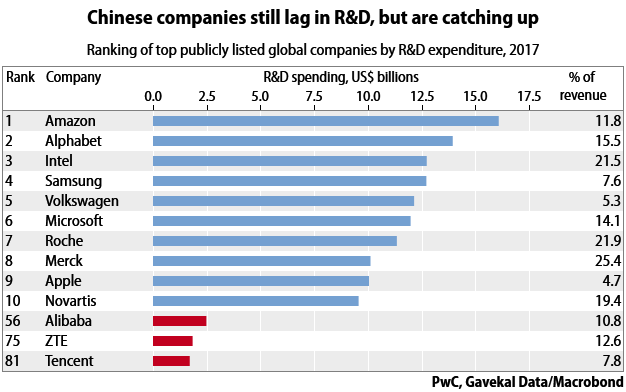
According to its many boosters, China has all of the necessary resources to make progress in machine learning. It has large and well-funded technology companies, including publicly traded giants like Tencent, Alibaba and Baidu, but also private companies with multi-billion-dollar valuations like ByteDance, which runs a popular news app with personalized recommendations, and SenseTime, which specializes in image and facial recognition.
AI-chart1

China also has the world’s largest population of internet and mobile phone users, who are creating huge amounts of data on daily basis through their interactions with software. It has a huge population of relatively low-cost college graduates, for doing the more repetitive work of categorizing data. And it also has more top artificial-intelligence researchers than any country other than the US; indeed, many of the top Chinese in the field were educated in the US and have worked for US companies.

China also has a government that has decided that artificial intelligence is going to be the key technology of the future, and that will not accept being left behind. An ambitious national plan released in July 2017 calls for China to lead the world in artificial intelligence theory, technology and applications by 2030 (for detailed analysis of the plan, see these reports by the Paulson Institute and Oxford University’s Future of Humanity Institute). While it is difficult for government plans to create fundamental research breakthroughs on demand, such plans can be good at mobilizing lots of resources. So to the extent that advances in machine learning are now about mobilizing resources, it is reasonable to think China will indeed be able to make lots of progress.
AI-chart2

The prospect of China being something close to a peer of the US in a major new technology is a shocking development for many Americans. Everyone knows that China’s economy has grown rapidly and that it has accomplished a lot. But most of its past successes in technology involve deploying things developed elsewhere, such as mobile phones, wind turbines or high-speed trains, on a large scale. China has a per-capita GDP of roughly US$8-9,000 at market exchange rates, lower than Mexico or Turkey—and no one is talking about their dominance in the technologies of the future. It is tempting to try to resolve this paradox by focusing on China’s state support for artificial intelligence, implying that its advantages are unfair. The rivalry is also not a purely economic one, since there are military uses for machine learning.

The paradox is more apparent than real. China is such a huge, diverse and unequal country that averages are not a good guide to the location of the cutting edge. The reality, as anyone who has visited Beijing, Shanghai, or Shenzhen in recent years can attest, is that the income, skills and education levels of its best people can be comparable to those in the US. That elite of course is not representative of all the hundreds of millions of their compatriots, but neither is the Silicon Valley elite representative of middle-class Americans.

The fact that China now has the capability to contribute to cutting-edge research is also in large part a result of its integration with the US: it is the decades of sending top Chinese students to top US universities that have built up the necessary human capital. Rather than say there is a competition between the artificial intelligence sectors in the US and China, it might be more accurate to say that there is a single, global field of machine-learning research that has a significant presence in both North America (Canada also has some top people) and China.

There is no AI race

More fundamentally, it is wrong to think of China and the US as being in a “race” for supremacy in artificial intelligence. Evoking the “space race” with the Soviet Union in the 1960s is the wrong analogy. The space race was about achieving clear technical landmarks defined in advance: first satellite in orbit, first human in orbit, first human on the moon, etc. Today, it’s not clear what the technical landmarks for an artificial intelligence race might be. There is a vague goal of “general purpose artificial intelligence,” which means the kind of thinking, talking computers that are familiar from decades of portrayal in science fiction. But there is no race to make one, since no one knows how.

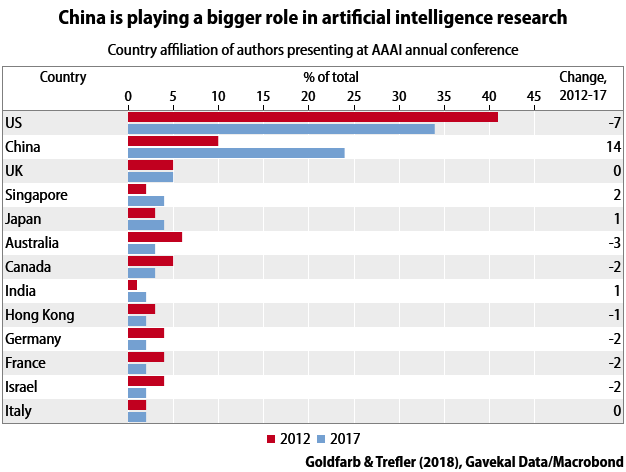
Rather, there are multiple related efforts going on to make progress on diverse sets of specific technical challenges and applications. If China is the first to achieve some technical breakthrough, that does not prevent the US from also doing so, nor does it guarantee that a Chinese company will control the market for applying that breakthrough. Recall that machine-learning applications can be “narrow” and “brittle”: software that is excellent at predicting, say, the video-watching habits of Chinese will not necessarily also dominate the American market. What we can say is that there are economies of scale and scope in machine-learning research: teams of experts who have successfully developed one machine-learning application themselves learn things that will make them better at developing other machine-learning applications (see this recent paper by Avi Goldfarb and Daniel Trefler for more).

Artificial intelligence is not a prize to be won, or even a single technology. Machine learning is a technique for solving problems and making software. At the moment, it is far from clear what the most commercially important use of machine learning will be. In a way, it is a solution in search of problems. China is making a big push in this area not because it knows what artificial intelligence will be able to do and wants to get there first, but because it does not know, and wants to make sure it does not lose out on the potential benefits. China’s development plan for artificial intelligence is mostly a laundry list of buzzwords and hoped-for technical breakthroughs.

The fact that machine learning is now in a resource-intensive phase does play to China’s strengths. There is an enormous amount of venture-capital money and government largesse flowing toward anything labeled “artificial intelligence” in China, and Chinese companies have had some notable successes in attracting high-profile figures in the field to join them. But fears that China will somehow monopolize the resources needed to make progress in machine learning are fanciful. After all, most of the key resources are human beings, who have minds of their own. And many of the key tools and concepts for creating machine-learning applications are in the public domain.

Will today’s advantages endure?

It is also not certain that the current resource-intensive phase of machine learning will last forever. As is usually the case when limited resources constrain development, people are trying to find ways to use fewer resources: in this case, refining machine learning so that it does not require so much human effort in categorizing data and fine-tuning algorithms. Some of the current buzzwords in the field are “unsupervised learning,” where the machine-learning algorithm is trained on raw data that is not classified or labeled, and “transfer learning,” where an algorithm that has already been trained on one dataset is repurposed onto another dataset, which requires much less data the second time around. Progress in these areas could lessen the advantages of China’s “big push” approach, though of course Chinese researchers would also benefit from them.

China’s current strength in machine learning is the result of a convergence between its own capabilities and the needs of the technology; since both are evolving, this convergence may not be a permanent one. But China’s government is correct to see the current moment as a great opportunity. China was already becoming one of the global clusters of machine-learning research even before the government decided to throw lots of subsidies at the technology. The self-reinforcing dynamics of clusters mean that today’s successes will make it easier for China to attract more machine-learning experts and companies in the future.

The biggest loser from this trend, however, is not the US, which already has well-established clusters of machine-learning research, but smaller nations who would also like to become home to such clusters. European countries, for instance, seem to be struggling to hold their own. The perception that there is a rivalry or race between the US and China ultimately derives from the fact that the two countries are rivals rather than friends. Artificial intelligence may indeed be the first example of a major cutting-edge technology whose development is led by geopolitical competitors—the US and China—rather than a group of friendly nations. The rising tensions between the US and China pose the question of whether a global artificial-intelligence field structured in this way is sustainable, or will be forced to split into national communities. The loss of those exchanges would slow progress in both countries.

A novelist’s view of China’s rise, from 1983

Walter Tevis’ 1983 science-fiction novel The Steps of the Sun is mostly not a very good book; unlike some of his other books (the excellent chess novel The Queen’s Gambit, or The Color of Money) it has not aged well. The one thing about the book that does seem ahead of its time is the worldbuilding: it is set in a future world in which China has unquestionably risen. Here is one background passage:

Half the people on the street were Chinese. By midsummer New York always seems to be a Chinese city, a kind of cultural suburb of Peking. The Russians are ahead of everybody else at heavy industry; the art comes from Buenos Aires and Rio de Janeiro; the political life in Aberdeen and Hangchow is far more lively than New York’s; and if you want to make a really big business arrangement you go to Peking, the world’s richest city.

But New York is still New York, even with its elevators not working and a total of one hundred fifty taxis permitted to operate (Peking has thousands, they are electric powered and have leather upholstery). But Peking is still a stodgy businessman’s city, with all the old China erased from its neoclassical architecture. The Chinese come to New York for the civilized life.

New York is the major city of a second-rank power, of a country whose time is slipping away; but it still has a bounce you don’t find anywhere else. There are restaurants with white tablecloths, with waiters in tuxedos that look like they came from the last century, and, however they beer-feed and hand-rub their fat old steers in Japan, the Kansas City steak served in a New York restaurant, with the dim lights and the polished wooden bar and the tuxedoed waiters, is still one of the delights of the world. And New York theater is the only theater to hold anybody’s interest for long; American music is the most sophisticated in the world.

The Chinese are still, behind those stuffy facades, the greatest gamblers on earth and the trickiest businessmen; they’ve accommodated their ideology and their asceticism of the last century to their present wealth with the ease of the Renaissance Popes; they are Communists the way Cesare Borgia was a Christian. And they love New York.

Some of these details are remarkably prescient: the Chinese tourists crowding the streets of New York, and the way the city serves as a kind of living museum of a certain type and period of culture. The bit about China being ahead of the US in electric vehicles also has a ripped-from-the-headlines feel. In another passage, a billionaire shows off his ability to speak Chinese (remind you of anyone?).

This is pretty unusual stuff for 1983, when Americans were obsessed with the rise of Japan and had barely begun to notice China. William Gibson’s much more famous Neuromancer, from 1984, chose Japan as the natural setting for its hyper-technological fantasies. So I am curious what might have inspired this aspect of the book; there is little in Tevis’ biography to suggest a particular interest in or knowledge of Asia.

51593


Are giant factories a symptom of labor repression?

That is the suggestion made in Deborah Cohen’s interesting review of Joshua B. Freeman’s Behemoth: A History of the Factory and the Making of the Modern World.

Giant factories were a feature of both the US and Soviet economies in the 1930s, which led some observers at the time to speculate that capitalism and socialism were converging toward a single economic form. But this convergence turned out to be quite temporary, as giant factories lasted much longer in the USSR:

By the late 1940s, the era of the showcase factory was over in the United States. The strength of unionization, particularly demonstrated by the formidable strike wave of 1945–1946, made clear to industrialists the danger of concentrating workers in a few plants.

More than simply a means of controlling costs or rationalizing distribution, the drive to open smaller and decentralized plants, especially in the low-wage, nonunionized South, was also a strategy to ensure that a company’s entire operation couldn’t be hamstrung by a strike.

At the same time, by contrast, industrial gigantism continued apace across the Eastern Bloc. The East Germans built the steel town of Stalinstadt (now Eisenhüttenstadt); in Poland, there rose Nowa Huta, with a workforce of nearly 30,000 by 1967. Crippling labor unrest wasn’t a problem that particularly worried leaders in the Eastern Bloc, who could count on a network of spies as well as a cadre of factory workers who were fervent believers in socialism.

The current world champion of industrial gigantism is, of course, China. The “Foxconn City” facility in Shenzhen is generally thought to be the world’s largest manufacturing facility, employing something over 200,000 workers. Strikes in China are not uncommon but tend to be short-term events related to specific disputes, rather than an organized strategy as part of collective bargaining. This of course is because China does not have independent unions; the state-controlled union tends to side with management. So the risk to a company’s operations from an individual strike is still low–though it is worth noting that Foxconn does not depend on one single large facility but instead has lots of large facilities, in China and many other countries.

d092_d186d0b5d185d183_d0a1d182d0b0d0bbd0b8d0bdd0b3d180d0b0d0b4d181d0bad0bed0b3d0be_d182d180d0b0d0bad182d0bed180d0bdd0bed0b3d0be_d0b7d0

The Volgograd Tractor Factory in the 1930s