Mapping China: The Soviet influence in the 1950s

How far back do the current economic problems of some Chinese provinces go? To a large extent the current downturn looks mainly resource-related, a result of the intense slowdown in housing construction. But it is also hard to avoid noticing that many of the places that are doing poorly have historical legacies that could be, shall we say, problematic. The three northeastern provinces, which were the cradle of state-owned industry in the 1950s and have been receiving heavy government support for decades, have been among the worst performing of all. Here are some interesting comments from Li Pumin of the National Development and Reform Commission, at a press conference on the Northeast in August 2015, which convey some of the flavor of the political discussion about the Northeast (my translation):

The General Secretary [Xi Jinping] in July and the Premier [Li Keqiang] in April each made inspection tours of the Northeast, and also held forums. This shows that Party Central and the State Council attach great importance to the revitalization of the Northeast. Why is it so important? …The Northeast was the first part of our country to be liberated, and it also has the best industrial base. During the First Five-Year Plan period when the Soviet Union helped build 156 projects, 58 of them were in the Northeast, or one-third of the total. This formed a large group of backbone enterprises in resources, energy, equipment manufacturing and national defense. As the “first born” of the People’s Republic, the Northeast made great contributions to building our country’s industrial system and the whole national economy. The comrades here today are perhaps rather young, but if you ask the older generation [they will tell you that] in the 1960s and 1970s, the Northeast produced a lot of equipment, technical information and personnel that supported the development of the mainland. …Also at that time the Northeast made other contributions, producing much oil, grain and timber to support China’s economic construction in the early days after Liberation. It should be said that as the “eldest son” of the People’s Republic, the Northeast has made great contributions, so the People’s Republic will not forget this during the current difficulties. This is the historical perspective.

Li’s mention of the Soviet projects in the 1950s piqued my interest–some possible data to work with! It was in fact not too hard to dig up a complete list of the projects, and from that make a few observations (there are a few lists on the internet, but I also confirmed these with printed sources). Indeed, the Northeast (aka Manchuria) received the lion’s share of the Soviet projects. These were the flagship projects of the early days of the planned economy, as China worked hand-in-hand with Soviet experts to replicate their model–which at the time, in the afterglow of the Allied victory in WWII, was seen as quite successful.

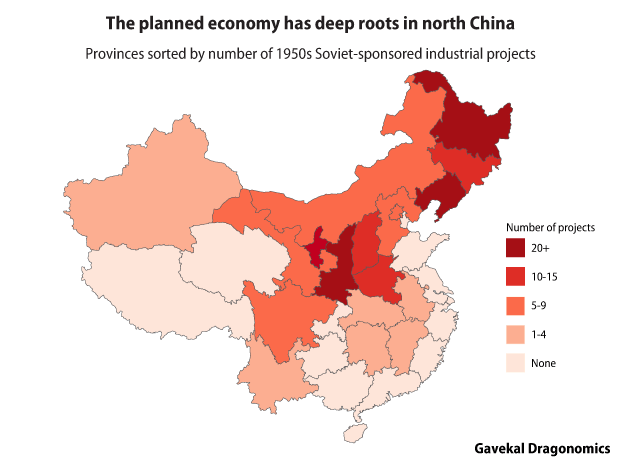
The bias toward the Northeast was perhaps even more dramatic than Li’s comments indicate. Many defense-related projects were built in two inland provinces, Shanxi and Shaanxi (Xi’an today is still one of the centers of China’s state-run aerospace industry). But civilian projects, mostly in heavy industry, were focused on the Northeast, which got 50 out of 106 projects (see the table below). The rest were mostly scattered around northern and inland China. What is remarkable about the map below is that not a single province on the southern or eastern coastal province was chosen as the site of a Soviet project in the 1950s. This is a clear sign how Mao and China’s early planners wanted to narrow the gap between the coast and the inland by channeling resources to the interior (keeping the defense industry far from potential attack was also part of the strategy.)
1950s-Soviet-project

The northern bias of the early planned economy does seems to explain something about China today–anyone who has traveled around the country can attest to the obvious differences between north and south. Try doing a simple “billboard test”: the billboards beside airport highways in the north advertise giant state-owned enterprises; down in Guangdong and Zhejiang, they advertise private firms and trade fairs. The flavor of urban life is also very different, with more small businesses, more variety in domestic brands and more vibrant shopping streets in the south.

On the other hand, I haven’t been able to come up with a very strong quantitative relationship. There is a positive but pretty weak correlation between the number of Soviet projects a province had in the 1950s and the size of its state sector today, really nothing to write home about. As my index of the influence of state-owned enterprises shows, the provinces where the state sector dominates most are the giant cities of Beijing and Shanghai, and the more remote western provinces that depend mainly on government projects. While the regional policy of the 1950s focused on channeling resources to the north and the northeast, in more recent decades the west has been the favored recipient–and China in the 1990s had a lot more resources to work with than it did in the 1950s. The Soviet-style planning of the early 1950s laid down one regional pattern, but the Soviet model fell out of favor in the 1960s, and subsequent decades had different priorities. So today’s regional pattern is really an overlay of different influences at different times.

So going back to the question I asked at the beginning: do the roots of today’s problems go all the way back to the 1950s? On the data I have now, it would be rash to say that the Northeastern provinces were condemned to have a recession in the 2010s because the Soviets built a lot of factories there in the 1950s. On the other hand, I cannot say that these two facts are completely unrelated. I’m still trying to tease out exactly how they are connected.


Appendix. Here’s the complete regional breakdown of the Soviet assistance projects, most of which took place during 1952-60. Manchuria is in bold.

Province No. of civilian projects No. of defense projects Total no. of projects
Liaoning 20 4 24
Heilongjiang 20 2 22
Jilin 10   10
Henan 9 1 10
Shaanxi 7 16 23
Shanxi 7 7 14
Gansu 7 1 8
Hebei 5   5
Yunnan 4   4
Inner Mongolia 3 2 5
Hubei 3 1 4
Jiangxi 3 1 4
Hunan 3   3
Sichuan 2 4 6
Beijing 1 4 5
Anhui 1   1
Xinjiang 1   1
Grand Total 106 43 149

(Note to nitpickers: yes, my table only shows 149 projects, rather than the 156 mentioned above. This is because in 1983 the official list of actually completed Soviet projects was revised to 150 from 156; one of those was a defense-related project that, for unexplained reasons, was counted as two projects for statistical purposes, and I didn’t bother to adjust for this.)

Why are Chinese policymakers so fixated on Japanese toilet seats?

The saga begins almost exactly a year ago, when the press was filled with stories of Chinese tourists to Japan returning laden down with fancy Japanese toilet seats. For anyone who has ever actually used one of these wonderful Japanese devices, there is no mystery at all why you might want one in your home. But the story apparently struck a nerve, and the local press, loath to pass up a Japan-bashing opportunity, repeatedly chided Chinese for not buying the domestic varieties. Premier Li Keqiang was even asked about the issue in a public forum; his reported comments were pretty balanced, praising the wide variety of choices that Chinese consumers have but also expressing hope that domestic companies could make products just as good. All pretty standard stuff, and it seemed like one of those little media storms that would simply die down on its own.

But no. The Japanese toilet seat meme has only grown stronger and more powerful. The propaganda campaign around Xi Jinping’s latest economic slogan–“supply-side reform”–has embraced the tale of the Japanese toilet seat as one of its main talking points. Since it was officially launched in December, the media blitz on “supply-side reform” has become inescapable. Famous Chinese economists now repeatedly invoke the Japanese toilet seat. Foreign journalists in Beijing are getting a steady stream of briefings from government officials and/or scholars explaining to them why the new mantra of “supply-side reform” is so great. The Japanese toilet seats come up every single time. I can also testify that the Japanese toilet seats have come up in every private conversation I have had about this “supply-side reform” slogan.

The Economist made a valiant recent attempt to explain this new Chinese concept of “supply-side reform,” though the article ends up describing the ideal program of some liberal economists rather than the actual plan adopted by the government (there is so far little indication that it has anything to do with Reagan or Thatcher). Which is understandable since it is hard to see many changes in actual policies that have resulted from the supply-side sloganeering. But taken on its own terms, the rhetoric of “supply-side reform” argues that the current problems of the Chinese economy arise not from a deficiency of demand, but from a failure of companies to adapt to the changing structure of demand. Here is one official explanation (my translation):

In recent years, the fact that Chinese people are traveling abroad to buy toilets, rice cookers and other appliances has become a hot topic, and has even disturbed the Premier. All these changes reflect the new changes in people’s demand for consumer goods: the demands of our people are changing, upgrading, with demand for high-quality consumer goods increasing. The production capacity that has formed over the years is no longer adapted to this changed demand: there is too much ineffective supply and not enough effective supply. For example, on the one hand the price of steel has fallen so that it costs the same as cabbage, while on the other hand we still need to import ballpoint pens.

(There is a variation on the theme that uses ballpoint pens rather than Japanese toilet seats as the example of alleged Chinese inferiority.) There is some surface plausibility to this account–who would deny that China’s state-owned enterprises are not adapting very quickly to changing economic realities? But as the ever-acerbic Yu Yongding pointed out in a recent interview, the concept of a shortage of “effective supply” makes absolutely no sense as a macroeconomic diagnosis of China today. If there is really not enough supply, then China should be experiencing trade deficits and inflation; instead it has a rising trade surplus and almost no inflation. My translation:

The meaning of insufficient effective demand is very clear. What is the meaning of insufficient effective supply? It seems to mean “selling the wrong things”: no one is buying the stuff that is being produced, and the stuff that people are buying has not been produced. …If there is insufficient supply, whether it is “effective” or “ineffective”, prices should rise. However, what we see is 46 consecutive months of negative growth in the PPI, and the GDP deflator going from positive to negative. It is very difficult to explain these phenomena as “insufficient effective supply.” Again, if we look at the most serious case of excess capacity–the steel industry–we see that the prices of steel products have fallen sharply and profits are shrinking. But it is obvious that this is caused by insufficient demand rather than “insufficient effective supply.” If there is insufficient effective supply of a product, then the price of this product should rise. I ask you: what products are these exactly?

So the example of the Japanese toilet seat is indeed very telling, but probably not for the reasons the officials who invoke it seem to think. To look at Chinese people buying this thoroughly Japanese product and see a woeful tale of domestic industrial failure betrays a particular kind of mindset–one that takes autarky as the norm and views trade as a form of weakness. The thinking seems to be that the economy can be rescued by redirecting to domestic companies the money that Chinese consumers spend on their vacations abroad. It’s hard to imagine any of the Western economists who would call themselves supply-siders making such an argument.

The Japanese toilet seat is in fact a perfect example of why you want to have trade in the first place. Japanese people , for their own reasons, have developed this unique tradition of extremely complex and comfortable toilet equipment. Instead of having to replicate the whole variety of cultural and institutional factors that led to Japan’s development of super-luxurious toilets, Chinese consumers who want a more pleasant bathroom experience can just buy one. It’s less about Japanese goods being superior to Chinese goods, and more about Japanese goods being different from Chinese goods.

One of the most interesting things about this whole “supply-side reform” push is how skeptically it has been received. Proponents of the “supply-side” slogan–a term that clearly pays homage to Western free-market ideology–are having to repeatedly fend off charges that they are plotting the return of central planning by another name (see this long piece in the People’s Daily). Perhaps they do not understand that the stories they tell about the Chinese economy are part of the reason those suspicions arise. The obsession with the Japanese toilet seat does not show a sincere desire to rid the economy of regulatory distortions, but rather a distrust of trade and market outcomes and a conviction that the bureaucracy knows better.

Reluctant pioneers on China’s northern frontier

Over the Chinese New Year holiday I read James Reardon-Anderson’s Reluctant Pioneers, one of the relatively small number of modern English-language histories of China’s Northeast, aka Manchuria. The Northeast is my favorite part of China, so of course I wanted to read the book, but the history of the Chinese migration into Manchuria is fairly amazing and of more general interest. Thomas Gottschang, another historian who has tackled the subject, summarized why in a 1987 article (JSTOR link):

The migration to Manchuria (Northeast China) from the North China provinces of Hebei and Shandong between 1890 and 1942 was one of the world’s largest population movements in the early 20th century. With an average annual flow of 500,000 people and a total net population transfer of over 8 million, the migration was comparable in size to the westward movement in the United States between 1880 and 1950. It was roughly twice as large as the great 19th-century emigration from Ireland, and its peak years in the late 1920s and early 1940s rivaled the heaviest flow of European immigration to the US in the mid-19th century.

Reardon-Anderson’s book argues that while the Chinese migration north of the Great Wall may have been similar in scale to the migration into the western US, the social and cultural dynamics of this Chinese frontier were utterly different. Many of the characteristics Americans automatically associate with frontier life were missing: socially, a pattern of individual homesteads striking far out on their own, and culturally, a sense that “conquering the frontier” transformed both people and the country for the better. I’ve stitched together some quotes to summarize the argument:

Most Chinese who found themselves, owing to the vicissitudes of life, outside the Great Wall were neither happy nor proud to be there. The movement of migrants and refugees was rarely driven by a quest for fortune or adventure or by a religious, political, or ideological calling. Instead, young men were sent out by their families to earn and return, while the punishment for failure was exile. (p.143)

Chinese crossing the Great Wall moved only as far as they had to. Most settled in the south, where natural conditions, previous acquaintances, and established communities made life seem familiar, comfortable, and promising. The earliest arrivals were often successful in renting or reclaiming land, founding new villages or joining communities that were sparsely populated and welcomed new recruits. As these areas filled up, later migrants arrived, adding to the burden of overpopulation and triggering a secondary migration into the next ring of land, which was more sparsely populated and able to absorb newcomers. (p. 137)

The opposite example–pioneers who had moved directly from China proper to some remote location to wrest land and livelihood from the wilderness–is conspicuous by its absence. Figures on the arrival and departure of migrants in northern Manchuria during the period 1921-26 show that only about 7.5% of the new arrivals chose to stay in the north while the remainder returned to southern Manchuria or to China proper. (p. 140)

Why did Chinese migration take this “reluctant” form of incremental moves out from existing settlements, rather than single households striking out into the far frontier? Contemporary observers of the migration to Manchuria in the 1920s favored cultural explanations: the alleged collective spirit of the Chinese as compared to the individualist nature of the American. Reardon-Anderson gives a more a nuanced account of how the social structure of northern Chinese villages affected incentives for migration, but does not entirely dismiss this type of explanation. He does however explain how other factors were also important:

One reason that migrants, even refugees with few choices in life, after traveling as far as the railroads or their legs would carry them, returned home or to densely populated southern Manchuria was that land on the frontier was expensive and tightly held by a minority of large owners who were disinclined to sell or in some cases even rent the land to the new arrivals. The policies of the late Qing to sell land and settle population in Manchuria and Inner Mongolia, which were ostensibly designed to raise money and strengthen the nation’s defense, also had the effect of shifting wealth and power to a minority of well-connected landowners. By the early 20th century, the ownership of land in these regions was concentrated in very few hands, and the refugees of the 1920s found little for sale or even for rent at prices they could afford. (p. 153)

Another reason was probably the different attitude of the government toward the exploitation of the frontier:

The Manchus recognized that China proper was the core of their empire and the main source of its wealth and power, while Manchuria was part of a periphery that must serve the function of protecting and preserving the core. Despite their special interest in the Manchu homeland and neighboring Inner Mongolia, the Qing treated these territories as a buffer zone. …Absent from the Qing agenda in Manchuria, Inner Mongolia, or any other border region was an ideological or developmental drive to conquer, convert, and control these territories. (p. 87)

One of the more interesting comparisons in the book is with the Russian settlement of Siberia (the lands north of Manchuria). Here the pattern seems more like the American frontier:

In contrast to Russian settlement west of the Urals, which operated under the thumb of Moscow, favored the landed elite, and kept labor in check, settlement in the east involved greater freedom of movement and choice on the part of peasants and less control by the military, the nobles, and the state. This pattern of migration and settlement produced in Siberia a society and culture with a distinct identity and separate regional character, of a sort unknown among Chinese communities in Manchuria. Russian migrants came to Siberia from throughout the “Black Earth” region, an area more than five times as large as Shandong and Hebei, with the result that settlers in the Russian Far East were more diverse and less likely to share a common identity than their counterparts in Manchuria. Russians moved as entire households, determined to leave the village for good, in contrast to Chinese who sent one or two young men on a temporary mission to find work and return with money to advance the fortunes of the family back home. (p. 164)

The book is clearly organized, reasonably well written, and no longer than it needs to be, all virtues; it is however an overpriced academic-press tome so hard to recommend that the casual reader pick it up. But at least there are things for the English-language reader to read about Manchuria (notably Michael Meyer’s excellent memoir In Machuria from last year). The Scholar’s Stage blog has an excellent discussion (Why Do We Know So Little About China’s WWII?) on the many, many important eras and episodes in Chinese and Asian history for which not a single English-language narrative history exists.

The most instructive comparisons are those that surprise

Here are some good thoughts from the late, great Benedict Anderson on how to compare countries in a useful and interesting way, part of a longer except from his memoir posted at the London Review of Books:

There are a few important points to bear in mind when one wants to make a comparison. First of all, one has to decide, in any given work, whether one is mainly after similarities or differences. It is very difficult, for example, to say, let alone prove, that Japan and China or Korea are basically similar or basically different. Either case could be made, depending on one’s angle of vision, one’s framework, and the conclusions towards which one intends to move. …

A second point is that, within the limits of plausible argument, the most instructive comparisons (whether of difference or similarity) are those that surprise. No Japanese will be surprised by a comparison with China, since it has been made for centuries, the path is well trodden, and people usually have their minds made up already. But a comparison of Japan with Austria or Mexico might catch the reader off her guard. …

A third reflection is that longitudinal comparisons of the same country over a long stretch of time are at least as important as cross-national comparisons. One reason for this has to do with the power of a certain kind of textbook-style national history that doesn’t disdain myths and has a vested interest in continuity and perpetuating an ancient ‘national identity’.

Following Anderson’s principles, is it still possible to make a surprising and informative comparison of China? Comparing China with South Korea or Japan was surprising in the 1980s but is not anymore. Since then, viewing China as a successful Asian “developmental state” rather than a Communist basket case has become conventional wisdom. Some recent writing has also compared China’s economic policies with those of the Soviet Union in the 1920s, a perspective I also found both surprising and useful.

It might be easier to come up with fresh comparisons in the field of politics rather than economics. One comparison I do not see made often, but which seems natural to me, is of China and Indonesia (this may just be because these happen to be the two Asian countries I have studied in depth). China and Indonesia both happen to be modern nation-states whose predecessor states were multi-ethnic empires (the Qing and the Dutch East Indies), and whose borders stayed largely unchanged after the shift from imperialism to nationalism. The fact that in both cases those empires were assembled by an alien people (the Manchu in China’s case, the Dutch in Indonesia’s case) has not lessened the appeal that the imperial boundaries hold for modern nationalists.

This point of similarity is interesting as most European empires did not manage to survive the 20th century with their borders intact (although the wider British Empire was obviously dismantled, the continuity of the core United Kingdom could qualify, as I think Robert Tombs is right to see as the UK as the “empire of the English”). And it also seems to be the case that many political and foreign policy issues for both China and Indonesia (and recently the UK) arise from the tensions between the desire to preserve the nation in its present form and the appeal of narrower forms of identity, be they religious, regional or ethnic. At any rate, comparison does help avoid the tendency to always see China’s problems as unique.

The geopolitical effects of China’s slowdown

I don’t pretend to know what those are going to be, but it’s useful to compare some of the different arguments that are out there.

Slower growth = more aggressive foreign policy. This is probably the most widespread view I see in the Western press. Richard Haas at the Council of Foreign Relations considers it a live possibility but seems to think realism will ultimately triumph:

There’s a bigger debate going on, is to what extent does China use foreign policy and geopolitical adventurism as something of a venting mechanism—that, if you can’t satisfy the folks at home with 8% economic growth, you satisfy them with nationalism… There are those who think we’re seeing elements of that already in the South and East China Sea.

I end up being slightly less alarmist, I guess is the word, because I think that China, as it slows down economically, is going to need a stable external environment. The last thing it could handle is a turbulent external environment. So I lean on the side that you won’t see a tremendous geopolitical push by China to offset or compensate from lost political standing. But I simply say that that is a robust debate, including people here at the Council as well as beyond.

Slower growth = less aggressive foreign policy. David Dollar and Michael E. O’Hanlon at Brookings make two arguments in favor of this. The first is more about attitudes:

There is no obvious correlation between economic growth and foreign policy chutzpah in international affairs. But internal Chinese voices in favor of greater bullishness and assertiveness—over Taiwan, or over overlapping claims to islands and seabeds and waters in the South China Sea, or over the Senkaku (also called Diaoyu) islands—will be emboldened if Chinese are collectively feeling their oats. Narratives that talk about a Chinese century, or China as the new hegemon, or China as the world’s top economic power, will likely be more influential in internal debates if growth rates remain inexorably robust. … And the expectation that, in a crisis, other countries will choose to kowtow to Beijing rather than push back against it will strengthen as does China’s economic clout.

Both the “opiate of the masses” and “feeling their oats” arguments have something to them, and I haven’t figured out which one I really believe yet. So I find Dollar and O’Hanlon’s second argument to be more convincing, since it is more about objective capabilities:

Historically and bureaucratically, China has tended to couple its defense spending levels closely to GDP. For several decades, the military budget has averaged 1.5-2% of national economic output, depending on different estimates. The linkage does not seem quite as strong or precise as in Japan, where the military virtually always receives 1% of GDP. But there has been far less variation in the military spending of the People’s Liberation Army relative to overall economic output than, say, in the United States. As such, a slowdown in the economic growth rate of China implies a likely slowdown in increases to the defense budget.

Is China’s slowdown really so hard to understand?

I have to confess to some frustration with some of the recent commentary on China coming from academic economists. Usually I value the perspectives from the academy as helping draw some needed attention to longer-term issues and away from the short-term noise that dominates the media and financial-market debates. But I think on China there is a tendency for some people to look past “simple” issues like the business cycle and housing in favor of discussing only complicated structural issues. Again, usually I’m all in favor of complex, historically nuanced explanations–but you can go too far with this stuff. Sometimes it’s really not that complicated.

Exhibit A is a survey of “top UK-based macroeconomists” about their expectations for China’s future growth. Many of the economists surveyed expect China’s GDP growth to be lower than 6% for several years, I view I agree with. The survey also asked for economists to give the reasons why they expect this slower growth, and here is what they came up with: “less space for catch-up growth,” “adverse demographic dynamics,” “problems in the financial sector,” “diminishing flows of rural-urban migrants,” “the ‘intentional’ rebalancing from high-growth industry to moderate-growth services,” “risks from ‘secular stagnation’ in developed economies.”

Exhibit B is a recent piece by Jeffrey Frankel, in which he lists no fewer than six economic forces behind China’s slowdown. Like the respondents to the UK survey, he also cites less space for catch-up growth, adverse demographic dynamics, diminishing flows of rural-urban migrants, and the rebalancing to services, while adding “diminishing return to capital” to the list (he leaves off secular stagnation in developed economies).

What I found amazing about these analyses is that they fail to even mention the most straightforward and direct explanation of why China’s growth is much slower today than it was in say, 2010 or 2007. It’s not like it’s a secret. From about 2003 to about 2010 China had the biggest construction boom of modern times and probably in all of human history. Then in 2011-12 the construction boom ended. That’s it. Really, that’s all you need to know. Well, you might need one more fact: housing and construction account for as much of a third of China’s GDP, once all their indirect linkages to other sectors are considered. I think a housing downturn explains very well the timing, severity and distribution of the economic slowdown that has actually occurred.

The long-term structural explanations favored by many academic economists–like the “middle-income trap,” demographics, etc–by contrast simply do not explain what China has been going through over the past few years. It’s possible that the diminishing return on capital argument is intended as a fancy way of accounting for the obvious downturn in housing investment. But here I have to agree with Michael Pettis when he says that “the deceleration in Chinese growth moreover has been far too rapid to be explained by any normal decline in marginal returns on capital as investment rises.”

As I have previously argued on this blog, the regional pattern of the slowdown is in fact very important. If China were really falling victim to the exhaustion of catch-up growth potential, then it would be experiencing a gradual slowdown, and the provinces slowing down would be those who had caught up the most. And this is not true; the high-income provinces are doing well while low-income provinces are hurting.

I have never really believed in the idea of the middle-income trap, and I increasingly feel that it is actually counter-productive in current discussions about China. If you think China is succumbing to the middle-income trap (in any of the various manifestations mentioned above) then you think China’s problems are complex and long-term in nature, and the proper response is a set of carefully calibrated structural and institutional reforms. If growth ends up worse than expected, you put the blame on the government for not taking the right policy prescriptions.

But if you agree with me that China is experiencing a lengthy downturn in housing construction that followed a lengthy boom in housing construction, then current rates of GDP growth are not primarily the result of the government’s failure to do structural reforms. That’s not to say structural reforms are not important–I do think the government should be liberalizing service sectors and taking other measures to improve the growth potential of the economy. The benefits of those reforms will however only show up further down the line, once the cyclical pressures from the downturn in housing have let up somewhat. None of the various structural reforms being debated today will do anything to change the fact that in the near term, China does not need to build a lot more housing. And that therefore business for companies related to housing construction (and there’s lots of those) will be poor.

Manchuria rediscovers the resource curse

The unwinding of the boom in China’s resource-dependent provinces is leading to some introspection as to what went wrong. In a way, the explanation is not that complicated. The troubled provinces tend to be big producers of energy (mainly coal) and metals (mainly steel); prices for these goods are collapsing and demand is falling as China’s housing boom peters out. Therefore the slowdown is much, much worse in the northern and northeastern provinces that specialize in these industries.

The China Economic Times, one of the wonkier Chinese newspapers, has lately been running a nice series of in-depth reports on these economically troubled provinces. I particularly enjoyed this piece by reporter Zhang Yiming, which focuses less on the immediate troubles of the coal and steel sectors and more on the longer-term question of why the Northeast in particular is so vulnerable to these troubles. I like that the author seems to have rediscovered the concept of the “resource curse,” much debated in the economic literature, by just talking to a lot of people in the former Manchuria. The piece is short enough to translate and share:

The Northeast is a vast territory rich in resources, whether we are talking about grain, forests or various kinds of minerals, but these resources have not been effectively developed.

The Northeast produces much grain, but large quantities of its grain are shipped to the south where they are processed into finer products, such as Cantonese moon cakes, that are then sold back to the Northeast. Another example is the Northeast’s timber, much of which is shipped to the south and made into high-end furniture, which then returns to the Northeast to be sold. The Northeast also produces a lot of animal fur, and Northeastern people have a tradition of wearing mink coats. But most of the mink coats Northeasterners buy are made in the south, such as Guangdong, Zhejiang and other coastal areas.

There are many similar cases. Although the resources are located in the Northeast, they are not effectively converted [into finished goods], but are sold at a low price to the resource-poor south. After extensive processing by southern factories and transformation into high value-added products, they are bought back by Northeast people at a high price. In this way the Northeast is stuck at the low end of the industrial chain, while the most profitable and most efficient parts of the chain stay in the south. Local people say that “those shrewd southerners have taken all the money.” From the perspective of a southern businessperson who lacks resources, all of the Northeast’s resources are very valuable in the south, as they can yield all kinds of products and form a complete industrial chain.

The China Economic Times‘ research group in its local surveys found that there are many reasons for this situation in the Northeast. One issue is the lack of appropriate local conditions, while another issue is the lack of local spending power, and these issues are closely related. For example, processing mink pelts into mink coats requires sophisticated technology and skills, and there is a lack of local personnel with the right skills. Some local mineral resources and chemical raw materials, due to the lack of a local downstream industry, can only be sold to companies in the south.

Local people know that if they can process these resources it will bring profits and create much more value, but there are few people doing this kind of work and most people lack the drive to change the status quo. Locals generally agreed that that they can earn considerable amounts of money by selling resources, so there is no need to spend a lot of time and energy in an effort to change the status quo. This issue is clearly shown in the development of the local private sector.

State-owned enterprises make up a large share of the Northeast’s old industrial base. In recent years, the private sector has vigorously developed, and the share of state-owned enterprises has gradually declined. But the growth of the private sector is not as fast as locals imagine. We observed that most private-sector companies are closely related to the exploitation of natural resources. Few are in the higher-value-added parts of the industrial chain, even in high-tech industries.

Given that currently the Northeast lacks the capacity for doing high-end processing, studying and introducing skills from the south is a viable option. But the China Economic Times research group found that southerners who come to the Northeast often do not fit in. The majority who do stay work closely with the leading local state-owned enterprises, and those tend to be in the upstream part of their sectors.

It is an obvious fact is that the reasons why businesspeople from the south do not stay in the Northeast is closely related to the business environment, as it is difficult for outsiders to get accustomed to the bureaucratic environment in a short time. Also, Northeast people are relatively lacking in market knowledge, especially in comparison with people from the south. Because the Northeast has so many resources, people are easily contented with what they have, and are unwilling  to spend lots of time on improving and extending the industrial value chain.

To change this status quo of low-efficiency resource development requires a lot of time and effort to change people’s thinking, and these kind of changes obviously cannot happen overnight.

A failure to invest in manufacturing and other industries during resource booms is indeed one of the mechanisms by which the resource curse is thought to operate, and there is certainly anecdotal evidence that this is part of what has been going in the China’s Northeast. The consensus in the economics literature seems to be that resource curse effects exist, but are highly dependent on institutions: Norway and the United States have lots of natural resources but have turned out pretty well. On the other hand, there is some evidence that resource-curse effects operate at the regional level even within economies that, as a whole, have escaped its worst effects (for instance, here is a paper on the Appalachian region of the US).

China usually tends to feature in this literature as one of the resource-poor Asian economies that was forced to become competitive in manufacturing because it could not rely on natural resources. This view obviously needs to be nuanced, and a regional perspective is helpful. China is in fact a huge producer of energy and other natural resources; it just happens to consume virtually all of its production domestically, and import a lot more besides. The main reason that a major resource endowment did not end up dominating the domestic economy is probably that China is just too darn big, and those resources are so unevenly spread across the country. China’s southern coast is indeed largely a resource-poor region forced to rely on its own manufacturing skills, but some other parts of the country do look like they are suffering from a variety of the resource curse.

Some excellent points about state-owned enterprises

A new paper from the Paulson Institute makes some points that are good to keep in mind when thinking about the role and function of state-owned enterprises in China. Basically, don’t fall into the trap of thinking that state-sector and private-sector companies are two completely different kinds of things:

China’s institutional environment blurs the boundary between SOEs and privately owned firms, which permits the state to exercise significant influence over firms irrespective of its equity ownership stakes and where firms of all ownership types compete for state-generated rents. …

Private ownership in China does not necessarily mean autonomy from the state. Indeed, many private firms in China bear a striking resemblance to SOEs along the dimensions typically thought to distinguish SOEs from POEs, including ready access to the instruments of state power and state largesse, proximity to the regulatory process, and little autonomy from discretionary state intervention in business judgment.

Generally the piece does a nice job of providing some empirical evidence for these propositions, which fall into the category of things that “everyone knows” but can be hard to pin down. Much of this will strike people with long experience in China as pretty common sense, but all too often common sense propositions are not clearly articulated. I also agree with another point the authors make: that the similarity in treatment of state and private companies is because the government is fundamentally interested in growth, rather than fundamentally interested in promoting SOEs:

The growth imperative forces the state to look beyond SOEs to bolster its claim to legitimacy, thus enabling private firms to secure access to the state’s discretionary authority in dispensing financial and regulatory favors by demonstrating growth potential, particularly to local government officials. As one recent private sector report notes, “local leaders these days are assessed based on economic growth, and are increasingly agnostic about what type of firm provides that growth.”

The discussion reminds me of a nice piece in The Economist from a few years ago, which pointed out that the state-private dichotomy is really more of a spectrum of influence and ownership, and gave examples of different companies at different positions along this spectrum. Here’s a table from that article summarizing some of the many varieties of Chinese state capitalism:

China’s size matters. But do we understand just how it matters?

After many years of working on China, I can still be surprised by just how big it is. It’s simple to say “China is huge,” but harder to really think through what it means. Nonetheless, a lot of people seem to think that size does not matter in any fundamental sense–the example I have in mind is the gent who years ago told me that “China is just Japan 20 years later and 10 times bigger,” which in fact is a surprisingly powerful rule of thumb. But I have to say that I suspect that some things do work differently in China because of its size, and that this is not well understood because we have no comparable examples to work with. We might call this the view, sometimes attributed to Stalin, that “quantity has a quality all its own.”

This question came to mind again after I read some interesting comments in a recent paper by the excellent Carsten Holz, the world’s foremost expert on Chinese statistics as well as a generally very thoughtful guy. The paper is not mostly about this question of size but he discusses it in passing:

China’s size is a new phenomenon in the study of developing economies. South Korea tried to develop a broad industrial base but soon began to specialize. Taiwan quickly abandoned plans for broad-based economic growth and focused on developing areas of comparative advantage, in many instances serving niche markets around the world. However, for China there are as yet no signs of significant specialization.

Across virtually all industries in China, the optimal firm size—the firm size with lowest per-unit production costs—is below market demand. I.e., there is sufficient market demand in every sector of the economy for several firms to co-exist and compete. The prospect of historically unprecedented domestic market size may yet lead to innovations in optimal firm size at lower per-unit production costs than hitherto experienced around the world.

Viewed from an international perspective, focusing on comparative advantage makes little sense for China: world demand may simply not be big enough to support any substantial degree of specialization in China. For example, for some electronics products China may already be the dominant world supplier, without, however, the electronics manufacturing industry dominating the Chinese manufacturing sector. In this case, world demand has driven specialization in production by China, except that in the Chinese economy the resulting degree of specialization is barely noticeable. As a result, one can expect to see ongoing investment across virtually every sector of the Chinese economy.

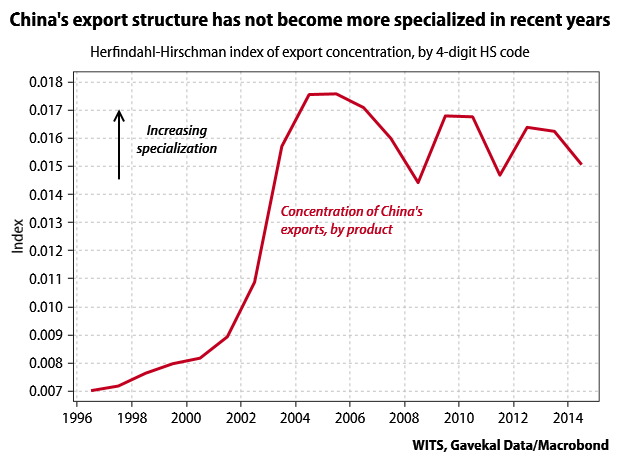
I found this a very striking idea, as one of the (many) things about China’s economy that has puzzled me in recent years is the apparent lack of specialization in its exports. There was fairly dramatic structural change in China’s exports up until about 2007, but since then the export structure has been largely stable. Exports have been growing, and China’s global market share has been rising until very recently. So China has generally been steadily becoming a more successful exporter. But as this has happened it has not shown much sign of becoming more specialized in particular types of products, which is usually one of the things that happens in countries that are successful exporters.

I had speculated that global demand was a limiting factor here: in the aftermath of the financial crisis, global demand for the kinds of things that China wants to specialize in–capital goods and equipment–has probably not expanded rapidly enough for China to have exported a lot more of those goods. But perhaps, as Carsten suggests, the issue is more fundamental, and one we have not really encountered before: China’s export industries might already large enough, relative to total world demand, that even a very successful export performance will not show up as much specialization. This is one to ponder further.

export share

Update. Here is a more precise measure of export specialization — a simple Herfindahl-Hirschman index of concentration, calculated at the 4-digit HS level (it’s the sum of the squares of the share of each product in the total). This actually shows export concentration has been bouncing around in a range since around 2003-04, so it looks less like a cyclical post-crisis phenomenon.

HHI-exports-product

A portrait of a Beijing park

I really enjoyed the article in The Economist‘s Christmas issue on Beijing’s Ritan Park–one of the few pieces of journalism I’ve read that really captures the flavor of daily life in the capital city. I lived near Ritan Park for a few years and frequented it regularly, and though I live near a different park these days, going to parks continues to be an important part of my routine. Here is a sample:

In every country tribes converge on parks at particular times of day. In the West, early-morning dog-walkers are succeeded by lonely buggy-pushing mothers, then lunchtime joggers. After school come running, shouting children, then lounging and smoking teenagers. A Chinese park’s rhythms are different. Dogs are banned. Most runners are gone by 10am (the activity is new enough to China that some jog in work boots and jeans). Teenagers, burdened with homework, are rarely seen during the week.

But Ritan Park has its own tribes, nonetheless. One is the bird-lovers. Every day Mu Xionglu, a former factory worker, comes to “walk the birds and walk myself”, meeting friends in a quiet corner, each with two thrushes shrouded by blue cloths. They unveil small wooden cages and hang them on trees, “to let the birds sing together and feel as if they’re in nature again”. An hour is enough for the birds to let it all out, he says.

You should read the whole thing, as it resists easy summary.