Xi’s new growth synthesis

After spending a few weeks in Beijing, the general relief people feel at being out from under the hammer of Covid controls and having daily life resume is palpable, and also quite enjoyable. Less positive is the sense I get in many conversations of a lingering, deeper uncertainty about the direction China is headed. Impressions of this sort are admittedly fuzzy and intangible. But I think in this case, the uncertainty people feel has direct and visible causes, rooted in the fundamentals of China’s political economy.

My basic theory of how China works in a very simplified and top-level sense is that the Communist Party leadership sets goals toward which the nation is to strive, and cadres throughout society and the government mobilize in an attempt to achieve those goals. For the best part of four decades, the mobilizational goal was economic growth. In 2017, Xi Jinping declared, in the most formal, explicit and public way possible, that growth would no longer be the goal toward which the nation would mobilize (for a fuller exegesis, see my old post “Mobilization and modules: what’s changing in China“).

By doing so, he introduced a profound instability into the system. Xi’s proposed replacement for the goal of growth –“a better life”–was so vague and content-free, even by the low standards of Communist slogans, that it offered no coherent guidance for what officials should actually be doing. In practice, it seems to have meant listening to whatever the big guy’s political obsession of the moment was. This instability was exposed in 2021, when Xi rolled out a seemingly never-ending series of regulatory crackdowns and campaigns. The resulting market chaos largely discredited his new everything-but-growth approach, at least among a segment of financial elites. In 2022, the Shanghai lockdown and the repeated, confusing waves of Covid controls in the rest of the country arguably discredited it among a broader swathe of the populace.

What Xi has been up to since the two pivotal events of late 2022, the Party Congress in October and the reopening from Covid controls in November, is in my interpretation pretty simple: he is trying to re-establish a mobilizational goal for the whole political system after that breakdown. A lot of people hope that a chastened Xi will go back to the old mobilization strategy of economic growth first, everything else second. I am pretty sure that is not happening, despite the supposedly “pragmatic” and business-friendly approach of the new leadership team installed at the Party Congress, and the clear near-term focus on stabilizing the economy (see my post “Pragmatism as ideology” for the complete version of why I don’t buy this).

However, I also don’t agree with the default China-cynic interpretation that Xi is just biding his time before launching another 2021-style wave of rectification campaigns. I think the damage to the central government’s public support and ability to execute policy during the last days of Covid lockdowns was actually quite serious (see my post “Interpreting China’s policy reversals” for more speculation about what was going on then). Xi is nothing if not fully committed to preserving Communist Party rule, and has repeatedly shown he is willing to change course and abandon previous priorities in service of this larger goal. What hasn’t been clear is just what lessons he learned from the past couple of years and how those lessons will be integrated into his larger ideological project.

After a round of top-level meetings and propaganda signals in late April and early May, the direction Xi has chosen is coming into view. I think we now have a much better sense of just what he is proposing as the system’s new mobilizational goal. As befits a good Marxist, he has avoided a forced choice between thesis (the Dengist growth-first approach) and antithesis (the 2021 politics-in-command mode) and instead come up with a synthesis of both. The key organizing concept in the latest propaganda is the “modernization of the industrial system,” a concept that combines a practical focus on economic realities with Xi’s signature concerns of national security and geopolitical competition with the US.

In the readout from April’s Politburo meeting, a call to “accelerate the construction of a modernized industrial system that supports the real economy” (加快建设以实体经济为支撑的现代化产业体系) features as part of the answer to the economy’s near-term difficulties. ““Economic growth is better than expected, and market demand has gradually recovered… But the positive turn in the economy is still mainly restorative; internal dynamism is not strong, and demand is still insufficient.” The idea seems to be that intensified industrial policy will help develop “new growth drivers” that will attract private-sector investment. For instance, the meeting called for stepping up support for electric vehicles, an area where industrial policy has had notable successes, as well as for artificial intelligence, an area where the results are so far more mixed.

A few days later, the first meeting of the Central Committee on Financial and Economic Affairs focused on the same concept, while offering more big-picture guidance. This body, one of the suite of high-level commissions chaired by Xi, typically meets once or twice a year to set economic priorities. Its meetings in 2021 focused on internet platform companies and the “common prosperity” agenda of tackling inequality, the key elements of the anti-growth agenda that spooked financial markets. In that context, it is highly significant that the communiqué says high up that “economic development is the Party’s central work” (会议指出,经济建设是党的中心工作). That is exactly the kind of language that adherents of the old, growth-focused order have been hoping would be restored.

Yet the rest of the communiqué makes clear that there is no return to the previous paradigm. Economic development is needed not because it makes people better off, but because it makes the nation great: Xi said at the meeting that “a modern industrial system is the material and technological foundation of a modern country, and the focus of economic development should be placed on the real economy to provide solid material support for China to realize its Second Centenary Goal.” That goal is the one Xi has laid down for China to become a “modernized socialist superpower” by 2049, the centenary of the founding of the People’s Republic.

To achieve modernization requires “building world-class enterprises” and “cherishing outstanding entrepreneurs,” the meeting declared, but their efforts are still ultimately in service to the national project. “Modernizing the industrial system…concerns whether China can take the strategic initiative when it comes to its future development and global competition.” A few key adjectives flesh out what such a system would look like: it must be “complete,” meaning that all segments of the value chain are within China’s borders, or under its control; “advanced,” meaning that China has a strong position in high technology, and “secure,” meaning not vulnerable to external shocks or threats.

At the level of rhetoric, all this is a clever synthesis of many of Xi’s favorite themes. In the new conception, the pursuit of national security, technological self-reliance and higher global status is not separated from the pursuit of economic growth, but integrated with it. The strengthening of the nation’s entire economy against US sanctions and other external shocks is a massive undertaking that will demand major investment projects and create lots of opportunities for domestic companies. The vision is of the entire nation united in a common undertaking that delivers both prosperity and security.

Compared to the highly politicized “better life” agenda that Xi offered up in 2017, “modernization” is a more concrete and also probably more attractive goal. At least implicitly, concessions are being offered to critics of the recent missteps: the government is clearly committed to ensuring a strong economy, supporting private businesses and attracting foreign investment.

Xi’s unrepentant nationalism and tough stance with the US have generally been the most broadly popular part of his agenda, supported by many people not otherwise enthusiastic about his political campaigns. A clear and more broadly acceptable mobilizational goal for China’s Leninist political system will help reduce uncertainty and instability. And in most any system, to lop off the less popular parts of an agenda, focus more on the popular bits, and deliver practical results on the economy is good politics.

Below the level of rhetoric, it is less clear what all this means in practical terms. China’s bureaucracy has for years now been directed to deliver a heightened focus on national security, industrial policy and technological self-reliance. Credible estimates suggest China already spends far more on industrial policy, in both relative and absolute terms, than any other major economy. Actually, if the new agenda does not require radical alterations of existing policies and programs, that is another point in its favor. But if Xi is planning to double down on those efforts, that would really push China’s economy into uncharted territory.
Searching for Xuanzang

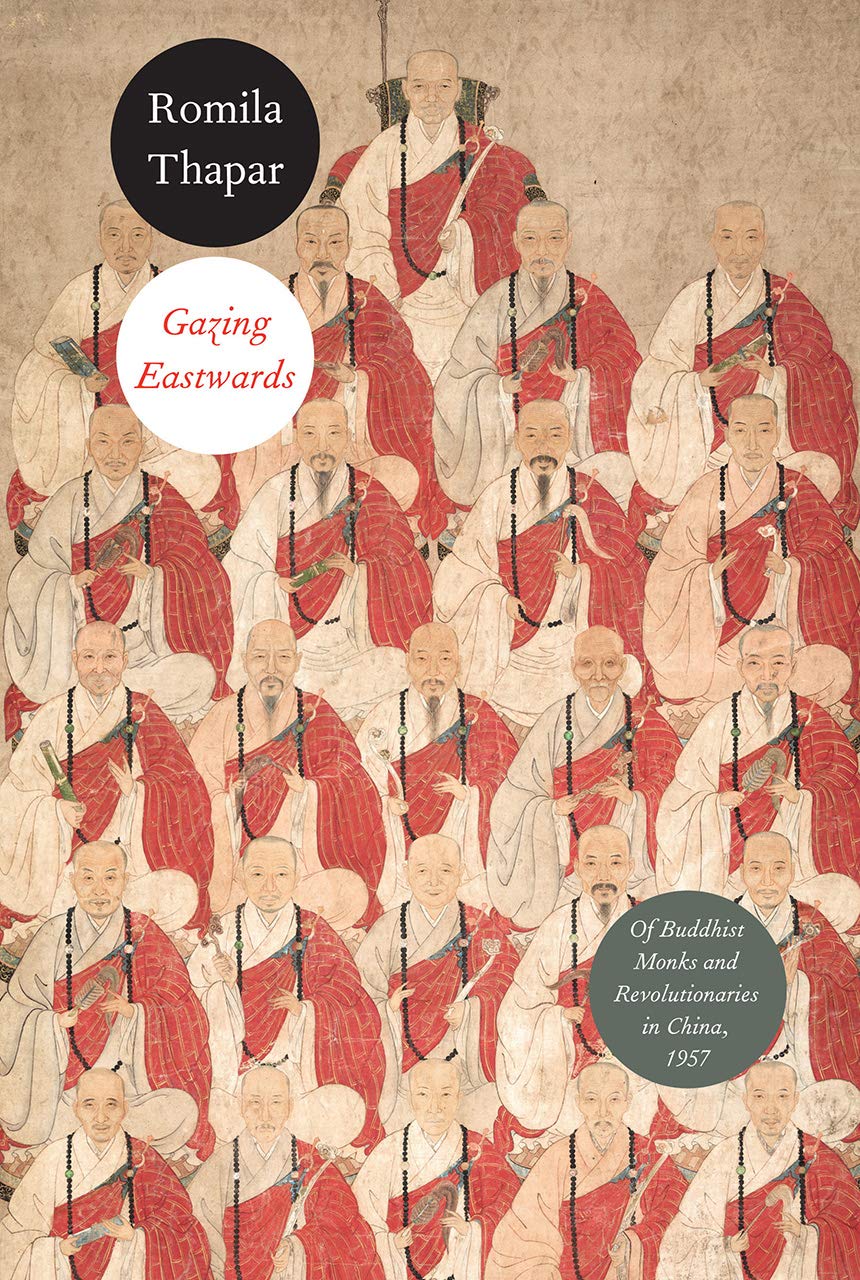
When Romila Thapar was a young PhD student in London in 1957, a surprising offer dropped in her lap: how would she like to be a research assistant on a trip to China to study Buddhist cave art? Although Thapar had no particular expertise on China, she had helped the art historian Anil de Silva with some research on historical Buddhist images, which was apparently enough to recommend her. The interruption in her dissertation research was initially daunting to Thapar, but her friends and advisors naturally told her that it was a once-in-a-lifetime opportunity and she should just go. The diary that she kept on the resulting journey was recently published, more than 60 years later, as Gazing Eastwards: Of Buddhist Monks and Revolutionaries in China, 1957.

An accomplished historian, Thapar maintains a professional, elevated tone in the framing material she wrote for the new book. The diary itself is something quite different and more charming: the record of a youthful mind filled with enthusiasm and curiosity at encountering a new culture. The young Thapar is excited by the opportunity to learn about China first-hand and throw off the prejudices she had absorbed in the colonial education system: “As a child I imbibed the ridiculous stories about the Chinese that were fostered in India, no doubt by the Raj. It was the land where the sly, slit-eyed Mongoloid-featured people lived, the land of mystery and strangeness, typifying the unknown, where people were said to disappear, kidnapped by suspicious-looking others.”

You can already sense a bit of the later intellectual commitment to dismantling misguided colonial scholarship and erecting an edifice of knowledge on more solid foundations; the nice review by Aditya Bahl in the New Left Review has more on how the book connects to Thapar’s later career.

The guiding spirit of her journey, however, is the great Buddhist monk, traveler and translator Xuanzang, famed for his accomplishments in bringing Buddhist scriptures from India to China. She circles back to him several times over the course of the diary, but her reflections on standing in Xuanzang’s tomb outside Xi’an are worth quoting at length:

It felt uncanny being there, and I had a distinct sensation of what may be called the sweep of past centuries as I stood alone on the balcony of the upper room looking out at the main monastery and down the hill. This was in a sense the moment that crystallized my journey to China. How incredible must have been Xuan Zang’s journey across Central Asia and India–a sixteen-year venture in the seventh century AD, and all in search of what he knew of as the true Buddhism–the Buddhism of India, which for the Chinese was the location of the western heaven. He was such an extraordinary person, and judging by his description of the journey, a man with incredible perception of place and person.

Yet no one in India, not a single person, thought of recording the conversations that many must have had with him not only on Buddhism, but specifically on Buddhism in China or even the contemporary philosophies that emanated from China. I have often wondered about what accounts for this lack of curiousity among pre-modern Indians who remained uninterested in commenting on the world beyond their immediate own, yet it was a world that they visited and worked in, either as Indian traders or as teachers of religion in Central Asia or in Southeast Asia. … It is such a stunning contrast to the Chinese avidly wanting to know about the wider world and writing about it.

It’s clear that Thapar feels a kind of obligation, or aspiration, to make up for India’s historical indifference to Xuanzang: her own journey is a chance to demonstrate that Indians can avidly want to know about the wider world as well. Her enthusiastic curiosity about everything in China is perfectly honest, but also guided by a broader ideal of the two great Asian nations restoring and amplifying their past historical links. What makes her diary more than an episodic collection of the impressions of a tourist–and there is plenty here about trains, hotels and restaurants–is its tragic arc as this earnest hope of intellectual connection is repeatedly denied.

At the time of her visit, July to October 1957, China was in the throes of the Anti-Rightist Campaign, one of the early examples of the waves of Communist persecution of real and imagined internal enemies that would grip the country for the next couple of decades. Thapar gets her first inklings that something is going on behind the scenes soon after her arrival in Beijing. Many of the scholars whose names she had been given by her professors in London turn out to be mysteriously unavailable to meet with her.

Those that do attend the various government-organized dinners and functions mainly confine themselves to small talk rather than topics of professional interest. “They seemed quite content to go on sipping green tea and talking about nothing in particular.” Thapar mentions in passing that one of the only Chinese professors to talk openly with her about history was Ji Xianlin, a scholar of Sanskrit and other ancient Indian languages; in the 1990s Ji would become more widely known for his memoir of persecution during the Cultural Revolution, The Cowshed.

Still, most of her initial impressions are positive. Thapar notices some of the same things people still notice about China: the food is amazing, and there is always construction happening. She generally feels great sympathy for the Chinese people, a sense amplified by the familiarity of the physical environment. In Lanzhou, she remarks: “There were many moments when I was strongly reminded of the old North-West Frontier Province, the areas across the upper Indus, especially the parts around Peshawar and the Afghan border where I had spent my childhood–the same bleak grey hills, the dusty roads, the mud houses and the walled structures on low hilltops.” Overall, her feeling was that China and India were in the same situation and going through much the same process of national development: “The initial shock was that China is so much like India–it is very much an Asian country.”

But as she leaves Beijing and heads through the provinces, on the way to the Buddhist sites of Maijinshan and Dunhuang that are the object of her friend’s research, the mysterious gaps and silences continue to worry her. “Despite my making several requests that we meet with some archaeologists and historians of ancient China to discuss their methods of historical analysis, my requests were ignored,” she complains, more than once. The scholars she does meet avoid substantive discussion, even on technical issues, or resort to repeating general slogans. “I find a tendency towards oversimplification. They say it is necessary in the early stages of socialist reconstruction, but I feel scared that once it comes it will stay. This is what happened in Russia.” Yet despite her worries, she is reluctant to criticize too strongly: “Sometimes I wonder if the fault doesn’t lie with me? Perhaps I fail to understand the problems of China.”

The weeks working on the Buddhist sites pass quickly and blissfully in the diary, and all too soon Thapar is on her way back to Beijing in preparation for final departure. On her second visit the evasions of her hosts are even more obvious: “I have repeatedly been requesting meetings with young people, university students and researchers, and young intellectuals, and all I have got by way of reply is a polite smile. It makes me so frustrated and even angry.” Talking to other foreigners in Beijing she begins to figure out the reason: “The Chinese are not lacking in courtesy. Clearly there were other reasons. One had heard about the ‘rectification campaigns’ that were currently going on in many offices…perhaps this made them reluctant to meet foreigners lest some of the issues inadvertently get talked about.”

In Beijing, she is caught up in a whirl of glamorous diplomatic receptions for foreign guests, hears a lecture by Joan Robinson, even shakes hands with both Mao Zedong and Zhou Enlai. But finally, a friendly, Chinese-speaking foreigner clues her in to the political reality by translating a newspaper article about one of the professors she had tried and failed to meet, who turns out to have been targeted as a rightist. “He was charged with not accepting the interpretation of history as authorized by the government; and he is said to have remarked that a hundred flowers were not blooming in the field of historical thought in China today, as is claimed, but only five, and that these were not sufficient since they all said much the same thing.” This crushing of dissent in history–her own discipline–is shocking and dispiriting.

Despite her best efforts to exemplify what she thinks of as the Chinese virtues of Xuanzang–open inquiry and cross-cultural exploration–she can find no one in Mao’s China who feels free to do the same in response. “I am interested in the experience of others because I believe that one learns from comparative studies,” the young Thapar writes, rather forlornly.

How Chinese ruined a perfectly good gender-neutral pronoun

One of most distinctive mistakes that native speakers of Chinese make when speaking English is to mix up the gender of the third-person singular pronoun. It is not uncommon for an otherwise fairly fluent speaker, with good accent and correct grammar, to say “she” instead of “he”, or vice versa, and not realize their mistake. It’s a difference that reveals how grammar shapes some habits of thought. English grammar requires you to hold in your mind at all times the gender of the persons you are talking about; Chinese grammar does not.

Spoken Chinese has only a single third-person pronoun, , which is gender-neutral, referring to all genders or none. Since Chinese grammar does not require speakers to mentally keep track of everyone’s gender, they often don’t. So when English forces them to make a choice, they sometimes just take a stab and get it wrong. Of course Chinese people are perfectly capable of learning the different habit of thought required by English grammar, but it’s not automatic.

It is possible to have an extended conversation in Chinese about a person who is not present without ever specifying whether that person is male or female, and indeed for the participants in that conversation to not actually know that person’s gender. This perfectly ordinary experience in Chinese can only be achieved in English by the deliberate use of unusual literary techniques. The example that springs to mind for me is Ann Leckie’s science-fiction novel Ancillary Justice, in which the narrator uses the pronoun “she” to refer to all individuals and doesn’t explicitly indicate their gender. Sometimes the reader can work it out from context, but a lot of the time you just don’t know. That’s weird experience for a speaker of a language with gendered pronouns.

What’s intriguing is that written Chinese is more like English in its use of pronouns than it is like spoken Chinese. There are three characters, all pronounced : 他 translates as “he” in both of the English senses, serving as the masculine third-person pronoun and as the (now contested) default pronoun for a person whose gender is unspecified or unknown; 她 is “she”, the specifically female third-person pronoun; and 它 is “it”, the neuter third-person pronoun usually used for inanimate objects.

Spoken Chinese is perfectly inclusive, referring to all people identically in a way that makes no presuppositions about gender. Written Chinese replicates the traditional hierarchical pattern in English, in which people are referred to as male unless there is a need to specify they are female. Yet the way that Chinese people actually speak–among other things, their distinctive mistakes in using English gendered pronouns–makes it clear they do not think in terms of those characters, and are mentally using only a single gender-neutral pronoun.

In my personal experience, this is one of the clearest demonstrations of a basic principle of linguistics: that spoken language is prior to written language. Of course this is obvious from both our personal and collective history. Every person learns to speak before learning to read and write, and humanity in general had spoken language before written language. But because of the antiquity, universality and cultural prestige of Chinese characters–the way the same writing system is used by speakers of different Chinese languages/dialects–there is sometimes a tendency for Chinese people to think the characters represent the “real” language. They don’t! The real language is what real people really speak.

The puzzle, then, is why written Chinese differs so much from the actual practice of spoken Chinese. A paper from 1997 by language maven David Moser has the answer (thanks to David for a Twitter conversation that inspired me to look up his piece). It turns out that gendered pronouns are a twentieth-century invention, introduced into the language by “reformers” who had been exposed to pronoun usage in other languages:

Prior to the May Fourth Movement [of 1919], there was only one written form for the third-person singular, the gender-neutral character 他. Later, due to the influence of foreign languages and the necessities of translation, prominent figures in the May Fourth Movement such as Lu Xun and Zhou Zuoren began to suggest creating a new character or characters to represent male and female third-person pronouns in the written language. According to Ling Yuanzheng, the first to advocate the use of 她 as the feminine written form while using the existing 他 as the masculine form was the poet and linguist Liu Bannong. Interestingly, though Liu’s proposal elicited much debate as to whether the introduction of any new characters was truly necessary, no one at the time raised the obvious possibility of creating a symmetrical character for the masculine third-person singular as well, thus leaving 他 as a gender-inclusive third-person pronoun.

The Chinese language reformers, instead of preserving the naturally gender-inclusive usage of their own language, instead grafted the hierarchical gender pronoun structure of English on top of it.

David notes that the poet Liu Dabai in the 1930s did try an alternative approach, creating new characters for both specifically male and female pronouns while preserving 他 as gender-neutral. What Liu’s scheme looked like is shown on the left in the graphic below, reproduced from David’s paper: three characters for three pronouns, each visually and semantically corresponding to the Chinese words for person, man and woman. The actual usage of modern Chinese is shown on the right: two characters for two pronouns, one that is primarily male but also gender-neutral, and one that is specifically female.

The whole episode is a fascinating example of the ways one language can influence another: not simply the ordinary one of borrowing vocabulary, but actually changing the grammatical structure. It seems fortunate that in this case the change was confined to the written language, and hasn’t altered the spoken one. Perhaps now that gender-inclusivity is more highly valued than it was a century ago, written Chinese can eventually come back into closer alignment with the spoken language.

Pragmatism as ideology

“Pragmatism” has become an inescapable piece of vocabulary in recent Western political commentary on China, the preferred term to indicate the opposite of whatever it is Xi Jinping has been doing lately. Everyone wants to offer an opinion about whether the newly installed Premier Li Qiang and his colleagues will be “pragmatic.” The optimists point out, correctly, that Li and others have a long track record of doing things to boost the economic development of the regions of which they were in charge.

Although I have used the term myself, this “pragmatism” discourse is starting to bother me. The word is being used to hark back to an idealized past of non-ideological decision-making, when China’s leaders threw off the straitjacket of socialism and focused on practical moves to make the economy function better and improve living standards. This long history is believed to have instilled in officials an approach, a disposition, of not caring too much about ideological questions and caring more about practical concerns–primarily economic growth.

But the contention, or implication, that pragmatism is non-ideological is just propaganda. The position that China’s government should focus all its efforts on raising living standards rather than implementing socialist values is itself an ideology. The opponents of this position in the 1970s and 1980s viscerally understood this. The conservatives argued, quite correctly, that such a change would undo a lot of their hard work and return power to the social elites whose position the Communist revolution had been devoted to overthrowing.

It was the ideological decision to focus primarily on economic growth–made and reinforced by the successive top leaders Hua Guofeng, Deng Xiaoping and Jiang Zemin–that created the space for “pragmatism.” The turn to economic reform in 1978 was explicitly framed as deploying the Communist Party’s political machinery for the goal of boosting growth rather than pursuing class struggle. For local officials to try different approaches and do whatever worked to expand the economy was not just tolerated, it was required.

Today, asking whether individual officials have a “pragmatic approach” is the wrong question. The system in which Chinese officials have been operating encouraged pragmatism, and some officials have been more successful than others in navigating that system. But Xi Jinping has been quite clear that he wants to change that system. As he has repeatedly stated, developing the economy is no longer the Communist Party’s top priority–in part because of the economic success already achieved, in part because the current challenges are different.

A recent Xinhua report on “The value of Xi Jinping’s economic thought” lays out the transition from the Deng-era priorities as clearly as the official buzzwords allow:

The Sixth Plenary Session of the 11th CPC Central Committee held in 1981 pointed out that the principal contradiction in the primary stage of socialism was between the people’s ever growing material and cultural needs and backward social production. This was a scientific conclusion made by the CPC based on the economic and social development stage at that time. The key point is to meet people’s basic material and cultural needs.

In 2017, Xi said in a report to the 19th CPC National Congress that as socialism with Chinese characteristics has entered a new era, the principal contradiction facing Chinese society has evolved to that between unbalanced and inadequate development and the people’s ever growing needs for a better life.

The evolution of the principal contradiction represents a historic shift of overall importance. The transition from providing for people’s basic needs to meeting people’s desire for a better life reflects China’s tremendous progress in economic and social development, as well as the comprehensive upgrading of the people’s needs for a better life.

Meeting the people’s ever growing new needs for a better life is the logical starting point of Xi Jinping Thought on Socialism with Chinese Characteristics for a New Era. Xi Jinping’s economic thought starts from this and has developed into a cohesive, in depth, and systematic economic theory system.

Xi Jinping’s economic thought starts from the principal contradiction facing Chinese society, coordinates needs and wants, focuses on social well being, and establishes the economics that seeks a better life for Chinese people.

It’s true that Xi hasn’t done a great job articulating what “a better life” actually consists of, a failure that has made policymaking more incoherent in recent years. But it is clear that economic growth has been relatively devalued, and a complex of other political concerns, most prominently national security, given more weight (for a fuller explanation, see my post from 2021, “Mobilization and modules: what’s changing in China“). This is indeed, as Xinhua says, a historic shift.

For 2023, the short-term priority is clearly to stabilize the economy. In his speech at the close of the annual legislative session, Xi called for “the economy to achieve effective qualitative improvement and reasonable quantitative growth, and continuously increase China’s economic strength, scientific and technological strength, and comprehensive national power.” A strong economy is certainly part of his vision; but again, economic strength is only part of the picture, not the overall goal.

We should indeed expect the new top administrators in China to be pragmatic in pursuing the goals laid down by Xi, if that means being flexible about tactics and responsive to empirical reality. Nor should we rule out the possibility that they will make decisions that end up being good for economic growth. But that would not mean a return to the “pragmatism” of previous decades, which was the product of an entirely different ideological orientation.

The political economy of financial discipline

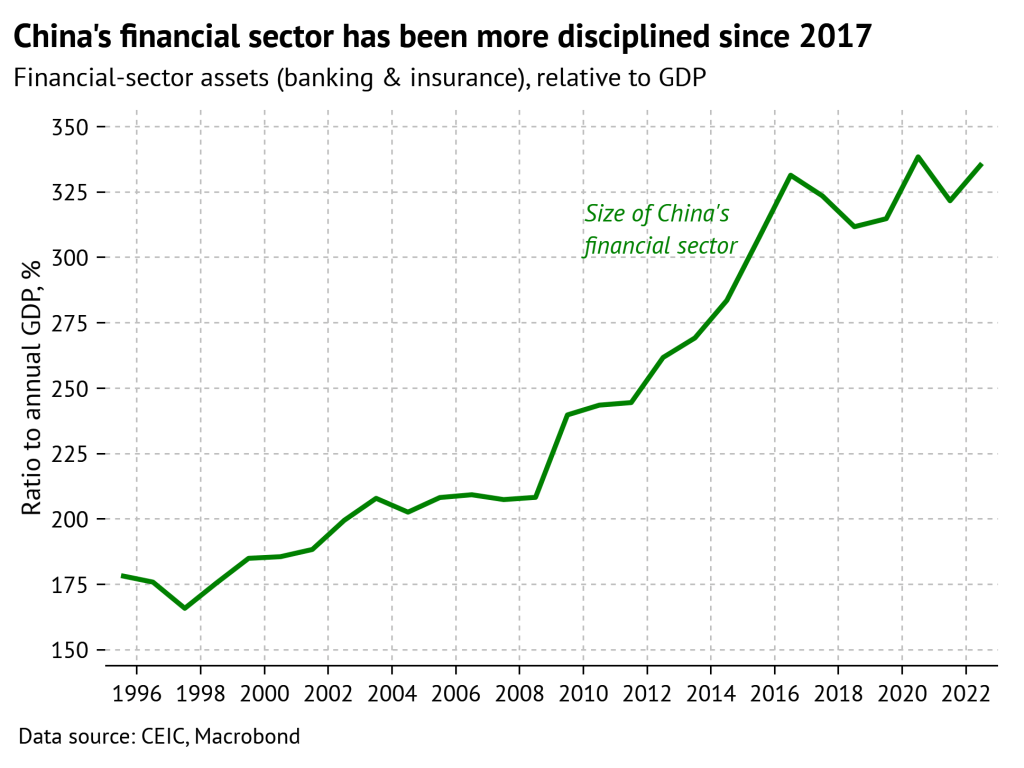
China’s most consequential economic policy of the last several years, aside of course from the Covid lockdowns, was its turn to increased financial discipline. In the decade after the 2008 global crisis, the financial sector had exploded in size, but in 2017 that growth came to, if not quite a halt, then a very obvious inflection point. As the chart below shows, the size of China’s financial sector relative to GDP has been roughly stable since then (the spikes in 2020 and 2022 were due to sharp slowdowns in the growth of the denominator rather than accelerations in the growth of the numerator).

The new direction was signaled at the end of 2016, and then really got going after Xi Jinping made the Politburo attend a study session on financial risk in early 2017. At the meeting he declared that “financial security is an important component of national security,” launching a campaign against financial risk in a way that made it a top political priority rather than a matter of mere technical management. Since then, the government has been remarkably consistent in holding to a tough, conservative stance on monetary policy and financial regulation.

Although no Chinese official would express it this way, essentially what happened in 2017 is that China started doing what the IMF and similar worthies had been telling it to do: control debt, close regulatory loopholes, impose hard budget constraints. This was a pretty unexpected move for Xi, who up until that point had focused his attention more on foreign policy, security issues, propaganda and ideology. It was also a pretty unexpected success for the technocratic types who had been warning about the dangers of rising debt for several years, to little effect.

This episode in Chinese economic policymaking is still not well understood. Why did the people usually identified in the Western press as “market reformers” focus their energy and political capital on this issue of financial discipline? And how were they so successful at getting their agenda adopted at the highest levels? Maybe one day when the principals write their memoirs we will know the real story.

But until then, I have some theories–or, at least, speculations. Even in a top-down system like Xi-era China, major policy decisions usually need buy-in from a range of interest groups. My speculation is that there are two major interest groups that aligned in support of this new agenda of financial discipline.

Let’s call the first group the “reform faction.” These people are indeed concerned that the surge in debt after 2008 has raised the risk of a financial crisis in China. But they also see the easy availability of credit as encouraging the worst features of the Chinese economy: the continued large role of state-owned enterprises, and the corrupt and unhealthy relationship between property developers and local governments. Imposing more financial discipline on these actors will thus help push the economy in the direction of higher productivity and a larger private sector.

Let’s call the second group the “control faction.” Their diagnosis of China’s problems is almost the opposite of the reform faction’s. Rather than seeing easy credit as enabling the dominance of inefficient state enterprises, they see it as enabling the aggressive expansion of corrupt and unaccountable private-sector companies. The huge concentrations of private wealth created by booms in property and the internet undermine China’s governance and challenge the authority of the Party. Imposing more financial discipline on these actors will reduce social and economic polarization and allow for healthier growth.

The ideals of these two factions are almost diametrically opposed. However, both can agree that the lax post-2008 policies caused a lot of problems, and that tighter central control of the financial system will help address these problems. The consensus policy is to impose financial discipline on both the private sector and the state sector, not just one or the other. For me, this model helps account for some of the internal contradictions of the financial crackdown–how it married a seemingly technocratic agenda with a socialist political campaign–as well as for its surprising toughness.

An unholy alliance between the reform faction and the control faction does not sound like an inherently stable configuration. Indeed, the indications are that the balance of interest groups is now shifting. All the top officials who implemented the financial crackdown are headed for retirement due to age. Recent corruption probes have implicated senior officials at the central bank and financial institutions. And the government has just announced a wide-ranging restructuring of the entire financial-regulatory apparatus.

Even if my model is wrong (as it quite likely is), the political economy around financial regulation in China has clearly shifted. Whatever was the actual balance of personalities, interests and agendas that supported the turn to financial discipline in Xi’s second term, it will be different for his third term.

Re-de-industrialization

China’s government has never been particularly shy about supporting its manufacturing sector, a key engine of growth for decades. Since 2021, though, it has become even more vocal about the importance of manufacturing, officially adopting in its plans the view that manufacturing is a special sector of the economy deserving of special treatment. That view may well be correct, and I have some sympathy for the argument. But the metric the government has chosen to measure its success is likely to prove a disappointment.

A good recent example of the new style of rhetoric around manufacturing is an article published in a recent issue of Seeking Truth, the Communist Party’s theoretical journal, by Jin Zhuanglong, head of the Ministry of Industry and Information Technology (MIIT). It does not break new ground but expresses the current line of thinking quite clearly; here are a few choice passages:

Industrialization is the precondition and foundation of modernization. … For a large country like ours, it will be difficult to achieve the goal of becoming a modernized superpower without a strong and large industrial sector. …

Industry is the main engine of economic growth, and plays a key role in stabilizing the overall macroeconomy. Industry is the main battlefield of technological innovation, it is the sector with the liveliest innovation activities, the most abundant achievements of innovation, the most concentrated applications of innovation, and the strongest innovation spillover effects. According to statistics, industry in the United States accounts for less than 20% of GDP, but 70% of innovation activities rely directly or indirectly on the industrial sector. …

We must hold fast to the real economy, especially the manufacturing sector, consolidate the advantages of a complete industrial system, keep the proportion of the manufacturing sector in GDP basically stable, and avoid the “virtualization” of the economy.

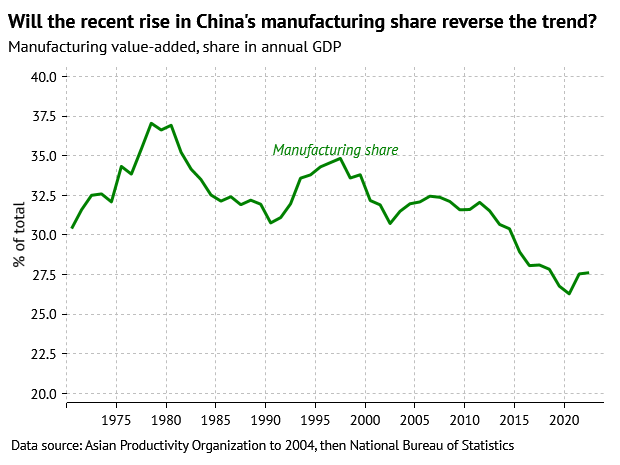
There are a lot of fairly abstract goals outlined in Jin’s article: many things that must be “improved” or “strengthened” in the common parlance of Chinese officialdom. The main one that can be actually measured is the manufacturing share of GDP; the goal of keeping that ratio “basically stable” was written into the 14th five-year plan.

That mandate is why, in the MIIT’s annual work conference in January, Jin proudly reported on the rise in the manufacturing sector’s share of GDP in 2022, to 28%. Such a shift in China’s economic structure is indeed a notable event, reversing a multi-year decline in the relative (not absolute) size of the manufacturing sector, which was over 30% of GDP as recently as 2014. But most of the change happened in 2021, when there was a simultaneous boom in both export manufacturing and in domestic demand, driven by property.

The property boom deflated in dramatic fashion in 2022, with historic declines in construction indicators. And while exports started off strong, by the end of the year they were declining, as China’s major export markets scaled back their spending on goods favored during the pandemic (furniture, electronics). The increase in the manufacturing share for the year as a whole was small, and higher-frequency data show it had actually begun declining by the end of the year.

China’s economic growth is universally expected to accelerate in 2023 thanks to the lifting of Covid restrictions, but a repeat of the 2021 manufacturing boom looks quite unlikely. Real-estate construction could pick up some, and with it demand for manufactured goods like steel, cement, and machinery, but a return to the boom years is not in the cards. While consumer spending in the US is solid, spending patterns are shifting to be less favorable to China (more services, fewer goods). A similar shift is likely to unfold domestically, with consumers splurging on the services, like travel, they have not been able to fully enjoy for three years.

It looks quite probable that manufacturing will lag rather than lead overall economic growth in 2023, resulting in a lower share of GDP. That may be why, at the latest MIIT work conference, stability in the manufacturing share was not mentioned as a specific goal for 2023, which it was for 2022 and 2021. There’s no point in emphasizing goals that are unrealistic.

Looking beyond the peculiar circumstances of 2023, I think it’s more likely than not that de-industrialization, meaning the decline of the manufacturing share of GDP, will resume. Rather than being an indication of the hollowing-out of the Chinese economy, as policymakers seem to fear, such continued structural change would probably be a fairly normal and neutral development.

The success of manufacturing in raising incomes in China naturally leads to some relative decline: as households’ incomes rise they tend to spend more on services, while at the same time Baumol’s cost disease raises the relative prices of services over time. Neither of those trends threatens the international competitiveness of Chinese manufacturing.

The manufacturing share of GDP stayed unusually high in China for decades in part because of typically socialist economic distortions: repressing consumer spending to channel investment into industrial capacity. Trying to maintain such distortions to prevent natural structural change could be quite costly in what is now a much larger, more marketized and globally integrated economy.

To really prop up the manufacturing share in an economy of China’s size would probably require extending the housing boom even further, or consistently undervaluing the currency, neither of which sounds like a great idea. My best guess is that China’s government won’t be able to stop a renewed decline in its manufacturing share of GDP, and, despite its rhetoric, won’t seriously try to.

A podcast with David Kimberley

Earlier in February, I did a podcast with David Kimberley of Kepler Trust Intelligence in the UK and talked about economic issues in China after the dropping of Covid restrictions. The full thing is online; the below is an edited transcript of the more substantive parts of the discussion. I’ve cleaned up the speech for easier reading but haven’t changed any of the content.


 David: Before we get started, I’ll just start with a small anecdote. So I went to Malaysia about six months ago, and a friend of mine from Hong Kong happened to be there at the same time. We met up and went out for dinner. And over the course of dinner, he kept complaining about things that were happening in Hong Kong and China at the time. Every time he was complaining about something, I would say, Why are they doing that? Why is this the policy? And and it went from mundane things to more serious things. And eventually he said, if you try to understand these policies, you’re just going to go insane. So it’s better to just accept them as they are and live your life accordingly.

Maybe to get started you could you talk a bit about why you think Chinese policy for Covid was so restrictive and also why there was this sudden change? I think for most people who are not keen watchers of the country, it felt like there was this really strict policy that was hard to understand, and then a very quick reversal that was equally hard to understand. So maybe you could talk a bit about both.

Andrew: Sure. I think the reversal is probably easier to understand because they had no choice, right? They were forced into changing policy. The Covid controls were breaking down. And they could either insist that people, local governments and companies continue to follow these extreme measures which weren’t working, or they could recognize that they weren’t working and tell people, okay, fine, we’re not gonna do it anymore. The reversal was basically forced on them by the realities of what was happening with the pandemic, which is that the virus had become so infectious that it was extremely difficult to control even with the very strict measures that China employed.

The local governments that were in charge of actually enforcing these measures had different levels of competence and enthusiasm for enforcing these measures. Some local governments were quite good at it and then others really weren’t that good at it or really didn’t want to do it for whatever reason. Because some local governments weren’t that good at restricting the spread of Covid, Covid spread. And so the weak parts of the system undermined the strong parts of the system, and then eventually the whole thing came crashing down.

So yeah, for the policy change, it’s not something I think was really decided in a considered way at the top. Of course they try to portray it that way, but if you look at the sequence of events, that’s not actually how it played out. They were trying to retain the Covid systems, but they basically just fell apart. And so they had no choice but to give up and say, okay, we’re done.

For the first part of the question, why did they do all this stuff in the first place? I think a lot of it is just path dependency. They got trapped into a certain set of a certain set of policies, a certain set of preconceptions that were difficult to get out of. In 2022, it was very popular for people to criticize China’s Covid policies and everyone’s like, oh, why are they doing this crazy stuff? But if you think back to the first half of 2021, actually China’s policies were looking pretty good.

The lockdowns in 2020 had effectively stamped out Covid. There was no domestic transmission of Covid in China, unlike everywhere else in the world. They had substantially reopened domestically, so for many people daily life had returned to normal. The economy was booming, and they had gotten this economic boom without having to borrow and spend in the way that a lot of Western governments were. They had low inflation and not a big increase in government debt. They didn’t overstimulate the economy. So actually the set of trade-offs that China made at that point in time was looking pretty good.

I think their strategy was essentially to say: okay, we’ve kicked this thing, but we are still going to stay closed off from the outside world because we want to prevent new infections from coming in. But basically what we’ll do is have a vaccination campaign that will achieve herd immunity. And then once we achieve herd immunity, we can gradually open up and then everything will be fine.

And of course what happened is that the SARS-CoV-2 virus continued to evolve into new variants, and these variants were so transmissible that herd immunity became impossible. And I don’t think they were prepared for that. There wasn’t an alternative strategy to achieving herd immunity. Because they had this this set of restrictions, the only thing they could do was to continue with them in order to not have a massive wave of Covid infections and deaths. Which of course is what they have just experienced.

David: That’s all very interesting. I think you did have some protests, which seems, again to someone that’s a casual observer, something that’s quite unusual in China. So did those things have any role to play or are those misconceptions?

Andrew: I do think that the protests had a very clear impact on Covid policy. At our firm, we put together a daily indicator of Covid policies. My colleagues did this heroic work of looking every day at the actual measures announced by 100 different city governments and then classifying them according to how severe they were.

If you look at the data series that we compiled, you see that the restrictiveness of Covid policies begins to immediately decline after the protests, before the central government had officially announced any change in policy. So it’s clear that the actual implementers of Covid policy, which are the local governments, responded to the popular discontent.

Another way you can see the same thing is just to look at the test results. What’s kind of counterintuitive is that immediately after the protests, the number of Covid cases plunges. This of course doesn’t reflect reality because the pandemic was spiraling out of control at that point. But what it means is that a lot of local governments simply stopped doing tests. Mandatory tests were a key part of the whole Covid control system.

So you can see very clearly in the data that the government immediately began to back off from the most restrictive policies in the face of these popular protests. I think there’s no question that they had a real impact.


David: To touch on something else people have been concerned about, which is the real estate sector. As far as I’m aware, most Chinese have their savings in real estate. Is that a bubble that’s about to burst? Is there a huge amount of risk there? Can you just talk about what’s happening in the real estate sector?

Andrew: What happened in the real estate sector last year was basically the biggest correction in housing, sales and construction in the history of the modern Chinese property market. You had something like 50% declines in new construction volumes, and 30% declines in housing sales volumes. We’re not in a situation where we’re waiting to see if bad things are going to happen. Very bad things have already happened. The question is whether bad things continue to happen or whether they get less bad.

This extraordinary collapse in the real estate sector is kind of a confluence of things that people expected and things that people didn’t expect. You’ve had this regulatory crackdown on property developers underway since about 2017. Basically the central government had decided, I think quite correctly, that property developers were a major source of financial risk because they were running highly leveraged business models and were incentivized to build too much housing. The government and financial regulators have been trying different ways to try to constrain the risk-taking behavior of property developers over the last several years.

The first two or three years of this campaign from 2017 to 2019 was partially effective, but did not really change property developers’ behavior. Then of course we have the Covid interlude in 2020 and 2021, and then this campaign comes back with a vengeance. They came up with some very tough, very restrictive measures that really reduced property developers’ access to finance and started to have pretty serious effects on their business.

And as the industry was feeling the effects of this in early 2022, it got this exogenous shock from the Shanghai lockdown. The Covid restrictions that had been fairly light up to that point became extremely strict all over again. And this created a lot of uncertainty among people. Everyone in China was like, oh, we thought this thing this stuff was over, we thought all these restrictions were going to gradually go away, and now it seems like they’re never going to go away and are going to be here forever. And this is terrible.

You had a collapse in property sales that happened in part because of the the lockdown and the collapse in household confidence. It’s difficult to disaggregate these things, but at the same time it was also driven by the deteriorating financial state of the developers, where they became unable to complete projects. And that made people understandably reluctant to hand over a lot of their money to developers.

This sharp collapse in property sales was basically a death blow for developers who already had extreme financial stress from the loss of external financing. It’s one thing to be finding it more difficult to borrow from banks or to issue bonds. But the main way that developers finance their business is by selling houses. If they’re not selling houses, then they really don’t have any money. And they didn’t have any access to external finance to make up the gap.

That imposed huge financial stress on developers. They not only had to stop work on existing projects, but they massively cut back all the new construction or purchases of land for future construction, simply because they didn’t have any money. They had no money from sales coming in the door and they couldn’t borrow it.

What’s happened over the last few months is that, simultaneously with this relaxation of Covid policy, the government has come around, slowly and I think somewhat reluctantly, to the view that it overdid things by trying crush the developers with financial regulation and that the macro effects of this were just too severe.

The priority now is to get housing sales going again, and restore normal funding channels for developers and prevent a further collapse in the sector. That’s where we are now. What the market is going to be looking for over the next weeks and months is some indication that property sales are going to normalize. They may not ever go back to their pre-Covid levels, but if they increase a little bit, that will make a big difference to the financial situation for developers and help halt this free fall in construction activity.


David: To finish off, I think most people listening to this will be individual investors who are not in China, and they are probably pondering whether or not they should be invested in Chinese companies. I think that after Russia invaded Ukraine, a lot of people had this realization of what it means to be invested in a country that is governed in, let’s say, a less transparent, more authoritarian way.

If I’m investing in Russia, you could talk about how great a company like Yandex is, or Gazprom’s dividend, but actually it is kind of irrelevant if in a single day all of that can just be wiped out. And you can’t predict whether or not that is going to happen. Many people were starting to wonder whether actually exactly the same thing applies to China. So I’m curious if you have any kind of thoughts around that. Do you think that China’s going to be able to lure back foreign investors?

Andrew: The short answer is apparently yes, because inflows from foreign investors into Chinese domestic stocks had their biggest month of all time in January. So there’s been a pretty big change in foreign investor sentiment, at least in the short term. But let me try to give you a little more thoughtful answer on this.

Over the years, talking to our clients, who are mainly institutional investors, a lot of them were very interested in finding a way to benefit from the long-term growth story of China, but also avoid what they saw as the political risks and lack of transparency involved in the Communist system. A lot of investors came to the conclusion that the way to do that, to achieve both those goals, was to buy shares in the Chinese private-sector internet companies.

These were companies that were clearly in a growing part of the economy. They were targeting consumer demand rather than government spending. And crucially, they were run by profit-seeking entrepreneurs. They were run by guys who wanted to make tons of money by providing internet services to a billion people. And it seemed that generally the government was okay with that and had given them space to do that. So from a Western investor’s perspective, this is the best of all possible worlds. You have all of the Chinese growth potential, and then you have none of the weird China stuff of state intervention and Communist Party jargon.

What really what happened in that regulatory crackdown, or whatever you want to call it, in 2021, is that this thesis was proved to be wrong. That, in fact, there wasn’t a special sector of the economy that was immune to government influence, and where you didn’t have to worry about Communist Party slogans or state intervention. The internet sector was also vulnerable to these issues just like every other sector of the Chinese economy. And I think that was a pretty big shock for a lot of people who had hoped that the internet sector was going to be different.

The polarization of global R&D spending

How has China’s rise as a science, research and technology powerhouse reshaped how research gets done across the world? One admittedly simplistic way to track this is to look at a single widely available statistic: R&D spending. (It’s worth keeping in mind that R&D spending is not precisely “science”–it does include spending on research projects by academic institutions, but most of it is actually corporate expenditures.) The story those numbers tell is less alarming for the US than you might assume from a lot of reporting, but the shift in the global distribution of research does create new issues.

While the OECD is the usual go-to source for cross-country data on R&D spending, I am not sympathetic with all of the technical choices they make. In particular, they present all their figures in terms of purchasing power parity, which in China’s case means R&D spending is converted to US dollars at an exchange rate of around 4, instead of 6-7. While the OECD charts show China’s total R&D spending overtaking that of the EU and closing in on the US, that’s mostly an artifact of this particular methodological choice.

Using purchasing power parity certainly sounds all proper and economist-y but it’s not automatically appropriate for every purpose. The PPP exchange rates were developed to compare the living standards of ordinary people across countries by laboriously comparing prices for a basket of the goods and services they consume; since a lot of these are not traded across borders their prices can vary widely. It’s not clear this is the right choice for comparing R&D expenditures, which are going to be mainly on salaries of highly skilled staff and specialized equipment. To me it seems more likely that there is in fact a global market for top researchers and their gear, and that therefore market exchange rates are appropriate.

To come up with more accurate charts, I made my own cross-country comparison of R&D spending. The procedure is simple: take the R&D share of GDP reported for a country in the World Bank’s World Development Indicators database, multiply that by its annual GDP, and convert to US dollars at market exchange rates. Since the R&D share of GDP doesn’t change a lot from year to year, in cases where it hasn’t been updated yet I use the previous year’s share times the current year’s actual GDP.

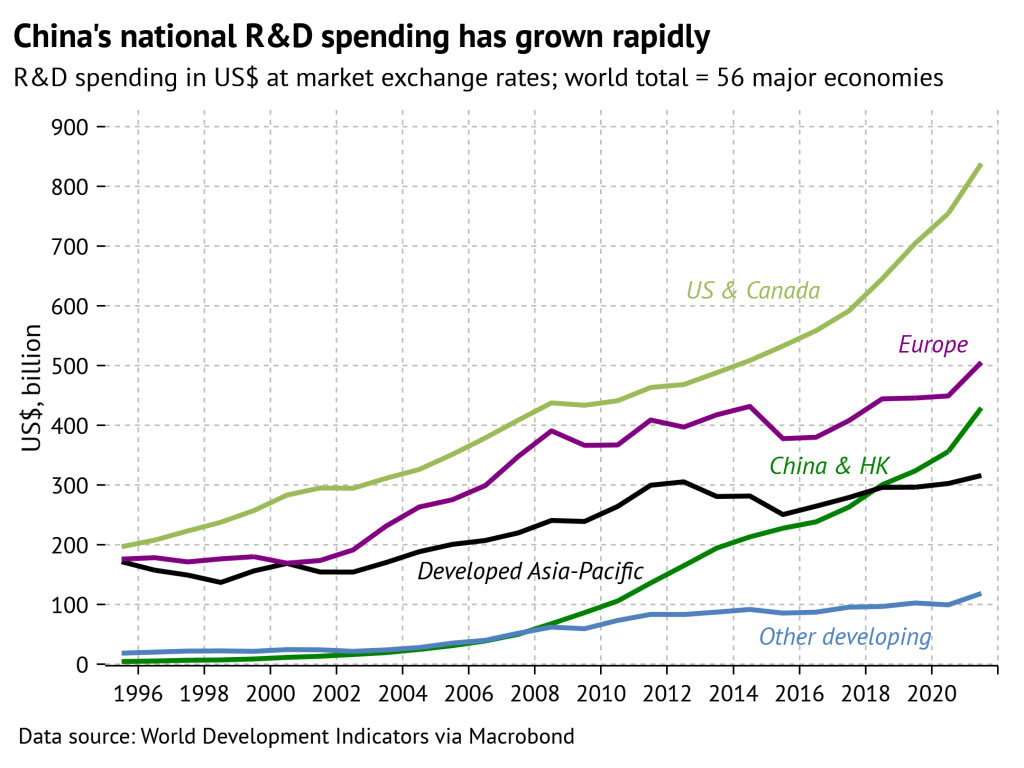
I ended up with 56 major economies where the World Bank has more than scattershot data on R&D spending, with data up to 2021. That’s not a complete sample of the world of course, but if a country can’t report its R&D spending to international organizations consistently then it probably isn’t capable of doing a lot of R&D spending anyway. Aggregating the countries into large regions generates the following result in terms of absolute values:

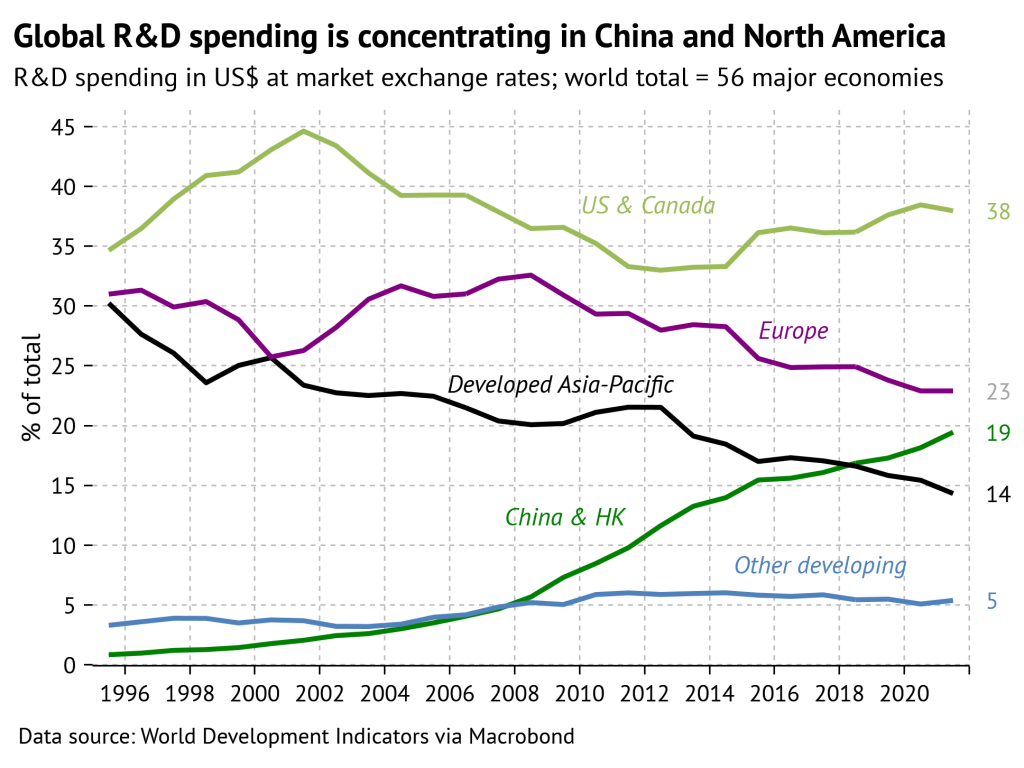
The rise of China is indeed pretty dramatic. In particular it has overtaken the combined R&D spending of developed countries in its own region of Asia (Australia, New Zealand, Japan, South Korea, Taiwan, Singapore), which has been somewhat stagnant for the past decade. R&D spending elsewhere in the world has continued to grow at a decent clip though. So it’s also useful to look at the relative shares:

To me this chart is even more interesting. Back in 1995, when data for most countries becomes available, global R&D spending was roughly equally distributed across three groups of developed economies, those in North America, Europe and Asia-Pacific. China’s rise has come mainly at the expense of Europe and developed Asia, whose R&D spending has not grown as rapidly in dollar terms. The US has done better and has actually kept a high share of global R&D spending, with its share rising not falling in the last several years. Other developing countries (admittedly not as well represented in this sample) have attained a marginally higher share of global R&D over the past decade, but nothing like China.

Based on recent trends, it seems that global R&D spending is becoming less evenly distributed across the world, and is increasingly concentrated in the two hubs of the US and China. That does line up with anecdotal impressions: the US and China are home to the two main clusters of large internet companies, and are also the two leading locations for artificial-intelligence research.

These two hubs are, obviously, not talking to each as much as they used to. There has been only minimal travel in and out of China for the past three years, and the recent political climate in the US has made collaboration with Chinese researchers much more fraught. If ties between the US and China stay troubled, then this more polarized distribution of global R&D spending might turn out to be a less efficient allocation of resources.

Those research dollars will do the most good for technological progress in the world as a whole if they are spent in complementary ways. If instead the two hubs are pursuing conflicting or duplicative agendas, then the same global sum of R&D spending could produce fewer results. This is speculative, of course, as in general it’s hard to know how inputs of R&D spending translate into the output of actual productivity gains. But it is clearly the case that the main global locations for R&D spending are different than they were two or three decades ago, and that the relationships among those locations are more complex.

Interpreting China’s policy reversals

What should we make of China’s recent and dramatic policy reversals? Not only did the government summarily abandon its strict Covid policies in December, it has also dropped years of restrictions on the real estate sector. Officials are taking a softer line on internet platform companies, targets of the regulatory crackdown in 2021, and even adopting a marginally less confrontational stance in foreign policy. All of these now-abandoned positions had once been considered key political priorities of top leader Xi Jinping.

So what does it mean that he is doing things so much differently than just a few months ago? Here are four of the leading interpretations that I’ve heard:

Don’t get fooled again. The professional China-watching community is nearly unanimous in its view that all of these policy shifts are merely short-term tactical adjustments to get the economy back on track and restore public and investor confidence after the missteps of 2021-22. According to this view, Xi faces no constraints on his power as he begins a third term heading a government packed with officials he has personally selected for loyalty. Nor is there any evidence that his ambitious long-term goals–of greater global stature and influence for China, a strong national security state, and technological self-sufficiency–have changed.

The recent “pragmatic” focus on economic growth and stabilization is therefore likely to be just a phase. The more political priorities, which were such a feature of Xi’s second term, will return to prominence soon enough. Neil Thomas has a careful example of this analysis over at ChinaFile, and Bill McCahill a more cynical one at the National Bureau of Asian Research.

A more benevolent dictator. These skeptical takes are being advanced mostly to counter the euphoria in financial markets unleashed after China’s abandonment of its Covid controls. A more optimistic school of thought contends that while Xi’s power is indeed untrammeled, his priorities have shifted after three years of economic and market disruption. The policy reversals on multiple fronts are seen as evidence that Xi can course correct, and will continue pursuing a more pragmatic and markets-friendly agenda in the future. For instance, former Morgan Stanley strategist Ruchir Sharma argued in an an FT column that the policy shifts show that Xi is “willing to reform, at least in the depths of a crisis.”

Of course we have no way of knowing what Xi “really” thinks, and whether the current priorities are a tactical feint or a strategic shift. But it’s not out of the question that Xi has in fact just changed his mind. We do know that Xi has in fact changed course on economic policy lots of times, so changing course again is not in itself a shocker. After all, one of the benefits of having absolute power is that you don’t have to worry about consistency.

Furthermore, Xi probably cares more about maintaining his own power and control over elite politics than about the details of various policies. Since his control over the system and key personnel looks secure after the 20th Party Congress, he can be flexible about specific policies. The implication of this view is that Xi is less ideological than sometimes portrayed, and just does what is needed to preserve the power and authority of his government.

The new technocrats. A variant of this interpretation gives credit for the policy pivot more to Xi’s lieutenants. The argument is that while the new leadership team he put in place at the Party Congress was generally portrayed as a bunch of incompetent sycophants in the Western press, in reality they are effective, competent and broadly business-friendly.

Since Xi is confident in their loyalty, he trusts them to do what is necessary, even if that means having to tolerate some embarrassing policy reversals. And because Xi isn’t fighting all the time with Li Keqiang, who kept trying to promote his own agenda, actual policymaking will end up being more sensible. This interpretation suggests that while Xi’s long-term policy priorities of national security and technological self-sufficiency will still be a major focus of government policy, they can be implemented in a less disruptive way than in recent years.

A quiet revolt. There is also a more radical interpretation than any of these: that policies are changing not because Xi’s own priorities have changed, either temporarily or permanently, but because his power has been diminished. The repeated cycles of forced obedience to top-down political campaigns, the enormous costs of the ever-stricter Covid controls, and and ultimately the near-collapse of the economy have, on this view, discredited Xi’s program and cost him authority.

Of course, he remains formally at the apex of the system, but his ability to enforce his views on the country has been diminished, and other people are quietly making more key decisions. The clearest evidence for this view is the way local governments started giving up on the whole system of Covid controls before receiving considered top-down instructions to do so. Anne Stevenson-Yang, always a thoughtful if jaundiced observer, says: “something very important has happened politically to reverse Xi’s power…I think there has been some kind of quiet internal revolt against Xi Jinping’s personal rule.”

I’m not yet a fully paid-up subscriber to any of these schools of thought.

The consensus view, that Xi is executing a short-term tactical correction while keeping his longer-term agenda basically unchanged, certainly has logic and much evidence on its side. But it’s also a product of a type of analysis, based mainly on careful reading of Party documents, that completely failed to anticipate the dramatic shifts in actual policies. That failure argues for giving more consideration to how feedback from economic conditions, public opinion and lower-level enforcement affect high-level policy decisions.

At the moment, I’m leaning toward an interpretation that combines some elements from all of these theories. I do feel that the reversal of Covid policies was a major political event for China. Although the suppression strategy actually worked for a while, by mid-2022, the evolution of new and super-transmissible subvariants made it no longer practical. The central government’s attempt to force local authorities and the populace at large to keep enforcing what had become unenforceable measures discredited both the policies and the decision-making behind them.

Perhaps the man at the top recognized that the center’s ability to enforce compliance with its dictates was at risk, and if the gap between rhetoric and reality became too wide it would expose dangerous weakness. Rather than try to force the bureaucracy to do things people really didn’t want to do, and risk failure, it was better to instead focus on the things that everyone wants and can agree on, like stabilizing the economy.

It’s not a complete course reversal. Some parts of Xi’s recent agenda do have widespread support, like reducing technological reliance on the US. But some other parts, like the common prosperity push, do not. So that’s why we see the most recent rhetoric emphasizing the former and downplaying the latter: it’s an effort to emphasize consensus within the bureaucracy and re-establish compliance. But because norms of authority are unsettled, the longer-term trajectory probably hasn’t yet been locked in. Depending on how the internal political maneuverings evolve from here, maybe this could be a sustained course correction. Or not.

The Jiang Zemin Consensus

Former Chinese leader Jiang Zemin, who died Wednesday at the age of 96, managed to be underestimated for most of his life, despite rising to exalted heights. He was not considered an inspiring figure when Deng Xiaoping plucked him from Shanghai to run the government after the 1989 purge, and in accounts of the pivotal economic reforms of the 1990s he is often overshadowed by the charismatic and decisive Zhu Rongji.

Yet looking back, it seems clear that Jiang was responsible for establishing many of the basic political and economic contours of contemporary China. The best short summary of his legacy I have seen came from historian Frank Dikötter, in an interview earlier in November; the whole thing is worth reading but here is the key excerpt:

I think that we have been fooled by very superficial impressions of a man who occasionally comes across as something of a buffoon. He likes to burst in song; he has a smattering of foreign languages; it’s rather easy to mock him. But this is a man who really has made all the key decisions.

However you look at it, it is very much Jiang Zemin who has shaped the China we know today: the giant flagship conglomerates; the grip that the party has on the private sector; the shift towards much greater support for state enterprises; the determined effort to ward off any attempts at so-called ‘peaceful evolution’ [i.e., toward democracy]. The list goes on. A remarkable man, if I may say so.

There are two biographies of Jiang, both of them making a good case that he should not be underestimated. Bruce Gilley’s Tiger on the Brink from 1998 offered an early assessment of Jiang’s tenure from a journalist who was on the ground in China for it, while Robert Kuhn’s hagiographic The Man Who Changed China from 2004 has more of the flavor of an authorized biography, valuable mostly for the interviews he scored with Party insiders.

In my own notes on the history of the 1990s, I’ve been tempted to call the political economy that emerged the Jiang Zemin Consensus. Deng usually gets the credit for restarting economic reforms in 1992 after the conservative turn in 1989, and it does seem that Jiang was initially slow to figure out what Deng wanted.

But once he did, Jiang was able to establish a much more consistent direction than the contentious back-and-forth of the 1980s. Jiang forged an enduring elite consensus on two fundamental issues in China: the relationship between politics and economics, and the relationship between the state and the private sector.

With his formulation that China is a “socialist market economy with Chinese characteristics,” he managed to finally end the long-running ideological debate within the Communist Party over whether market economics could be consistent with a socialist (or more precisely Leninist) political system. Today, almost everyone in China accepts that both market forces and state planning can be deployed to achieve particular goals.

And with his two-track reforms to state-owned enterprises, Jiang reset the balance between the state and private sectors. Thousands of small or underperforming SOEs, mostly belonging to local governments were closed or privatized, reducing the fiscal burden on the government and enlivening the private sector. But the remaining SOEs were consolidated into larger entities and received more direct government supervision and support.

That balancing of interest groups has also proved remarkably durable: in purely quantitative terms, the share of economic value-added generated by the state and private sectors has hardly changed at all since the mid-1990s (see my piece Some Facts About China’s State Capitalism).

For all of Xi Jinping’s power and ambition, he hasn’t yet altered the basic tenets of the Jiang Zemin Consensus.