Mapping China: Which provinces are most dominated by state-owned firms?

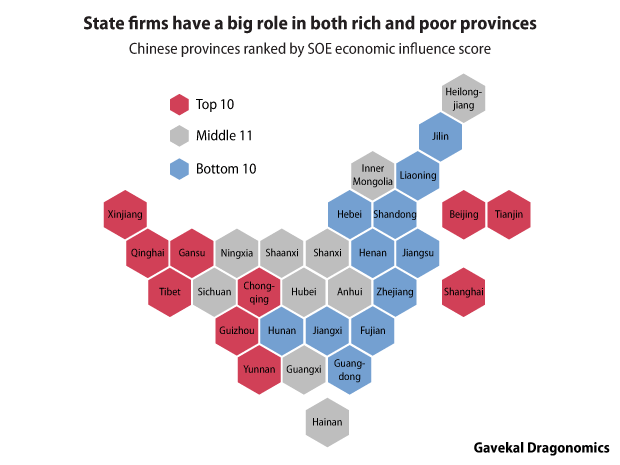
The answer I’ve come up with is not quite the one I expected, but it does make sense I think. Beijing is number one, naturally–it’s the place where all the major national state-owned enterprises are headquartered, and SOE influence is inescapable. But after that easy one, anecdotal impressions do not provide much of a guide. According to my scoring system, the provinces where SOEs have the biggest economic weight are the wealthy coastal municipalities, and the far western provinces. In other words, SOEs dominate both the richest and poorest provinces in China, and play a relatively lesser role (though still a large one) everywhere else.

It is interesting that this pattern does not map that well onto the geographic distribution of China’s economic slowdown. Liberals like Sheng Hong of the Unirule Institute argue that the slowdown is caused by the poor performance of SOEs. At least in terms of simple correlations, that does not look to be totally true–indeed the provinces with a high SOE influence score are among those where economic growth has held up relatively better. This is probably because spending by SOEs is one of the main channels the government uses to support growth (it’s the Chinese replacement for countercyclical fiscal policy, which otherwise they don’t do much of).

The provinces where growth has been really terrible are those whose industrial structure is most exposed to the downturn in housing construction, which mainly means places with big mining or steel sectors. Since a lot of mines and steel mills are in fact privately owned, these provinces are actually not as SOE-dominated as some others. I think the poor western provinces have such high SOE influence scores because they do not have much indigenous industry, and are heavily dependent on investment projects funded by the central government and SOEs.

I would not let SOEs are completely off the hook, though it is tricky to disentangle the effects of state ownership and the effects of industrial structure. You could argue (and I probably would) that SOEs tend to make poor investment decisions and thus contributed to excess capacity in the steel and mining sectors, making the slowdown worse. But this argument is complicated by the fact that the provinces with the most resilient, service-driven economies–Beijing and Shanghai–are also incredibly state-dominated. So there’s not a straight correlation between more SOE influence and worse economic outcomes. At first glance, the relative outperformance of services against heavy industry seems to be a bigger effect than the outperformance of private firms against SOEs.

Anyway, food for thought, and further work. And now to the fun part–the map! I use my hex grid map of China in order to show the province names more clearly, and not diminish the importance of the three coastal municipalities which are geographically small but economically large.

hex-map-provincial-SOE-rank-readable

The three indicators I used to compute the SOE economic influence score are: state-owned enterprises’ share of gross industrial output value (as of 2011), state-owned enterprises share of fixed-asset investment (as of 2012) and the ratio of local state-owned enterprises’ assets to provincial GDP (as of 2013). For each indicator I use the most recent data available, but these ratios do not change dramatically over time. I normalized the reading of each indicator and then summed the normalized scores for each province to generate the overall score and ranking.

If I had to pick one indicator out of the three as the most reliable, it would be the SOE share of fixed-asset investment. The SOE share of industrial output (which I mapped previously) does not account for the important role SOEs play in the service sector, which is particularly important in places like Beijing, while the assets of local SOEs would not capture activity by central SOEs which is quite significant in some places. The northeastern provinces, which are generally viewed as having very state-dominated economies, rank very high in terms of the SOE role in industry, but not as high in terms of the broader indicators–which is an interesting corrective to the standard regional prejudice. The complete ranking of the provinces is below:

Top 10   Middle 11   Bottom 10  
Beijing 1 Shaanxi 11 Hunan 22
Qinghai 2 Shanxi 12 Jilin 23
Gansu 3 Heilongjiang 13 Zhejiang 24
Tibet 4 Ningxia 14 Jiangxi 25
Guizhou 5 Guangxi 15 Guangdong 26
Chongqing 6 Anhui 16 Liaoning 27
Yunnan 7 Sichuan 17 Hebei 28
Xinjiang 8 Inner Mongolia 18 Jiangsu 29
Shanghai 9 Hainan 19 Shandong 30
Tianjin 10 Hubei 20 Henan 31
Fujian 21

Du Runsheng, world’s most influential economist?

Last week, Du Runsheng passed away at the ripe old age of 102. The death of the “father of rural reform” was widely covered in China and Hong Kong, as Du’s proteges include such Chinese economic luminaries as Zhou Qiren and Justin Yifu Lin, not to mention Wang Qishan, who is now one of the seven most powerful men in China. But I have yet to see a proper obituary of Du in the foreign press, which is a real pity. You could make a case that Du was one of the most influential economists to have ever lived.

He was one of the primary authors of the rural reform policies China adopted in the early 1980s, which reversed agricultural collectivization and returned control of farmland to individual farm households. It is no exaggeration to say that as a result, hundreds of millions of people were able to escape poverty. If you measure influence by the sheer number of lives affected, then it seems Du would have to rank pretty high.

By all accounts, Du was a sensible and modest fellow who would never have described himself in this way. As a 2012 article in Caixin, on the occasion of his 99th birthday, said:

Since retiring, Du has downplayed his personal contributions to the rural household contract system. Rather, he credits farmers with coming up with the basic ideas that led to the successful policy.
It’s most important when handling rural land reform, he has often stressed, that government officials “respect farmers’ choices” and “investigate” in the field before adopting new policies.
At the birthday party, Du was honored for his special contributions to rural development research. A tribute cited the work of a Rural Policy Research Office team under Du that led to the household contract system, which was called the economic theory that’s had the greatest influence on modern Chinese society.
Du said he would accept the honor as “just a symbol of this team” because “rural reform relied on a team.”

Like many reform-era figures, Du survived earlier purges and was later rehabilitated. Though it is tempting for someone who went through so much and made such great contributions, we should probably not see him simply as a saintly figure dedicated to the welfare of farmers. Du was a military leader during the civil war, and also contributed to the initial post-1949 land reform; both roles would have meant being involved in quite a bit of violence. But I am pretty sure his life offers some great, complex stories that are begging to be told more widely.

For further reading, there is a first-person account by Du of the early days of rural reform, published in English by the International Food Policy Research Institute. There is also of course a Wikipedia page, and some of Du’s policy speeches have been translated and collected.

W. Arthur Lewis on stagnation, slowdowns and traps

The case for pessimism about sustained fast growth in any economy has rarely been so well put as in the following passage, one of my favorites, from Lewis’ 1955 book The Theory of Economic Growth:

“There are thus many pits into which a country may fall, as a result of prolonged growth: it may weary of material things, its entrepreneurs may behave less competitively, its public may create barriers to change, the distribution of income may alter unfavorably, it may exhaust its natural resources, it may lose its place in international trade, or it may run out of innovations. In addition, it may be a victim of natural disaster, or it may be ruined by war, by civil strife, or by misgovernment.

None of these is inevitable. On the other hand, when there are so many pits into which a country may fall, it is not in the least surprising that countries have fallen into one or more of these pits in the past. One cannot predict when the rate of investment in any particular country will begin to slow down–whether it will be after decades or after centuries. But the expectation that a long period of growth is in due course succeeded by slower growth, by stagnation, or even by decline seems fairly well supported by the little we know of the economic history of the past four thousand years.”

The passage comes from the section on secular stagnation in the book, a concept that is obviously having something of a renaissance these days. Lewis is mostly known today for his model of how labor in a poor country moves from a traditional to a modern sector, a concept many people feel captured something fundamental about how China and other developing nations work. But this book is not referred to much these days, though you can read a quite favorable recent overview of the whole thing here. I confess I have only dipped around in it–the prose style is not always invigorating–but each time to my benefit.

I like this passage because of the way it makes clear that economic growth is not easy and that lots of things can go wrong with it. It’s a simple point, but it’s basically why I’m never been that enamored of the concept of the middle-income trap. In its original formulation, it was the idea that middle-income countries tend to stop growing because their exports get squeezed between low-wage competitors and high-wage innovators. Sure, there are things that can go wrong in middle-income countries so that they fail to maintain fast growth–but lots of things can go wrong besides export competitiveness, and things can go wrong at pretty much any income level, not just the middle.

What’s interesting is to figure out what might be going wrong in each individual case (though I’m still waiting for an actual example of a nation that became “weary of material things”). It is indeed not surprising that a country may fall into a pit, but we still want to know which pit it is and why it fell, and not assume it’s always the same pit. As I’ve argued before, it’s not clear for instance that the middle-income trap model of declining export competitiveness is really the best explanation of what’s happening in China right now.

Unirule’s caustic take on state-owned enterprise reform

Most liberal-leaning thinkers in China seem to be disappointed with the long-awaited plan on state-owned enterprise reform that was published in September, a reaction I share. But if you would like to read a thoroughgoing rant on why the SOE reform plan is not just disappointing but completely missing the point, I recommend reading the interview below.

The speaker is Sheng Hong of the Unirule Institute, an independent and very liberal think tank. They are also unapologetically out of the mainstream of the Chinese discussion on SOEs, so you won’t see these kind of opinions represented in most reporting. I probably wouldn’t frame the issues the same way they do, but I still appreciate their views, which are a bracing corrective to most of what is written about SOEs in China.

The interview was also quite fun to translate, since it is so plain-spoken and polemical; hat tip to the folks at China Policy for the pointer. (Note: I have translated most but not all of the interview, leaving out some repetitions and some of the harder-to-follow bits; the original is here).

Interviewer: Why do you not support the new round of SOE reform?

Sheng Hong: Reform is about solving problems, and this reform basically does not address the problems I am talking about. For instance, the issue of state enterprise monopolies, the issue of state enterprises using national resources for free or for a low price, the issue of not sharing their profits, the issue of unlimited allocation [of resources] within state enterprises–these are the real problems.

What I think is the most serious problem is that state enterprises even exist. State enterprises make it impossible for the government to treat both non-state and state enterprises fairly, damaging the impartiality of government. Officials move back and forth between state enterprise jobs and civil service positions, which means that government officials and SOE executives are the same group of people. The existence of state enterprises makes it very difficult for us to expect the government will treat state and non-state firms equally, which damages the basic reason for government to exist: that it is impartial. We give state enterprises so many favorable policies and monopoly rights, how can private companies compete with them? They are not equal competitors in the market, which damages the basic principles of the market economy.

The fact that these monopolistic state enterprises exist, and occupy a large share of our national resources, creates an enormous loss of resources–many trillions of yuan a year. The slowdown in our country’s economy is to a large degree a result of the existence of monopolistic state enterprises and protected monopolies. This is a pressing issue, every day it is not fixed we lose billions. If it is not going to solve this problem, then what is reform for?

Interviewer: The reform document mentions that we should make state enterprises “stronger, better and bigger.”

Sheng Hong: To make state enterprises “stronger, better and bigger” is a mistake. Why do state enterprises need to be bigger and stronger? State enterprises are not normal companies, they should not be competing with private companies in profit-oriented sectors. If profit-making companies can do something, then state enterprises should not do it. Add to that the fact state enterprises can use their political capital to obtain monopoly rights, they can use their political strength to obtain free resources–this harms the Chinese people. …

What we say are problems, they [government officials] do not think are problems, what we think are not problems, they think are problems. What can this reform plan for state enterprises really mean? They have completely ignored different opinions and critical voices in society, and are hell-bent on making state enterprises bigger and stronger. Can this be called reform? Under the flag of reform they are doing anti-reform things, this is just deceiving the public.

Interviewer: Aside from the problem of monopolies, there are also internal governance problems with state enterprises. You have mentioned the fact that insiders control the award of bonuses, and this reform document also calls for separating state enterprise managers into two categories, [political] appointees and those recruited [from the market]. Can this have any effect on the vested interests of state-enterprise executives?

Sheng Hong: It cannot. Say you split the executives into two categories, one category is commercial, the other category is public interest. Let’s just talk about the commercial ones. I want to evaluate you according to your performance, but how to assess your performance? The performance is not real. Where does your profit come from? Because you have a monopoly, because you don’t pay rent for your land, because the interest rate on your loan is low, you only pay 30 yuan a ton for oil exploration rights while everyone else pays 400 yuan, it is completely unequal. So how am I supposed to judge your real performance?

Take finance as another example: banks make a lot of profit, but you have to know where their profit comes from. The central bank determines the gap between deposit and lending rates, and though it has been adjusted some in the last couple of years, for more than 10 years the margin was unchanged at 3%. This margin is equivalent to a monopoly price, and it is also a regulated price: the government determines your 3% margin. In most countries this is 1.5%-2%; in countries with a market economy the margin is decided by competition. But this 3% is decided by administrative departments, how can it be a true indicator? How are you supposed to judge whether these people are really working hard? If you give an idiot the right to a monopoly won’t he still make money? …

Interviewer: The reform document also covers the management of state assets, and drawing on the Temasek model, it proposes a change from the management of state assets to the management of state capital. … What do you make of the Temasek model?

Sheng Hong: Discussion of the Temasek model is superfluous. All you need to know is that some people in China want to keep state enterprises, so they are always bringing up Temasek. Why do we need to talk about the Temasek model? Temasek is called “state capital” rather than a state-owned enterprise, this means it is a company operated according to civil law but its capital is owned by the state. The problem is why do you want this state-owned capital, there is no need for it. The state capital can be given to the Singaporean people. The basic principle is that a state or a government gets its income from taxes, so why do you need to do this stuff? There is no value in having a deep discussion of this [Temasek model]. …

Interviwer: You have previously proposed dismembering state enterprises, for instance splitting PetroChina and Sinopec into many small companies. But instead we see that after the merger of the two railcar makers, there is now a wave of mergers among the central SOEs. What effects will this have?

Sheng Hong: After the mergers and acquisitions the power of the monopolies will only get bigger, which means nothing good for society, for consumers or for private companies. The logic is very simple: as monopoly power gets stronger there is less and less you can do to constrain it. After the merger of central SOEs, it will be even harder for the central government to manage them, because there will be more conflicts. Take PetroChina and Sinopec–the NDRC and NEA cannot control them, you cannot say no to these monsters. If you merge the three oil companies into one oil company, then it would be even worse. If Premier Li Keqiang goes up against China’s one and only oil company, then his negotiating position is not at all the same as if there were three companies or five companies.

Another example is that when there was just one telecom company, China Telecom, the cost for the central government to negotiate with it was very high. Later when China Unicom entered the market, the change was very rapid. So if the central government really wants to reform, it should not do mergers, but the exact opposite: breakups. …

It’s just like Jia Yi said during the Han dynasty: the more dukes there are, the less power they have. In the early Han, there were many dukes who were too powerful, and the central government could not control them, so it used its power to grant titles to increase their number. For instance if one duke had three sons, after the duke died all three sons were given a title, so each one got a third of the land. In this way after a few generations each duke became very small, and this was beneficial to the central government. For monopolistic state enterprises it’s the same: if you think that merging them together will make them easier to manage, that is a very foolish idea. …

Interviewer: There’s one thing I really don’t understand. After the late 1990s, when China Telecom, China Unicom, PetroChina, Sinopec and all these central SOEs were set up, why has market reform of state enterprises slowly ground to a halt?

Sheng Hong: Because the interest groups figured things out. In the beginning, no one really understood the market economy, but later the state enterprises and government departments figured it out: if you get rid of competitors you can make more profit. There is also some historical background. In the late 1990s, state enterprises were all in deep trouble, so there was discussion of how to bail out state enterprises, Zhu Rongji was also trying to solve the triangular debt problem, and so on. Around 2000, resource prices were fairly low, including the price of oil, coal and land, so the resource-based state enterprises had very serious difficulties. At that time the state enterprise executives understood the benefits of monopoly, and Zhu Rongji thought this was a good way to bail them out. Especially at the beginning no one really noticed. The monopoly of the three national oil companies was established in 1999 with a series of mergers. At that time the oil price was pretty low, so they wanted a monopoly. The justification at the time was to save the SOEs, so there was not much political opposition. That’s the historical background. No one paid much attention, and didn’t think much of the three national oil companies; it was only later that they started thinking the three oil companies were so great. As the oil price gradually rose, it made them aware of their own interests, so they reinforced their monopoly rights. That was the process.

On regional gaps, the growth slowdown and the missing middle-income trap

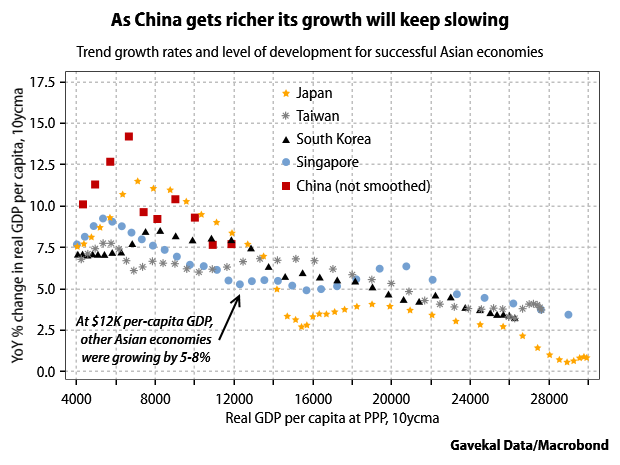
A simple explanation for why China’s economic growth is slowing is that China is due for a slowdown. Even if you don’t subscribe to strong versions of the middle-income trap theory, which I don’t, there is still a very obvious tendency for developing countries’ growth rates to decline as they get richer. China is now an upper-middle-income country, with per-capita GDP of around $12,000 at purchasing power parity, which means it has less of the rapid “catch-up” type of economic growth to do. It is also an economy with $10 trillion in annual output, which means that high percentage growth rates are now pretty difficult to achieve.

Asia-growth-potential

In a very interesting paper back in 2012 (when China’s current economic downturn really began), two researchers for the San Francisco Fed pointed out that such a growth slowdown would play out very differently across China. Since there are huge income gaps between Chinese provinces, some parts of China would be much more affected by the loss of growth potential due to higher incomes. We should see a slowdown first in the wealthiest provinces–Beijing, Shanghai, Guangdong–and only much later in the poorer inland provinces:

Our statistical exercise forecasts a slowdown in both regions, but the pace is quite different. In the developed provinces, the slowdown is relatively rapid, though not abrupt. Expected growth in these provinces falls to 7% in the five-year interval beginning in 2016.

However, the expected pace of slowdown in the emerging provinces is even less. Expected growth in these provinces doesn’t fall to 7% until sometime during the five-year interval beginning in 2024. The reason for this discrepancy is that the emerging provinces have a long way to go before they reach income levels associated with the middle-income trap.

This implies that, in the near future, rapid growth in China will be concentrated primarily in the Chinese interior rather than in the more advanced areas near the coast. For example, by 2020, growth in the developed provinces is expected to slow to a still-healthy, but unexceptional 5.5%. But growth in the emerging provinces is expected to remain a robust 7.5%. Thus, China’s overall growth slowdown may not be severe. The advanced provinces may indeed reach income levels associated with the middle-income trap. But rapid expansion in the emerging provinces will at least partly offset the overall effect on China’s growth.

Intuitively this makes a lot of sense. And the high growth potential of the developing inland provinces is one reason that optimists have cited for expecting continued decent growth from China; see this August paper, and also Timothy Taylor. But I’m less sure these days that this is the right way of looking at what’s going on in China.

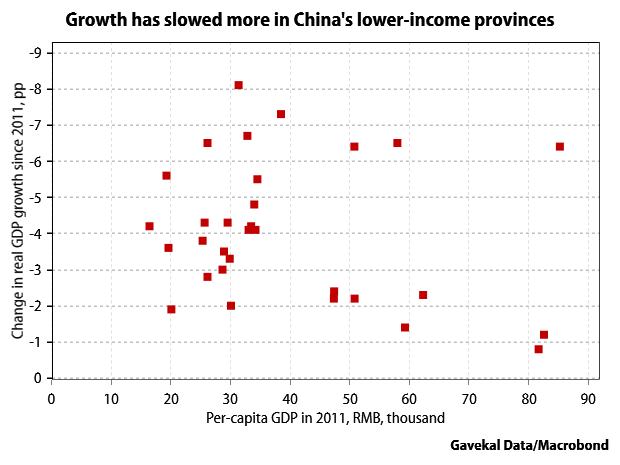
The reason is that the current slowdown does not look much like what the San Francisco Fed researchers predicted just a couple years ago. Rather than a slowdown led by richer provinces, we have a slowdown that generally much deeper in the poorer inland provinces. As the chart below shows, more of the severe growth slowdowns have occurred in what are still fairly low-income provinces. Beijing and Shanghai (in the bottom right corner) have hardly slowed at all by comparison.

provincial_slowdown_scatter

What does this tell us? I don’t claim to have figured out all the implications yet, but this evidence does not seem to favor accounts of China that emphasize a loss of competitiveness due to high wages, and a slowdown in productivity growth due to the maturing of the economy. To put it more simply, it does not look like the middle-income trap has sprung on China. The middle-to-high-income parts of the country are doing okay, while the lower-income parts are challenged.

I’ve posted a few times on this blog about the woes of China’s rust belt (aka The Manchurian Recession), and it’s pretty clear that these places have fairly serious issues and are not enjoying an unproblematic convergence toward the higher-income coast. As some of the more skeptical commentary about the inland provinces is now starting to emphasize, rather than benefiting from their relatively low wages, in fact these places are having a lot of trouble competing with the accumulated and institutionalized advantages of the richer provinces. The current troubles don’t necessarily mean the inland provinces are permanently stuck, but we probably need to look more closely at the specific mechanisms by which the inland provinces can achieve high growth and convergence.

My own preferred account of China’s current slowdown would emphasize the central role of the past decade’s housing boom, and the way this boom reinforced an existing bias toward heavy industry in many of the inland provinces (a bias with roots going back to 1950s). Capitalizing on the housing boom allowed these provinces to achieve rapid growth and convergence for a while. But this convergence was built on poor foundations as the industrial structure of the inland provinces could not survive the end of the housing boom, which meant that demand for construction materials has stopped growing. Meanwhile the richer coastal provinces, with their more diversified industrial sectors and much higher levels of human capital have been able to adapt better to the rapid changes in the economy. The conventional wisdom on the coastal provinces, which has emphasized the challenges from their dependence on exports and relatively high wages, also looks in need of an update.

Are African economies doing better or worse than we thought?

I did not find myself with a clear answer to that question after reading Morten Jerven’s new book Africa: Why Economists Get It Wrong, which I picked up in hopes of adding to my very scanty knowledge about the region. About three-quarters of the book seems to be arguing that Africa is doing better than than many people thought, as it criticizes a whole swathe of economic research about a supposed “chronic failure of growth” in Africa. Here’s a sample:

The simple point I am making is that, in contrast to what the growth literature tells us, the African growth experience has not been one of persistent stagnation. According to GDP data in international prices from the Angus Maddison dataset, the African GDP per capita in 1960 was about one-sixth of world GDP per capita. This remained true until 1977, after which the gap widened, and by 2000 the African GDP per capita was less than one-tenth of world GDP per capita. The African growth shortfall is thus a more recent phenomenon: before 1977, African economies were not lagging behind significantly in terms of growth rates.

A lot of his effort goes into attacking growth regressions that ignore both the historical trajectory of the growth data and take a simplistic view of the social and institutional factors supposedly related to growth. I am very sympathetic to these criticisms, but even after accepting his arguments it’s not clear that we are left with a very positive growth picture for Africa. So it’s not true that African economies have never experienced economic growth; on the other hand, it still looks like the growth data are pretty poor for a good three decades or so.

In the last quarter of the book Jerven then switches to arguing that Africa is in fact doing worse than some people think. He reviews some of his previous work on African GDP statistics to tackle the opposite side of the growth stagnation argument, and argues that the optimistic “Africa Rising” story of recent years is also overwrought and undersupported:

It is likely that very recent growth data are overestimating economic growth. First, for some economies – and Ghana is the best example – the growth figures are higher because there was a recent large upward revision in GDP levels. When the time series is smoothed out across the 2000s in light of these new data, it shows an exaggerated acceleration in growth. Second, for those economies that have very outdated base years, the GDP level is most probably underestimated. This has two effects. One is obvious: when the base is too low, growth estimates are too high. … A second effect results from statisticians and consultants adding to the GDP measure to make it more exhaustive by revising current and previous GDP estimates upward as they go along.

Jerven does not spend much time building up a new narrative about Africa to replace the two that he demolishes. But when he is describing Africa itself rather than people’s arguments about it, the description is not terribly positive: African governments for instance are “relatively fragile and particularly vulnerable to economic downturns and temporary fluctuations.” Such weak governments are unlikely to be able to replicate the kind of “developmental state” policies that have been successful in Asia (the best recent summary of this strategy is Joe Studwell’s How Asia Works). And nothing in this book challenged my naive understanding of most African economies as being heavily reliant on agriculture and exports of raw commodities, and therefore unlikely to generate the kind of sustained growth seen in the more successful examples of economic development in Asia and the European periphery.

I tend to agree with the Financial Times review that the book tends to skate over some rather obvious facts in its mission to show that Africa’s situation is more complicated than many theories allow. On the whole I felt that too much of the book is devoted to internecine academic warfare, and not enough to developing a coherent narrative about African economic development for the general reader. I am still in the market for one of these, so suggestions would be very welcome.

Coping with industrial decay

Chuin-Wei Yap has an excellent piece in the Wall Street Journal on the shutdown of the Panchenggang steel mill near Chengdu, apparently the largest state-owned steel mill to be closed since the 1950s. The piece is mostly about the human angle, and what happens to “company towns” around China that are centered on declining industries like steel mills or coal mines:

Cities and towns across China are losing some of their biggest employers in a process reminiscent of the factory shutdowns that decades ago hit Rust Belt America, from Detroit to Baltimore.

Paper mills are being forced out of the southern city of Dongguan as it tries to prod manufacturers to move up the value chain. In the northern county of Luquan, made wealthy by cement, scores of polluting producers have shut down as the local government tries to retool the area for tourism; a full-scale replica of the Great Sphinx of Giza—made of cement—stands on the city’s edge.

As communities begin to hollow out, it is straining a social compact that has been a feature of the Communist Party’s rule: that state-owned companies would take care of the industrial workforce, even in difficult times. It is a bargain meant to keep workers from going on strike, or worse, becoming a source of antigovernment unrest, like the dockyard workers who helped bring down Poland’s communist government.

In Qingbaijiang, the industrial district where Panchenggang sits north of Chengdu, thousands of residents have gone elsewhere in search of employment. “For Rent” signs line the streets of once-bustling neighborhoods. Petty crime is edging up.

Read the whole thing, and be sure to check out the spooky video with nice aerial photography of the steel mill and town.

This is a phenomenon we’re only going to hear more about in coming years. It’s not unknown in China currently, but most of the examples I’ve seen of empty “rust belt” towns are in the northeast, and are rare in the rest of the country. As the paragraph above highlights, one of the main ways to deal with local economic decline is for people simply to move. In fact, the northern and inland provinces have been gradually losing population in recent years, at least in relative terms (the national population is still growing, so not that many places have an absolute decline in population).

population-shift-2010-14

Again, this fits the regional pattern of industrial structure and economic distress that I’ve written about several times on this blog: the declining industries are disproportionately located in the inland provinces, particularly north and west. So people have been leaving those places and concentrating in the zones of prosperity with more and better jobs, primarily the Beijing-Tianjin-Hebei area and the southern coastal provinces.

The need to allow people to migrate to help them adjust to the changing economic structure only reinforces the urgency of overhauling China’s household-registration system, which creates lots of disincentives for migration by limiting migrants’ access to social services. There was a lot of discussion about this soon after Premier Li Keqiang took office, but little has been heard of late. I suspect this is because the government is not prepared for the big increase in fiscal spending that would be required to equalize treatment.

Some good sense on Chinese consumption

I agree with almost everything Yukon Huang says in this piece, “How China’s Consumption Matters,” though he is more optimistic than I am that 7% GDP growth is sustainable for China. The obsession of many economic commentators with “rebalancing” and the consumption share of GDP is largely beside the point.

China’s future growth rate will be largely determined by what the sustainable rate of investment and productivity growth turns out to be. Trying to boost consumption with subsidies or “stimulus” will help only in the short term, if that. This means that the most important reforms are the ones with the potential to increase high-return investments by the private sector–for instance liberalizing service sectors and overhauling state-owned enterprises.

Here’s some excerpts from Yukon’s article:

A country’s gross domestic product grows with increased investment and productivity, and to a lesser extent with growth in the labor force. Consumption doesn’t drive growth. It’s the result of growth.

Household consumption’s share of the Chinese economy, for instance, is around 35%—the lowest of any major economy. Yet over the past decade per-capita consumption in China has increased by about 8% to 9% in real terms after adjusting for inflation—multiples faster than any other developed economy and on average twice that of developing economies. …

What’s important, then, is the maximization of consumption’s growth over time, not its share of GDP in the near term. …

The challenge now is to increase productivity through reforms so that moderately rapid growth and continued increases in personal consumption can be sustained. Whether consumption as a share of GDP rises or falls is incidental. It should not be seen as an objective in its own right.

The Manchurian Recession

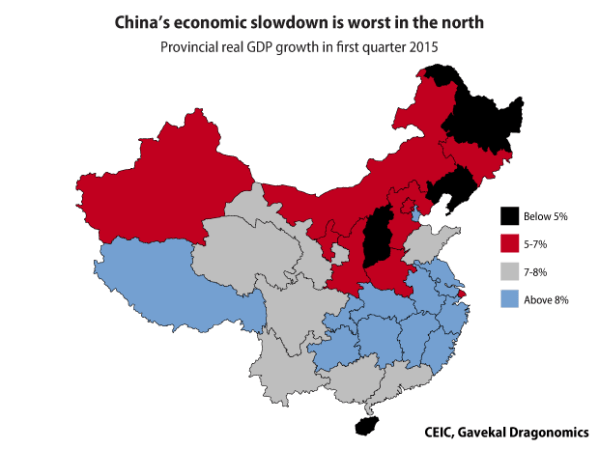
Coming back from my own trip out to the provinces, I find that Simon Denyer of the Washington Post has an excellent report on the economic problems of China’s northeast. As is becoming increasingly clear, if you want to find China’s recession, the northeast is the place to look. And you don’t have to look very hard: in the first half of 2015, nominal GDP growth in both Liaoning and Heilongjiang provinces was negative (Jilin managed a meagre 4.4% gain).

The three provinces that comprise most of historic Manchuria are more dependent on heavy industry and more dominated by state-owned enterprises than the rest of the country. So they are extremely vulnerable to the current downturn, whose main feature is stagnant or declining demand for many of the products, like steel, that are made by state-owned heavy industrial companies. The northeast is not the only part of China effectively in recession: coal-mining provinces like Inner Mongolia and Shanxi are suffering, as is Hebei, the nation’s largest steel producer. But these northern and northeastern provinces are at the center of China’s current problems, as is quite clear from the data:

2015Q1-provincial-GDP-tradmap

Simon’s piece has a couple of choice observations that encapsulate some of the problems the northeast is facing. Here is one:

“Everyone knows what the problem is. It is structural,” said an official dealing with economic policy in the Liaoning government who spoke on the condition of anonymity because he was not authorized to talk to the press.

“Everybody knows what to do. You need to change the economic structure. But what concrete steps to take? Nobody knows,” he said. “What can we do? Financial sector? You can’t compete with cities like Shanghai. High-tech industries? Those won’t flourish overnight.”

and another:

Zhou Dewen, who runs a business association in Wenzhou, scouts out investment possibilities throughout China. He has led 20 small-business delegations to the northeast, but he has not been able to work up much enthusiasm for the region.

“The northeast still thinks of itself as the big brother, because they were the first to get rich after the new China was founded,” he said. “They are sitting on their glories and not advancing with time. Their mind-set is still the old planned-economy stuff. They don’t see that small businesses can do big things.”

Still wanted: some frank talk about China’s growth prospects

One of the more depressing pieces of economic news to come into my inbox recently was this piece in the Chinese-language Economic Information Daily. I translate the first paragraph below:

The Fifth Plenum will be held in October this year to research and draft the proposal for the 13th Five-Year Plan, but the Economic Information Daily has learned that as of now it is still undecided whether the economic growth target will be 6.5% or 7%. Economists have different views on China’s potential economic growth rate over the next five years, but most of them think it should be over 7%.

This is depressing because it appears to indicate (with the usual caveats about the reliability of Chinese press reports) that there is hardly any meaningful debate about China’s economic prospects at the highest level of policymaking. If the question is whether the growth target for 2016-2020 should be the same as the previous five years, or half a percentage point slower, then that’s not even asking the right question. It is also disappointing because there had previously been some discussion about whether the next five-year plan should jettison GDP growth targets entirely, and instead target other indicators more directly related to the welfare of its population (maybe China could do something crazy like, I don’t know, target inflation and unemployment instead?). A move away from the fetishization of GDP numbers and toward more realistic policymaking in China is desperately needed, and right now I’m not feeling so optimistic that it is coming.

To get a sense of the problem, sample the rest of the commentary in the article, which features quotes from lots of big names–the type of economists who speak at conferences, write op-eds and get asked to advise the government. Hu Angang, a prominent Chinese economist who has been on the academic advisory commission for a few five-year plans now, is quoted as recommending a growth target of “about” 7% for the next five-year plan period (2016-2020). He says this would imply that anything from 6.6% to 7.4% would be an acceptable growth rate, but that 6.6% would be a “floor” for growth. Peking University economist Liu Wei says potential growth will be 7% or higher until 2023. Fan Gang, another well-known economist from one of the main non-government think tanks, also thinks future growth should be 7% or higher. Wang Yiming of the Development Research Center, a major in-house government think tank, also plumps for 7%. A more cautious view comes from China Banking Association economist Ba Shusong, who warns that because of the exhaustion of the demographic dividend and slower exports, GDP growth is likely to slow to 6.5% over the next five years.

Is it just me, or is it feeling like an echo chamber in here? Of course, it is easy to find Chinese economists who are not wedded to the view that GDP growth will never fall below 7% (I even work with some). But the point is that the public discussion of future growth prospects has been extremely impoverished of late. For all the recent propaganda about a “new normal” that requires some tough adjustments to slower growth, there is little public discussion of scenarios other than continued steady 7% growth. While in the international media you can read about a full range of possibilities, from crash to boom, in the official Chinese press you rarely see numbers other than 6% or 7% growth (or even 8%–I have on this blog previously criticized Justin Lin’s insistence that growth will be 8%). It feels like the topic of future growth rates has become so politicized that, whatever people’s private views, they have little incentive to publicly argue that China should prepare for lower growth. And if that means no one is preparing for lower growth, then we have a problem.

Out in the real world, it is pretty obvious that growth will head below 7% during the next five-year plan period, thanks to extremely high debt levels, the end of a decade-long housing boom and a severe slowdown in private-sector investment. The IMF, hardly a bastion of radical views, is forecasting 6.8% GDP growth for this year, and said in its Article IV review last week that China should look for growth of 6.0-6.5% in 2016. The IMF is urging China to accept this slowdown to what it calls “safer and more sustainable” growth rates, and adapt policy to this trend. I sure hope they succeed.