Winter has come: the state of steel in China

It’s hard to understand the Chinese economy without understanding what’s going on in the steel sector. I found the following short interview with Cai Rang, chairman of the China Iron & Steel Research Institute Group, to be one of the better recent summaries of the situation I’ve come across in domestic sources, and also useful as an indicator of what some insiders are thinking. Here’s my translation:

Interviewer: How is the current round of excess capacity in steel different from those that came before?

Cai Rang: During the past few years, China did not clearly recognize the historical stage of development that the steel industry had reached. Therefore when steel prices would rise and fall, everyone would think: winter has come, so spring cannot be far off. Because of this kind of thinking, during the previous rounds of capacity reduction there was no consensus on whether the steel industry was really in winter or in spring, and some companies were still pursuing economies of scale [by continuing to expand].

Now, however, the macro environment has changed, and most people believe that the steel industry will not enter another springtime, and the previous glorious phase of rapid development must end. In short, the steel industry has already entered the post-industrial era. Because of this, the effects of the restructuring, mergers, acquisitions and capacity reduction going on now may be different from before. But we must still avoid the old problem of a capacity rebound [after capacity reduction], and steel companies cannot have a “land grab” mentality [i.e., expanding output while others cut output in order to gain market share, because if every company pursues this strategy then output will not fall]. Reducing excess capacity will mean large numbers of firms closing their doors, and this requires both companies and society to shoulder responsibility.

Interviewer: On the one hand China’s steel industry has excess capacity, but on the other hand there is still a need to import steel, so how should we understand this issue?

Cai Rang: China’s current excess capacity in steel products is a sectoral excess: there is a lot of low-end steel, but the supply of high-end steel is insufficient. The ordinary steel products that China manufactures are not that different from those made abroad, and there are even some technological advantages over foreign companies. But for particular types of steel products there are still about 20 million tons of imports, among which there are about 200 tons of low-volume, high-tech sophisticated steel products that must be imported, such as steel used in airplanes.

In the future steel companies will have to transform their development model, and through product upgrading and replacement move in an energy-saving and environmentally friendly direction. Steel companies will need to put a lot of effort into those high-end products that China lacks and cannot yet produce, but they will also need to avoid creating a second round of excess capacity in high-end steel products that leads to a race to the bottom as they vie to drive down prices.

Judging from China’s current level of industrialization, there are not many steel products that need large amounts of investment and concentrated development. Those that remain are are all high-end specialized products, and investing in these products is much more demanding in terms of equipment, personnel and operating costs.

Interviewer: In order to digest excess capacity, China is exporting a large amount of steel products, and this has led to antidumping cases. What changes do you expect in the steel industry?

Cai Rang: China’s current steel production capacity is 1.2 billion tons, but domestic demand cannot completely absorb this capacity. In 2015 China exported about 100 million tons of steel products; this was a relief for domestic capacity but a shock to the international market. Already nine European countries have made antidumping complaints, and Japan, Korea and India have also complained. This shows that our country’s current steel production capacity is not sustainable, and must be genuinely reduced.

Now the relevant departments are drafting the 13th five-year plan for the iron and steel industry, and the preliminary plan is to first cut 200 million tons, and eventually stabilize steel capacity around 700 million tons. This will require many companies to exit the market, and those steel companies that remain will experience great changes both internally and externally. For instance externally, the integration of the internet and intelligent manufacturing could cause great changes in steel procurement and sales methods. Internally, the entire production process, the technology configuration, the quality of equipment and the efficiency of production all need to be improved, costs reduced, and energy use and raw material consumption optimized. There are historical reasons for the excess capacity in the iron and steel industry—in the past everyone was desperate to add supply—and today there is still some new capacity awaiting approval from the government. So capacity must be reduced.

Interviewer: Can China draw lessons from any international experience in dealing with the excess capacity problem?

Cai Rang: During America’s industrialization process, steel was one of its three pillar industries. Then came a wave of bankruptcies, and the whole process was very painful. But now output has come down, and there has been a big adjustment in social attitudes. Gradually funds and labor moved to space technology and aerospace, and now investment is in information technology and the internet. Iron and steel production moved to Asia, and Japan’s steel industry rose rapidly—Baosteel and other Chinese steelmakers were all set up to study Japan’s model at that time. The American city of Pittsburgh used to be the steel capital of the US, but today it has already become a city of education, of culture, of science. They got rid of three big steel plants, and in their place built the biggest shopping mall in the region. The whole city has been completely transformed. We can learn from this kind of experience.
What I’ve been listening to lately

  • Tomeka Reid — Tomeka Reid Quartet. A fresh, lively and generally fantastic recording that should have made it onto more best-of lists for 2015. The lineup of cello, guitar, bass, drums makes for a unique sound, particularly given that the guitarist is Mary Halvorson, hands-down the most interesting new guitarist of the early 21st century. But it’s not just an avant-garde workout: the compositions are strong and tuneful and the group is swinging. Highly recommended.
  • Joe Lovano & Hank Jones — Kids. A 2006 duet session from two grand masters, whose subtle interplay is of the highest order. The title track, “Kids Are Pretty People,” is a particularly gorgeous highlight.
  • Jason Moran — Soundtrack to Human Motion. The sound here is reminiscent of nothing so much as one of Andrew Hill’s classic 1960s sessions: the oblique compositions, the combination of piano and vibes. But that’s a great sound, and this 1999 session–Moran’s debut–is an impressive and enjoyable take on one of the more complex parts of the jazz tradition.
  • Sidney Bechet — The Best of Sidney Bechet. The title is a bit misleading, as this is not a career-spanning overview but a selection of recordings on Blue Note. But the quality is indeed very high–Bechet has one of the great sounds in jazz, his huge tone is always modern, always unmistakable. I came back to these tracks after reading a nice interview with the Ben Goldberg where he singles out the track “Blue Horizon” as an early favorite: “I couldn’t believe the sound. It was as if he’d built the clarinet himself out of a big chunk of ebony that he’d split with an axe.”
  • Kora Jazz Trio — Part Two. An old favorite that has popped up again on shuffle recently. The singing and kora playing of Djeli Moussa Diawara are the nominal highlight, but for me the group’s unique sound is really founded on the powerfully rhythmic piano playing of Abdoulaye Diabaté.

Did Australia invent central bank transparency?

On a recent visit to Australia, I was told that the Reserve Bank of Australia was the first central bank to ever issue a press release announcing a change in monetary policy. That first statement came out on January 23, 1990, a full four years before the US Federal Reserve started announcing its own monetary policy decisions. I certainly did not know this fact before, and on reviewing standard accounts of the rise of central bank transparency, it appears that many other people may also not be aware of the RBA’s trailblazing. Here is one often-cited paper by Alan Blinder et al. from 2008:

Alan Greenspan, who once prided himself on “mumbling with great incoherence,” was by 2003 explicitly managing expectations by telling everyone that the Fed would keep the federal funds rate low “for a considerable period.” This guidance was only the latest step in what was, by then, a long march toward greater transparency that began in February 1994 when the Federal Open Market Committee (FOMC) first started announcing its decisions on the federal funds rate target. In May 1999, the FOMC began publishing an assessment of its “bias” with respect to future changes in monetary policy in its statements. It also began issuing fuller statements, even when it was not changing rates. About three years later, it began announcing FOMC votes—with names attached—immediately after each meeting. Starting in February 2005, the FOMC expedited the release of its minutes to make them available before the subsequent FOMC meeting. And most recently, starting in November 2007, the Fed has increased the frequency and expanded the content and horizon of its publicly-released forecasts.

Other central banks have also become remarkably more transparent in the last 10-15 years and are placing much greater weight on their communications. In fact, the Fed is more of a laggard than a leader in this regard. The Reserve Bank of New Zealand and the Bank of England were early and enthusiastic converts to greater transparency, and Norges Bank (the central bank of Norway) and Sveriges Riksbank (the central bank of Sweden) may now be in the vanguard. Arguably, the European Central Bank (ECB) has been more transparent than the Fed ever since it opened its doors in 1998.

Australia is not mentioned at all in this account, which seems rather unfair. The RBA is certainly not tooting its own horn; the bank’s own website merely states, in perfectly neutral central-bank-ese:

Since January 1990, each change to monetary policy has been announced in a media release, which sets out the change in the cash rate target and the reasons for it.

That first press release from 1990 is still preserved online. It is interesting to note that the press release was issued only a day after the decision was made, and after the RBA had already acted in the market to achieve its goal:

The Governor of the Reserve Bank (Mr Bernie Fraser) confirmed that the Bank had operated in the domestic money market this morning to bring about a modest reduction in interest rates.

The Reserve Bank Board, which reviewed the case for an easing in monetary policy at its November and December meetings, agreed at a meeting yesterday that it was appropriate to be making some adjustment now.

It is a bit challenging for me to verify whether the RBA’s statement was indeed the first in the world, but the claim certainly holds up to an initial examination–I can’t find any evidence online of an earlier monetary policy statement by the Bank of England or the Reserve Bank of New Zealand, the other early adopters of transparency. That of course doesn’t definitively mean that there wasn’t one, and I would welcome information and correction from those better informed. But the Australians were certainly very early getting onto the road that has led, more recently, to “forward guidance” and “dot plots.” Perhaps that is something they do not wish to brag about…

Update. A correspondent informs me that the Reserve Bank of New Zealand made its first public monetary policy statement in March 1990, a move that was required by 1989 legislation governing the central bank. The statement lays out the central bank’s goals for monetary policy, expressed in specific targets for the CPI, although it does not explicitly announce a change in monetary policy settings. This is because the RBNZ’s target rate for monetary policy, the official cash rate or OCR, was not yet in existence (it was introduced in 1999). But the statement is in other ways perhaps more transparent than the RBA’s, being clearer about the policy goals and more detailed in its economic analysis. The RBNZ statement was also required by law, while as best I can tell the RBA’s first statement was issued at the central bank’s own discretion. So the two early statements are not exactly the same thing; in any case, the RBA beat the RBNZ to the punch by two months or so. The Aussies have it, by a nose.

Unpacking the many consequences of China’s housing boom

Here is one of the best papers on the Chinese economy I’ve read in a long time–and I read a lot of papers on the Chinese economy. Currently in draft, “A Rebalancing Chinese Economy: Challenges and International Implications” is a systematic explanation of most of the big macro questions about China. The authors are Guonan Ma, an eminent Chinese economist recently retired from the BIS, and Ivan Roberts and Gerard Kelly of the Reserve Bank of Australia.

While there’s a lot to digest in this paper, for this post I want to pull out some of the thoughts about housing. I ranted a while back about how academic economists were ignoring the role of the housing market in driving economic developments in China. This paper by contrast puts housing front and center, and very effectively too. From the conclusion:

We find that conventional analysis understates the role of the household sector in contributing to the high investment share of the economy. Our explanation for the imbalances emphasises the role played by housing market deregulation as one of multiple prolonged positive productivity and demand shocks to the Chinese economy that simultaneously sustained returns to capital, lifted investment and boosted both private and public saving. While recent discussions stress the need to reform financial markets to foster rebalancing, we argue that rebalancing will probably happen anyway as a natural outcome of dwindling income windfalls from worsening demographics, fading positive productivity shocks and maturing housing markets, all of which helped drive the imbalances in the first place.

And some more details from the body of the piece:

The role played by the deregulation of housing markets in China deserves special emphasis. In 1988, the Chinese constitution was amended to legalise the transactions of land use rights, laying the foundation for private home ownership. Throughout the 1980s and 1990s, most of the housing provided by SOEs to their employees was privatised at a discount to the replacement cost. Mortgages were introduced in 1997, and official mortgage rates were cut five times during 1998-2002 to counter the negative consequences of the Asian Financial Crisis.

The deregulation of housing markets saw residential investment rise sharply starting in the early 2000s to almost 16% of GDP currently. This housing boom stimulated huge capacity-building in many related upstream and downstream industries, including steel, cement, glass, household appliances and financial services. Using data from the 2010 input-output tables and more up-to-date data on value-added, Xu et al (2015) estimate that, directly and indirectly, residential housing accounted for 29.4% of GDP growth in 2013.

It is likely that the housing boom simultaneously boosted growth, investment and saving in China while subtracting from net household income (through higher mortgage payments). The rise of private home ownership in the late 1990s boosted incentives to save by households strongly motivated to upgrade their housing and to build up private assets, while generating higher investment. As discussed, the rise in household investment mostly reflected individual investment in residential construction. The property investment booms in the 2000s further boosted land sales proceeds accruing to local Chinese governments, helping to fund investment in infrastructure. At the same time, the steady rise of mortgage loans as a share of total credit (reaching 12% in 2014) implied larger interest payments by home-buyers to financial institutions and a corresponding fall in households’ net property income. In turn, this contributed to the decline in the household share of income in the 1990s and 2000s.

The housing boom increased both sales volumes and prices, lifting corporate earnings and the return to capital across many related industries and helping to underpin strong corporate saving and investment until the late 2000s. In sum, the opening of the housing market can be viewed as a prolonged positive demand shock to the Chinese economy, sustaining returns to capital, boosting investment and lifting both private and public saving at the same time.

The paper is long and somewhat technical in parts, but also conceptually very clear, and the whole thing is very much worth reading. The draft was presented at the Reserve Bank of Australia’s annual conference last week; other draft papers from the conference have also been posted online.

Can China deliver a consumer-focused fiscal stimulus?

Ben Bernanke has weighed in with an interesting intervention on China, arguing that fiscal policy targeted at household consumption could offer a way out of the current economic problems:

An alternative worth exploring is targeted fiscal policy, by which I mean government spending and tax measures aimed specifically at aiding the transition in China’s growth model. (Spending on traditional infrastructure like roads and bridges is not what I have in mind; in the Chinese context, that’s part of the old growth model.) For example, as China observers have noted, the lack of a strong social safety net—the fact that Chinese citizens are mostly on their own when it comes to covering costs of health care, education, and retirement—is an important motivation for China’s extraordinarily high household saving rate. Fiscal policies aimed at increasing income security, such as strengthening the pension system, would help to promote consumer confidence and consumer spending. Likewise, tax cuts or credits could be used to enhance households’ disposable income, and government-financed training and relocation programs could help workers transition from slowing to expanding sectors. Whether subsidies to services industries are appropriate would need to be studied; but certainly, unwinding existing subsidies to heavy industry and state-owned enterprises, together with efforts to promote entrepreneurship and a more-level playing field, would be constructive.

There are a few things to say about this. First and to be clear, I agree. It would generally be a good thing to switch fiscal priorities from off-budget spending on infrastructure to on-budget spending that supports consumption. But that’s part of the problem: people have been giving China this particular bit of advice for years. And in fact the government has not ignored this advice, and has steadily raised spending on social programs (universal healthcare coverage was more or less achieved in 2011).

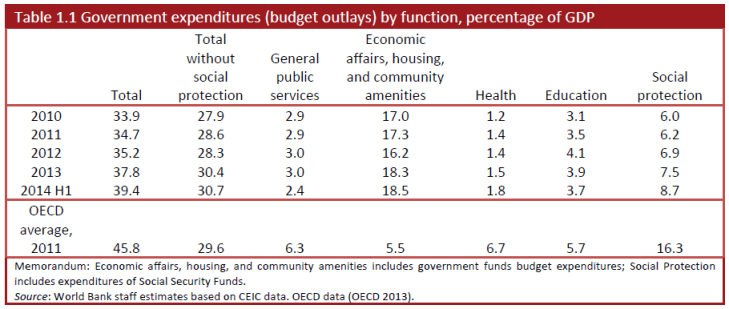
Of course, China could do still more. But it may not be that simple for them to do a lot more than they are already doing. China has a fiscal system that is strongly biased toward delivering investment rather than streams of benefits to consumers. It’s worth stopping to think for a bit about just how unusual this is, as most governments around the world are the exact opposite: they are primarily bureaucracies for delivering social programs, not designing investment projects. The World Bank office a while back made a fascinating comparison of China’s fiscal spending patterns with those of OECD countries. The results are summarized in the excerpt and table below:

A large share of government spending supports capital expenditures in transport, housing, and other economic activities, as gaps in providing core public services remain wide. While the size of government expenditures (public finance budget, government fund budget, and social security budget) remains similar to the OECD average, the composition of expenditures differs substantially. First, spending on general public services is under half the OECD average. It is declining due to continuing efforts to reduce wasteful public outlays: in the first half of 2014 it accounted for only 2.4% of GDP, down from 3.0% in 2013. Second, despite gradual increases, expenditures on social services (health, education, and social protection) are far lower than in the OECD countries. Third, outlays on economic affairs, housing, and community amenities are about three times as high as the OECD average.

China-OECD-WB-fiscal

Note that this bias toward investment spending is very strong in the official government budget–even before any of local governments’ massive off-budget spending on infrastructure is accounted for. So while I don’t think it’s wrong to urge China to shift the composition of its fiscal spending, I also think it’s important to recognize that this might be difficult to do quickly. They have a set of institutions and priorities that are well established and deeply rooted, and making a big shift in those would require both a different way of thinking and extensive practical changes. It’s certainly not impossible, but it’s also not easy.

A final point is that even if they do move to a consumer-focused fiscal stimulus, it might not deliver that much net impact on growth. This is simply because of the size of existing infrastructure-based fiscal stimulus: the IMF estimates that once off-budget local government spending is included, the annual fiscal deficit is on the order of 10% of GDP (compared to an on-budget deficit of 2-3%). Given the already-huge size of infrastructure spending, it seems more likely that consumer-focused spending would replace it rather than add to it over time. This would be a good way to soften the impact of reducing infrastructure spending; it also seems likely that the multipliers from a consumption stimulus would be higher than infrastructure spending at this point, as infrastructure is probably reaching diminishing returns. But expenditure-switching seems more like a strategy for allowing China to wind down its enormous fiscal deficits than one for delivering a lot of additional fiscal stimulus.

Who is Lev Gumilev?

I did not know the answer to that question, but now I am very glad that I do. In an excellent weekend piece in the Financial Times, Charles Clover explains why this Russian “academic scribbler of a few years back” is now being name-checked by Putin:

Working as a historian from the late 1950s to the end of his life, Gumilev became a renowned expert on the steppe tribes of inner Eurasia: the Scythians, the Xiongnu, the Huns, Turks, Khitai, Tanguts and Mongols. Their history did not record the progress of enlightenment and reason but rather an endless cycle of migration, conquest and genocide. Every few hundred years, nomads would sweep out of the steppes, plunder the flourishing kingdoms of Europe, the Middle East or Asia, and then vanish into history’s fog just as quickly as they had come. The victors in these struggles were not the societies that led the world in technology, wealth and reason. Instead, they had something that Machiavelli described as virtù, or martial spirit, while the medieval Arab philosopher Ibn Khaldun described the tribal solidarity of nomadic raiders of civilised cities as asabiyya. To Gumilev, this was passionarnost.

In this idea was the germ of a new Russian nationalism. In his later years, Gumilev celebrated Eurasianism, a theory developed in the 1920s by Russian exiles. Nostalgia for their homeland and the trauma of the Bolshevik revolution had led them to reject the idea that Russia could ever be western and bourgeois. Instead, they wrote, it owed its heritage more to the fierce nomads and steppe tribes of Eurasia. The Enlightenment, in the form of advanced European social theories, had brought Russia to genocide and ruin, while there was a harmony in the wildness of the Huns, the Turks, the Mongols. The steppe lands and forests of the inner continent had traditionally been prone to rule by a single conquering imperial banner. The Russians, they — and now Gumilev — wrote, were the latest incarnation of this timeless continental unity.

Gumilev’s theories have become the standard for a generation of hardliners in Russia, who see in his books the template for a synthesis of nationalism and internationalism that could form the founding idea of a new Eurasia, a singular political unit enjoying much the same frontiers as the USSR. Gumilev’s Eurasianism, a buzzword in official circles, provided the inspiration for Putin’s Eurasian Union, a vision first laid out in October 2011, a week after he announced his intention to return as president of the Russian Federation. Russia, said Putin, would join its former Soviet subjects in a union “that won’t be like other previous unions”. Few, however, doubt that the new union aims to bring the region once again under the Kremlin’s hand.

Clover’s book on Russian nationalism is out later this year.

Unconstrained experiments in 21st century state capitalism

That seems to be theme behind two recent and excellent pieces by Shai Oster at Bloomberg. Both are a useful reminder that China is not pursuing an existing economic and social model, or even a well-defined ideology, but is inventing its own model as it hurtles along.

First up is a piece on an effort, perhaps quixotic, to predict future acts of terrorism:

The Communist Party has directed one of the country’s largest state-run defense contractors, China Electronics Technology Group, to develop software to collate data on jobs, hobbies, consumption habits, and other behavior of ordinary citizens to predict terrorist acts before they occur. “It’s very crucial to examine the cause after an act of terror,” Wu Manqing, the chief engineer for the military contractor, told reporters at a conference in December. “But what is more important is to predict the upcoming activities.”

He hinted at the scope of the data collection effort when he said the software would be able to draw portraits of suspects by cross-referencing information from bank accounts, jobs, hobbies, consumption patterns, and footage from surveillance cameras. The program would flag unusual behavior, such as a resident of a poor village who suddenly has a lot of money in her bank account or someone with no overseas relatives who makes frequent calls to foreigners. According to Wu, these could be indicators that a person is a terrorist. “We don’t call it a big data platform,” he said, “but a united information environment.”

… Brookings’s Pillar is skeptical. “No system of surveillance and exploitation of intelligence can stop everything,” he says. But Tsui, the Hong Kong professor, says if anyone has a chance of coming up with a workable high-tech Big Brother, it’s the Chinese. The lack of privacy protections means that China’s data sniffers are more practiced than those in the West. “The people who are good at this are good because they have access to a lot of data,” he says. “They can experiment with all kinds of stuff.”

Then there’s the recent and unprecedented expansion of “venture capital” funds sponsored by local governments and other official bodies:

The country’s government-backed venture funds raised about 1.5 trillion yuan ($231 billion) in 2015, tripling the amount under management in a single year to 2.2 trillion yuan, according to data compiled by the consultancy Zero2IPO Group. That’s the biggest pot of money for startups in the world and almost five times the sum raised by other venture firms last year globally, according to London-based consultancy Preqin Ltd.

The money’s in what are known as government guidance funds, where local and central agencies play some role. With 780 such funds nationwide and a lot of experimentation, there’s no set model for how they’re managed or funded. The bulk of their capital comes from tax revenue or state-backed loans.

The money is part of Premier Li Keqiang’s effort to bolster the slowing Chinese economy through innovation and reducing its dependence on heavy industry. The country began a campaign to support entrepreneurship in 2014 and has since opened 1,600 high-tech incubators for startups.

Honestly, I don’t have much analysis to offer on either of these reports, other than, wow.

Go read “China’s two-speed economy”

The Saturday essay in the WSJ this week is an excellent piece by Andy Browne (full disclosure: my former bureau chief) on China’s two-speed economy, a phenomenon that I’ve been exploring both in our Dragonomics research and on this blog. The reporting nicely illustrates both the extremely troubled and the extremely prosperous parts of China’s economy, and also makes a strong argument that how Xi Jinping handles the lagging regions will be crucial for the country’s prospects. Here’s an excerpt:

For international investors, China’s two-speed economy—one dying, the other accelerating—is utterly confusing, and it has produced wildly contrasting strategies. If China keeps subsidizing wasteful investment to keep industrial cities alive, its financial system will eventually blow up: At 260% of gross domestic product, the country’s overall debt is approaching danger levels. Some Wall Street hedge funds are taking huge speculative bets against the Chinese currency. Global markets are bracing for a “hard landing” by the Chinese economy and years of subpar growth. The financier George Soros says China is already crashing.

At the same time, however, some of the world’s smartest investors are making the opposite wager: They are piling in. Last year, China attracted up to $37 billion in venture capital, much of it for technology hubs along the coast. That is more than the U.S. typically draws in a year and multiples of what Europe usually pulls in. …

Who’s right? Politics will largely determine the outcome. … Two years ago, Mr. Xi announced an ambitious 60-point economic reform program to give markets a “decisive role” in allocating resources. Many expected that he would shutter state loss-makers and open protected state industries like telecommunications and banking to entrepreneurs, even as he attacked the patronage networks that weave through local industry and governments.

But Mr. Xi seems to have gotten cold feet. Instead of closing down state enterprises, he is bulking them up. He seems afraid that allowing market forces to prevail will entrench geographically based wealth disparities and that an aggrieved underclass could erode the Communist Party’s legitimacy. As Mr. Xi has made clear during his three years in office, his first priority is to save the party. The economy can wait. Against this political backdrop, Beijing’s usually decisive economic decision-making process has started to look rudderless.

Mapping China: The spread of the nominal growth slowdown

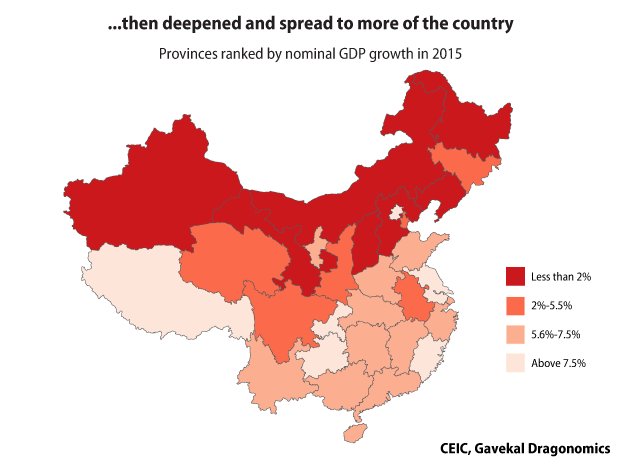
This week the last of the provinces reported their GDP data for 2015, so now the full set is available–which means more maps! I’m going to focus on provincial nominal GDP growth here, as the changes are more dramatic, and more interesting, than in real GDP growth. Here’s an example: in 2014, three provinces reported real GDP growth below 6% (Shanxi, Liaoning and Heilongjiang), and three provinces reported real GDP growth above 10.5% (Guizhou, Chongqing and Tibet). In 2015, the same three lagging provinces were the only ones to report real GDP growth below 6%, and the same three leaders were the only ones to report real GDP growth above 10.5%. So, not much change, right?

Not at all. Nominal GDP growth tells a different story, and a more intuitive one: there was a broader and deeper slowdown last year. In 2014, exactly one province had nominal GDP growth below 2%: the coal capital of Shanxi, with 1.3% growth. But in 2015, seven provinces reported nominal GDP growth below 2%: Shanxi again at 0.3%, but also Gansu, Liaoning, Heilongjiang, Xinjiang, Hebei and Inner Mongolia. In Gansu, nominal growth was actually negative, with its GDP declining 0.7%. Similarly, in 2014 there were 10 provinces that reported nominal GDP growth above 10.5%, but in 2015 that number shrank to three. The three remaining fast-growth provinces, again Guizhou, Chongqing and Tibet, have economies that are heavily dependent on government subsidies.

2014-nominal-growth

2015-nominal-growth

The regional pattern of the slowdown is pretty clear: it is deepest in the heavy-industry-dependent provinces of the north and far west. This fact, and the fact that the slowdown is so much deeper in nominal terms than in real terms, to me reinforces the point that China’s slowdown has its origins in the housing downturn and the knock-on effects in commodity prices.

Is the People’s Daily jumping on the data journalism bandwagon?

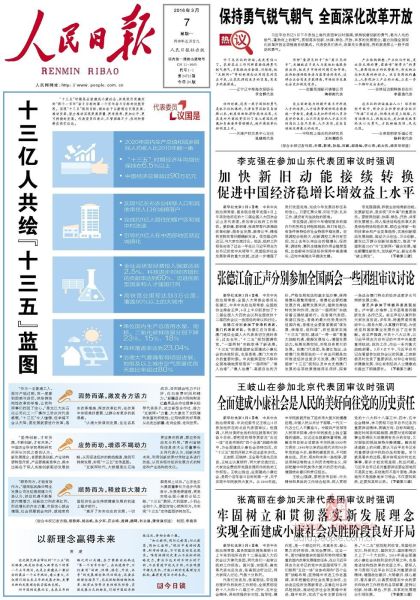
At the least, the Party’s paper certainly seems to have woken up to the fad for infographics. In my admittedly limited experience (it’s not like I read the thing every day), I have never seen an enormous color infographic splashed over the front page of the People’s Daily, in the spot usually reserved for Very Important Personages. But here is one taking pride of place in March 3 edition:RMRB2016030301

The infographic explains the five slogans that are in the next Five-Year Plan, which will be published at next week’s legislative session, and then picks a statistic and graphic that goes with each one. (For reference, the plan urges that China’s development be “innovative,” “coordinated,” “green,” “open,” and “shared.”) Charming stuff, if a bit tame compared to the amazing cartoon video explaining the Five-Year Plan that blew up the internet a while back.

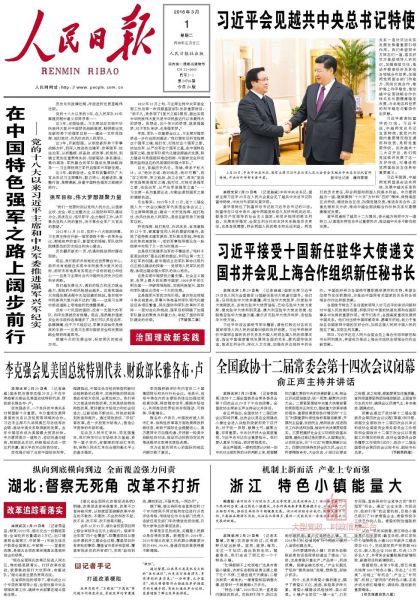
Still, it is lively by the standards of the People’s Daily. Here is what a more normal day at the Communist Party newspaper looks like, from a couple of days ago–a photograph of Xi Jinping meeting a foreign dignitary, reports of government meetings, etc.

RMRB2016030101

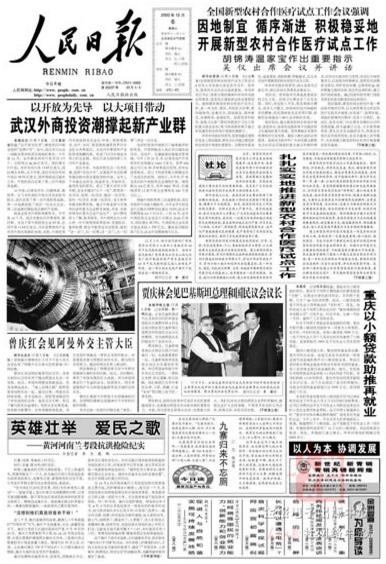
The People’s Daily does have a history of, very slowly, adapting conventions of other newspapers. It started printing the front page in color only in 2004, and these days also breaks up its traditional text-heavy layout with a touch more white space. So even before the infographics, this gray lady had already become a bit more bling. Here’s a front page from late 2003, just before the switch to color, which gives you some of the flavor of the proper old-school style: visiting dignitaries and sturdy industrial equipment.
RMRB20031206

Update. Clearly I should have waited another couple of days to do this post, as Monday’s issue devoted half of its entire front page to a giant infographic on the Five-Year Plan. At this rate, the People’s Daily should be looking like the USA Today of the late 1980s (of We’re Eating More Beets! fame) sometime in the 2020s…

RMRB2016030701