One book, twenty views about China

The universe of independent research on China has grown much larger in recent years, as can be seen from the contents of this new e-book. John Mauldin and Worth Wray have pulled together a good number of commentators and China watchers, among whom are some friends and partners in crime in Beijing and Hong Kong. My employer Gavekal is also well represented, with a piece by our CEO Louis and one by my colleague Ernan Cui. My own piece is on China’s exports and its New Silk Road ambitions. There’s a wide range of views about China represented in the book, including some I disagree with, so it should make for a good and varied read.


mauldin_book_small

Risks and politics in capital account liberalization

Various talking heads, including yours truly, are quoted in this Bloomberg piece about the risks to China’s decision to step up the pace of capital-account liberalization in recent months. Here are some indicative comments:

“History shows that if China prematurely opens the capital account before properly sequencing in other reforms the results could be disastrous for financial stability and longer-run growth prospects,” said Kevin Gallagher, an associate professor of international relations at Boston University who co-wrote a paper on China’s cross-border capital deregulation. “I worry that they are forgetting the past.”

The best sequencing would have China first free up its domestic financial sector and shift to using interest rates as the major tool to affect credit, according to Louis Kuijs, Royal Bank of Scotland Group Plc’s chief China economist. Next, policy makers should allow greater currency flexibility, and then open the borders to capital flows, said Kuijs, who previously served as the World Bank’s senior economist in Beijing.

Why all the hand-wringing? In April, central bank governor Zhou Xiaochuan made a surprisingly public and specific pledge to complete some additional opening of the capital account during 2015–a timetable explicitly driven by the goal having the renminbi blessed by inclusion in the IMF’s currency basket for the SDR, whose quinquennial review begins in November. The IMF has made very positive noises in response, so it is looking like a done deal. The symbolism of having the renminbi recognized as a reserve currency is obviously very important to China. Or, what I think is more likely, the symbolism is politically useful for Zhou. An issue of national prestige is a much better way to convince the rest of the government of the merits of additional capital account opening than a technical economic argument. In any case, it seems pretty clear that the decision to open up more to capital flows (through measures like the trading link between the Shanghai and Hong Kong stock markets) is not being driven by technocratic concerns about sequencing, but by political opportunity.

It’s reasonable to worry about the potential consequences of this opportunistic strategy. I have a lot of respect for Louis Kuijs and do not quibble with his preferred sequencing. And there are definitely a number of Chinese economists who think opening the capital account should be a relatively low priority, undertaken only after more liberalization of the domestic economy. However if we are describing what is actually going on in China, rather than prescribing what it should be doing, I think it is pretty clear that the proper sequencing of reforms is not the big priority.

Does this make sense? If you think about how governments actually work, it does. Policy changes tend not to happen at the exact moment that the eggheads think is optimal, but when there is a political opportunity to get agreement on them. Proposals can sit on the shelf for years until the right political moment arrives. It looks like Zhou has decided to seize the moment to push through some additional opening of the capital account, without worrying too much about whether it is exactly the right time to do so. Sure, some people may quibble about the sequencing of reforms, and there may be some messes to clean up later. But getting the sequence wrong may be less of a risk than missing a political window of opportunity that may re-open for years. At least, that is the apparent calculation.

The politics of capital-account liberalization are a useful reminder that China’s economic reforms do not, despite how it may sometimes seem to outsiders, proceed according to a detailed top-down plan made long in advance.

Does this plan for tackling China’s excess capacity have a chance?

What is to be done about the excess capacity in China’s heavy industry? As the decade-long housing boom has topped out in recent years, companies that had bet on ever-rising demand for construction and building materials are finding themselves with idle factory capacity. The excess is probably most serious in steel, but is also evident in related sectors like coal mining (the fuel for the power plants that drive steel smelters). This idle capacity weighs on the economy by depressing prices and margins in the affected industries, and holding back corporate investment and hiring plans. The debate over how to respond to this issue pits those who advocate letting the troubled companies collapse and markets right themselves, against those who fear too much dislocation and argue for extending more subsidies and bank credit to help troubled companies through a rough patch.

Neither of these options is particularly attractive, and the choice to some extent is a false one. Yet discussion of the excess capacity problem seems to mostly swing between an extreme Andrew Mellon-style “liquidationist” position, and the “extend and pretend” school of hoping the problem will go away eventually if troubled enterprises get enough support. The government of late has seemed to lean toward the latter position: the central bank’s lowering of interest rates makes it easier for indebted companies to stay current on their interest payments. A May decision to lower industrial electricity rates and give iron ore mines a tax break was also clearly aimed at reducing operating costs for excess-capacity sectors. Recently Liu Shijin, an economist and senior official at the Development Research Center, a government think tank, stepped in with a proposal cleverly designed to appeal to both sides.

Because I think his proposal is both interesting and realistic in the Chinese context, I have translated here the relevant section of interview in which it appears. The key point is that he proposes using government debt to fund a restructuring plan to shut down excess capacity–which, because it will have real money behind it, will be more effective than previous such plans. I think he is right that direct government funding will be more effective than indirect measures like subsidies, and that there is a public interest in getting the market to clear sooner rather than later. But his plan does require the government to accept a higher level of official debt–something it has historically been reluctant to do, though recent plans for restructuring local-government debt have shown some acceptance of the principle. On the other hand, the sum of 300 billion renminbi that he quotes is hardly a prohibitive figure, given the size of China’s economy and government revenues. Overall this proposal seems like an advance on the current confused strategy, but I do not know how to handicap its chances of actually becoming policy.

China Economic Times: In recent years, China has been restructuring industries with serious excess capacity, but the speed of adjustment is not satisfactory. What are the underlying causes, and how can the situation be improved?

Liu Shijin: I think that the slow pace of restructuring in industries with serious excess capacity in recent years is due to two reasons. First is the effect of the “acceleration principle” that is inherent to the heavy and chemical industries. Due to the increasing specialization of the modern market economy, the production chain for final goods including infrastructure and real estate has lengthened. When demand for these final goods enters into a long-term phase of rapid growth, intermediate inputs will experience a self-reinforcing “acceleration effect.” So the extent of excess capacity in these industries, and the scale of the required reduction, could be greater than originally expected.

Second is the fact that local governments’ attitude toward industrial restructuring is not very proactive, or even passive. Although everyone has recognized that overcapacity is serious and that restructuring is inevitable, often they hope that others will restructure first so they do not have to. In addition to trying to avoid the conflicts caused by shuttering businesses and dealing with debts and re-employment, there is also a lot of selfish thinking by local governments: maintaining the existing businesses means you have a chunk of GDP, from which you can also get tax revenue. The result of these actions is that businesses are losing lots of money; bad companies want to exit the market but cannot, and good companies are also worn down. This is not sustainable.

To cope with this difficult situation, we must have determination to make progress, within a specific time period, in the exit and restructuring of this serious excess capacity. We can consider implementing an action plan for reducing capacity and raising efficiency in industries with serious excess capacity.

China Economic Times: Can you tell us about the specific ideas and measures you envision being part of this action plan?

Liu Shijin: I think this plan should include the following six parts:

First, select the industries to be included in the scope of the action plan, such as steel, coal, petroleum, petrochemicals, iron ore and other industries.

Second, draft a capacity reduction plan. As a preliminary calculation, the plan can be drafted to cover 10% of nationwide production in 2015, with the affected provinces’ plans made according to their share. State macro management departments can sign capacity reduction commitments or agreements with the affected provinces.

Third, establish a “capacity reduction and restructuring fund,” funded largely through the issuance of long-term (10 years or more) dedicated bonds. The amount of the bond issue will be determined by the scale of the capacity reduction in each province. The bonds will be issued and repaid by provincial governments, but the central government will subsidize the interest. The fund will be mainly used to subsidize corporate closures, restructuring and capacity reduction, as well as the placement and re-employment of affected workers. The size of the fund will be approved on the basis of these costs.

Fourth, the affected provinces will use this fund as a lever to promote implementation of the capacity reduction and restructuring plan. When designating production capacity for exit, we should not use the phrase “backward production capacity,” as this terminology is very characteristic of the planned economy. In practice it often means using the size or age of the equipment as a benchmark, rather than its efficiency or compliance with regulations. We recommend using the categories of “illegal capacity” and “inefficient capacity;” the former meaning that which does not national regulations on environmental, energy saving, safety, etc., and the latter meaning capacity with low efficiency that does not have a strong position in market competition. Local governments should follow open and transparent criteria to make a list of companies with “illegal capacity” and “inefficient capacity,” and guide these companies to take the initiative to participate in the capacity reduction and restructuring action plan. Companies that go through closure, restructuring and other capacity reduction measures can receive corresponding subsidies for capacity reduction, staff placement and re-employment. Regions with a large number of competitive enterprises can try using an auction technique, in which the company that bids the lowest [restructuring] cost will have preference in obtaining the subsidy. In short, the idea is to reduce the barriers and conflicts in the process by giving some compensation and some choice to companies that reduce their capacity.

Fifth, give local governments a relatively large amount of autonomy and scope for innovation in the use of the fund and the techniques for cutting capacity. [trimmed for space reasons] …

Sixth, there should be appropriate preventive and punitive measures to prevent a situation where companies think “other people are cutting capacity so I don’t have cut to cut capacity.” National statistics and auditing agencies can do checks in the affected regions, and we can also introduce mechanisms for public supervision. If they find that capacity reductions have been reduced or falsified, there can be a public report and criticism, and a corresponding reduction in the central government’s subsidy. There can also be a request for political discipline of those areas that have committed to reduce capacity. We can use administrative methods in combination with market mechanisms to ensure the desired effect.

China Economic Times: What do you think will happen if such an action plan is implemented?

Liu Shijin: If you implement this action plan for reducing capacity, restructuring industry and raising efficiency, it will send an important signal to society, which is that there will be important changes in the relationship of supply and demand in the affected industries. This signal may drive a rebound in prices. Coal and steel account for a large share of the industries with severe overcapacity. According to preliminary estimates, the funds required for these two sectors are 80-100 billion yuan and 200 billion yuan respectively. If the term of the bonds is over 10 years, and there is an interest subsidy from the central government, it will not create great pressure for local governments. In the short term, there may be some impact on the growth of local GDP and tax revenue from cutting capacity, but once prices rise, these losses will be more than made up for. This is a process of “trading quantity for price,” and is overall beneficial to the locality. Therefore this should be considered a supportive policy for areas with a high concentration of excess capacity, particularly the old industrial bases that have a high proportion of heavy and chemical industries.

 

Mapping China: Six decades of population flows

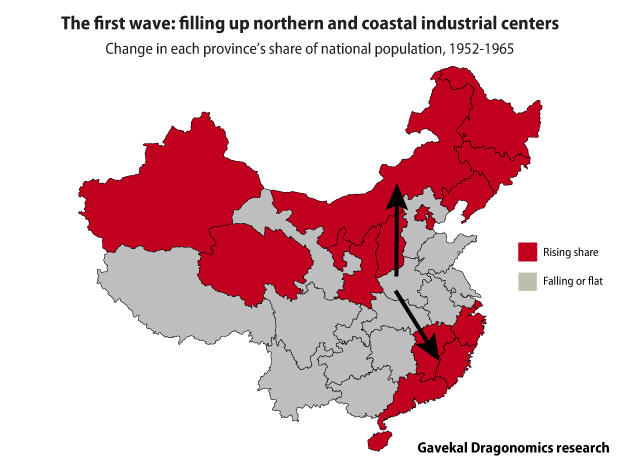
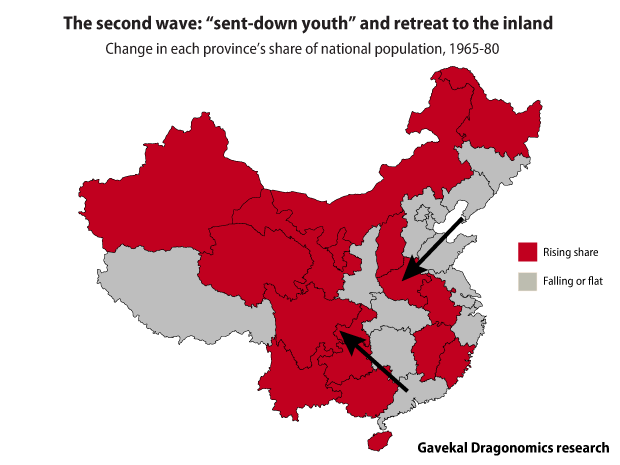
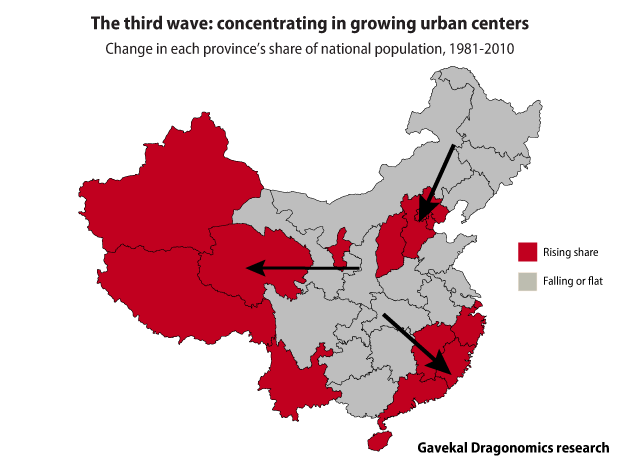
One of my recent side interests has been getting an understanding of how China’s population flows in recent decades relate to patterns further back in history. Mass migration has been a feature of Chinese history long before recent years’ headlines about migrant workers and urbanization. One example is the huge movement of people into Manchuria in the late 19th and early 20th century, which was in terms of the absolute number of people comparable to movement of people into the western United States from 1880-1950, and larger than the emigration from Ireland in the 19th century (according to statistics from Thomas Gottschang’s 1987 article; JSTOR link). After the founding of the People’s Republic in 1949, central planning and political campaigns also had big effects on the movement of people. Examples here are the heavy-industrialization drive of the 1950s, or the “sent-down youth” phenomenon of the 1960s, when millions of students were shipped from urban centers to more isolated provinces.

To try to give myself a way to better understand and visualize all this history, I went through a fairly simple exercise. I put together a spreadsheet of population by province going back to the 1950s from various Chinese statistical yearbooks. Then I looked at which provinces had a rising or falling share of population over time. If the natural rate of population growth does not vary too much from province to province, then a rising or falling share of national population should be a result of net in- or out-migration. The maps below are the result; they depict three big eras in Chinese population flows over the past six decades. The results are obviously sensitive to the periods chosen, which probably could be refined. I also ended up treating the entire reform era (post-1980) as one period as differences among the three decades were not great. (The arrows are just to help clarify the trend, and do not actually indicate the source and destination of migration flows–the data do not permit such precision.)

Hopefully the maps should mostly speak for themselves, but the shift in the direction of population flows over time is quite striking. The first years of Communist rule led to big flows of people into old and new industrial centers in north China and the Pearl and Yangtze River deltas. Some of those movements were then reversed in the chaos of the 1960s, which saw the coastal provinces lose people to a belt of inland provinces. With the reform era the influence of political campaigns declined, and the market forces helped draw people to growing urban centers where higher wages could be earned. The formation of big urban concentrations around Beijing, Shanghai and Guangzhou/Shenzhen is clearly visible in the map. Some regional patterns persist throughout the three periods, notably the net migration into Xinjiang and other western provinces, as well as the island of Hainan, which were places that were relatively lightly populated. I’m sure there is more to learn here, but I have to say these initial results are quite pleasing.

population-shift-1952-65


population-shift-1965-80


population-shift-1981-2010

In China of the 2010s, some echoes from the 1970s

Browsing at the Beijing Book Fair this past weekend, I stumbled across an old book (in English) called China’s Economy: A Basic Guide, by one Christopher Howe, mixed in among the usual mess of the collected works of Mao and art auction catalogs. Of course I snapped it up; not because it is some kind of lost classic, but because it presents a view of China circa 1976, before the reform era and big changes in the Chinese economy that ensued. In these days when China’s massive role in the global economy is a fact of life, it’s hard to look at its history without having your view colored by the knowledge of what happened after 1978. I think it’s quite informative to see what China looked like to people who did not already know that it was going to turn into a world-shaking economic power.

In fact there seem to be some interesting continuities between the China of the 1970s and the China of the 2010s, suggesting that the launch of “reform and opening” was not such a break with the past as it sometimes seems. I have only skipped around in the book so far, but a few interesting parallels have already jumped out. Take this passage, which appears to show that today’s obsession with the internationalization of the renminbi has deep historical roots:

The Chinese frequently refer to the fact that trading partners from sixty countries use the renminbi as the unit of settlement. In general, this reflects the wishes of the Chinese rather than of their trading partners; indeed, insistence that contracts are denominated in the renminbi has at times been a serious obstacle to trade.

On the domestic front, this passage describing urbanization policy also sounded spookily contemporary:

In 1958 a further policy was introduced, one that has persisted to this day. This is the policy of developing “small and medium” cities. In conversation, Chinese officials give varying definitions of these city types, but an authoritative article published in 1958 described the policy in the following terms. “Small cities” have populations of up to 300,000, and are to be “generally developed”; “medium cities” are those with populations of 400,000 to 700,000, and are to have “limited development.” Anything bigger is a “large city,” and is to be “generally restricted.” Special emphasis is put on control of cities with populations of a million or more.

With some updates to the numbers for the size of cities, this passage would serve nearly word-for-word as a summary of the current government’s urbanization policy. It is interesting that the focus on “small and medium” cities, which I think is misguided, has such a long history. It’s not clear why this policy has remained so attractive over time–Howe notes that the justifications for the policy kept changing–but perhaps inertia explains some of its persistence. I suspect further reading will reveal even more parallels.

ChrisHoweChinasEconomy_small

Has China’s pollution held back life expectancy?

A short and nicely data-focused paper in the latest American Economic Review, entitled “Growth, Pollution, and Life Expectancy: China from 1991–2012,” poses a troubling question: Why has China’s life expectancy not risen even more than it has? While life expectancy has risen over the past two decades, as have incomes, the experience of neighboring countries suggests even greater improvements should have been possible. Infant mortality in China has fallen quite a bit as extreme poverty has been alleviated and improvements have been made in public health, sanitation and hospital care. But adult mortality has not fallen as much as it did in Taiwan, South Korea or Japan, according to the authors. And therefore gains in total life expectancy have lagged.

LifeExpectancy

Air pollution is certainly the villain of the moment in China, and the authors make a plausible if indirect case for its role. Using data on causes of death, the authors find evidence that deaths from cardiorespiratory illness have not declined as much as other other deaths. Deaths from cardiorespiratory illnesses are also more common in places where air pollution is worse. So they suggest that the effects of pollution on health are offsetting the increased public-health spending that comes with higher incomes, holding back improvements in overall life expectancy. Here’s a summary:

causes of death which are presumably affected by pollution have declined much more slowly than other causes of death. In particular, heart disease, stroke, and lung cancer have remained at similar levels through the 1990s and 2010s, and these cardiorespiratory illnesses now comprise a much larger share of Chinese mortality. In contrast, mortality rates from noncardiorespiratory illnesses, such as communicable diseases, have declined much more rapidly over the same period. Communicable disease mortality rates are very likely to be responsive to hospital construction and public health initiatives, but less sensitive to pollution. As such, the cause-specific mortality trends suggest that China’s income growth has improved health outcomes, but failed to do so for pollution-sensitive causes of death.

Joining the Paulson Institute

Starting this month, I will be a nonresident senior fellow at the Paulson Institute, the Chicago-based think tank. Yes, I’m still based in Beijing and working full-time at Gavekal, but I hope this affiliation will give me a chance to contribute a bit more to some of the public debates on China. I had a very good experience working with the Paulson Institute’s people on the paper I did for them a couple of years ago on state-owned enterprises, and I look forward to doing more good work with them. Thanks to Evan Feigenbaum and Damien Ma for giving me the opportunity to collaborate with them, and thanks also to the surprisingly large number of people who have already heard about this and sent kind wishes.

I should probably also make clear that the usual disclaimer applies: this is my personal blog, and the views expressed here are mine and not those of my employer, nor of the Paulson Institute.

In the future, all economic debates will be conducted through rap battles

That happy future is getting closer, thanks to this excellent discussion of the changing policies of the Chinese government under Xi Jinping, delivered in the hip-hop idiom:

And let’s not forget previous instalments in this genre:

  • the rap battle on currencies on the codependent US-China economic relationship
  • the original Keynes vs. Hayek rap battle, though round two is even better

A warning on Chinese education

The Financial Times has a series of articles this week about China’s rural migrant workers; the general theme seems to be that the fact that a very large number of people have successfully transitioned from backbreaking low-paying farmwork to higher-paying industrial and service jobs is a big problem for China. To me that seems like a rather strange angle to take. Sure, once a lot of people have made this transition it means fewer will make it in the future, but that’s a sign of success not failure.

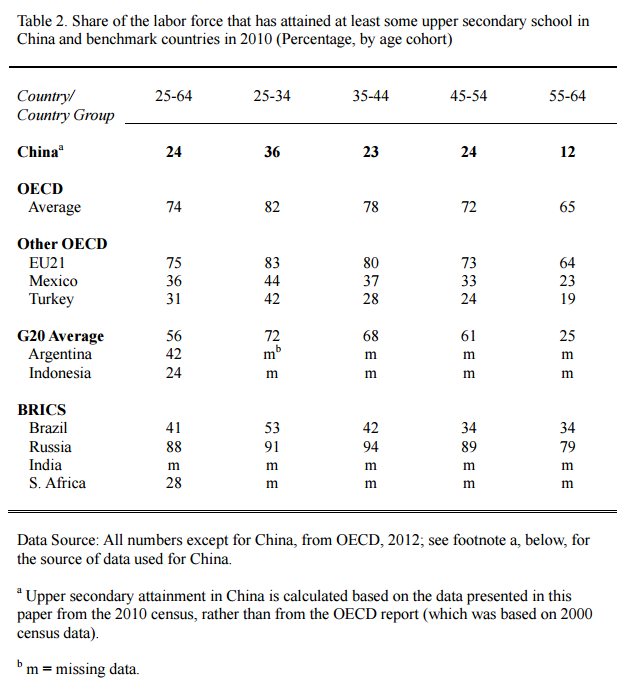
A more relevant question to ask is probably: once rural migrants have made the transition to the urban economy, how well-equipped are they to keep raising their incomes? Migrants get a big one-time gain in incomes just from going from the rural sector to the urban sector, but how do they do once they’re in the urban sector? A recent paper by the great development economist Scott Rozelle and a number of co-authors tackles this question by taking a close look at the educational level of Chinese workers. Scott has written more papers about Chinese agriculture than I can count, but over the last few years his focus has really been on rural education issues, and he has bent my ear about this every time I have seen him. The new paper documents more formally what Scott has been saying in talks and presentations for a while: China does not in fact have a very well-educated workforce, primarily because of problems in rural education.

Below are the data they calculate from the Chinese census, with comparative figures from the OECD:

Rozelle_Table2

The census data show much lower levels of educational attainment than the Ministry of Education’s figures, which claim very high enrollment rates. Some studies have shown far fewer rural students are completing secondary education than officially reported. The reasons why rural students are dropping out of school is not extensively discussed in this paper (there is more detail here). One factor that Scott has highlighted before is the very strong gains in migrant wages in recent years, which have made it more attractive for kids to start work early without completing school. It is also the case that the children of rural-to-urban migrants often fall into an administrative limbo between their home area and where their parents work, limiting their educational opportunities.

Why is the lagging education of rural kids a potential economic problem? Because they are the workforce of the future, and the future will need more highly-educated workers. To quote from the paper:

Wages are rising and low-wage manufacturing is moving out. China is already making plans to become an economy that will be based on higher value-added, high-wage industries. This will mean, of course, that there will be a high demand for skilled labor. International experience demonstrates that individuals will need to have to have acquired skills taught at the level of high school or above if they hope to be competitive in these higher value-added industries. If China fails to endow its labor force with such skills, not only will many individuals have a difficult time finding employment, the newly emerging industries may also falter from a short supply of skilled labor. The whole economy may experience slower development.

Jazz discoveries so far in 2015

The blogging has been heavy on the economics of late, so here is some good music that I heard for the first time in 2015:

  • Preservation Hall Jazz Band – That’s It!. By my old-fogey standards, this counts as a new recording–it was issued in 2013. And it’s one of the most fun things I’ve listened to in a while. It is very far from the musty recreations of New Orleans traditional jazz that I feared; the Preservation Hall group on this recording has a lot of younger players, and they are doing all original tunes not standards. The result is lively, rhythmic and feels not at all preserved.
  • Jazz Jamaica From The Workshop. This 1962 session features many of the instrumental giants that would go on to dominate Jamaican music–Roland Alphonso, Tommy McCook, Don Drummond, Ernest Ranglin. For any reggae lover like myself, that is enough to recommend it. But they are not playing reggae here, this is actually properly in the jazz idiom. In a way it feels like a glimpse of an alternate musical future–what if Tommy McCook had gone on to do lots of tenor-and-rhythm dates for Blue Note? It didn’t happen, and I’m happy to have reggae and dub instead, but it’s still fun to listen and ponder. The real star of the session is guitarist Ernest Ranglin, whose virtuosity works well in a jazz context (his great latter-day recording Below The Bassline is a more conscious fusion of jazz and Jamaican rhythms).
  • Moacir Santos – Coisas. Wonderful miniatures by a largish ensemble led by the Brazilian composer, from 1965. Far superior to his 1970s outings on Blue Note.
  • Gil Evans – The Individualism of Gil Evans. The famous Gil Evans-Miles Davis collaborations (Sketches of Spain, etc) are of course classic recordings and I was exposed to them early on in my jazz education. But over the last couple of years I’ve been exploring Evans’ recordings under his own name, many of which are fantastic and much less well known. The moody arrangements on this are fantastic; I particularly liked the slow and spooky cover of Willie Dixon’s “Spoonful.”
  • Gary Burton – A Genuine Tong Funeral. The title is a bit of a joke, as the recording carries a disclaimer that this music has nothing whatsoever to do with Chinese traditional music. It’s a series of longer pieces composed by Carla Bley featuring Gary Burton’s vibes quartet augmented by a larger group with horns. An excellent example of the rethinking of big band music that was going on in the 1960s.
  • New Jazz Orchestra – Le Dejeuner Sur L’herbe. Another innovative big band recording from the 1960s, previously mentioned here.
  • Jan Garbarek – “Hasta Siempre” from Wichi-Tai-To. Garbarek’s early recordings for ECM come highly recommended as masterpieces of the 1970s avant-garde, but I have generally found them to be more miss than hit. One of the hits is this fantastic cover of Carlos Puebla’s tune–a.k.a. “the Che Guevara song”.