How many China predictions still hold up after 113 years?

I have low confidence that many of today’s China predictions would meet such a longevity test. But John A. Hobson’s classic Imperialism: A Study, published in 1902, seems to have called the direction China would ultimately take pretty much correctly–albeit after a period of 75 years or so when things were going the other way. Here is the quote, which I find quite amazing even after having read it several times:

It is at least conceivable that China might so turn the tables upon the Western industrial nations, and, either by adopting their capital and organisers or, as is more probable, by substituting her own, might flood their markets with her cheaper manufactures, and refusing their imports in exchange might take her payment in liens upon their capital, reversing the earlier process of investment until she gradually obtained financial control over her quondam patrons and civilisers. This is no idle speculation. If China in very truth possesses those industrial and business capacities with which she is commonly accredited, and the Western Powers are able to have their will in developing her upon Western lines, it seems extremely likely that this reaction will result.

This discussion on China is in Part II, Chapter V of Imperialism, which is available online. I claim no credit for discovering this wonderful snippet; that goes to Duncan Green via Branko Milanovic. However it does make me wish that I had kept reading Hobson when I first picked up the book a couple years ago.

Everything you need to know about China’s slowing growth

…or almost everything, anyway, can be learned by reading Dwight Perkins’ paper in the latest Asian Development Review. The paper is very clearly written and logical, and has the benefit of being freely available online (it is published by the ADB), unlike most academic publications. Dwight is probably my favorite development economist and it is always worth hearing his thoughts about China. While it will contain few surprises for those who have been closely following developments in China over the last few years, I still find it useful to go back to basics periodically.

The paper’s case is simple: China is a country with a very high share of investment in GDP, which is reaching saturation for investment demand in some sectors. This means that both the returns on investment in those sectors is falling (affecting productivity) and the growth of total investment is slowing (affecting capital accumulation). Therefore, growth slows. One of the more interesting parts of the paper is how Dwight thinks through the difficult question of future demand for various types of investment, particularly in infrastructure.

The same issue of the journal also contains a paper by Justin Lin making the case that China’s growth does not have to slow down substantially. This looks like a more formal presentation of the case Justin has been making recently that China can sustain 8% growth, which I’ve discussed on this blog previously. It seems worthwhile to try to compare the two papers, though this involves wading through tables of growth-accounting assumptions. Interestingly, the difference between the two does not seem to be relative optimism or pessimism about “reform” and its effect on future productivity gains. Justin says 2.1% TFP growth over the next two decades is enough to sustain 8% GDP growth, while Dwight says 2.1% TFP growth will only produce 6% GDP growth.

This means that the key difference between a slower-growth and higher-growth scenario is the pace of future investment spending. Which of course makes perfect sense since investment spending has been the biggest driver of China’s growth so far. Justin’s case for a higher rate of investment growth in the future is not very clearly spelled out, but he does mention “continued large-scale infrastructure investment” and the need for new investment caused by changing technology. To be fair, it’s clear that neither author has, surprise surprise, solved the puzzle of how to forecast investment demand over the long term. But Justin’s paper, despite the nod to changing technology, seems to rely more on extrapolating the recent levels of certain indicators into the future, while Dwight does more thinking about how things might change in the future compared to today. It should be pretty clear which approach I think is better.

How to think about Chinese consumption

Over at the ChinaFile site, I have a contribution up to a conversation on How Much Consumerism Can China Afford? It’s a short piece, and the gist of it is in the passage below–I call it the “two economies” theory of China.

The big story in the Chinese economy over the past decade was the boom in Industrial China, led by housing, with Consumer China tagging along. The big story over the next decade will be the decline of Industrial China, and the continued growth of Consumer China. Industrial China will falter largely because the demand for new housing and infrastructure in China is getting met, and is very unlikely to grow further from its current enormous size. Consumer China, however, is continuing to grow at a decent pace while this big adjustment is going on. But because the gains in Consumer China are not enough to offset the losses in Industrial China, overall economic growth will slow.

Mapping China: base and superstructure

A very interesting new paper from MIT, entitled “China’s Ideological Spectrum,” has been making the rounds over the last few days. It uses some unique survey data to show what some basic political terms mean in practice in China. The paper identifies the “core ideological divide” among Chinese people as between left-conservatives (authoritarian government, socialist economics, traditional social values) and right-liberals (constitutional politics, market economics, individual rights). The authors find that support for left-conservative views is highly correlated; in other words, that people who look with nostalgia upon the planned economy also tend to have traditional social values and support authoritarian government, while those who favor, for instance, gay rights also tend to support more market-based economics and democratic politics. This pattern is quite different from the contemporary West, where many people are both economically conservative and socially liberal, or vice versa. (Another key point is that conservatives in China are considered to be left, while liberals are considered right–the opposite of the American usage, though sensible since what Chinese conservatives want to conserve is in fact a leftist system). While the broad conclusions are probably not surprising to those familiar with China, the explanation is clear and the empirical evidence strong and interesting; very much worth reading.

While there are a lot of interesting details in the paper, being a lover of maps I of course immediately looked at the map, which shows the variation in ideology around China. I’ve reproduced it below; the 10 most conservative provinces are colored red, the 10 most liberal blue, and those in the middle purple.

provinces-ideology

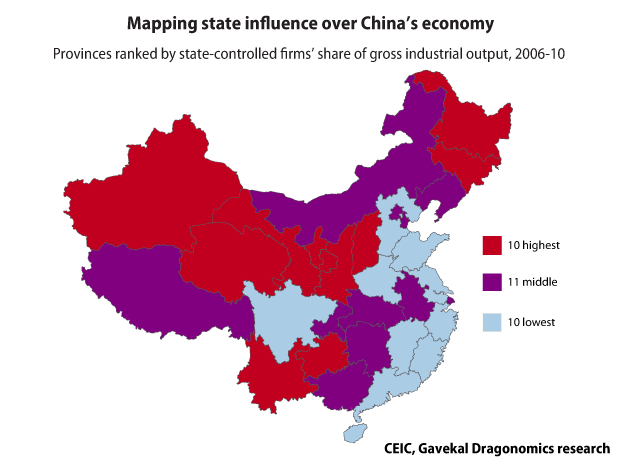
The authors run some regressions and find that provinces with more liberal populations also tend to have higher incomes, more openness to trade and higher rates of urbanization. The broad pattern is reasonably intuitive, as are some of the specifics (Tianjin being more conservative than Beijing will surprise no one who has been to both places). But I also wondered, if conservatism means in part support for the state role in the economy, why not also measure its relationship to a state role in the economy? Given that we are talking about a leftist system, a little Marxist analysis seems appropriate: how is the superstructure (ideology) related to the base (economy)? Or to put it a different way, do people whose livelihoods depend on SOEs think more highly of SOEs? Below is my own map of state influence over the economy, color-coded in the same way: red for the 10 most state-dominated provinces are red, blue for the 10 least are blue, and purple for those in the middle.

provinces-SOEs

The indicator I used is state-owned enterprises’ share of gross industrial output. This is not a perfect measure, as it does not include the service sector where many SOEs operate–Beijing’s highly service-driven economy is also heavily state-owned, and if services were included then Beijing would almost certainly be in the 10 highest, rather than in the middle as shown here. But the pattern seems broadly correct: provincial economies are least state-dominated on the eastern coast, more so in the central provinces, and most state-dominated in the old industrial bases and resource-heavy border areas.

This map also lines up pretty well with the ideology map, though there are some interesting divergences. The old industrial bases of Jilin and Heilongjiang in the northeast, which certainly have some of the most state-dominated economies in China (and currently among the worst-performing), register as only moderate in their ideological conservatism. If I had to come up with an explanation for this, it would go something like this: the large role of state enterprises in these provinces has not in fact been a good thing in the last couple of decades. There were mass layoffs and immense social dislocation in the late 1990s as money-losing SOEs were overhauled, and there has been a lot of out-migration to more prosperous regions since then. Northeasterners do tend to be rather socially conservative, but because of their own experiences I suspect they are also unlikely to have the illusion that state-owned enterprises are wonderful things.

Remembering the North China Herald

Many people have heard of the South China Morning Post, Hong Kong’s main English-language daily newspaper (Chinese name: Nanhua Zaobao), which has been published continuously since 1903. But how many people still remember its mainland counterpart and predecessor, the North China Herald (in Chinese: Beihua Jiebao), which was published in Shanghai starting in 1850? The weekly Herald and its daily counterpart, the North China Daily News, were published until 1941 and 1951 respectively, when first civil war and then Communist victory put an end to many such quasi-colonial legacies. Although primarily covering the expatriate community and their legal and business doings, the Herald also boasted of its coverage of events throughout China. Many libraries now have the full text of the papers available in a digital archive.

northchinaherald

I first heard about the Herald from a journalist I knew back when I first moved to Beijing, oh these many moons ago. At that time (late 1990s), English-language expatriate magazines were springing up in Beijing, doing the usual bar/restaurant listings, but also writing about Chinese culture in a way that was unusual then (though has become almost commonplace today). According to this guy, the dream of some people behind these expat rags was ultimately to revive the name of the North China Herald, and start a real, independent English-language newspaper inside mainland China.

I’m not sure why this memory suddenly sprang back to mind today, but thinking about this idea in the context of today’s China makes the late 1990s seem like a very long time ago. The idea that China would evolve in such a way that foreign-controlled media could play a major role domestically was probably never that well-founded, but it seemed less ridiculous 15 years ago than it does today. Instead of foreign-run newspapers within China, we now have CCTV on cable networks in the US, and a government that is currently blocking the websites of at least three of the biggest English-language news organization (The Wall Street Journal, The New York Times, Bloomberg). There is some independent English-language media (http://english.caixin.com/), but it is a spin-off of Chinese-language media and is largely run by Chinese people not expatriates.

This gap between vision and reality I think reflects a couple of things: 1) the tendency of foreigners to think that China will evolve in ways familiar to them, 2) the tendency of foreigners to overstate their own importance in how China evolves. More generally, I do not think we should expect institutions that were the product of a China that had low income and education levels domestically, and weak status internationally, to reappear in a China with high and rising levels of income, education and international influence. And judging by the ruckus that has resulted from its recent attempts at international institution-building, China is not done surprising us yet.

Jeff Sachs is right about Why Nations Fail

Reading the transcript of Jeff Sachs’ very interesting talk with Tyler Cowen, I had to stop myself from cheering aloud at the following passage. It captures perfectly the reaction I had myself when reading Why Nations Fail. Overall I found it a disappointing, wrongheaded and generally overhyped book, and the way Acemoglu and Robinson deal with (or, really, fail to deal with) China lays bare the problems in their approach. Sachs puts it better than I could, so I will just quote him in full:

Acemoglu and Robinson’s book Why Nations Fail was one of my least favorite books. I think it is just a bad book, because it takes one thought and tries to drive it as the only explanation of history. That’s not a good approach in my view to history, which is a very interesting, complex tableau.

They missed one fundamental point right from the start, which is that when you look at development, there are at least two fundamental drivers, not just one. The one that they talk about is innovation, and innovation as being a fundamental driver of growth. There’s a lot of truth to that in the history of the world.

But there’s a second fundamental aspect when we look out in the world and say, “Who’s doing well? Who’s doing badly? Why?” and so forth. That’s what is sometimes called “catching up.” The phenomenon of catching up is very different from the phenomenon of forging ahead at the front of the technology horizon.

When you take that simple distinction, it helps to explain a lot of the post-1960 question that you’re asking. The most successful countries in the world in the last 50 years have been basically the East Asian economies and Southeast Asian economies.

Very rarely do they look like the textbook model of Acemoglu and Robinson of the free market economy and so forth. In fact, the People’s Republic of China they characterize as just — that’s an anomaly that is going to collapse in the future so we don’t have to explain it now.

I think that’s a huge mistake and a misunderstanding of the basics. China’s in a catching-up mode. The institutions of catching up are quite different from the institutions of being the technology leader, for example. Just understanding that would give them a little more clarity about institutions, per se.

Why Chinese save, or the death of the precautionary savings hypothesis

For more than a decade, one of the big economic questions about China has been: why is the household savings rate so high, and still rising? We may now be getting to a point where the conventional wisdom on this question is changing. I have thought for a while that the evidence for the old conventional wisdom was unconvincing; I’m glad to see that a lot of good research is now providing an alternative.

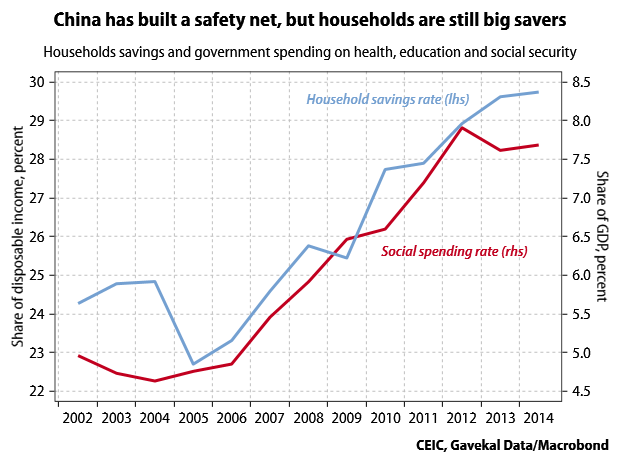
For those who can recall the big debates about the Chinese economy ten or so years ago, the high household savings rate and the low share of consumption in GDP were central issues. And the preferred explanation, the precautionary savings hypothesis, held that these problems were the result of government policy, and could be fixed. If there was one piece of advice that well-meaning outsiders like the IMF, ADB and World Bank all agreed on, it was that China’s government needed to increase spending on social programs. The hypothesis was that China’s inadequate social safety net meant that households needed to save a lot in order to pay for future healthcare and education expenses, not to mention their own retirement and that of their parents. Once a stronger safety net was put in place, those worries would diminish, and Chinese consumer spending would blossom. Here’s just one of many examples from the period, from the IMF’s 2006 Article IV report on China: “The government also needs to raise social spending in the areas of education, health care, and pensions, which will serve to reduce precautionary saving and boost consumption over time.” (The standard research presenting the precautionary savings hypothesis is this IMF paper from 2008 by Marcos Chamon and Eswar Prasad.)

The interesting thing about this recommendation is that the Chinese government actually listened to it: in 2006, government spending on education, health care and social security started to rise sharply. Of course, this did not happen just because the IMF said so. The precautionary savings hypothesis was not only plausible, but also in sync with domestic political trends. A growing chorus of influential domestic scholars were also pushing for a stronger government safety net, since the old one provided indirectly by state-owned enterprises had broken down. The economic argument that this would lower the savings rate and boost consumption was eagerly adopted by this group of people, but, in my experience anyway, they were driven mainly by social concerns. The resulting expansion of the social safety net was the signature accomplishment of the Hu Jintao-Wen Jiabao administration. One thing it did not do, however, was lower the savings rate: social spending went up, and the savings rate kept rising.

savingsrate

On its face then, the data from the past decade presents a rather large challenge to the precautionary savings hypothesis: the policy recommendation has been followed, and the predicted result has not been achieved. Of course, you could still argue that the increase in spending was not enough to really alleviate all the well-founded worries about future retirement, education and health expenses. But to me the results of this very large natural experiment suggest we should be looking elsewhere for explanations. This being economics, there are of course alternative theories to choose from. What most of these explanations share is the idea that China’s high savings rate is not a “distortion” produced by bizarre and unreasonable government policies, but a natural response to changing economic conditions.

A string of recent papers point to demographics and rising incomes as the key drivers of China’s savings rate. These explanations are also reasonably intuitive. The demographic argument is, more or less, that since China now has more people who are in the stage of life where they do most of their saving, the overall savings rate is high. And in fact we can observe that the share of the working-age population rose sharply as savings rates were also marching higher. The income argument flows from the fact that people with higher incomes tend to have a higher savings rate. This is a consequence of the diminishing marginal utility of consumption: when you start earning more money, you also spend more, but not quite as much more. So if in aggregate people’s incomes are going up, their savings rate should also go up. And given China’s rapid growth, incomes have been going up quite a lot.

The excellent Calla Wiemer has been arguing against the precautionary savings hypothesis on these grounds (see this 2010 paper) for some time, but she is now getting a lot more support. An interesting IMF paper from December does a cross-country comparison of episodes when savings rate rose sharply, and finds that such episodes are in fact relatively common, and that they generally followed surges in economic growth. An NBER paper also does a US-China comparison to evaluate the precautionary savings hypothesis, and finds that the difference in savings rates is explained mainly by differences in income growth. Most recently, the latest issue of American Economic Journal: Macroeconomics has a strong paper that comes up with a detailed demographic model for the savings rate (including some factors I skipped over above). And once the authors add rapid income growth into their model, it accounts rather nicely for how China’s savings rate has actually evolved.

There is increasingly strong evidence, in other words, that the reason China has had a high and rising savings rate is that it has been experiencing a major demographic transition and a historic surge in income growth at the same time. The implication is that as the population gets older and economic growth slows down–both trends that seem fairly unavoidable now–the savings rate should start leveling off and declining. Another implication is that dramatic policy interventions aimed at pushing down the housing savings rate are not as urgent (and here we might note that government social spending has stopped rising relative to GDP). Let’s see if this emerging conventional wisdom holds up better than the previous version.

The bureaucratic theory of technological stagnation

I’m finding David Graeber’s new book, The Utopia of Rules, to be a surprisingly enjoyable read. He’s a clear and vigorous writer, and as befits an anthropologist he is good at mining the minutiae of daily life for broader insights. Though admittedly my own long-ago degree in anthropology biases me to cheer him on, since Graeber is the only current example I know of a public intellectual who is an anthropologist (a species whose influence has always lagged economists, historians and sociologists.)

But I have to confess I was surprised to find the second of the book’s three essays tackling a fashionable topic among economists, bloggers and other non-anthropological commentators: the pace of technological progress, or rather the perceived lack thereof. The piece, entitled “Of Flying Cars and the Declining Rate of Profit,” mounts an original and compelling argument for why technology seems to be changing so much less quickly than we once hoped it would: in a word, it’s all about bureaucracy. Bureaucracy is not a synonym for “government,” even though Americans now tend to use the word that way. It’s a way of doing things, one whose pervasiveness means, in his words, that “a timid, bureaucratic spirit has come to suffuse every aspect of intellectual life.”

To summarize his argument as briefly as I can (and with much less style than the original):

  1. Corporations increasingly only spend their research money on product development and marketing, rather than seeking true breakthroughs. “The amount of really innovative research being done in the private sector has actually declined since the heyday of Bell Labs and similar corporate research divisions in the fifties and sixties.”
  2. Government investment in basic research has increased substantially, but since the 1980s has been directed primarily toward military purposes that are easier to justify, rather than true fundamental research. “The U.S. government…shifted their emphasis sharply away from civilian projects like the space program and in the direction of military research.”
  3. In academic institutions, the actual practice of research has become incredibly bureaucratic, time-consuming, and generally organized in such a way as to prevent genuine creativity.

On this last point, there is no substitute for quoting Graeber at a bit more length:

Our collective fascination with the mythic origins of Silicon Valley and the Internet have blinded us to what’s really going on. It has allowed us imagine that research and development is now driven, primarily, by small teams of plucky entrepreneurs, or the sort of decentralized cooperation that creates open-source software. It isn’t. These are just the sort of research teams most likely to produce results. If anything, research has been moving in the opposite direction. It is still driven by giant, bureaucratic projects; what has changed is the bureaucratic culture. The increasing interpenetration of government, university, and private firms has led all parties to adopt language, sensibilities, and organizational forms that originated in the corporate world. While this might have helped somewhat in speeding up the creation of immediately marketable products— as this is what corporate bureaucracies are designed to do— in terms of fostering original research, the results have been catastrophic.

Common sense dictates that if you want to maximize scientific creativity, you find some bright people, give them the resources they need to pursue whatever idea comes into their heads, and then leave them alone for a while. Most will probably turn up nothing, but one or two may well discover something completely unexpected. If you want to minimize the possibility of unexpected breakthroughs, tell those same people they will receive no resources at all unless they spend the bulk of their time competing against each other to convince you they already know what they are going to discover. That’s pretty much the system we have now.


How does this stand up? Well, it’s an essay and not an exercise in econometrics, and the piece is not, shall we say, overburdened with detailed empirical evidence. But it’s actually not too hard to find some. Point 1 has support from some economic research, notably a recent NBER paper entitled: “Killing the Golden Goose? The Decline of Science in Corporate R&D.” The title pretty makes the point pretty clear, but the specific finding is that “Over the period 1980-–2007…investments in scientific research by publicly traded American companies, as measured by publications in scientific journals by company scientists, has diminished over time.”

Point 2 is straightforwardly factual, as can be determined from a quick check of the data on federal R&D spending collated by the AAAS. After 1981, the share of defense R&D in total federal spending on R&D rose sharply from around 50% to 60-70% (though interestingly, it has come back down to about 50% over the last couple of budgets). Point 3 is a bit more difficult to substantiate with data, but it’s hard to imagine that other accounts of the grant-writing process are going to end up concluding that it is an ideal system. So it’s intuitively appealing. The risk of course is that we often think our current institutions are flawed and imperfect reflections of what our great ancestors did, which is why measuring things is a good corrective. But on the whole, I’d say the case against bureaucracy is definitely one I’m going to be thinking about.

Things from the UK that I’m enjoying

And I mean besides the stalwarts of rain, irony and mushrooms for breakfast, all of which I got to sample briefly on a work trip last week.

A recent discovery is Europe in Autumn by Dave Hutchinson. The setting of a future Europe that has splintered into numerous microstates has a ripped-from-the-headlines feel, even though it was published well before Scotland’s close-call referendum on independence. Technology plans almost no role in this imagined future, most of the thinking is about political and social changes and their consequences–a surprisingly rare strategy for any author, genre or otherwise. The book was highly recommended by Adam Roberts, himself a British author of no mean chops, and I did quite enjoy it–the best parts are almost like an Alan-Furst-for-the-2030s in the way they give you a view from the social and geographic margins of Europe. The plot of last third or so of the book rather falls apart, which for me keeps it from being the kind of masterpiece that Roberts calls it, but on the whole it’s both fun and thought-provoking. Previous British entries in this smallish category of “political science fiction” include Ken MacLeod’s excellent Fall Revolution series.

Under the more capacious category of obscure 1960s jazz, we have the UK reissue this year of Dejeuner sur l’herbe, a 1968 album by The New Jazz Orchestra. Neil Ardley is the man behind it, and no, I had never heard of him or most of the British players on this album before either. The rapturous comments on the Amazon.co.uk site call this one of the best jazz albums ever, which it probably is for a certain generation of British jazz listener. I haven’t listened to it enough yet to make that call, but already it is clear that it is in fact very good, and very reminiscent of the great Gil Evans albums of the 1960s. It’s a good reminder that there was some interesting stuff happening in the UK jazz scene back then. In particular I’m a great fan of Joe Harriott, who recorded some lively albums in the idiom of Ornette Coleman, and also some of the first and best attempts to meld jazz with Indian classical music.

Feeling the elephant of state-owned enterprise reform

The major financial news agencies (Bloomberg, Reuters, The Wall Street Journal) all have stories today about a new round of state-owned enterprise reforms that Beijing is expected to roll out shortly. (Full disclosure: both a colleague and myself are quoted in these articles). But anyone who bothered to read and compare all three stories might come away a bit confused. The Bloomberg story focuses on a proposal to transfer the government’s ownership stakes in SOEs to asset-management companies, and generally casts a positive light on the move. The Reuters and WSJ stories spin the changes as “industrial consolidation,” and generally take a more skeptical tone. So what is going on, and is it good or bad?

Unfortunately the reform plans have not actually been announced–the stories are based on conversations with officials and scholars–so we can’t evaluate them yet. The agency that manages the central government’s SOEs, known as Sasac, is widely expected to publish its plans later this month. But reading between the lines, the reporters appear to be hearing pretty much the same thing. And in fact most of this speculation has been widely reported in Chinese domestic media in recent weeks and months (reporting that the foreign media, adhering to an unwritten rule, do not acknowledge).

The idea of putting the top 100 or so big SOEs under asset-management companies, that would interfere less in day-to-day operations and focus on financial returns, does indeed seem broadly positive. This direction was in fact flagged more than a year ago in some early statements about SOE reform, which referred to a shift from “managing state enterprises” to “managing state capital,” implying a move to a more financially-driven model. The ambiguity is that these asset-management firms will reportedly be grouped by industry, and may in fact be formed on the basis of existing SOEs. In which case the resulting entities may look less like a financial portfolio and more like a forced industrial consolidation. This is I think why the WSJ and Reuters talk about this as a move away from market forces rather than towards them–and with good reason, given the enthusiasm the government has shown for forced consolidation of SOEs in the past.

The WSJ story asserts that the reform plan “takes large-scale privatization off the table,” but doesn’t explain why that would be the case. In fact I think part of the logic of handing ownership stakes to financial investors is to make partial privatization of SOEs easier. And the key slogan of SOE reform to date has been “mixed ownership,” which is hard to understand as anything other than an endorsement of additional privatization, however limited. Though I do expect much more partial privatization to happen at the local government level than at the large, strategic firms in Beijing that are the focus of this discussion. (Indeed, Shandong governor Guo Shuqing alluded a bit indirectly to this possibility recently.)

In the end, whether this upcoming reform plan means a new round of centrally-planned consolidation, or a move to impose more financial-market discipline (or, perhaps more likely, some odd combination of both) depends on a lot of things we don’t know yet. So I am going to make an unhelpful analysis: it depends, and I want to wait to see what the government actually proposes. In any case, we need to keep an eye on what the government is doing in other arenas. And as I’ve suggested previously, the really important reforms are not just to improve the management and ownership of state enterprises, but also to deregulate state-dominated industries and allow more private-sector activity.