How the Soviet Union tried to control the growth of large cities

Returning to my theme of socialist urbanization, here is a good overview of the Soviet system for controlling the expansion of large cities. The parallels with China are, at least to my eye, immediately obvious and striking. The passage is from Planning in the Soviet Union by Judith Pallot and Denis J.B. Shaw; it was published in 1981 which is why the USSR is referred to in the present tense:

Many Soviet writers claim that a socialist society’s ability to control the process of urbanization is a demonstration of its superiority to capitalism. Thus [geographer Boris Sergeevich] Khorev writes that the spontaneous and uncontrolled growth of cities in the West has produced such unfavorable consequences that “they militate in effect against the very system of large-scale capitalism.” By contrast, he believes, “only socialism has the possibility of using the best achievements of the modern urban form of settlement for the great masses of workers.”

Early efforts to control the rapid growth of the largest cities date from the 1930s, when rural-urban migration was threatening to produce total chaos for housing and services. Since then, with an increasing concern about regional development questions and the standard of living in cities, the policy has become more clearly defined and now embraces many more cities. The 25th Congress of the Communist Party of the Soviet Union in 1976 once again stressed the need to restrain the growth of large cities as part of a policy of industrial decentralization.

Soviet controls over the expansion of cities have three major aspects. The first is the propiska system, controlling migration into cities. The internal passport system was introduced in 1932 and at the same time a policy was implemented to control the inflow of permanent migrants into Moscow and Leningrad [St. Petersburg]. These efforts were reinforced by the plans for the two cities, promulgated in 1935, which allowed for only modest population expansion. Since that time many large cities have been declared “closed” to voluntary residence. In order to take up permanent residence in one of these cities, therefore, a special permit or propiska is required. For those who residence is temporary, such as university students, there are temporary propiska. Except for those born in a closed city, the propiska is not easy to acquire.

China: hukou system. Check.

The second control to city expansion lies in the ownership and direction of industry and of other forms of economic activity by the Soviet state. In 1931 the government decreed that all new industrial expansion was to take place outside Moscow and Leningrad. These provisions were reinforced by the 1935 plans for the cities and by subsequent government action on decentralization, especially after 1938. In 1939 five more cities–Khar’kov, Kiev, Rostov, Gor’kiy and Sverdlovsk–were added to the restricted list, and by 1956 there were 48 cities in which there was to be no further new industrial construction or expansion by already-existing plant. …In the 1960s and 1970s a whole new generation of development plans was drawn up for major cities, affirming the restrictions on, or prohibition of new industrial developments. Many plans also specify that activities not basic to a city’s economy, and polluting industries, should be relocated to satellites.

China: forced relocation of industry. Check.

The third arm in city control is that over land use. Soviet legislation on land has a special category of “land under populated settlements” and the granting of the right to use urban land is vested in the executive committee of the city soviet subject tot eh guidance of higher authority. In principle, the, industrial ministries and enterprises are unable to acquire new land without the expressed consent of local and higher authority.  …

China: monopoly state ownership of urban land. Check.

The USSR’s three largest cities in 1959 subsequently grow more slowly than other cities with populations over 100,000…the 24 largest cities of 1959 (population 500,000+) had over 25 percent of the total urban population in 1959, but less than 23 percent in 1976. In spite of these favorable trends, Khorev and others believe that the largest Soviet cities are still growing much too quickly and such tendencies are exacerbating urban problems. It is certainly the case that many cities have exceeded the growth rates expected by the planners. In the case of Moscow, for example, the 1970 city plan stressed the necessity of containing the capital’s population within the 7 million mark. At that time, however, the city’s population already stood at 6.9 million, and had reached 7.8 million by 1978. Leningrad’s city plan, approved in 1966, envisaged a population of 3.4-3.5 million people by the latter half of the 1980s, or 4 million including the suburban settlements. This level had already been reached by 1970.

Historically, China’s policies to control the growth of the largest cities only succeeded in slowing population growth rather than halting it–and even that limited success has imposed great human and economic costs. But the most recent and most draconian iteration of these policies may actually be succeeding in capping population growth. Soviet urban planning policies often failed because they were internally contradictory and poorly administered. Is the Chinese administrative state now powerful enough to actually implement the sterile visions of socialist urbanization?

pallot-shaw-planning


Mapping China’s 19th century provincial incomes

A passing reference from the encyclopedic Pseudoerasmus sent me to the work of Paul Caruana-Galizia, who has done an impressive series of papers quantifying historical income levels on a regional (rather than the usual national) basis for many countries.

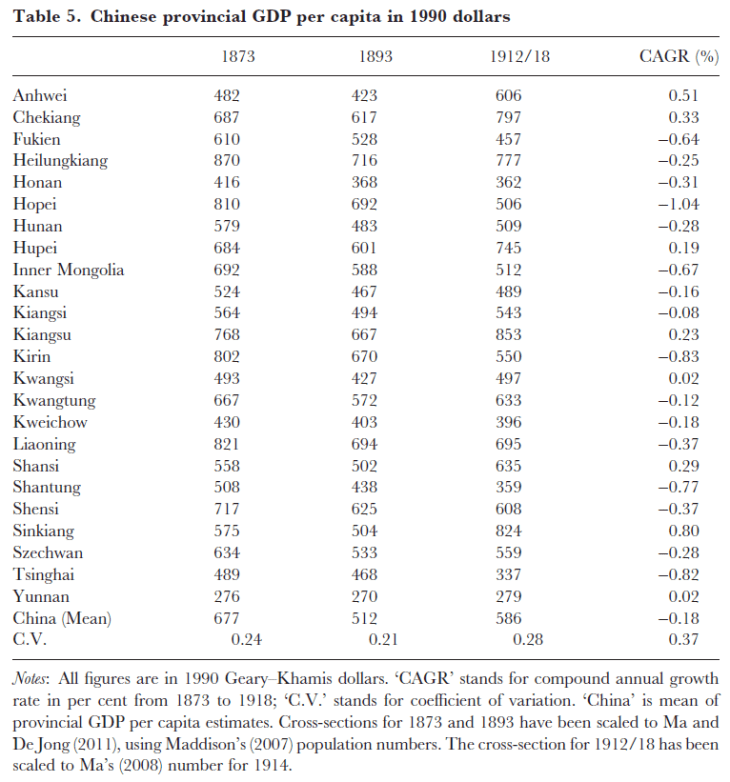
His paper on China, written with Ye Ma, gives us provincial per-capita GDP for the late 19th and early 20th centuries — an essential resource for comparing patterns of development over a longer time period.

The paper inexplicably does not include a map, so I have made a couple myself:

provincial-per-capita-GDP-1873

provincial-per-capita-GDP-1914

(Note: In these maps, Hebei includes the present-day municipalities of Beijing and Tianjin, Jiangsu includes Shanghai, and Sichuan includes Chongqing.)

The decline of incomes across most provinces (with Jiangsu and Xinjiang notable exceptions) is visually very obvious. Regional inequality was also basically stable over this period, probably reflecting the absence of sustained growth. Here is some useful commentary from the paper for context:

How do these per capita income levels compare with Europe’s? In 1873, Heilongjiang was China’s richest province with a GDP per capita of $870. In 1870 Europe, there were eight regions out of a sample of 200 that had per capita incomes between $800 and $950. Of these eight, five were in Austria-Hungary, one in France (Haut-Garonne), one in Germany (East Prussia), and one in Spain (Extremadura). These comparisons add weight to the argument by Pomeranz that some European areas were at similar levels of development to Asian ones. The fact remains, however, that China’s richest province – some 43 per cent above the Chinese average in 1873 – was only as rich as Europe’s poorest regions. … By the close of the period, Jiangsu surpassed Heilongjiang as the richest Chinese province with an income of $853. The only comparable European region is Dalmatia ($874).

On a macro level, the results corroborate histories of national economic decline and stagnation. China’s mean provincial per capita income compound annual growth rate over the period was −0.20 per cent. The internal disorder and continuous shocks to the economy in the forms of rebellions, foreign wars, and natural disasters meant that most Chinese were better off at the end of the nineteenth century than they were at the start of the twentieth.

Ma and de Jong’s numbers show that Chinese real GDP per capita dropped by 10 per cent from 1873 to 1912. Looking to Europe for comparisons, we see that Italian regions enjoyed an annual growth in per capita income of some 1.2 per cent, similar to that in France. These figures fit with Gernet’s claim that China’s ‘tragic period’ coincided with Europe’s ‘acceleration.’

And here’s the original table for reference:

Caruana-Galizia-table

Is China making the right tradeoff between short term and long term growth?

China has since 2008 engaged in repeated rounds of debt-fueled stimulus policies to prop up economic growth–a pattern that has become so entrenched that many people have forgotten that China ever did anything else. Lots of people, including me, have been critical of these policy choices. Most of these criticisms are, at their base, arguing that China is making the wrong trade-off between the short term and the long term. By focusing too much on preventing short-term growth slowdowns, it is creating more longer-term problems.

There are many examples of such arguments, but a couple of the more recent and systematic ones are worth highlighting. In “Local Crowding Out in China,” by Yi Huang, Marco Pagano, and Ugo Panizza, the authors argue that local governments’ reliance on banks to fund the off-balance-sheet stimulus spending crowded out funds for private-sector investment:

In China, between 2006 and 2013 local government debt almost quadrupled from 5.8% to 22% of GDP. … Given China’s geographically segmented financial market, this increase in local debt created imbalances in local financial markets: to underwrite it, banks curtailed financing to private domestic firms, forcing them to cut down on investment. This local crowding-out was more pronounced in the cities that issued more public debt. Public firms were shielded from the funding scarcity, thanks to preferential access to bank credit and almost exclusive access to bond financing. So were foreign firms, which could turn to their home countries’ capital markets. … Given that private companies are the most dynamic component of the Chinese economy, our results suggest that the large-scale local public debt issuance in connection with massive fiscal stimulus may have sapped the country’s longer-term growth prospects.

A related argument is found in “The Long Shadow of China’s Fiscal Expansion,” by Chong-En Bai, Chang-Tai Hsieh, and Zeng Song, an excellent overview of the post-crisis economic environment. This piece focuses not on the constraints imposed on banks by the need to finance large local government programs, but on the power that this expanded spending gave local governments. They argue that political favoritism has increased, leading to worse investment decisions:

This stimulus was largely financed by the creation of off-balance-sheet companies that allowed local governments to circumvent financial controls. About three-quarters of the stimulus spending was done by these off-balance-sheet companies, on behalf of local governments, with only a small increase in the official budget deficit. After the stimulus spending ended, local governments continued to use their newfound power to obtain access to financial resources.

The result has been an increase in off-balance-sheet local government debt and an increase in investment spending. Local governments, which have long faced high-powered incentives to support favored local businesses, have used this newfound power to channel financial resources toward favored private firms. The effects on the efficiency of capital allocation may, in turn, have had important effects on aggregate productivity growth in recent years.

Personally I find both arguments pretty convincing, as they are well-founded in the realities of how China’s political economy functions. But these kind of criticisms are not new, and so far do not seem to be very convincing to the people actually making economic policy decisions in China. The feared long-term economic damage from the stimulus is difficult to quantify, while the short-term economic costs from a more severe downturn are much more obvious. And to be fair, it is usually not obvious how to make the right trade-offs between the short term and long term.

If I was going to defend the Chinese government’s side in this argument, it would be on the grounds that the long-term damage from deep short-term downturns is indeed fairly severe. And therefore that the best way to ensure incomes rise over the long term is to minimize recessions in the short term. Or, as Napoleon reportedly said: “the game is always with him who commits the fewest faults.”

Some of the strongest support for this view comes from ideas advanced by the economic historian John Joseph Wallis, a collaborator with the great Douglass North. Their wonderful 2009 book Violence and Social Orders: A Conceptual Framework for Interpreting Recorded Human History argues that the change from slow pre-modern economic growth to fast modern economic growth, and the distinction between poor and rich countries, basically comes down to doing a better job of avoiding economic disasters. Here is a passage from the book:

Economic growth, measured as increases in per capita income, occurs when countries sustain positive growth rates in per capita income over the long term. Over the long stretch of human history before 1800, the evidence suggests that the long-run rate of growth of per capita income was very close to zero. A long-term growth rate of zero does not mean, however, that societies never experienced higher standards of material well-being in the past. A zero growth rate implies that every period of increasing per capita income was matched by a corresponding period of decreasing income. Modern societies that made the transition to open access, and subsequently became wealthier than any other society in human history, did so because they greatly reduced the episodes of negative growth.

The historical pattern of offsetting periods of positive and negative growth episodes is easier to see in the modern world, where we have better data… Strikingly, the richest countries are not distinguished by higher positive growth rates when they do grow. In fact, the richest countries have the lowest average positive growth rates by a substantial amount. …When they grow, poor countries grow faster than rich countries. They are poor because they experience more frequent episodes of shrinking income and more negative growth during the episodes.

Recently Wallis has, in collaboration with Stephen Broadberry, restated and extended this argument using more comprehensive historical data. The idea is being dubbed “shrink theory,” and as one commentator has already noted, its implications are on the face of it very negative for “any kind of theory that holds that economic recessions are purifying, ultimately beneficial to the economy, and even good for the national character.”

So if the Chinese government wanted to make an economically literate defense of its stimulus policies, it could do worse than to embrace the shrink theory of Wallis and Broadberry. Perhaps there is no hard tradeoff between the short term and the long term: keeping growth going in the short term is also the best way to maximize income gains over the long term. Officials could argue they do not need to spend time worrying about measures that might damage long-term productivity growth, since no one really knows what causes long-term productivity growth anyway, and are right to focus on preventing deep and damaging cyclical downturns.

Yet I think it is unlikely that Wallis and Broadberry will be speaking at a Politburo study session anytime soon, as the their main argument is not really about how to do counter-cyclical economic policy, but about the relationship between political systems and economic growth. They argue some societies are better at avoiding damaging economic downturns because they have more open and flexible political systems–ones that are better at decision-making and avoiding instability and violence in power transitions. I don’t know if they have articulated a specific view on China, but it seems likely that they would view China’s political system as still being at risk of generating damaging instability and an associated economic downturn in the future.

The historical roots of China’s industrial clusters

I’ve been interested in industrial clusters in China for a while, since I think they tell us a lot about underlying patterns of private-sector economic activity. Clusters are behind much of China’s decades-long success in exports, and more recently seem to be related to some fast-growing domestic service sectors as well.

A recent working paper by Xiwei Zhu et al., “Entrepreneurship and Industrial Clusters: Evidence from the China Industrial Census“,  makes some interesting points on this topic. The authors do some fancy math to identify clusters from data on the location of industrial firms, which results in the nice map below.

Zhu-cluster-map.png

The results are broadly consistent with more anecdotal approaches to identifying: industrial clusters are most prevalent in the coastal provinces of Zhejiang, Jiangsu and Guangdong (but note that Sichuan far inland also does pretty well). Places with lots of clusters also tend to be places where the private sector is a larger part of the economy.

Why do clusters form in these places? Geography is part of the traditional explanation, and the authors do find that access to ports (i.e., access to world markets) contributes to the formation of clusters. But they also argue that what they call the historical “supply of entrepreneurs” is an important factor.

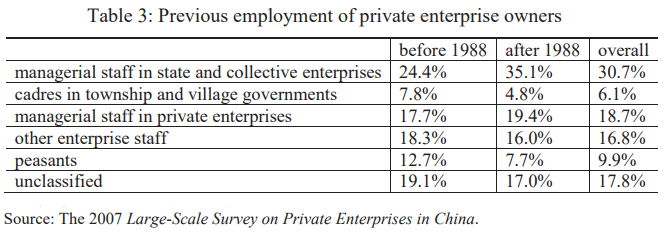
Since there were few recognized private companies in China before the 1990s, most founders of private-sector firms had to come from somewhere else–and state-owned or collective enterprises were a major source.

Zhu-entrepreneur-table.png

The authors use the number of firms in 1985 as an indicator of this historical potential for entrepreneurship. And they find that the number of all firms in 1985 is closely related with the number of private-sector firms in 2004:

Zhu-firms-scatter.png

The pattern suggests that the places where private-sector businesses flourished after liberalization were in fact those places where disguised private-sector businesses were already most prevalent. This fits in with historical evidence from the 1970s that pre-Communist commercial traditions and patterns often continued in the form of collective enterprises.

Though this particular paper is heavy on data and light on historical interpretation, I think it does contribute to a different narrative about China’s economic development. In such a narrative, China’s growth resurgence, at least in the 1980s and 1990s, is more about the flourishing of long-suppressed indigenous entrepreneurial traditions than the success of top-down development programs.