How the Soviet Union tried to control the growth of large cities

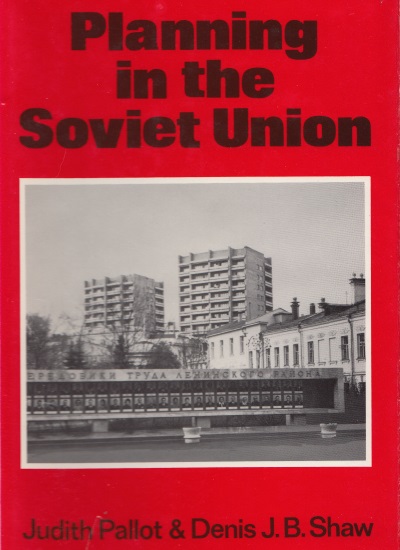
Returning to my theme of socialist urbanization, here is a good overview of the Soviet system for controlling the expansion of large cities. The parallels with China are, at least to my eye, immediately obvious and striking. The passage is from Planning in the Soviet Union by Judith Pallot and Denis J.B. Shaw; it was published in 1981 which is why the USSR is referred to in the present tense:

Many Soviet writers claim that a socialist society’s ability to control the process of urbanization is a demonstration of its superiority to capitalism. Thus [geographer Boris Sergeevich] Khorev writes that the spontaneous and uncontrolled growth of cities in the West has produced such unfavorable consequences that “they militate in effect against the very system of large-scale capitalism.” By contrast, he believes, “only socialism has the possibility of using the best achievements of the modern urban form of settlement for the great masses of workers.”

Early efforts to control the rapid growth of the largest cities date from the 1930s, when rural-urban migration was threatening to produce total chaos for housing and services. Since then, with an increasing concern about regional development questions and the standard of living in cities, the policy has become more clearly defined and now embraces many more cities. The 25th Congress of the Communist Party of the Soviet Union in 1976 once again stressed the need to restrain the growth of large cities as part of a policy of industrial decentralization.

Soviet controls over the expansion of cities have three major aspects. The first is the propiska system, controlling migration into cities. The internal passport system was introduced in 1932 and at the same time a policy was implemented to control the inflow of permanent migrants into Moscow and Leningrad [St. Petersburg]. These efforts were reinforced by the plans for the two cities, promulgated in 1935, which allowed for only modest population expansion. Since that time many large cities have been declared “closed” to voluntary residence. In order to take up permanent residence in one of these cities, therefore, a special permit or propiska is required. For those who residence is temporary, such as university students, there are temporary propiska. Except for those born in a closed city, the propiska is not easy to acquire.

China: hukou system. Check.

The second control to city expansion lies in the ownership and direction of industry and of other forms of economic activity by the Soviet state. In 1931 the government decreed that all new industrial expansion was to take place outside Moscow and Leningrad. These provisions were reinforced by the 1935 plans for the cities and by subsequent government action on decentralization, especially after 1938. In 1939 five more cities–Khar’kov, Kiev, Rostov, Gor’kiy and Sverdlovsk–were added to the restricted list, and by 1956 there were 48 cities in which there was to be no further new industrial construction or expansion by already-existing plant. …In the 1960s and 1970s a whole new generation of development plans was drawn up for major cities, affirming the restrictions on, or prohibition of new industrial developments. Many plans also specify that activities not basic to a city’s economy, and polluting industries, should be relocated to satellites.

China: forced relocation of industry. Check.

The third arm in city control is that over land use. Soviet legislation on land has a special category of “land under populated settlements” and the granting of the right to use urban land is vested in the executive committee of the city soviet subject tot eh guidance of higher authority. In principle, the, industrial ministries and enterprises are unable to acquire new land without the expressed consent of local and higher authority.  …

China: monopoly state ownership of urban land. Check.

The USSR’s three largest cities in 1959 subsequently grow more slowly than other cities with populations over 100,000…the 24 largest cities of 1959 (population 500,000+) had over 25 percent of the total urban population in 1959, but less than 23 percent in 1976. In spite of these favorable trends, Khorev and others believe that the largest Soviet cities are still growing much too quickly and such tendencies are exacerbating urban problems. It is certainly the case that many cities have exceeded the growth rates expected by the planners. In the case of Moscow, for example, the 1970 city plan stressed the necessity of containing the capital’s population within the 7 million mark. At that time, however, the city’s population already stood at 6.9 million, and had reached 7.8 million by 1978. Leningrad’s city plan, approved in 1966, envisaged a population of 3.4-3.5 million people by the latter half of the 1980s, or 4 million including the suburban settlements. This level had already been reached by 1970.

Historically, China’s policies to control the growth of the largest cities only succeeded in slowing population growth rather than halting it–and even that limited success has imposed great human and economic costs. But the most recent and most draconian iteration of these policies may actually be succeeding in capping population growth. Soviet urban planning policies often failed because they were internally contradictory and poorly administered. Is the Chinese administrative state now powerful enough to actually implement the sterile visions of socialist urbanization?
pallot-shaw-planning


Francis Spufford on ethics and economics in colonial America

I’m greatly enjoying Francis Spufford’s Golden Hill: A Novel of Old New York, after waiting a year for it to appear in the US (what’s up with these ridiculous lags, publishing?).

It is wonderfully written, and it is hard for someone with an interest in economic history not to be charmed by a book whose plot revolves around the difficulties of moving money long distances in the era before modern banking and national currencies.

The bravura opening chapter is almost an essay on trust and the ethics of commerce, and is difficult to excerpt, but here’s a fun passage on changing money in 1746:

“Well, now, let’s see. We don’t get much London gold, the flow being, as you might say, all the other way; it’s moidores, and half-joes, mostly, when the yellow lady shows her face. So I believe I could offer you a hundred and eighty per centum on face, in New-York money. Which, for four guineas, would come to—”

“One hundred and fifty one shillings, twopence-halfpenny.”

“You’re a calculator, are you? A sharp reckoner. Now I’m afraid you can have only a little of it in coin; the reason being, as I said when first we began, that little coin is current at the present.” Lovell opened a box with a key from his fob chain and dredged up silver—worn silver, silver knocked and clatter’d in the battles of circulation—which he built into a little stack in front of Smith.

“A Mexica dollar, which we pass at eight-and-fourpence. A piece of four, half that. A couple of Portugee cruzeiros, three shillings New-York. A quarter-guilder. Two kreutzers, Lemberg. One kreutzer, Danish. Five sous. And a Moresco piece we can’t read, but it weighs at fourteen pennyweight, sterling, so we’ll call it two-and-six, New-York. Twenty-one and fourpence, total. Leaving a hundred and twenty-nine, tenpence-halfpenny to find in paper.”

Lovell accordingly began to count out a pile of creased and folded slips next to the silver, some printed black and some printed red and some brown, like the despoiled pages of a prayerbook, only of varying shapes and sizes; some limp and torn; some leathery with grease; some marked only with dirty letterpress and others bearing coats-of-arms, whales spouting, shooting stars, feathers, leaves, savages; all of which he laid down with the rapidity of a card-dealer, licking his fingers fingers for the better passage of it all.

“Wait a minute,” said Mr. Smith. “What’s this?”

“You don’t know our money, sir?” said the clerk. “They didn’t tell you we use notes, specie being so scarce, this side?”

“No,” said Smith.

The pile grew.

“Fourpence Connecticut, eightpence Rhode Island,” murmured Lovell. “Two shilling Rhode Island, eighteenpence Jersey, one shilling Jersey, eighteenpence Philadelphia, one shilling Maryland . . .” He had reached the bottom of the box.

513nac43afl-_sx329_bo1204203200_

There never was a man named Vladimir Ilich Lenin

Lenin-desk-1918

Lenin at his desk, 1918

Fun facts for the centenary of the Russian revolution:

The name ‘Vladimir Ilich Lenin’ is a posthumous creation. The living man went by many names, but ‘Vladimir Ilich Lenin’ was not among them.

What should we call him? He was christened, shortly after his birth in 1870, as Vladimir Ilich Ulyanov. ‘Ilich’ is a patronymic, meaning ‘son of Ilya’. And yet, for many during his lifetime and after, ‘Ilich’ conveyed a greater sense of the individuality of the man than ‘Vladimir’. As soon as he started on his revolutionary career in the early 1890s the exigencies of the underground led our hero to distance himself from his given name. The surviving copy of his first major written production – Who are these ‘Friends of the People’ and How Do They Fight against the Social Democrats? (1893) – has no authorial name on the title-page. In works legally published in the 1890s our hero adopted more than one new name: K. Tulin or (for his magnum opus of 1899, The Development of Capitalism in Russia) Vladimir Ilin, a pseudonym that hardly hides his real name. Right up to the 1917 revolution, legally published works by Vl. Ilin continued to appear. …

Our hero acquired his ‘usual literary signature’ around 1901, while serving as one of the editors of the underground newspaper Iskra, when he began to sign his published work as ‘N. Lenin’. Why ‘Lenin’? We have already seen a certain fondness for pseudonyms ending in ‘-in’. But ‘Lenin’ seems to have been the name of an actual person whose passport helped our man leave Russia in 1900. This passport was made available to Lenin, at second or third hand, as a family favour; in the end, he did not have to use it.

‘N. Lenin’, not ‘V.I. Lenin’. His published works, right to the end, have ‘N. Lenin’ on the title page. What does the ‘N’ stand for? Nothing. Revolutionary pseudonyms very often included meaningless initials. But when N. Lenin became world famous, the idea got about that N stood for Nikolai – an evocative name indeed , combining Nikolai the Last (the tsar replaced by Lenin) , Niccolò Machiavelli and Old Nick. In 1919 one of the first more-or-less accurate biographical sketches in English proclaimed its subject to be Nikolai Lenin. President Ronald Reagan was still talking about Nikolai Lenin in the 1980s – and perhaps this name is just as legitimate historically as ‘V.I. Lenin’.

In any event, Lenin never used ‘Vladimir Ilich Lenin’ as a signature. Most of his letters are simply signed ‘Yours, Lenin’ or the like. Certainly Lenin did not bother to hide his real name. In a 1908 letter to Maxim Gorky signed ‘Yours, N. Lenin,’ he gives his Geneva address: ‘Mr. Wl. Oulianoff. 17. Rue des deux Ponts. 17 (chez Küpfer)’. Only in letters to his family and to Inessa Armand does he usually forego his usual literary signature and sign off as V.U. or V.I.

After 1917, when signing official documents in his capacity of Chair of the Council of People’s Commissars, Lenin evidently felt that his family name was necessary, and so his official signature on government decrees was ‘Vl. Ulianov (Lenin)’. Other revolutionaries whose underground klichki (pseudonyms) became famous did not retain their family name in this manner – certainly not J. V. Stalin (born Dzhugashvili).

It seems that our subject, for reasons both personal and official, fought to maintain a distinction between Vladimir Ilich the person and Lenin the political institution.

The quote is from Lars Lih’s Lenin, a short and sympathetic intellectual biography. I also note that Sean McMeekin’s nice piece “Was Lenin A German Agent?” refers to him correctly, as Vladimir Ulyanov alias Lenin.

Reinhard Bendix on the economic dilemma for nationalist politicians

Is there a connection between nationalism in politics and inward-looking, statist economic policies? The examples of China and Russia (and perhaps Turkey) in recent years suggest that there could be.

But where does this linkage come from? I recently stumbled across a 1987 article by the sociologist Reinhard Bendix, called “The Intellectual’s Dilemma in the Modern World,” in which he articulates this connection rather well. Here is the relevant passage:

There is a family resemblance between the Third World of today and the poor countries of earlier eras. In the sixteenth and seventeenth centuries, English intellectuals and other people reacted to the economic advance of Holland and the Spanish world empire. In the eighteenth century, German writers reacted positively or negatively to the economic and political advance of England and France. In response to the French revolution, German rulers proposed to do for “their” people–by a revolution from above–what the French people had done at great cost by and for themselves. Russian intellectuals during the nineteenth century took standards derived from Western European developments to form counterimages of czarist realities; and in the twentieth century Russian revolutionaries adopted programs and tactics derived from the French revolution and Marxist theory in their overthrow of the czarist regime.  …

Every idea taken from elsewhere can be both an asset to the development of a country and a reminder of its comparative backwardness–that is, both a model to be emulated and a threat to its national identity. What appears desirable from the standpoint of progress often appears dangerous to national independence. The revolution in communications since the fifteenth century has been accompanied by ever new confrontations with this cruel dilemma, and the rise of nationalism has been the response nearly everywhere. …

The division is deep over which path the country should follow. Perception of advances abroad are reminders of backwardness or dangers and weaknesses at home. Intellectuals attempt to cope with the ensuing dilemma: whether to adopt the advanced model and invite its attending corruptions, or fall back upon native traditions and risk their inappropriateness to the world of power and progress. This dilemma engenders heated debates and ever-uneasy compromises. People want their country recognized and respected in the world, and to this end they cultivate or revive native traditions. … But the desire to be recognized and respected in the world also calls for the development of a modern economy and government, and this effort at development focuses attention upon ideas and models derived from the advanced society of one’s choice.

I owe the reference to Elena Chebankova’s article “Ideas, Ideology & Intellectuals in Search of Russia’s Political Future” in the spring 2017 issue of Daedalus. She applies the Bendix dichotomy to the Russian situation as follows:

This cruel dilemma forces a split within the intellectual scene of second-wave industrialization states, of which Russia is part. Intellectuals of those countries inevitably face an uneasy choice between losing intellectual and cultural independence by admitting their backwardness and adopting the externally borrowed progressive paradigm, or reaffirming nativism and tradition by holding on to the previously chosen path.

The drama for Russian intellectuals is in the quandary of either adopting the ideology of individual freedom and bourgeois liberties, combined with embracing Western ontology, or clinging to the idiosyncratic centralized modes of governance that could conduct modernization and development, albeit in a risky alternative fashion.

The point is simple: economic policies that are perceived as pursuing convergence with “the West” can be difficult to reconcile with nationalist aspirations to have a country walk its own road. And to the extent that good economic policies actually mean “converging with the West,” nationalism can mean fewer good economic policies.

Of course this relationship is not a necessary one: there is no country that does not have some nationalism in its politics, and good economic policies do not actually have to mean (or be perceived as) “converging with the West.” Deng Xiaoping for one found no difficulty in reconciling his strong Chinese nationalism with liberalizing domestic markets and opening up to global trade. It also seems like Modi in India is managing to pursue a similar combination of nationalist politics with economic restructuring.

But countries with a socialist legacy perhaps face the dilemma more keenly — to a large extent the distinctive “Chinese way” or “Russian way” is, thanks to their history, socialism and the planned economy. And therefore appeals to nationalism can shade more easily into statist economic policies.

In any case, I found this old Bendix article surprisingly useful for thinking about these current questions. It is rather difficult to find online, so I’ve put a copy up on this site; you can download the PDF here.

bendix_reinhard.jpg

Reinhard Bendix

Welcome to the land of soft openings

I’m about halfway through Ian Johnson’s The Souls Of China: The Return of Religion After Mao , but it’s already clear it’s the China book of the year. Not just because the subject matter is fascinating and undercovered, but also because it is packed with insights about all aspects of contemporary China.

I hope to blog more about the discussion of religion later, but for now I really want to share the following passage, which despite being more or less tossed off as an aside is a fairly profound insight into how China works:

China is the land of soft openings: projects are first announced to big fanfare, structures erected as declarations of intent, and only then filled with content. In this sense, developing a new ideology to unify China is similar to building a shopping mall: the deal is publicized, the building goes up, a few stores open, but only years later are all the shops and restaurants open for business, and only after a number of anchor tenants have gone bankrupt. This makeshift model differs from how Westerns like to see projects–envisioned and planned thoroughly, then completed according to that design. But it has its own logic. If viable, the project goes ahead; if not, backing out is easier.

Keeping this pattern in mind is a good way to maintain a clear head when dealing with the latest grandiose Chinese announcement.

The frenzy of commentary on China’s Belt and Road Initiative has, for instance, generally not done this. Much of this makes the fundamental mistake of not understanding that the initiative is indeed in soft opening mode, and talking about it as if it is a massive and detailed plan for infrastructure development (it isn’t). On the other hand, that doesn’t mean that it’s correct to take all the official rhetoric about shared prosperity at face value, as too many ludicrously overwrought op-ed pieces have. A makeshift structure that gets filled in over time is, I think, exactly the right way to think about it.


(Disclosure: Ian is a friend and former colleague, so I was predisposed to like his book. But I’d recommend it anyway.)

41x86djhvkl-_sx329_bo1204203200_

On Nightfall, What It Is, and Whether It Falls on Us

I enjoyed these passages in A. Roger Ekirch’s At Day’s Close: Night in Times Pasta well-known and well-liked work of social history, where he describes how the term “nightfall” reveals an older way of thinking about night. Not as the absence of light, but as an actual substance descending from the sky. As he points out, “falling” is not in fact an accurate visual description of what happens at sundown:

Rather than falling, night, to the watchful eye, rises. Emerging first in the valleys, shadows slowly ascend sloping hillsides. Fading rays known as “sunsuckers” dart upward behind clouds as if being inhaled for another day. While pastures and woodlands are lost to gloom, the western sky remains aglow even as the sun draws low beneath the horizon. …

Darkness signified more than the temporary absence of light. According to popular cosmology, night actually fell each evening with the descent of noxious vapors from the sky. Night, wrote Richard Niccols in 1610, “did powre grim darknesse downe.” Kept at bay by daylight, descending mists reportedly contributed, no less than the sun’s departure, to the onset of darkness. In Herefordshire, nightfall was known as “drop night.” Some individuals described themselves “within night,” as if enveloped by a mammoth black cloud; in fact, criminal prosecutions in Scottish courts routinely referred to offenses having been committed “under cloud of night.” …

In his essay “On Nightfall, What It Is, and Whether It Falls on Us,” the sixteenth-century French physician Laurent Joubert derided popular fears… he disputed the prevailing notion that “nightfall is a certain rheumatic quality in the evening and night air that falls from the sky.” “There is no evil quality in nightfall air,” he insisted, with night itself being “nothing more than the obscurity or darkness of the air as a result of the absence of the sun.” All the same, the traditional wisdom about nightfall persisted for many years.

The idea of sixteenth-century pamphleteers duking it out over the reality of nightfall, in a sort of archaic version of internet flame wars over climate change, is somehow very pleasing.

512bkzdtlgfl

Soviet urbanization was highly coercive

If there is a consensus view of the first decades of Soviet economic history, it probably goes something like this: Stalin oversaw a dramatic transformation of the Russian economy from agrarian to industrial, but at enormous and unnecessary human cost. The most famous example of his coercive policies leading to terrible human costs is probably agricultural collectivization, but in recent reading I learned that the early urbanization drive was also highly coercive.

A long 2012 report by Charles Becker, S. Joshua Mendelsohn and Kseniya Benderskaya, “Russian urbanization in the Soviet and post-Soviet eras” is a very useful overview, and touches on this question:

The magnitude of the USSR’s economic transition during the Stalin and Khrushchev eras can be difficult for outsiders to grasp: in 1928, some 75 per cent of Russia’s labour force were self-employed farmers and craftspeople, 18 per cent were manual workers, and only 3 per cent were members of a kolkhoz or cooperative. By 1939, only 3 per cent of the labour force remained as own-account farmers, while 47 per cent were members of a kolkhoz or cooperative, and 50 per cent were manual workers. …

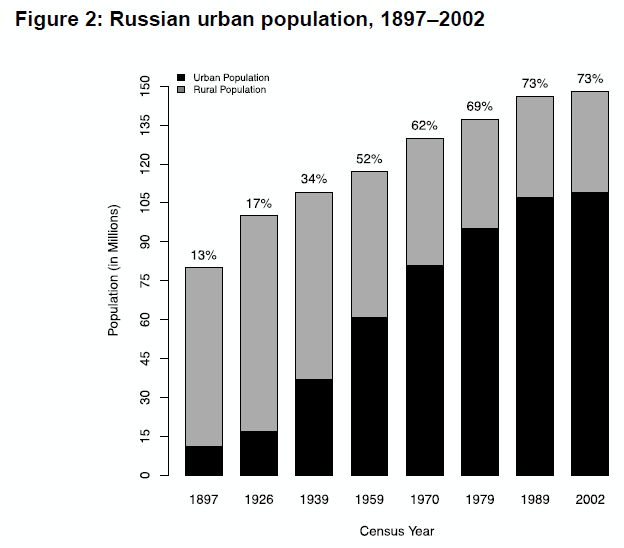
In 1926 there were still no large regions where even one-quarter of the population was urban. … This setting changed dramatically in the next 13 years, when the USSR’s urban population as a whole rose by 119 per cent. By 1939, urbanization rates above 40 per cent were recorded in the Northwest and Russian Far East, while most other regions were between 25 and just under 40 per cent urban.

russia-urban-pop

This explosive urbanization in the 1930s reflected both crash industrialisation and agricultural collectivisation, which drove many people from the land. To urbanise rapidly during a period of rural upheaval and declining productivity could occur at that time only in a command economy whose directors were willing to suppress consumption, especially by the rural population. …

It is also important to recognise than much Russian migration was not fully voluntary: studies cited by Mkrtchian (2009) suggest that ‘migration organised by the authorities’ peaked at about 40 per cent of the total in the late 1940s, and even in the late 1970s and early 1980s accounted for as much as 15 per cent of the total. A considerable but uncertain share of this organised migration involved forced labour (of political prisoners and conventional criminals). After sentences were completed, it was common to prevent convicts from returning to their original homes, forcing them to settle in remote, northern areas. …

There is more detail in the following passages from Fiona Hill and Clifford Gaddy’s The Siberian Curse: How Communist Planners Left Russia Out in the Cold:

Soviet statistics deliberately masked the fact that the achievements of the USSR’s industrialization campaign were based on slave labor. Forced labor camps in the GULAG system that exceeded 3,000 or 5,000 people (depending on location) were classified as towns. This meant that to the outside observer, regions like Siberia were experiencing unprecedented population as well as industrial growth.  In their book on prison labor in the USSR, David Dallin and Boris Nikolaevsky note that forced migration was an essential component in this population growth— underscored by the fact that the fastest urban growth was recorded in the Russian North and the Far East, where most of the labor camps were located.

Even after their release, prisoners still contributed to the population growth of regions like Siberia. On the completion of their sentences, former prisoners were given a new provisional status of “special migrant.” As such, they were legally prohibited from relocating or moving back to their original homes. Everyone who passed through the GULAG system east of the Urals became part of the “migration” wave that swept through Siberia and the Far East, whether they liked it or not.

The town of Norilsk and the giant mining company Norilsk Nickel are probably one of the most famous result of this type of forced urbanization:

Noril’sk consisted of a series of labor and construction camps that operated from June 1935 to August 1956. The early numbers of prisoners were small, around 1,200 in October 1935, but swelled to a peak of 72,500 in 1951. The camp construction brigades built the giant Noril’sk Nickel foundry, the city of Noril’sk itself, most of its basic municipal infrastructure, and other small processing factories that served Noril’sk Nickel. Camp labor extracted and processed local resources including gold, cobalt, platinum, and coal; produced cement; and provided the labor pool for a whole range of local industries.

Hill and Gaddy argue that this forced urbanization, with its concentration on populating the cold Siberian wastes, led to a city pattern that is highly costly and inefficient. And because of path dependencies–cities rarely shrink once they are established–the legacy of that forced urbanization continues to impose costs on the Russian economy.

For me, this urbanization evidence weakens the view that “Stalin killed lots of people, but at least he urbanized and industrialized the country” and gives more weight to the argument that “Stalin killed lots of people, and screwed up the industrialization process.” An excellent recent and data-driven assessment of the Stalin era, “Was Stalin Necessary for Russia’s Economic Development?” also generally supports the latter view.

“Impatient with ordinary sunsets”: Eve Babitz’s one-liners

Winning the award for the book most unlike what I usually read is Eve Babitz’s Slow Days, Fast Company: The World, The Flesh, and L.A.a sort of impressionistic mini-memoir of Los Angeles in the early 1970s. I can’t say that I had a particular interest in Hollywood party people before picking it up, but it sucked me in nonetheless, mainly because she is such a brilliant writer. One example:

A long time ago my mother and I were driving to a wedding. I had been engaged to both the groom and the best man at one time or another. I was twenty-three, a clerk-typist by day and a groupie- adventuress prowling the hot Sunset Strip at night. I’d broken off with both of those guys because I was impatient with ordinary sunsets; I was sure that somewhere a grandiose carnival was going on in the sky and I was missing it. But still, it made me feel funny having those guys slip away like that.

“Impatient with ordinary sunsets” is just a wonderful turn of phrase.

Once I start excerpting it’s hard to stop, so I’ll confine myself to one of her classic one-liners:

She was an actress, and like all actresses, she was only real when she was pretending.

OK, one more, just because:

Art is supposed to uphold standards of organization and structure, but you can’t have those things in Southern California—people have tried.

The general theme is that Babitz works very hard to seem superficial while actually cutting to the chase.

41trroywaal

What is the real driver of the Russian revanche?

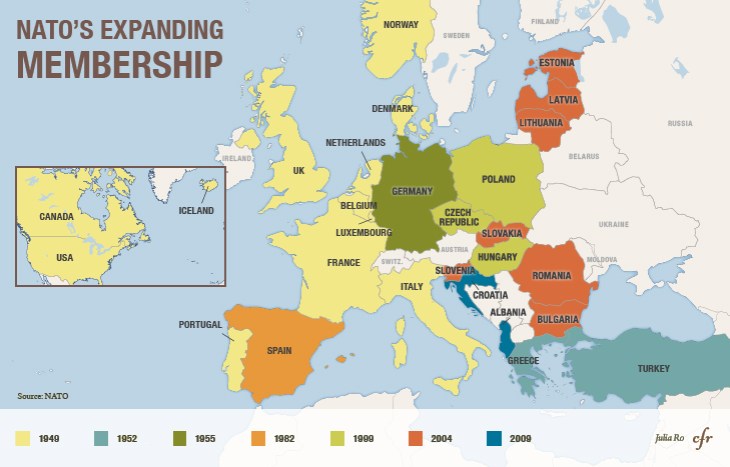
The deterioration of US-Russia relations, and Russia’s shift to increasingly repressive domestic politics and an increasingly aggressive external stance, is one of the most important shifts in global politics over the past couple of decades. One of the standard explanations for this worrying trend is that it is Russia’s natural reaction to what it could only perceive as aggression by the West: the expansion of NATO up to Russian borders. Indeed, just such an outcome was predicted by many Russia hands when NATO expansion was first proposed. Here is George F. Kennan’s famous 1997 op-ed in the New York Times: 

And perhaps it is not too late to advance a view that, I believe, is not only mine alone but is shared by a number of others with extensive and in most instances more recent experience in Russian matters. The view, bluntly stated, is that expanding NATO would be the most fateful error of American policy in the entire post-cold-war era.

Such a decision may be expected to inflame the nationalistic, anti-Western and militaristic tendencies in Russian opinion; to have an adverse effect on the development of Russian democracy; to restore the atmosphere of the cold war to East-West relations, and to impel Russian foreign policy in directions decidedly not to our liking.

nato_map_final

The new “Russia Beyond Putin” issue of Daedalus (available on Kindle) has an interesting piece by Keith A. Darden, “Russian Revanche: External Threats & Regime Reactions,” which suggests a slightly different narrative. Rather than NATO expansion per se, he argues, it was NATO’s shift to a doctrine of external intervention that catalyzed Russia’s fears:

NATO expansion – which began in the mid-1990s – was not well received in Russia, but NATO expansion alone appears to have been insufficient to raise the specter of a threat to Russia’s territorial integrity. Russia’s security doctrine in 1997, which followed the invitation of Poland, Hungary, and the Czech Republic to join the NATO alliance, did not explicitly identify NATO or the United States in the list of threats Russia faced. Indeed, external military threats hardly merited mention.

This changed with Kosovo. The NATO bombing of Yugoslavia in 1999 shifted perceptions completely: it showed that the alliance could (and would) be used for offensive out-of-area operations to intervene in the internal affairs of a sovereign state without United Nations approval. Russian leaders immediately registered the potential threat. The link of external (U.S./NATO) military power with internal opposition (the Kosovo Liberation Army) to undermine a rival government came to be perceived as a new model of warfare and the “foundation of a unipolar world.”

In Russia’s October 1999 National Security Concept – the first following the Kosovo War – international influence in Russia’s internal politics was identified as a threat to national security. An expansion of the domestic control of the state was articulated as strategically necessary to prevent external actors from undermining Russia’s internal security. In a world of asymmetric Western power, the notion that a state’s internal opposition could be exploited by outside powers to undermine a regime created a perverse incentive for some regimes to circumscribe or eliminate the internal pluralism essential to democratic rule. …

The extra-constitutional ouster of Viktor Yanukovych’s government [in Ukraine] and the seizure of power by a pro-U.S., pro-NATO, and anti-Russian coalition clearly marked a sharp increase in the perception of threat in Moscow, triggering a full triad of balancing efforts (military, internal, and ideological). As a military response, Russia used its newly revamped special forces to quickly invade and annex Crimea and to sustain a separatist insurgency in eastern Ukraine. By May 2014, the Russian security doctrine identified color revolutions as a form of hybrid warfare used by the United States as the primary external threat.

If Russia’s anti-Western reaction is not a uniquely Russian phenomenon, but instead an instance of a more general trend, then this interpretation makes sense. Only Russia was threatened by the expansion of NATO. But many countries could reasonably feel threatened by the West’s new willingness to overthrow governments it dislikes.

Darden suggests that China has followed a similar trajectory for similar reasons. And indeed it is true that China’s government perceived the “color revolutions” of the early 2000s in much the same way as Russia did, as “organizational pro-Western proxies used by the U.S. to oust unfriendly leaders.” The broader conclusion is not very cheerful:

To place the Russian reaction in broader context it is useful to recall historian and diplomat E. H. Carr, who pointed to the relations of power that underlay normative commitments in international affairs. Writing in the 1930s, but looking back at the ideologies of predominant states, Carr noted that internationalism and universalism were ideologies of states that aspired to world leadership – to hegemony. Universal values suit the powerful, Carr thought, for they justify universal intervention and interference in the internal affairs of other states, something only the powerful are capable of. “Pleas for international solidarity and world union,” Carr wrote, “come from those dominant nations which may hope to exercise control over a unified world.”

Similarly, Carr noted that the ideological reaction of rising powers was a function of positions of relative weakness. “Countries which are struggling to force their way into the dominant group naturally tend to invoke nationalism against the internationalism of the controlling powers.” Universalism, whether liberal or communist, is the ideology of the dominant. The aspiring or declining powers mobilize nationalism and particularism.

In the antiliberalism of great powers like Russia and China, we see the paradoxical effect of the singularity of American power and dominance: a defensive inversion of dominant norms. For states strong enough to mount a challenge, and with a prior history of framing internal pluralism as a source of external threat, resistance to U.S. power will present as an antiliberalism that is likely to shape domestic institutions. It is depressing that the primary effect of a world dominated by liberal democratic states may not be the gradual extension of democracy and the normative assimilation of the world’s nondemocratic emerging powers, but it should not come as a surprise. The primary effect of muscular liberalism may be to generate an opposing reaction.

So far, my favorite book about the 2016 election is one that came out in 2014

Like many good books, Martin Gurri’s The Revolt of the Public and the Crisis of Authority in the New Millennium is about One Big Idea, though the implications take a while to work through. It’s basically a story of how technology and media are changing politics.

Though Gurri does not, I found it helpful to put the idea in economists’ terms: a dramatic increase in the supply of information and media has pushed down its value. For many established institutions, this has meant a decline in influence, as their once-authoritative statements must now compete for attention and truth-value with a growing horde of statements from the margins. The struggles of old-line newspapers, political parties, and governments in the new environment are thus all of a piece:

The grand hierarchies of the industrial age feel themselves to be in decline, and I’m disposed to agree. They evolved to operate on a more docile social structure – one in which far less information circulated far more slowly among far fewer persons. Today a networked public runs wild among the old institutions, and bleeds them of the power to command attention and define the intellectual and political agenda. Every expert is surrounded by a horde of amateurs eager to pounce on every mistake and mock every unsuccessful prediction or policy. Every CRU has its hacker, every Mubarak his Wael Ghonim, every Barack Obama his Tea Party. Nothing is secret and nothing is sacred, so the hierarchies some time ago lost their heroic ambitions and now they have lost their nerve. They doubt their own authority, and they have good reason to do so.

Gurri really won my heart when he brought this insight together with the work of the great anthropologist Mary Douglas, who had an uncanny knack for creating powerful and useful analytical frameworks:

Another way to characterize the collision of the two worlds is as an episode in the primordial contest between the Center and the Border. The terms were employed by Mary Douglas and Aaron Wildavsky in another context, long before the advent of the information tsunami, but they are singularly apt for our present condition. “Center” and “Border” can be applied to organizations embracing specific structures, ideals, and beliefs about the future. The two archetypes are relative to each other, and perform a kind of dance which determines the direction of social action.

The Center, Douglas and Wildavsky write, is dominated by large, hierarchical organizations. It frankly believes in sacrificing the few for the good of the whole. It is smug about its rigid procedures. It is too slow, too blind to new information. It will not believe in new dangers and will often be taken by surprise. The Center envisions the future to be a continuation of the status quo, and churns out program after program to protect this vision. The Border, in contrast, is composed of “sects” – we would say “networks” – which are voluntary associations of equals. Sects exist to oppose the Center: they stand firmly against. They have, however, “no intention of governing” and develop “no capacity for exercising power.” Rank means inequality, hierarchy means conspiracy to the Border. Rather than articulate programs as alternatives to those of the Center, sects aim to model the behaviors demanded from the “godly or good society.” Making a program is a center strategy; attacking center programs on behalf of nature, God, or the world is border strategy.

If this is starting to sound a bit like what happened in the primaries last year, that is no accident. Gurri I think provides a useful way of thinking about the realignment of politics made clear by the 2016 election in the US, and the UK’s Brexit referendum:

I was trained, as even the youngest of us were, to think in terms of the old categories: to think, for example, that the direction of American politics depended on the balance between Democrats and Republicans. Yet both parties are, in form and spirit, organizations of the Center. Both are heavily invested in the established order, offering the public minor differences in perspective on the same small set of questions. Surprises in America’s political trajectory are unlikely to come from the alternation of Democrat and Republican. The analyst searching for discontinuities – for the possibility of radical change – must wrench his mind free of the old categories and turn to the subterranean strife of hierarchy and network: in the political parties, between “netroots” activists and a variety of Tea Party networks on one side, and the Democratic and Republican organizations on the other. There, different languages are spoken, potent contradictions can be found. …

The book is consistently interesting, and although he refrains from making explicit predictions it nonetheless often feels quite prescient. Gurri’s blog extends the analysis into 2016, though that piece will make more sense after having read the book.

51eiqavwepl-_sx260_