The Newcastle shipyards in world history

I recently paid my first visit to Newcastle-upon-Tyne in northern England, which is a worthwhile stop for anyone interested in the history of the Industrial Revolution. If you follow the promenade along the river to the west, outside the city center you come to a low-rise brick office park. There is no particular reason for a tourist to hang out there, but I was intrigued by the fact that several of the buildings had what appeared to be Japanese names. Looking around, sure enough there was an explanatory placard: the office park sits on the site of the old Newcastle shipyards, and one of their major customers in the late 19th century was the Japanese navy. The buildings were named after the ships.

I had not known until then that the UK had supplied much of the hardware that enabled Japan’s famous military victory over Russia in their war of 1904-5. British shipyards had built all six of the Japanese navy’s battleships, four of its eight cruisers (other European powers supplied the rest), and 16 of its 24 destroyers (the other eight were domestic).

Japan of course was busy building up its own shipbuilding industry, but being able to purchase leading-edge military technology on the open market was essential. Admiral Togo Heihachiro, who commanded the navy in the battle in which Russia’s Baltic fleet was destroyed, had studied in England as a young man, and in 1911 visited Newcastle to express his thanks for its role in arming the navy.

togo-header

Japan’s military victory over Russia was the first time an Asian power had defeated a European one in modern times. It was shocking to European and American observers at the time, as it overturned what had been assumed to be an established order. The Russo-Japanese War was a clear turning point in what was to become the century-long rise of Asia and the quest of non-European countries to achieve parity with the European imperial powers. But what does it mean that Japan’s victory was in fact aided and encouraged by some of those same European imperial powers?

Perhaps one point is that rivalry among existing great powers is one of the forces that helps produce new powers: an existing power can seek advantage over its adversaries by encouraging the rise of new powers. The US decision to engage with Communist China in the 1970s cannot, of course, be understood in isolation from its rivalry with the Soviet Union: the US wanted to make sure that China was, if not exactly on its side, at least not on the USSR’s side.

Another possible interpretation is that commercial interests (or, if you prefer, capitalism) can be disruptive to hierarchies in international relations. Would Japan’s aggressive drive to bring its navy up to European standards have been as successful if it did not also boost the sales and profits of Armstrong Whitwork & Co in Newcastle? Similarly, it is hard to imagine that the US would have been so accommodating of China’s “peaceful rise” over the past few decades if it had not also presented big opportunities for American companies.

What surprised Pieter Bottelier about Chinese economic history

Pieter Bottelier has observed a lot of recent Chinese economic history, starting with his tenure as head of the World Bank’s office in China from 1993-97. But his new book, Economic Policy Making in China (1949-2016): The Role of Economists, goes farther back, and opens with an interesting collection of “puzzles and surprises” he encountered doing research on these earlier periods.

I quite enjoyed these observations; here is a selection of a few of them:

  • Surprise: The Chinese communists, who were relatively inexperienced in economic matters when the CPC was gaining strength in the 1930s and ’40s, were more effective in suppressing inflation in areas they controlled than Chiang Kai-shek’s more experienced Nationalist government.

If Chiang Kai-shek had been able to control hyperinflation during the civil war, it would have been much harder for the communists to prevail in that conflict. I was surprised to see how much importance the communists attached to financial stability and how effective they were in fighting inflation before the establishment of the PRC in 1949. …While most historians typically focused on the political and military achievements of the CPC, I found that the financial history, including a surprising degree of fiscal conservatism and appreciation of the importance of financial stability, deserves more attention.

  • Surprise: The extent to which initial economic reforms in the late ’70s were influenced by the need to create jobs for the millions of people (especially youth) returning to the cities from the countryside after the Cultural Revolution had ended.

To reduce the risk of social instability, there was a compelling need for job creation in urban areas after the Cultural Revolution. One of the first and most important reform measures in the late 1970s was to legitimize and facilitate street vending and other labor-intensive retail trading. Most of the millions of people returning to the cities after the Cultural Revolution had been forced by the Party to undergo “re-education” through labor in rural areas. If it hadn’t been for the special efforts to create job opportunities in urban areas for these people, Deng Xiaoping’s economic reforms might not have been as successful as they were.

  • Surprise: The importance of coining the term “socialist market economy” in 1992 to describe the kind of economic system China wanted to establish.

I was surprised to learn how important this had been in the evolution of China’s reforms. In the West, we normally don’t attach a lot of importance to names; we ask rhetorically: “what’s in a name?” By contrast, in China the name of a person, thing or concept is typically very important; a name has real meaning. One of the more important contributions Jiang Zemin made to China’s reform efforts when he was the Party’s General Secretary (1989-2002) was to give a name to the goal of these efforts.

  • Surprise: I was surprised to find that leading Chinese reform economists consider Gu Zhun, a philosopher/economist and historian (who was trained as an accountant and who died in 1974), the “father” of China’s market reforms.

Gu Zhun is now recognized as one of the most important thinkers of the Mao era. He was a brilliant and courageous intellectual; an original thinker with a fiercely independent, some say stubborn, mind. Like Sun Yefang, he opposed some of Mao’s economic policies in the 1950s. He died (of lung cancer) at the age of 59. Had his health kept up for another decade, he might have emerged as one of the most important Chinese reform economists under Deng Xiaoping. Given the breadth and depth of his interests and academic pursuits, he would be called a “Renaissance Man” in the West.

There are several more surprises discussed in the introduction, and I could have read even more of them – it’s a nice format. But the book then shifts gears, and becomes mainly a series of biographical sketches of a number of people who were influential on Chinese economic policymaking (despite the title, not necessarily trained economists). Both parts were reminders of just how much there still is to learn about even fairly recent history in China, so much of which is still obscured by a combination of official propaganda and reformist mythmaking.

51sgc1eqpbl-_sx331_bo1204203200_

Lessons from watching *Dying to Survive*

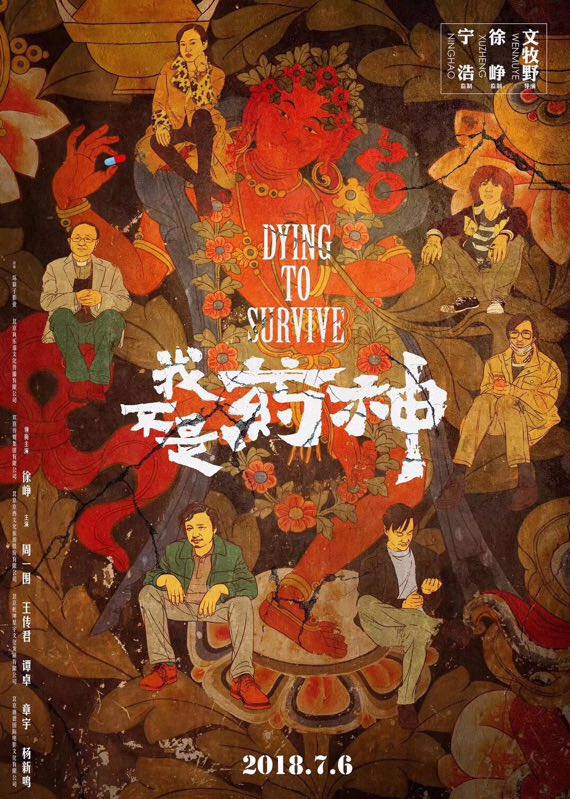
On the recommendation of several friends, my wife and I went to see China’s hit summer movie in Beijing last month. Called “Dying to Survive” in English — the Chinese title 《我不是药神》 translates as “I Am Not the Medicine God” — it’s an unusual blockbuster in that it’s not escapist action fare but a realistic social drama. It tells the story, loosely based on real events, of a Shanghai man who smuggled Indian generic cancer drugs for patients who could not afford the real thing.

It’s a pretty good movie and worth seeing (the print we saw in Beijing had English subtitles, so it’s accessible to non-Chinese viewers): it’s well shot, well acted, well edited, and if the tearjerker parts of the storyline are not too surprising, they are still moving and effective. The first half of the film is my favorite, thanks to its sympathetic and realistic depiction of the lives of people living at the margins of Shanghai’s glitzy society. The protagonist starts out as an obviously dodgy seller of supposed aphrodisiacs, and his partners in crime include a dancer in a club, a rural migrant working in a slaughterhouse and, most surprisingly, a Christian pastor.

But what’s really interesting about the film is how you can see the struggle between the demands of making popular art and satisfying official propaganda playing out in the open. How many dramatizations of social problems end by displaying on screen a detailed timeline of the government policy measures that decisively solved said social problem? (The Economist wrote a bafflingly wrong-headed article about the film, calling it “a radical departure from China’s film policy, which is to encourage the production of uplifting fare that presents the government in a good light.” They must not have stayed for the credits.)

At times “Dying to Survive” feels like two movies stapled together. When the main characters are on the screen, the tone is of low-key realism. But when the police and court system appear, everything changes: the actors are stiff and predictable, straight from central casting for one of China’s cookie-cutter state television dramas. The cops are upright, businesslike and effective, the judges wise and firm. They ensure that the drug smuggler is eventually brought to justice, and serves a prison sentence for his crimes. The message is: yes, high drug prices are a social problem, but that does not excuse breaking the law; the government will take care of things.

What’s more interesting is how the movie departs from the real-life story of Lu Yong, who did smuggle into China the Indian generic version of Novartis’ cancer drug Glivec (the drug did not have patent protection in India). Lu was himself a patient who needed the drug, while the movie’s protagonist Cheng Yong gets into smuggling because he needs the money, and then develops sympathy for the struggling patients over time. (Lu has publicly stated he was unhappy with being portrayed in this way, and said he had not been consulted or compensated by the producers of the movie.) This alteration is rather understandable, as it creates a more interesting story arc: Cheng Yong starts off as an unsympathetic character (he hits his ex-wife in an early scene) and gradually matures into a sympathetic one.

The real punchline is that Lu Yong never served a prison term for his smuggling. When he was brought before a court, the public outcry led the judges to release him. The true story, in other words, was even more like a movie than the movie: in the end, the morally upright hero is recognized for doing good deeds and praised rather than condemned. (In Lu Yong’s blog post about the movie, he says that the movie’s producers told him that a political leader had ordered that the movie play up the role of the government and play down individual heroics.) That courtroom scene would have been a triumphant climax for any other drama. But suggesting that popular morality can override the demands of the law was apparently a bit too dangerous.

I do think “Dying to Survive” is a successful piece of popular art, but it is one that shows very clearly the constraints under which it was made. For further reading, I recommend this piece by Richard Yu, in which he argues that it serves as a potential template for how Chinese movies can discuss social problems–as long as they celebrate the accomplishments of the government.

dying-to-survive

Nick Lardy on the crowding-out of private investment

The Australian National University’s annual free China Update book is bigger and more interesting than usual this year, in honor of the 40th anniversary of the start of reform and opening up in 1978. It’s got contributions from lots of prominent China economists that I have only begun to work my way through.

Naturally, I immediately checked out the chapter on private sector development by Nick Lardy. It’s quite a useful update to his work on the economic weight and role of the private and state sectors, and includes a careful, data-driven assessment of the resurgence of state enterprises under Xi Jinping. Here is a section where he identifies the symptoms of the crowding-out of private investment by SOEs:

The most plausible explanation of the waning of private investment is crowding out—an explanation supported by several pieces of evidence.

First, the share of bank loans to nonfinancial corporations that went to private firms fell from 57 per cent in 2013 to only 19 per cent by 2015, while the share that went to SOEs almost doubled over the same period—from 35 per cent to 69 per cent.

Second, financing of private firms through microfinance companies stalled after 2015. Lending by these companies grew rapidly from 2008, when the People’s Bank of China and the China Securities Regulatory Commission first issued formal guidelines on microfinance companies. The volume of such lending levelled off at just less than RMB1 trillion in 2014, but has not grown since.

Third, between 2011 and 2015, SOEs’ profits rose by only RMB30 billion, or 1 percentage point, while the investment of these firms rose by almost RMB2 trillion, or more than 20 per cent. Much of the differential between the growth of investment and the growth of profits must have come from increased borrowing from banks.

Fourth, indirect evidence suggests that SOEs have borrowed increasing amounts of funds to cover their financial losses. In 2005, 50 per cent of all SOEs were lossmaking. By 2016, the share of lossmaking SOEs had declined slightly, to 45 per cent. Thus, roughly half of China’s SOEs for more than a decade have been unable to fully cover their cost of capital. Moreover, the magnitude of losses generated by lossmaking firms increased sevenfold, from RMB243 billion in 2005 to RMB1.95 trillion in 2016. As a share of GDP, these losses doubled, from 1.3 per cent in 2006 to 2.6 per cent in 2016.

The interesting question at the moment is how this crowding-out of the private sector evolves in response to the government’s campaign to rein in financial risks. Surprisingly, one of the big casualties has been investment by state entities: there’s been a sharp slowdown in infrastructure investment as the central government has tightened controls over local government fundraising. Mostly as a result, the non-state share of fixed-asset investment rose to 65% in the first half of 2018 from 63% in 2017.

But it would be unusual for tighter financial conditions to really benefit private-sector firms, which tend to be smaller and riskier borrowers than state firms. And there is indeed a great deal of official concern at the moment over small businesses losing access to credit.

(Also see this previous post for other references on the crowding-out of private-sector investment.)


Richard Bush on Xi vs Trump, or, who is the real Maoist?

Richard Bush from Brookings has come up with the best point-by-point comparison of Xi Jinping and Donald Trump, the two most important global political figures of the present moment, that I have yet seen.

Some of these points may seem obvious by now, but there is always value in a concise and clear summary, and I thought this was exceptionally concise and clear. I also largely agree with it. I have lightly edited the bullet points below for clarity:

The similarities:

  • Ambition. They each have grand and similar ambitions for their countries: the great rejuvenation of the Chinese nation and making America great again.
  • Self-regard. They each have a high estimation of their own ability to lead their countries and confidence that they can overcome all obstacles. Each believes he is above the law and each in his own way. Xi has worked to ensure that the courts are subordinate to the Communist Party and to create extra-judicial mechanisms. Trump wants a law-enforcement system that is loyal to him.
  • Nationalism. Each is tapping into nationalist sentiment. Xi plays on the public’s desire to restore China to a global leadership role. Trump plays on the fears of white people about non-whites, both immigrants and native-born.

The differences:

  • Institutions. Xi basically accepts China’s political institutions. He believes they work and that they can be improved. Much of what he has done is to restore the Party’s leadership role. He is confident about his ability to work within China’s institutional structure. In this regard, he is very much like Deng Xiaoping and Liu Shaoqi, but like Liu, he wants the CCP to penetrate most sectors of Chinese society. Donald Trump rejects the role of institutions and the limits they place on himself. He regularly criticizes America’s governing institutions and works to undermine them. In this sense, he is something of a Maoist.
  • Program. Xi Jinping has a much more systematic vision of what he wishes to accomplish and how to get there. Trump thinks in terms of slogans and does not appreciate the contradictions among his various goals. Each leader appears to be a populist but Xi is a genuine populist and Trump is a sham populist.
  • Discipline. Xi Jinping is very disciplined in his leadership style. Trump thrives on chaos, which he does everything to create, and he cares very much about his image and whether others respect him.

The whole speech on US-China relations from which this is drawn is very much worth reading.

There are laws of history, and they work in China’s favor

The latest issue of Bill Bishop’s excellent Sinocism newsletter pointed out an interesting speech by Kevin Rudd analyzing recent Xi Jinping’s official pronouncements on foreign policy. Here is the section that jumped out at me:

There is a second element to the June 2018 Conference which grows out of the first. It is Xi’s deeply Marxist, dialectical-materialist view of history based on permanently evolving “contradictions” between what dialecticians call thesis, antithesis and synthesis. In Xi’s view, this in turn gives rise to defined “laws” of historical development which are both prescriptive and predictive.

This may sound like old-fashioned Marxism. That’s because it is. The intellectual software of generations of Chinese leaders has been shaped by this conceptual framework for interpreting and responding to what they define as scientific, objective reality. And Xi Jinping belongs to that tradition. Remember he has already convened special study sessions of the politburo on understanding both dialectical and historical materialism in the past.

According to the conference report: “Xi suggested to not only observe the current international situation, but also review the past, summarise historical laws, and look towards the future to better understand the trend of history.” Furthermore, according to the same report in Xinhua, to obtain “an accurate understanding of the overall situation, Xi underlined not only the observation of detailed phenomena, but also a deep appreciation of the essence of the overall situation in order not to get lost in complexity and the changing international situation.” Xi concludes on this count by stating that “throughout human history, the development of the world has always been the result of contradictions intertwining and interacting with each other.”

Once again, all this will seem more than a little arcane. But in the ideological dialect of the Communist Party, it seems to mean several things. First, that there is nothing random about what is unfolding in the world today. Second, these reflect certain immutable laws of political and economic development. Third, the business of Chinese foreign policy is to use this dialectal prism to understand precisely what is happening in the world today, why it is happening and what to do about it. And fourth, applying these disciplines to the current period, it means that the global order is at a turning point with the relative decline of the US and the West, with this coinciding with the fortuitous national and international circumstances currently enabling China’s rise.

This sounds very much like a conclusion that I also have come to: Xi Jinping’s thinking really comes out of a 19th-century social-science worldview. He has a high degree of confidence that objective laws governing the workings of society and the economy exist, that knowing these laws does not pose any particular philosophical or practical difficulties, and therefore that these laws form a solid basis for government policy (see my post “Reading the Communist Manifesto with Xi Jinping“).

Since the Chinese Communist Party has figured out these rules, it can have a high degree of confidence in the success of its policies. Far being a cynical post-truth manipulator like Putin, Xi gives every sign of being a true believer in his brand of pseudo-scientific, authoritarian, developmental Marxism. His confident nationalism in foreign policy and confident interventionism in economic policy are both underpinned by a high degree of epistemic confidence that he knows how the world really works.

Should China be in the Global North or Global South?

I’ve never been a big fan of the terms “Global North” and “Global South,” which in some quarters are used as synonyms for “developed” and “developing” economies. This is mainly because their actual meanings are too disconnected from their literal meanings. If the south of the globe means anything, it means the southern hemisphere. And yet the “Global South” is conventionally understood to include China, which is, let’s face it, in the northern hemisphere. To me, it doesn’t seem to clarify things to use a term from geography in a way that makes its geographical meaning incoherent.

So I was interested to come across William Polk’s new book Crusade and Jihad: The Thousand-Year War Between the Muslim World and the Global North (thanks to a nice review by Malise Ruthven), in which the conventional identities of the Global North and Global South are slightly altered. He calls the Global North “the relatively rich, advanced, and formerly imperial powers” and the Global South “the relatively poor, traditional, mostly former colonial peoples–here, specifically those of the Muslim world.”

Yet China and Russia are, in his view, unquestionably members of the Global North, along with usual suspects Britain and France. Not being a small-minded geographical pedant like myself, he does not focus too much on the fact that both are located in the northern hemisphere. What seems to matter for Polk is that they were clearly imperial powers, who acted toward Muslims in ways not very different from the imperialists of Western Europe. Here is an example:

When the Northern powers set out to conquer and control the Muslim South, they saw Arabic as a sort of defensive wall. It encircled nations and united generations. The Chinese, Russian, British, and French imperialists each tried to suppress it and to replace it with their own languages. …

In dealing with the Chinese-dominated Turkish-speaking peoples of Central Asia, Chiang Kai-shek went even further than the British and French imperialists. Following revolts in 1933 by the Kazakh peoples and the proclamation in 1944 by the Uyghurs of the short-lived East Turkish Republic, Chiang decreed that there were no such people as the Turks, even though the Chinese had a name for them, Chantou. He said that they were just part of the “greater Chinese race.” He tried to force Turkish speakers to give up their native language and learn Chinese. Chiang’s successors in the People’s Republic of China still employ his policy: they are linguistically “denationalizing” the Uyghur people.

At the same time as Chiang was suppressing the Uyghurs, Joseph Stalin was tightening the linguistic screws on the Asian peoples who had been conquered by the tsars. The better to dominate them, the Soviet Union divided what had been the common written language (Ottoman Turkish) “horizontally” by converting all written materials from the traditional (Arabic-based) script first to Latin in 1926– 1927 and then to Cyrillic in 1936.

I have to say that this grouping makes some sense to me. It is useful to recall that the only only major nineteenth-century imperial power whose borders are largely unchanged today is China.

China is these days unquestionably a great power, whose relationship with other developing countries is not exactly one of equality. The term “Global South” was originally coined in the 1970s, when it was more plausible to see China as differing from other developing countries mainly in its size. I wonder if Polk’s book might mark the beginning of a rectification of these names for groups of countries, for a time when it seems more appropriate to put China in with other large economies and great powers.

51lnhhi3fol-_sx329_bo1204203200_

The size of a problem matters

Dominique Fong at The Wall Street Journal has checked in on Ordos, Inner Mongolia, and found that China’s most famous ghost town–the new district of Kangbashi–is still, well, pretty ghostly:

Local officials had hoped to attract a million people to the new area, nearly matching the size of the old city 20 miles away. Architectural showpieces—a museum in the form of a giant metallic bean bag, a library resembling a shelf of books, a sports stadium reminiscent of a modern Coliseum—were built as attractions. Officials have since reduced their population goal to 300,000, and they are just halfway there. An early resident, Hu Richa, has been waiting seven years for more neighbors. Still, he says, “There’s barely anyone living here.”

The city has spent 14 years planning, erecting and maintaining Kangbashi, which has the distinction of being one of China’s best-known “ghost towns”—gleaming but sparsely populated new urban centers adjacent to older metropolises. Built by the dozen across the country, the new areas reflect—and were meant to accelerate—China’s economic boom. As the country’s growth has slowed, many of them have become serious liabilities, deep in debt, with little prospect of full occupancy anytime soon. …

According to a study by Lu Ming, a professor at Shanghai Jiao Tong University, 272 new districts across China have been built with borrowed funds near existing cities. Other researchers, using different definitions for ghost towns, find smaller numbers, but all agree that there is a serious problem.

While I don’t really disagree with anything in this piece (in which one of my colleagues is quoted), I have to say that I find the limited analysis a little frustrating. The ghost town phenomenon has been extensively reported for several years now, and yet the Chinese property market strangely refuses to collapse in the way that these reports always suggest it should. Construction starts have been growing pretty consistently for the past two and half years, and have actually accelerated some this year.

At this point in the China story I feel like saying “there is a serious problem” and stopping there is not really sufficient. It is of course not wrong to point out that China has lots of capital misallocation and has been heavily reliant on expanding debt to drive growth. But many people have correctly identified problems in the Chinese economy, and yet they have not been correct about the trajectory the economy would take.

In my view, outside observers of China have not been so good about understanding 1) the actual size of problems, 2) the constraints on policymakers’ ability to address problems. It is easy to suggest that problems are extremely large or cannot be easily solved, but it would be better to put more effort into identifying just how big problems are and how they might be addressed.

The ghost town phenomenon is a good example where the relative size matters a lot. Both anecdotal and statistical evidence suggests these huge clumps of unused housing are concentrated in northern China, in areas more reliant on resoure extraction and heavy industry. The property markets in these areas are certainly troubled, but they are also a relatively small part of the national total. The construction and sales recovery of the last few years has been driven mostly by southern and central China, where populations are growing and inventories are in fact quite low.


On reading ‘Alive in the Bitter Sea’

Fox Butterfield’s China: Alive in the Bitter Sea is the original China journalist’s book of the modern, post-Cultural Revolution era, and it holds up quite well today. Published in 1982, it captures China at a remarkable and delicate turning point: a time when the old system had lost all credibility thanks to the exhausting turmoil of the Cultural Revolution, but it was not yet clear what new system would come to replace it.

By his own admission, Butterfield completely missed the economic renaissance that was beginning to unfold during his time in China, possibly because he was prevented from traveling to the rural areas where the most dramatic changes were taking place. But for me this adds rather than subtracts to the book’s value, because it is not shaped by the false confidence of hindsight, and reflects all the doubts and uncertainties of the time. Given all the China-model triumphalism that is going around today, it is useful to recall that in 1980 no one knew that an economic miracle was about to unfold in China, least of all the Chinese.

But Butterfield was a good enough reporter that there are plenty of hints of what was to come in his interviews. One of many excellent anecdotes in the book is the following:

By lucky chance, on the night before I left China, a friend arranged for me to have dinner with a member of Mao’s family. My friend specified we could meet only if I agreed not to divulge the man’s identity–he lived a precarious existence–and I assented.

He turned out to be a dignified, reserved middle-aged man with a high forehead and swept-back hair reminiscent of Mao. Whenever he mentioned Mao, it was always as “the Chairman.” He wanted to talk with me, he said, because he felt there was misunderstanding about Mao. Mao was not a conservative, he insisted, he was always open-minded. He loved to read books–when he went on tours of the provinces, the one thing he took with him were cartons of books, and his bed was always half covered with unread volumes. …

When dinner was finished, Mao’s relative wanted to ask me a question. Why, he pondered, was China so backward compared to Japan? One hundred years ago they had been at the same level. “Is it because socialism is not as good as capitalism?” he asked.

It was an awkward situation. I felt embarrassed to evaluate China’s adoption of communism in front of a member of Mao’s family. But then he answered for me.

“In theory, socialism is excellent,” he said. “It provides for economic as well as political democracy. But in practice, it has shown weaknesses. We let the state and the bureaucracy grow too strong and prevented the development of individual initiative. China needs to find some way to combine the two systems.”

Would the Chairman feel the that way? I asked.

“The Chairman was always prepared to learn,” he answered.

Thanks to Lucy Hornby for recommending this book to me.

51rk8cqcxrl-_sx330_bo1204203200_


A Weberian analysis of Xi Jinping’s power

A  long essay by Chinese constitutional scholar Jiang Shigong has been making the rounds of China-watching circles, thanks to an impressive full translation by David Ownby (Don Clarke has made some interesting comments on it already). It’s a fascinating document in a kind of court philosopher mode, with Jiang interpreting the Communist Party’s current political priorities and leadership into an intellectual framework using both Chinese history and Western philosophy.

One part that I found particularly surprising and interesting was Jiang’s analysis of Xi Jinping’s consolidation of power in terms of Max Weber’s tripartite classification of authority:

In terms of Weberian theory, General Secretary Xi Jinping’s position as the core of the Party center, the core of the entire Party, his authoritative position as leader, arises not only from the ‘legal authority’ obtained by virtue of his legally defined positions as Party Secretary, National Chairman, Chairman of the Central Military Committee and not even from the ‘traditional authority’ born of the Party’s historical tradition.

More important is the fact that Xi Jinping, at a particular moment in history, courageously took up the political responsibility of the historical mission, and in the face of an era of historical transformation of the entire world, demonstrated the capacity to construct the great theory facilitating China’s development path, as well as the capacity to control complicated domestic and international events, thus consolidating the hearts and minds of the entire Party and the people of the entire country, hence becoming the core leader praised by the entire Party, the entire army and the entire country, possessing a special ‘charismatic authority’.

One of the interesting things about this passage is that it comes remarkably close to admitting that there is in fact a cult of personality around Xi Jinping: “charismatic authority” in Weber’s formulation is based on people’s personal devotion to the leader and their belief in his special qualities. Perhaps this Weberian terminology is a useful way for his supporters to recognize that Xi Jinping has in fact shifted toward personalized rule without evoking the more problematic Communist precedents of Mao and Stalin.

But I think Jiang’s framework is not just interesting as propaganda: it is significant, I think, that he argues that Xi possess all three forms of Weberian legitimate authority: traditional, legal, and charismatic. This analysis in my view is correct, and actually helps us understand how Xi differs from his predecessors.

Xi is more powerful than Hu Jintao because he has a charismatic authority that Hu never managed. But Xi’s charismatic authority is a complement to his traditional and legal authority, not a replacement for it. This is the major way he differs from Mao Zedong, who tried to use his personal charisma to overthrow tradition and law. Xi is an organization man as well as a charismatic figure, who has put lots of effort into clarifying bureaucratic reporting lines and emphasizing traditional morality–things that Mao never had much time for.