Privatization, growth and inequality in Russia and China

There was an interesting presentation at the AEA meeting in Philadelphia from the team working on the World Wealth & Income Database that included a comparison of how privatization and inequality developed in Russia and China (link for AEA members).

The data work is quite impressive and useful; here for instance is a lovely chart showing the trajectories of privatization across China and Russia, with comparisons to the Czech Republic and the advanced economies:

public-wealth

This doesn’t change the usual understanding that Russia pursued a “big bang” or “shock therapy” approach to the privatization of state enterprises in the early 1990s, while China moved later and more gradually, but it does illustrate it very vividly (Czech appears to have pursued a strategy somewhat intermediate between the two).

Another noticeable trend in the data, which was not really discussed by the authors, is the flatlining of China’s public wealth share after around 2006. This fits nicely with my own observation that SOE reform and privatization came mostly to a halt in the period from 2003-06, partly in response to concerns about insiders illicitly enriching themselves off the privatization process. For instance, the phrase “preventing the loss of state assets” made its way into high-level policy documents for the first time in 2003, and is still being invoked today.

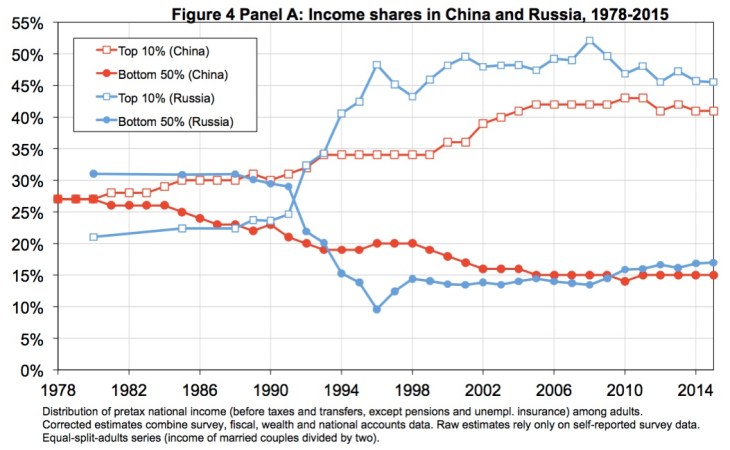
Why Chinese policymakers would want to avoid a Russia-style outcome is nicely captured in another chart on the evolution of inequality:

income-share

This data seems to make it pretty clear that the extreme increase in Russian inequality was indeed closely linked to the early 1990s privatization process, as has long been clear from more anecdotal and historical accounts. Other data presented by the authors (Filip Novokmet, Thomas Piketty, Li Yang, Gabriel Zucman) show that private wealth increased in Russia largely at the expense of public wealth–in other words, as a result of the transfer of assets–while in China private wealth increased more steadily as a result of rapid economic growth and housing reform.

I’ve been quite critical of China’s policies for state enterprises for a while now, since I think the lack of progress on privatization has allowed SOEs to become more inefficient and blocked the growth and market access of private firms. So this paper was a useful reminder that in the early 2000s China’s government had good reasons for wanting to be cautious about privatization.

The paper also suggests to me that Russia had two policy failures not just one: yes, privatization was mismanaged, but it also failed to drive broad economic growth in the aftermath of privatization. These two failures were obviously not unrelated but they are also analytically separable.

I don’t think that a resumption of SOE privatization in China would mean that broad-based economic growth would suffer; quite the reverse in fact. Measured inequality would probably increase as a result of more privatization, but I also doubt that current figures are really capturing the inequality produced by corruption and rent-extraction by SOE insiders.

There is more detail on all this in the original WID papers on Russia and China, which I haven’t yet gone through closely.

Tianjin’s 1955 campaign to expel rural migrants

The recent forced eviction of thousands of migrant workers from Beijing (see this ChinaFile discussion for an overview) has been a rather depressing confirmation of what I wrote about in my socialist urbanization series of posts earlier this year. China’s urbanization policy is, unfortunately, still captive to a vision of top-down management of population flows with its origins in socialist planning.

While there were campaigns to push migrants out of Beijing earlier this year, the latest one has been notably harsher, and has attracted much more public criticism. I can’t begin to sort through everything, but one interesting tidbit did turn up in the flood of online commentary. An article from 2016, describing a 1955 campaign to expel rural migrants from Tianjin, has been reposted across the Chinese internet–without additional commentary, since the parallels are pretty obvious to everyone.

It’s interesting enough that I have translated several excerpts from it below:

After Tianjin’s port opened in 1860, rural villagers gradually developed a tradition of seeking work there, because of Tianjin’s advantageous geographical location and transport links, along with the difficult conditions in surrounding rural villages. After the foundation of New China [in 1949], the spontaneous movement of peasants into Tianjin did not decline. In just seven days in March 1953, more than 1,450 people “blindly” moved into urban districts. In the year from January 1954 to February 1955, the rural population migrating to Tianjin reached 119,923 people.

From the perspective of the government, peasants “blindly” migrating to Tianjin was not beneficial to the city or the countryside. Therefore, in 1955 Tianjin carried out its first campaign-style program of “mobilizing the blind inflows of people into Tianjin to return to the villages and work.” This program used many kinds of mobilization strategies simultaneously, and in the end, many tens of thousands of rural migrants in Tianjin were successfully returned to their villages. In the following decade, the Tianjin government repeatedly organized campaigns to return peasants to their villages, but generally their methods were based on the 1955 campaign.

The government was fairly worried about all the peasants moving on their own into the city. At the time, the Tianjin Municipal Committee said: “After these people move in, the vast majority do not find work, and become part of the city’s consumer population, adding to the burden on the government.” But this statement is not entirely consistent with the actual situation at the time, and did not help people understand the true reasons why rural people were moving to the city. According to the statistics of one police station in Tianjin for February, April and October of 1954, “after these people came to the city, 21% found steady employment, and 23% found irregular employment.” That is to say, in the area covered by this police station, 44% of the rural migrant population had found work. …

One of the ways peasants would make a living in Tianjin was to use city friends or relatives, or the labor market in Wandezhuang, to find positions as temporary workers or apprentices in factories, mines, enterprises and shops. Another was for them to carry their own simple tools and walk down the streets and alleys asking for work. …In fact at the time, because grain rationing had not yet been implemented in the cities, and urban wages were fairly high, they could feed their families. From the perspective of the peasants, moving to the city is the natural result of a rational calculation.

But this was not the case from the government perspective. The development strategy of prioritizing heavy industry limited the ability of the city’s labor market to absorb new workers. According to statistics, every 100 million yuan of investment in light industry would require 16,000 workers, but the same investment in heavy industry would require only 5,000 workers. … After the start of the heavy industry construction under the First Five-Year Plan, investment in commerce and services gradually declined. One result was that people’s life in the city became less convenient, it became harder to find places to eat or make clothes; another result was that the number of job openings shrank, and Tianjin’s job market could not absorb all the people coming from the countryside.

The large-scale migration of peasants also reduced the farm labor force and threatened agricultural stability, and with it the national plan for economic development. The propaganda of the time said: “if agricultural development cannot keep up with the demands of industrial development, and industry cannot obtain sufficient supplies of grain and raw materials, socialist industrialization cannot be achieved.”

Overall, from the government perspective, the “blind” migration of peasants to the city damaged the order of the nation’s planned economy, worsened the pressure on urban employment, reduced the productivity of the countryside and affected agricultural output. It’s worth pointing out that in 1953 and 1954, Tianjin carried out two operations to discourage rural migration, but because only regular methods were employed, they were not very effective.

Because of the increasingly serious in-migration problem, in 1955 the Tianjin Municipal Committee decided to launch the first focused, citywide operation to mobilize the migrant population to return to the villages, led by the Party committee and the government and assisted by multiple departments. This operation required all work units to “take effective measures to ensure the migrant population in a planned and step-by-step manner returns to their villages to participate in production, and to prevent continued blind inflows of external population to the city in the future.” Designated as a project with “historical significance for the work of socialist transformation,” it was Tianjin’s first campaign-style peasant mobilization since 1949, and policymakers had high expectations for its success.

“Propaganda and education” was very important to the mobilization work. Compared with the Communist Party of the Soviet Union, the Chinese Communist Party is better at techniques of “persuasion and education,” and these were used the most. … But in practice Tianjin also used administrative measures relating to labor, household registration and grain to consolidate and expand the initial results of the mobilization campaign.

From 1949 to 1954, the city government’s administration of hukou was fairly relaxed. During this period, due to the relevant provisions of the “Common Program” [the temporary constitution of 1949] on the right to freedom of movement, Tianjin basically did not restrict the transfer of hukou and migrants could apply for an urban hukou as long as they had migration permits. However with the 1955 campaign to mobilize peasants to return to their, such a relaxed policy was no longer appropriate, and in July the Tianjin Municipal Committee restricted the hukou registration of “people blindly entering Tianjin from the countryside or other places.” However, the ability of the household registration system to control migration would not have been great without its being linked to grain supply and employment.

In August 1955, the State Council and Tianjin Municipality announced the start of the grain rationing system in Tianjin. Each resident of Tianjin would be issued grain vouchers for a fixed amount of grain, depending on their work and age, and grain would be supplied according to the vouchers. Without a Tianjin urban hukou, it was not possible to complete the procedures to obtain grain vouchers, and thus impossible to buy grain. The supply of grain was also limited: in 1955, the first allocation plan called for distributing an average of 26.51 pounds per person, 2.81 pounds less than the original plan. Many people felt that this was not enough to entertain friends or family, or make festive dishes for the holidays. Because the grain quotas could only satisfy, or not even completely satisfy, their own needs,  urban residents found it difficult to assist their rural friends and relatives.

For those unemployed workers that fit the profile of those to be returned to their villages, the Tianjin municipal employment agencies stopped providing job placement services, and stopped or delayed their unemployment relief. In May 1955, the Tianjin Administration of Industry & Commerce also carried out a campaign to ban unlicensed street vendors, and to mobilize rural street vendors to return to their villages. In August 1955, the effort was expanded to licensed street vendors who met the requirements for being returned to their villages. To encourage the vendors to leave, state-owned companies stopped supplying them with goods, and local police stations limited the distribution of grain vouchers. By the second half of 1955, those peasants doing business on the streets of Tianjin could tell which way the wind was blowing. …

By mid-February 1956, when the mobilization campaign concluded, 126,324 peasants in Tianjin had been mobilized to return to their cities, and the flow of population into the city had been greatly reduced. …

Before the founding of New China, the Chinese Communist Party thought of peasants as the predecessors of workers, and that therefore in the future many millions of peasants would enter the cities and work in factories. But after the founding of New China, the government did not welcome the rural population spontaneously flowing into the cities. It thought that the building of the nation must be carried out in a planned and organized manner, and that peasants must not be blindly drawn into the cities.

The author is Wang Linran, a historian at Nankai University in Tianjin. The Chinese citation for the original article is 王凛然,《“进城”与“还乡”:1955年农民“盲目”进津与政府应对》, 《史林》,2016年,第4期,第157-168页.
tianjin-1956

A Tianjin coop in 1956

Chinese economic history as seen through eyeglasses

I recently got a new pair of glasses from an American optician, after almost two decades of buying my glasses in China. There was definitely some sticker shock on my part: it really drove home how the relative prices of customized labor-intensive goods can dramatically differ between a high-labor-cost economy and a lower-labor-cost economy. But it also made me think about all the various places in China I have bought glasses from over the years, and how they changed as the economy developed.

The first pair of glasses I bought in Beijing, probably somewhere around 1998-2000, was from a big state-owned store on the Wangfujing shopping street (it’s not there anymore of course, the redevelopment down there has left only a few landmarks untouched). It was classic SOE retail: massively overstaffed by lots of officious middle-aged employees in white jackets, who make you fill out paperwork in triplicate just to pay the bill. But it was well known and trusted–not perhaps to give you the absolute best deal, but to ensure some basic level of quality and not completely rip you off. While there’s not much state-owned retail around these days, consumer-facing SOEs still tend to trade on that higher level of trust.

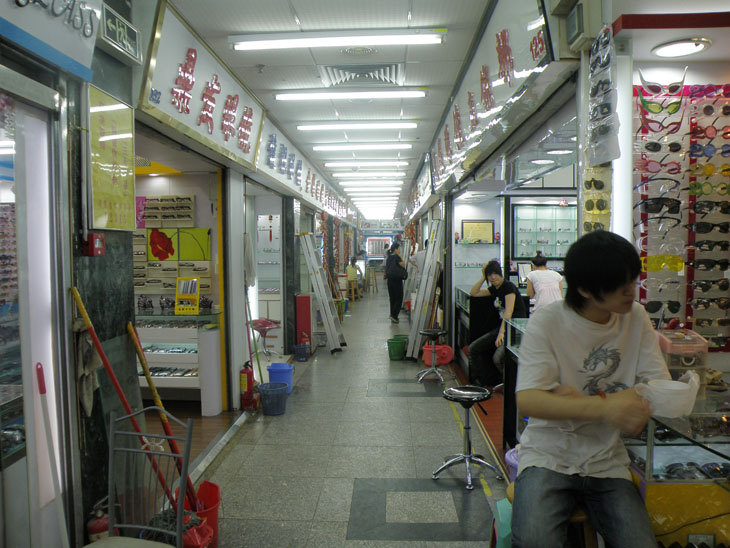
In later years I was introduced to the wonders of the “glasses city” (眼镜城): massive buildings featuring floors and floors of nothing but opticians, who will measure your prescription and grind out your lenses in a few hours. On various occasions I went to two different ones, both in the Panjiayuan area. No licensing, no regulation, no safety standards (the haze of toxic fumes was worrying), but wow, overwhelming choice and unbelievable prices. The lack of barriers to entry was also apparent in the people running the stores too: rather than the local Beijingers who staffed the state outlets, they were often migrants from places like Fujian.

Here was a rare real-world example of almost-perfect competition. The tradeoff was almost exactly the opposite of the state store: low prices in exchange for low levels of trust. With hundreds of suppliers, doing any kind of systematic comparison shopping would take more time than it was worth–so it was normal to get a friend or relative to provide an introduction to a reliable shop.

OLYMPUS DIGITAL CAMERA

But eventually the shopping adventure in the glasses city started to get tiring, and I wanted something less random and exhausting. My wife was also encouraging me to get higher-quality glasses. For my last couple of pairs, I headed to local-brand chain retailers. While in the U.S. it seems like the high end of the eyewear market is occupied by independent opticians and chain stores cater more to budget shoppers, it’s the reverse in China: the independent operators are in the low-end glasses city, and the larger operations go after the higher-end market.

Still, the experience was a bit more like developed-world retail. Prices are higher, but (perceived) quality is also higher. Of course there is competition, but much effort goes into mitigating its effects, and on upselling the consumer with endless options and upgrades, all presented as backed by the latest technology and medical research. You come out with a pretty good pair of glasses, but also the feeling that you did not quite understand what you just bought and are not exactly sure why you paid what you did. But overall the model is not as medicalized as in the U.S., where opticians act as healthcare providers and “prescribe” glasses–trying to take advantage of the fact that you are not supposed to bargain over healthcare costs.

These three types of shopping experience do, in hindsight, seem to match up rather nicely with the different stages of China’s economic life: from the socialist 1970s, to the explosion of hyper-competitive small businesses in the 1980s and 1990s, to the more recent phase of consolidation and oligopoly and the rising importance of branding and fashion.

I do feel a bit nostalgic for the free-for-all of the glasses city. While it’s still there, I think it’s past its prime, as rising urban incomes mean that more and more of the population is probably making the same calculation I did: pay more in order to spend less time and get higher quality. And the next stage is clearly coming, though I haven’t bought glasses online yet in either country.

Westworld in China anecdote of the day

This has to be one of the odder side effects of the normalization of diplomatic relations between the US and China in 1979:

In the middle of all this, to set the seal on new-found friendship, in early February 1979 China’s supreme leader went off on his famous trip to the United States. Screened without commentary to an astounded television audience back home, the diminutive Deng Xiaoping was paraded nightly schmoozing with his new friend Jimmy Carter and assorted U.S. moneybags. Here he was at Simonton, Texas, at a rodeo, buried under a ten-gallon Stetson. There he was, taking tea and sandwiches in the palatial ranch-house style villa of a ‘typical’ American worker.

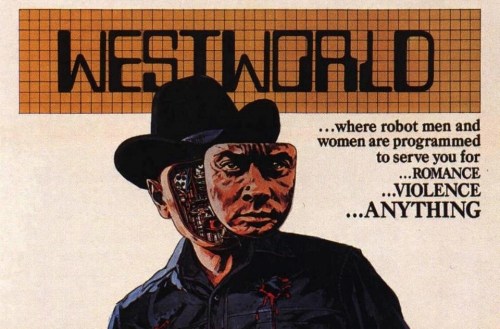
And this was the week, too, that our local cinema, and no doubt every movie-house in the nation, chose to screen Yul Brunner in Westworld.

Westworld’s story line has leading world statesmen invited to a subterranean lair in a Nevada desert crawling with rattlesnakes. Once there, their brains and organs are dismantled, to be replaced by robotic parts. Heads and bodies are then sewn up to create an end result indistinguishable from the human original. The robot ‘leaders’ are then despatched to their respective countries where they must do the bidding of an evil West World clique bent on ruling the universe.

This daft performance over, as we trooped down the concrete spittle-covered stairs of the cinema, I was all ears for audience reaction. Almost echoing my thoughts, though more literally, an elderly farmer grabbed my coat sleeves and proclaimed loudly: ‘Probably that’s what they’ll be doing to old Deng.’

That is from Richard Kirkby, Intruder in Mao’s Realm: An Englishman’s Eyewitness Account of 1970s China; the author was teaching English in Shandong province at the time.

westworld-original-movie-poster

apdeng1000-500x348

The spectacle of businesses begging to be beggared

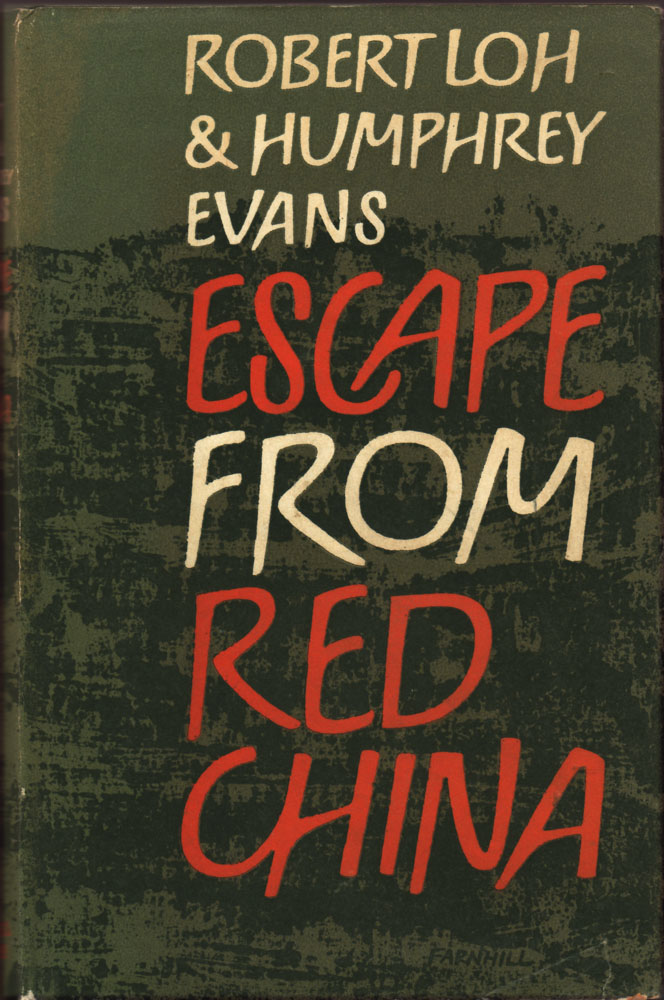
Robert Loh’s 1962 memoir, Escape from Red China, recently became available again as a low-priced ebook, and it deserves to be more widely read–and perhaps particularly so at this moment in Chinese history. It is a rare portrait of the early years of the People’s Republic, describing in vivid detail the progress of the Communist Party’s escalating political campaigns (Loh’s book is frequently cited in Frank Dikotter’s history of the period, The Tragedy of Liberation: A History of the Chinese Revolution 1945-1957).

While there are many memoirs of the later Cultural Revolution period from people who experienced it as children or adults, first-person accounts of the previous decade are much rarer. Loh’s account is particularly valuable since he was a family friend of the famous Shanghai “red capitalist” Rong Yiren, and worked for him managing flour mills (Rong is thinly disguised under the pseudonym “J.P. Chan” in the book, but his identity is obvious). Loh thus had firsthand experience of how the Communist Party dealt with private business in this period.

A particularly interesting section of the book is his account of the build-up to the nationalization of private businesses after 1956. Rather than simply expropriate private firms at a stroke, the Party gradually put ever more pressure on them to place themselves in public hands:

The softening-up became apparent in late 1954 when the first pilot projects for Joint State-Private Enterprise were inaugurated. One or two firms from each branch of trade were chosen. The pilot projects were always the best equipped and most profitably operated firms. The State acquired part ownership of these firms by taking over the shares of such “counter-revolutionary elements” as the big investor T. V. Soong, by taking shares in lieu of the fines assessed under [the] Five-Anti [campaign], and even, in a very few cases, by actual investment.

These pilot Joint State-Private Enterprises were given every possible advantage. Their assets were evaluated fairly. The tax levies were just. Government low-interest loans were easily available. Adequate quantities of raw materials were supplied promptly. Labor problems were solved without bother or friction. Priority was given to these firms’ distribution and transportation facilities. In fact, the government saw to it that the pilot projects operated smoothly and showed a healthy profit.

In short, the capitalists who had the State for a joint partner did very well indeed. Each of them was made into a rosy picture of socialism’s glorious future.

On the other hand, the horrors of “free” private enterprise were depicted even more graphically. We “national capitalists” whose firms were not chosen for Joint State-Private Enterprise were “softened up” by being denied all of the advantages given to the pilot project owners.

My experiences at the flour mills were typical. The contempt and animosity I had been receiving from the mills’ Party Secretary became worse. The amount of wheat sent to us by the government had not been enough to keep our mills operating a quarter of the time; now we were sent less. Moreover, the fees paid for our work were reduced. Our losses therefore became even greater. We were still not permitted to go out of business, but bank loans became even harder to get. And, of course, the workers were made to demonstrate more frequently and violently against me.

Later, Loh describes how Mao decided to accelerate the rollout of this model of “joint” enterprises to all private companies. There was enormous pressure to make this appear to happen voluntarily, with local businesspeople handing in their “applications” for state partnership in public celebrations.

All the Chinese Communist propaganda at the time emphasized the “miracle” of businessmen happily surrendering their enterprises. The inference was that they clamored for socialism because its benefits had been proven to them by the patient, kindly, generous, always truthful, meticulously honest and infinitely wise Communists. People in the Communist bloc and the more naïve in the neutralist nations accepted this explanation without question. I have gathered that the Westerners, however, have been confused ever since by the picture of businessmen begging to be beggared.

It is true that the Chinese businessmen did exhibit wild enthusiasm, but they acted out of fear. Each had been made to understand that his future depended on his contribution during the “high tide of socialist transformation.” Once he had given up his enterprise, he knew that his sole means of livelihood would depend on the whim of the Communists. In short, he was struggling with almost hysterical intensity simply for survival.

Moreover, he knew he would not survive at all if he refused to apply for Joint State-Private status. Of the 165,000 firms in Shanghai, I knew of only one whose owner did not make the application. He was an elderly man whose enterprise was a medium-size paper mill. I spoke to him and attempted, for his own good, to make him change his mind. He was too panic-stricken, however, to face the future without the possession of the enterprise which, throughout his life, had been his sole means of security. He quickly lost his possession, of course; immediately after the campaign the government cut off his source of raw materials and refused to place further orders with him. The bank refused him loans. Within two months, he was bankrupt. He was sued by his employees’ Trade Union and by the Tax Bureau. He was arrested and sentenced to the work gangs of labor reform.

escape-from-red-china-book-with-dj-front-cover

I wouldn’t want to overdo the historical parallels with the present moment. But it’s true that the Communist Party is still a master of getting private companies to do what it wants, mainly by demonstrating how difficult life for them can be if they don’t.

The most obvious recent example is the crackdown on a group of high-flying private conglomerates, led by Wang Jianlin’s Wanda Group, which were pressured into abandoning overseas investments and selling billions of dollars of assets. “Wanda will respond to the state’s call,” Wang told Caixin when asked for an explanation of the sudden change of business strategy.

Another very interesting recent story is the reported desire of the government for big internet companies to “offer the state a stake” so that it can have a more direct role in managing social media and online commerce. It is hard not to hear some echoes of that 1950s push for companies to make voluntary applications to the state to take them over.

Thoughts prompted by an interview with CKGSB

Along with many other worthies, I was interviewed for a long article on state-owned enterprises in the Cheung Kong Graduate School of Business magazine. One of the questions that I was asked, which is one of the ones people always ask, is: aren’t SOEs bad for China’s growth?

Given that profitability and productivity is systematically lower in state firms compared to private firms, it seems like the answer should be yes. Yet it’s fairly clear that in China’s case, growth is higher than it would be otherwise, precisely because SOEs have maintained very high rates of investment spending. So the growth numbers are probably not where the economic effects of SOEs are most obvious. But I suggested that they can still be seen if you take a broader view:

“Having a large share of economic activity controlled by state-owned enterprises means larger potential for corruption, lower potential for innovation and a smaller range of opportunities for people to pursue different careers and lifestyles,” says Batson. “There are a lot of effects on how the economy is structured that make a difference to people aside from the effects on the growth rate.”

For me, the broader point that came out of this discussion was this: the question of whether China’s economy should be organized around a large role for SOEs is ultimately not a technical question about growth maximization but one about values, what kind of society is desired. As long as the costs are not overwhelming–as they were during the 1990s, when the entire state sector was losing money–the government can continue to pursue its socialist values. And so far the costs have indeed been manageable.

Which Chinese provinces are most dominated by state-owned firms, updated

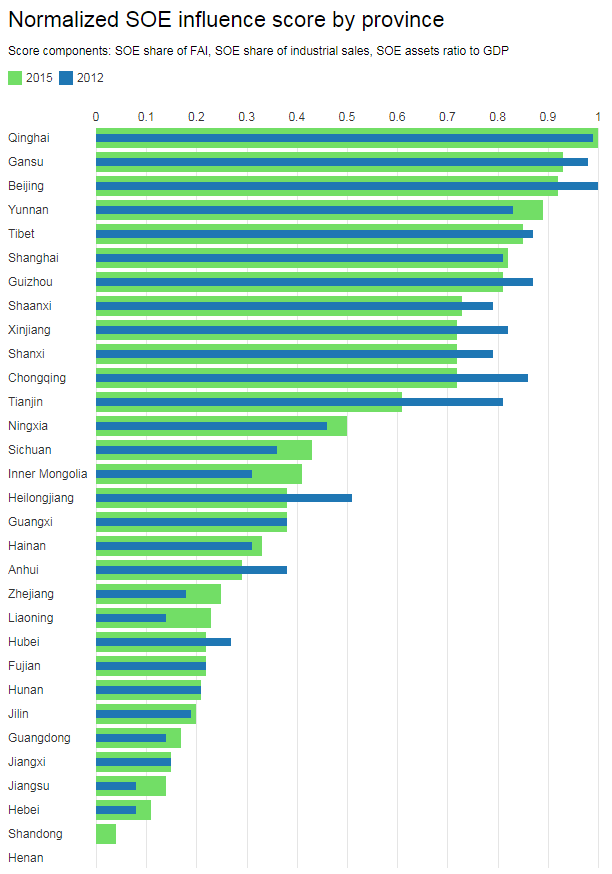
One of my earlier and wonkier posts on this blog was a way to score China’s provinces by the relative size of their state-owned enterprise sector. While anyone who has been to China can tell that some places are more state-dominated than others, the goal was to add some discipline to those kind of impressions. The underlying data for that exercise was a bit patchy, so I’ve updated the scores with more consistent data for 2015.

Below are the results; there’s not a huge amount of change, so I thought it would be more interesting to present the actual scores rather than a map (there’s one in the previous post). The score is computed by standardizing and summing the SOE share of fixed-asset investment, the SOE share of industrial sales, and the ratio of local SOE assets to GDP; the underlying data comes from Chinese statistical yearbooks.

SOE-influence-score-2015

Note that these are relative scores not absolute ones–the highest-scoring province gets a 1, which doesn’t mean the provincial economy is 100% state-dominated. A few interesting things to point out:

  • The poor western provinces have by far the most state-dominated economies. In part this is because their economies are small, in part it is because SOEs are one of the main channels through which regional redistribution happens in China. Poor western provinces get more state-sponsored infrastructure and investment projects. For instance, in Tibet 76% of fixed-asset investment spending is by SOEs, compared to a national average of around 32%.
  • The four provincial-level municipalities, Beijing, Shanghai, Tianjin, Chongqing, also have very high levels of SOE activity. Beijing in particular stands out with a very high score on all three components, despite the fact that, unlike Gansu or Yunnan, it has very substantial amounts of foreign investment and domestic private-sector activity, particularly in high tech. I think this is not a size effect since the municipalities have economies and populations larger than many provinces. In part I think it reflects their political importance and clout, which means more state activity.
  • It’s interesting that the three northeastern provinces have relatively moderate scores despite being generally portrayed as the bastions of state enterprise. My guess is that the northeast has not gotten the kind of infrastructure spending boost that the western provinces have, which is the main thing driving their scores so high. The assets/GDP metric also only covers local-government-controlled SOEs, where the northeast in fact ranks very low; they are home to more central-government-controlled SOEs which are getting missed by this metric. So, the score is not a perfect tool.
  • While there’s not a simple correlation between the SOE influence score and income levels or growth rates, it’s nonetheless true that most of the action in the Chinese economy happens in places that are not so state dominated. The four big coastal provinces–Guangdong, Jiangsu, Shandong, Zhejiang–are all at the bottom of the list, and account for a bit more than 25% of China’s GDP. The dozen most state-dominated provinces combined are still smaller than that: the four municipalities account for about 11% of GDP, and the other eight provinces that top the list account for about 10% of GDP.

The 1917 October Revolution lives on in China

Here in late October 2017, I am reading a lot about the centennial of the 1917 revolution in Russia, and a lot about the 19th Communist Party Congress in China. It seems strange to me that the connection between these two events is not being discussed more.

Surely it is obvious? The most consequential and long-lasting geopolitical legacy of the 1917 revolution in Russia has to be that in 2017 China is still governed by the Communist Party. And yet this fact is glossed over in a lot of the current discussion about the meaning and legacy of the October Revolution. I was struck by the fact that, in Sunday’s special issue of the New York Times Book Review on the revolution, not one book about China was reviewed.

In Russia today, the 1917 revolution hardly seems like a live issue. Shaun Walker has a nice piece in The Guardian pointing out how ambivalent the current government is about embracing the October Revolution, and how it is not being officially celebrated:

Putin has been equivocal in his statements on the revolution but has made it clear that his main issue is the violent seizure of power undertaken by the Bolsheviks. Putin has fetishised the sanctity of statehood, however distasteful the ruling regime may be: whether it be in modern-day Kiev or Damascus, or in tsarist Russia.

“When we look at the lessons from a century ago, we see how ambiguous the results were, and how there were both negative and positive consequences of those events,” said Putin this week, coming back to a thought he has expounded on many times before. “We have to ask the question: was it really not possible to develop not through revolution but through evolution, without destroying statehood and mercilessly ruining the fate of millions, but through gradual, step-by-step progress?”

This, ultimately, is the key message from the Kremlin as the anniversary approaches. Monarchists and the ultra-Orthodox are free to idolise Nicholas II; communists and nostalgics are free to look back on the Bolsheviks as the harbingers of a new civilisation, but state collapse and violent protests are always to be condemned.

Cut to China, where the government is sponsoring the publication of a nice new edition of Lenin’s Collected Works to commemorate the centennial of the revolution, and the government is proudly wrapping itself in the flag of socialism.

LeninWorks-Chinese

Top propaganda official Liu Qibao in September gave a fascinating speech to a meeting commemorating the anniversary of the 1917 revolution, which has recently been officially translated into English. I actually think the whole thing is worth reading, but here are a few excerpts to give a taste:

The October Revolution brought Marxism-Leninism to China. After the First Opium War (1840-1842), China was gradually reduced to a semi-colonial and semi-feudal society and the Chinese nation was plunged into deep suffering. … The October Revolution ignited a new hope for realizing national independence and people’s liberation.

… A century ago, China was poor and weak, and it was bullied by big powers. Since then, our country has gone through many setbacks and hardships before rising up and achieving glory. The Chinese nation has undergone unprecedented changes — from standing up to prospering and strengthening to establishing its position amongst nations of the world.

Never in history have we been closer to the goal of the great renewal of the Chinese nation, and never in history have we had greater confidence and capability to realize this goal. This tremendous change is attributed to the fact that we have chosen the path of socialism which was opened up by the October Revolution…

The epoch-making historical feat of the October Revolution and the major achievements of the Soviet socialism system cannot be negated by dissolution of the Soviet Union. The reasons behind the Soviet breakup are many, including rigidity and conservatism; yet, the root cause was its turning away from Marxism-Leninism and from the socialist path created by the October Revolution.

China’s Communist Party is therefore saying, in so many words, that because of the failure of the Soviet Union, the true legacy of the 1917 revolution today is to be found in China. This of course is propaganda, but it is also in some sense actually true.

It may be even more true than the Party would like to admit. Although the Soviet Union officially recognized the Nationalist government during China’s civil war, it also quietly put its thumb on the scales to support the Communists during their campaign to capture Manchuria. And it was fear of provoking the Soviet Union that kept the US from intervening more decisively to support the Nationalists. Arguably, the Communist victory in the civil war would have been impossible without this implicit backing of the Soviet Union (see my previous post on this history for more detail).

Because of China, it seems like the question of the legacy of the 1917 revolution is still very much a contemporary one, rather than something that can be relegated to the history books.

SDR inclusion as commitment device

Chinese central bank governor Zhou Xiaochuan recently gave an interview to Caijing magazine, on the occasion of the first anniversary of the renminbi’s inclusion in the currency basket for the IMF’s Special Drawing Right, or SDR, alongside the dollar, euro, pound and yen. This obscure piece of financial infrastructure improbably dominated the headlines for a while, as China waged a public campaign for inclusion. But most people could not figure out why SDR inclusion meant so much to China, and in the end the world seemed to decide that it was mostly a symbolic victory in China’s quest for global status. We haven’t heard much about the SDR since.

Zhou, though, still seems to think that SDR inclusion was a big deal. And since he has for decades been one of the main figures driving the modernization of China’s financial system, his track record is not that of someone who just pursues empty pieces of symbolism. Zhou is already past the normal retirement age and probably will not be in office this time next year, so SDR inclusion is part of his legacy. In the long interview (Chinese text here), he gives what I think is quite a revealing justification:

The entry of the renminbi into the SDR basket will produce a “ratcheting effect” for China’s opening up. This is like the ratchet on the rope in a volleyball net; when the net is tightened the ratchet latches on to the rope, so once it is set in position it cannot go back, cannot reverse. In English there is an expression, “past the point of no return.” Of course, in economics and society there is no absolute “ratchet,” I don’t mean that it’s absolutely impossible for there to be a reverse, just that it is very difficult.

In China’s reform and opening up process, whether in attracting foreign investment, liberalizing foreign trade, reforming the exchange rate, entering the WTO, etc, there were often some small reversals in the middle, or kind of a stop-and-go. But once we took that step, it was very difficult to go back.

After the renminbi entered the SDR, both international institutions and financial markets are using the renminbi more and more; international investors are using the renminbi to invest in the domestic financial market; laws and regulations have been revised; traders and exporters are all using new procedures. If you want to go backward, it is difficult, and the costs are high.

Perhaps another way of putting this is that SDR inclusion is a commitment device. In addition to the practical concerns raised by Zhou, there would also be reputational costs to reversing exchange-rate and capital-account reforms. Since SDR inclusion is contingent on the IMF’s determination that the renminbi is “freely usable,” it could conceivably be reversed if the currency were to stop being freely usable. What future Chinese central bank governor will want to see headlines screaming “IMF expels renminbi from SDR”?

Of course, China over the past year has in fact been de-facto tightening capital controls by stepping up scrutiny of overseas M&A and slowing down approval of foreign-exchange transactions. But it has done so largely by using its regulatory discretion rather than changing formal rules. So perhaps the commitment device is working some.

It is telling though that this justification for SDR inclusion is about consolidating and defending past reforms, rather than advancing new ones, though Zhou clearly wants to see those as well.

Lagarde-Zhou

Christine Lagarde and Zhou Xiaochuan in 2016


Hong Kong’s war of attrition against street hawkers

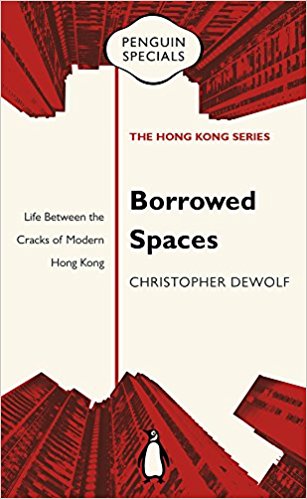
I enjoyed Christopher DeWolf’s Borrowed Spaces: Life Between the Cracks of Modern Hong Kong, the latest installment I read in the Penguin Hong Kong series. It’s a nice piece of reportage that helps fill in the little-known (to me anyway) history of street life and informal urban structures in Hong Kong.

The book is particularly good at providing an alternative perspective on how Hong Kong’s government actually works. To anyone who has spent time in Hong Kong, the idea that it has the world’s freest economy (as the Heritage Foundation perennially tells us) is just patently, obviously untrue. But even so I was fairly shocked to discover that the government has for decades been actively trying to get rid of the small-scale retail entrepreneurs known as street hawkers:

For years, activity in the streets of Hong Kong was only loosely regulated, but by the 1970s, the government decided it was time to assert more control. The theory at the time was that, as cities transitioned from “third world” to “first world,” such informal uses of urban space would dwindle as the economy developed and people became wealthier. One day, the reasoning went, there would no longer be any need for hawkers, dai pai dong, squatter villages or anything of the sort.

In light of this argument, the Hong Kong government opted for a policy of elimination through attrition. Squatter villages were frozen in place, their residents prohibited from expanding their homes until they could be replaced with public housing estates. Street hawkers were licensed and regulated.  …

The catch was that, while hawkers were still allowed to ply their trade, their licenses were made exceptionally hard to transfer. Even today, when a licensed hawker dies, his or her license can only be transferred to a surviving spouse. The intent was to eventually eliminate all street hawker stalls, and this 1970s-era policy is now well on its way to achieving that goal. In 2015, there were just 6,133 licensed hawkers in Hong Kong; another 1,440 work illegally.

The biggest markets are thriving, including the always busy meat, seafood, fruit and vegetable stalls around Nelson Street and Canton Road, but many of the secondary markets are withering away – not for lack of business, but because the government is actively relocating stalls and buying back hawker licenses in order to clear the streets. Between 2013 and 2015, a total of 481 hawkers surrendered their licenses. …

It is hard not to notice that shrinking opportunities in this part of the economy have coincided, at least, with the general decline in entrepreneurship and social mobility:

The crackdown on informal life isn’t necessarily responsible for the persistent inequality and decline of social mobility in Hong Kong, but there’s a case to be made that it has exacerbated the situation by denying people access to affordable products and the ability to become entrepreneurs.

51jnihqzzml-_sx305_bo1204203200_