Is steel excess capacity a symptom of China’s system, or of its size?

The wave of Chinese steel exports hitting world markets is one of the most visible ways in which the country’s domestic slowdown is affecting the rest of us. All too visible, as it is leading to the shutdown of steel plants across Europe and prompting many countries to push for anti-dumping tariffs on Chinese steel.

How should we understand this phenomenon? The usual tendency, among both Chinese and foreign observers, is to attribute Chinese problems to distinctively Chinese causes. China is always different, it stands alone culturally, politically, economically. So the tendency is to take China’s excess capacity in steel as a sign of something peculiar to its system.

This may not always be the right way to look at the question. Indeed there is a more parsimonious explanation for the excess capacity that gets less discussion. What if the main reason that the world cannot digest China’s steel exports is not that its steel industry is peculiarly distorted, but that China is peculiarly large? I have previously suggested that the effects of China’s enormous size are not well understood, and I think this may be one area where size is indeed a very important factor (I am not denying that the excesses of state-led investment are part of the story; my point is that it’s not all of the story).

A comparison with Japan I think makes this easier to see. The primary use of steel, as discussed previously, is as a construction material, so rapid increases in steel use are usually a result of urbanization. Japan’s domestic steel output and steel consumption surged throughout the 1960s, but its domestic steel consumption peaked in 1973 (it later hit a new high in the late 1990s, but let’s ignore that for now). Other indicators of construction activity also peaked around the same time, so that was apparently a turning point for Japan’s urbanization process. While domestic steel consumption continued at a decent level, it retreated from the peak and stopped growing. However the capacity that the steel industry had built up to serve domestic demand was still there. So Japan naturally started exporting more steel. In the early 1970s, Japan’s steel exports accounted for 20% or more of all global steel exports.

The trajectory of China’s steel exports is eerily similar. China’s domestic steel consumption appears to have peaked in 2013, and since then its steel exports have surged, hitting 112 million tons in 2015. China’s share of global steel exports also is now probably around 20%, matching Japan’s in the early 1970s. The chart below shows the parallel. Japan could not sustain a global steel export market share of over 20% for long, and given the political backlash that China is now experiencing, it will probably encounter a similar ceiling in market share.
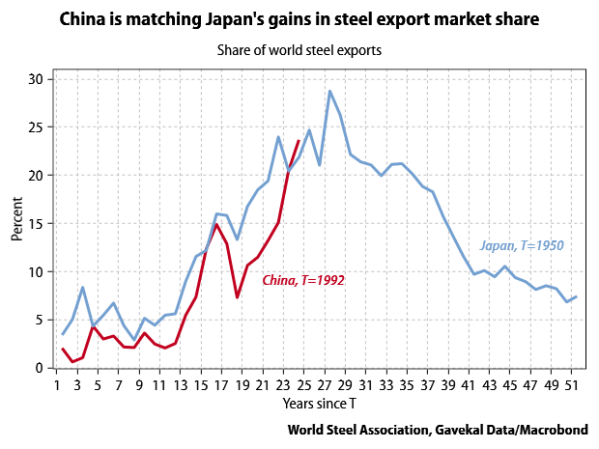
Japan-China-steel-export-market-share

In relative terms Japan and China do look quite similar. China’s peak level of true domestic steel use in per capita terms was close to, but below, Japan’s, meaning it is actually a somewhat more efficient user of steel–as one would expect given three more decades of technological improvement. In absolute terms of course they are quite different: Japan had about 100 million people in the 1970s and China has 1.4 billion now. Japan’s crude steel production in the late 1970s was just over 100 million tons a year, but China’s is now over 800 million tons a year. China’s steel exports last year are larger than Japan’s annual steel output in the early 1970s.

That size is now a problem for China, because a 20% global market share in steel exports is, well, just not enough in domestic terms. China is now exporting close to 15% of its domestic steel output, the most it ever has. But in the early 1970s, Japan was exporting close to 30% of its domestic steel output. And once you factor in indirect steel exports–the steel contained in products like cars and ships–Japan was actually exporting 40-50% of its domestic steel output.
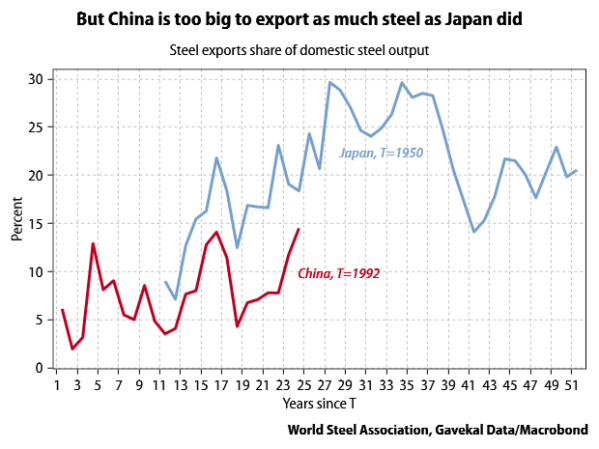
Japan-China-steel-export-output-share

Japan built up a steel industry to serve domestic urbanization, but then was able to successfully transition the industry to exports. China cannot plausibly transition its steel industry to exports. Why? Because China is too big (or, depending on your point of view, the world is not growing fast enough; if India’s steel demand was now beginning a Chinese-style urbanization boom, this whole discussion could be moot). If China was a small Communist country, it could just export enough steel to keep its domestic industry afloat, and no one would complain that much. Because it is a large Communist country, it can’t export enough steel to keep its domestic industry afloat. And therefore there is a lot of excess capacity. But most people tend to focus on the fact that it is a Communist country, not on the fact that it is a large country.

What’s the implication of all this? Well, as the Chinese industry official I quoted recently said, China probably cannot avoid reducing its steel output in coming years–unless it rather quickly becomes a much, much bigger exporter of cars and other steel-using goods.


Note on sources. Thanks to Wing Thye Woo of UC Davis for asking the question that prompted this little investigation. The historical data are from the yearbooks of the World Steel Association, a wonderful resource. Since the older historical data is somewhat patchy, I had to convert between different concepts (steel production and apparent steel use) and statistical bases (crude steel equivalent and finished steel equivalent) to get these longer time series, so the figures in the charts should be taken as approximations rather than precise records. Also though I had data for China’s steel exports for 2015, I did not have the world total, so the figure in the chart is a guesstimate.
Where is Chen Yun when we need him?

I’ve been dipping in and out of Ezra Vogel’s Deng Xiaoping and the Transformation of China, which is less a biography and more an authorized history of elite policymaking. The sections on the early reform era are particularly interesting, not least because they do not sound anything like what is going on in China today. In the very first years after the Third Plenum formalized the turn toward a market economy, there was a constant back-and-forth on the right direction for the economy.

Deng was gung-ho for growth, and viewed aggressive growth targets as a way of breaking free of the oppressive Maoist orthodoxy. But he shared power with Chen Yun, who was widely respected for correctly opposing Mao’s excesses in the Great Leap Forward, and who was consistently a voice for caution and realism. Deng of course ultimately won the argument, and Chen Yun today is often viewed, rather unfairly, as a planned economy stick-in-the-mud. But in fact he played a “necessary but annoying” role, as Vogel puts it, in keeping Deng’s ambitions tied to economic reality.

Reading the passages below, I could not help but wonder: who in China’s leadership is now playing Chen Yun’s role? Of course we know little of what is going on behind the scenes, but there are no obvious candidates. And wouldn’t China be better off if the overriding focus on highly politicized growth targets, which have become a form of orthodoxy themselves, was offset with some concern for enormous (if hidden) government deficits, rising strain in the financial system, and other economic imbalances? In short, couldn’t China today do with a bit more of the Chen Yun spirit?

Okay, editorializing over. Here is a history lesson from Vogel:

When Deng became preeminent leader in December 1978, Chen Yun, who had just rejoined the top leadership team, called attention to a potential crisis looming in the economy: visions of growth had gotten out of hand, the budget was out of balance, and commitments for purchasing technology from abroad had exceeded China’s foreign currency reserves, which were needed to pay for them. Among the leaders trying to provide direction for the economy in this new uncharted era, there were countless opinions about how to proceed. But as officials at the top began aggregating the various views, the different views tended to coalesce around two opposite poles. One group centered around the builders, who eagerly sought to introduce new factories and infrastructure projects; the other group, led by Chen Yun, the balancers, cautiously tried to ensure that resources were available for all the national priorities. …

Deng Xiaoping, like Hua Guofeng, was at heart a builder who wanted to see rapid progress. He admired project managers who under adverse circumstances had been able to complete important projects that provided visible signs of progress. Deng, who had little patience with detailed calculations, considered the cautious balancers necessary, but annoying. …

On December 10, 1978, during the meeting of the Northeast group at the Central Party Work Conference, Chen Yun voiced his concerns about the uncontrolled exuberance that had reached the highest level of party leaders. As if giving adult supervision to overly excited teenagers, Chen Yun laid out the problems in the ten-year economic vision. He spoke with authority, suggesting that he already knew he would be appointed to the Politburo. He said, “We should maintain steady progress and not get caught up in a headlong rush. . . . When materials are not available for a project, whether at the local or national level, it should not be launched.”

Before the Third Plenum, Deng Xiaoping had been fully supportive of the project managers, but after December 1978, when Chen Yun warned about the lack of careful planning, Deng threw his weight behind Chen. … Why did Deng shift course from supporting the builders to backing the balancers, led by Chen Yun? Deng recognized the importance of putting the economy on a solid base for the new era, and the summary economic data assembled in December for the past year reflected serious problems. At the time, there was only US$4 billion in foreign currency reserves and most of the foreign currency income from exports was already committed, although contracts had been signed to purchase over US$7 billion of foreign equipment. Even though the imbalances would seem infinitesimal when contrasted with the foreign trade figures a decade later, they loomed large enough to worry cautious officials who were accustomed to smaller amounts and who were frightened by the leverage that such debt might give the capitalist countries.

By March 1979, Chen Yun had collected more data, done more analysis, and was ready to systematically present his proposals for cutting back on the contracts to import foreign plants and for lowering the economic targets for the next several years. Some of his proposals, and even the terminology, were remarkably similar to the retrenchment policies that he had introduced to recover from the Great Leap Forward. Rather than use the term “retrenchment,” the term he used earlier, which would have sounded very negative, Chen Yun used the term “readjustment” (tiaozheng). …

The essence of Chen Yun’s approach to planning was balance: balance income and expenditures, loans and the ability to repay, and foreign currency income and expenditures. He also sought a balance between investment in consumer goods and producer goods, between heavy and light industry, and between industry and agriculture. In 1978, some 57 percent of China’s industrial output was from heavy industry and only 43 percent from light industry. Chen Yun, like many other officials, believed that China’s economy had been out of balance since 1958, with food and consumer goods sacrificed for more heavy industry than the people could bear. In 1980, under Chen Yun’s direction, heavy industry grew only 1.4 percent whereas light industry grew 18.4 percent; and in 1981 heavy industry declined by 4.7 percent whereas light industry grew 14.1 percent.

By the time Chen Yun returned to work in late 1980, the budget deficits had ballooned to become the largest since the Communists took over. The seriousness of the problem made Chen Yun more determined to clamp down and enabled him to gain support from other officials, including Deng. The deficit had grown not only due to the costs of the Vietnam War, but also because of the increase in procurement prices paid to the farmers for grain, the decline in agricultural taxes, and the costs of resettling people who had earlier been sent to the countryside and were now allowed to return to the cities. Moreover, the central government began allowing provinces and local enterprises to keep more of their own funds to stimulate local initiatives, a strategy that had reduced the total amount of taxes collected by the central government. The result was a great stimulus for many provinces, but Chen Yun considered the serious budget deficits alarming and potentially disastrous. …

In November 1980 China’s economic growth rate targets for 1981 were set at a much lower rate, 3.7 percent, and capital construction allocations were reduced from 55 billion yuan to 30 billion yuan. When there were complaints that such restraints would waste valuable time, Chen retorted, “How much time have we wasted since the Opium War? Over a hundred years. Why is it such a big thing to wait three years to move ahead?” What had most delayed China’s advances since 1949, he said, was leftist errors made while rashly pushing ahead. Chen Yun was allowed to take firm control over guiding the drafts for the Sixth Five-Year Plan (1981–1985) and over bringing the budget and deficit under control.

Winter has come: the state of steel in China

It’s hard to understand the Chinese economy without understanding what’s going on in the steel sector. I found the following short interview with Cai Rang, chairman of the China Iron & Steel Research Institute Group, to be one of the better recent summaries of the situation I’ve come across in domestic sources, and also useful as an indicator of what some insiders are thinking. Here’s my translation:

Interviewer: How is the current round of excess capacity in steel different from those that came before?

Cai Rang: During the past few years, China did not clearly recognize the historical stage of development that the steel industry had reached. Therefore when steel prices would rise and fall, everyone would think: winter has come, so spring cannot be far off. Because of this kind of thinking, during the previous rounds of capacity reduction there was no consensus on whether the steel industry was really in winter or in spring, and some companies were still pursuing economies of scale [by continuing to expand].

Now, however, the macro environment has changed, and most people believe that the steel industry will not enter another springtime, and the previous glorious phase of rapid development must end. In short, the steel industry has already entered the post-industrial era. Because of this, the effects of the restructuring, mergers, acquisitions and capacity reduction going on now may be different from before. But we must still avoid the old problem of a capacity rebound [after capacity reduction], and steel companies cannot have a “land grab” mentality [i.e., expanding output while others cut output in order to gain market share, because if every company pursues this strategy then output will not fall]. Reducing excess capacity will mean large numbers of firms closing their doors, and this requires both companies and society to shoulder responsibility.

Interviewer: On the one hand China’s steel industry has excess capacity, but on the other hand there is still a need to import steel, so how should we understand this issue?

Cai Rang: China’s current excess capacity in steel products is a sectoral excess: there is a lot of low-end steel, but the supply of high-end steel is insufficient. The ordinary steel products that China manufactures are not that different from those made abroad, and there are even some technological advantages over foreign companies. But for particular types of steel products there are still about 20 million tons of imports, among which there are about 200 tons of low-volume, high-tech sophisticated steel products that must be imported, such as steel used in airplanes.

In the future steel companies will have to transform their development model, and through product upgrading and replacement move in an energy-saving and environmentally friendly direction. Steel companies will need to put a lot of effort into those high-end products that China lacks and cannot yet produce, but they will also need to avoid creating a second round of excess capacity in high-end steel products that leads to a race to the bottom as they vie to drive down prices.

Judging from China’s current level of industrialization, there are not many steel products that need large amounts of investment and concentrated development. Those that remain are are all high-end specialized products, and investing in these products is much more demanding in terms of equipment, personnel and operating costs.

Interviewer: In order to digest excess capacity, China is exporting a large amount of steel products, and this has led to antidumping cases. What changes do you expect in the steel industry?

Cai Rang: China’s current steel production capacity is 1.2 billion tons, but domestic demand cannot completely absorb this capacity. In 2015 China exported about 100 million tons of steel products; this was a relief for domestic capacity but a shock to the international market. Already nine European countries have made antidumping complaints, and Japan, Korea and India have also complained. This shows that our country’s current steel production capacity is not sustainable, and must be genuinely reduced.

Now the relevant departments are drafting the 13th five-year plan for the iron and steel industry, and the preliminary plan is to first cut 200 million tons, and eventually stabilize steel capacity around 700 million tons. This will require many companies to exit the market, and those steel companies that remain will experience great changes both internally and externally. For instance externally, the integration of the internet and intelligent manufacturing could cause great changes in steel procurement and sales methods. Internally, the entire production process, the technology configuration, the quality of equipment and the efficiency of production all need to be improved, costs reduced, and energy use and raw material consumption optimized. There are historical reasons for the excess capacity in the iron and steel industry—in the past everyone was desperate to add supply—and today there is still some new capacity awaiting approval from the government. So capacity must be reduced.

Interviewer: Can China draw lessons from any international experience in dealing with the excess capacity problem?

Cai Rang: During America’s industrialization process, steel was one of its three pillar industries. Then came a wave of bankruptcies, and the whole process was very painful. But now output has come down, and there has been a big adjustment in social attitudes. Gradually funds and labor moved to space technology and aerospace, and now investment is in information technology and the internet. Iron and steel production moved to Asia, and Japan’s steel industry rose rapidly—Baosteel and other Chinese steelmakers were all set up to study Japan’s model at that time. The American city of Pittsburgh used to be the steel capital of the US, but today it has already become a city of education, of culture, of science. They got rid of three big steel plants, and in their place built the biggest shopping mall in the region. The whole city has been completely transformed. We can learn from this kind of experience.

Unpacking the many consequences of China’s housing boom

Here is one of the best papers on the Chinese economy I’ve read in a long time–and I read a lot of papers on the Chinese economy. Currently in draft, “A Rebalancing Chinese Economy: Challenges and International Implications” is a systematic explanation of most of the big macro questions about China. The authors are Guonan Ma, an eminent Chinese economist recently retired from the BIS, and Ivan Roberts and Gerard Kelly of the Reserve Bank of Australia.

While there’s a lot to digest in this paper, for this post I want to pull out some of the thoughts about housing. I ranted a while back about how academic economists were ignoring the role of the housing market in driving economic developments in China. This paper by contrast puts housing front and center, and very effectively too. From the conclusion:

We find that conventional analysis understates the role of the household sector in contributing to the high investment share of the economy. Our explanation for the imbalances emphasises the role played by housing market deregulation as one of multiple prolonged positive productivity and demand shocks to the Chinese economy that simultaneously sustained returns to capital, lifted investment and boosted both private and public saving. While recent discussions stress the need to reform financial markets to foster rebalancing, we argue that rebalancing will probably happen anyway as a natural outcome of dwindling income windfalls from worsening demographics, fading positive productivity shocks and maturing housing markets, all of which helped drive the imbalances in the first place.

And some more details from the body of the piece:

The role played by the deregulation of housing markets in China deserves special emphasis. In 1988, the Chinese constitution was amended to legalise the transactions of land use rights, laying the foundation for private home ownership. Throughout the 1980s and 1990s, most of the housing provided by SOEs to their employees was privatised at a discount to the replacement cost. Mortgages were introduced in 1997, and official mortgage rates were cut five times during 1998-2002 to counter the negative consequences of the Asian Financial Crisis.

The deregulation of housing markets saw residential investment rise sharply starting in the early 2000s to almost 16% of GDP currently. This housing boom stimulated huge capacity-building in many related upstream and downstream industries, including steel, cement, glass, household appliances and financial services. Using data from the 2010 input-output tables and more up-to-date data on value-added, Xu et al (2015) estimate that, directly and indirectly, residential housing accounted for 29.4% of GDP growth in 2013.

It is likely that the housing boom simultaneously boosted growth, investment and saving in China while subtracting from net household income (through higher mortgage payments). The rise of private home ownership in the late 1990s boosted incentives to save by households strongly motivated to upgrade their housing and to build up private assets, while generating higher investment. As discussed, the rise in household investment mostly reflected individual investment in residential construction. The property investment booms in the 2000s further boosted land sales proceeds accruing to local Chinese governments, helping to fund investment in infrastructure. At the same time, the steady rise of mortgage loans as a share of total credit (reaching 12% in 2014) implied larger interest payments by home-buyers to financial institutions and a corresponding fall in households’ net property income. In turn, this contributed to the decline in the household share of income in the 1990s and 2000s.

The housing boom increased both sales volumes and prices, lifting corporate earnings and the return to capital across many related industries and helping to underpin strong corporate saving and investment until the late 2000s. In sum, the opening of the housing market can be viewed as a prolonged positive demand shock to the Chinese economy, sustaining returns to capital, boosting investment and lifting both private and public saving at the same time.

The paper is long and somewhat technical in parts, but also conceptually very clear, and the whole thing is very much worth reading. The draft was presented at the Reserve Bank of Australia’s annual conference last week; other draft papers from the conference have also been posted online.

Can China deliver a consumer-focused fiscal stimulus?

Ben Bernanke has weighed in with an interesting intervention on China, arguing that fiscal policy targeted at household consumption could offer a way out of the current economic problems:

An alternative worth exploring is targeted fiscal policy, by which I mean government spending and tax measures aimed specifically at aiding the transition in China’s growth model. (Spending on traditional infrastructure like roads and bridges is not what I have in mind; in the Chinese context, that’s part of the old growth model.) For example, as China observers have noted, the lack of a strong social safety net—the fact that Chinese citizens are mostly on their own when it comes to covering costs of health care, education, and retirement—is an important motivation for China’s extraordinarily high household saving rate. Fiscal policies aimed at increasing income security, such as strengthening the pension system, would help to promote consumer confidence and consumer spending. Likewise, tax cuts or credits could be used to enhance households’ disposable income, and government-financed training and relocation programs could help workers transition from slowing to expanding sectors. Whether subsidies to services industries are appropriate would need to be studied; but certainly, unwinding existing subsidies to heavy industry and state-owned enterprises, together with efforts to promote entrepreneurship and a more-level playing field, would be constructive.

There are a few things to say about this. First and to be clear, I agree. It would generally be a good thing to switch fiscal priorities from off-budget spending on infrastructure to on-budget spending that supports consumption. But that’s part of the problem: people have been giving China this particular bit of advice for years. And in fact the government has not ignored this advice, and has steadily raised spending on social programs (universal healthcare coverage was more or less achieved in 2011).

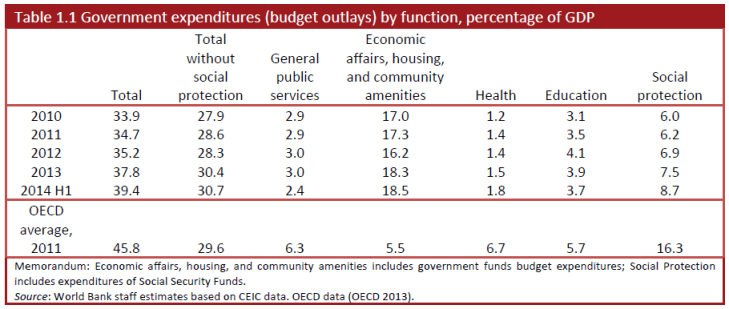
Of course, China could do still more. But it may not be that simple for them to do a lot more than they are already doing. China has a fiscal system that is strongly biased toward delivering investment rather than streams of benefits to consumers. It’s worth stopping to think for a bit about just how unusual this is, as most governments around the world are the exact opposite: they are primarily bureaucracies for delivering social programs, not designing investment projects. The World Bank office a while back made a fascinating comparison of China’s fiscal spending patterns with those of OECD countries. The results are summarized in the excerpt and table below:

A large share of government spending supports capital expenditures in transport, housing, and other economic activities, as gaps in providing core public services remain wide. While the size of government expenditures (public finance budget, government fund budget, and social security budget) remains similar to the OECD average, the composition of expenditures differs substantially. First, spending on general public services is under half the OECD average. It is declining due to continuing efforts to reduce wasteful public outlays: in the first half of 2014 it accounted for only 2.4% of GDP, down from 3.0% in 2013. Second, despite gradual increases, expenditures on social services (health, education, and social protection) are far lower than in the OECD countries. Third, outlays on economic affairs, housing, and community amenities are about three times as high as the OECD average.

China-OECD-WB-fiscal

Note that this bias toward investment spending is very strong in the official government budget–even before any of local governments’ massive off-budget spending on infrastructure is accounted for. So while I don’t think it’s wrong to urge China to shift the composition of its fiscal spending, I also think it’s important to recognize that this might be difficult to do quickly. They have a set of institutions and priorities that are well established and deeply rooted, and making a big shift in those would require both a different way of thinking and extensive practical changes. It’s certainly not impossible, but it’s also not easy.

A final point is that even if they do move to a consumer-focused fiscal stimulus, it might not deliver that much net impact on growth. This is simply because of the size of existing infrastructure-based fiscal stimulus: the IMF estimates that once off-budget local government spending is included, the annual fiscal deficit is on the order of 10% of GDP (compared to an on-budget deficit of 2-3%). Given the already-huge size of infrastructure spending, it seems more likely that consumer-focused spending would replace it rather than add to it over time. This would be a good way to soften the impact of reducing infrastructure spending; it also seems likely that the multipliers from a consumption stimulus would be higher than infrastructure spending at this point, as infrastructure is probably reaching diminishing returns. But expenditure-switching seems more like a strategy for allowing China to wind down its enormous fiscal deficits than one for delivering a lot of additional fiscal stimulus.

Unconstrained experiments in 21st century state capitalism

That seems to be theme behind two recent and excellent pieces by Shai Oster at Bloomberg. Both are a useful reminder that China is not pursuing an existing economic and social model, or even a well-defined ideology, but is inventing its own model as it hurtles along.

First up is a piece on an effort, perhaps quixotic, to predict future acts of terrorism:

The Communist Party has directed one of the country’s largest state-run defense contractors, China Electronics Technology Group, to develop software to collate data on jobs, hobbies, consumption habits, and other behavior of ordinary citizens to predict terrorist acts before they occur. “It’s very crucial to examine the cause after an act of terror,” Wu Manqing, the chief engineer for the military contractor, told reporters at a conference in December. “But what is more important is to predict the upcoming activities.”

He hinted at the scope of the data collection effort when he said the software would be able to draw portraits of suspects by cross-referencing information from bank accounts, jobs, hobbies, consumption patterns, and footage from surveillance cameras. The program would flag unusual behavior, such as a resident of a poor village who suddenly has a lot of money in her bank account or someone with no overseas relatives who makes frequent calls to foreigners. According to Wu, these could be indicators that a person is a terrorist. “We don’t call it a big data platform,” he said, “but a united information environment.”

… Brookings’s Pillar is skeptical. “No system of surveillance and exploitation of intelligence can stop everything,” he says. But Tsui, the Hong Kong professor, says if anyone has a chance of coming up with a workable high-tech Big Brother, it’s the Chinese. The lack of privacy protections means that China’s data sniffers are more practiced than those in the West. “The people who are good at this are good because they have access to a lot of data,” he says. “They can experiment with all kinds of stuff.”

Then there’s the recent and unprecedented expansion of “venture capital” funds sponsored by local governments and other official bodies:

The country’s government-backed venture funds raised about 1.5 trillion yuan ($231 billion) in 2015, tripling the amount under management in a single year to 2.2 trillion yuan, according to data compiled by the consultancy Zero2IPO Group. That’s the biggest pot of money for startups in the world and almost five times the sum raised by other venture firms last year globally, according to London-based consultancy Preqin Ltd.

The money’s in what are known as government guidance funds, where local and central agencies play some role. With 780 such funds nationwide and a lot of experimentation, there’s no set model for how they’re managed or funded. The bulk of their capital comes from tax revenue or state-backed loans.

The money is part of Premier Li Keqiang’s effort to bolster the slowing Chinese economy through innovation and reducing its dependence on heavy industry. The country began a campaign to support entrepreneurship in 2014 and has since opened 1,600 high-tech incubators for startups.

Honestly, I don’t have much analysis to offer on either of these reports, other than, wow.

Go read “China’s two-speed economy”

The Saturday essay in the WSJ this week is an excellent piece by Andy Browne (full disclosure: my former bureau chief) on China’s two-speed economy, a phenomenon that I’ve been exploring both in our Dragonomics research and on this blog. The reporting nicely illustrates both the extremely troubled and the extremely prosperous parts of China’s economy, and also makes a strong argument that how Xi Jinping handles the lagging regions will be crucial for the country’s prospects. Here’s an excerpt:

For international investors, China’s two-speed economy—one dying, the other accelerating—is utterly confusing, and it has produced wildly contrasting strategies. If China keeps subsidizing wasteful investment to keep industrial cities alive, its financial system will eventually blow up: At 260% of gross domestic product, the country’s overall debt is approaching danger levels. Some Wall Street hedge funds are taking huge speculative bets against the Chinese currency. Global markets are bracing for a “hard landing” by the Chinese economy and years of subpar growth. The financier George Soros says China is already crashing.

At the same time, however, some of the world’s smartest investors are making the opposite wager: They are piling in. Last year, China attracted up to $37 billion in venture capital, much of it for technology hubs along the coast. That is more than the U.S. typically draws in a year and multiples of what Europe usually pulls in. …

Who’s right? Politics will largely determine the outcome. … Two years ago, Mr. Xi announced an ambitious 60-point economic reform program to give markets a “decisive role” in allocating resources. Many expected that he would shutter state loss-makers and open protected state industries like telecommunications and banking to entrepreneurs, even as he attacked the patronage networks that weave through local industry and governments.

But Mr. Xi seems to have gotten cold feet. Instead of closing down state enterprises, he is bulking them up. He seems afraid that allowing market forces to prevail will entrench geographically based wealth disparities and that an aggrieved underclass could erode the Communist Party’s legitimacy. As Mr. Xi has made clear during his three years in office, his first priority is to save the party. The economy can wait. Against this political backdrop, Beijing’s usually decisive economic decision-making process has started to look rudderless.

Mapping China: The spread of the nominal growth slowdown

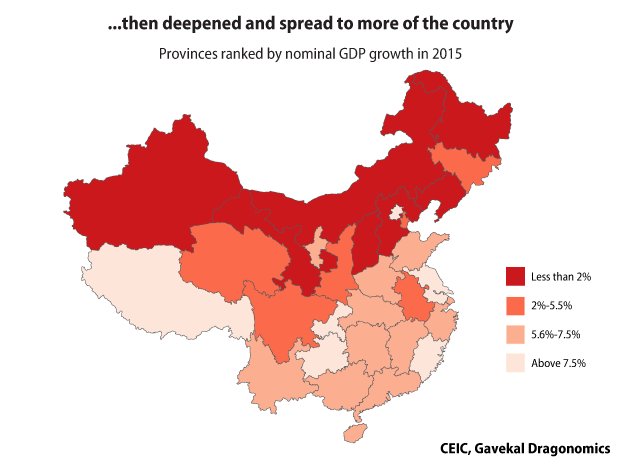
This week the last of the provinces reported their GDP data for 2015, so now the full set is available–which means more maps! I’m going to focus on provincial nominal GDP growth here, as the changes are more dramatic, and more interesting, than in real GDP growth. Here’s an example: in 2014, three provinces reported real GDP growth below 6% (Shanxi, Liaoning and Heilongjiang), and three provinces reported real GDP growth above 10.5% (Guizhou, Chongqing and Tibet). In 2015, the same three lagging provinces were the only ones to report real GDP growth below 6%, and the same three leaders were the only ones to report real GDP growth above 10.5%. So, not much change, right?

Not at all. Nominal GDP growth tells a different story, and a more intuitive one: there was a broader and deeper slowdown last year. In 2014, exactly one province had nominal GDP growth below 2%: the coal capital of Shanxi, with 1.3% growth. But in 2015, seven provinces reported nominal GDP growth below 2%: Shanxi again at 0.3%, but also Gansu, Liaoning, Heilongjiang, Xinjiang, Hebei and Inner Mongolia. In Gansu, nominal growth was actually negative, with its GDP declining 0.7%. Similarly, in 2014 there were 10 provinces that reported nominal GDP growth above 10.5%, but in 2015 that number shrank to three. The three remaining fast-growth provinces, again Guizhou, Chongqing and Tibet, have economies that are heavily dependent on government subsidies.

2014-nominal-growth

2015-nominal-growth

The regional pattern of the slowdown is pretty clear: it is deepest in the heavy-industry-dependent provinces of the north and far west. This fact, and the fact that the slowdown is so much deeper in nominal terms than in real terms, to me reinforces the point that China’s slowdown has its origins in the housing downturn and the knock-on effects in commodity prices.

Is the People’s Daily jumping on the data journalism bandwagon?

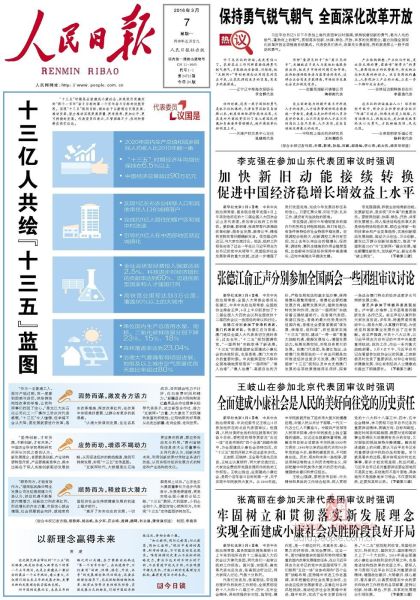
At the least, the Party’s paper certainly seems to have woken up to the fad for infographics. In my admittedly limited experience (it’s not like I read the thing every day), I have never seen an enormous color infographic splashed over the front page of the People’s Daily, in the spot usually reserved for Very Important Personages. But here is one taking pride of place in March 3 edition:RMRB2016030301

The infographic explains the five slogans that are in the next Five-Year Plan, which will be published at next week’s legislative session, and then picks a statistic and graphic that goes with each one. (For reference, the plan urges that China’s development be “innovative,” “coordinated,” “green,” “open,” and “shared.”) Charming stuff, if a bit tame compared to the amazing cartoon video explaining the Five-Year Plan that blew up the internet a while back.

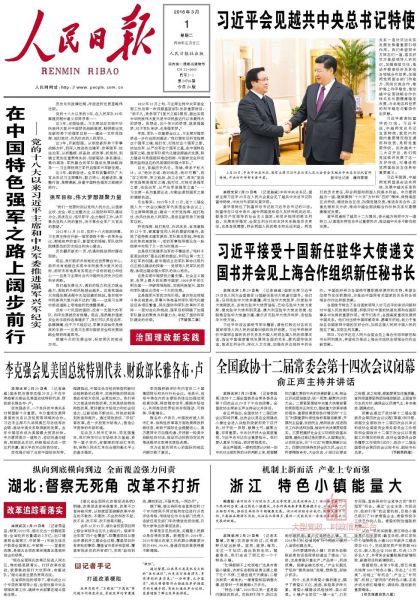
Still, it is lively by the standards of the People’s Daily. Here is what a more normal day at the Communist Party newspaper looks like, from a couple of days ago–a photograph of Xi Jinping meeting a foreign dignitary, reports of government meetings, etc.

RMRB2016030101

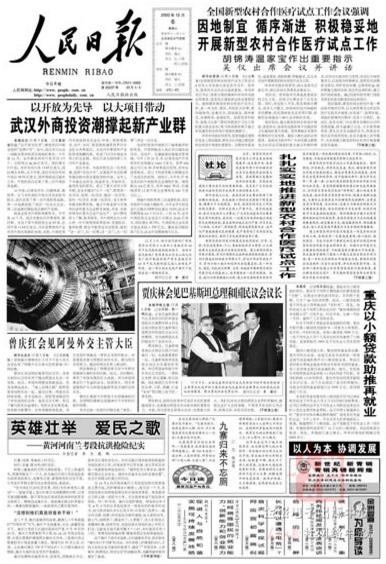
The People’s Daily does have a history of, very slowly, adapting conventions of other newspapers. It started printing the front page in color only in 2004, and these days also breaks up its traditional text-heavy layout with a touch more white space. So even before the infographics, this gray lady had already become a bit more bling. Here’s a front page from late 2003, just before the switch to color, which gives you some of the flavor of the proper old-school style: visiting dignitaries and sturdy industrial equipment.
RMRB20031206

Update. Clearly I should have waited another couple of days to do this post, as Monday’s issue devoted half of its entire front page to a giant infographic on the Five-Year Plan. At this rate, the People’s Daily should be looking like the USA Today of the late 1980s (of We’re Eating More Beets! fame) sometime in the 2020s…

RMRB2016030701

A prediction about Chinese agriculture

My favorite part of How Asia Works, the book about Asian development by my old colleague Joe Studwell, is the opening section on agriculture. He emphasizes just how productive small, labor-intensive family farms are–much more productive than big businesses and government planners tend to give them credit for. This high productivity (in terms of output per hectare rather than output per worker) underpins Joe’s argument that successful Asian countries are precisely those that had land reform programs that broke up large landholdings and created a class of entrepreneurial small farmers. Nonetheless, labor-intensive small farms are only the best option when there is a lot of available farm labor; once urbanization takes off and the supply of farm labor shrinks, farms do have to become larger and more mechanized. This shift allows higher output per worker, but does not necessarily mean an increase in output per hectare.

For the last several years, China’s policymakers have been preoccupied with trying to accelerate this process, encouraging family farms to rent their land to larger, more commercial operations. Policies that subsidize large farms and glorify agricultural “modernization” are everywhere. While Joe’s book is mostly history, he does offer an interesting prediction about how this process might play out:

So long as there is no large-scale civil unrest as a result of land redevelopment and conversion, the main concern for central government in the next few years will be that the rise of commercial farming is leading to reduced output of staple foodstuffs. Aside from the fact that scale agriculture substitutes profit for yield, commercial farming in China also does not cultivate core foods like rice and wheat. Instead it concentrates on more value-added, high-margin, specialist crops, such as vegetables, herbs and flowers – sometimes for export. China’s imports of staple foodstuffs are beginning to increase quickly (albeit from a low base) as household farmland disappears. At some point, this will start alarm bells ringing in Beijing about food security – the Chinese Communist Party has a longstanding, and sensible, fear of the country being at the mercy of substantial food imports. There will likely be a clamp-down on household farm land conversions to commercial agriculture.

I thought of Joe’s prediction when I recently came across some interesting research on how farm consolidation is playing out. The passage below is from a long report by the eminent agricultural economist Liu Shouying, which includes a lot of data on the changing patterns of farmland ownership and use (because Chinese farmland cannot legally be sold, his discussion of land consolidation repeatedly refers to the “transfer” of farmers’ land-use rights; this usually means one farmer subletting his land to another, but can also include, for instance, the contribution of land-use rights to a company in exchange for equity). I’ve skipped most of the crunchy bits and gone straight for the closing summary (my translation):

One issue is that land transfers are irregular. The market for land transfers is not yet fully established, and most land transfers are done spontaneously between rural households. Oral agreements are still the majority, so the process of land transfer is not standardized. There is no appropriate and scientific standard for appraising the value of land, so it is difficult for the agreed-upon price to accurately reflect the value of the land. Some land transfers have no written contract, only an oral agreement. And for land transfers that do have a contract, the main party is often the village or a cooperative–but the individual farmers who actually have the land-use rights have not given any written authorization. As a result it is not clear whether the parties to the transfer are qualified to make it. In 2014 there were 91,700 cases of disputes over land transfers, an increase of 42.39% from 2010. …

A second issue is that after being transferred some land is no longer used for producing staple crops. In recent years, as the scale of transfers of land management rights has expanded and accelerated, the objectives and interests in land transfers have become more complex. Gradually there has emerged the phenomenon of the “de-staple-ization” of farmland. This tendency is more obvious in the developed eastern provinces [here the author cities statistics showing that of all farmland that had been leased or otherwise transferred in 2014, 56.82% was used to grow staple crops; the share was only 25.33% in Guangdong]. Looking at the profitability of agricultural operations, staple crops are relatively less profitable products. And because those who have land transfer contracts have to pay rent on the land, they choose high-profit products in order to realize the benefits of the land transfer. Therefore, the shift away from staple crops has become the basic trend and motive for land transfers.

The gist seems pretty clear: the consolidation of farmland has produced an increasing number of social disputes, and the new operators tend to stop producing grain and grow cash crops instead. In other words, the precise issues of “civil unrest” and “reduced output of staple foodstuffs” that Joe warned about are appearing (with the important caveat that nationwide grain output is still rising not falling, as increases in productivity have so far outweighed changes in land use).

While you still see a lot of dramatic rhetoric from the government about overhauling small family farms into larger, more “modern” operations, it is also the case that Xi’s administration seems to be pretty conservative in practice about food security. So I would say that Joe’s prediction–that the natural consequences of farm consolidation will at some point force a rethink of the policy to promote it–is looking pretty good right now.